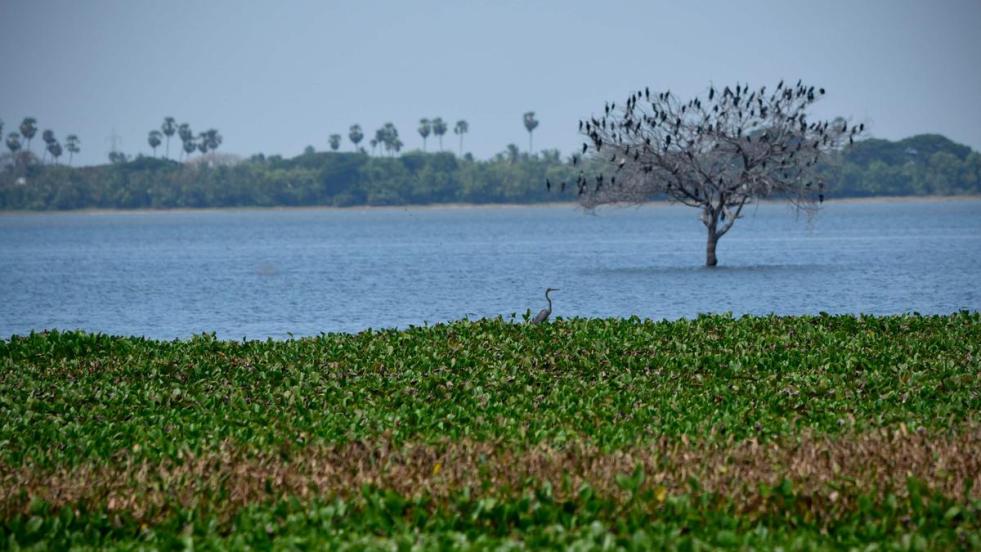
(Feature Image: A view of the Bahour Lake near Puducherry. Photo Credit: S.S. Kumar/The Hindu)
On the World Wetlands Day (WWD) 2024, this report compiles top ten developments related to Central and state govt actions for wetlands in India. The year 2023 has seen release of first water body survey and launch of Amrit Dharohar & MISHTI schemes by central govt. India has signed institutional framework agreement for the Central Asian Flyway (CAF) to strengthen conservation efforts for migratory birds and their habitats.
The state govts have announced more wetland plans which are becoming a routine with no change in ground situation. Despite judicial intervention the respective govts have not taken necessary actions to protect and restore Najafgarh jheel, Dhanauri wetlands and wetlands in Goa. Broadly, the year 2023 has passed with no remarkable achievement on govt front which provide hope for better future for India’s wetlands. Please see the first and second parts of yearend overviews covering the status of Ramsar sites and other wetlands in India.
1. MoJS First water bodies census The Ministry of Jal Shakti (MoJS) has conducted the first-ever census of water bodies across the nation. The census provides an inventory of India’s water resources, including natural and man-made water bodies like ponds, tanks, lakes, and more, and to collect data on the encroachment of water bodies. The Census also highlighted disparities between rural and urban areas and varying levels of encroachment and revealed insights.
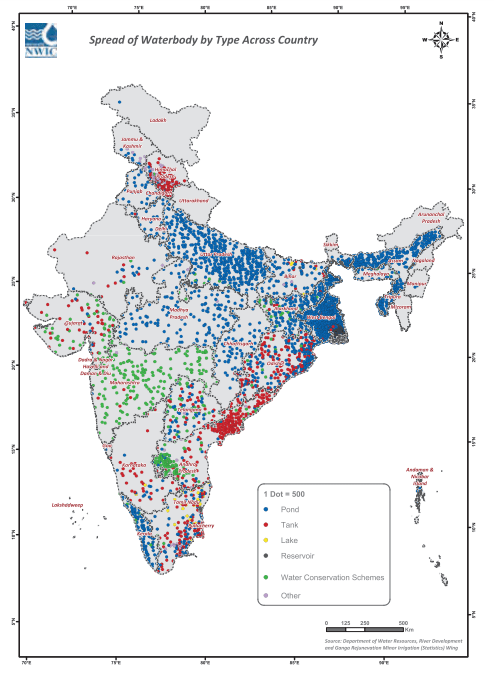
The census was launched under the centrally sponsored scheme, “Irrigation Census” in convergence with the 6th Minor Irrigation Census in order to have a comprehensive national database of all water bodies. The information on all important aspects of the water bodies including their type, condition, status of encroachments, use, storage capacity, status of filling up of storage, etc was collected. It covered all the water bodies located in rural as well as urban areas that are in-use or not in-use. The census also took into account all type of uses of water bodies like irrigation, industry, pisciculture, domestic/ drinking, recreation, religious, ground water recharge etc. The All India and State-wise reports have been published. https://pib.gov.in/PressReleasePage.aspx?PRID=1918970; Link to Download All India Report: https://jalshakti-dowr.gov.in/document/all-india-report-of-first-census-of-water-bodies-volume-1/; State Wise Report: https://jalshakti-dowr.gov.in/document/state-wise-report-of-first-census-of-water-bodies-volume-2/ (23 April 2023)
1 out of 6 Water Bodies can’t be used At 20.3 lakh or 83.7%, most water bodies in India are in use. But the remaining 4 lakh or 16.3% water bodies are not usable due to low water levels, pollution, encroachment, or excess salinity. The most common use is for pisciculture, followed by irrigation and groundwater recharge. Only 1 in 10 water bodies acts as a source of drinking water. About 9 in 10 in-use water bodies serve up to 100 people each and just 1.7% are large enough to meet the needs of 50,000 people or more. 89% of water bodies are used by a single village or town. https://epaper.timesgroup.com/timesspecial/governance-infrastructure/over-24l-water-bodies-but-1-out-of-6-can-t-be-used/1682531648357 (26 Apr 2023)
Water bodies census welcome, but how reliable? While the publication by the MoJS of the first water body census of India is not only welcome but urgently required, the usefulness of the census findings will depend on the quality of the information in the report. Firstly, such a census should have been conducted in a bottom up way, starting from villages in rural areas and ward in urban areas. That way, the census findings would have not only been more reliable, but also the process would have helped create greater awareness about the water bodies and issues surrounding them.
In case of Karnataka, as the report shows the survey by the Tank Conservation and Development Authority and Karnataka Public Land Corporation in 2021 showed the state had 40483 water bodies, whereas the Jal Shakti Ministry census of 2022 says the state has just 26994 water bodies, a huge 13489 less than the 2021 census. Clearly so many water bodies cannot disappear in a year. As some experts from Karnataka have asked, is the Jal Shakti Census a deliberate attempt to show that a much lower number of water bodies exist, allowing encroachers to go ahead to destroy water bodies not registered in the census?
Thirdly, as the Down to Earth has pointed out, there is no data about the state of the catchment area of the water bodies, since the state of the catchment area would decide the health of the water body. In Maharashtra, the report below suggests, 92.7% water bodies are formed by check dams. This again raise questions about the census.
While detailed analysis of the Jal Shakti Ministry census will throw more light on the quality of the census numbers, the available information so far raises a lot of questions. We may need a better census soon that will really help us understand the state of India’s water bodies. https://sandrp.in/2023/05/01/drp-nb-010523-water-bodies-census-welcome-but-how-reliable/ (1 May 2023)
First waterbody survey: Some questionable statements Data on reservoirs and rivers has been available on the India Water Resources Information System for the last few years, but thus far there has been no data on smaller water bodies that are the lifeline of rural India and critical cultural, flood-control and recreational spaces in cities. (Both aspects raised here in the Hindu report are wrong, availability of data on rivers and NO data on smaller water bodies).
Similarly this unqualified certificate given to the Census date in the Hindu report is also wrong: “The census built on existing and publicly available satellite-derived datasets. This dataset was also extremely rich, allowing citizens to hone in on a specific village and download the historical time series data on each water body. But it only includes attributes that can be observed from space. The water body census extends this to social characteristics including ownership, use and condition.” The data has huge problems.
The issues highlighted with the data are useful, particularly lack of ecosystem assessment, among others. https://www.thehindu.com/sci-tech/energy-and-environment/water-census-ministry-jal-shakti-findings-analysis/article66822865.ece (08 May 2023)
Good start but their condition is concerning However, while determining whether water bodies were functioning or not, the census did not recognise the ecosystem services provided by these water bodies, pointed out Himanshu Thakkar. Thakkar, coordinator of SANDRP. He said that the water bodies, whether big or small, are important for biodiversity, water harvesting and groundwater recharge. But the census did not analyse the possible impact of water bodies on the ecosystem’s overall health. Thakkar added that doing this would have helped policymakers assess water bodies in terms of their eco-functioning.
Thakkar pointed out inconsistencies in data collection of the study. For example, he notes, in Karnataka state, the census report has found about 27,000 water bodies, out of which about 21,000 are not in use. But this is in contrast to the findings of a joint survey conducted by the Tank Conservation and Development Authority and Karnataka Public Land Corporation in 2021, which recorded 40,483 water bodies in the state. “How can so many water bodies be wiped out in a matter of a year or so,” he asked, saying that an independent assessment is needed to properly review the data published in the census report. https://india.mongabay.com/2023/05/documenting-indias-water-bodies-a-good-start-but-the-state-of-many-of-them-is-concerning-say-experts/ (19 May 2023)
Experts question methodology There is confusion regarding the definition of waterbodies used; there are also discrepancies about whether waterbodies are in rural or urban areas and whether or not they have been encroached upon. https://www.downtoearth.org.in/news/water/india-s-first-census-of-waterbodies-is-a-much-awaited-one-but-experts-question-the-methodology-here-is-why-89234 (28 May 2023)
Over 38,000 water bodies encroached Nivedita Khandekar A total of 1.6% water bodies are encroached. 95.4% of them are in rural areas and the remaining number in cities. “11.8% of encroached water bodies have more than 75% area under encroachment while 62.8% water bodies have less than 25% area under encroachment,” the Census said, and added: “16.3% (3,94,500) water bodies are not in use owing to drying up, construction, siltation, destroyed beyond repair, salinity and other reasons.” https://www.news9live.com/india/india-has-over-2400000-water-bodies-reveals-first-ever-water-bodies-census-au1779-2110640 (19 April 2023) Hridayesh Joshi: – The first census of waterbodies clearly shows that ponds and waterbodies have been heavily encroached upon in urban areas, which is causing both floods and water crisis. Experts say this is a step in the right direction but the data needs to be made more accurate and comprehensive. https://hindi.newslaundry.com/2023/04/26/indias-first-waterbodies-census-shows-more-than-24-lacs-waterbodies-in-india (26 April 2023) EDIT Around 55% of India’s water bodies are privately owned, choking their access to marginalised communities such as the backward castes. Such conflicts are expected to worsen as the water crisis explodes. The information yielded by the survey must be used to institute a humane and democratic culture. https://www.telegraphindia.com/opinion/not-for-all-editorial-on-the-grim-reality-of-water-crisis/cid/1932678 (27 April 2023) EDIT The report could help policymakers arrive at informed decisions on matters as diverse as urban planning and rural employment generation schemes. https://indianexpress.com/article/opinion/editorials/express-view-on-water-body-census-it-is-a-welcome-initiative-8572151/ (24 April 2023)
2. Karnataka 13489 water bodies lost in a year? Karnataka’s loss of 13,489 water bodies in just a year between 2021 and 2022 has become a pressing concern. According to the National Water Bodies census report, Karnataka has about 26,994 lakes and waterbodies and, of them, 21,120 waterbodies (78.2%) have either dried up or been irreparably destroyed. This is in stark contrast to findings of a joint survey conducted by the Tank Conservation and Development Authority and Karnataka Public Land Corporation in 2021 which had recorded 40,483 lakes, and the Karnataka State Remote Sensing Applications Centre (KSRSAC), a nodal agency for GIS and remote sensing in Karnataka, that had documented 33,326 lakes.
Critical of the findings of the central ministry, Anjaneya Reddy of Shashwatha Neeravari Horta Samiti said, “All the figures published by the state govt in 2021 were entirely based on scientific data and field verification. How can the numbers change so drastically in less than a year? Also, the census figures appear to be a deliberate attempt to bring down the number of waterbodies so that the land under these waterbodies can easily be taken over in the coming days. The state govt must reject these findings and share its scientific data with the Jal Shakti ministry.” Former secretary to the minor irrigation dept & chief engineer Capt Raja Rao urged the govt to contest these figures. https://timesofindia.indiatimes.com/city/bengaluru/13000-water-bodies-lost-in-1-year-centres-first-survey-puts-karnataka-lake-tally-at-mere-27000/articleshow/99773105.cms (26 Apr 2023)
3. Centre PM launches 2 schemes for wetland, mangrove conservation On the occasion of World Environment Day, PM Modi on June 5 launched two schemes–Amrit Dharohar and MISHTI (Mangrove Initiative for Shoreline Habitats and Tangible Incomes)–aimed at reviving the country’s wetlands and mangroves. The country also accounts for about 3% of South Asia’s mangrove population. Apart from the Sundarbans in W Bengal, the Andamans region, the Kachchh and Jamnagar areas in Gujarat have substantial mangrove cover.
The PM said, the launch of Amrit Dharohar Yojana will ensure the conservation of the existing Ramsar sites through public participation, and these sites will become the centre of eco-tourism and a source of green jobs for thousands of people. The MISHTI scheme will help revive and protect the mangrove ecosystem in the country. With this, the mangrove cover will be restored in nine states across the country and help in mitigating the threat to lives and livelihoods in coastal areas from rising sea levels and disasters like cyclones. (These claims, however, are not backed by the details in the scheme.)
While Amrit Dharohar aims to achieve sustainable ecosystem development with the help of local communities over the next three years, MISHTI envisages comprehensively exploring the possible area for development of mangroves covering nearly 540 sq km, spread across 11 states and two union territories over five years, starting FY24. The primary objectives of the MISHTI scheme are sharing of best practices on plantation techniques, management practices, conservation measures and resource mobilisation through public-private partnership. The Centre will cover 80% of the project cost, state govts will contribute 20%. https://www.livemint.com/news/india/world-environment-day-pm-modi-launches-2-schemes-for-wetland-mangrove-conservation-11685966128412.html (05 Jun 2023) Both these schemes were also announced by Union Finance Minister Nirmal Sitharaman during budget session on Feb 1, 2023. https://www.hindustantimes.com/india-news/fmannounces-misthi-scheme-in-union-budget-for-mangrove-plantations-101675265659103.html (02 Feb. 2023); https://india.mongabay.com/2023/02/india-budgets-for-mangroves-and-wetlands/ (3 Feb 2023)
4. Karnataka monitors largest number of lakes but Telangana tops in offering relevant water quality data Karnataka and Telangana monitor 172 (Highest in India by any state) and 160 lakes, respectively, jointly accounting for 59% of the total number of 562 lakes being monitored by various State Pollution Control Boards/ Pollution Control Committees across 28 States, said the analysis by Action Aid Association.
Delhi, Madhya Pradesh, Andhra Pradesh, Gujarat, Tripura, Rajasthan and West Bengal accounted for 161 of monitored lakes, while Goa, Tamil Nadu, Kerala, Haryana, Bihar, Uttar Pradesh, Himachal Pradesh, Jharkhand, Puducherry, Meghalaya, Odisha, Nagaland, Mizoram and Chhattisgarh put together have 69 lakes under monitoring.
Study found that Telangana was the only State that offered “most updated” lake water quality data in less than 30 days of testing the water samples from various lakes in the State and updated it on the websites of PCB. The country’s worst State Pollution Control Boards/ Pollution Control Committees were from the national capital Delhi and Gujarat that maintained only “junk”, unusable and 10-year-old data.
Arunachal Pradesh, Assam, Maharashtra, Punjab, Andaman and Nicobar Islands, Dadra and Nagar Haveli, Odisha and Chandigarh had “lack of data.” Pollution Control Boards in Lakshadweep, Ladakh, and Manipur didn’t even have websites. “Our analysis revealed that in most cases, lakes are neglected or not even acknowledged as important elements of the ecosystems,’‘ said Raghavendra B. Pachhapur, Senior Lead Projects, ActionAid Association. https://www.thehindu.com/news/national/karnataka/karnataka-monitors-largest-number-of-lakes-in-india-but-telangana-tops-in-offering-relevant-water-quality-data-actionaid/article66980901.ece (18 June 2023)
5. India among 11 countries to work on CAF protection Eleven countries have agreed on an institutional framework for the Central Asian Flyway (CAF) to strengthen conservation efforts for migratory birds and their habitats in a coordinated manner. The decision on the institutional framework for CAF was taken in the meeting of range countries of the central Asian region during May 2-4. The meeting was jointly organised by MoEF and the United Nations Environment Programme/ Convention on Migratory Species (UNEP/CMS).

The agreed institutional framework for the CAF carries details of priority areas for implementation with countries giving their consent on a draft roadmap for updating the CMS CAF action plan. It has a compilation of best practices to ensure the sustainable conservation of migratory birds & their habitats. Out of 370 species of migratory birds that visit the sub-continent annually, 310 species use wetlands as their home, remaining species are landbirds, inhabiting dispersed terrestrial areas. https://timesofindia.indiatimes.com/india/india-gears-up-for-a-leadership-role-in-central-asian-flyway-for-conserving-migratory-birds-and-their-habitats/articleshow/100041778.cms (6 May 2023)
6. Najafgarh Jheel NWC not to acquire 115 acres In Feb 2023, the NGT had directed high-level committee (HLC) to look at the rejuvenation of the lake. NGT also directed Haryana’s chief secretary to deal with the portion of the lake that lay in that state. Both Delhi and Haryana governments had prepared an environmental management plan. However, during a meeting of HLC held on Jan 10 2024, Najafgarh Wetland Committee (NWC) told HLC that acquiring the land around the lake would cost around Rs 268 crore, a significant financial burden.
“Further, there would be a threat of encroachment of acquired land if the water receded. NWC had unanimously concluded that the Jheel area in its current nature needed to be maintained,” say the minutes of the meeting. The minutes also say, “It was decided that gram sabha land may be identified and replaced or given in exchange by DM (Southwest) to the landowners of permanently inundated land to protect the Najafgarh wetland to the extent possible and at a minimum cost to the exchequer with the approval of the competent authority.”
Experts said villages around the Najafgarh lake remain inundated throughout the year due to high groundwater level. During the review meet, NWC told HLC that the problem of wastewater entering the lake was likely to see significant improvement by March 2025, which is the deadline for multiple projects being undertaken by the Haryana to prevent pollution flowing into the lake. https://timesofindia.indiatimes.com/city/delhi/najafgarh-wetland-committee-no-acquisition-of-115-acres-in-najafgarh/articleshow/107245163.cms (30 Jan. 2024)
7. Uttar Pradesh Govt seeks 4 weeks to tell NGT of status of Dhanauri wetland The Uttar Pradesh govt has sought four weeks to inform the NGT about the status of notifying or providing legal protection to the Dhanauri wetland in Greater Noida. The Dhanauri wetland harbours 23 species of endangered, critically endangered, and threatened birds, and is one of the most important habitats for the sarus crane. However, the UP govt has been dragging its feet on notifying the area as a wetland for several years now.
Anand Arya, a Greater Noida-based environmentalist, moved NGT on Oct 3, praying that the tribunal direct the UP govt to notify Dhanauri wetland as the Balmiki Ramsar Wetland and Sarus Sanctuary/Conservation Reserve, as directed by the Union environment ministry in five separate letters — May 28, 2019; March 20, 2020; Aug 30, 2020; Feb 21, 2022; Mar 17, 2022 — and implement a conservation plan for the wetland in consultation with the Wildlife Institute of India. https://www.hindustantimes.com/cities/delhi-news/upgovt-seeks-4-weeks-to-tell-ngt-of-status-of-greater-noida-s-dhanauri-wetland-101697395486920.html (16 Oct 2023)
Jewar airport has fuelled a fight for Dhanauri wetlands The Noida International Airport at Jewar has given environmentalists, bird-watchers, and conservationists fresh impetus, reinvigorating a decade–long fight to get the govt to legally protect 112 ha of wetlands. Earlier this month, 77-yr-old birdwatcher Anand Arya approached the NGT demanding that airport construction be halted until the Uttar Pradesh govt declares Dhanauri a Ramsar wetland site.
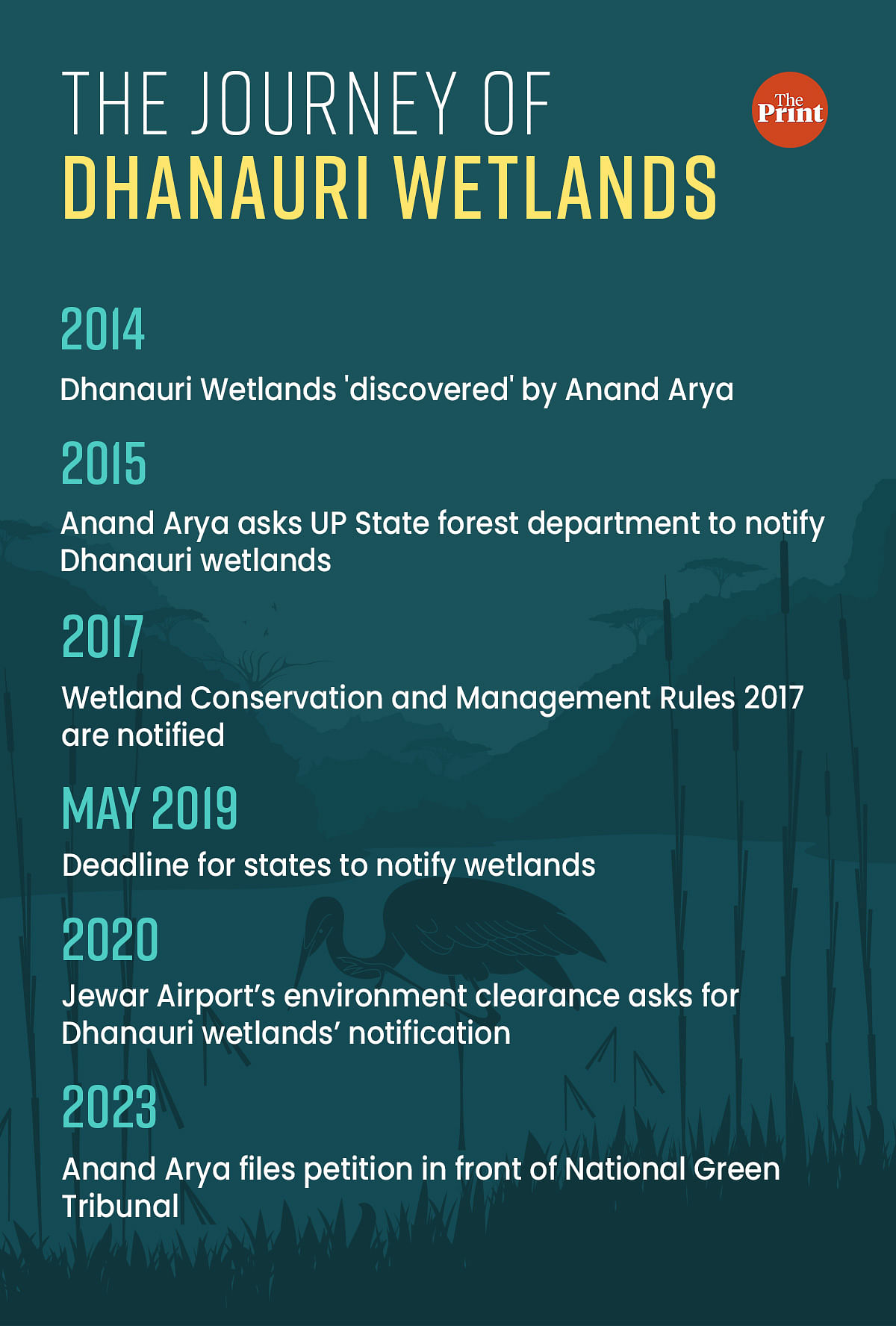
Even the environment clearance given to Jewar Airport in 2020 identified Dhanauri as a wetland of conservation importance and suggested that it be notified. But any action remains trapped in bureaucratic back and forth between the state wetlands department, forest dept, and the airport developer-Yamuna Expressway Industrial Development Authority. Resistance from villagers who own paddy fields in the wetlands & want adequate compensation has further muddied the water. https://theprint.in/ground-reports/jewar-airport-has-fuelled-a-fight-for-dhanauri-wetlands-up-now-has-to-balance-3-priorities/1816393/ (24 Oct 2023)
8. Delhi Agencies seek to delist 232 out of 1,045 waterbodies The Wetland Authority of Delhi (WAD) has received requests to delete 232 waterbodies, i.e. 22.2% of the total 1,045, from its records. The requests have been made by some of the 16 agencies that own waterbodies in the city. Around the same time last year, the WAD had received requests to delete 214 waterbodies.
“An agency makes such a request on various grounds, including waterbodies being encroached upon or drying up,” an official said, adding that the WAD is yet to act on the requests. The Delhi Development Authority has sought the deletion of 223 of the 822 waterbodies it owns. Data from earlier surveys were used to arrive at 1,045 as the total number of waterbodies. The WAD has prepared ‘brief documents’ for 710 of them, while the rest are either encroached upon or their owners are yet to be identified or determined. https://www.thehindu.com/news/cities/Delhi/delhi-agencies-seek-to-delist-232-out-of-1045-waterbodies/article66847072.ece (14 May 2023)
9. Centre 30 closed coal mines to be developed as forests, waterbodies “The de-coaled lands are being put to environment friendly usage by filling them up with flyash, creating forest cover, agriculture lands, solar plants and water bodies. Of the expected more than 2 lakh ha of de-coaled lands, around 20000 ha has been identified and 500 ha per year of it will be made available for various environmental usages over the next few years” Amrit Lal Meena, union secretary for coal, said on May 15 2023. Coal mines last for average 25 to 30 years. https://timesofindia.indiatimes.com/india/india-to-close-around-30-coal-mines-in-next-few-years-to-pave-way-for-forests-water-bodies/articleshow/100255117.cms (15 May 2023)
10. Goa City to have 50 notified wetlands in 2 years: SWA The State Wetland Authority (SWA) has informed the NGT that it is in the process of notifying 35 additional wetlands, which will take the total number of notified wetlands in Goa to 50. The process is expected to take two years. The SWA, which submitted its quarterly progress report, as required by the NGT, after petitioner Kashinath Shetye approached the tribunal accusing the govt of dragging its feet on notifying wetlands, said that the process of survey, identification and then notifying the wetlands was on.
Petitioner Shetye, however, expressed reservations over the reduced number of wetlands being identified pointing out that as per a prior statement before the NGT, 385 wetlands have been delineated that have an area of over 5 ha, and 167 wetlands which are less than 2.25 ha, thus totalling to 550 wetlands in Goa covering an area of 213.77 sq km. https://www.hindustantimes.com/cities/others/goa-state-wetland-authority-to-notify-35-additional-wetlands-taking-total-to-50-in-two-years-gswa-to-ngt-101688543841135.html (5 Jul 2023)
Other Relevant Reports
Nisar will aid understand forests & wetlands better: JPL The Nasa-Isro Synthetic Aperture Radar (Nisar) satellite, set to launch in early 2024, will offer researchers an unprecedented opportunity to delve into Earth’s forests and wetlands, the Jet Propulsion Lab (JPL) of Nasa said on Oct 28 2023. Nisar will embark on a mission that involves scanning nearly the entire Earth’s land and ice surfaces every 12 days. JPL further said Nisar will provide vital data on the motion of the land, aiding researchers in understanding the dynamics of geological events such as earthquakes, volcanic eruptions, landslides, subsidence, and uplift. Additionally, it will monitor the movement and melting of glaciers and sea ice, providing information for climate and environmental studies. https://timesofindia.indiatimes.com/home/science/nisar-will-aid-understand-forests-wetlands-better-jpl/articleshow/104781034.cms (28 Oct. 2023)
5 more Ramsar sites selected 3 of these sites, Ankasamudra Bird Conservation Reserve, Aghanashini Estuary and Magadi Kere Conservation Reserve are located in Karnataka whereas 2 Karaivetti Bird Sanctuary and Longwood Shola Reserve Forest are in Tamilnadu. With the addition of these five wetlands to List of Wetlands of International Importance, the total area covered under Ramsar sites is now 1.33 million ha which is an increase of 5,523.87 ha from existing area (of 1.327 million ha. Tamil Nadu continues to have maximum number of Ramsar Sites (16 sites) followed by Uttar Pradesh (10 sites). https://pib.gov.in/PressReleasePage.aspx?PRID=2000838 (31 Jan. 2024)
Union Environment Minister Bhupender Yadav: -The number of Ramsar sites has increased to 80 and the Centre is asking states to notify and recognise more small and large wetlands, and involve local people and communities in their management, union environment minister, Bhupender Yadav said in an interview with HT. https://www.hindustantimes.com/india-news/interview-centre-plans-to-identify-conserve-more-wetlands-says-union-minister-101706727218406.html (01 Feb. 2024)
Of the 5 wetlands added to the Ramsar list, Magadi Kere Conservation Reserve, Ankasamudra Bird Conservation Reserve, and Aghanashini Estuary are in Karnataka and Karaivetti Bird Sanctuary and Longwood Shola Reserve Forest are in Tamil Nadu. https://www.thehindu.com/sci-tech/energy-and-environment/five-more-indian-wetlands-added-to-ramsar-list/article67795594.ece (31 Jan. 2024)
Tamil Nadu 2 more Ramsar sites; tops the country with 16 sites The State govt had submitted proposals for the Longwood Shola Reserve Forest in The Nilgiris and the Karaivetti Bird Sanctuary in Ariyalur. The MoEF and the Ramsar Sites Secretariat accepted them, and both places were designated as Ramsar sites on January 31.
Longwood Shola covers 116.07 hectares. It is among the places deemed Important Bird and Biodiversity Areas. It is home to more than 700 species of flora and fauna. Of the 177 bird species, 14 are endemic to the Western Ghats. Longwood Shola is an integral part of the fragile Nilgiris ecosystem, and is a major source of water for Kotagiri, supplying water to 18 villages downstream.
The Karaivetti Bird Sanctuary covers 453.7 hectares. The wetland is also one of the Important Bird and Biodiversity Areas of Tamil Nadu. The sanctuary lies in the Central Asian Flyway, and is an important breeding and foraging ground for waterbirds. https://www.thehindu.com/sci-tech/energy-and-environment/tn-gets-two-more-ramsar-sites-tops-the-country-with-16-sites/article67797025.ece (01 Feb. 2024)
Karnataka 3 new Ramsar sites With a size of more than 4,800 ha, Aghanashini estuary is the largest one. Located in Uttara Kannada district, it supports over 66 waterbird species and over 1% of the biogeographic population of 15 waterbird species including river tern, oriental darter, lesser black-backed gull, woolly- necked stork and Eurasian oystercatcher. The brackish water of the estuary provides diverse ecosystem services including flood and erosion risk mitigation, biodiversity conservation and livelihood support. It also provides livelihoods to 6,000- 7,500 families by supporting fishing, agriculture, collection of edible bivalves and crabs, shrimp aquaculture, traditional fish farming in the estuarine rice fields, bivalve shell collection and salt production.
Other two wetlands are smaller. Ankasamudra is an irrigation tank built centuries ago and spread over an area of 98 ha whereas Magadi Kere is a human-made wetland (54.38 ha) is home to over 166 species of birds, of which 130 are migratory. The wetland in Gadag district is also one of the largest wintering grounds for the Bar-headed goose in southern India. It is a designated Important Bird Area and listed as a priority area for conservation in India as nearly 8000 birds visit the site in winter.
The recognition for the new Karnataka sites came two years after Ranganathittu Bird Sanctuary received the Ramsar tag, making it Karnataka’s first such protected wetland. For comparison, the first two Indian Ramsar sites were Keoladeo National Park in Rajasthan and Chilika Lake in Odisha, both receiving the status in 1981. https://www.deccanherald.com/india/karnataka/three-new-ramsar-sites-in-karnataka-2874048 (31 Jan. 2024)
Rajasthan Govt. proposes to develop 5 wetlands as Ramsar sites The Rajasthan govt has sent a proposal earlier this month to get Ramsar Tag for five wetlands to the Union environment ministry: Khinchan bird sanctuary in Jodhpur, Chandlai in Jaipur, Kanwas Pakshi Vihar in Kota, Lunkaransar in Bikaner, and Menar Lake in Udaipur district. All five wetlands fall in the Central Asian Flyway, used by migratory birds that start flying to this region from Nov onwards and stay here till Feb. Before this, Sambhar Lake was declared as a Ramsar site in March 1990 and Keoladeo Ghana National Park was given the Ramsar tag in October 1981.
At some of these sites, action is being taken by the SPCB to stop industrial effluents from being released into the water and efforts are also on to stop encroachments. “At Chandlai Lake in Jaipur, with the help of SPCB, four industries were shut down in the region that were releasing effluents in the lake. Measures are being taken to maintain the air and water quality of these wetlands so that the overall ecosystem can be managed,” said a senior official. https://timesofindia.indiatimes.com/city/jaipur/rajasthan-proposes-to-develop-5-wetlands-as-ramsar-sites/articleshow/106338889.cms (28 Oct. 2023)
Bihar Govt for inclusion of 4 wetlands as Ramsar site The govt will pitch for declaration of 4 wetlands — Udaipur lake in West Champaran, Vikramshila Dolphin Sanctuary in Bhagalpur, Gogabeel lake in Katihar and Gokul reservoir in Buxar — as Ramsar sites. A decision to this effect was taken in the third meeting of SWA on July 19 under the chairmanship of environment & forest minister Tej Pratap Yadav. The SWA also gave its nod for notification of 24 wetlands, according to the Wetlands (Conservation & Management) Rules, 2017.
Approval was given for preparation of documents, health cards ‘wetland friends’ (local volunteers) of 45 wetlands larger than 100 ha in the next phase. Approval was given for the integrated management plan for Gokul reservoir wetland under the Bhojpur forest division. The total number of wetlands in the state is around 4,410, including around 3,000 natural & 1,410 man-made water bodies. https://timesofindia.indiatimes.com/city/patna/bihar-to-pitch-for-inclusion-of-four-wetlands-as-ramsar-site/articleshow/101966010.cms (19 Jul 2023)
Uttar Pradesh Each constituency to have a wetland: SWA One wetland will be developed as a tourist attraction in each constituency, as decided by the SWA on Dec 6. The initiative aims to engage MLA/public representatives and gram panchayats in the process. Arun K Saxena, the minister for forest and climate change, chaired the fifth meeting of UPSWA and directed officials to promptly act on the decision. SWA also resolved to establish Village Wetland Committees (VWC) under the chairmanship of the respective Pradhan.

During the meeting, it was decided to officially designate 50 wetlands, covering approximately 1,000 ha in nine districts, under Wetland Rules, 2017. These wetlands are expected to make a substantial contribution to carbon sequestration, storing an estimated 81 to 216 ton of carbon per acre. The authority also approved the management plan for the Upper Ganga River, the first Ramsar site in the state, encompassing an area of 26,590 ha. The meeting discussed the implementation of the Gangetic Floodplain Wetlands of UP scheme, funded by the NMCG. As part of this scheme, verification of 282 wetlands within a 10 km radius on both sides of the Ganga River is underway. https://www.hindustantimes.com/cities/others/each-constituency-will-have-one-wetland-as-a-tourist-spot-upswa-101701870332978.html (6 Dec 2023)
Wetlands in Bijnor to be developed for Sarus conservation There are 117 Sarus cranes in the district which are spotted in more than 50 large wetland areas. The Rs 1.56 Cr programme is scheduled to start in July 2023. “As per a census carried out last year, there are over 17,000 cranes in Uttar Pradesh. Of them, the highest number of cranes are found in Etawah (3,293) & Mainpuri (2,737).” https://www.daijiworld.com/news/newsDisplay?newsID=1087195 (06 June 2023)
17000 wetlands identified through satellite in UP. https://www.livehindustan.com/uttar-pradesh/story-17-thousand-wetlands-discovered-through-satellite-for-the-first-time-in-up-preparations-to-increase-groundwater-9061463.html (13 Dec. 2023)
Madhya Pradesh First wetland complex to come up in Dhar Over the next 5-6 years, the state’s first wetland complex will be built in Dhar. The project has already received Centre’s approval at a cost of Rs 40 crore. The project will protect and preserve Raja Bhoj’s Devi, Munj and Dhoop Sagar ponds. Administrative approval was granted in March 2022, and technical approval is expected soon. The first phase is expected to begin by the end of 2023. https://www.freepressjournal.in/indore/madhya-pradesh-states-first-wetland-complex-to-come-up-in-dhar (4 Feb. 2023)
Kerala ‘Wetland of dragonflies’ mires Technopark’s expansion plans Nearly 61 acres of land at Technopark’s Phase III campus, in the state capital, acquired in 2007, remain unutilised, as the agriculture department had submitted a report to the revenue department stating the area is a “wetland” that hosts a significant number of dragonflies. However, the state government is likely to take a call soon on whether to allow buildings on the plot, despite the agriculture department’s report.
As per government records, the entire land parcel within Phase III was classified as paddy land, with conversion allowed subject to conditions. The government had issued a gazette notification dated February 6, 2007, during the land acquisition procedures, clearly stating that some portions were reclaimed paddy fields. However, there was no mention of a wetland. As per the Kerala Conservation of Paddy Land and Wetland Act, 2008, there are provisions for converting paddy land for other purposes. https://www.newindianexpress.com/states/kerala/2023/mar/24/wetland-of-dragonflies-mires-technoparks-expansion-plans-2558905.html (24 March 2023)
Tamil Nadu SWA orders action against encroachment in Udhagamandalam wetland The SWA has ordered the Nilgiris authorities to file a report on wetland encroachment in the district following construction activities near the Udhagamandalam railway station and other facilities close to the Ooty lake. https://www.thehindu.com/news/national/tamil-nadu/state-wetland-authority-orders-action-against-encroachment-in-udhagamandalam-wetland/article67489477.ece (03 Nov. 2023 )
Puducherry 5 waterbodies to get wetlands status The identified waterbodies in the first phase are Oussudu Lake, Bahour Lake, Vadhanur tank, Katterikuppam tank, and Korkadu tank. 320 ha Oussudu Lake is a bird sanctuary, co-managed by Tamil Nadu & Puducherry. https://www.thehindu.com/news/cities/puducherry/five-waterbodies-in-puducherry-to-get-wetlands-status-soon/article66988719.ece ( 20 June 2023)
J&K Project to rejuvenate wetlands Such reports are being routinely published in the media without any basic information on the mega projects. https://www.thehindu.com/news/national/other-states/jammu-and-kashmirs-admin-undertakes-mega-project-to-rejuvenate-local-wetlands/article66617963.ece (14 March 2023)
Meghalaya Panel dedicated to Umiam lake The Expert Committee constituted by the state govt to suggest measures for restoration and protection of water bodies in the state, in its third meeting, resolved to set up a sub-committee to formulate guidelines and setting up by-laws specifically needed for Umiam lake. https://theshillongtimes.com/2023/02/20/panel-dedicated-to-umiam-lake-mooted/ (20 Feb 2023)
Meghalaya No construction near water bodies: Govt to HC The state government has assured the High Court that no construction will be allowed to commence or continue near any of the water bodies, particularly the Umiam Lake. During the hearing of a PIL, the state submitted before the court that model guidelines for maintaining the sanctity of the water bodies are being drafted together with guidelines pertaining to license or permission being granted to construct near such water bodies. The state also informed the court that aquatic experts have also been inducted into the expert committee for preservation of water bodies. Later, the court fixed the next hearing on the matter after six weeks. https://theshillongtimes.com/2023/04/12/no-construction-near-water-bodies-govt-assures-hc/ (12 April 2023)
Compiled by Bhim Singh Rawat (bhim.sandrp@gmail.com)

 SANDRP