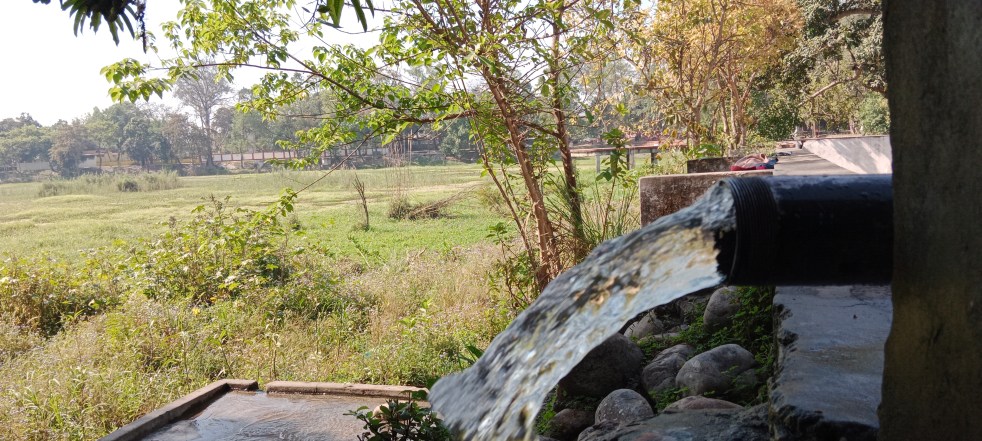
(Feature Image: Drona Sagar Taal in Kashipur, Uttarakhand being filled with tubewell water in April 2023. Bhim Singh Rawat/SANDRP)
This second part of yearend overview on Groundwater issues in India lists top ten Government actions. While the groundwater has become backbone for all types of consumption including domestic water supply, irrigation, industrial use; depletion of the finite resource continue; the government efforts particularly of central government have been limited to mapping and monitoring. There is neither a recognition that groundwater is India’s water lifeline, nor is there any serious attempt at effective bottom up, decentralised regulation of groundwater.
The aquifer mapping scheme ongoing since 2012 has been extended till March 2026. The govt has planned to increase the number of monitoring wells and equipped them with digital sensors. Meanwhile the Parliament panel report has revealed that the National Water Mission (NWM) lacks adequate funds and autonomy. Several state governments have taken respective measures for protection of groundwater sources however they have largely shown no noteworthy results so far.
In the first part of the series on GW in 2023, we highlighted the overall groundwater situation in the country and in the third part we will cover legal intervention taken aiming conservation of groundwater during past one year.
1. Leading groundwater recharge districts The Union ministry of Jal Shakti has in its maiden census report rated Nashik, Jalna and Aurangabad from Maharashtra among the top five districts of the country for “remarkable work” in terms of groundwater recharge. Anantapur from Andhra Pradesh and Sitapur in Uttar Pradesh also found a place in the Top Five list in the report released on April 26 2023. A senior state water conservation and soil development official said a lot of efforts had gone into construction and refill of water bodies in Maharashtra during the rainy season, enabling recharge of the groundwater.
Shankar Nagar, a retired irrigation department official, expressed surprise over the findings. “The latest survey reports mention a certain rise in groundwater level for Parbhani and Nanded. But the report shows Aurangabad and Jalna among the top five districts. Considering the soil and rock pattern of Marathwada, authorities need to elaborate further on the findings mentioned in the report and the basis for it,” he said. https://timesofindia.indiatimes.com/city/nashik/nashik-aurangabad-jalna-among-top-5-districts-leading-india-in-groundwater-recharge/articleshow/99829455.cms (28 April 2023)
2. CGWB GW Assessment report As per the latest assessment of dynamic groundwater resources, the total annual groundwater recharge for the entire country is 449.08 bcm. The total natural discharge works out to be 41.89 bcm. The annual extractable groundwater resources for the entire country is 407.21 bcm. However the extraction of groundwater is more than 100 per cent in several states and UTs, including Haryana, Punjab, Rajasthan, Dadra & Nagar Haveli and Daman & Diu. In Punjab, especially Sangrur and Malerkotla, the extraction of groundwater is 164 per cent of the recharge. https://www.tribuneindia.com/news/india/central-board-flags-over-extraction-of-groundwater-in-punjab-haryana-568784 (05 Dec. 2023)
Arsenic found in 25, fluoride in 27 states Arsenic has been detected in groundwater in parts of 230 dists in 25 states and fluoride in 469 dists in 27 states, Union Minister of State for Jal Shakti Bishweswar Tudu said in Rajya Sabha. CGWB along with the National Institute of Hydrology prepared a report on “Mitigation and Remedy of Groundwater menace in India: A Vision Document” in 2010 and it has been circulated to various concerned agencies & depts for guidance & execution. https://www.thehindu.com/news/national/arsenic-found-in-groundwater-in-25-states-fluoride-in-27-states-govt/article67604776.ece (04 Dec. 2023)
Groundwater recharge increased in India? There are at least two headline numbers (Plz see DRP NB 041223) of Government of India’s Dynamic Groundwater Resource Assessment Report 2023 released by Union Minister on Dec 2 2023, that seem counter intuitive and misleading. These are exactly the issues we raised about the 2022 report too. Firstly, the PIB Press Release that accompanied the report release says India’s annual groundwater recharge in 2023 has increased by 11.48 BCM compared to the same in 2022.

Secondly, it says the groundwater situation has improved in at least 226 of the 6553 assessment Units across the country. Both seem counter intuitive and possibly misleading in the face of increasing groundwater use, depleting levels, worsening quality of groundwater and our increasing dependence on groundwater.
The PIB PR also does not clarify as to where the recharge is increasing and where there is improvement in groundwater situation. The increase in recharge, for example, could be not of any use if it is happening in water logged or salinized areas or if it is happening where groundwater quality is so bad that it is not useful. In absence of clarity on these issues, the statements in the PIB PR can be a way to pat one’s own back and which can also lead to complacency and to ignore the dire situation. https://sandrp.in/2023/12/04/drp-nb-041223-groundwater-recharge-increased-in-india/ (04 Dec. 2023)
Opinion Groundwater governance in better shape Apart from some useful data and ongoing schemes, plans, Subodh Yadav, Joint Secretary, MoWR is making controversial claims of increase in recharge and reduction in numbers of overexploited units.
According to the latest assessment, there has been a 3% reduction in the number of ‘overexploited’ groundwater units and a 4% increase in the number of ‘safe’ category units as compared to 2017. There was an improvement in groundwater conditions in 909 units. The assessment also showed a reduction in annual extraction (of about 9.53 billion cubic meters); the data for irrigation, industrial and domestic use, respectively, is 208.49 BCM, 3.64 BCM and 27.05 BCM. Overall extraction saw a declining trend, of about 3.25% since 2017. Around 9.37 BCM of additional groundwater potential was created through artificial water conservation structures. https://www.thehindu.com/opinion/op-ed/indias-groundwater-governance-is-in-better-shape/article66440954.ece (28 Jan. 2023)
3. Parliament Committee Changing GW use patterns The parliamentary com. report on groundwater tabled in Lok Sabha has some excellent data. Groundwater meets 67% of irrigation needs and is the source of 80% of drinking water. About 89% of the annual groundwater extraction of 218 bcm is for irrigation. https://timesofindia.indiatimes.com/blogs/toi-editorials/watering-holes-ipcc-house-committee-reports-are-reminders-on-changing-water-use-patterns-but-its-a-political-challenge/ (21 Mar 2023)
Panel suggests prepaid cards for power to save groundwater Observing that the primary reason for excessive exploitation of groundwater is cultivation of water guzzler paddy and sugarcane crops, which are “heavily incentivized”, a Parliamentary Standing Committee has said that use of electric pumps needs to be further discouraged by introducing measures such pre-paid cards for power supply and restricting power supply to few hours a day.
The committee has recommended that the Jal Shakti Ministry should take the initiative by urging both the Power Ministry and Department of Agriculture and Farmers Welfare along with state govts to take these measures. https://indianexpress.com/article/india/house-panel-suggests-prepaid-cards-for-power-to-save-groundwater-8508938/ (21 March 2023)
Dip in groundwater levels in 20 cities Groundwater levels in Delhi, Ghaziabad, Faridabad, and 20 other cities dipped by more than 20 m from 2017 to 2020, according to a report tabled by a Parliamentary Standing Committee on Mar 20. While Haryana’s Faridabad has become 100% dependent on groundwater cities including Ghaziabad in Uttar Pradesh are “on the verge of becoming totally dependent on it”, the report says. Delhi, Jaipur and Hyderabad are among the major cities severely affected by groundwater contamination.
The report quotes the Ministry of Housing and Urban Affairs (MoHUA) as saying that increasing population, urbanisation and concretisation are some of the reasons behind the groundwater depletion in these cities.
The committee was of the view that to stop unrestricted use of groundwater for commercial uses, strict enforcement of the regulations, stringent vigil and appropriate penalties were needed. The parliamentary panel has also recommended manual monitoring of groundwater level four times a year and collecting water quality samples once a year to obtain background information of quality change regionally.
The committee also recommended that the government give the National Water Mission (NWM) the financial powers and autonomy needed to fulfil their objectives as it is “still not well-equipped with adequate funds and autonomy” and needs expertise in the form of consultants and advisors, who are yet to be appointed. https://theprint.in/india/parliament-panel-report-flags-dip-in-groundwater-levels-in-delhi-ghaziabad-faridabad-20-other-cities/1458577/ (20 March 2023)
4. Groundwater domination As per the 2023 assessment, the Stage of Ground Water Extraction, which is a measure of Annual Ground Water Extraction for all uses (irrigation, industrial & domestic use) over Annual Extractable Ground Water Resource, is 59% for India. As per the latest (6th) Minor Irrigation (MI) Census, the total number of ground water schemes/structures in India is 2,19,32,799 (Dugwell – 82,78,425; Shallow Tubewell –55,85,839; Medium Tubewell–43,18,275 & Deep Tubewell – 37,50,260).
As per ‘The UN World Water Development Report 2022 – ‘Groundwater Making the invisible visible’ India is among top ten countries with the highest shares in global groundwater withdrawal in 2017. Some of the important measures for rejuvenating ground water in the country can be seen here. https://pib.gov.in/PressReleasePage.aspx?PRID=1986272 (14 Dec 2023)
Groundwater dominates MI 94.8% of MI schemes, out of a total of 23.14 million, rely on groundwater, while the remaining 5.2% are surface water (SW) schemes, according to the latest census data released by the Ministry of Jal Shakti. https://www.livemint.com/news/india/groundwater-dominates-indias-minor-irrigation-landscape-with-94-8-share-report-11693051474575.html (26 Aug. 2023)
5. Digital assessment of groundwater The groundwater assessment report would now be released on an annual basis starting in 2023. Earlier, the Ministry brought out several of its assessment reports with irregular gaps. For instance, the ‘National Compilation of Dynamic Groundwater Resources in India’ released in 2022, and the previous edition in 2017. “We are also increasing the number of monitoring wells for better data gathering,” Pankaj Kumar, Secretary, Ministry of Jal Shakti said.
“With our 26,000-plus monitoring wells, clubbed with those from different state govts, we were getting data from 67,000 locations for our assessment reports. We plan to expand our own network to 40,000 locations. So are several states. We are expecting this total number to increase to about one lakh,” said Subodh Yadav, Jt Secretary in the Jal Shakti Ministry. https://www.news9live.com/india/jal-shakti-ministrys-groundwater-assessment-goes-digital-report-to-be-out-every-year-2137053 (12 May 2023)
Currently, such information is only measured a couple of times a year and communicated via reports of the Central Ground Water Board (CGWB). Establishing a network that will continuously measure groundwater quality, feed it into a centralised network such as that of the National Water Informatics Centre (NWIC) and make it available for monitoring would make groundwater visible, Yadav said.
This would help “provide groundwater forecasts to farmers that would be useful for sowing & updated advisories can influence groundwater extraction”, says a Dept of Water Resources official. https://www.thehindu.com/news/national/jal-shakti-ministry-plans-network-of-groundwater-sensors-to-monitor-quality-contamination-levels/article66769580.ece (23 Apr 2023)
6. Aquifer mapping scheme extended till March 2026 The scheme has been approved for implementation till 31st March 2026 and includes activities like monitoring, assessment and regulation of groundwater resources and strengthening of infrastructure for technological upgradation. https://pib.gov.in/PressReleasePage.aspx?PRID=1982449 (4 Dec 2023)
GW table mapping to complete in 2023 Minister of State for Jal Shakti Bishweswar Tudu said out of the total geographical area of around 33 lakh sqkm, around 25 lakh sqkm of mappable area has been identified. “So far, an area of 24.57 lakh sq km (as on Dec 30, 2022) has been covered under the programme. The remaining areas are targeted to be covered by March 2023,” he said.
The CGWB has taken up the Aquifer Mapping and Management Programme since 2012 under the scheme of Ground Water Management and Regulation. https://www.ndtv.com/india-news/after-decade-of-survey-indias-ground-water-table-mapping-to-complete-this-year-centre-3780662 (14 Feb. 2023)
7. GSI to assess groundwater contamination by heavy metals The Geological Survey of India (GSI) is taking up a project to determine the level of contamination by trace elements and heavy metals in groundwater in parts of Punjab and Haryana and prepare a geo-environmental map to identify contaminated and non-contaminated areas. The project, to be executed over two-years, will cover areas in the dists of Ludhiana, Jalandhar & Nawanshahr in Punjab & parts of Rohtak and Bhiwani dists in Haryana. The project will also trace the geogenic and anthropogenic causes of the contamination & suggest possible remedial measures. GSI has earlier carried out several hydro-geological and geo-environmental studies in different parts of Punjab and Haryana to locate the occurrence of groundwater and assess the quality of groundwater from open wells.
According to experts, the highly industrialised areas of Ludhiana and Jalandhar dists of Punjab are also affected by heavy metal pollution. Seven districts of Punjab and 14 districts of Haryana have fluoride concentration beyond the permissible limits, according to CGWB. Some studies have indicated industrial and domestic effluents, aerosols, fly ash, exhaust from fertiliser plants, sewage sludges and pesticides as probable reasons for the presence of high levels of toxic contaminants. https://www.tribuneindia.com/news/punjab/geological-survey-of-india-to-assess-groundwater-contamination-by-heavy-metals-in-punjab-and-haryana-511828 (27 May 2023)
8. Kerala Drilling borewells without permit will be fined Rs 1 lakh Although a directive in this respect was issued earlier, in 2014, it was later halted due to ambiguity. This particular order has now been altered. Borewells that are illegally dug (in violation of the rules) will be fined Rs. 1 lakh, while unregistered wells will be fined Rs. 25,000. The penalty may be imposed at the discretion of the Executive Engineer, Groundwater Department.
The agencies must pay a one-time registration fee of Rs 60,000. The agent must register with the Groundwater Department’s ‘Neerarivu’ mobile app after the agency receives the registration certificate. Each borewell’s specifics must be uploaded to this application.
Beginning in 2014, registration for borewell agencies became necessary. The order could not be executed until 2017 due to a court case. There were questions about how to impose the fine as well. This resulted in the suspension of the earlier order and the issuance of a new one that clarified these clauses.
The Kudumbasree is conducting the survey to gather information about the State’s borewells and the water supply. 39 blocks of data are uploaded via the ‘Neerarivu’ app during the first phase. For this study, the Groundwater Department has set out Rs 6 crore. 7 lakh wells’ worth of information have been gathered thus far. For gathering and submitting the information for one well, Rs 32.50 is provided. If the well is located in a hilly area, it costs Rs 52.50. https://www.eastcoastdaily.in/2023/01/31/drilling-borewells-without-permit-will-be-fined-rs-1-lakh-revised-order-issued.html (31 Jan. 2023)
Govt relaxes borewell norms As per the latest notification, no prior permission is needed to dig a borewell up to a depth of 100 metre in areas with adequate groundwater availability– also called safe blocks. However, many argue that the relaxation of norms could lead to widespread water misuse. As per the existing rules, officials should inspect and issue certificates based on groundwater level. The applicant should also receive permission from the concerned local self-government institution. As per the availability of water in the area, permission is granted under safe block, critical, and semi-critical categories. https://english.mathrubhumi.com/news/kerala/kerala-govt-relaxes-borewell-norms-1.8425305 (26 March 2023)
9. Punjab Groundwater charges set to be levied on non-exempted users Charges for extracting ground water will be levied on all non-exempted users, including the industry, starting Feb 2023, with the state water regulation and development authority notifying directions in this regard. The new directions, however, do not cover groundwater use for agriculture, drinking and domestic purposes, said an official statement, adding that the Punjab Water Regulation and Development Authority (PWRDA) has notified Punjab Groundwater Extraction and Conservation Directions, 2023.
All non-exempted users shall have to submit an application to the authority for seeking permission to extract groundwater. The groundwater charges have been fixed to reflect the extent of groundwater stress in each block of Punjab. The blocks of Punjab have been categorised in three zones (green, yellow and orange) based on the extent of annual groundwater extraction in comparison to annual groundwater recharge for fixing the charges.
In the green zone, the charges will be Rs 4 – 14 per cubic metre depending upon the volume of groundwater extracted. In yellow zone, the charges will be Rs 6 – 18 per cubic metre, and in orange zone, Rs 8 – 22 per cubic metre. The charges are meant for different categories of volume of water extraction which include more than Rs 300 till 1,500 cubic metres per month, over Rs 1,500 till 15,000 cubic metres, more than Rs 15,000 up to 75,000 cubic metres and more than 75,000 cubic metres per month. Besides, a non-refundable application fee for permission to extract water will also be charged. https://www.business-standard.com/article/current-affairs/groundwater-charges-set-to-be-levied-on-non-exempted-users-in-punjab-123012900017_1.html (29 Jan 2023)
Industry calls GW charges hefty, seeks rollback A day after the PWRDA announced the charges to be levied on the industry and other non-exempted users from Feb 1, several leading industry associations demanded immediate rollback. The industry bodies said the charges were high and would make the local manufacturers uncompetitive in a highly cutthroat market. They urged the state govt to hold prior consultation before putting any such additional burden on the industry. https://www.hindustantimes.com/cities/chandigarh-news/water-regulators-announcement-punjab-industry-calls-groundwater-charges-hefty-seeks-rollback-101675013505098.html (29 Jan 2023)
10. Telangana Groundwater tariff rollout Going forward this will change and these units will be metered and charged as per their use. The only exemption: Users drawing up to 25 cubic metres. The new tariffs will be rolled out by end of June or early July. Residential apartments and housing societies extracting anything from 26 to 50 cubic metres will have to pay a fee of 1 per litre. For more than 50 cubic meters, this amount will be 2 per litre.
“Till now, the Telangana govt was implementing the Water, Tree and Land Act. But here on, user charges will be collected as per new policy on groundwater extraction,” a senior official said adding that these tariffs have been fixed as per the recommendations of the CGWA. Accordingly, the Telangana govt formulated Telangana State Ground Water Extractions Rule-2023 – and issued gazette notification (dated June 2) implementing the new charges. Except for 12 states, including Telangana, the remaining have been following the CWGA policy since 2020. https://timesofindia.indiatimes.com/city/hyderabad/free-groundwater-not-anymore-tariff-rollout-to-save-dipping-table/articleshow/101229380.cms (24 June 2023)
Groundwater atlas released Special Chief Secretary (Irrigation) Rajat Kumar on Jan 20 2023 released the Ground Water Atlas of Telangana. He stated that this was a major step towards dissemination of scientific data and taking effective managerial decisions for the ultimate goal of groundwater management in Telangana. https://telanganatoday.com/special-cs-rajat-kumar-releases-ground-water-atlas-of-telangana (20 Jan. 2023)
Some Relevant Reports
Report Bhujal app The Bhujal water monitoring app works on the sonar technology, says Vijay Gawade, founder of Waterlab Solutions. “Every borewell is covered with a metal cap by default. One needs to tap the metal cap with a hammer or iron rod at an interval of two seconds. The echo generated by tapping the metal cap captured on the Bhujal app, helps to figure out the water level in the borewell and the entire process takes less than 30 seconds,” he adds. “The process does not require opening of the cap of the borewell. Measuring water level helps individuals and agencies to manage the usage.” Gawade said.
The Bhujal app, which works on android system, can be freely downloaded from Google Playstore. The company charges a subscription fee of ₹199 per year. There are over 1,600 downloads, so far, Gawade said adding that the company is targeting farmers, urban households and the government agencies among others with its app, which helps in better water management. “We are targeting users in the Southern states such as Andhra Pradesh, Telangana, Karnataka and Tamil Nadu, where the borewell usage is relatively higher than other States,” Gawade said. https://www.thehindubusinessline.com/economy/agri-business/pune-based-start-ups-bhujal-app-helps-monitor-borewell-water-levels-digitally/article66816914.ece (05 May 2023)
Opinion Multi-pronged strategy needed to conserve groundwater SK Sarkar: On the supply side, aquifer recharge of groundwater occurs through rivers, rainfall percolation and natural water bodies. However, the speed of groundwater recharge is slow from the last two sources; worse, rivers are shrinking due to mismanagement. Major rivers like Ganga, Narmada and Cauvery have experienced contraction, leading to a reduction in the recharge potential.
– The Supreme Court’s recommendation to designate groundwater as a common pool resource under the ‘Public Trust Doctrine’, with states as trustees, should be promptly adopted. However, in many states, panchayats have little role in groundwater management. Relevant state departments often retain control over groundwater irrigation management, citing a lack of technical knowledge and expertise among panchayats. This must be reconsidered, emphasising increased participation of the people in groundwater management. Panchayats should be given incentives for groundwater conservation and penalties should be imposed for failing to meet the targets. https://www.tribuneindia.com/news/comment/multi-pronged-strategy-needed-to-conserve-groundwater-583415 (22 Jan. 2024)
Punjab Govt mulling replicating Telangana model To check depleting ground water table CM Bhagwant Mann on Feb 15, 2023 announced that the feasibility of replicating Telangana model for recharging the water table would be examined in Punjab. Mann, along with officers of the irrigation dept recently visited Hyderabad to analyse the Telangana model of water conservation. He added that the Telangana govt had constructed small dams in the villages for conserving ground water and as a result, ground water level had increased by up to two m in the villages. https://timesofindia.indiatimes.com/city/chandigarh/will-replicate-telangana-model-for-recharging-water-table-says-mann/articleshow/97998195.cms (17 Feb 2023) The CM said the need of the hour is to channelise canal water in Punjab for saving the groundwater for the coming generations. https://www.hindustantimes.com/cities/chandigarh-news/punjab-mulling-replicating-telangana-model-for-groundwater-conservation-bhagwant-mann-101676557953361.html (16 Feb. 2023)
140 check dams on rivulets to control groundwater depletion Principal Secretary (Water Resources) Krishan Kumar said the project being executed under the MGNREGA had been drawn up for the dams and tree plantation in Hoshiarpur, Ropar, Bathinda, Sangrur, Ferozepur, Moga, Patiala, Jalandhar, Amritsar and Muktsar districts. The govt has also tied up with the Israel Govt to check groundwater depletion and improve recharging. He said: “Till the time state farmers do not come out of paddy-wheat cycle, groundwater depletion can’t be prevented. A lot more needs to be done than just check dams.” https://www.tribuneindia.com/news/punjab/140-check-dams-on-rivulets-to-control-groundwater-depletion-481326 (20 Feb. 2023) CGWB had given Punjab a Rs 6,773 crore plan for constructing at least 11 lakh structures for recharging the fast-depleting underground water in rural as well as urban areas all over the state. https://www.tribuneindia.com/news/punjab/monsoon-session-6-773-crore-plan-to-recharge-depleting-underground-water-in-punjab-418889 (05 Aug. 2022)
Efforts afoot to restore traditional water courses The use of free power for farming has a new casualty — water courses — called “nehri khale” in local parlance, these are slowly disappearing. As many as 16,892 courses that were carrying canal water for irrigating fields till a few years ago are missing. The Irrigation Department has undertaken an exercise to restore these courses, of which there are 47,025. A study has found that at places where the maximum water courses have disappeared, the ground water depletion is the maximum. https://www.tribuneindia.com/news/punjab/efforts-afoot-to-restore-traditional-water-courses-518253 (19 June 2023)
Moga to re-establish permanent watercourses All the five blocks of the district – Moga-1, Moga-2, Baghapurna, Nihal Singh Wala and Kot Ise Khan – fall in the dark zone due to overexploitation of groundwater. The water recharging in these blocks is also taking place at a slow rate. According to the official record, the water table is depleting at a rate of 1 metre every year, thus posing a serious threat to groundwater levels. Moga deputy commissioner Kulwant Singh instructed the irrigation & canal departments to prepare a report regarding the actual length, infrastructure and other facts of the canals, distributaries, minors & watercourses in the dist, action should be initiated for cleaning & revival of watercourses. https://www.hindustantimes.com/cities/chandigarh-news/moga-district-administration-to-restore-permanent-watercourses-to-check-decline-in-groundwater-levels-101685043543834.html (26 May 2023)
Uttar Pradesh Govt to build recharge stations in 13 dists The govt has decided to construct “groundwater charging stations” in 13 dists. The project worth Rs 8 crore has been cleared by the govt and will be undertaken by the state Minor Irrigation Dept. The 13 districts are Hathras, Badaun, Moradabad, Sambhal, Prayagraj, Kaushambi, Fatehpur, Pratapgarh, Sonbhadra, Lalitpur, Jalaun, Hamirpur & Chitrakoot. https://indianexpress.com/article/cities/lucknow/govt-to-construct-groundwater-charging-stations-in-13-districts-8897562/ (18 Aug. 2023)
Hotels, industrial units get notices for using GW without permit After a survey revealed around 135 hotels, several industrial units and many other users are drawing ground water in bulk without permission from the government, the Meerut district groundwater council issued notices to them, asking them to apply for no objection certificates for the water they are using. If they fail to do it in a month, a heavy file will be imposed. Based on the survey’s findings, a detailed report was sent to the NGT. The NGT ordered the ground water department to take appropriate action. The users can apply for the NOC through the Nivesh Mitra portal. https://timesofindia.indiatimes.com/city/meerut/hotels-industrial-units-get-notices-for-using-groundwater-without-permit/articleshow/97593914.cms (4 Feb. 2023)
13 units fined ₹10 lakh each over illegal water extraction 13 establishments in Gautam Budh Nagar have been fined ₹10 lakh each for illegally extracting groundwater without the necessary permits. 5 establishments have paid the fine. Further actions, such as sealing their borewells, will be considered if they fail to pay. The groundwater department will continue identifying and taking legal action against builders who deplete groundwater resources and fail to follow regulations. Last week, 17 establishments had their permits for groundwater extraction revoked for violating regulations. https://www.hindustantimes.com/cities/noida-news/13-fined-10-lakh-each-over-illegal-water-extraction-101696877576387.html (10 Oct. 2023)
13 builders fined Rs 5 lakh The district administration on June 14 fined 13 developers Rs 5 lakh each for extracting groundwater to carry out construction in their projects in Noida and Greater Noida. The move followed a survey carried out on the instructions of district magistrate Manish Kumar Verma by a joint team of the Noida and Greater Noida authorities, the pollution board and the groundwater department. The govt data show that groundwater has depleted sharply in the district in the past 10 years. The average groundwater level dipped from 7.94m in 2012 to 16.56m in 2022. 2023 data was not available. https://timesofindia.indiatimes.com/city/noida/13-builders-extract-groundwater-for-projects-fined-rs-5-lakh/articleshow/101032070.cms (16 June 2023)
Tripura Govt mulls legislation to regulate groundwater Agartala has witnessed rapid urbanisation and a rise in apartment construction over the last five years. Groundwater is now the only source of water for the city. City dwellers install water pumps to extract groundwater instead of depending on the state govt’s water supply. An official is concerned that this practice has affected the groundwater tables. Before it is too late, legislation will be brought about to regulate the use of privately owned water pumps. https://www.eastmojo.com/tripura/2023/05/16/tripura-mulls-govt-policy-to-regulate-underground-water/ (16 May 2023)
CM launches first groundwater treatment plant CM Dr Manik Saha Dec. 5 inaugurated the state’s first ever Superiority Control and Data Acquisition (SCADA) groundwater treatment plant at Ushabazar in Agartala to provide clean drinking water to households. The 8 MLD plant was built at a cost of Rs 78 crore. The plant has a smart water quality metre and remote control facilities. https://indianexpress.com/article/india/tripura-cm-launches-first-ever-groundwater-treatment-plant-which-can-generate-8-million-litre-of-drinking-every-day-9056043/ (5 Dec 2023)
Kerala Groundwater dept to ramp up quality testing infra As per a proposal cleared by the State government on June 27, the department will arrange more observation wells in regions where groundwater quality is a matter of concern. The first phase will involve the selection of one such block in each of the 14 districts and list wells in one-square-km grids.
Compiling the data from the observation wells will constitute the second phase. To do this, the department will make use of the mobile laboratory introduced under the National Hydrology Project. The aim of the project is to compile data that offer an accurate picture of water quality in a given region. It will help to create awareness about quality issues and help govt departments concerned to launch the necessary preventive measures. https://www.thehindu.com/news/national/kerala/groundwater-department-to-ramp-up-infrastructure-for-testing-groundwater-quality/article67030509.ece (01 July 2023)
Gujarat AMC to stop GW use by industry in 2 years Ahmedabad Municipal Corporation (AMC) has announced its plans to supply treated water to industrial units in the city in two years. This was resolved at a meeting on Nov. 7 between representatives of the AMC, the SPCB and three major industrial associations in Ahmedabad. To this end, AMC will set up a 180 MLD tertiary treatment plant at Pirana in two years and lay a pipeline network to supply its treated water to industrial units.
Representatives of three industrial associations in the city will sign an MoU with the AMC in this regard. Charges for use of this treated water will be fixed soon. “A policy in this regard is being formulated by the state government,” said a senior AMC official. An AMC official, on condition of anonymity, said, “A total of 1,320 MLD of sewage water is treated in Ahmedabad city. Of this, 350 to 400 MLD is released into the Fatehwadi canal and the rest is released into the Sabarmati. At present, industrial units are provided 10 MLD of treated sewage water. https://timesofindia.indiatimes.com/city/ahmedabad/corporation-to-stop-groundwater-use-by-industry-in-2-years-supply-treated-water/articleshow/105053266.cms (8 Nov. 2023)
Rajasthan Insights from ABY This report by Council on Energy, Environment and Water (CEEW) in collaboration with the Ministry of Jal Shakti, ‘India’s Participatory Groundwater Management Program: Learnings from the Atal Bhujal Yojana (ABY) Implementation in Rajasthan’ provides an assessment of the scheme, combining desk review and field visits.
It explores the implementation status, identifies key drivers of success (strengths), outlines implementation challenges (weaknesses), highlights opportunities for improvement, and assesses external threats impacting the scheme’s sustainability. https://www.indiawaterportal.org/articles/insights-atal-bhujal-yojana-rajasthan (12 Dec. 2023)
RWH in govt buildings The govt’s has decided to construct water harvesting structures in the govt buildings on the basis of feasibility in the rural areas of 17 dists under the incentive component of the ABY. https://www.thehindu.com/news/national/other-states/water-harvesting-structures-in-rajasthans-villages-set-to-promote-sustainable-management/article66703205.ece (6 Apr 2023)
Himachal Pradesh Assembly passes groundwater amendment Bill State assembly on April 6 passed the HP Groundwater (Regulation and Control of Development and Management) Amendment Bill, 2023, with a voice vote amid the opposition BJP resisting the move to “dilute” the Act by abolishing the provision of punishment. The Bill was introduced in the assembly on April 5 by deputy CM Mukesh Agnihotri. The amendment in Section 21 of the state Groundwater Act, 2005, provides that in place of imprisonment of five years, the offender will be penalised with a fine of ₹10 lakh. Presenting the Bill, the deputy CM said that hand pumps, irrigation and drinking water are out of the purview of this Act. Whosoever applies for the connection, if the department does not give permission within 60 days, then it will be considered as deemed permission. https://www.hindustantimes.com/cities/chandigarh-news/himachal-pradesh-assembly-passes-groundwater-amendment-bill-with-fine-up-to-rs-10-lakh-for-violators-bjp-opposes-move-groundwaterbill-himachalpradesh-watermanagement-101680802546770.html (06 April 2023)
Delhi 246 hotels extracting groundwater illegally: DPCC Of 296 hotels and guest houses inspected in the Paharganj area, 246 were found to be extracting groundwater illegally, according to a report by the Delhi Pollution Control Committee (DPCC) to the NGT. An application filed before the NGT earlier in 2023 had listed 536 hotels and guest houses in the Paharganj area that were allegedly extracting groundwater illegally. On the orders of the Tribunal, a joint inspection was carried out by representatives of the DPCC, Delhi Jal Board (DJB), and the Municipal Corporation of Delhi (MCD) in July-August 2023. While 296 out of the 536 listed hotels and guest houses have been inspected so far, the DPCC has told NGT that it needs 2 months to complete the survey. https://indianexpress.com/article/cities/delhi/hotels-guest-houses-paharganj-extracting-groundwater-illegally-dpcc-8921953/ (03 Aug. 2023)
Haryana 32 units fined for extracting GW without permission The Faridabad Municipal Corp has served notices on 32 units, including private companies and residential societies, for unauthorised extraction of groundwater. The civic agency has imposed a fine of Rs 10 lakh each against these offenders. A 2021-22 report of the ABY said against a total recharge capacity of 11,034.07 ha-m (HM), around 22,151.60 HM was being extracted in the district. As a result, the water table has declined by more than 10 m in the past 15 years. The water table in the majority of the spots have depleted by 10 to 12 m since 2008. Moreover, the city is getting a supply of 330 MLD against a demand of 450 MLD. https://www.tribuneindia.com/news/haryana/32-faridabad-units-fined-rs-10-lakh-each-for-extraction-of-water-sans-permission-497451 (15 Apr 2023)
Arsenic, Fluoride high Groundwater in 51 habitations across 18 districts in Haryana is contaminated with arsenic, which includes nine in Karnal alone — Salwan, Nanhera, Kalra Jagir, Ghari Khajur, Nalvi Khurd, Ramba, Nalvi Kalan, Chorkarsa and Kurlan. There are six locations each in Sirsa and Bhiwani and five each in Rohtak and Sonepat. The CGWB recently shared the data on arsenic and fluoride contamination with the Haryana Water Resources (Conservation, Regulation and Management) Authority. There are 136 locations across 20 districts where the groundwater is contaminated with fluoride. https://www.tribuneindia.com/news/haryana/arsenic-fluoride-in-haryana-groundwater-high-581865 (17 Feb 2024)
GMDA to provide daily water table data online The metropolitan authority is planning to replace the existing manual piezometers (devices used to measure underground water pressure) with automatic ones, which will transmit data to GMDA’s integrated command control centre (ICCC) for 24X7 monitoring. This data will be uploaded daily on the GMDA website dashboard for residents by mid 2024. The idea is for GMDA and residents to be able to understand and monitor groundwater extraction and recharge patterns, officials said.
“Apart from upgrading the existing 110 manual piezometers in the city with new ones, we will also install 81 more devices at every 10 sqkm to better monitor groundwater depth. Work will be completed by June. Using GPS, we have already identified locations where we will install the additional piezometers,” GMDA additional CEO Subhash Yadav said. Haryana Water Resources Authority (HWRA) launched an integrated action plan on April 26, 2023 to plug the state’s water gap. The government plans to save 5.48 trillion litres of water over the next 2 years with a series of interventions. https://timesofindia.indiatimes.com/city/gurgaon/soon-you-can-check-your-areas-water-table-online/articleshow/106942119.cms (18 Jan. 2024)
Govt saves 2487 million cubic feet water under biennial action plan The Haryana Water Resources Authority (HWRA) on Thursday (Jan. 18) said the state had been able to save 2,487 million cubic metre (2,48,702 crore litres) of water till December 2023, against the target of saving 2,605 million cubic metre (2,60,498 crore litres), a 95% achievement, under the biennial integrated water resources action plan 2023-25.
HWRA chairperson Keshni Anand Arora said successful initiatives under this action plan included direct seeding of rice in about 2.45 lakh acres, crop diversification in 2.44 lakh acres, and construction of 26 water reservoirs for floodwater conservation by the irrigation and water resources department. She said the irrigation and water resources department has saved 16,627 crore litres of water by modernising and rehabilitating water channels, constructing new storage facilities for floodwaters, and reusing treated effluent water. https://www.hindustantimes.com/cities/chandigarh-news/haryana-saves-2487-million-cubic-feet-water-under-biennial-action-plan-101705601165643.html (19 Jan. 2024)
Madhya Pradesh Neemuch: Collector bans tube-wells Neemuch collector declared the district ‘water deficient’ on April 12. Citing continuous decline in groundwater levels, he further banned digging of tube-wells and irrigation without prior permission. Notably, in a recent study by NAQUIM, it was revealed that the stage of groundwater extraction is very high in the districts of Indore, Mandsaur, Neemuch, Ratlam, Shajapur and Ujjain. Agar-Malwa district has a stage of 90-100pc. https://www.freepressjournal.in/indore/mp-neemuch-declared-water-scarce-district-as-groundwater-level-continues-to-decline-collector-bans-tube-wells (12 April 2023)
Maharashtra Govt allots ₹10cr for 12 concrete dams with gates in Yeola taluka Twelve gated concrete dams will be constructed across several water bodies in Yeola taluka to facilitate the storage of water and groundwater recharge, officials said on Jan 12. These dams will ensure drinking water supply and irrigation for local villagers. The state govt has allocated Rs10.3 crore for the project through the Maharashtra Water Conservation Corp. The works will ensure the percolation of water in these villages during monsoon, thus reducing the dependency on tankers. In Nov 2023, the state had declared Yeola as a drought-affected taluka. https://timesofindia.indiatimes.com/city/nashik/government-allocates-10-crore-for-construction-of-12-gated-concrete-dams-in-yeola-taluka-nashik/articleshow/106797724.cms (13 Jan. 2024)
Jharkhand Govt to set up groundwater board: Minister State govt will soon set up a board to stop depletion of groundwater, minister Mithilesh Thakur said in the assembly on March 20. Pointing out that only 14 states have groundwater boards, Thakur, the Minister of State, Water Resource department, said a draft has been prepared and the board will be functional by next year. https://www.outlookindia.com/national/jharkhand-to-set-up-its-groundwater-board-soon-minister-news-271673 (20 March 2023)
Karnataka Borewell census to be held in 2024 As part of the all India borewell census undertaken by the CGWB in coordination with the groundwater boards of all states in 2024, the State Govt is working to find out the total number of authorised and unauthorised borewells in the state. In the previous census in 2019, Karnataka registered 14 lakh authorised borewells, but there was no conclusive report on the unauthorised borewells. Taking note of NGT case, the MoEF&CC has asked all State govts to submit a report on the groundwater levels and the measures taken to address the issue. https://www.newindianexpress.com/cities/bengaluru/2023/dec/15/declining-groundwater-level-borewell-census-to-be-held-in-2024-2641691.html (15 Dec. 2023)
Bihar Govt tough on commercial use of groundwater Public health and engineering department minister Lalit Kumar Yadav said in the state assembly on March 23 that a high-level committee headed by chief secretary has been constituted to give recommendations on the ways of regulating the mechanised drawing of underground water for its commercial sale for drinking purposes. Yadav said the committee headed by the chief secretary and involving officials from other departments has been constituted because the final framing of the regulation policy will require the perspectives of various departments.
The minister said the Centre has given licence to 61 firms to operate their plants and conduct commercial activities. Singh said over and above them, there are several unregistered operations going on in every district. Its combined effect is the depletion of underground reserve. The minister said the department has also constituted a committee of its own officials, which will visit other states to look into the matter, including with regard to the regulation of unauthorised withdrawal of underground water. “The assessment of the two committees will lead to the framing of the regulation policy,” Yadav said. https://timesofindia.indiatimes.com/city/patna/govt-tough-on-commercial-use-of-groundwater/articleshow/98956762.cms (24 March 2023)
122 Bhagalpur schools to harvest rainwaterGovt schools in the district will soon have a rainwater harvesting system to recharge the groundwater resources. Schoolchildren will also be made aware of the need for preservation of water resources. A fresh proposal for installation of rainwater harvesting system in 122 middle schools in the district with an expenditure of Rs 10 lakh has been sent to the education department. Sources said schools having 3,000 square feet or more rooftop area would get the rainwater harvesting system. https://timesofindia.indiatimes.com/city/patna/122-bhagalpur-schools-to-harvest-rainwater/articleshow/106971107.cms (19 Jan. 2024)
Compiled by Bhim Singh Rawat (bhim.sandrp@gmail.com)

 SANDRP