
(Feature Image: CWC’s Delhi Railway Bridge forecast site showing abrupt changes in Yamuna water level during unusual flood spell in July 2023)
July and August are peak months of South West monsoon. There has already been flood related destruction in several states including Himachal Pradesh, Punjab, Haryana, Delhi and Uttarakhand so far. Amid these flood spells, SANDRP has observed many serious issues plaguing Central Water Commission’s (CWC) flood forecasting and monitoring work and some of these are described below.
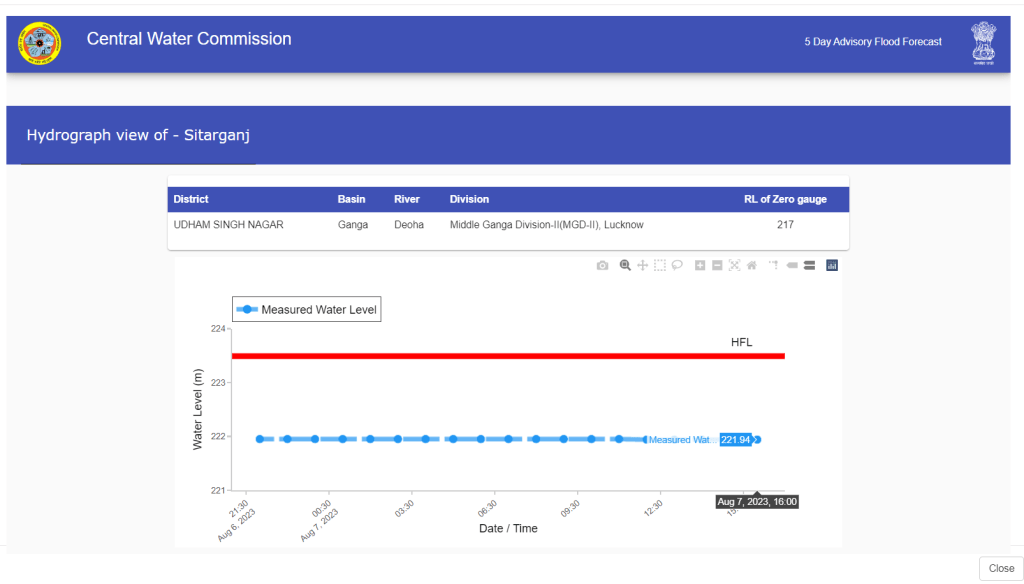
Uttarakhand During 8-9 Aug 2023, several parts of Uttarakhand witnessed heavy rainfall. Severe flash flood incidents were reported from Haldwani, Udham Singh (US) Nagar & Kotdwar. When we visited the CWC’s Flood Forecast website to check the rise in water levels in respective rivers in these areas; we found that hydrographs of several flood monitoring sites not been updated since Aug 6-7.
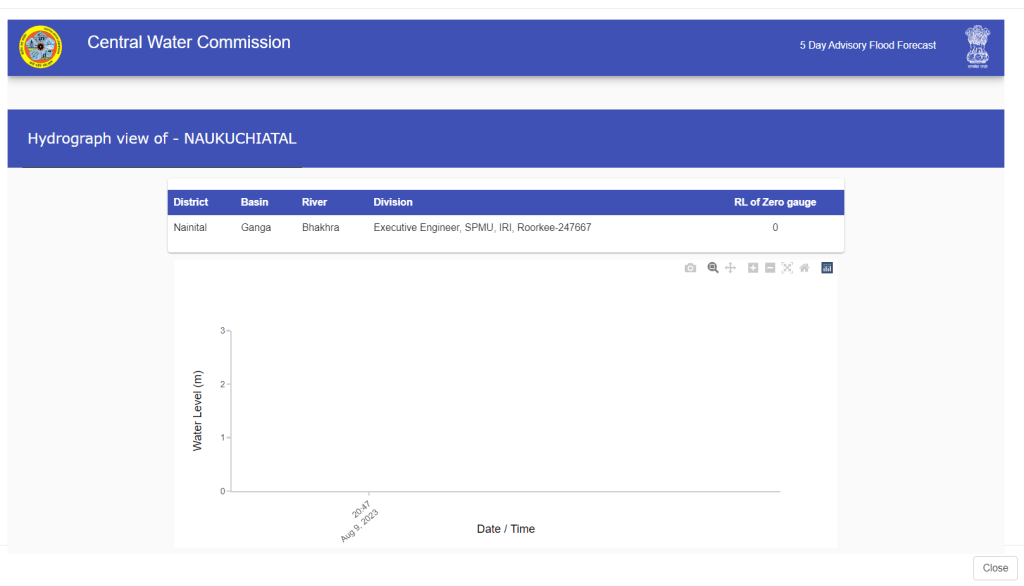
Few of these sites are Kathgodam on Kichha river, Sitarganj on Deoha river, Suyalbari and Garjia on Kosi river, Naula and Kalagarh dam on Ramganga river and Fica barrage on Fica river. Also the Naukuchiatal site in Nainital was found inactive. All these sites are under Middle Ganga Division (MGD)-2 and there are a total 63 flood monitoring stations under MGD-2 of which 12 are in Uttarakhand and 51 are in Uttar Pradesh.
We raised the problem with CWC’s through twitter and kept tracking the progress. Surprisingly, the hydrographs for all these sites named above and some more sites in adjoining districts of Uttar Pradesh including Bhojpur on Dehla river, Bhatpura on Ramganga river in Rampur district and Shergarh on Kichha river in Bareilly district showed no notable improvement all through Aug 10, 2023. Amid this, there were reports for flood related damages from Haldwani & US Nagar.

Finally, on August 11, 2023, we contacted some local sources who are following CWC’s flood monitoring work in the Uttarakhand state and came to know that these sites could be facing lack of manpower issue. They also revealed that CWC has gradually reduced the number of regular workforce and hires some staffs for flood period on contractual basis.
To confirm the information, we contacted Sarbjit Kumar Singh, Executive Engineer (EE), MGD-2 and he told us that the contract for monitoring the above-mentioned sites had expired on July 30, 2023. As per him, the CWC, Head Quarter, Delhi was already informed regarding this but the contract period was not extended in time & the contractor staff had stopped working.
He acknowledged that this was a serious issue and such a situation should not have occurred at the first place but stated that it would be resolved in a week time. It is also learnt that CWC does not directly select the contractual staff for flood monitoring work but takes the services of Water and Power Consultancy Services Limited (WAPCOS) for the purpose.
Delhi During unusual flood spell in Yamuna in second week of July 2023, the river not only breached the highest flood level (HFL) of 207.49 meter dated 06.09.1978 at the Delhi Railway Station level forecast site but also unexpectedly rose by 1.17 m rise and set 208.66 m as new HFL on 13.07.2023.
While the flood level was still above the HFL, the hydrograph for the site taken on July 15, 2023 showed a sharp deep of 2.03 meter (at 24:00 hour on 12.07.2023) and remained below the HFL (till 23:00 hour 13.07.2023) before displaying a sudden rise of 1.17 meter and taking the flood level above the HFL again.
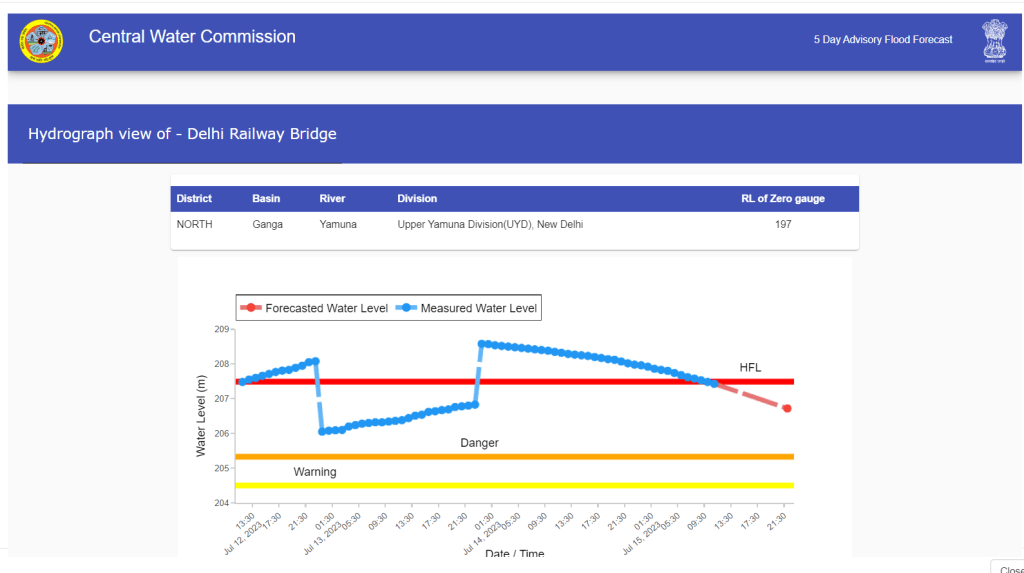
This was quite incorrect data being exhibited while the peak flood spell was passing through Delhi. Moreover, the same incident was observed on the hydrographs of all sites in the upper and middle segment of river Yamuna.
The problem was highlighted with CWC through twitter and the agency acknowledged the problem but did not make any corrections. When Deepak Sagar, the Junior Engineer (JE), Delhi Railway Bridge site was informed about the issue; he appeared unaware of this and cited a wrong data entry by Multi-Tasking Staff (MTS) as a possible reason behind the mistake. But the question of how this could happen simultaneously for all the sites on Yamuna around Delhi remained unanswered.
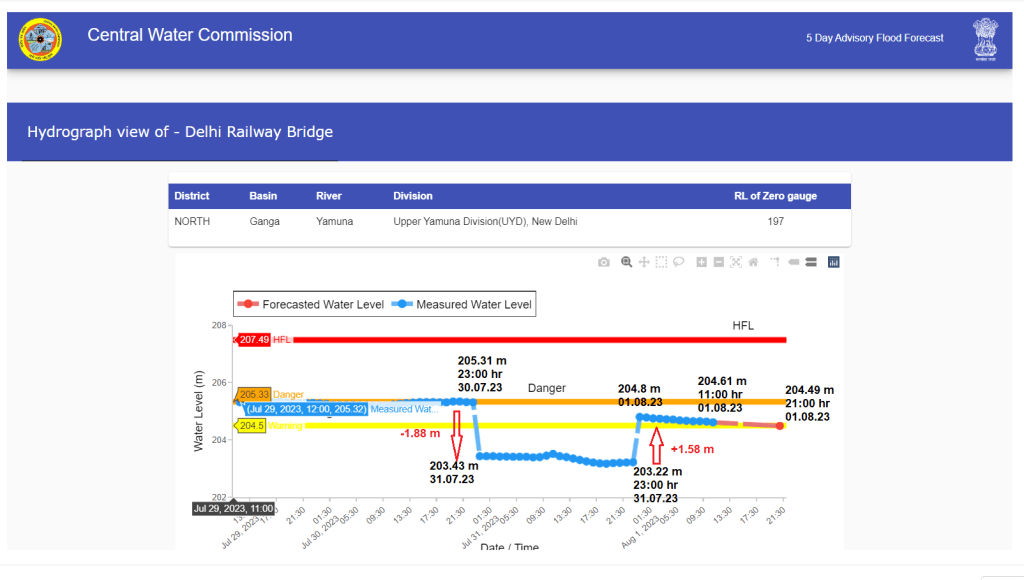
Disappointingly, the same error reoccurred at the same site when the flood level recorded well till 01.08.2023 abruptly fell by 1.88 meter and increased by 1.58 meter for the entire day of 31.07.2023. The hydrographs for all the sites in the upper and middle segment of Yamuna displayed the same error.
The issue was again raised with CWC but remained unresolved. The concerned official first appeared unaware of the incident but later stated that the Hydromet division, Delhi have got the information about it and are working to fix it.
Trying to find out the reason behind this serious problem, when we contacted H P Chaurasia, EE, Upper Yamuna Division (UYD), he too expressed his surprise and said that the error took place on all the 48 sites under UYD. As per him, National Water Informatics Centre (NWIC) is maintaining the water level data on the hydrographs and he has written to NWIC and is waiting for the response.
He opined that hacking attempts could be the reason for the error but shared that NWIC refused to accept this. Regarding causes of unusual rise in Yamuna flood level in Delhi, he stated that senior officials have briefed a parliamentary committee & refrained from making further comment.
We then contacted Sachin Khuraschev, Deputy Director, Water Information Management System (WIMS) at NWIC who cited some technical glitch as a reason for the abrupt changes in water levels on hydrographs for sites under UYD during July 13, 2023. When asked why it has taken so long to figure out the problem and why it had reoccurred, he seemed unaware of the same error happening twice and replied that the process took time and CWC has been informed about the reasons.
Regarding un-updation of hydrographs under MGD-2, he said that the hydrographs are updated according to the data received and WIMS cannot update it if there is no data submission.
Himachal Pradesh Himachal Pradesh had witnessed massive floods in Beas river in July 2023. Sadly, CWC has no flood monitoring and forecast site on the Beas though the river flows for about 256km in the state.
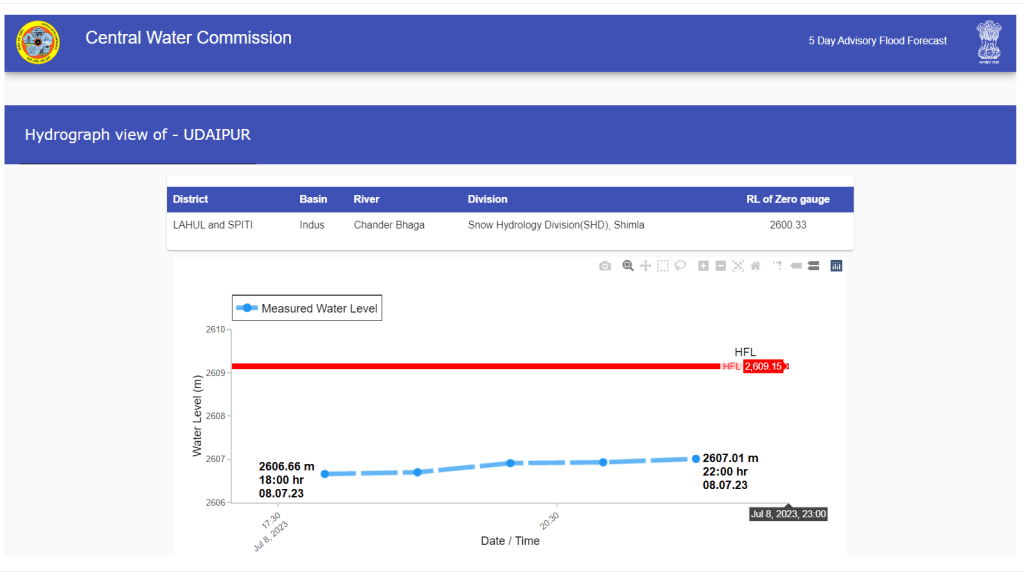
The CWC flood forecast website incorrectly lists Barot station on Beas whereas the geographical location of the site is at about 25 km aerial distance on Uhl river. Moreover, the hydrographs for sites in Lahul and Spiti were running late by more than one day during the July 2023 flood spell. This has proved a major and serious gap in CWC’s flood monitoring work in the state.
When we talked to Prakash Chandra, EE, CWC posted in Shimla regarding the issue, he accepted that Barot site is located on Uhl river but did not know that it is wrongly listed on Beas river. According to Prakash Chandra, Bhakhra Beas Management Board (BBMB) monitors the flood level in Beas at their dam sites.
It is worth mentioning that BBMB dams levels, inflow and discharges data are not in public domain, so the flood and reservoir monitoring done by BBMB is not useful for people.
NHPC’s Parbati III and other dams have been blamed for aggravating flood impact in Sainj valley by the locals in July 2023 (see SANDRP blog on this). However, the inflow, outflow level and other data of these dams are not in public domain, so it is not useful for the affected people or anyone else.
Though, Prakash Chandra stated that the BBMB and NHPC share their water discharge data with State Disaster Management Authority (SDMA) but there is no way for people to know this information to cross check their figures which leaves room for manipulation. This necessitates the need for credible flood monitoring work by a third party in the flood prone state on an urgent basis.
Acknowledging the need of more flood monitoring and forecast sites in the state, Prakash Chandra stated that CWC, Shimla would soon have a meeting to discuss the issue. Regarding the delay in updation of hydrographs for sites in Lahul & Spiti, he said that during the flood event the area was disconnected with mobile network services.
Presently, CWC uses two methods to measure flood levels in rivers manually and through telemetry a system installed at 1054 sites across the country. In telemetry system the water level is measured by ground-based sensors working on bubbler principle also known PTB (Permanent Termination Block) automatically and transmitted to CWC’s 27 modelling centers and 3 Earth Receiving Stations (ERS).
The telemetry system has been introduced under flood modernization project 2010 onwards. However, there have been issues of maintenance and mis-match between water levels recorded manually and by the telemetry system for the same site. As a result, these ground-based sensor sites are now gradually being replaced with radar-based telemetry systems after 2017.
Central Flood Control Room
SANDRP raised all these issues with Sharad Chandra, Director, Flood Forecast Monitoring Department, CWC, Delhi. Regarding problems with hydrographs for MGD-2 in Uttarakhand and Uttar Pradesh, he stated that it was an administrative issue and would be resolved soon.
For mal-functioning of hydrographs in UYD, he stated that it could be due to some technical error and the hydro-met division has informed the NWIC about this.
When asked about reasons behind unprecedented rise in Yamuna flood level in Delhi, he said that it could be due to cumulative impact of prolonged releases of 1 lakh cusec discharges from Hathni Kund Barrage (HKB) and due to encroachments of river floodplain in Delhi.
But when we shared that the highest flood level was not breached during higher discharges in past years, Sharad Chandra stated that there is no way to authentic peak flow discharges from HKB in past years and even during 1978 floods. He further stated that the site has been recalibrated and the discharge figures are more realistic now.
On the lack of flood monitoring sites in Himachal Pradesh, he agreed that there is need to open more sites in the state and the river of Barot site would be corrected from Beas to Uhl.
Meanwhile, in a welcome change CWC has started showing the amount of water being discharged in Yamuna as River Outflow with grey color in HKB hydrograph. Earlier discharges in the river during flood time were shown as Canal Outflow and SANDRP has highlighted the absurdity in August 2022.
SANDRP has been highlighting the shortcomings and serious problems in CWC flood monitoring and forecast work for past many years. The links of our two recent blogs on the issue are given below.
Monsoon 2022: CWC Changing HFLs in Ad-hock Manner
Rivers Breaching Highest Flood Levels in July 2023
Bhim Singh Rawat (bhim.sandrp@gmail.com)

 SANDRP