Bhagirathi · Ganga · Uttarakhand

Walking along Ganga in Uttarakhand in 2017

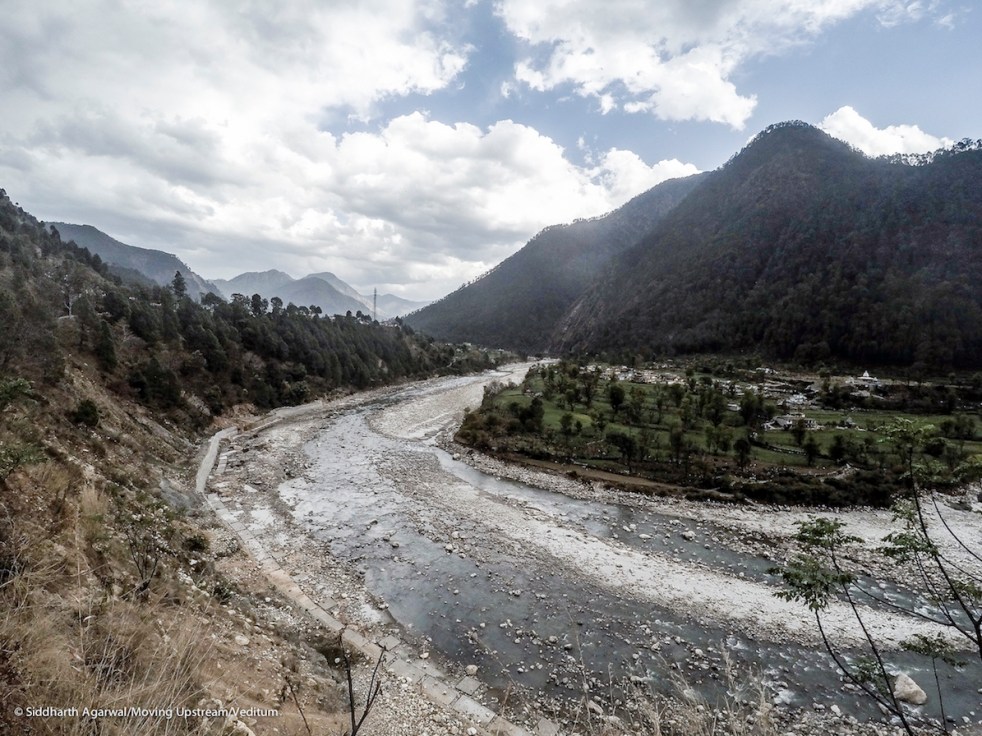
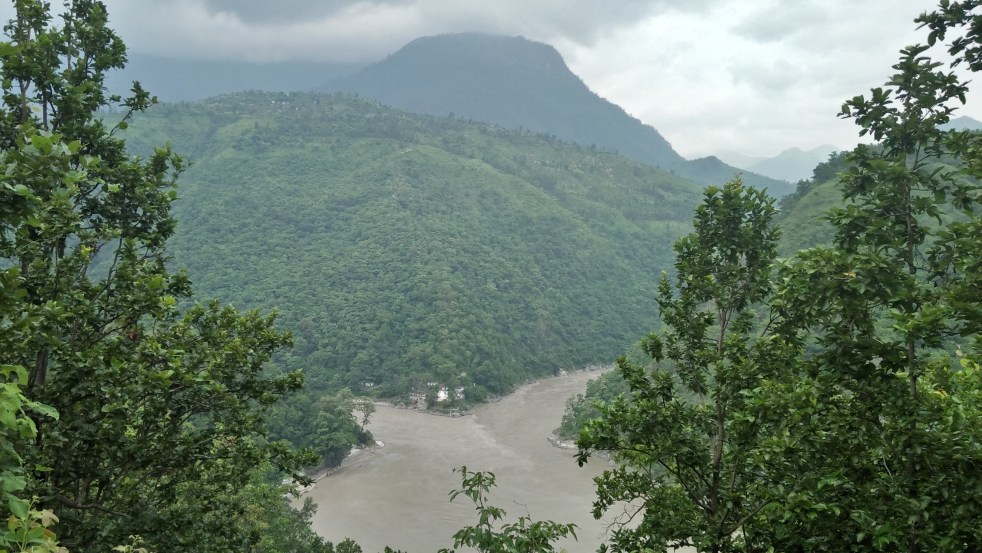
Above: The Bhagirathi valley has a lot of beautiful bends, comparable to the most popular scenic spots across the world. But we’re busy cutting down the mountain to make broader roads in these eco-sensitive areas. Image taken in March 2017. Photo credits: Siddharth Agarwal 

Guest Blog by Siddharth Agarwal

In the initial stages of planning the Moving Upstream project on the Ganga for Veditum, where we were going to walk along the whole length of the river, I had approached a lot of individuals to learn from their experiences about the river and the many connected stories around it. These learnings varied from science and activism to adventure and survival. Of all those who were approached, Himanshu Thakkar from SANDRP had been the most generous in extending knowledge resources and sharing contacts from the field. He even entertained a couple of my visits to their office and shared with me a copy of the SANDRP report prepared by Theo, called Headwater Extinctions (February 2014,  see: https://sandrp.wordpress.com/2014/12/16/new-publication-headwater-extinctions-impact-of-hydropower-projects-on-fish-and-river-ecosystems-in-upper-ganga-and-beas-basins/, it includes link to full report), along with a few other documents.

Headwater Extinctions looks at the role played by small and large hydropower projects in altering the fish biodiversity and river ecosystems in the Himalayan reaches of the Ganga and Beas basins. It also speaks about the perspective of local people and that of the authorities towards hydropower projects. Theo, who is an adventurer and ecologist, penned down the report with a scientific aptitude, while I will limit myself here in this revisit report to updated observations made on ground while walking along the Ganga in Uttarakhand (March 2017). This comparative observation will hopefully enable a conversation that requires continuity. Continue reading “Walking along Ganga in Uttarakhand in 2017”
Dams

Development NOT Dams: Pancheshwar affected people demand

(Feature Image: Pancheshwar Temple at the confluence of Saryu and Kali Rivers. Pics: Bhim )

The people to be affected by the proposed Pancheshwar Multipurpose dam project are saying we need development NOT dam in ecologically sensitive Himalayan region.  The untimely Environment Public Hearing (EPH) for 123 to be affected villages in Uttarakhand State has been rushed through in August 2017 with numerous violations as we reported earlier.  

During one week long trip to the affected districts of Champawat, Pithoragarh and Almora, I along with Sumit Mahar of Himdhara visited proposed dam site and few of the villages that may face submergence in the unlikely possibility of the project coming up, to understand the local social and environmental issues.

Continue reading “Development NOT Dams: Pancheshwar affected people demand”

Dams · DRP News Bulletin

DRP: 4 Sep 2017 (Uma Bharti Shifted, any Better Hopes From Gadkari?)

In the Cabinet Reshuffle on Sept 3, 2017, Uma Bharti has been removed as Union Ministry of Water Resources, River Development and Ganga Rejuvenation, for what media is widely calling as her non-performance (http://indiatoday.intoday.in/story/uma-bharti-ganga-experts-cabinet-reshuffle/1/1039555.html).

Unfortunately, some in Media are rather valiantly trying to show that she did achieve something (see for example: http://indianexpress.com/article/india/nitin-gadkari-60-minister-water-resources-river-development-ganga-rejuvenation-ganga-clean-up-the-biggest-challenge-4827277/), when what they are showing only the claims of expenditure or achievement of the ministry, no real achievement on ground based on independent scrutiny or evidence.

Mr Nitin Gadkari has been given the charge of this ministry in addition to his current charge of Ministry of Surface Transport. The first thing that strikes about Mr Gadkari is that as minister in current government he has been strong advocate for use of rivers for inland navigation and he also achieved through an act in Parliament, listing of 111 main stretches of rivers for this purpose. In the initial few months of this government in power, he actually publicly said that he wants to build a barrage every 100 km along Ganga, which he latter said could be done every 50 km. The impact of one existing such barrage on Ganga for navigation, namely Farakka is well known, and it is so severe that MPs and now even Bihar’s current Chief Minister have been demanding decommissioning of the barrage. Indeed, there are huge social and environmental impacts of use of rivers for navigation, but Mr Gadkari’s ministry has been pushing the case that there is no need for even social and environmental impact assessment of the inland navigation plans or activities. Now it will be interesting to see what does Mr Gadkari says about this as Minister of Water Resources, River Development and Ganga Rejuvenation. If past is any guide, it does seem that Ganga, Brahmaputra and other rivers on the list of inland navigation could be in for greater deterioration rather improvement.

Continue reading “DRP: 4 Sep 2017 (Uma Bharti Shifted, any Better Hopes From Gadkari?)”
Environment Impact Assessment · Interlinking of RIvers · NWDA

REUTER’s biased, misleading, erroneous reporting about Ken Betwa Project

ABOVE: A fabulous view of Ken river. Nesting sites of Long-billed vultures are to the right. All will go under water if Ken-Betwa linkup is carried out, Photo by AJT Johnsingh

On Sept 1, 2017, Reuters published a report[i] about Interlinking of Rivers, with focus on Modi flagging off work on Ken Betwa Project. The report was carried VERY widely, including in local, national and international media. [This note was sent as a letter to a number of persons at Reuters and Thomson Reuters on Sept 2, 2017, there has been no response so far as I publish this several hours later.]

Unfortunately, it’s a biased, very misleading, erroneous report with factual inaccuracies that one does not expect in a Reuters report.  Continue reading “REUTER’s biased, misleading, erroneous reporting about Ken Betwa Project”

Dams · India Rivers Week

Nominations for BPS-2017 & Shri Anupam Mishra Memorial Medal-2017 Invited

Dear All,

Greetings from the India Rivers Week (IRW) Organising Committee!

This is to request for nominations for Bhagirath Prayaas Samman (BPS) 2017.

As you will recall BPS is an attempt to acknowledge and celebrate outstanding, inspirational, unsung initiatives in river conservation.

This year we are also initiating Shri Anupam Mishra Memorial Medal to celebrate media professionals who have established an exceptional body of credible work on various aspects of rivers leading to changes in behaviour, public discourse, law and policy. Self nominations will also be considered.

Please find attached the announcement and the nomination forms.

PLEASE SEND AN EMAIL TO SURESH BABU TO GET THE ATTACHMENT MENTIONED HERE suresh@wwfindia.netBPS Call for nominations 2017.

Last date for nominations: September 25, 2017. A jury will take decision about the final awardees based on set of criteria.

Continue reading “Nominations for BPS-2017 & Shri Anupam Mishra Memorial Medal-2017 Invited”

Dams

Loud Media Message: Public hearing of  Pancheshwar Dam is illegal

Before, during and after the controversial public hearing of destructive Pancheshwar Dam, held in three districts in Uttarakhand, wide media reports in print, in audio-visual and social media gave a loud and clear message: The public hearings violated all legal and democratic norms, in letter and spirit and were clearly illegal.

The Pancheshwar multipurpose project has generated much controversy in India and in Nepal. Its Environment Public Hearing (EPH) was held on August 9, 11 and 17 at Champawat, Pithoragarh and Almora in Uttarakhand. Held during monsoon season in disaster prone hilly region they have invited sharp criticism from all concerned.

There have been scores of reports by local and national media revealing the significant environmental issues being compromised by concerned authorities. We have compiled some key media reports here to illustrate,  how clear is the message from all media that the public hearing, the EIA and the project itself involves so many violations of law and democratic norms. They are clearly unacceptable.  

Continue reading “Loud Media Message: Public hearing of  Pancheshwar Dam is illegal”

Dams · DRP News Bulletin

DRP: 28 August 2017 (Need for Policy on Equitable Sharing of River Flow)

Krishna River Water Sharing Dispute  The Andhra Pradesh government is contemplating a legal battle against the Maharashtra and Karnataka governments for denying the “rightful share” of Krishna river water to the state. 

As per DU Rao, Water Resources Minister, Andhra Pradesh, State Government is consulting legal experts to file either a special leave petition or public interest litigation in the Supreme Court against Maharashtra and Karnataka for withholding water in river Krishna and depriving the lower riparian state of its rightful share. The minister also said that upper riparian states are not releasing water even as a humanitarian gesture to meet drinking water needs.

The minister further stated that due to abundant rains, reservoirs on river Krishna in Maharashtra and Karnataka were filled to the brim. Both these states have a total of 275 tmc ft of water stored in their reservoirs, but they are not letting out even one tmc ft to lower riparian states like Telangana and Andhra and instead taking cover under tribunals, those states are fully utilising the water.

It will really be a good case if they draft it well. The Maharashtra and Karnataka parts of Krishna basin have stored 275 TMC of water and Maharashtra is also diverting water from Krishna basin to high rainfall Konkan area this monsoon, but not releasing any water to downstream Telangana and Andhra Pradesh. http://www.deccanchronicle.com/nation/current-affairs/220817/ap-mulls-moving-sc-against-maharashtra-karnataka-over-krishna-water.html

Continue reading “DRP: 28 August 2017 (Need for Policy on Equitable Sharing of River Flow)”
Dams

Pancheshwar Dam’s Public Hearing: Neither People nor Environment were heard

The recently concluded Pancheshwar dam Environment Public Hearing (EPH) is classic example of how undemocratically EPH are conducted against the letter and spirit of EIA notification of Sept 2006. Umpteen violations were committed wilfully during three EPH on Pancheshwar Dam on 09, 11 and 17 August 2017 in Champawat, Pithoragarh and Almora district of Uttarakhand.

WHY EPHs IN MONSOON? In July 2017, the proposed Pancheshwar Dam Project planned on Kali river along the India-Nepal border invited sharp criticisms from local groups. Given the ongoing monsoon rain across the disaster prone hills, the people asked the concerned District Magistrates and Uttarakhand Environment Protection and Pollution Control Board (UEPPCB) for the rescheduling[I] the EPH. But overlooking genuine public concerns and incidents of cloud bursts and landslides causing flash floods and road blocks in the project affected districts the authorities went ahead with the EPH plans.  

Continue reading “Pancheshwar Dam’s Public Hearing: Neither People nor Environment were heard”

Ganga

INTACH pilot project reduces Assi River Pollution in Varanasi by 70% in two months, at least cost, without any structures

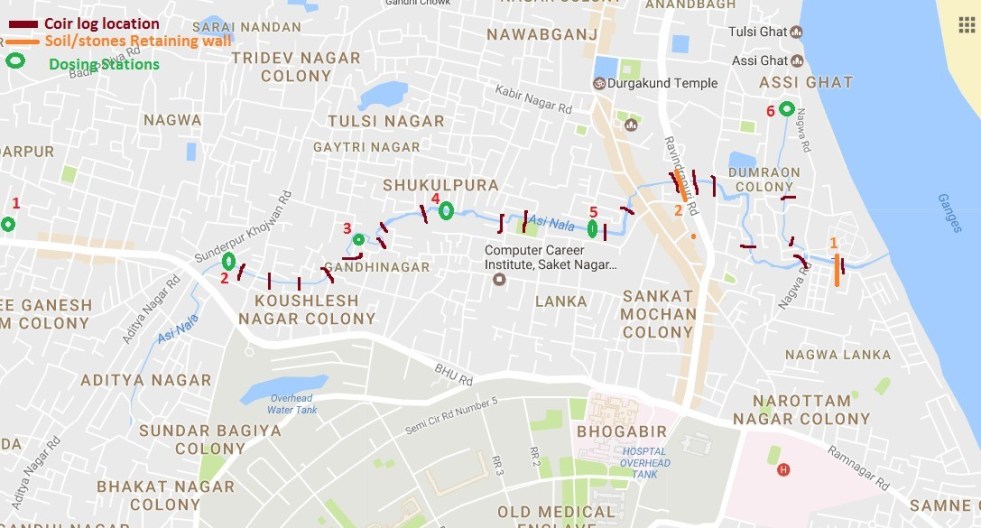
Above: Map showing interventions in Assi River in Varanasi (INTACH)

REPORT TO DIVISIONAL COMMISSIONER, VARANASI

On INTACH’s Pilot Project on Assi Nadi [24th Jan/17 – 26th Feb/17]

Guest Blog by Manu Bhatnagar, INTACH

  1. INTACH is a national non-profit organization, a registered society under Society’s Act since 1984, having the Secretaries of the GoI Ministries of Environment, Forest & Ganga Rejuvenation, Ministry of Urban Development, Ministry of Culture, DG [ASI] and DG [NM] on its Governing Council with its accounts duly audited by the Office of CAG.
  2. High pollution load in holy River Ganga at Varanasi is due to domestic wastewater flowing into the river through 33 nallahs and rivulets. Sewerage systems and treatment plants are going to take several years to be in place and effective. In the meantime the river will continue to remain polluted. Based on its experience in Delhi and Agra INTACH has initiated a one month pilot project for cleaning wastewater flow in Assi Nadi using the process of bacterial bioremediation.

Continue reading “INTACH pilot project reduces Assi River Pollution in Varanasi by 70% in two months, at least cost, without any structures”

Dams · DRP News Bulletin

DRP: 21 August 2017 (Unscientific Obsession With Dredging)

It seems the Chief Ministers of all the flood affected states are obsessed about dredging the rivers and reservoirs and are advocating massive scale dredging as a solution to flooding. This is partly triggered by the Rivers-as-waterways advocacy by Union Surface Transport Minister Shri Nitin Gadkari and partly by the need for showing to the people that they are doing something new to tackle floods, it seems. Bihar Chief Minister Nitish Kumar contributed to it in a way last year when he mentioned the accumulation of millions of tons of silt along Ganga due to the backwater impact of Farakka Dam. This year, the Assam Chief Minister Sarbananda Sonowal[i] has been talking about dredging Brahmaputra as a solution to floods in Assam.

Continue reading “DRP: 21 August 2017 (Unscientific Obsession With Dredging)”