Dams · DRP News Bulletin

DRP: 22 May 2017 (SOLVE SILTATION OF GANGA OR REMOVE FARAKKA DAM TO REVIVE GANGA: BIHAR CM)

Bihar Chief Minister Nitish Kumar again has urged the central govt to remove the Farakka barrage in West Bengal and make a countrywide policy on silt management for letting river Ganga to flow freely.

“Siltation is destroying Ganga’s ecology and health. It’s due to heavy deposits of silt on the riverbed that stream of the river is being badly affected,” Kumar said at a two-day national seminar on ‘Obstacles in the Incessant Flow of the Ganga’.

Speaking on the occasion, Swami Avimukteshwara Anand criticised Union Water Resources Minister Uma Bharati for doing absolutely nothing for the cause of the river Ganga and said she seems more interested in her chair rather  than the river. He also criticised  Prime Minister Modi for claiming that he is son  of Ganga, but doing nothing positive for the river. Swami ji said Nitin Gadkari seems bent on further destroying the river in the name of National Waterway.

Addressing the seminar Nitish Kukar said that Bihar’s demand for the framing of national policy on desiltation of the Ganga and clearance of silt in the state is not a political issue, as the matter is related to larger environmental and biodiversity issues facing the people.

He added, “Concrete steps have to be taken to ensure incessant flow of the Ganga. Otherwise, cleanliness of the river is not possible.” Referring to the need to protect biodiversity, he said conservation of the Ganga dolphins is dependent on the cleanliness of its water. He added the Farakka barrage constructed across the river in West Bengal has led to slow flow of water between Buxar to Bhagalpur, and consequent annual flood and waterlogging during the monsoon.

Nitish recalled the devastating flood that the state had witnessed in the Ganga basin last year and said Bihar had spent Rs 1,058 crore over the last five years to prevent soil erosion. He appealed to the Centre to frame a sound policy on silt management, stressing that it should be prepared by making on the spot survey and assessment of the prevailing situation. Nitish said even the report of the committee headed by Madhav Chitale had accepted the problem of siltation facing the Ganga.

Continue reading “DRP: 22 May 2017 (SOLVE SILTATION OF GANGA OR REMOVE FARAKKA DAM TO REVIVE GANGA: BIHAR CM)”
Dams

Odisha Rivers Profile

About Odisha

Odisha is located on the eastern coast of India, between 17o31‟ and 22o 31‟ N latitude and 81o 31‟ and 87 o 31‟ E longitude. It covers 155,707 km2 , which represents about 4.74% of the area of India. The climate of state is tropical with 1450mm average rainfall.

The 2011 Census established the State‟s population at 41.9 million, 16% of which lived in urban centres. The average population density is 270 persons per km2, compared to 382 for India.  Odisha is a land of possibilities. The State is endowed with bountiful of resources, people, land, water, forest, minerals and other minor resources. The State is divided into 30 districts, of which Mayurbhanj is the largest (1042km2) and Jagatsinghpur the smallest (197km2). The districts are subdivided into 314 CD Blocks. There are 58 sub-divisions and 171 tahasils. According to 2001 census there are 51,349 villages and 6234 Gram Panchayats.(ORISSA STATE WATER PLAN, 2004). 

Continue reading “Odisha Rivers Profile”

Dams

Jharkhand Rivers Profile

About Jharkhand 

Jharkhand State stands on a hilly undulating plateau characterized by predominantly tropical forests and tribal settlements. The total geographical area of the State is 79.70 lakh hectares. The state falls under the Tropical Monsoon climatic region. Presently there are 24 districts in Jharkhand. The population of the State is 32.96 million.

Marvelous eye catching rare geological/geomorphological features like rejuvenated meandering and deep cutting young rivers like Damodar are the uniqueness in the State. It is rate because of combination of senility with the character of young rivers. The state has the luxuriant forests and lush green rolling seasonal meadows. Magnificent undulating hills and valleys are the special attraction. The golden river ‘Swarnarekha’ adds melody in the pristine environment along the course. A combination of table-top flat lands and the peneplain with dome shaped exfoliating hillocks resembling like inverted Nagara (drum) are spread over the state. Further, the Tors or the balanced diamond shaped rocks are also present wonderful nature of the state.

Continue reading “Jharkhand Rivers Profile”

Dams · DRP News Bulletin

DRP: 15 May 2017 (MP talks about Narmada Seva after destroying the River with Dams, displacement of Lakhs)

On conclusion of five month long Narmada Sewa Yatra, Prime Minister Narendra Modi is today ( May 15, 2017) launching a road-map for steps to be taken for the conservation of the Narmada river. The MP state assembly has also recently declared river Narmada a living entity. Even otherwise quiet on rivers environment minister Anil Madhav Dave has expressed concerns for Narmada.

Contrary to all this, the Central Govt and 3 states of MP, Maharashtra and Gujarat have begun a process towards sanctioning completion of the Sardar Sarovar Dam, with closure of the 17 meters high gates. It is a countdown towards impounding waters in the 214 km land stretch where more than 40,000 families are residing till date. There are standing crops and massive plantations; thousands of pakka houses, schools, other public and private services erected; hundreds of temples, tens of mosques (as opposed to three temples claimed by the authorities), adivasi gods and worship places, all of which will be submerged. In protest thousands of people from Narmada valley, to be affected by Sardar Sarovar Project created a Human Chain on the borders of living village communities and on the banks of the river, protesting against any decision to close the dam gates.

Continue reading “DRP: 15 May 2017 (MP talks about Narmada Seva after destroying the River with Dams, displacement of Lakhs)”
Dams · DRP News Bulletin

DRP: 8 May 2017 (Inspiring: How Kerala Panchayat brings a dying river back to life)

The Kuttamperoor stream in Kerala, connecting the Pampa and Achankovil rivers, had been a nearly stagnant, shrunken cesspool of dumped waste and weeds for more than a decade. Some weeks ago, it was resuscitated as a flowing river, thanks to the will of the Budhanur gram panchayat in Alappuzha district, and the commitment of 700 local men and women who worked to bring the river back to life under the MGNREGA.

The Kuttamperoor was once a full 12 kilometres long and, at places, over 100 feet wide. The river originates from Achankovil at Ulunthi, near Mavelikkara, and flows through Ennackad, Budhanur, Kuttamperoor, Mannar, and Pandanad before merging with the Pampa at Nakkida near Parumala in Pathanamthitta district.

Continue reading “DRP: 8 May 2017 (Inspiring: How Kerala Panchayat brings a dying river back to life)”
Dams · Interlinking of RIvers

Open Letter of Protest on Ken Betwa Project to MoEF

Above: Part of proposed Ken-Betwa link submergence area (Photo by Joanna Van Gruisen)

To:

Shri. Anil Madhav Dave
Honourable Minister of State (Independent Charge),

Ministry of Environment, Forest, and Climate Change (MoEF&CC)

Indira Paryavaran Bhawan, Jor Bagh Road, New Delhi – 110003

May 2, 2017

Honourable Minister,

Please consider this joint letter (See PDF file with logos here: Letter to MoEF Ken Betwa 020517) from an informal coalition of environment and wildlife organisations as a collective note of protest against the proposed Ken-Betwa River Link Project. Continue reading “Open Letter of Protest on Ken Betwa Project to MoEF”

Dams · DRP News Bulletin

DRP: 1 May 2017 (Ken Betwa won’t help, here is what CAN help Bundelkhand)

Union Water Ministry has launched an extensive water conservation program for drought prone areas of Bundelkhand, Marathwada, Kalahandi, Bolangir and Koraput in Odisha on April 28, 2017 at Bandri, Sagar Madhya Pradesh. As per report, the Water Ministry has prepared a master plan for artificial recharge of ground water in Bundelkhand region.

In UP region of Bundelkhand, around 1100 percolation tanks, 14000 small check dams/Nala bunds and 7200 Recharge pits/shafts have been identified. In MP region of Bundelkhand, around 2000 percolation tanks, 55000 small check dams/Nala bunds and 17000 Recharge shafts have been identified. She said as a part of ground water exploration, 234 wells in UP are proposed to be constructed in five districts of Bundelkhand i.e., Banda, Hamirpur, Jalaun, Chitrakoot and Mahoba. As a part of ground water exploration, 259 wells in MP are proposed to be constructed in six districts of Bundelkhand.

Continue reading “DRP: 1 May 2017 (Ken Betwa won’t help, here is what CAN help Bundelkhand)”
Andhra Pradesh · Dams · Karnataka · Maharashtra · Telangana

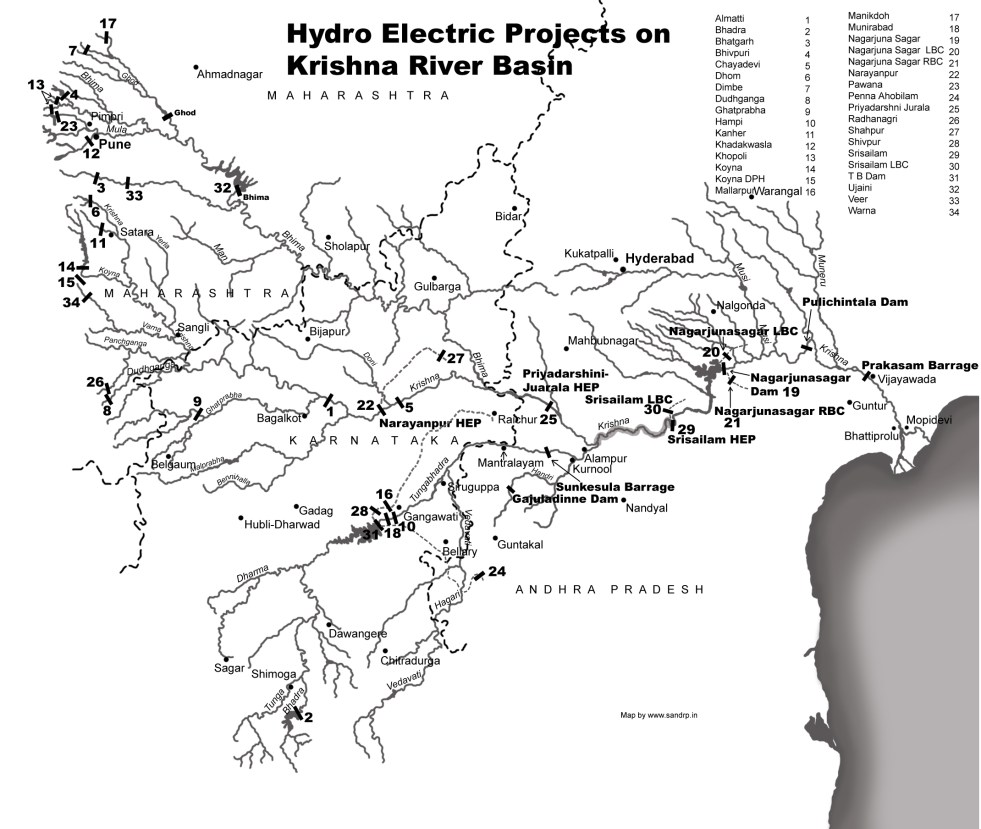
STOP DIVERSION OF WATER FROM DROUGHT HIT KRISHNA BASIN

Release water from Koyna & Tata dams to drought hit Karnataka, Telangana & Andhra Pradesh

Large parts of South India, including parts of Karnataka, Andhra Pradesh and Telangana are facing unprecedented drought and water scarcity. However, Maharashtra is sending OUT billions of liters of water FROM drought hit Krishna basin to High Rainfall Konkan region to flow to the sea. Continue reading “STOP DIVERSION OF WATER FROM DROUGHT HIT KRISHNA BASIN”

Dams · DRP News Bulletin

DRP: 24 April 2017 ( NHPC says Dams have no adverse impacts anywhere in the world! Admits, Hydro is no longer viable for private sector)

Centre Getting forest clearance is not a problem now: NHPC Chairman In an interview, taking a dig at its private peers, NHPC chairman KM Singh said that NHPC is the only company in the county that has the capability to execute hydro projects. He also said that in the NDA regime green clearances come easy, while local agitation by NGOs is the biggest threat. He further stated that there has been no negative impact of building a dam, not just in India, but anywhere in the world.

Continue reading “DRP: 24 April 2017 ( NHPC says Dams have no adverse impacts anywhere in the world! Admits, Hydro is no longer viable for private sector)”
Beas · Himachal Pradesh

NHPC negligence leads to man-made disaster in Parbati Valley in Himachal Pradesh

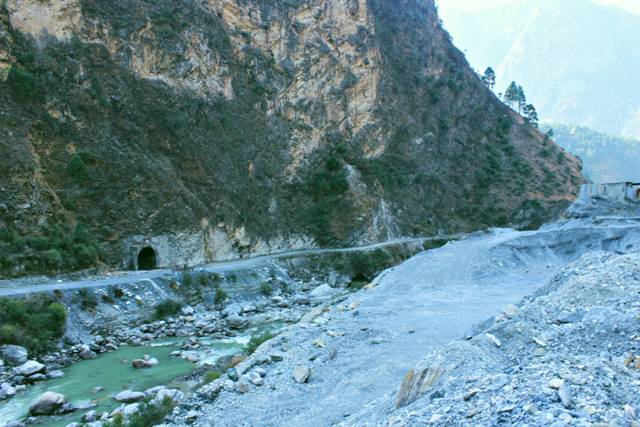
(Above: illegal muck dumping by Parbati HEP along the Sainj River in Himachal Pradesh)

The people of Sainj-Parbati valley in Beas basin in Himachal Pradesh’s Kullu disrict’s Banjar Tehsil are living in constant fear of a disaster. Since six days now, the power tunnel of the NHPC’s under construction 800 MW Parbati II hydropower project is heavily leaking, but NHPC refused to stop water release into the tunnel till the leakage led to landslides and displacement of people. Ultimately on the night of April 17, 2017, huge cracks spread over 200 m appeared in the hills, leading to landslide & fall of soil and rocks, immediately threatening eight families of Rahan (Reina) village, though over 400 families of some 12 villages of Rella Panchayat (including Rella, Sharan, Jiva, Sulga, Khadoa, Rahan, Shalah, Bhebal, Bahara, Bagidhar, Khaul, etc) are facing the prospects of disaster as cracks in the hill have appeared just above the villages. People here are spending sleepless nights since several days now. They are afraid that if the leakage continues, these villages will have to be evacuated any moment, else a major catastrophe may result.[i] Continue reading “NHPC negligence leads to man-made disaster in Parbati Valley in Himachal Pradesh”