
It was bit of a shock to get up to a VERY wet Sunday on March 1, 2015, having slept past midnight the previous night with a ‘dry’ weather. When I checked my inbox, the message from Manoj Misra of Yamuna Jiye Abhiyaan was waiting to provide a link to Accuweather.com site[1] and also satellite image from India Meteorology Department (IMD) site[2]. It looked ominous: “A potent storm will drop unusually far south as March begins, blasting India and Pakistan with heavy thunderstorms, flooding rain and burying mountain snow.” Northwestern India and Northern Pakistan were to face the maximum impact, but the impacts were to reach far down south right upto Karnataka. As the site said it was a rare event: “It is rare for widespread substantial rain such as this elsewhere across northern and central India”. Continue reading “Early Spring Rains bring Climate Disaster for farmers in India”
Tag: Yamuna

An Epic Voyage along the Ganga comes to close!
From Burton and Speke’s expedition to the origin of Nile to the age old Narmada Parikrama or the Chaar Dhaam Yatras (which are as much river journeys as pilgrimages), River journeys have always enthralled travelers and listeners alike. Continue reading “An Epic Voyage along the Ganga comes to close!”

NGT Orders MAILY SE NIRMAL YAMUNA – WILL THIS LEAD TO A REJUVENATED YAMUNA?
Guest Blog by Manoj Misra (yamunajiye@gmail.com), Yamuna Jiye Abhiyan, Delhi
The National Green Tribunal (NGT) in a landmark judgment pronounced on 13 January 2015[1], has set an ambitious road map for a rejuvenated river Yamuna by 2017. Naming it as “Maily se Nirmal Yamuna rejuvenation project, 2017” the green court in the judgment spread over almost 100 pages has detailed steps necessary to achieve what all previous efforts have miserably failed. Continue reading “NGT Orders MAILY SE NIRMAL YAMUNA – WILL THIS LEAD TO A REJUVENATED YAMUNA?”
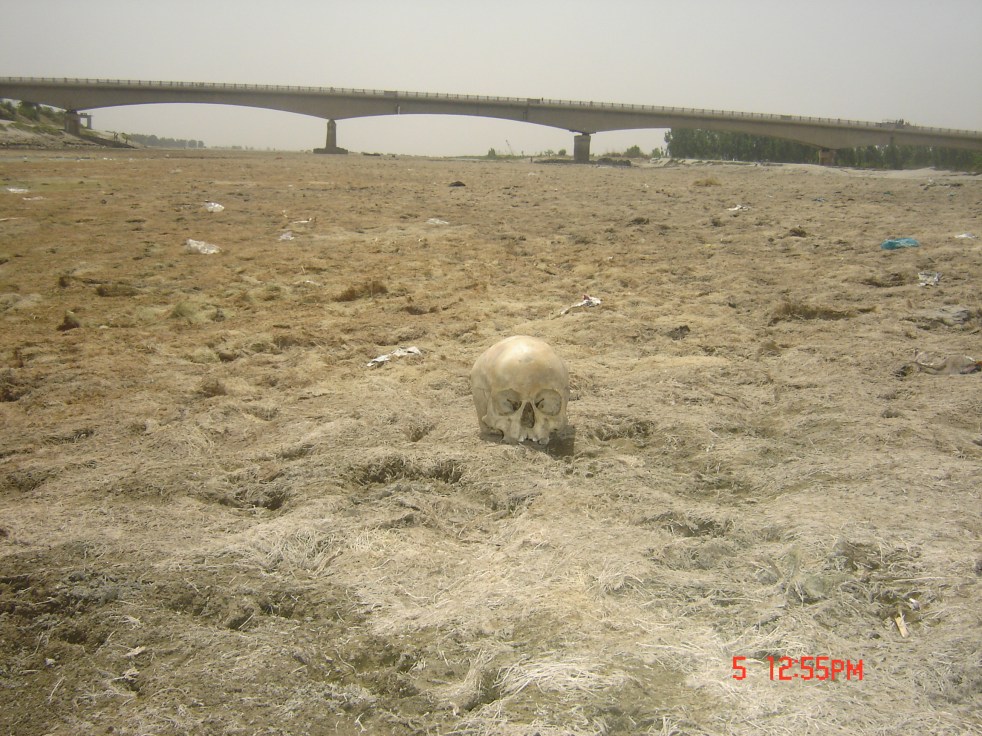
YAMUNA IS ‘HOT’: But JICA’s two decades of failure to rejuvenate Yamuna won’t be forgotten in a hurry
Above: Dead river Yamuna at Mawi, Panipat Photo: Yamuna Jiya Abhiyan
~ Guest Blog by Manoj Misra (yamunajiye@gmail.com)
Ganga is hotter but Yamuna is hot too, with a number of suitors now trying to chase it, thanks to Prime Minister Modi’s often expressed desire for a rejuvenated Ganga.
But Sinya Ejima, the JICA (Japan International Cooperation Agency) chief in India takes the cake, when he expects to swim and drink the Yamuna waters in Delhi in 2017 (thanks to JICA’s assistance to the Yamuna Action Plan, YAP) [1].
But is there more to this public declaration of bravado by Mr Ejima than that meets the eye? Let us try and decipher..
It was way back in 1993-94 when Government of India launched Yamuna Action Plan with an objective to “bring the water quality of the river back to bathing level” with JICA’s (then called the JBIC) assistance. In popular scientific ‘pollution’ parlance, it meant achieving a BOD level of 3 mg per liter all through the length of the 1376 km river from Yamunotri till Allahabad.
Yamuna Action Plan was implemented like its predecessor Ganga Action Plan (GAP) as primarily a pollution abatement effort in 21 cities in Haryana and UP and the National Capital territory of Delhi and claimed to have created a total sewage treatment capacity of 753 MLD at a total cost of Rs 682 crores (1 Crore = 10 million).
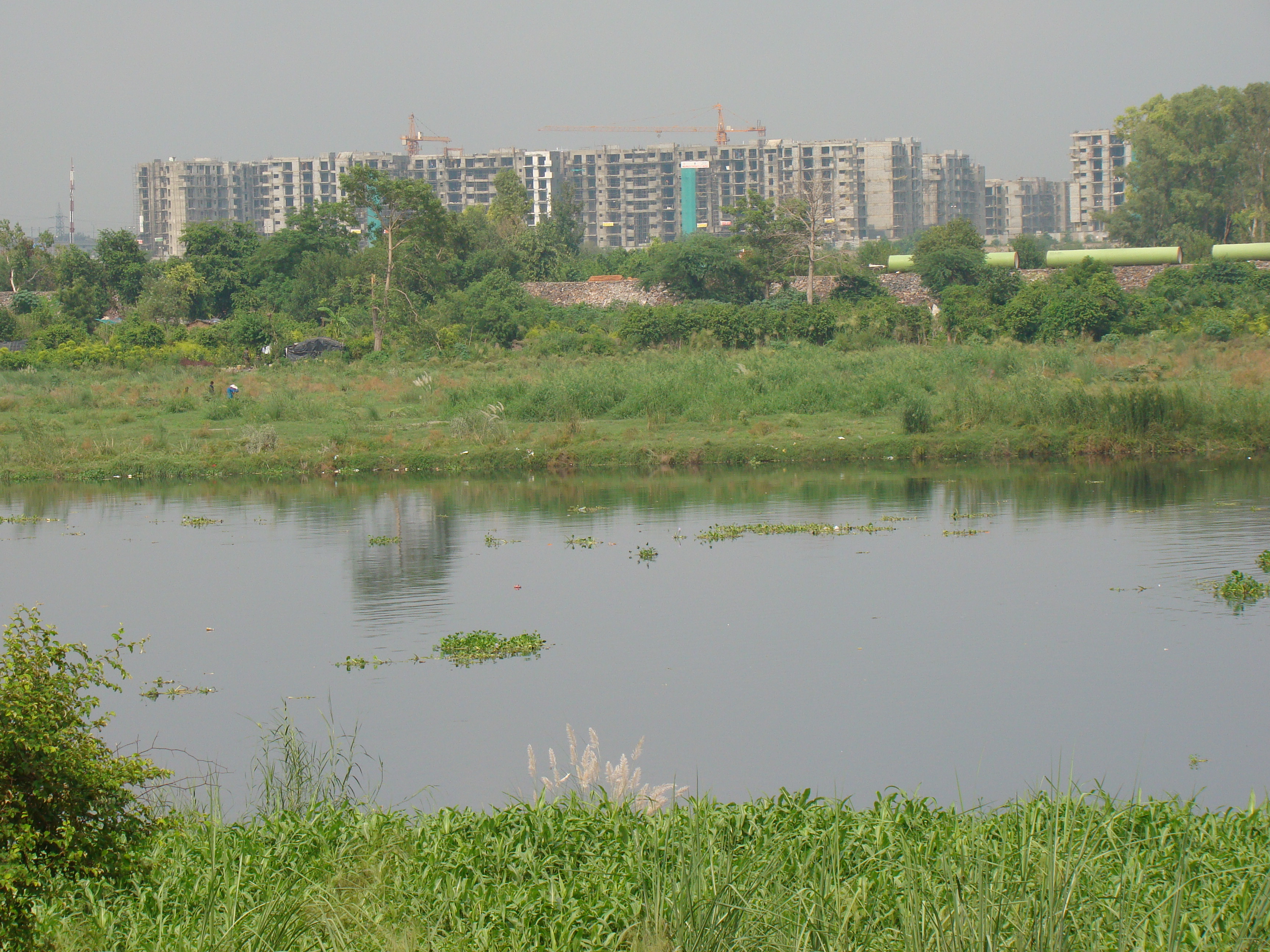
YAP II began, again with JICA assistance, in 2003 at a total cost of Rs 624 crore for abatement of pollution of river Yamuna in Delhi, UP (98 towns) and Haryana (6 towns). It claims to have created additional sewage treatment capacity of 189 MLD.
Yamuna Action Plan III, again with JICA assistance with a projected life span of 7 years is currently underway since 2012 and is aimed again at the pollution abatement in the city of Delhi. The cost estimate of YAP III is Rs 1656 crores and its components include rehabilitation of damaged trunk sewers in the Kondli and Rithala catchments; rehabilitation and modernization of STPs at Okhla, Rithala and Kondli in tune with the under preparation sewerage master plan for the city.
Against all the above mentioned efforts, tall claims and money spent (largely national debt), the Central Pollution Control Board, in response to the Supreme Court of India, reported in March 2012:
“River Yamuna is not conforming to the desired levels from Panipat downstream to Agra downstream due to higher concentration of one or the other criteria pollutants.” The report added that “efforts of state governments of Haryana, Uttar Pradesh and the National Capital Territory of Delhi for collection and treatment of waste water are not showing improvement in the water quality of river Yamuna.”
Clearly, all the past efforts at the ‘cleaning’ of river Yamuna mostly with JICA assistance (read loan) have failed.
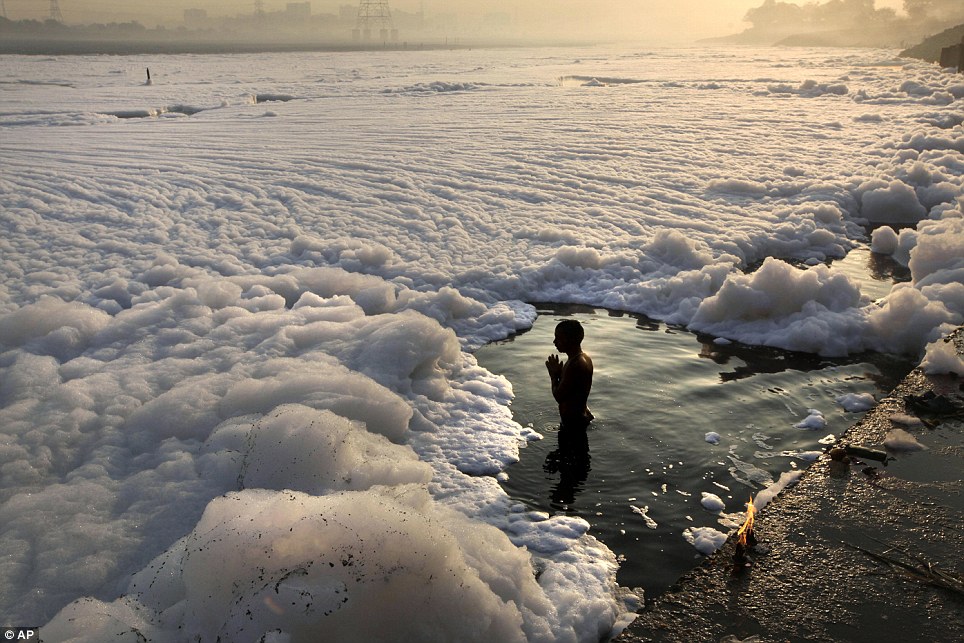
So, what could have prompted this new found source of energy and bravado as shown by Mr Ejima, the JICA chief in India at a presentation the other day at the India-Japan joint working group meet on Urban Development on ‘JICA’s Operations In Urban Sector in India’ in Delhi?
It is no longer a secret that following Prime Minister Modi’s clarion call from the ghats in Varanasi for the rejuvenation of river Ganga (and by implication its other tributaries like Yamuna), there has been a sudden and newly-found interest in rivers of India by countries like Holland, Germany, France and Australia (to name but a few) and a regular stream of experts/visitors (read consultants) there from can be found making the rounds of the corridors of power in New Delhi.
All this could be unnerving and a turf threat to any ‘established’ provider of goods and services in the name of river cleaning in India, say the likes of JICA, and possibly thus the said show of bravado by its chief in India.
However, the so-called river ‘cleaning’ route focused on pollution abatement as the primary means of river ‘rejuvenation’ is in our understanding fundamentally flawed and hence destined to fail. Results of all past similar efforts validate our stand.
If only we could begin practicing the basic principle of a ‘River’ and ‘Sewer’ not meant to mix, and that all sewerage improvement works (main component of JICA assistance) in cities of India be treated and planned as a strategy of ushering in a sound urban management, rather than river rejuvenation?
Sine qua non for any river rejuvenation is the restoration of its flow in its most natural state.
However, if true to his words, Mr Sinya with his tested and failed (unfortunately) primarily pollution abatement efforts can still manage to restore the Yamuna enough to swim and drink its waters in the year 2017, we would love to toast him as a national river restoration icon. AMEN.
END NOTES:
[1] PIB press release, see: http://pib.nic.in/newsite/PrintRelease.aspx?relid=110911
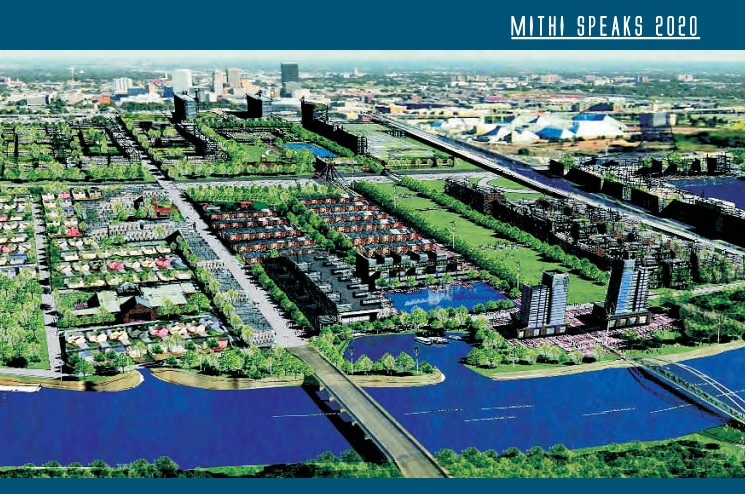
Riverfront Development in India: Cosmetic make up on deep wounds
There is a rush of riverfront development schemes in India. We have heard of Sabarmati Riverfront development being drummed many times, followed by the proposed rejuvenation of Ganga, supposedly on the lines of Sabarmati.
What does Riverfront Development entail? Is it River Restoration? Are the millions of rupees spent on Riverfront Development schemes justified? Will it help in saving our damaged rivers?
A cursory glance at the existing river restoration/ improvement/beautification schemes indicates that the discourse revolves mainly around recreational and commercial activities. It is more about real estate than river. Activities that are promoted on the riverfronts typically include promenades, boat trips, shopping, petty shops, restaurants, theme parks, walk ways and even parking lots in the encroached river bed.

Pioneering project in Riverfront Development was claimed to be the Sabarmati Riverfront Development project of Ahmedabad city which was supposed to be designed based on riverfronts of Thames in London and Seine in Paris. The project which began as an urban development project is lately being pushed as a role model for many urban rivers in India. This kind of riverfront development essentially changes the ecological and social scape of the river transforming it into an urban commercial space rather than a natural, social, cultural, ecological landscape. Is it wise to go for this kind of development on riverfronts? What does it do to the river ecosystem, its hydrological cycle? What does it do to the downstream of river? These questions need to be explored before accepting the current model of riverfront development as replicable or laudable.
Reclaim and beautify!
Most of the currently ongoing projects lay a heavy emphasis on beautification of rivers. Riverfronts are treated as extension of urban spaces and are often conceived as ‘vibrant’, ‘throbbing’ or ‘breathing’ spaces by the designers. Concrete Wall Embankments, reclamation of the riverine floodplains and commercialization of the reclaimed land are the innate components of these projects. Quick glimpse at various Riverfront Development Projects confirms this.
Sabarmati Riverfront Development Project
Sabarmati Riverfront Development Project of Ahmedabad city which is presented as a pioneer in urban transformation[1] has been proposed by Environmental Planning Collaborative (EPC), an Ahmedabad-based urban planning consultancy firm, in 1997 and envisaged to develop a stretch of 10.4 km of the banks on both sides of the river by creating concrete embankment walls on both banks with walkways. A Special Purpose Vehicle called the Sabarmati Riverfront Development Corporation Ltd. (SRFDCL) was formed in the same year for implementation of the project. The financial cost of the initiative was estimated to be in the range of around INR 11520 million[2]. Around two thirds of this amount has already been spent.
Construction of the project started in 2005. The project sought to develop the riverfront on either side of the Sabarmati for 10.4 kms by constructing embankments and roads, laying water supply lines and trunk sewers, building pumping stations, and developing gardens and promenades[3]. Mainstay of the project was the sale of riverfront property. Land along the 10.4 km stretch on both the banks was reclaimed by constructing retaining walls of height ranging from 4 to 6m[4]. 21% of the 185 ha of reclaimed land which was developed by concretizing the river bank[5] was sold to private developers for commercial purpose.[6] Activities hosted on this reclaimed land were recreational and commercial activities like restaurants, shops, waterfront settlements, gardens, walkways, amusement parks, golf course, water sports and some for public purpose like roads etc. The sale of reclaimed land created by the project is expected to cover the full cost of the project. Ahmedabad Municipal Corporation (AMC) claims that the after the project “river has added vibrancy to the urban landscape of Ahmadabad with its open spaces, walkways, well-designed gardens along with activities which contribute to economic growth.”[7]
Even though the project has been modeled as “best practice” by several financing institutions[8], it has also drawn severe criticism for poor rehabilitation of the displaced (rehabilitation happened only after High Court orders following a public interest petition) disrupting the nexus of shelter, livelihood and services of urban poor, lack of transparency in the execution and for tampering with the carrying capacity of the river. No Environment Impact Assessment of the project has been conducted nor any credible public consultation process held.
Sabarmati channel has been uniformly narrowed to 275 metres during the riverfront development project, when naturally average width of the channel was 382 metres and the narrowest cross-section was 330 metres[9]. In this attempt of “pinching the river”[10], the original character of the river is changed completely from seasonally flowing river to an impounded tank illegally taking water from Narmada Canal[11]. River banks have been treated as land that is wasted on which value could be created by reclaiming and not as seasonal ecological systems with floodplains as an integral part of its flows (Baviskar 2011). Seasonality of the river is destroyed and fauna and avi fauna on edges have been damaged. No thought has been given for protection, sustenance or enhancement of the riverine ecosystem. The water that is now impounded in this stretch is not even Sabarmati river water, but Narmada River Water, on which the city of Ahmedabad or Sabarmati has no right, it’s the water meant for drought prone areas of Kutch, Saurashtra and North Gujarat.
The River Sabarmati itself was a perennial river till the Dharoi Dam in the upstream stopped all water at least in non Monsoon months, making the river dry. The stretch flowing through Ahmedabad was carrying the mostly untreated sewage of Ahmedabad city and toxic effluents from the City and district industries.
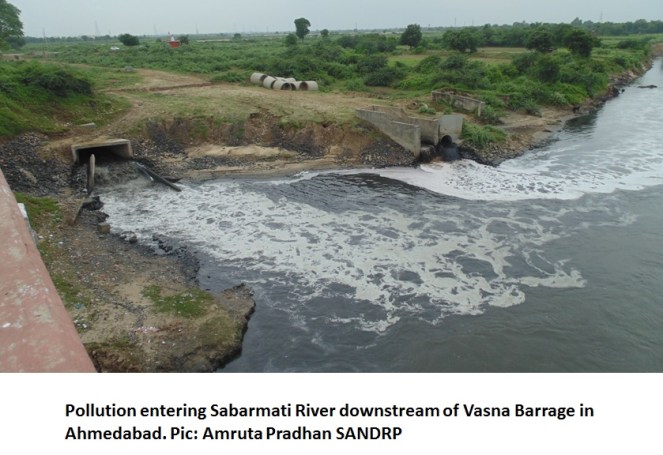
In the name of Sabarmati River front development, no cleaning of the river has happened, the project has only transferred the water from both banks to the river downstream from Vasna barrage, which is situated downstream from the city. The Vasna barrage stops and stores the water released from Narmada Main Canal that crosses the river about 10.4 km upstream from the barrage. Thus this 10.4 km stretch of the river now holds the Narmada water and huge losses from the stretch are losses for the drought prone areas.
The reclaimed land and the narrowing of the channel have been tampering with the carrying capacity of the river. The project was stalled during August 2006 to March 2007 due to heavy floods[12]. Prior to the floods, the river’s maximum carrying capacity was calculated at 4.75 lakh cusecs on basis of the rainfall over last 100 years[13]. The floods however proved the calculation wrong. National Institute of Hydrology (NIH) and Indian Institute of Technology Roorkee (IITR) were asked to re-evaluate the project design, in the light of the river’s carrying capacity, and see whether the execution of the project would damage the river’s ecology[14]. Report by the NIH, Roorkee in 2007 said “the calculations did not take into account any simultaneous rainfall over the entire catchment area”[15]. This means that the carrying capacity was based only on the water flow from the Dharoi Dam (which is upstream of Ahmedabad City) and not from other places in the river’s catchment until Ahmedabad that also contribute to the volume of water in the Sabarmati. This report states that the riverfront development is “not a flood control scheme”, and that the municipal corporation will have to work out other measures to meet the impending challenge of floods.
The project is also heavily criticized for the poor rehabilitation of the evicted slum population. Large scale eviction was being carried out in an utmost non-transparent manner. A public interest litigation (PIL) was filed in the Gujarat High Court by Sabarmati Nagarik Adhikar Manch (SNAM) or Sabarmati Citizens Rights Forum, supported by several other non-governmental organisations (NGOs) to ensure that the rehabilitation plan was shared with them and to bring transparency to the process. According to the high court orders, at least 11,000 affected families were to be rehabilitated and resettled by AMC. Demolition drive went on without ensuring rehabilitation. Over 3,000 people have moved to a marshland in the outskirts of city with negligible compensation, little & infrequent access to drinking water and minimal sanitation facilities[16].
“The ecology of the river is being transformed to satisfy the commercial greed of a select few,” said Darshni Mahadevia of CEPT, expressing concerns about riverfront ‘beautification’[17].
The project that has converted the Sabarmati River into an urban space by reclaiming nearly 200 ha of land and has sustained by borrowing water from Narmada Canal today is claimed to be a role model for many riverfront development projects in the country. Should this model really be replicated? Many of the rivers like Yamuna, Ganga, Mithi, Brahmaputra etc. that are being ‘developed’, have had a flood history which is being ignored in the process. With having no regards to the hazards of floods, several riverfront projects are being pushed across the country by different government agencies.
The fact that even after a Riverfront Development Project, Water Quality of Sabarmati downstream the Vasna Barrage is extremely poor and the cosmetic treatment of flowing water stretch at Ahmedabad is actually water from Narmada, which was promised for the drought hit regions of Kutch and Saurashtra, highlights the contradictory and superficial nature of such Riverfront development schemes.
Yamuna Riverfront Development inspired from Sabarmati Model
Recently the newly elected BJP led Central Government sent a team of bureaucrats to Gujarat to study the feasibility of replicating the successful model of the Sabarmati Riverfront Development Project for cleaning the Yamuna[18]. Despite the concerns about flooding of Yamuna, the team is exploring ways of replicating Sabarmati Model. In 2009, the Sheila Dikshit administration was also planning channelizing the Yamuna and putting up a waterfront like Paris and London with recreational facilities, parking lots and promenades etc[19].
Reclamation of the floodplains to create a concrete riverfront, like in Ahmedabad, could be ecologically unsound and even dangerous for Delhi that is already extremely vulnerable to floods[20]. The sediment load in Yamuna is very high. The non-channelized river rises by over four metres during peak monsoon flooding[21]. Risk of flooding will increase multifold for a channelized river. The Inter-governmental Panel on Climate Change last year put Delhi among three world cities at high risk of floods. Tokyo and Shanghai are the two other cities.
An expert committee appointed by the Ministry of Environment & Forests (MoEF) to examine the Yamuna River Front Development Scheme of the Delhi Development Authority (DDA) recommended that DDA should scrap its ambitious plan for developing recreational facilities, parking lots and promenades. [22] The committee was formed following order from National Green Tribunal which was drawn in response to a petition filed by activists and Yamuna Jiye Abhiyaan convener Manoj Misra.[23] The committee pointed out that recreational spots located in active floodplain areas would kill the river and cause floods in the city. About the Sabarmati Model Being followed, CR Babu, Chair of the committee said: “There is no Sabarmati river. It’s stagnant water with concrete walls on two sides. The floodplains have been concretized to make pathways and real estate projects. It cannot be replicated for our Yamuna”.
The committee report says the Yamuna Riverfront Development scheme will reduce the river’s flood-carrying capacity and increase flooding and pollution and it recommended a ban on developmental activity in the river’s Zone ‘O’ and its active floodplains on the Uttar Pradesh side. It also said that a 52-km stretch of the Yamuna in Delhi and Uttar Pradesh be declared a ‘conservation zone’ as restoring the river’s ecological functions is heavily dependent on the environmental flow through this stretch, particularly in the lean season.
Manoj Misra of Yamuna Jiye Abhiyan, dismisses the Sabarmati solution saying “We cannot call it a Sabarmati model… It’s like a mirage created for a brief stretch. Let’s be clear about it. If the Delhi bureaucrats have gone there to learn from the Gujarat model, it’s up to them to figure out if it can be implemented. I cannot call the Sabarmati project a river rejuvenation project – it’s more of a real estate project… That is not advisable for Delhi.” [24]
Another important aspect which does not feature at all during the talks of Yamuna Riverfront Development is the massive displacement that will take place. Over a dozen unauthorised colonies are located on the riverbed. These colonies which have been in existence for over 40 years will have to be uprooted which again may lead to Sabarmati like situation where urban poor are brushed aside to serve interests of real estate developers and urban middle class.[25]
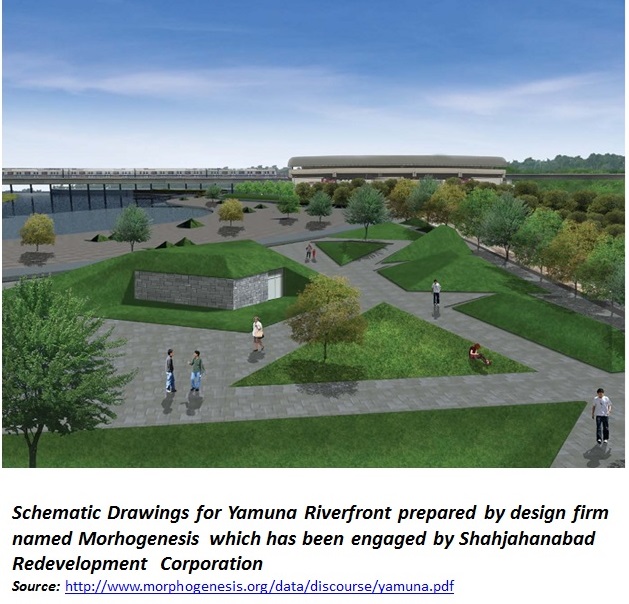
City of Noida on the other hand has decided to go ahead with the Rs 200 crore Yamuna Riverfront Development Project that Greater Noida Authority (GNA) has been planning[26]. The project involves developing recreational facilities like parks, Yoga centres, picnic spots and sports centres, polo grounds, golf course etc. on Hindon and Yamuna floodplains. Officials from GNA claim that these facilities will be for recreational purpose and will be developed without disrupting the natural flow of Yamuna. Here again the project has nothing to do with sustaining, cleaning, rejuvenation of the river.
Ganga cannot be ‘developed’ as Sabarmati
Prime Minister Narendra Modi made a promise during his election campaign in Varanasi to clean up Ganga.[27] The National Ganga River Basin Authority (NGRBA) was shifted from the environment ministry to the water resources ministry.[28] New name for the Ministry of Water Resources is Ministry of Water Resources, River Development and Ganga Rejuvenation. Uma Bharati was assigned with this specially created ministry for cleaning Ganga by the PM. “If Sabarmati can be cleaned, all other rivers can also be made better.” print media has quoted Uma Bharati.[29] Ms Uma Bharati seems to have no idea that Sabarmati has NOT been cleaned, the Sabarmati project just transferred the polluted water downstream of the 10.4 km stretch. Can Sabarmati Model be replicated at Ganga? Even if it is replicated, will it help the cause or river or river rejuvenation? The answer is clearly a BIG NO. A number of apprehensions have been raised in this regard. “The so-called Sabarmati model won’t work for the Ganga. The Sabarmati has neither been cleaned nor rejuvenated,” Openindia News quotes Himanshu Thakkar, environmentalist and coordinator of SANDRP[30]. He further points out that
Sabarmati Model survives on water from Narmada canal in the stretch of 10.4 km which flows through the Ahmedabad city. This is not possible in case of Ganga.
Priority for the river rejuvenation is restoring its water quality, freshwater flow and not riverbank beautification. More than Rs. 5,000 crore (some estimates this figure to be over Rs 20 000 crores) has been spent on cleaning the Ganga in the past 28 years. The Ganga Action Plan was launched in 1986 and was in 1994 extended to the Yamuna, Gomti and other tributaries of the Ganga. The second phase of the Ganga Action Plan was launched in 2000 and NGRBA was created in 2009.[31] The plan however has not achieved what it set out to achieve. Water quality for Ganga River has been declining and is unfit even for irrigation or bathing. Potable use is out of question. The count of harmful organisms, including hazardous faecal bacteria, at many locations is more than 100 times the limit set by the government. The water’s biochemical oxygen content, which is vital for the survival of aquatic wildlife, has dipped drastically.[32] Any “cosmetic treatments”[33] will not work for Ganga, like they have not worked for Sabarmati.
Several Riverfront Development Projects springing up across nation
While there are experts opposing replication of Sabarmati Riverfront Project on Ganga and Yamuna River, there are several other riverfront projects which are inspired by the Sabarmati Project and which are being pushed without any kind of studies or impact assessment. Their possible impacts on the riverine ecology, flood patterns, downstream areas etc. are going unchecked.
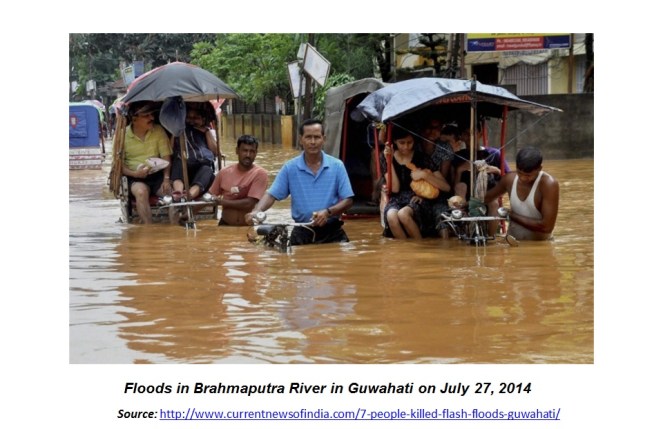
Brahmaputra Riverfront Development Project: Another “multi-dimensional environment improvement and urban rejuvenation project” that is set to come up with plans for reclaimed river banks is on Brahmaputra River in Guwahati[34]. While on one hand the city is struggling to cope up with the flood prone nature of the Brahmaputra River, State Government of Assam plans to take up an ambitious project to develop the city riverfront named ‘Brahmaputra Riverfront Development Project’ under the Assam Infrastructure Financing Authority. The riverfront project will be implemented by the Guwahati Metropolitan Development Authority (GMDA) in phases[35]. Foundation of the beautification project was laid by the Chief Minister Tarun Gogoi in February 2013. The project plans to achieve maximum possible reclamation[36].While the plan talks of revitalization of the river ecology and Strengthening of riverbanks through soil bio engineering it has several urban features on its agenda like promenade, Ghats, Plazas and Parks; buildings, conference facilities, Parking lots, ferry terminals, Bus and para transport stops, Urban utilities and drainage, Improved infrastructure for floating restaurants, Public amenities; Dhobi Ghats, etc.[37]
Will such a huge real estate development leave any room for river or its revitalization?
Tendency to flood is an important feature of River Brahmaputra. The river also has one of the highest sediment loads in the world. Every year during the successive floods, most of the areas in the valley of Assam remain submerged for a considerable numbers of days causing wide spread damages. In a phenomenon as recent as June 27, 2014 Guwahati experienced heavy downpour for 15 hours, setting off flash floods[38]. Half of the city was submerged under flood water. The authorities blamed illegal encroachments on watersheds across the state capital for the flash floods, which had choked the natural outlets for the gushing water. National Institute of Hydrology (NIH), Roorkee; upon being requested by the GMDA; is carrying out a study which includes river shifting analysis for studying stability of the river banks, flow variations to determine the perennial water depth, estimate of floods of various return periods for design of river embankments, estimate of water surface profiles employing hydro-dynamic river flow model and design parameters for river embankments[39]. The Bramhaputra Riverfront Development Project however has been inaugurated even before the requisite studies have been completed.
Gomti Riverfront Development Project in Lucknow: The project by the Lucknow Development Authority is based on the Sabarmati Riverfront Model. It plans to “beautify” Gomti River between Gomti Barrage and Bridge on Bye-pass road connecting Lucknow-Hardoi road and Lucknow-Sitapur road, a length of about 15 Km. According to the Technical Bid Document released by the Lucknow Development Authority, the Riverfront Project has no component of water treatment or river restoration, but is a landscape-based development project, which will also look at “reclaiming” the river banks for activities like shops, entertainment area, promenades, etc. The inspiration for the project swings from Thames Rivefront in London, to Sabarmati in Gujarat, depending on the political party in power.[40]
In all this discussion, there is no mention of maintaining adequate flow in Gomti, treating sewage, conserving its floodplains, or any other ecological angles.
River Improvement and Restoration are also about real estate!
For many government agencies, ironically, not just river beautification, but the idea of river improvement and restoration is also about channelizing rivers and providing recreational facilities.
Pune Rivefront Project: Pune Municipal Corporation, the Pune city also known for chronically polluting Mula and Mutha rivers that flow through the heart of the city, has sanctioned a River Improvement Project, under the aegis of JNNURM (Jawaharlal Nehru National Urban Renewal Mission). The Project envisages channelizing the river, introducing barrages to maintain water levels, development of riparian zone as entertainment and shopping groups, even Parking lots, introducing navigation in the river etc. There are several issues with this “improvement” project. Firstly, it is not planned according to the once in a hundred years flood in Pune, it plans to constrict the river further, thus encroaching the riverbed. Creation of stagnant pools through barrages will result in backwater effect on the many nallahs that join the river. These Nallahs routinely flood in rainy season and additional backwater in these nallahs will worsen the situation further. The project does not say a word about treating water quality, but envisages to build drainage lines inside the riverbed and carry the sewage out of Pune city limits. This hardly qualifies as river rejuvenation or restoration. A case has been filed against this project in National Green Tribunal.
Goda Park (Godavari Riverfront Project) in Nashik, Maharashtra: Godavari emerging from the Brahmagiri Hills in Nashik is famed not only for being one of the longest rivers in India, but also because Kumbh Mela is held on its banks every 12 years in Nashik. Nashik and Trimbakeshwar have had no dearth of funding for cleaning Godavari. They have received funds from the National River Conservation Directorate as well as JNNURM. Despite this, Godavari is extremely filthy in Nashik. Ignoring the pressing issues of water quality, Nashik Municipal Corporation and a specific political party have been hankering after beatification of Godavari’s banks. In fact, the project has been handed over to Reliance Foundation by the Nashik Municipal Corporation[41] without any public consultations or discussions. As per reports, the components of this 13.5 kms long project will be laser shows, musical fountains, rope-way, multi-purpose meeting hall, garden, water sports, canteen, etc.[42]
In the meantime, there are several court orders against Nashik Municipal Corporation pending about severe water pollution in the River including Ram Kund where holy dip on Kumbh Mela is supposed to be taken.
Mithi Riverfront Development: Stretch of 18 km of Mithi River flows through city of Mumbai. Course of Mithi has been modified throughout the city to host range of activities.[43] On 26 July 2005, the river flooded some of the most densely populated areas claiming nearly 1000 lives[44].
After these catastrophic floods, the Municipal Corporation of Greater Mumbai (MCGM) and Mumbai Metropolitan Region Development Authority (MMRDA) made a plan to “restore” the river. BMC and MMRDA’s definition of restoration involves desilting, beautification and building of a retaining wall. Stretch of 4.5 km of the total six km stretch of the river that falls within MMRDA’s jurisdiction is covered with mangroves. MMRDA has planned to beautify the stretch of remaining 1.5 km (10 Ha) which lies right amidst mangroves by developing a promenade. MMRDA plans developing this project on a PPP (Public Private Partnership) basis. Interestingly, the Mukesh Ambani-led Reliance Foundation and Standard Chartered bank have been selected for this project.[45]
As per the Coastal Zone Management Plan (CZMP) of the area, the proposed Mithi Riverfront Development Project falls in Coastal Regulation Zone (CRZ) II and III. The proposal was presented to CRZ authority in its 82nd meeting on 10th June, 2013[46]. CRZ authority has not allowed any reclamation or construction activities in this stretch. For Widening, lengthening & reconstruction of the existing bridge CRZ has referred the proposal to MoEF and asked MMRDA to take prior permission of High Court if the proposal involves destruction of mangroves[47].
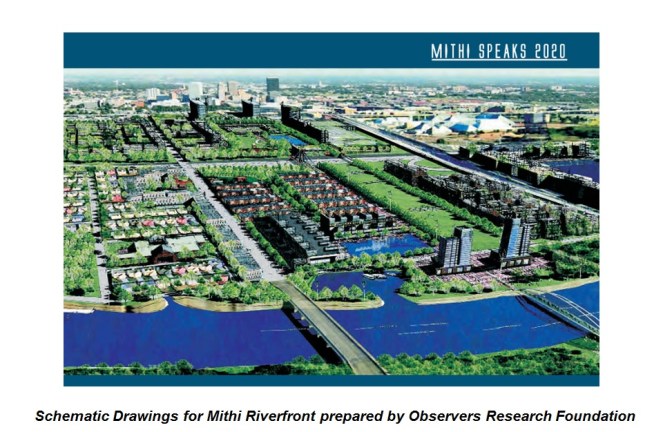
Observer Research Foundation, a private, not for profit organization (funded by Reliance India[48]) from Mumbai has come up with a study that recommends a 21-point programme for reclaiming the Mithi, envisaging a single and unbroken river-park corridor spanning across the entire 18-km length of the Mithi with dedicated bicycle tracks, gardens, amphitheatres, sports and recreation.[49]
Riverfront Development is NOT River Restoration
As is evident, the riverfront projects discussed above are essentially river bank beautification & Real Estate Development projects and not helping restoration of the river. The projects aim at comodifying rivers to develop urban scapes. Such riverfront development changes the essential character of the river. Stream channelization and alteration of shoreline disconnects the river stretch from adjacent ecosystems and leads to risks of habitat degradation, changes in the flow regime and siltation[50].
While the water of the rivers flows in the natural landscapes, there are many processes that are happening. Sediments are carried, fertile land is created along the banks, river channel is widened, flooding, deposition of sediments during flooding, cleansing of river etc.[51] However the urban rivers are alienated from this natural landscape to such an extent that the rivers are reduced to merely nallas carrying city’s sewage and filth.
Flow, connectivity and flood are fundamental characteristics of rivers and rivers need space for that. If these are violated the river water spreads uncontrolled through the habitation causing catastrophic events like Mithi Flooding.
Creating more room for rivers
While Indian cities are busy replicating Riverfronts of Thames and Seine, there are some remarkable projects going on in some other countries which actually talk of giving more room to the rivers during floods. They are trying to restore the river and not beautify, concretize, channelise or encroach on it.
In the Netherlands, such an integrated approach has been adopted for ‘Room for the River Program’[52]. The program is currently being implemented in the Dutch Rhine River Basin of the country.
The programme started in 2006 is scheduled to be completed by 2015. The objectives of the programme are improving safety against flooding of riverine areas of Rivers Rhine and Meuse by increasing the discharge capacity and improving of spatial quality of the riverine area.
At 39 locations, measures will be taken to give the river space to flood safely through flood bypasses, excavation of flood plains, dike relocation and lowering of groynes etc. Moreover, the measures will be designed in such a way that they improve the quality of the immediate surroundings.
While Room for the River programme focuses on flood management in sustainable way, Yolo Bypass is another unique initiative aimed at keeping intact the benefits to the ecosystem without causing a negative impact on water supply[53]. The Yolo Bypass is a flood bypass in the Sacramento Valley located in Yolo and Solano Counties of California State in USA. The primary function of the bypass is flood damage reduction. It is a designated floodway that encompasses 60,000 acres in eastern Yolo County between the cities of Davis and Sacramento. All the properties within the bypass are subject to a flood easement that allows the state to flood the land for public safety and ecological benefit.
Conclusion
Riverfront of Thames in London and Seine in Paris are often cited as successful models of riverfront development in India. However, the ecological as well as social setting of Indian rivers and the challenges that we face are significantly different from these foreign models. A Blind replication will only be wastage of public funds and degradation of the rivers further. Riverfront development projects across the country seem to be alienated from the river, and talk only about its urban banks, trying to achieve cosmetic changes on deeper wounds by encroachment and real estate development on the belly of the rivers. The need of the hour is river rejuvenation and not river FRONT development. Let us hope that we see central place for rivers in all these projects. Moreover, there is neither any social or environmental impact assessment, nor any regulation or democratic participatory decision making process. Such projects will only be at the cost of the poor, the environment, future generation and to short term benefits of real estate developers and a section of urban middle class.
Amruta Pradhan, SANDRP (With Inputs from Himanshu Thakkar & Parineeta Dandekar)
An edited version of this article has been published at: http://indiatogether.org/gujarat-sabarmati-riverfront-development-model-for-ganga-yamuna-environment
END NOTES:
[1] http://www.egovamc.com/SRFDCL/SRFDCL.pdf
[2] http://www.egovamc.com/SRFDCL/SRFDCL.pdf
[3] http://www.frontline.in/static/html/fl2802/stories/20110128280208500.htm
[4] http://www.frontline.in/static/html/fl2802/stories/20110128280208500.htm
[5]http://www.business-standard.com/article/current-affairs/amc-bets-on-huge-returns-from-riverfront-property-sale-114032000894_1.html
[6] http://indiaenvironmentportal.org.in/files/file/Sabarmati%20Riverfront.pdf
[7] http://www.egovamc.com/SRFDCL/SRFDCL.pdf
[8] http://indiaenvironmentportal.org.in/files/file/Sabarmati%20Riverfront.pdf
[9] http://www.downtoearth.org.in/node/5786
[10] http://www.frontline.in/static/html/fl2802/stories/20110128280208500.htm
[11] http://landscapeindiapbb.wordpress.com/2013/10/30/riverfront-development-ahmedabad/
[12] http://www.downtoearth.org.in/node/5786
[13] http://archive.indianexpress.com/news/flood-control-in-sabarmati-a-challenge-for-amc/654704/
[14] http://www.downtoearth.org.in/node/5786
[15] http://archive.indianexpress.com/news/flood-control-in-sabarmati-a-challenge-for-amc/654704/
[16] http://indiaenvironmentportal.org.in/files/file/Sabarmati%20Riverfront.pdf
[17] http://www.downtoearth.org.in/node/5786
[18] http://timesofindia.indiatimes.com/city/delhi/Delhi-babu-all-praise-for-Sabarmati-plan/articleshow/36363896.cms
[19] http://timesofindia.indiatimes.com/city/delhi/Scientist-cautions-against-riverfront-plan/articleshow/38500711.cms
[20]http://timesofindia.indiatimes.com/city/delhi/River-experts-say-Sabarmati-no-model-for-Yamuna/articleshow/36222968.cms
[21] http://timesofindia.indiatimes.com/city/delhi/Scientist-cautions-against-riverfront-plan/articleshow/38500711.cms
[22]http://timesofindia.indiatimes.com/city/delhi/Scientist-opposes-Sabarmati-model-says-reclaiming-floodplain-not-a-good-idea-for-Yamuna/articleshow/36679502.cms
[23] http://www.newindianexpress.com/nation/Yamuna-Action-Plan-Soon-Promises-MoEF/2013/12/19/article1953318.ece,
http://www.indiaenvironmentportal.org.in/files/Yamuna%20River%20Front%20NGT%2018Dec2013.pdf
[24]http://timesofindia.indiatimes.com/city/delhi/River-experts-say-Sabarmati-no-model-for-Yamuna/articleshow/36222968.cms
[25] http://www.asianage.com/delhi/illegal-colonies-near-river-may-be-shifted-946
[26] http://timesofindia.indiatimes.com/city/noida/Twin-cities-to-go-ahead-with-riverfront-project/articleshow/34845006.cms
[27] http://indianexpress.com/article/india/politics/modi-assigns-task-of-cleaning-ganga-to-uma-bharti/,
[28]http://www.hindustantimes.com/india-news/clean-up-act-superbody-headed-by-pm-modi-to-drive-mission-ganga/article1-1253158.aspx
[29] http://www.firstpost.com/politics/cleaning-up-the-ganga-yamuna-why-modi-must-forget-sabarmati-model-1560939.html
[30] http://news.oneindia.in/india/sabarmati-model-not-enough-for-ganga-1478033.html
[31] http://news.oneindia.in/india/sabarmati-model-not-enough-for-ganga-1478033.html
[32] http://www.business-standard.com/article/opinion/rejuvenating-a-river-114052801804_1.html
[33] http://www.business-standard.com/article/opinion/rejuvenating-a-river-114052801804_1.html
[34] http://www.assamtribune.com/scripts/detailsnew.asp?id=aug3113/city05
[35] http://guwahatilife.blogspot.in/2011/02/cm-lays-foundation-of-beautification-of.html
[36] http://www.assamtribune.com/scripts/detailsnew.asp?id=aug3113/city05
[37] http://www.psda.in/guwahati.asp
[38] http://www.ndtv.com/article/india/flash-floods-in-guwahati-seven-dead-in-last-15-hours-548974
[39] http://www.assamtribune.com/scripts/detailsnew.asp?id=aug3113/city05
[40]http://timesofindia.indiatimes.com/city/lucknow/Lucknow-Development-Authority-to-get-new-blueprint-of-Gomti-riverfront-development-project/articleshow/19687344.cms
http://m.financialexpress.com/news/akhilesh-wants-london-eye-in-lucknow/975999/
[41] http://www.reliancefoundation.org/urban_renewal.html
[42]http://articles.economictimes.indiatimes.com/2013-09-20/news/42252355_1_goda-park-project-reliance-foundation-mns-chief-raj-thackeray
[43] The Mumbai airport has its domestic and international terminals, and its cargo complex along the Mithi River. There are five major railway stations along the Mithi River including Mahim and Bandra on the western line andSion, Chunnabhatti and Kurla on the central line. The upcoming V ersova-Andheri-Ghatkopar corridor of the Mumbai Metro project that also crosses over the Mithi River has two stations planned along the Mithi River at Marol and Saki Naka. There are also several bus stops located close to the river all along its banks.
(Source: http://orfonline.org/cms/sites/orfonline/modules/report/ReportDetail.html?cmaid=23400&mmacmaid=23401)
[44] http://orfonline.org/cms/sites/orfonline/modules/report/ReportDetail.html?cmaid=23400&mmacmaid=23401
[45] http://indianexpress.com/article/cities/mumbai/beautification-plans-of-mithi-river-promenade-stuck-over-crz-norms/
[46] https://mczma.maharashtra.gov.in/pdf/MCZMA_MoM82.pdf
[47] The proposal was cleared subject to compliance of following conditions
(i) The proposed construction should be carried out strictly as per the provisions of CRZ Notification, 2011 (as amended from time to time) and guidelines/ clarifications given by MoEF time to time.
(ii) Disposal of debris during construction phase should be as per MSW (M&H) rules. 2000.
(iii) Tidal flow of river should not be obstructed.
(iv) The project proponent should obtain prior High Court permission, if the proposal involves destruction of mangroves or construction falls with 50 nil buffer zone.
(v) All other required permissions from different statutory authorities should be obtained prior to commencement of work
[48] http://www.rediff.com/news/report/najeeb-jung-the-man-who-may-run-delhi/20131213.htm
[49]http://www.indiawaterportal.org/sites/indiawaterportal.org/files/why_mumbai_must_reclaim_its_mithi_gautam_kirtane_orf_2011.pdf
[50] http://water.epa.gov/type/wetlands/restore/principles.cfm
[51] Nature Conservation by Ketki Ghate, Manasi Karandikar
[52] http://www.downtoearth.org.in/node/5786
[53] http://www.americanrivers.org/initiative/floods/projects/yolo-bypass-and-the-fremont-weir/

LAKHWAR DAM PROJECT: Why the project should not go ahead
PRESS STATEMENT ON WORLD EARTH DAY: APRIL 22, 2013
We the signatories to this statement would like to bring some key issues to the attention of all concerned on the proposed Lakhwar Dam Project on the Yamuna River in Upper Yamuna River Basin in Dehradun district of Uttarakhand state.
The proposed dam involves a massive 204 m high dam with storage capacity of 580 Million Cubic meters, submergence area of 1385.2 ha, including 868.08 ha forest land, at least 50 villages to be affected by submergence of land in the upstream, many more in the downstream area. This site is just about 120 km downstream of the river’s origins from the holy shrine of Yamunotri. The composite project involves, in addition to the Lakhwar dam with 300 MW underground power house, another 86 m high Vyasi dam with 2.7 km long tunnel and 120 MW underground power house and a barrage at Katapathar.
As can be seen from the details below:
a) The project has not undergone basic, credible environment or social appraisal in any participatory manner.
b) It does not have legally valid environment or forest clearance.
c) There has not been any cumulative impact assessment of various existing, under construction and planned dams and hydro-projects in the Yamuna system.
d) There has not been any credible assessment about options for the project.
e) The project is to come up in an area that is seismically active, prone to flash floods and also prone to erosion and land slides.
f) The spillway capacity of the project has been awfully underestimated resulting in significant risks of dam damage / breakage with concomitant risks of unprecedented downstream flooding and destruction. It may be mentioned here that Delhi is a major city standing in the path of the river in the downstream area.
g) The religious and spiritual importance of the Yamuna River is at risk since whatever remains of the river will be completely destroyed both in the upstream and downstream of the project.
h) No agreement exists among the Upper Yamuna basin states about sharing of costs and benefits of the project, which should be a pre-condition for taking up any such project.
i) It is well known that Yamuna River is already one of the most threatened rivers in the country and the project shall further adversely affect the river system.
Recently as well as earlier last year thousands of people from Allahabad/ Vrindavan marched to Delhi, seeking a revival of their river Yamuna. The focus of the authorities should be on ways and means to restore the river Yamuna system rather than take such massive project without even basic appraisal.
We thus urge the official agencies at both the state and at the centre level to not go ahead with this project. We urge them to rather take steps to protect and preserve than destroy one of the biggest and culturally important river, without even basic appraisal at project or basin level or any options assessment carried out in a due participatory manner.
We hope that the government will not go ahead with this project until all the issues mentioned have been satisfactorily resolved.
Endorsed by:
Ramaswamy Iyer, Former Union Water Resources Secretary, Delhi, ramaswamy.iyer@gmail.com
E.A.S. Sarma, Former Union Power Secretary, Vishakhapattanam, eassarma@gmail.com
Medha Patkar, Narmada Bachao Andolan, Badwani, nba.medha@gmail.com
Ashish Kothari, Kalpavriksh, Pune, chikikothari@gmail.com
Rajendra Singh, Tarun Bharat Sangh, Rajasthan, watermantbs@yahoo.com
Prof. MK Prasad, Kerala Sastra Sahitya Parishad, Cochin, prasadmkprasad@gmail.com
Bittu Sahgal, Editor, Sanctuary Asia, Mumbai bittusahgal@gmail.com
Prashant Bhushan, Senior Supreme Court Lawyer, Delhi, prashantbhush@gmail.com
Vandana Shiva, Navdanya, Delhi, vandana.shiva@gmail.com
10. Amit Bhaduri, Prof. Emeritus, JNU, Delhi, amit.bhaduri@gmail.com
Ravi Agarwal, Toxics Link, New Delhi, ravig64@gmail.com
Madhu Bhaduri, Former Indian Ambassador & member Yamuna Jiye Abhiyaan, Delhi, madhubhaduri@rediffmail.com
Prof S. Janakarajan, Madras Institute of Development Studies, Chennai, janak@mids.ac.in
Dr Dinesh Mishra, Barh Mukti Abhiyan, Bihar, dkmishra108@gmail.com
Sharad Lele, Centre for Environment and Development, Bangalore, sharad.lele@gmail.com
S. Faizi CBD Alliance, Kerala, s.faizi111@gmail.com
Rohit Prajapati, Paryavaran Suraksha Samiti, Gujarat, rohit.prajapati@gmail.com
Bharat Jhunjhunwala, Former Professor-IIM Bengaluru, Uttarakhand, bharatjj@gmail.com
Vimalbhai, Matu Jansangthan, Uttarakhand, matujansangthan@gmail.com
20. E Theophilus, Malika Virdi, Himal Prakriti, Uttarakhand, etheophilus@gmail.com
Ramnarayan K, Save the Rivers Campaign Uttarakhand, ramnarayan.k@gmail.com
Kalyani Menon-Sen, Feminist Learning Partnerships, Gurgaon, kmenonsen@gmail.com
Dr RK Ranjan, Citizens Concern for Dams and Development, Manipur ranjanrk50@gmail.com
Jiten Yumnam, Committee on Natural Resources Protection in Manipur, jitnyumnam@yahoo.co.in
Renuka Huidrom, Centre for Research and Advocacy, Manipur, mangangmacha@gmail.com
Shweta Narayan, The Other Media, Chennai, nopvcever.new@gmail.com
Wilfred Dcosta, Indian Social Action Forum – INSAF, New Delhi insafdelhi@gmail.com
Nidhi Agarwal, Activist, Community rights on environment, Delhi, nidhi.sibia@gmail.com
Rahul Banerjee, Dhas Gramin Vikas Kendra, Indore, rahul.indauri@gmail.com
30. Subhadra Khaperde, Kansari Nu Vadavno, Khargone, subhadra.khaperde@gmail.com
Shankar Tadwal, Khedut Mazdoor Chetna Sangath, Alirajpur, shankarkmcs@rediffmail.com
Michael Mazgaonkar, Gujarat, mozdam@gmail.com
Ranjan Panda, Convenor, Water Initiatives Odisha, ranjanpanda@gmail.com
M Gopakumar, Bangalore, gopakumar.rootcause@gmail.com
Janak Daftari, Jal Biradari, Mithi Nadi Sansad, Mumbai, daffy@jalsangrah.org
Shripad Dharmadhikary, Manthan Ahdyayan Kendra, Pune, manthan.shripad@gmail.com
Prof Rohan D’Souza, Jawaharlal Nehru University, Delhi, rohanxdsouza@gmail.com
Dr Brij Gopal, Jaipur, brij44@gmail.com
Alok Agarwal, Narmada Bachao Andolan & Jan Sangharsh Morch, Madhya Pradesh, aloknba@gmail.com
40. Debi Goenka, Conservation Action Trust, Mumbai, debi1@cat.org.in
Shardul Bajikar, Editor – Natural History, Saveus Wildlife India, Mumbai shardulbajikar@gmail.com
Sankar Ray, Kolkata, sankar.ray@gmail.com
Samir Mehta, International Rivers, Mumbai, samir@internationalrivers.org
V Rukmini Rao, Gramya Resource Centre for Women, Secunderabad, vrukminirao@yahoo.com
Dr. Latha Anantha, River Research Centre, Kerala, latha.anantha9@gmail.com
Mrs Anjali Damania, Aam Admi Party, Mumbai, anjalidamania@rediffmail.com
Manshi Asher, Him Dhara, Himachal Pradesh, manshi.asher@gmail.com
Commodore (rtd) Lokesh Batra, Social and RTI activist, NOIDA, batra_lokesh@yahoo.com
Arun Tiwari, Water activist, Delhi, amethiarun@gmail.com
50. Ananda Banerjee, Writer and member, Yamuna Jiye Abhiyaan, Delhi,
Sudha Mohan, Yamuna Jiye Abhiyaan, Delhi, sudhamohan@peaceinst.org
Dr Sitaram Taigor, Yamuna Jiye Abhiyaan, Madhya Pradesh, srtchambal@gmail.com
Bhim S Rawat, Yamuna Jiye Abhiyaan, Delhi, we4earth@gmail.com
Prasad Chacko, Social activist, Ahmedabad, prasad.chacko@gmail.com
Swathi Seshadri, EQUATIONS, Bangalore, swathi.s@equitabletourism.org
Parineeta Dandekar, SANDRP, Pune, parineeta.dandekar@gmail.com,
Manoj Mishra, Yamuna Jiye Abhiyaan, Delhi (09910153601, yamunajiye@gmail.com)
58. Himanshu Thakkar, South Asia Network on Dams, Rivers & People, 86-D, AD block, Shalimar Bagh, Delhi (09968242798, ht.sandrp@gmail.com)
Annexure
DETAILED NOTES
1. No Options Assessment There has been no assessment to show that this project is the best option available for the services that it is supposed to provide, including water supply to Delhi, irrigation in Uttarakhand, hydropower generation and water storage. It was not done during the process preceding the now out-dated environmental clearance given in 1986, nor has it been done subsequently.
It is well known that Delhi has much cheaper, environment friendly and local options that has not been explored with any sense of seriousness. These include reduction in transmission & distribution losses (which stand at 35%), rainwater harvesting (as National Green Tribunal order in April 2013 exposed, even the Delhi Metro is not doing this) including groundwater recharge, demand side management, stopping non essential water use, protection of local water bodies, protection of flood plains, streams and the ridge, recycle and reuse of treated sewage, among others.
As far as irrigation in Uttarakhand is concerned, in this relatively high rainfall area, and considering the local agro-geo-climatic situation and suitable cropping patterns, better options exist. Similarly about other claimed services.
It may be added here that the EIA manual of Union Ministry of Environment & Forests, the National Water Policy and best practices around the world including the recommendations of the World Commission on Dams, require such an options assessment study, including no project scenario, before embarking on such costly and risky projects.
2. No Basin wide cumulative impact assessment or basin study: Yamuna River is already in very bad situation in many senses, including being very polluted for lack of surface water flow. The river basin also has large number of projects existing and under construction, See: http://www.sandrp.in/basin_maps/Major_Hydro_Projects_in_Yamuna_Basin.pdf, for details. Particularly, see the concentration of projects in narrow upper Yamuna Basin. However, there has been no basin wide cumulative impact assessment of projects and water use in the basin in the context of its carrying capacity on various aspects. Without such an assessment, adding more projects may not only be unsustainable, it may actually be worse than zero sum game, since the new projects will have large number of adverse impacts. That we may have already crossed the basin carrying capacity upstream of Delhi seems evident from the worsening state of Yamuna over the past decades in spite of investment of thousands of crores rupees. Adding this project with its massive impacts without such an assessment may actually be an invitation to disaster.
We learn that a Yamuna basin study has been assigned to the Indian Council for Forestry Research and Education (Dehradun). However, it should be noted that in the first place, ICFRE has had poor track record. Its EIA study for the Renuka dam in the same Yamuna basin was so poor that it was based on the poor quality of the study that the National Green Tribunal stayed the work on the project for over a year now.
3. No valid environment clearance, no valid EIA-EMP or Public consultation process
The Composite Lakhwar Vyasi project got environment clearance 27 years back in 1986 without any comprehensive environment impact assessment (EIA) or preparation of environment management plan (EMP) or any participatory process. Some preliminary work started, continued only till 1992 and stopped thereafter for lack of funds.
a) In Sept 2007, the 120 MW Vyasi HEP, part of the original composite project, sought and got environment clearance although the minutes of the Expert Appraisal Committee of MoEF notes a number of unresolved issues. In Nov 2010 EAC meeting, the EAC considered the Lakhwar Dam for Env clearance, and raised a number of questions, none of them were ever resolved. The EAC did not consider the project in any meeting after Nov 2010.
This sequence of events makes it clear that Lakhwar Dam does not have valid environment clearance. The MoEF and project proponent assumption that the Environment Clearance (EC) of 1986 is valid is not correct, since if that EC was not valid for the Vyasi HEP which has sought and received fresh EC in Sept 2007, then how could Lakhwar HEP Dam of which Vyasi HEP is a part, continue to possess a valid EC.
Thus to give investment clearance to Lakhwar dam without valid EC will be imprudent, and might invite long drawn legal challenge to the project, resulting in more delays and in turn unnecessary cost escalations.
b) The project also does not have valid EIA-EMP. What ever assessments were done before the 1986 EC cannot be considered adequate or valid today. The environment standards and also environment situation has hugely changed in the intervening 27 years.
The project did not have any public consultation process in 1986 or anytime there after. Fresh EC will require that and the project must go through that process.
4. Issues raised by EAC remain unresolved: When the 43rd meeting of EAC considered the project for EC on Nov 12-13, 2010, the minutes of the meeting raised a large number of questions, all of them remain unresolved. These issues are fundamental in nature. Without resolving these issues, the project should not go ahead.
Just to illustrate, EAC raised questions about the need and usefulness of various project components. It is clear from the EAC minutes that the project also involves construction of Katapathar barrage downstream from Vyasi Power House at Hatiari. However, just about 10 km downstream from this barrage there is an existing barrage at Dak Pathar. It is not clear why this Katapathar barrage is required, the EAC asked. None of these issues have been resolved.
5. Project does not have valid forest clearance: The composite Lakhwar Vyasi project requires a very large area of forest land, at 868.08 ha, the diversion was originally permitted for the UP irrigation Dept, which was then transferred to Uttaranchal Irrigation Dept upon creation of the separate Uttaranchal State. However, the project has now been transferred to Uttaranchal Jal Vidyut Nigam Limited. The Vyasi Project was earlier transferred to NHPC and now stands transferred to UJVNL.
In Aug 2012 FAC (Forest Advisory Committee is a statutory body under the Forest Conservation Act 1980) meeting, there was a proposal put forward to transfer the clearance for 99.93 ha (out of total forest land of Rs 868.08 ha for composite project) forest land required only for the Vyasi Project to UJVNL from Uttaranchal Irrigation Dept. While discussing this proposal, FAC noted that the Vyasi project was earlier transferred NHPC, without getting the forest clearance transferred in favour of NHPC. In fact FAC has recommended, “State Govt shall examine the reasons for not obtaining prior approval of the Central Govt under the Forest (Conservation) Act, 1980, for change of user agency from irrigation dept to NHPC and fix responsibility”. Secondly what is apparent from the minutes of the Aug 2012 FAC meeting is that even the Catchment Area Treatment Plan for the Vyasi project has not yet been prepared. This shocking state of lack of preparation of basic management plan is the consequence of allowing the project based on outdated clearances. The FAC has now asked the user agency to fulfil all such requirements, before which the project will not be given stage II forest clearance. So the Vyasi Project also so far does not have stage II forest clearance.
Most importantly, the transfer of forest clearance for the remaining 768.15 ha of forest land required for the Lakhwar project from Uttarakhnd irrigation dept to the current project agency UJVNL has not been even sought. So the Lakhwar project does not have valid forest clearance even for first stage, and surely no stage II forest clearance. Under the circumstances, the project does not have legal sanction.
6. Inadeaquate spillway capacity The project spillway capacity is proposed to be of 8000 cumecs, as per official website, see: http://india-wris.nrsc.gov.in/wrpinfo/index.php?title=Lakhwar_D00723. However, as per the latest estimates, the location is likely to experience probable Maximum Flood of 18000 cumecs. This is as per a paper titled “The probable maximum flood at the Ukai and Lakhwar dam sites in India” by P R Rakhecha and C Clark, presented in the year 2000 at an international Symposium. Dr Rakhecha later joined Govt of India’s Indian Institute of Tropical Meteorology in Pune. The paper concludes: “For the Lakhwar dam site there would be significant flow over the dam crest after 12 h from the start of the storm hydrograph and this would be maintained for over 18 h. The maximum depth of flow over the crest would be 4 m which is large enough to cause major if not catastrophic damage to the dam structure.”
Thus the spillway capacity of the project needs to be reviewed and it would not be prudent to go ahead without the same as the new PMF could cause major damage to the dam, the paper says. Any damage to this massive structure will have far reaching consequences all along the downstream area, right upto Delhi and downstream.
In fact even for the Vyasi HEP, while discussing the project in the EAC meeting of Aug 16, 2007, the minutes notes that the clarification sought by EAC on Dam Break Analysis for the project is incomplete, inadequate and far from satisfactory and the EAC desired further concurrence of Central Water Commission. In fact, EAC should not have recommended EC to the Vyasi Project with a flawed study. For the bigger Lakhwar project, there has not even been any such appraisal.
7. No agreement among Upper Yamuna basin states, Unresolved disputes The Lakhwar storage project is part of the Upper Yamuna basin. An interstate agreement was arrived at in 1994 for sharing of water in the Upper Yamuna basin among the basin states of Himachal Pradesh, Uttar Pradesh (now also Uttarakhand), Haryana, Delhi and Rajasthan. Each project under the agreement required separate agreements. However, there has been no agreement on sharing the costs and benefits of the individual projects under the agreement.
On Renuka project also in the same Upper Yamuna basin, there was an agreement that was arrived at in 1994, but the Ministry of Law has said that the agreement is no longer valid. For several years now the Upper Yamuna River Basin Board has been holding meetings, but has failed to arrive at any agreement for sharing the costs and benefits of Renuka dam. For Lakhwar dam there has been not been any serious attempt in that direction. The current project proposal envisages to provide 50% of water (about 165 MCM) to Delhi and 50% to Uttarakhand for irrigation (see: http://www.business-standard.com/article/companies/work-on-300-mw-lakhwar-project-to-begin-by-aug-112062200178_1.html dated June 22, 2012 includes statement from project proponent UJVNL (Uttarakhand Jal Vidyut Nigam Ltd) Chairman). However, this proposal completely ignores the claims of share from the project by Uttar Pradesh, Haryana, Rajasthan and Himachal Pradesh. To go ahead with the project without an inter state agreement on sharing costs and benefits would surely not be prudent.
8. Inadequate cost estimates As per estimate as on March 1996 the cost of the project is Rs 1446 crore out of which Rs 227 crore have been spent (see: official website http://uttarakhandirrigation.com/lakhwar_vyasi_project.html). Note that this cost was for the composite project, including Vyasi HEP. As per UJVNL official webstie http://www.uttarakhandjalvidyut.com/lakhwar.php, the cost of Lakhwar Project alone is Rs 4620.48 crore on Feb 2010. The same site gives the cost of Vyasi HEP at Rs 1010.89 crores, so the cost of combined project at Feb 2010 PL is Rs 5631.37 crores. The cost has thus seen 300% escalation in 14 years between 1996 and 2010. This is a very costly project and the cost is likely to be even higher at current prices. In any case, the estimate should be for current price level and the cost benefit calculations should also be for the latest date.
9. Seismically active area, erosion prone landscape: The project area is seismically active, flash flood, land slides, cloud bursts and erosion prone. In the context of changing climate, all these factors are likely to be further accentuated. When the project was first proposed in mid 1980s, none of these issues as also the issues of biodiversity conservation, need to conserve forests for local adaptation, forest rights compliance, environment flows etc were seen as relevant or important. However, all of these issues are important today. The project clearly needs to be reappraised keeping all these issues in mind.
~~
 SANDRP