Patoda: How a village in drought hit State turned water self-reliant At a time when almost every village in drought-hit Marathwada is facing acute water scarcity tiny Patoda, on the fringes of water-starved Aurangabad city, is offering valuable lesson in water management conservation and harvesting. Though it is surrounded by arid villages but Patoda’s residents regard water as more precious than money. They follow strict rules about usage and strictly carry the water audits. Water meters are installed in every households and entire village recycles each drop of waste water it generates. Today no rain water flows out of the village. Percolation has recharged the aquifers and the water table has risen. So effective is its water conservation model that Patoda has now become a model for the rest of Marathwada and has won 22 state & national awards. But it did not happened over nights. In fact it is a result of over 10 years joint efforts done by villagers.
Tag: wetlands
DRP: 25 APRIL 2016 (One Year After Nepal Earthquake, Has the World Learnt Any Lesson?)
On this day in 2015, the massive Nepal earthquake of 7.9 intensity (Richter scale) shook the scenic Himalayan Nation. The earthquake left a major trail of destruction affecting over 20 districts and killing over 9 thousand people. According to expert Dave Petley, Langtang rock and ice avalanche was the most dramatic and significant landslide, that killed the most individuals. The earthquake killed over 9000 people, with 255 still missing. The severity of the quake can be gauged from the fact that more than a third of the disaster related deaths in 2015 occurred in Nepal’s April 25 earthquake. The earthquake-induced flash floods, landslides and aftershocks also damaged up to 15 hydropower plants, which has not been still restored fully. Surprisingly despite the increasing number of disasters taking place across the globe, world only spends less than a fifth of the money on Disaster Risk Reduction Compared to Disaster management. Nepal will still take years from recovering socio-economic losses caused by the quake. But it is pertinent that in the wake of the quake and other disasters, human civilisation must learn its lesson. It’s true that development and disaster cannot be stopped but we must make our developmental decisions more informed, rule based and democratic so that it helps us deal better with disasters by decreasing their intensity and velocity and our short-sighted developmental choices do not get translated into a disaster itself. Continue reading “DRP: 25 APRIL 2016 (One Year After Nepal Earthquake, Has the World Learnt Any Lesson?)”
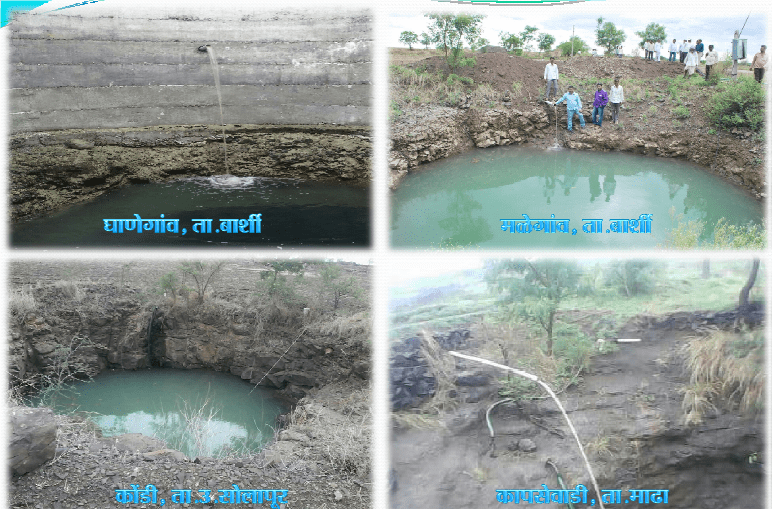
DRP: 18 April 2016 (Prior action & planning can reduce Drought impact: Solapur shows)
Union Water Resources Minister Uma Bharti in an interview tried to refute charges that the Centre reacted late to India’s drought crisis. Water minister makes strange statements that one cannot do any planning about drought & her govt is the first govt to provide water through tankers. However, Solapur, a chronically drought-hit district in Maharashtra was serviced with more than 200 tankers in 2013-14, even when the monsoon rainfall was better than this year. In this drought, there are only 16 tankers plying in Solapur. Drinking water sources have been secured, water from Ujani dam for and sugar cane has been disallowed. The district leads the way in Jal Yukta Shivar Program in the state, new avenues of Agricultural credit are opening, options to sugarcane are being developed, errant sugar factories are being fined for polluting drinking water sources. Will the Union Government accept its mistakes and make amends?
DRP: 11 April 2016 (Harsh Summer: In Search of Green Pastures)
With ponds and lakes drying up, cattle in Telangana are forced to travel long distances for fodder and water. Here, buffaloes are moving towards a water source near Medipalli in Adilabad district on 09 April.
Continue reading “DRP: 11 April 2016 (Harsh Summer: In Search of Green Pastures)”
DRP: 4 April 2016 (India Water Week shows absence of fresh thinking from water resources establishment)
SANDRP Comments India Water Week continues to show absence of any fresh thinking from water resources establishment The 4th India Water Week being organized by Union Ministry of Water Resources, River Development and Ganga Rejuvenation during April 4-8, 2016 in Delhi shows continued absence of any fresh thinking from water resources establishment.
The Information Brochure of the event says: “Ministry of Water Resources, RD & GR is to organize the India Water Week -2016 between April 4-8, 2016 to use it as a platform to elicit ideas and opinions from global level decision makers, politicians, researchers and entrepreneurs in the field of water resources for mutual benefit and goodwill… This is the fourth event of its kind with the theme “Water for all : Striving together” focusing on improving efficiencies of water use across all sectors… ”
DRP: 28 March 2016(Is India facing its worst-ever water crisis?)
Is India facing its worst-ever water crisis? On 11 March first time in 30 years history power generation at Farakka power plant in West Bengal was suspended for 10 days due to non-availability of water in Ganges. Nobody is sure why but the evidence about the declining water levels and waning health of the 2,500km long Ganges is mounting. Monsoon rains have been scanty for the second year in succession. The melting of snow in the Himalayas has been delayed. Water tables have also been declining in the Ganges basin due to the reckless extraction of groundwater. The 3-month-long summer is barely weeks away but water availability in India’s 91 reservoirs is at its lowest in a decade, with stocks at a paltry 29% of their total storage capacity, according to the Central Water Commission. Thousands of villagers in drought-hit region of Maharashtra depend on tankers for water & authorities in Latur district, fearing violence, have imposed prohibitory orders on gatherings of more than 5 people around storage tanks. Tens of thousands of farmers and livestock have moved to camps providing free fodder and water for animals in parched districts. The govt has asked local municipalities to stop supplying water to swimming pools. States like Punjab are squabbling over ownership of river waters. In water-scarce Orissa, farmers have reportedly breached embankments to save their crops. Realy the waning health of the sacred river underscores the rising crisis of water in India.
Continue reading “DRP: 28 March 2016(Is India facing its worst-ever water crisis?)”

Smart Urban Water options: Harvest rainwater, Protect water bodies
Municipal water supply systems in India are struggling to meet the demands of the burgeoning population in cities. Rapid urbanisation is increasing the freshwater demand for different purposes. Ground water being used to meet water shortages has fallen to dangerously low levels. The solution to the urban water crisis lies in harvesting rainwater and reviving local water bodies and wetlands which can store the water and help replenish ground water. It is also imperative that water is used judiciously and leakages in the distribution system are plugged.
Scarcity in water supply: Municipal agencies are struggling to supply water as water levels in reservoirs are plummeting because of the deficit rainfall in 2015. For instance, as of Jan 2016, the Navi Mumbai Municipal Corporation (NMMC) has suspended accepting applications for new supply connections until the onset of monsoon. To tide over the water shortage, the NMMC has disconnected many illegal connections, many in slum areas. It is also taking measures to prevent theft and plug leakages to bring down distribution losses which are currently 19% of the water supplied.
Continue reading “Smart Urban Water options: Harvest rainwater, Protect water bodies”
DRP: 14 March 2016 (No Rain Dance, Only Dry Holy This Time: Pune District Administration)
Dam levels down, ‘rain dance’ for Holi dropped Pune district, where a water cut is in effect due to depleting water levels in the dams, will not have any kind of “rain dance” functions this Holi. As water reserved in the dams is to be used only for drinking purposes as per the district administration’s instructions, the collectorate has urged people to go for a “Dry Holi” this year and will ensure that there are no such functions during Holi. With dam levels coming down to as much as 23% of their capacity, the entertainment department of the collectorate will ensure that permissions are not given for events like the “rain dance” during the festival. Meanwhile, a BJP legislator in Mumbai has written to the Brihanmumbai Municipal Commissioner seeking a ban on “rain dance” functions in Mumbai in the metro during Holi. Ameet Satam, in a letter to the BMC, said that the civic body should ban rain dance and even asked the corporation to slap a fine of Rs 50,000 on those who indulge in waste of water.
DRP: 22 Feb. 16 (Unprecedented water crisis in Delhi due to Jat quota stir)
Unprecedented water crisis in Delhi due to Jat stir Terming the water crisis in the national capital as “unprecedented”, Delhi minister Kapil Mishra has warned that the situation might worsen in the next few days if the supply from Haryana is not immediately restored. He said the Delhi Jal Board (DJB) had almost run out of water and advised people to use water judiciously. Delhi gets its bulk of water supply from Haryana and the stir has affected 65% of water supply in Delhi has been cut with the shutting down of seven water treatment plants— Wazirabad, Chandrawal, Dwarka, Okhla, Haiderpur, Nangloi and Bawana which provide around 500 million gallons per day (MGD). In all Delhi has nine water treatment plants which together produce 820 MGD of potable water. Of these, only two Sonia Vihar and Bhagirathi fed by water from Uttar Pradesh are operational. The current production is only 240 MGD. Among the areas affected were Dwarka, Janakpuri, Munirka, Palam, Rajouri Garden, Punjabi Bagh, Vasant Kunj, Saket, Green Park and Lodhi Colony, where residents complained of little or no water. In another news report DJB is reported to have made 140 water filling points functional to feed tankers which would be sent across the city, reeling under an unprecedented water crisis. Water Minister Kapil Mishra reviewed the contingency plan for water management in West, North, North-west, Outer and Central Delhi and said tankers will deliver water at 663 points to partially meet the shortage of 480 MGD. These points will keep rotating. Plan is to cover around 2,000 points by Monday evening. The DJB supplies around 900 MGD of water daily out of which around 600 MGD of raw water come from Munak Canal. Even if Haryana releases water immediately, it will take at least 24 hours to restore the supply. Meanwhile Supreme Court on 22 Feb.16 scolded Delhi government. for approaching the court instead of resolving the water crisis with Haryana. The Kejriwal government had approached the top court on in view of the severe water crisis in the national capital after Jat protesters blocked water supply through Munak canal in Sonipat. During the hearing on government’s plea, the court took strong objection to Water Minister Kapil Mishra’s presence inside the courtroom. On the other hand, the minister accuses Haryana & Central Government for providing no official information on the crisis He said the Delhi government was “repeatedly trying to communicate” with the two governments to find out when will the supply resume, but without much success. Also see Jat quota stir: Water supply cut, Delhi may go dry
Continue reading “DRP: 22 Feb. 16 (Unprecedented water crisis in Delhi due to Jat quota stir)”
What does the Draft National Wildlife Action Plan have to offer for our Rivers?
Draft of India’s upcoming National Wildlife Action Plan (NWAP) has been put in open domain for comments. A perusal of this Draft indicates that although it is a detailed document, it has nothing to offer for our Rivers, which receive next to no protection, despite them supporting rich freshwater biodiversity, as well as livelihoods of millions. We hope the Final NWAP addresses this critical lacuna. If you agree, please do send in your comments to wl-mef@gov.in. Last date for comments is over ( 17th February 2016), but it may still be a good idea to push for this issue. ( Access draft here: http://envfor.nic.in/sites/default/files/NWAP%20-COMMENTS_0.pdf)
SANDRP’s submission on Draft NWAP, sent to GOI: Continue reading “What does the Draft National Wildlife Action Plan have to offer for our Rivers?”
 SANDRP