DRP News Bulletin

DRP NB2 24X2022: Stay on Shimla Draft Development Plan 2041 A Right Step by NGT

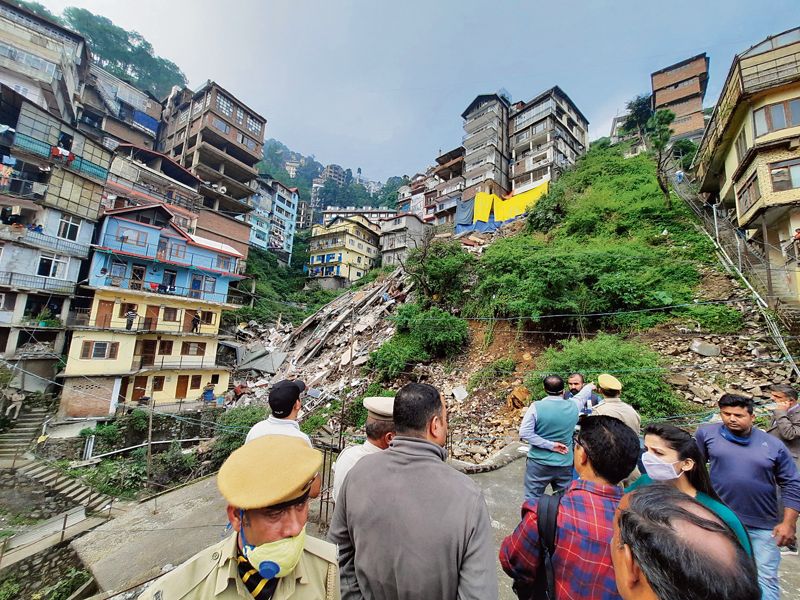
(Feature Image:- Locals gather near the debris of the building which collapsed at Kachi Ghati in Shimla. Credit Amit Kanwar/ The Tribune Oct. 2021)

In a welcome development, National Green Tribunal (NGT) has put Shimla Draft Development Plan (SDDP) 2041 on hold finding it ill-conceived and in directly violation of its earlier order of regulating haphazard construction activity in the state capital. This is a major set back of present government which had been hoodwinking the judiciary to provide relief to unauthorized structures with Shimla Planning Area in view of upcoming state assembly election.

To push the SDDP, the government went on to challenge NGT’s judicial power and even approached Supreme Court and chose to ignore the principle of sustainable development.  The NGT order is a validation of the crusade launched by environmentalists and social organizations to save the Queen of Hills from further concretization and degradation.

The government has failed to get any relief from NGT, High Court and Supreme Court on the issue. Its time, the government wake up to the gravity of concerns and fragility of the hill station which has also been struggling to meet potable water demand and performing poorly on solid and liquid waste treatment front.

Continue reading “DRP NB2 24X2022: Stay on Shimla Draft Development Plan 2041 A Right Step by NGT”
DRP News Bulletin

DRP NB 5 July 2021: Supreme Court pulls up MoEF, NGT over environment issues: Will it go far?

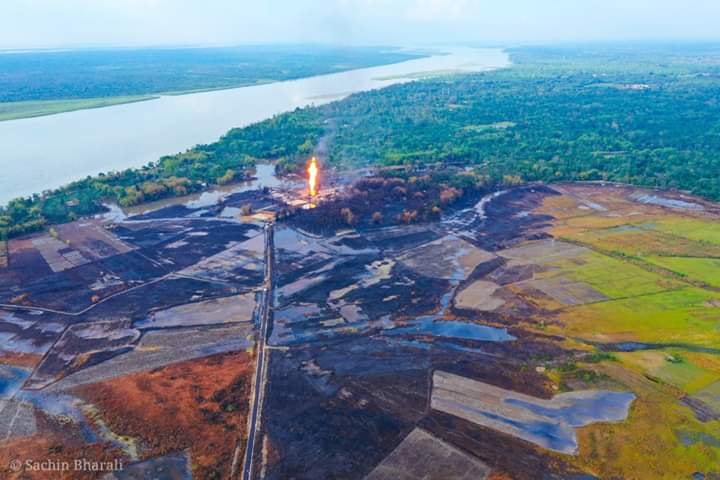
(Feature image:- Aerial image of the fire – Photo by Sachin Bharali, from the Facebook page I am Dehing Patkai https://www.facebook.com/iamdehingpatkai/photos/pcb.131915155180713/131915048514057/?type=3&theater)

In the last week, the Supreme Court of India used rather strong words against Union Ministry of Environment and Forests under the leadership of Prakash Javdekar. It said: “You must show it is a ministry for environment and not just ‘of environment’. You (ministry) have been constantly diluting the environmental standards. That’s all that has been happening”. While this was necessary and in fact it should have come several years earlier, one hopes the SC does not stop at using just strong words, but ensures that the MoEF is held accountable for its numerous unpardonable anti environment acts.

In another notable event, the Supreme Court also pulled up the NGT for not understanding even basic conflict of interest: “We are surprised by this order of the NGT. It is the OIL Ltd. which is responsible for the damage to the wetlands and its own Managing Director has been inducted into the committee? … We are very dissatisfied with the manner the NGT has pushed the matter off its hands. It is the National Green Tribunal, it must have some alacrity and concern for the environment. And after the report of the first committee, three committees have been set up separately! What is this?” This again is welcome and was long overdue. NGT had shown similar lack of understanding of conflict of interest in the Lower Subansiri case which also SC needs to open up for review. Conflict of Interest is a MAJOR dark spot in functioning of India’s governance and SC needs to do lot more to correct this.

Continue reading “DRP NB 5 July 2021: Supreme Court pulls up MoEF, NGT over environment issues: Will it go far?”
Dams · DRP News Bulletin

DRP News Bulletin 19 February 2018 (How Are We Treating Our Urban Rivers?)

In this comprehensive article Mumbai-based author Vaishnavi Chandrashekhar throws the light on the plight of Uraban Rivers. “Rivers and streams have borne the brunt of the recent urban explosion in India, a nation whose population has nearly doubled in the last 40 years to 1.35 billion. Unplanned growth has led to the use of water bodies as dumping grounds for sewage and industrial effluent. According to CPCB, 63 % of the urban sewage flowing into rivers (some 62 billion liters a day) is untreated.

In addition, riverbanks, wetlands, and floodplains have been claimed over time by infrastructure, slums, offices, and housing developments – all of which has narrowed natural river channels and distorted flow, greatly reducing the ability of India’s rivers to buffer flooding. It also has taken a toll on biodiversity. http://e360.yale.edu/features/dying-waters-india-struggles-to-clean-up-its-polluted-urban-rivers (Yale Environment 360, 15 Feb. 2018) 

Continue reading “DRP News Bulletin 19 February 2018 (How Are We Treating Our Urban Rivers?)”

Dams

Maletha; Battle won but war remains to be fought

Chronicle of an emphatic victory against crushers continued from May 2015 onwards

After hosting two days long workshop on Sustainable Mountain Development (02-03 May 2015) Maletha continued its agitation against stone crushers. The event popularised the villagers’ strength and struggle on wider platform.

On 8th of May 2015, villagers issued warnings of resuming indefinite hunger strike if the govt. failed to take a stand on the issue of stone crushers. A protest march was organized on 15th of May 2015 and two villagers Vimla Devi, head of Mahila Sangrash Samiti and Dev Singh Negi started observing fast on alternate days. Setting 25th May 2015 as deadline for State Govt. to act, villagers again demanded closing down of all illegal stone crushers running in Kirti Nagar block.

Meanwhile referring to High Court Nainital (HCN) April 2015 order, State Govt communicated that firm action will be taken against crusher units violating the stipulated norms. Following that, Commissioner Garhwal (GC) CS Napalchyal visited Maletha. Despite finding one stone crusher belonging to Satyam Shivam Sundaram Company violating environmental norms, he ordered a magisterial probe in the matter. Feeling disappointed by state machinery, Hemanti Negi a village woman sat on indefinite hunger strike on 25th May 2015.

Continue reading “Maletha; Battle won but war remains to be fought”