DRP News Bulletin

DRP 060323: India’s regulators blind to increasing threats in Himalayas

This week the weekly DRP bulletin brings news of increasing threats from changing climate in inherently disaster prone Himalayas. The news come from Ladakh in the NW to Nagaland in the NE, and includes Uttarakhand among others. The news is about retreating glaciers, increasing threats of Glacial Lake Outburst floods and landslides. The news also notes that factors like indiscriminate infrastructure development and lack of drainage are worsening the disaster potential of the Himalayan states. Most importantly, implicitly more than explicitly, the news reports highlight complete inattention of the regulators to these increasing threats and risks in inherently vulnerable Himalayas while considering new infrastructure projects like Highways, Railways, Hydropower projects, Dams and urbanization and also in terms of disaster management laws and practices.

It underlines that the threats and risks in the Himalayan states is also increasing due to changing rainfall patterns due to changing climate. This trinity of inherent vulnerability, changing climate and inattention to the risks of indiscriminate infrastructure projects is clearly very very dangerous, but there is little hope for any immediate change. One clear indication is the handling of the Joshimath disaster, a clear case of how not to handle communication as Dave Petley has noted. The Prime Minister’s office is sitting on the report submitted by the investigating agencies several weeks ago. Why should this report be a secret or will we get a negotiated report?

Continue reading “DRP 060323: India’s regulators blind to increasing threats in Himalayas”
DRP News Bulletin

DRP 270223: How much Pump Storage Hydro capacity is required in India?

(Feature Image: State steps up pumped hydro storage projects amid coal crisis. Source: EQ Mag Pro/ May 2022)

On Feb 15, 2023, Union Ministry of Power issued draft guidelines for Pump Storage Projects, inviting comments from stakeholders in 15 days to the email id – hydro2-mop@gov.in. The guidelines say that more Pump Storage Projects (PSPs) are required in view of increasing solar and wind power capacity connected to the grid, to stabilize the grid, store the power to make it available during non-solar and non-wind power hours and for peaking power, reactive power, etc. It describes the PSP as “clean, green, safe, and non-explosive” and “environment friendly” option. No studies or basis are provided for this sweeping conclusion.

Continue reading “DRP 270223: How much Pump Storage Hydro capacity is required in India?”
DRP News Bulletin

DRP 200223: US EPA starts reporting methane emissions from dams

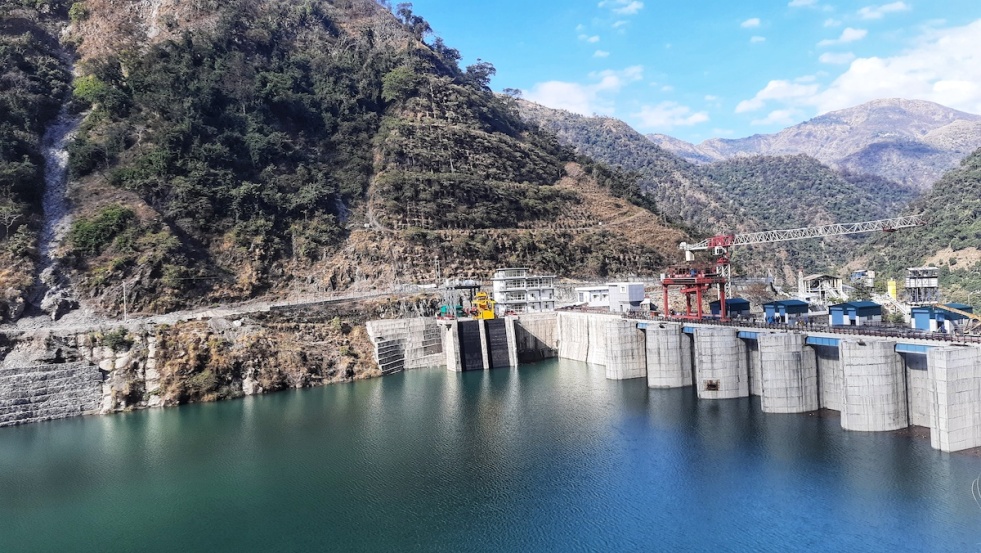
(Feature Image:-Vyasi HEP dam reservoir on Yamuna river in Dehradun. Credit: Varsha Singh/Third Pole, Jan. 2022)

In a landmark move, United States Environment Protection Agency has started reporting methane emissions from dams and hydropower projects in its annual reporting to UN in 2022. It needs to go a step further and make it mandatory for all dams and hydropower projects to annually report such emissions on their websites. This will not only help clear the mistaken notion that hydropower projects are climate friendly, it will also help take right policy measures and project construction or decommissioning decisions. It will also lead to more scientific accounting of global warming causing emissions. It will also give the consumer right picture about GHG emissions from such projects when they look at options for electricity supply. There is a lot that India and rest of the world that needs to learn from this and implement on urgent basis as US EPA seems to be the first agency to do this.  

Continue reading “DRP 200223: US EPA starts reporting methane emissions from dams”
Sand Mining

Riverbed Mining 2022: Judiciary tries but fails to bring effective change

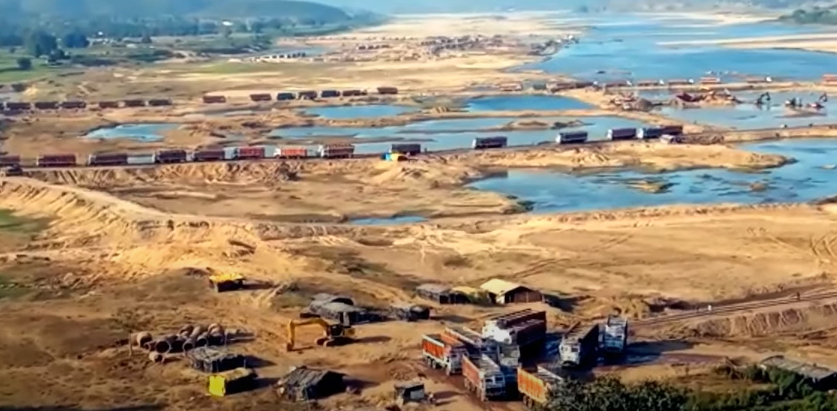
(Feature Image: Screen shot of The Power Time Dec. 2022 video news report revealing large scale mechanized, illegal sand mining in Sone rivers in Sonbhadra district Uttar Pradesh)

Judiciary has been striving to remedy the lawless situation currently dominating riverbed mining in India. The year 2022 has been full of court cases and orders dealing with unsustainable and illegal riverbed mining operations. In this yearend overview, we have reported top ten judicial interventions to control exploitative minor mineral mining by various state governments and to make the regulators accountable against the illegalities & violations.

In 1st part of the annual Sand Mining overviews, we tracked the adverse impacts of riverbed mining activities on freshwater species and rivers’ eco-system. In 2nd part, we covered the riverine community’s agitations against destructive riverbed mining. The 3rd part highlighted the damages and threats to infrastructures by excessive, mechanized riverbed mining.

Continue reading “Riverbed Mining 2022: Judiciary tries but fails to bring effective change”
Wetlands

WWD 2023: Top Ten Judicial Interventions to Improve Wetlands Governance

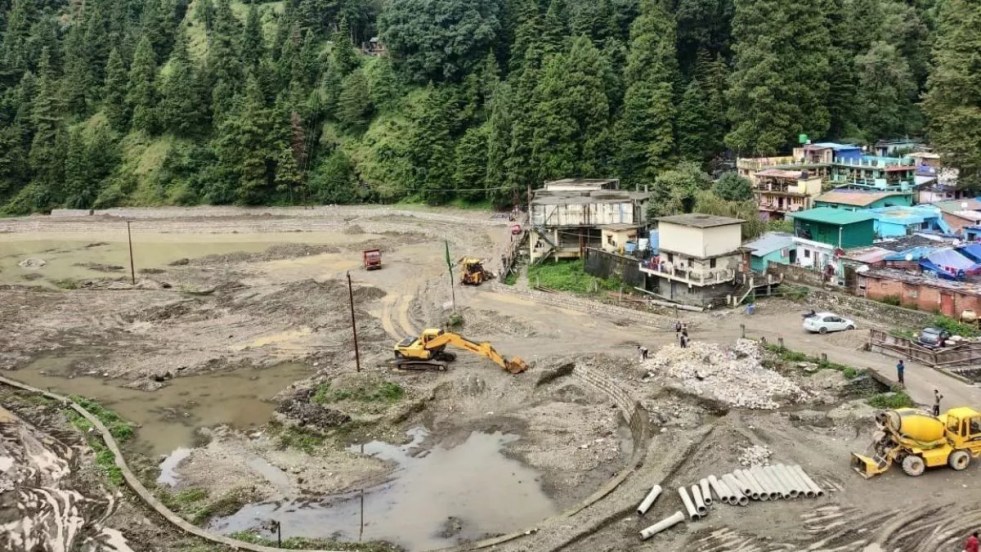
(Feature Image: Construction activities in Sukhatal lake area in Nainital, Uttarakhand. Source: Dainik Jagran, Nov. 2022)

In this third part of wetlands overview, SANDRP tracks top ten judicial interventions regarding protection of wetlands in India in 2022. The part one has highlighted general situation of wetlands and part two has covered some governmental actions for wetlands conservation.

Continue reading “WWD 2023: Top Ten Judicial Interventions to Improve Wetlands Governance”
Sand Mining

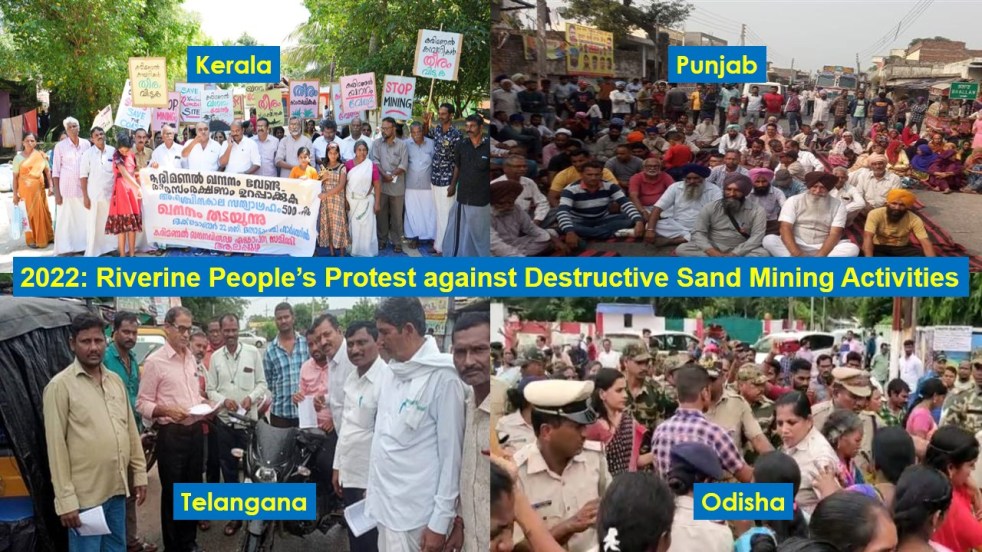
2022: Riverine People’s Protest against Destructive Sand Mining Activities

The rampant riverbed mining in India have reached the alarming stage where the adverse impacts on river’s eco-system, river based environmental services including fishing, groundwater recharge, potable and irrigational water supply schemes have started affecting the riverine communities in multiple ways. Given the poor track records of responsible agencies in addressing their plight, the dependent, affected and concerned people have been left with no option but to resist. Like in past years, there have been several incidents of riverine people strongly opposing the destructive mining practices in many states in 2022. This overview compiles some such incidents which we could track. The first part of the overview highlighting the adverse impacts of riverbed mining on river eco-system and freshwater species can be seen here.      

Continue reading “2022: Riverine People’s Protest against Destructive Sand Mining Activities”
DRP News Bulletin

DRP 261222: People on roads against hydro projects that govt is pushing

(Joshimath residents staging protest against land sinking and damages to their homes demanding rehabilitation & halt in NTPC’s Tapovan Vishnugad HEP tunnel work on Dec. 24, 2022. Image source: Atul Sati, Joshimath)

People of at least four states are opposing hydropower projects that the central and state governments are pushing, ignoring all the ground realities. In Uttarakhand, the Joshimath residents are on roads to wake up the government that seems deaf to their protests due to their houses cracking and land subsiding due to the tunnels being blasted for hydropower projects and Char Dham highway being built ignoring the voices of not only the affected people, but also the experts.

In Arunachal Pradesh, people have been writing to the central govt authorities against the Etalin and Dibang projects being pushed in Dibang valley of Brahmaputra basin.

In Himachal Pradesh, the people of Kinnaur and Lahaul Spiti districts have made it an election issue the destructive hydropower projects being pushed there both by the state and central governments.

In Andhra Pradesh too people have been protesting against the pump storage projects being given permission in schedule tribe areas without their prior informed consent and ignoring the statutory requirements.

2022 is thus ending with people’s active protests across the country against destructive, disaster prone and unviable projects being pushed against their wishes and in violation of any proper consultations or even any credible impact assessments. In the escalating impacts of climate change, these projects are even more problematic as they not only worsen the adaptive capacity of people and invite more frequent, intense and spread of the disasters, but they also destroy the mitigation tools like forests and flowing rivers. This when all these projects are not even economically viable, and when better, cheaper options are available. It would be best if sooner the government listens to the people and stop pursuing such projects.

Continue reading “DRP 261222: People on roads against hydro projects that govt is pushing”
Dam Disaster

2022 Fly ash dam breaches in India

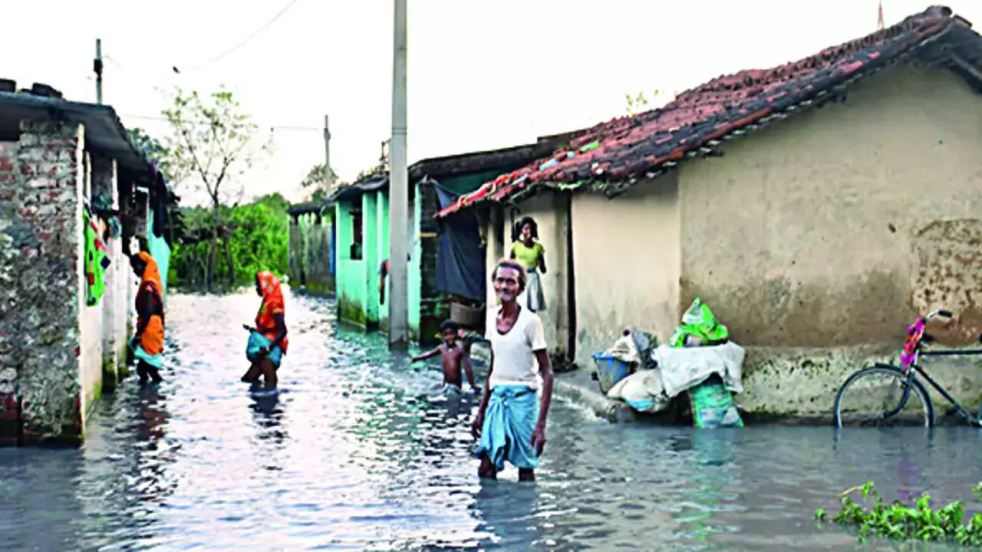
(Feature image:- This is the second time in the six months that Rautdih village has become inundated by the breach of ash pond embankment in Bokaro. ToI, Oct. 09, 2022)

Most mining companies make dams to store the semi solid slurry waste from the mines. Similarly most thermal power projects have fly ash dams to store the fly ash slurry. These dams store highly toxic slurries but there is little happening by way of regulation, monitoring or compliance at design, construction or operation level. Many of these dams breach or overflow, leading of release of the toxic slurry in the downstream areas. These dams do not even come under monitoring of Central Water Commission or under the dam safety act passed by the parliament. Despite accidents happening with huge adverse consequences, there is no accountability.

In this report, we have compiled the instances that we could locate about breaches of such dams in 2022. We earlier wrote about the Singrauli instance in April 2020 and in the 2019 SW Monsoon dam breach compilation report.

Continue reading “2022 Fly ash dam breaches in India”
DRP News Bulletin

DRP 191222: Question marks over viability of pump hydro projects

(Feature Image: 1772 Mw PSHPs Spain. Photo courtesy of Iberdrola/ ENR)

The question marks over viability of huge number of pump storage hydro projects (PSHP) being pushed forward in India currently were flowing in the rivers for long. This week, Moody’s investors Service (MIS) seems to have strengthened this after it downgraded Greenko Energy Holdings’ corporate family rating. It may be noted that Greenko is the biggest investor in PSHPs in India from private sector and a major part of Greenko’s new investments are in PSHP.

This makes the implications of MIS’s downgrade all the more interesting. MIS has noted that PHSPs are capital intensive and each PHSP will generate cash flow only after at least 2-3 years of construction (in reality it can be much longer than 2-3 years, the operative phrase here is at least). It also noted that the additional debt to be raised from Greenko’s capital spending, coupled with a rising interest environment will put further pressure on “GEH’s already weak financial metrics” and that Greenko’s high financial leverage due to its substantial capital spending program will keep its financial metrics below its downgrade trigger “for an extended period of time”.

Continue reading “DRP 191222: Question marks over viability of pump hydro projects”
DRP News Bulletin

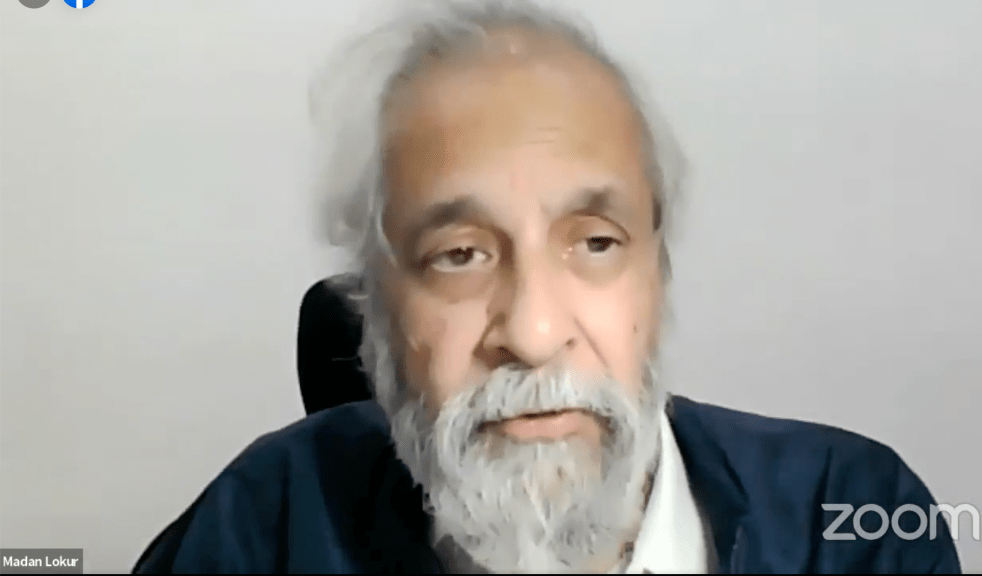
DRP 281122: Justice Lokur at IRW 2022: We need to be vocally more aggressive to make a difference

In his key note address at the final session of India Rivers Week 2022, Justice Madan Lokur, former judge of Supreme Court of India said, “Time has come we need to be a little more active and aggressive vocally to ensure that we are listened to about the problems we all are facing. Farmers struggle, the CAA amendment etc. are good examples. There is need for a political will to bring about any change. How do we generate such a political will is the issue.”

Among other messages Justice Lokur gave in his key note address at the final session of India Rivers Week 2022 on Nov 27, 2022 included: “Rivers belong to all, not a select few… We need to ensure that we are effective in our work, our messages.”

The two day, five session India Rivers Week 2022 function focused on use of rivers as waterways, organized in collaboration between India Rivers Forum (IRF is constituted by ten organizations now) and Manthan Adhyayan Kendra ended on Nov 27, 2022. The IRW 2022 sessions had a number of highlights, we will try to bring them to you in separate articles.

Continue reading “DRP 281122: Justice Lokur at IRW 2022: We need to be vocally more aggressive to make a difference”