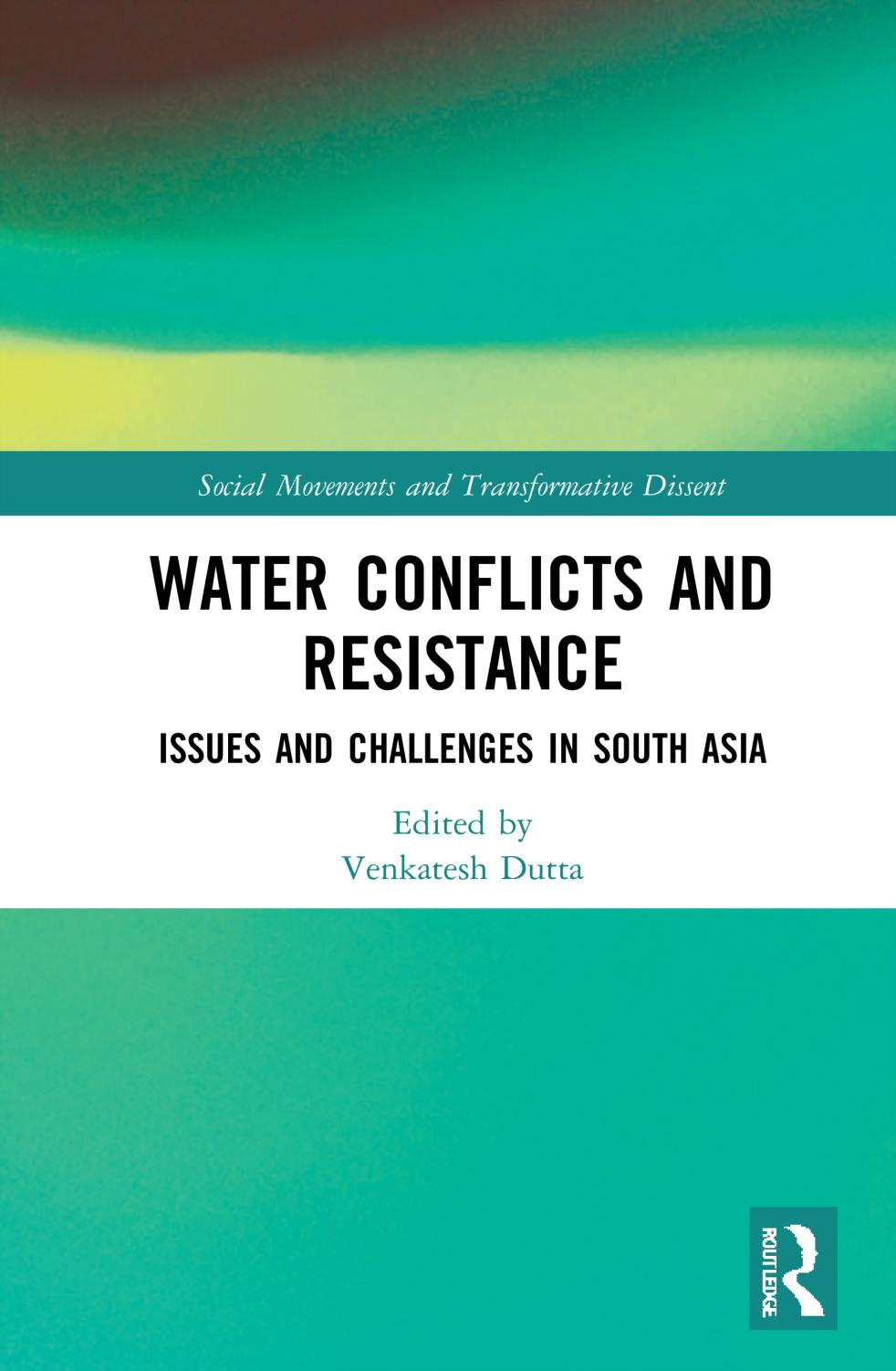
BOOK: Venkatesh Dutta (ed.) (2022), Water Conflicts and Resistance: Issues and Challenges in South Asia, Routledge, New Delhi. [Key words: Politics of Water, South Asia, Transboundary disputes, Water conflicts, Resistance, Waterscapes]
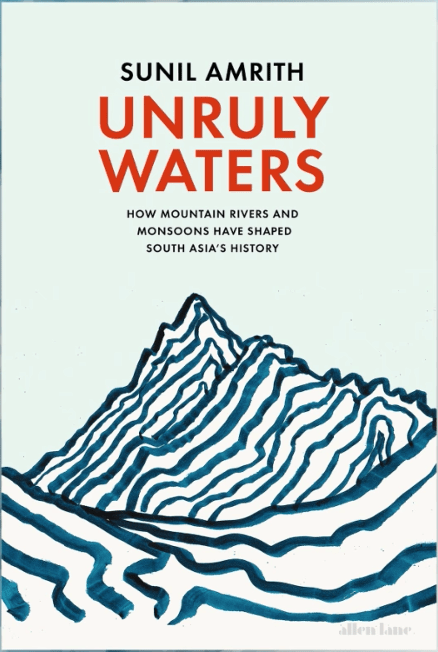
The recent arrival of this edited volume on changing nature of water conflicts in South Asia is a significant addition to the increasing literature on politics of water. I can recall two more texts namely Unruly Waters: How Mountain Rivers and Monsoons have Shaped South Asia’s History (Allen Lane, 2018) by Sunil Amruth and Water Issues in Himalayan South Asia: Internal Challenges, Disputes and Transboundary Tensions (Springer, 2020) an edited volume by Amit Ranjan. In the last two decades, politics of water has emerged as an interdisciplinary area of study and the framework of this book also suggests the same. The contributors range from water experts, govt. professionals to civil society activists and they capture the nuances of water conflicts at local, regional and transboundary scales.
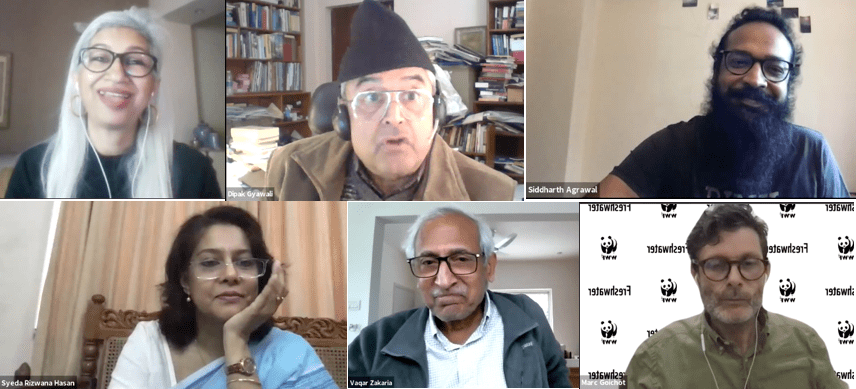
The insightful River sand mining focused South Asia meeting titled “Blood on the sand: dangers of riverbed mining in South Asia” was held on Dec 11, 2020. It was one of the off shoots of the IRW 2020 held dialogues on River Sand mining in India. One of the underlining theme that reverberated through the presentations was again that people on ground must have a role in governance of sand mining, considering the failure of governance of river sand mining by all concerned departments and governments. While the discussions brought out a number of scientific insights, the role of scientific studies and assessment was another key point emphasised by all.
Unruly Waters: How Mountain Rivers & Monsoons Have Shaped Asia’s History (by Sunil Amrith (2018), Penguin/ Allen Lane, New Delhi) unfolds the mysteries of monsoon in countless ways. It is written by Sunil Amrith, a historian and professor at Harvard University and the book has much more to offer to numerous other disciplines ranging from geology to ecology and political economy to name a few. Interdisciplinary as well as multidisciplinary orientation of the book makes it an interesting read for even the lay persons.
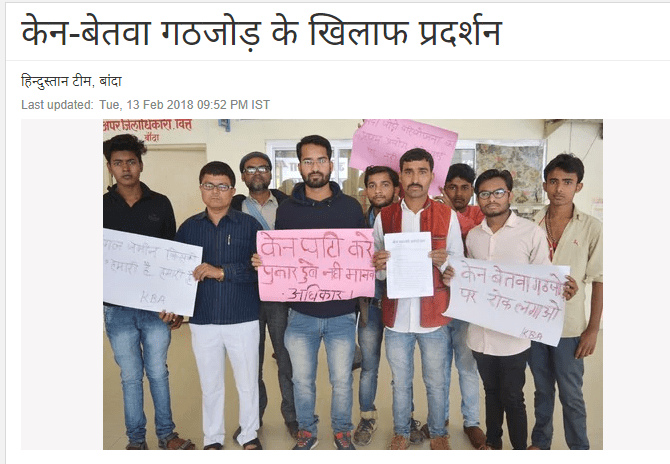
When Central Government is trying to push Ken Betwa link project terming it as beneficial for both Madhya Pradesh and Uttar Pradesh, local people of Banda are now also protesting against it, in addition to the people of Panna that are already opposing it. On Feb. 13, 2018, the Ken Bachao Samiti comprising of farmers, citizens and social workers in Banda sat on a Dharna before district magistrate office. The group have also sent a memorandum to the President of India, demanding immediate cancelling of the project. Raising serious concerns over environmental and social of the linking project, they asked demanded proper impact assessment and public consultation and said the project wont be allowed to go forward. Indeed, as they have said, there has been no downstream impact assessment and people of Banda are likely to loose their river. https://www.livehindustan.com/uttar-pradesh/banda/story-demonstrate-against-ken-betwa-alliance-1800951.html (Hindustan Hindi,13 Feb. 2018)
There have been many positive developments on agriculture, groundwater and environment round the week. In the first positive development, data from the first impact study of Paramparagat Krishi Vikas Yojana (PKVY) shows that small and marginal farmers, who can’t afford costly agricultural inputs, are turning a new leaf by going organic because of lower costs and higher margins. The study conducted by the National Institute of Agriculture Extension Management, has also revealed that Net Returns of organic farmers were higher for all the three crops studied, namely wheat, paddy and soybean, by 15.8%, 36.7% and 50% respectively.
This was based on study of 690 organic clusters in 25 states, out of some 6211 clusters comprising of 2.25 lakh farmers in a PKVY (each ha getting Rs 50 000 as aid) scheme launched in 2015, comprising of 52.3% small farmers. The average cluster size was 69 acres, in each there were 54.6 farmers on average. Maharashtra had the highest number of clusters at 1043 and MP had the highest area under clusters. The funding however remained irregular. India’s domestic organic food market is expected to show Compound Annual Growth rate of 25%, says the study. https://www.hindustantimes.com/india-news/small-farmers-go-big-with-organic-farming/story-nlyQQVUnoewHgeJyvaAnJI.html (Hindustan Times, 29 January 2018)
Another positive news report, have disclosed that how a simple groundwater recharge technique is transforming farmlands in Gujarat. The simple pit and pipe system simply and expertly captures standing water during rains, thus freeing arable land from water logging while recharging groundwater to use for irrigation during the lean season. This is essentially a simple groundwater recharge scheme but appears to last long. As per report about 3000 such units have already been installed in Gujarat and several other states. http://www.thehindu.com/society/this-simple-technology-has-transformed-gujarat-farmlands-into-an-oasis/article22529034.ece (The Hindu, 27 January 2018)
The third positive news have come from Central Government which has prepared a Rs 6000 crore plan to recharge ground water. The scheme is yet to be cleared by the Expenditure Finance Committee and the Cabinet.
As per report, the new 5-yr long scheme will be funded 50: 50 by the World Bank and centre, to be implemented in Gujarat, Maharashtra, Madhya Pradesh, Uttar Pradesh, Karnataka, Haryana and Rajasthan, covering 78 districts, 193 blocks and 8300 gram panchayats.
As per Counter View report, a well-informed Gujarat government source has told it that a major reason why the Sardar Sarovar Narmada Nigam Ltd (SSNNL) recently declared there would be “no water” from the multi-purpose irrigation scheme, Sardar Sarovar dam, to Gujarat farmers starting March 15, 2018, is Madhya Pradesh elections, scheduled for this year-end.
The source, refusing to be identified, said, “Already, massive preparations are on in Madhya Pradesh to provide as much Narmada water to the state’s farmers by storing as much water as possible. The idea is to appease the farmers with Narmada waters in the same way as it was done last year before the elections took place in Gujarat.”
In another report, anonymous official admits water shortage apparent in Nov 2017 before Gujarat polls was not announced, another indicator of how Narmada dams are used to achieve political ends. https://www.counterview.net/2018/01/narmada-water-for-irrigation-state.html (Counter View, 21 January 2018)
However, this is not happening for the first time. This also happened before the Nov 2017 Gujarat elections and also before 2014 General elections and 2012 Punjab elections, as illustrated below.
Today is 13th day of the Swami Shivanand fast unto death to protect Ganga River from illegal mining. The health of 70 years old Marti Sadan head is turning critical with each passing hour. If no intervention is done immediately, the Saint’s life will be in danger.
Matri Sadan resumed its fight against rampant mining in Ganga on May 13th, 2017 after State Government opened Ganga riverbed mining which the Ashram is strongly opposing for last many years.
For first eleven days two disciples of the Ashram observed hunger strike. But seeing no response from Govt, Swami Shivanand himself sat on fast unto death on May 24, 2017 against indiscriminate mining of national river. Still the Govt went ahead with Ganga mining activities stating that it was necessary to protect the city from flood.
In response the Saint shunned even taking water. But instead of communication with the protesters, the State Govt reportedly on May 28, 2017 triedto force feed the saint to fail the agitation for which the Govt was criticized greatly.
After mounting pressure the CM of Uttarakhand is learnt requesting to stop hunger strike. Following this mining was stopped in Ganga and the saint started taking water after six days but decided to continue fast as long as Government imposes complete ban on mining in writing.
On June 02, 2017, accusing the State Govt of blatant apathy towards Swami Shivanand’s hunger strike against illegal mining on the Ganga riverbed in the Kumbh Mela area, a group of scientists, activists and followers have written to the PM Modirequesting the PM to intervene without delay to stop unscientific mining of the Ganga.
The Kuttamperoor stream in Kerala, connecting the Pampa and Achankovil rivers, had been a nearly stagnant, shrunken cesspool of dumped waste and weeds for more than a decade. Some weeks ago, it was resuscitated as a flowing river, thanks to the will of the Budhanur gram panchayat in Alappuzha district, and the commitment of 700 local men and women who worked to bring the river back to life under the MGNREGA.
The Kuttamperoor was once a full 12 kilometres long and, at places, over 100 feet wide. The river originates from Achankovil at Ulunthi, near Mavelikkara, and flows through Ennackad, Budhanur, Kuttamperoor, Mannar, and Pandanad before merging with the Pampa at Nakkida near Parumala in Pathanamthitta district.
Union Water Ministry has launched an extensive water conservation program for drought prone areas of Bundelkhand, Marathwada, Kalahandi, Bolangir and Koraput in Odisha on April 28, 2017 at Bandri, Sagar Madhya Pradesh. As per report, the Water Ministry has prepared a master plan for artificial recharge of ground water in Bundelkhand region.
In UP region of Bundelkhand, around 1100 percolation tanks, 14000 small check dams/Nala bunds and 7200 Recharge pits/shafts have been identified. In MP region of Bundelkhand, around 2000 percolation tanks, 55000 small check dams/Nala bunds and 17000 Recharge shafts have been identified. She said as a part of ground water exploration, 234 wells in UP are proposed to be constructed in five districts of Bundelkhand i.e., Banda, Hamirpur, Jalaun, Chitrakoot and Mahoba. As a part of ground water exploration, 259 wells in MP are proposed to be constructed in six districts of Bundelkhand.


 SANDRP