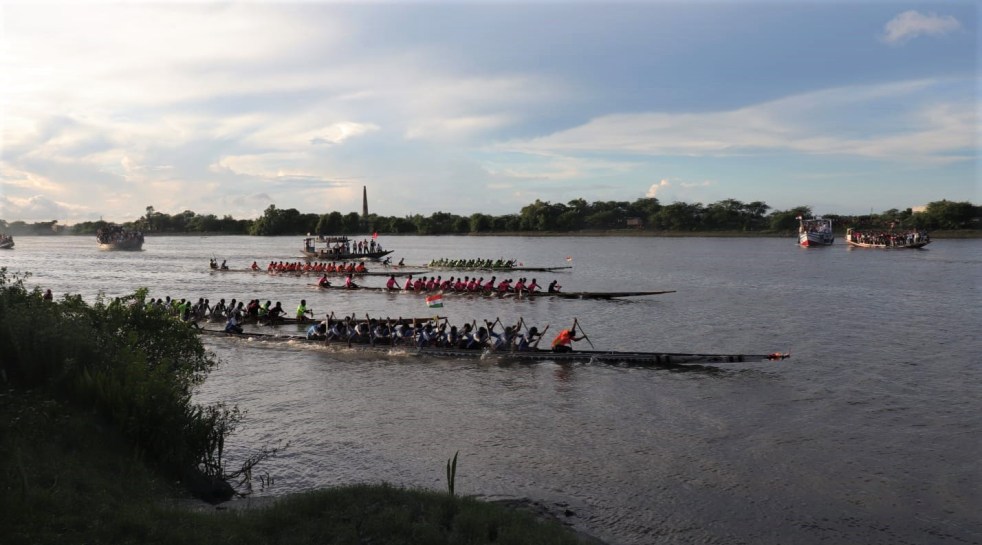
In the Nadi-Matrik land (born to the river) of Bengal, where a blade of grass takes on layered meanings, river boats are not to be taken lightly. For boatmen who row down a vast river for days at end, a boat is more than a mode of transport. It is symbolic of the mortal body: frail, tattered and adrift, in search of a safe harbor.
Continue reading “Boat Races of Bengal: A River Carnival”Tag: rivers
DRP 260922: Need for new credible Polavaram backwater study
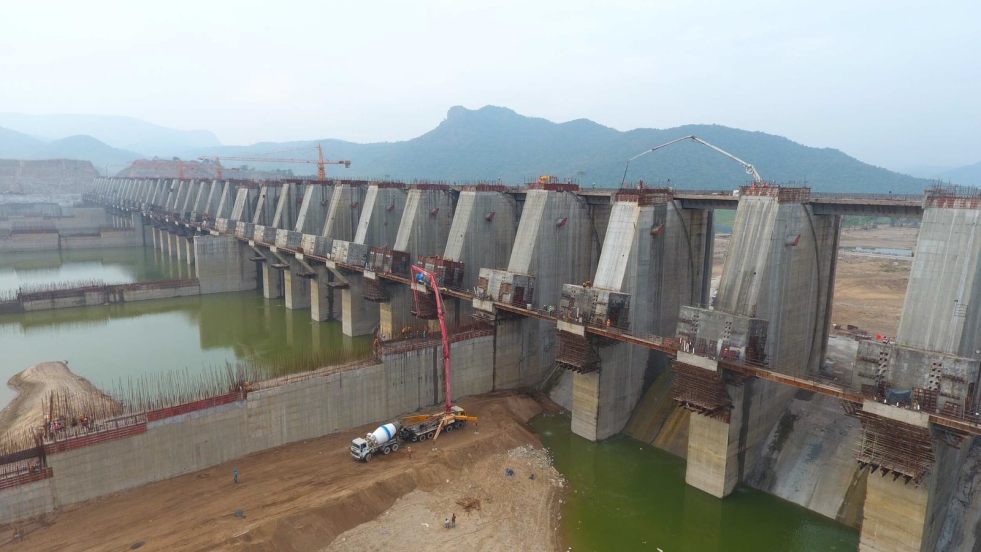
(Feature Image:- The construction of the Polavaram dam across the Godavari river has posed a big threat to the Pulasa fish, as its movement to the upstream of the river could be curtailed. HT PHOTO).
Telangana state has demanded fresh backwater study for the Polavaram dam based on a number of grounds including the higher spillway capacity and outdated river cross sections of 1990s used in the old study. The changing rainfall pattern and resultant changing river flow pattern, both due to changed rainfall and changed state of catchment area also should be a reason for such a fresh study. However, more importantly, the study needs to be done in a credible way involving independent experts, not just state or central govt officials or academics from govt run institutions. Moreover, the study and all the information related to it has to be completely and promptly in public domain as these studies are required for the affected people and affected area. Normally Central Water Commission does such studies and refuses to make it public. What is the use or reason for backwater study to be secret? Possibly CWC is not confident of the quality of the study and that is why it is very important to have experts in the study team who are known to take independent stand. It is useful not only for the states of Telangana, Odisha and Chhattisgarh, but also for the people of Andhra Pradesh too. And earlier this is done, better it will be for all concerned.
Continue reading “DRP 260922: Need for new credible Polavaram backwater study“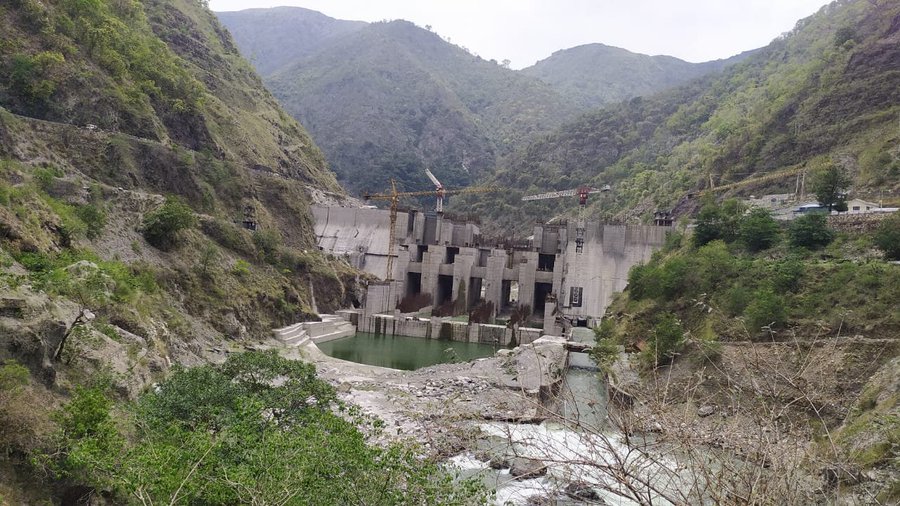
DRP 190922: Dams bringing unprecedented changes to the World’s Rivers
A new study published this week once again highlights not so well known impact of large dams on the rivers: role of rivers in building, supplying sediment, nutrients to floodplains, deltas, coastlines, estuaries, oceans and supporting so much biodiversity and how large dams are majorly adversely impacting this role of rivers. The study by scientists at Dartmouth using images from the NASA-US Geological Survey for 414 of the world’s largest rivers show the unprecedented changes the dams are bringing to World’s rivers, the impacts that in many cases are outweighing the impacts of climate change. This is particularly true of the northern hemisphere that includes India, World’s third largest dam builder.
Unfortunately in India, there is very little appreciation or acknowledgement of this role of rivers and how dams are affecting it. The least one can expect is that the Government of India should urgently initiate a study to document and understand this phenomena and also highlight what needs to be done about it. The study should be done by an independent team of multidisciplinary experts.
Continue reading “DRP 190922: Dams bringing unprecedented changes to the World’s Rivers“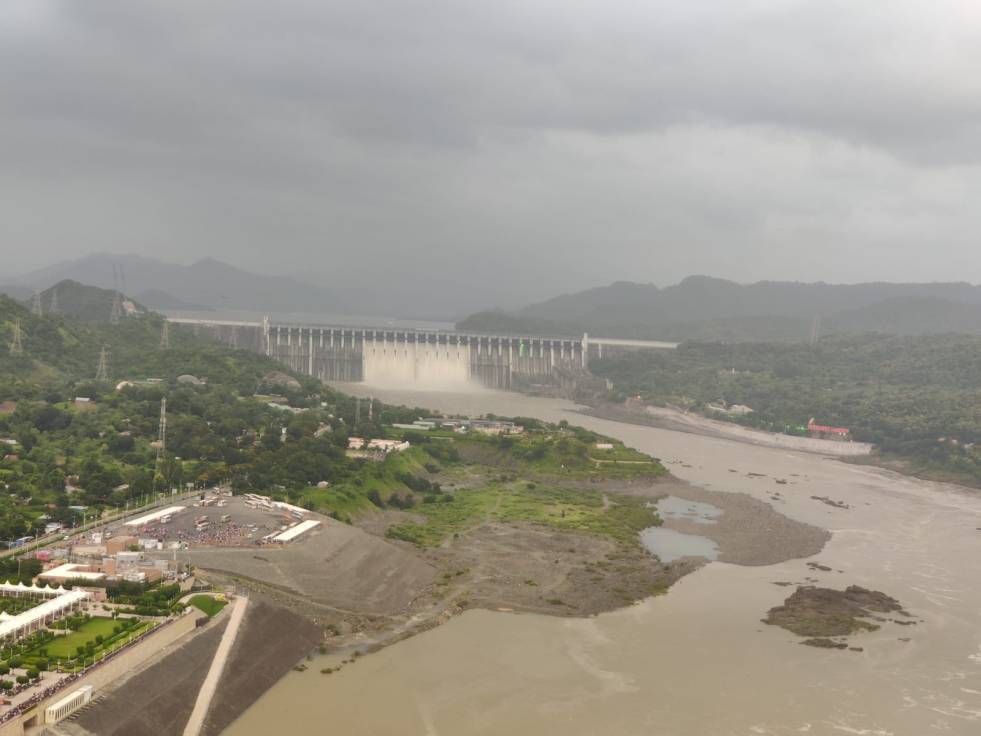
DRP 050922: Corruption in Large Dams & pro dam media Mughals
(Feature Image: Sardar Sarovar Dam on Narmada river. Source: Central Water Commission 30.08.2022)
As this article on corruption in large dams in India shows, it is open secret that large dams involve massive corruption, kickbacks and political funding. But the politicians from PM downwards across the party lines have understandably no interest in this issue.
But unfortunately, the large dams-corruption is not limited to politicians. The corruption in various forms plague even the media Mughals like Swaminathan Ankalesaria Aiyer and Shekhar Gupta, both known for their fundamentalist pro dam views. They too have no interest in corruption in large dams. In fact some of them have no qualms accepting sponsorships of dam contractors for their media awards! They are however, ever ready to criticize Narmada Bachao Andolan and Medha Patkar, though they have no clue about the issues they are talking about and keep using some flawed study whose reply (by Nandini Oza and Shripad Dharmadhikary) is already out in public domain. It is interesting that they have launched this fresh attack on dam critics just when Gujarat Chief Minister and country’s Home Minister have also launched attack on the NBA. Neither Gujarat CM, PM or HM is replying as to why Kutch, the main justification for Gujarat getting disproportionate share of Narmada waters, were the last to get their share of the water (even now not fully as the canal distribution system is still incomplete), almost two decades after the water rich Central Gujarat started getting Narmada waters. Nor are the pro dam media Mughals bothered about this.
Continue reading “DRP 050922: Corruption in Large Dams & pro dam media Mughals“
DRP 290822: MP’s Dam safety mess: Publish the Karam inquiry report
(Feature Image: Karam dam after breach. Source: Patrika)
Every week we get more evidence of the massive Dam safety mess in Madhya Pradesh. The Karam dam disaster that started on the eve of independence day is still unfolding. The inquiry committee report has been submitted, but it has not been made public. This is totally wrong and shocking. Dam Safety is a public interest issue and all information related to dam safety has to be in public domain. The inquiry committee report should be immediately put in public domain. More importantly an independent inquiry should be set up as the inquiry set up earlier was more of an in-house inquiry.
Close on heals of Karam dam disaster comes the news of risks due to unattended Maheshwar dam, a massive dam on Narmada river that remains unfinished and unattended, with one of the gates damaged and story of stolen motors, wires and other spare parts and power cut, which means the hydraulic system for gates is non-functional. Again the report of the NVDA-MWR officials after visit to the dam site should be in out in public domain, as also the reports of the dam safety committee reportedly set up the MP govt for assessing safety of all the dams of MP.
Continue reading “DRP 290822: MP’s Dam safety mess: Publish the Karam inquiry report“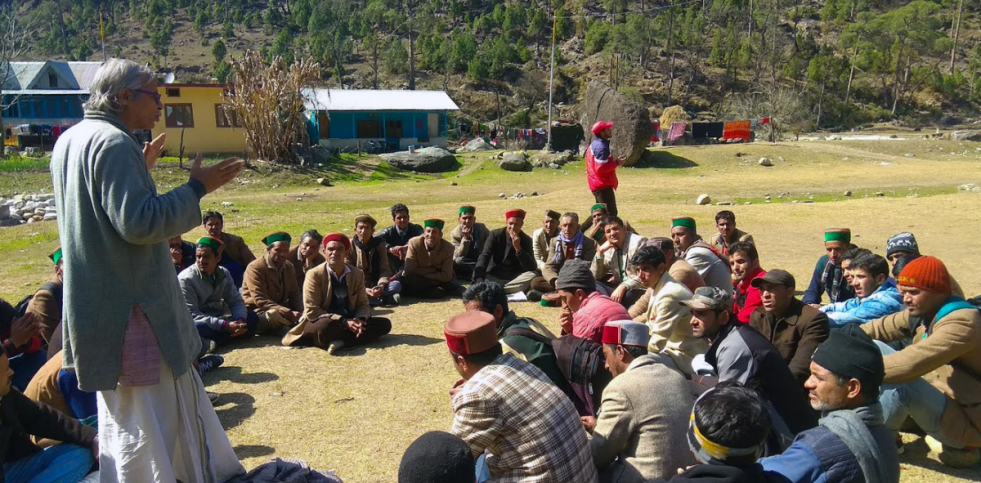
DRP 220822: Salutes to Vimalbhai
(Feature Image:- Vimal Bhai with a group of villagers in Uttarakhand. Photo: Matu Jansangathan/ The Wire)
It’s very sad occasion. Vimalbhai, who has been tirelessly active on issues related to dams, rivers and environment in Uttarakhand in particular and India in general, left us on Aug 15, 2022 for his journey beyond this world. He was a remarkably dedicated, committed and yet always smiling, simple man with simple needs. His loss is already being felt. May his soul rest in peace and may his friends and family get the strength to bear the loss.
Continue reading “DRP 220822: Salutes to Vimalbhai”
DRP 080822: Why is Centre not taking action against violations, defects of Kaleshwaram Project of Telangana?
(Feature image source: Pratidin News)
Union Water Resources or what is now called Jal Shakti minister Shri Gajendra Shekhawat made a rare and rather interesting statement this week about Kaleshwaram Lift Irrigation Project of Telangana, supposed to be the world’s biggest lift irrigation project, India’s most expensive ever irrigation project. The Union Minister publicly said that the Kaleshwaram project did not have all the clearances, project thus involved violations, and had defects, leading to submergence of three barrages and a massive power house last month. It is not clear if the Union Minister has also written to this effect to the Telangana state government and also taken action against the project. This is because the allegations made by the Union Minister are about such a huge project and are serious in nature.
If the Union Minister has done neither, as seems to be the case, he hope he is doing something on these lines soon. We do not expect a responsible Union Minister not take any action on such an important matter and is only making such statements for public consumption (incidentally, he seems to have made these statements in Karnataka, not in Telangana). Questions will be raised if the Union Minister fails to take such an action.
Continue reading “DRP 080822: Why is Centre not taking action against violations, defects of Kaleshwaram Project of Telangana?“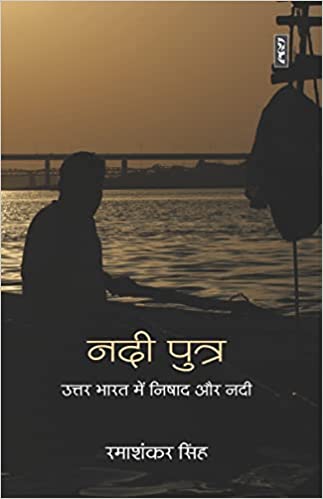
BOOK REVIEW: Rare book on Rivers and fisherfolks of North India
Guest Article by Dr. Ruchi Shree
BOOK: Ramashankar Singh (2022), Nadi-Putra: Uttar Bharat me Nishad aur Nadi, Setu Prakashan, New Delhi.
The arrival of books viz. Dipesh Chakravarty’s The Climate of History in Planetary Age (2021), Amitav Ghosh’s The Great Derangement: Climate Change and the Unthinkable (2016), A Nutmeg’s Curse: Parables for a Planet in Crisis (2021), Sunil Amruth’s The Unruly Waters: How Mountain Rivers and Monsoons have shaped South Asia’s History (2019) and numerous others has blurred the disciplinary divide between literature, politics and environment. These books have brought attention to the worsening environmental crisis worldwide and how developing countries or the global south is facing its severe brunt. As a consequence, one may notice an upsurge in literature in hindi and other regional languages around environmental issues in India. Last year, Shekhar Pathak’s book Hari Bhari Ummeed (2021) narrated the complexities of Chipko Movement at its 40 years and now this book here for review joins the club of interdisciplinary texts on environmental issues in India.
Continue reading “BOOK REVIEW: Rare book on Rivers and fisherfolks of North India”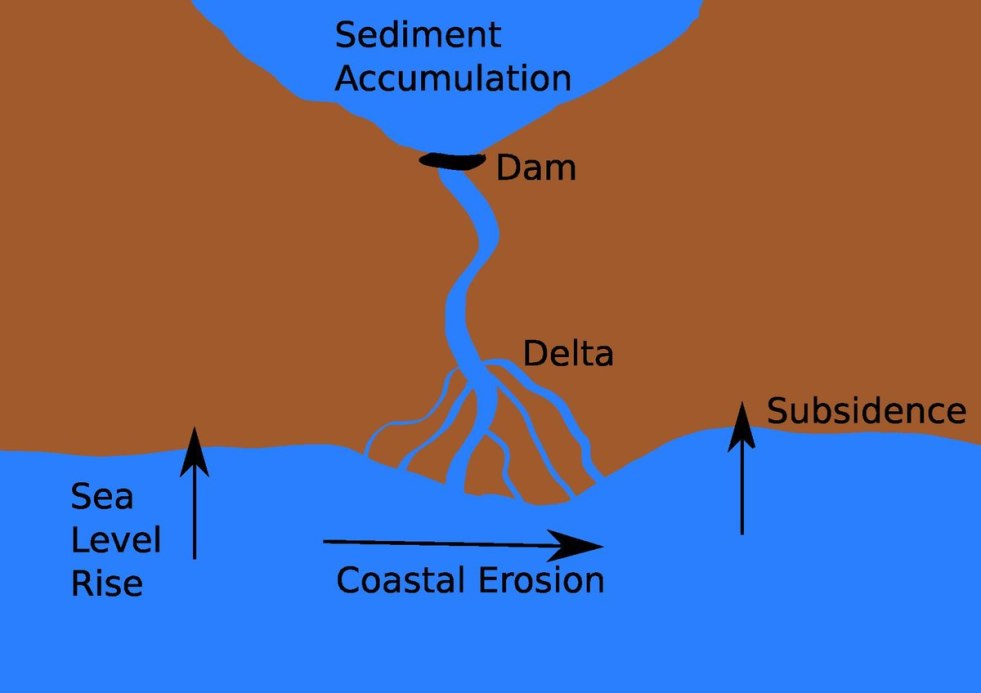
DRP 01 Aug 2022: Dams reduce sediment load in rivers leading to higher coastal erosion
(Feature image: Delta Land Loss Mechanisms. Source Wikimedia Commons)
A new study this week has reminded us what has been known for long. Dams not only store water but also trap the sediment flowing in the river. Whatever smaller quantity of water flow from dams to downstream areas, has much lower or no silt. A lot of that silt was supposed to reach the coast, helping fight against the erosion of the coast due to sea tides and waves. With drastically lower sediment reaching the coasts, higher coastal erosion is the result. While climate change is definitely contributing to the increased coast erosion due to more frequent and higher intensity storms from the sea, the role of dams tend to work as force multiplier in increasing the coastal erosion due to less sediment reaching the coasts from river.
While a new study by a Pune University has highlighted this phenomena in case of Godavari river, peninsular India’s biggest river, this is also happening at most other rivers and where they meet the coasts. As in case of Farakka, closer the terminal dam is to the coast, greater is its effectiveness to trap the river sediment and higher is its contribution likely to be to the increase in coastal erosion.
Continue reading “DRP 01 Aug 2022: Dams reduce sediment load in rivers leading to higher coastal erosion”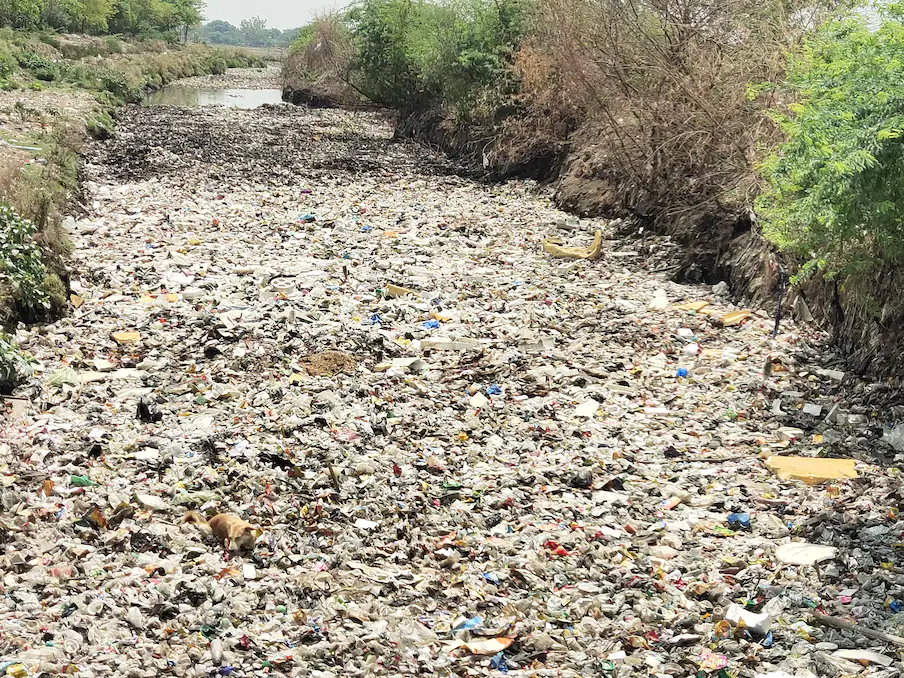
DRP 250722: State of Yamuna River ignored by NMCG and MoEF
(Feature Image:- A drain choked with solid waste and untreated effluents running through Yamuna floodplains in Mathura. Source: News 18, 13072022.)
This year, even in the middle of monsoon, the Yamuna river in the national capital is in such a pathetic state, there is insufficient flows in the most of the days. The govt may jump to blame it on poor monsoon rains, ignoring that the upstream dams like the recently commissioned Vyasi dam not releasing water in the downstream is also a major reason beside the unsustainable riverbed mining and also dumping of solid waste in the upstream, including due to the building of mindless projects like the Char Dham highway, all in the news this week. Both National Mission on Clean Ganga (NMCG) and Union Ministry of Environment and Forests (MoEF) should be concerned about this lack of flows downstream from the dam and other issues listed above, but they clearly seem least bothered.
Continue reading “DRP 250722: State of Yamuna River ignored by NMCG and MoEF” SANDRP