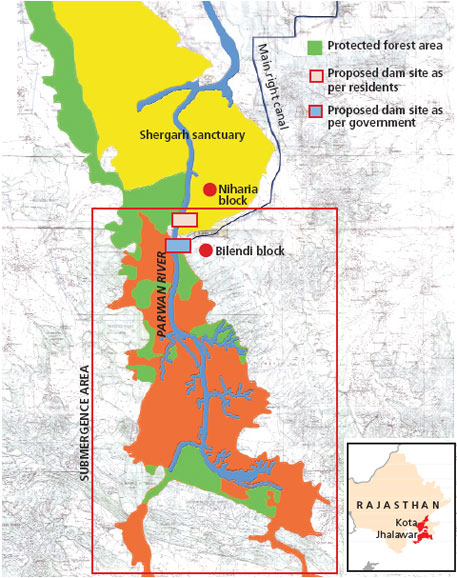
Reports[1] indicate that Congress leader Rahul Gandhi is to lay foundation stone for the controversial Parwan Irrigation Project in Jhalawar district in Rajasthan (see the map above, taken from Down to Earth), before speaking at public meeting in Baran district on Tuesday, Sept 17, 2013. Detailed analysis of official documents and other reliable accounts indicate that this unnecessary dam is seemingly being pushed to supply water to some of the proposed thermal power projects in Baran and Jhalawar districts.

The project will require 12248 ha of land including submergence of massive 9810 ha of land as per conservative government estimates, displacing about 100 000 people[2] from at least 67 villages of Baran and Jhalawar districts in Hadauti region of Rajasthan. It will require at least 1835 ha of forest land, and will affect at least 2 lakh trees only on this forest land, lakhs of trees on non forest land will also stand destroyed. Most of the 1.31 lakh Ha of land in Baran, Jhalawar and Kota districts that is supposedly to get irrigation is already irrigated. These districts have average rainfall of 842 mm (Baran[3]), 923.5 mm (Jhalawar[4]) and 804 mm (Kota[5]), which is high by Rajasthan standards. If there is adequate harvesting of this rainwater, groundwater levels would certainly rise and remain sustainable with appropriate cropping pattern. This has happened in neighbouring Alwar and Jaipur districts.
This Rs 2000 crore dam with huge impacts is certainly not required for this purpose.
From all accounts, in reality the dam seems to be pushed for thermal power projects like the 1320 MW Kawai coal based thermal power project of Adani[6], 1320 MW coal based Chhabra[7] thermal power project of Rajasthan Rajya Vidyut Utpadan Nigam Ltd and the 330 MW gas based thermal power project of RRVUN at the same location. Very strangely, these projects applied for environmental clearance based on water supply from Parwan dam, even when Parwan dam does not have all the required statutory clearances, and when work its yet to start. The MoEF should have refused to sanction these thermal power projects before Parwan dam was in place.
This action of the MoEF speaks volumes about poor environmental governance due to which the TPS were cleared based on water from a project that is yet to see even foundation stone or all necessary clearances! The allocation for thermal power projects has increased[8] from earlier 40 Million Cubic meters (MCM) to 79 MCM to 87.8 MCM and this is likely to increase further considering these allocations did not take into account the transmission and evaporation losses.
Manipulated clearance process In fact the Parwan dam still does not have all the necessary statutory clearances. A quick look at the way Parwan got various clearances:
Þ Environmental Impact Assessment From the minutes of the 40th and 45th meetings of the Expert Appraisal Committee on River Valley Committee held in August and December 2010 it is clear that the EIA of the project did not have: Full social impact assessment, Full R&R Plan with Categories of Project affected persons and land for each category, Proper Dam break analysis, proper command area development plan with cropping pattern or necessary irrigation intensity (Only 14% kharif irrigation intensity provided as noted by EAC) and drainage plan, muck disposal plan. The basic facts in the EIA were wrong and the EAC should have rejected the EIA.
Þ Contradictions in EIA The EIA is full of contradictory information. For example it says the forest land coming under submergence is 1608.59 ha when the FAC form A[9] says that submerging forest land is 1731.48 ha. This is a very big difference by any standards.
Þ R & R Plan Firstly, there is such huge difference in the figures of displaced and affected people in various documents; it is clear there has been no credible social impact assessment. For example, EAC notes that 2722 houses to be submerged, 3002 (2142 in FAC factsheet in 0413) families to be affected, of which 461 tribal families. No R&R for non tribal families, which is completely unjust. Even for the tribal families there is no adequate provision of agricultural land. FAC sub committee accepts: “Most of these families do not belong to the notified Scheduled Tribes and also do not have any documentary evidence to prove that they are in possession of the forest land for a continuous period of minimum 75 years.” So most of the people will not even be eligible for resettlement or rehabilitation.
Þ How many people are affected? About 1401 families with population of 8650 persons will be displaced fully while 741 families with 4172 persons will be displaced partially. The ST population comprises 340 families with population of 1524 persons fully displaced and 121 families population 882 persons are partially displaced. However, independent sources are saying that the project will affect more than a lakh of people. This is a huge difference. Track record of past projects shows that official figures are always gross under estimates.
Þ EAC recommendation However, even when the responses to EAC’s fundamental concerns were not available, EAC recommended clearance to the project in December 2010. This showed how the EAC basically works as a rubber stamp.
Þ Environment clearance After EAC’s recommendation, the MEF is supposed to issue Environmental clearance. However, a visit to MEF website[10] on September 16, 2013 shows no information about clearance to the project. We learn from other sources that the MEF issued clearance to the project in 2011, but since it is not put up on the MEF website as required under EIA notification and NGT orders, the project will remain open to legal challenge with 30/90 days of MEF putting up the clearance letter on MEF website.
Þ Wildlife clearance The Standing Committee of the National Board of Wildlife in its 22nd meeting[11] held on April 25, 2011 considered the project. This was the infamous meeting[12] chaired by the then Union Minister of state (Independent Charge) of Environment and Forests Jairam Ramesh pushed 59 projects in two hours (average two minutes per project). He reportedly[13] said later that this was done under pressure, but the damage was done.
Þ Dr M.K. Ranjitsinh[14] and Dr Divyabhanusinh Chavda[15] submitted dissent notes, but the minister had predetermined objective and did not listen to any argument. The NBWL decided to clear the project even without knowing if the Shergarh wildflife sanctuary will be affected, how much water the downstream river will need, what will be the impact of the project on Jawahar Sagar Sanctuary, Rana Pratap Sagar Sanctuary or Chambal River Sanctuary or the project even had done basic options assessment or impact assessment.
Þ Location with respect to Shergarh WLS One of the key issues about this project is the location of the project with respect to Shergarh Wild Life Sanctuary. As noted by the FAC sub committee, the Parwan Doob Kshetra Hitkari and Jangal Bachao Samiti has been saying that the dam site is right inside the Sanctuary. However, if the project were to affect the WLS, it would require a Supreme Court clearance. To avoid this, manipulations have been going on.
The Site Inspection Report[16] of Forest Advisory Committee noted this issue and conducted a joint inspection in June 2012. The SIR said after this exercise that the proposed dam is 150 m in the upstream of the boundary of the WLS. However, the Parwan Doob Kshetra Hitkari and Jangal Bachao Samiti have contested this conclusion and said there was manipulation in this exercise.
But the EIA of the project, as noted by the 40th and 45th EAC meeting said that the project is five km away from the Shergarh WLS (this itself shows how poor is the EIA and how poor is the appraisal by EAC. Shockingly, even the Environment Clearance letter of 2011 also reportedly says that the project is 5 km away from the WLS, another reason why the EC will remain open to legal challenge.) In June 2013 there was another attempt at resolving this dispute, but again due to heavy rains could not be resolved. Funnily, the NBWL, which should be most concerned about this issue, has shown no concern. Until this issue is satisfactorily resolved, the project cannot go ahead, it will remain open to legal challenge.
Þ Recommendation of 25 cusecs release The NBWL condition that 25 cusecs (cubic feet per second) water should be released for the environment is not based on any assessment of water requirement for the river and biodiversity in the downstream, since such an assessment has never been done. It seems like another manipulation, based on the fact that Shergarh weir, 10 km downstream from the dam site, has storage capacity of 16 MCM, which is equal to release of 25 cusecs water!
Þ Gram Sabha resolutions The FAC factsheet[17] agrees that there are contradictory gram sabha resolutions, one set against the project and another submitted by the project authorities in favour of the project. The resolutions submitted by the opposing committee, which is without vested interests, is likely to be correct. There should be an inquiry about the correctness of the gramsabha resolutions by an independent body.
Þ Forest Advisory Committee The FAC considered the project in its meetings in Sept 2012 and April 2013 and recommended clearance in April 2013 meeting when all the fundamental issues remained unresolved.
Þ FAC sub-committee A sub committee of FAC visited the project in March 2013. Their report accepts a number of serious anomalies. For example, it says: “FAC sub committee report says: “It (is) a fact that a major part of the command area of the project is presently irrigated by using tube wells… Though there is no mention in the EIA report and other documents, about 79 MCM water from the dam is proposed to be utilized for 1,200 MW and 2,520 MW thermal power plants being constructed at Kawai and Chhabra respectively, in Baran district… It has been accepted by the project proponent that approach road to the historic Kakoni temple will be submerged. Submergence of the approach road will hinder free movement of devotees to the said temple, which may result in public resentment.”
Þ Forest Clearance After the FAC recommended forest clearance for the project in April 2013 in questionable circumstances, the MEF is supposed to issue in principle forest clearance and than after fulfillment of conditions in the in-principle clearance, it can issue final clearance. A perusal of the MoEF FC website[18] on Sept 16, 2013 shows that the site does not display any of the clearance letters. Our letter to the concerned MoEF officers on Sept 15, 2013 remains unanswered. We came to know through independent sources that in principle forest clearance has been issued in middle of August 2013, final forest clearance will take a long time.
Þ Compensatory Afforestation Plan Full plan and maps of CAP have not been submitted, says FAC factsheet. It is not even known if the land for CA is free of encroachment, the DFO says it will be ensured when the possession taken, as reported in Factsheet in April 2013. CA land is in 32 villages in at least 32 pieces, the DFO has not even visited all the lands to ascertain if it is suitable for CA and yet DFO has given certificate that it is suitable for CA. This seems like typical case where CA has no chance of success as noted by CAG audit report on CA in Sept 2013. It is completely illegal of CCF, PCCF, state forest department, FAC or MoEF to consider the project without full CAP with all the required details verified on ground.
Þ CWC clearance The Central Water Commission’s Technical Advisory Committee is supposed to clear all major irrigation projects. This TAC appraisal is supposed to happen only after all the final clearances are given as TAC recommendation is the basis for Planning Commission’s investment clearance. Since the Parwan project does not have the final forest clearance, it cannot be considered by the TAC of CWC. However, we learn that on Friday, Sept 13, 2013, TAC met and cleared the project.
Þ Planning Commission Investment clearance Project cannot have the Planning Commission Investment Clearance since it does not have all other clearances in place. Without this clearance no funds can be allocated for the project from state or central plans.
Þ Big irrigation projects not delivering As even Planning Commission and CAG has noted and as SANDRP has been showing through analysis for so many years, since 1992-93, net irrigated area by Major and Medium Irrigation Projects at National level has not seen any increase. There is little sense in spending massive amounts on such projects without understanding this reality. We hope Planning Commission, CWC, Rajasthan government and people concerned with this issue will take heed of this. Unless of course, if the intention is to create reliable reservoirs of water for thermal power projects, as seems to be case here, while pushing projects in the name of irrigation for Rajasthan farmers.
What all this means is that Rs 2332.52 crore project with Rajasthan’s fourth largest reservoir (after Bisalpur, Rana Pratap Sagar and Mahi Bajaj Sagar) is being planned without a proper appraisal or legally supportable clearances. Bull dozing ahead with such a project which has huge social, environmental and economic costs is not only bound to keep it open to agitations, legal challenges and delays, but is also not likely to have justification in public eye. It can even be politically counter productive. Nehruvian era of trying to win elections through such so called temples of modern era is gone, and our politicians need to learn this fast.
It is hoped that better sense prevails and Mr Rahul Gandhi will ask the project to go through due process rather than laying foundation stone of this controversial project that has more questions than answers.
Himanshu Thakkar (ht.sandrp@gmail.com)
South Asia Network on Dams, Rivers & People (https://sandrp.in/)
END NOTES:
[12] http://articles.timesofindia.indiatimes.com/2011-09-30/india/30229554_1_clearance-process-nature-conservation-foundation-nbwl: ““The NBWL members note that in their last meeting during Jairam Ramesh’s tenure as environment minister they were forced to clear most of the 59 proposals to start projects in protected areas – wildlife sanctuaries and national parks – in only two hours… Yet another fact of the same meeting was that 39 clearance proposals were received only two days prior to the meeting leaving very little time, and no working day, for the members to even glance through the proposals.” The NBWL members who have signed the letter include Biswajit Mohanty from the Wildlife Society of Orissa, Asad Rahmani of the Bombay Natural History Society, T R Shankar Raman of the Nature Conservation Foundation, Bivabh Talukdar of Aranyaak, M K Ranjit Sinh, Divyabhanusinh Chavda, Brijendra Singh, Valmik Thapar, Prerna Bindra, Bittu Sehgal, Mitali Kakkar and Uma Ramakrishnan.”
[14] “The Parvan major irrigation project, Rajasthan, which will submerge 81.67 sq.km. of the Shergarh Wildlife Sanctuary and what is more, will result in the destruction of approximately 186443 trees, in a tree deficit State like Rajasthan. Furthermore, even though 25cusecs of water is proposed to be continuously released into the Chambal from the proposed dam, this project will result in a major diversion of water from the Chambal, which has already been identified as deficient in water flow to support the last viable populations of the endangered Gharial and the Dolphin, in the April 2011 report prepared by the Wildlife Institute of India at the instance of the MoEF. The report specifically recommends that no further diversion of water from the Chambal should take place if the future survival of the endangered aquatic species mentioned above, is to be secured. There is also no EIA of the project, with regard to the impact upon the aquatic life and ecology of the downstream Jawahar Sagar Sanctuary, Rana Pratap Sagar Sanctuary and the National Chambal Sanctuary”.
[15] “With regard to Parvan major irrigation project in Rajasthan, please record that I had pointed out at the meeting that nearly 2 lac trees need to be inundated/chopped for the purpose. Though I did not mention it then, I feel very strongly that proper EIA of the project must be done.”









 SANDRP