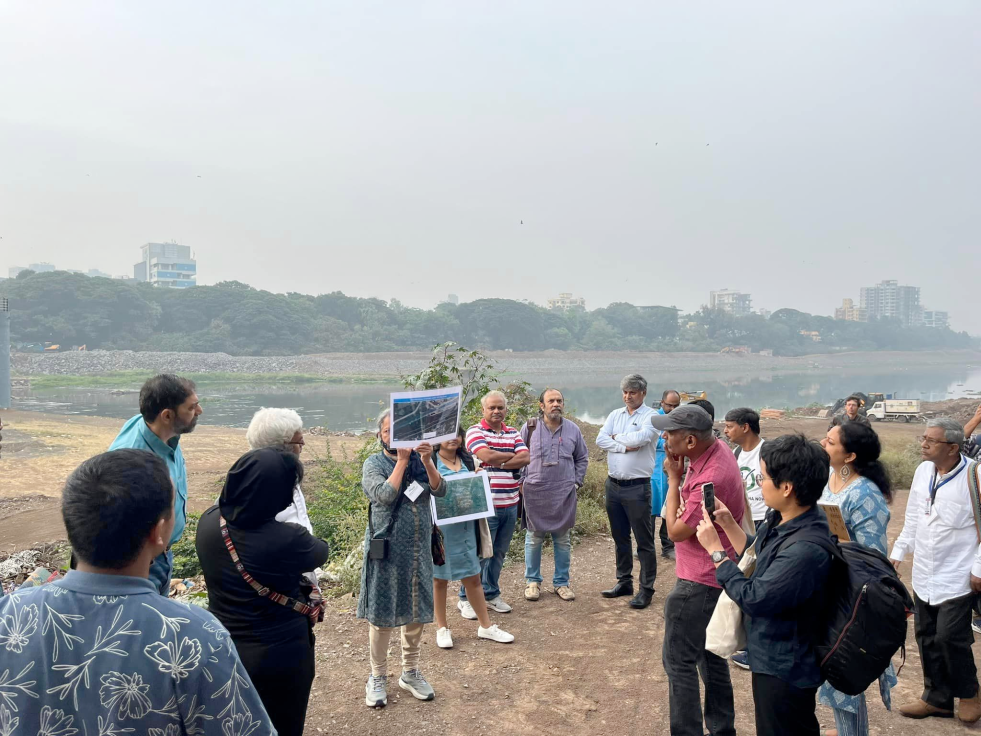
India Rivers Forum (IRF) is a vibrant and active network of organizations and individuals that is committed to the conservation and safeguarding of our rivers against needless and detrimental development. Every year IRF organizes the India Rivers Week (IRW) to raise awareness regarding these issues. This year IRW, organized in Pune, brought together more than 100 practitioners, including representatives from academia and civil society movements, to discuss River Front Development (RFD) unfolding in different parts of the country.
Continue reading “Preserve the Ecological Integrity of Rivers – statement on Pune River Front development by India River Week 2023”Tag: Pollution
WFD 2023: Untreated Effluents with Non-existent Regulation Killing Inland Fish En-Masse
(Fish in large number killed in Krishna river in Sangli in March 2023 due to untreated industrial effluents discharge. Image Source: ToI)
On occasion of World Fisheries Day 2023, incidents of mass fish death in rivers and water bodies in India during past one year are compiled here. The report highlights how untreated effluents from industrial and domestic sources with non-existent regulation have been primarily responsible for most of the en masse fish kill incidents across the country. In the first part of the series, we have covered the positive developments related to fish, fisherfolks and fisheries. And in the second part, we have covered the ongoing resistance and struggles of Indian fishers against developmental projects endangering their survival and livelihoods.
Continue reading “WFD 2023: Untreated Effluents with Non-existent Regulation Killing Inland Fish En-Masse”World Fisheries Day 2023: Resistance and Struggles of Fisherfolks
(Feature Image: A Konda Reddi tribe rowing a Dhone, a traditional boat, in the Godavari near the Papikonda hills in Alluri Sitarama Raju district. Photo Credit: T. Appala Naidu/ The Hindu)
On occasion of World Fisheries Days 2023, this compilation of important developments from 2023 highlighting the ongoing resistance and struggles of inland as well as coastal fisherfolks in India whose lives and livelihoods have been significantly affected by destructive developmental projects including dams & hydro power projects, increasing pollution and encroachments of water bodies, mechanized mining of sand from rivers & coastal areas, unsustainable fishing and invasive fish species.
The compilation first lists ten most remarkable developments on the issue and then covers the other relevant incidents in section wise manner. In the first part of the series we have highlighted ten positive stories on river fish and fisherfolks of India. The third part has covered the mass fish death incidents in India that have occurred during past one year.
Continue reading “World Fisheries Day 2023: Resistance and Struggles of Fisherfolks”DRP NB 231023: Need to be a little serious about Dam Safety, Flood Forecasting, Use of Early Warnings
(Feature Image: Landslide warning board at Lakhwar dam site on Yamuna river. SANDRP, June 2015)
India need to relook the Dam Safety Act Experts say the Sikkim incident exemplifies blind spots in both legislation and implementation. The DSA does not promote risk-based decision-making and fails to incentivise transparency. Himanshu Thakkar, an environmental activist and coordinator of South Asia Network on Dams, Rivers and People, says that the frequency and scale of such disasters reveal a pattern of neglect: “It keeps happening regularly, people face disastrous consequences and we call these ‘natural disasters’. But there’s nothing natural about them.”
A robust DSA should allow different stakeholders to access information easily, but India’s framework falls short. “Dam safety is a public purpose function. Everything about dam safety, functions of all the institutions and committees and authorities, their reports, decisions minutes and agendas, everything should be promptly available to the public,” says Mr. Thakkar. “But nothing is in the public domain.” He adds that transparency is further obstructed when national and State bodies comprise government employees and engineers who worked on these projects, compromising objective decision making and lacking “people with a proven track record of taking independent decisions.”
Continue reading “DRP NB 231023: Need to be a little serious about Dam Safety, Flood Forecasting, Use of Early Warnings”DRP NB 091023: MoEF Panel concerned about impacts of Small Hydro
(Gangani SHP on Yamuna river in Uttarkashi affected by June 2013 flash flood. Image: Yamuna Jiye Abhiyan/July 2013)
The Forest Advisory Committee of Union Ministry of Environment and Forests (MoEF) have rightly raised concerns about the impacts of so called small hydropower projects, that is hydropower projects with capacity below 25 MW. The MoEF assumes, following such unknown science or logic, that such projects have no environment and social impacts, they do not need environment and social impact assessments or management plan, they do not need any public consultation process, they do not need any monitoring or compliance and most significantly, they do not even need any clearances! A more unscientific thinking of the govt of India’s top environmental body would be difficult to find.
Continue reading “DRP NB 091023: MoEF Panel concerned about impacts of Small Hydro”DRP NB 110923: Another independent institution-CEC destroyed
(Feature Image: Ramganga River near Marchula. SANDRP 08 Sept. 2023)
The Govt of India’s Sept 5 2023 notification reconstituting the Central Empowered Committee completely destroys the independent nature of this institution of accountability and course correction. This institution, set up by the Supreme Court in 2002 and reconstituted in 2008, worked as eyes and ears of the Supreme Court on environmental issues. The new committee has no independent members, it will be constituted by the MoEF, MoEF itself has such an abysmally poor track record.
The notification, reports said, diluted the CEC’s autonomy on four key counts: the committee will report to the ministry, instead of the SC; the ministry will pick all the members and the SC will have no role in the process; the ministry, and not the court, will fund the committee; the provision of having two NGOs in the committee has been done away with.
Continue reading “DRP NB 110923: Another independent institution-CEC destroyed”DRP NB 280823: Defund nature destroying activities
(Feature Image: Construction work of World Bank funded 444Mw Vishugad-Pipaltkoti hydro dam project is going. The Developer have been found dumping muck in massive amount in river and carrying out blasting work evening during monsoon time. Image Source: Social Media)
This is indeed the key message if we are serious about tackling climate change with any sincerity. The adverse impacts of mindless activities in the name of development, are acting as force multipliers for climate change impacts as we are experiencing first hand, latest example being in Himachal Pradesh and Punjab.
Particularly when the “development” activities are done without credible project specific and cumulative impact assessment, genuine public consultation process and confidence inspiring monitoring and compliance processes, as is the norm.
Continue reading “DRP NB 280823: Defund nature destroying activities”The 2023 Yamuna floods of Delhi only a trailer of bigger floods to come in future?
(Feature Image:- Boats tied to Yamuna river bank at Wazirabad Barrage in June 2023. SANDRP)
In this detailed interview by Questions of Cities; Bhim Singh Rawat, associate coordinator, SANDRP talks on multiple issues affecting the Yamuna and offers some corrective measures to improve the overall condition of the river. The interview has already been published by Question of Cities and can be seen here. The interview also covers possible reasons behind unusual floods in Yamuna in Delhi in July 2023 and the detailed SANDRP blog on the issue can be seen here.
Continue reading “The 2023 Yamuna floods of Delhi only a trailer of bigger floods to come in future?”DRP NB 310723: Disastrous SHORT TERMISM in Urban India
(Feature Image: Earthmovers on restoration work as massive landslide damaged buildings at Shamti after heavy monsoon rainfall, in Solan district, on July 11, 2023 | Photo Credit: PTI/The Hindu)
The Supreme Court’s notice on Shimla development plan that lacks balance between development and environment is welcome and one hopes the apex court takes the issue to its logical conclusion. The consequences of unplanned and ill planned urban developments are a clear invitation to major disasters, including floods, landslides, traffic congestions, air and water pollution, health hazards and also water shortages. The Shimla Master plan also violates the NGT directions with complete impunity.
This is exactly what the EDIT in the Times of India on Mussoorie misery, dangerous short termism that pervades across sectors in Urban India with no policy to guide Urban Water sector or for that matter any other sector.
Continue reading “DRP NB 310723: Disastrous SHORT TERMISM in Urban India”DRP NB 030723: Peak Hour Tariffs to be implemented from April 2024
(Feature Image: Vyasi HEP power station at Hathyari, Dehradun. SANDRP, June 2023)
This announcement by the government is indeed much belated but welcome step that India plans to increase peak hour power tariff compared to non-peak hour power tariff, beginning with commercial and industrial consumers from April 2024 a year later for others excluding agriculture consumers. The notification mentions it as daytime tariff (during solar hours) and night time power use, but this essentially also helps peak management.
This will not only put a premium on peak hour power consumption and hence generation, but also hopefully ensure that assessment of impacts of the peak hour power generation including at hydropower projects is done and done in a credible way, along with compensating those affected. It will also hopefully ensure that existing hydro capacity is used optimally for peak hour power generation before going for new hydro projects in the name of increasing peak our power generation.
One also hopes that it will lead to better peak hour power management and also considering all the options for such power generation rather than pushing hydro projects blindly in the name of peak hour power generation.
Continue reading “DRP NB 030723: Peak Hour Tariffs to be implemented from April 2024”