DRP News Bulletin

DRP NB 200323: Time to Focus on Natural Water Storages

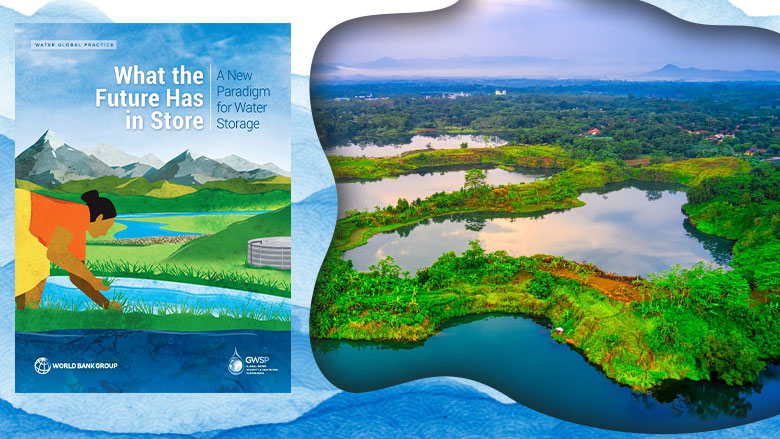
(Feature Image: Cover page of World Bank report titled What the Future Has in Store: A New Paradigm for Water Storage)

On the occasion of World Water Day 2023, the United Nation will be organizing a conference (March 22-24) in New York, USA. In its latest report the World Bank has also raised concern over decline in fresh water storages and underlined the need of a new approach for integration of built and natural water storages as a measure to adapt to climate change related water challenges and better management of water resources.

There is no doubt that large parts of the world are facing water scarcity and insecurity from existing and looming threats both from man made reasons and changing climates. Given the omnipresent & increasing shortages of cumulative storage capacity and adverse impacts of built water storages especially big reservoirs and dams; it is time global bodies like UN, World Bank, policy makers and governments at large must focus on conservation and replenishment of natural water storages, which are far better, cost effective options available to address and mitigate ever increasing and evolving climatic threats on human water security and sources.

Continue reading “DRP NB 200323: Time to Focus on Natural Water Storages”
DRP News Bulletin

DRP NB 060323: India’s regulators blind to increasing threats in Himalayas

This week the weekly DRP bulletin brings news of increasing threats from changing climate in inherently disaster prone Himalayas. The news come from Ladakh in the NW to Nagaland in the NE, and includes Uttarakhand among others. The news is about retreating glaciers, increasing threats of Glacial Lake Outburst floods and landslides. The news also notes that factors like indiscriminate infrastructure development and lack of drainage are worsening the disaster potential of the Himalayan states. Most importantly, implicitly more than explicitly, the news reports highlight complete inattention of the regulators to these increasing threats and risks in inherently vulnerable Himalayas while considering new infrastructure projects like Highways, Railways, Hydropower projects, Dams and urbanization and also in terms of disaster management laws and practices.

It underlines that the threats and risks in the Himalayan states is also increasing due to changing rainfall patterns due to changing climate. This trinity of inherent vulnerability, changing climate and inattention to the risks of indiscriminate infrastructure projects is clearly very very dangerous, but there is little hope for any immediate change. One clear indication is the handling of the Joshimath disaster, a clear case of how not to handle communication as Dave Petley has noted. The Prime Minister’s office is sitting on the report submitted by the investigating agencies several weeks ago. Why should this report be a secret or will we get a negotiated report?

Continue reading “DRP NB 060323: India’s regulators blind to increasing threats in Himalayas”
DRP News Bulletin

DRP NB 270223: How much Pump Storage Hydro capacity is required in India?

(Feature Image: State steps up pumped hydro storage projects amid coal crisis. Source: EQ Mag Pro/ May 2022)

On Feb 15, 2023, Union Ministry of Power issued draft guidelines for Pump Storage Projects, inviting comments from stakeholders in 15 days to the email id – hydro2-mop@gov.in. The guidelines say that more Pump Storage Projects (PSPs) are required in view of increasing solar and wind power capacity connected to the grid, to stabilize the grid, store the power to make it available during non-solar and non-wind power hours and for peaking power, reactive power, etc. It describes the PSP as “clean, green, safe, and non-explosive” and “environment friendly” option. No studies or basis are provided for this sweeping conclusion.

Continue reading “DRP NB 270223: How much Pump Storage Hydro capacity is required in India?”
DRP News Bulletin

DRP NB 200223: US EPA starts reporting methane emissions from dams

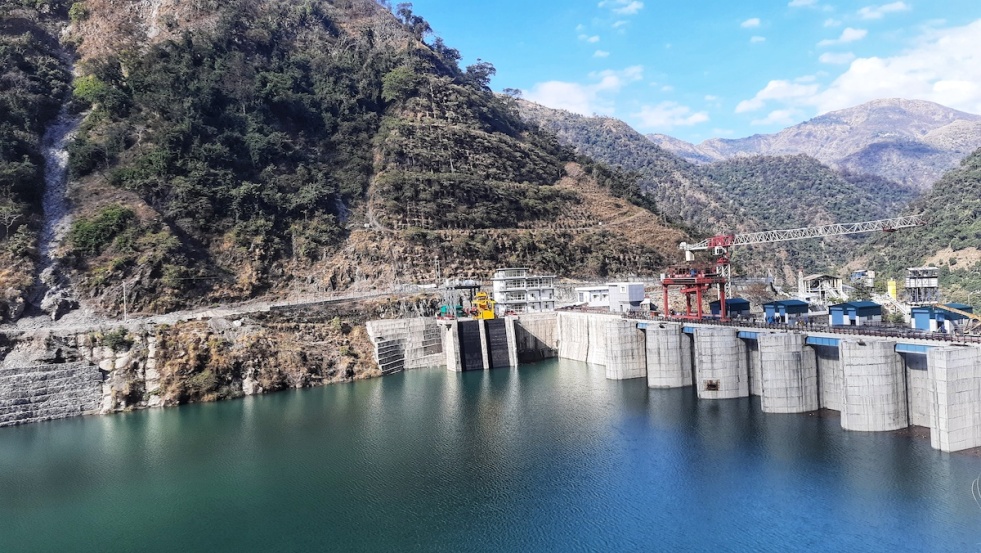
(Feature Image:-Vyasi HEP dam reservoir on Yamuna river in Dehradun. Credit: Varsha Singh/Third Pole, Jan. 2022)

In a landmark move, United States Environment Protection Agency has started reporting methane emissions from dams and hydropower projects in its annual reporting to UN in 2022. It needs to go a step further and make it mandatory for all dams and hydropower projects to annually report such emissions on their websites. This will not only help clear the mistaken notion that hydropower projects are climate friendly, it will also help take right policy measures and project construction or decommissioning decisions. It will also lead to more scientific accounting of global warming causing emissions. It will also give the consumer right picture about GHG emissions from such projects when they look at options for electricity supply. There is a lot that India and rest of the world that needs to learn from this and implement on urgent basis as US EPA seems to be the first agency to do this.  

Continue reading “DRP NB 200223: US EPA starts reporting methane emissions from dams”
DRP News Bulletin

DRP NB 130223: El Nino set to endanger 2023 SW Monsoon rains

After four years (SW Monsoons of 2019 [110.4%], 2020 [108.74% compared to normal rainfall], 2021 [99.3% or almost normal rainfall], 2022 [106.5%]) of normal or surplus monsoon rainfall, SW Monsoon 2023 could face rainfall deficit and uncertainties as per US Govt weather agency NOAA and also India’s IMD. El Nino conditions are many times associated with poor monsoon rainfall in India. Since SW Monsoon provides more than 75% of total annual rainfall of India, this can be critical for India. The shift from particularly prolonged La Nina conditions to El Nino conditions should be a warning sign for India. IMD DG has said that the department will come out with an update on Feb 28, which should be sufficient advance notice to take necessary steps to tackle its possible impacts on upcoming Summer and SW Monsoon. We hope the government is ready to take the necessary steps to tackle any eventuality.

Continue reading “DRP NB 130223: El Nino set to endanger 2023 SW Monsoon rains”
DRP News Bulletin

DRP NB 060223: Wetlands in India face damages, threats and Govt Apathy

(Feature Image:-Nayapakkam a lake near Chennai and a bird hotspot. 190 species have been recorded here and is a refuge for migratory harriers. https://ebird.org/hotspot/L3396760 Excavators were filling one end of the lake yesterday. Allegedly the ACS group is building an International school over it. M Yuvan, 05 Feb. 2023)

On the occasion of World Wetlands Day 2023 on Feb 2, 2023, SANDRP brought out five overviews about state of India’s wetlands. These included overview related to: 1. India’s Ramsar Wetlands 2. General overview of India’s wetlands 3. Top Ten stories about govt actions about wetlands 4. Top ten stories about judiciary actions about wetlands and 5. Positive stories about India’s wetlands. The links to the five overviews are available below.

The first thing that strikes from these overviews is that state of wetlands in India is bad, getting worse, they continue to face systemic neglect, damages, threats and govt apathy including Ramsar wetlands, which are supposed to have better protection than other wetlands, which is unfortunately not true. The nameplate of Ramsar wetland has now been given to 75 wetlands, but that provides no additional protection to them. in the name of information of Ramsar sites, there is only a combined interactive map apart from two separate pdf file links with location map and state wise listing Ramsar wetlands on Wetlands of India portal by MoEF&CC. The govt has neither prepared any concrete plan to address the threats nor has it developed credible monitoring mechanism which clearly shows it has no intention to improve the governance of these sites.

Continue reading “DRP NB 060223: Wetlands in India face damages, threats and Govt Apathy”
Sand Mining

Riverbed Mining 2022: Judiciary tries but fails to bring effective change

(Feature Image: Screen shot of The Power Time Dec. 2022 video news report revealing large scale mechanized, illegal sand mining in Sone rivers in Sonbhadra district Uttar Pradesh)

Judiciary has been striving to remedy the lawless situation currently dominating riverbed mining in India. The year 2022 has been full of court cases and orders dealing with unsustainable and illegal riverbed mining operations. In this yearend overview, we have reported top ten judicial interventions to control exploitative minor mineral mining by various state governments and to make the regulators accountable against the illegalities & violations.

In 1st part of the annual Sand Mining overviews, we tracked the adverse impacts of riverbed mining activities on freshwater species and rivers’ eco-system. In 2nd part, we covered the riverine community’s agitations against destructive riverbed mining. The 3rd part highlighted the damages and threats to infrastructures by excessive, mechanized riverbed mining.

Continue reading “Riverbed Mining 2022: Judiciary tries but fails to bring effective change”
Dams · Wetlands

WWD 2023: India’s Ramsar Wetlands face Damages, Threats & Govt Apathy

(Feature Image: The dumping ground is adjacent to the Deepor Beel wetland. Photo by Surajit Sharma./ Mongabay India, Aug. 2022)

Marking the World Wetlands Day 2023, this fourth overview by SANDRP compiles reports from 2022 revealing the worsening situation of Ramsar wetlands sites in India. In past few years, the government has shown great hurry in getting Ramsar tag for 75 wetlands from 26 in the country to symbolically mark 75th anniversary of Independence without showing any interest in resolving the existing and looming threats including increasing pollution, siltation, encroachments and climate change threats over old and even new Ramsar wetlands.

The ground reports show that the sole focus of the government is on pushing destructive and ornamental projects in the name of tourism and beautification on these wetlands which are only seen damaging their remaining eco-systems and threatening the livelihoods of dependent communities as an additional threat which only underlines that Ramsar tag does NOT help in wetlands protection and conservation. Experts, citizen groups have been raising this fact for years but in vain. Furthermore the process for seeking Ramsar recognition lacks consultation and participation of primary stakeholders and concerned citizens.

Moreover, in the name of information of Ramsar sites, there is only a combined interactive map apart from two separate pdf file links with location map and state wise listing Ramsar wetlands on Wetlands of India portal by MoEF&CC. The govt has neither prepared any concrete plan to address the threats, nor has it developed credible monitoring mechanism which clearly shows it has no intention to improve the governance of these sites.   

Continue reading “WWD 2023: India’s Ramsar Wetlands face Damages, Threats & Govt Apathy”
Wetlands

WWD 2023: Top Ten Judicial Interventions to Improve Wetlands Governance

(Feature Image: Construction activities in Sukhatal lake area in Nainital, Uttarakhand. Source: Dainik Jagran, Nov. 2022)

In this third part of wetlands overview, SANDRP tracks top ten judicial interventions regarding protection of wetlands in India in 2022. The part one has highlighted general situation of wetlands and part two has covered some governmental actions for wetlands conservation.

Continue reading “WWD 2023: Top Ten Judicial Interventions to Improve Wetlands Governance”
Wetlands

WWD 2023: Top Ten India Wetlands Stories about Govt Actions

(Feature Image: Kochi Corporation’s proposal to reclaim wetlands at Brahmapuram shot down. A view of the Brahmapuram solid waste treatment plant on the banks of the Kadambrayar. | Photo Credit: Thulasi Kakkat/ The Hindu)

In this second part of annual wetlands overview of 2022, SANDRP compiles the top ten actions by various governments in India regarding wetlands in 2022. The compilation also highlights some of the controversial steps planned and taken by the governments with an adverse impacts on wetlands conservation. The first part of wetlands review 2022 has focused on the how wetlands continue to suffer from misgovernance. 

Continue reading “WWD 2023: Top Ten India Wetlands Stories about Govt Actions”