Govt plans National Water CommissionIn one of the most significant reforms in the water sector in a long time, the govt is in the process of ordering a complete restructuring of the organisations responsible for regulating the use of water resources, with the objective of bringing in greater efficiency, better planning and increased emphasis on conservation of water. According to news report the Central Water Commission (CWC), which oversees irrigation projects, flood management and drinking water supply, and the Central Ground Water Board (CGWB) are likely to be disbanded, and a National Water Commission is proposed to be set up in their place. A few other smaller organisations with specialised mandate like data gathering and analysis are also likely to be created.
A team under Mihir Shah, a former member of the then Planning Commission of India, is already preparing a blueprint for better management of water resources. The idea of institutional restructuring is said to have the backing of this panel. It is likely to submit its report in the next two months. In the new scheme of things, more emphasis is being given to judicious use, and conservation, of ground water. It is estimated that despite elaborate irrigation projects, about 60 per cent of irrigation during the non-rainy season is still done by pumping out ground water. The large irrigation projects, meanwhile, have given sub-optimal results.
A large number of sewage treatment plants, being built as part of the Clean Ganga initiative that will eventually spread to other rivers as well, will provide a new source of water that is fit not only for industrial use but also for irrigation and many other purposes. The river rejuvenation plans, not just of Ganga but others as well, will become an integral part of overall water resources management. Apart from reducing pollution in the rivers, and maintaining a minimum ecological flow, the rejuvenation plans would also ensure that the rivers are able to adequately recharge the aquifers in its basins.
Allocation of water resources to each state is also on the agenda. But this process is likely to take time as it would involve extensive consultations with the state governments. Once a consensus emerges, a central legislation on allocation of water resources is planned to be brought in. This is aimed at reducing inter-state water disputes.
86 Villages rise in protest against dam on Ghaggar A dam is proposed to be constructed on the Ghaggar, near Banur, at a cost of Rs 75 crore. An agreement was signed between representatives of various villages located downstream and the Irrigation Department in 2006 promising 200 cusecsto irrigate fields in thesevillages. Villagers now fear that they will not get the promised 200 cusecs after the construction of the dam. Their claim is that the water flow in the river is much lower than 400 cusecs, as claimed by the irrigation department. The department, on the other hand, sticks to its stand that the water flow in the river is sufficient enough to feed the canal and the villages downstream. However, a perusal of the monthly average discharge data of the river for the past 10 years, defies the department’s claim. It revealed that the average yearly discharge barely crossed 400-cusec mark over the past 10 years, excluding the peak period (July to September). Interestingly NABARD and the State Irrigation department had separately conducted studies of the project well before giving it a green signal.
Eight Indian States have already declared drought this year. Apart from UP the other states are Karnataka, Maharashtra, Madhya Pradesh, Chhattisgarh, Odisha, Andhra Pradesh and Jharkhand.
In 2015, India witnesses many weather extremes which can be linked to Climate Change. The unseasonal rains in March, then back-to-back failure of Southwest Monsoon that has led to severe drought conditions in many Indian states. Right now Tamil Nadu, Andhra Pradesh are facing severe flood conditions caused by heavier Northeast monsoon rain. The year 2015 also saw record breaking heat. Clearly Climate Change have started unfolding abnormal weather incidences in India impacting millions of people lives who have become victim of Climate Change despite no fault of theirs. But Indian government is neither connecting these disasters with climate change, nor identifying the victims, leave aside asking for justice for these victims.
UTTARAKHAND: Vishnugad-Peepalkoti Hydroelectric Project affected protested against World Bank (09 July 2015) The affected people of Vishnugad-Peepalkoti Hydroelectric Project (VPHP) have surrounded the officers of World Bank with the slogan of “World Bank Go Back, Let Ganga free”. In even the bad weather and rain, almost 70-80 people have surrounded the hotel in which the team of World Bank was staying. Their officers were present there from 03rd July without the knowledge of villagers. After the incident, Ms.Sona Thakur of World Bank has came out and asked them to sit and talk inside the hotel. https://www.facebook.com/sandrp.in/posts/1083146828379656
MHA to Monitor Landslide Dams to Avoid Any Disaster (10 July 2015) The threat of severe earthquakes in the Himalayan region close on the heels of the devastating one in Nepal, as indicated by several scientific studies, has prompted India to put hundreds of landslide dams or LSDs under constant monitoring so that they do not break with catastrophic consequences. The Centre has roped in the National Remote Sensing Centre, Central Water Commission and the Indian Air Force as part of the new SOPs to ensure continuous monitoring of the quantity of water flow of all major rivers in the upper reaches by visual, instrumental, aerial and satellite surveillance, and ascertaining the cause of a reduced water flow at the earliest. http://epaperbeta.timesofindia.com/Article.aspx?eid=31818&articlexml=MHA-to-Monitor-Landslide-Dams-to-Avoid-Any-10072015003067
NAPM Press Release: Frustrated over long delay in rehabilitation, Sardar Sarovar Project Affected Commits Suicide (10 July 2015) Yesterday, on 9th July 2015, in the village Chimalkhedy, barely 10 to 12 kms away from the Sardar Sarovar Dam, TembhryaKutarya consumed poison and committed suicide. This news reveals the actual dire reality underlying the false tall claims of rehabilitation by Maharashtra Government. While this press note is being drafted the dead body of the old man Tembhrya Kutarya is decaying on the banks of the river Narmada in the village Chimalkhedy and the Govt. is “still thinking” how to take MBBS doctor there to do postmortem. Dr. Anil Patil appointed on the riverine dispensary on the medical barge that is very irregular, in spite of being in Kevadia colony (the colony near SSP) since yesterday morning was apparently neither aware of nor was concerned about this incident. https://www.facebook.com/sandrp.in/posts/1083835098310829
“Right now, hydel is almost stalled”: Piyush Goyal (18 May 2015)
Union Power Minister makes some candid comments on Hydro: “Right now, hydel is almost stalled. We have Teesta stuck for various reasons. Subansiri, Maheshwar, Lower Subansiri, all of them have different challenges. Small hydros are facing challenges of transmission, they are facing challenges of local area problems. So, by and by, the hydro sector will need a more holistic thinking. The courts have also taken up certain matters, particularly in Uttarakhand, post the tragedy (of floods in 2013). There is the mission of Ganga to ensure that there is a reasonable flow—Aviral Ganga, which we are committed to. We are working on all of these plans… For example, Subansiri had an issue where the local population had concerns. We immediately got an eight-member very, very high-level expert committee, including Central Water Commission, Central Electricity Authority, and experts from Assam. They are all working together to see the environmental impact, structural impact, riparian state impact and riverbed impact.
DRP from SANDRP January 2015: The following developments are about dams, rivers & people, mostly from India but also some from South Asia and rest of the world. This is for the period Jan 1 to Feb 12, 2015, we hope to publish this more frequently in future. These were put up on daily basis on SANDRP Face book page: https://www.facebook.com/sandrp.in. If you want to get it regularly, you can like the FB page.
Reliable data and information that is both correct and validated on ground, is a pre requisite to understand any feature or activity. And for a river, a constantly evolving and truly complex entity, it becomes even more crucial. The wellness quotient of rivers, their present health status, all these and more can only be understood, once we have the rudimentary knowledge of the river and the basins that they form.
A step in this direction has been taken up by the India WRIS (Water Resources Information System) project (A joint venture between Central Water Commission and Indian Space Research Organisation), that aims “to provide a ‘Single Window Solution’ for water resources data & information in a standardized national GIS framework”[i]. This project has generated 20 basin level reports that share important information on the salient features of the basin, their division into sub basins, the river systems that flow through it and the water resource structures, such as irrigation & hydro electric projects in the basin. Another crucial inclusion is the length of major rivers in each basin, which have been GIS calculated (Geographic information system)[ii] and in a few reports the place of origin of the rivers too is mentioned. (Ganga Basin Report). This is an improvement over the earlier documented river lengths that included the canal length along with the river lengths, in earlier CWC documents (e.g. water and related statistics)!
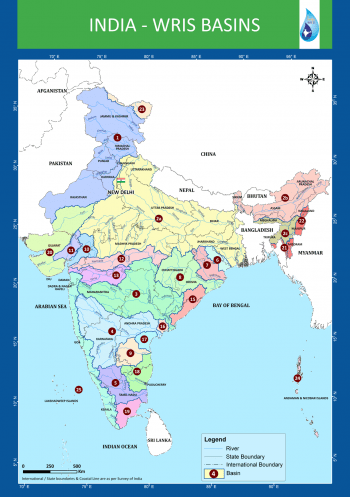
The Basin reports include basin level maps which also show the proposed inter basin transfer links and the major water resource structures & projects. Individual maps at the sub basin level mark the rivers & their watersheds. The report gives details on the topography, climate, the land use / land cover area , and also the information on hydro meteorological stations like groundwater observation cells, flood forecasting sites and even water tourism sites.
These reports can be downloaded from the WRIS site.[iii]
The reports are an attempt to document the water resources data & information for a better and more integrated planning, at the basin level. A table below tabulates some important parameters from the 20 basin reports.
Missing Dams! It can be seen from table on next page that total number of dams in all the 20 basins come to 4572. Assuming that this includes all the completed large dams in India by Dec 2013 (WRIS report is dated March 2014), if we look at the number of large dams in India as in Dec 2013 in the National Register of Large Dams (NRLD), the figure is 4845. This leaves a difference of 273 large dams, which are missing from the WRIS list! This seems like a big descripancy. Unfortunately, since NRLD gives only statewise list and does not provide river basin wise list and since WRIS list provides only river basin wise list and does not provide the names of districts and states, it is not possible to check which are the missing dams, but WRIS need to answer that.
Sub Basins These 20 basins have been further delineated into a number of sub basins. The sub basins details include the geographical extent of the sub basin, the rivers flowing in it, the states that they travel through, number and size range of watersheds and also the details of dams, weirs, barrages, anicuts, lifts & power houses, accompanied by maps at this level. The irrigation and hydro electric projects in the area are detailed and mapped for greater convenience. The sub basin list is given here to get a detailed picure.
Indus Basin Sub-basins:
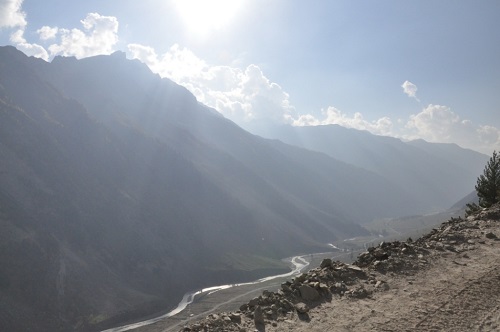
River Dras in Indus Basin in Jammu and Kashmir (Photo by Sabita Kaushal)
Beas Sub Basin
Chenab Sub Basin
Ghaghar and others Sub Basin
Gilgit Sub Basin
Jhelum Sub Basin
Lower Indus Sub Basin
Ravi Sub Basin
Shyok Sub Basin
Satluj Lower Sub Basin
Satluj Upper Sub Basin
Upper Indus Sub Basin
S. No
River Basin
Major river
No. of sub basins
No. of watersheds
No. of water resource structures
No. of water resource projects
Irrigation
Hydro Electric
Dams
Barrages
Weirs
Anicuts
Lifts
Power Houses
Major
Medium
ERM*
1
Indus (Upto border)
Indus (India)
11
497
39
13
18
0
45
59
30
40
21
55
2a
Ganga
Ganga
19
980
784
66
92
1
45
56
144
334
63
39
b
Brahmaputra
Brahmaputra (India)
2
180
16
17
5
0
4
21
9
13
3
17
c
Barak & others basin
Barak
3
77
4
3
0
0
0
3
0
6
3
3
3
Godavari
Godavari
8
466
921
28
18
1
62
16
70
216
6
14
4
Krishna
Krishna
7
391
660
12
58
6
119
35
76
135
10
30
5
Cauvery
Cauvery
3
132
96
10
16
9
24
16
42
3
15
6
Subernarekha
Subernarekha & Burhabalang
1
45
38
4
12
0
0
3
5
34
0
1
7
Brahmani & Baitarni
Brahmani & Baitarni
2
79
61
5
4
1
0
1
8
35
4
1
8
Mahanadi
Mahanadi
3
227
253
14
13
0
1
6
24
50
16
5
9
Pennar
Pennar
2
90
58
0
1
2
0
1
7
14
0
1
10
Mahi
Mahi
2
63
134
0
4
0
0
3
10
29
3
2
11
Sabarmati
Sabarmati
2
51
50
2
10
0
0
0
9
11
4
–
12
Narmada
Narmada
3
150
277
2
2
0
4
9
21
23
1
6
13
Tapi
Tapi
3
100
356
8
11
0
13
2
13
68
2
1
14
WFR Tapi to Tadri
Many independent rivers flowing
2
96
219
0
3
0
1
18
13
15
1
12
15
WFR Tadri to Kanyakumari
3
92
69
6
6
4
0
29
19
12
7
21
16
EFR Mahanadi_ Pennar
4
132
64
5
12
12
0
0
12
46
10
0
17
EFR Pennar _ Kanyakumari
4
165
61
2
2
11
0
6
13
33
4
5
18
WFR Kutch _ Saurashtra
Luni
6
268
408
1
10
0
0
0
8
100
4
15
19
Area of inland drainage in Rajasthan
Many independent rivers flowing
–
–
1
0
0
0
48
0
11
1
1
0
20
Minor rivers draining into Myanmar(Burma) & Bangladesh
Many independent rivers flowing
4
54
3
5
0
0
3
–
3
4
1
–
Total
94
4335
4572
203
335
* Extension, Renovation and Modernization ** Data has been accumulated from the individual Basin Reports from India WRIS[iv]
Ganga Basin
Yamuna Lower
Yamuna Middle
Yamuna Upper
Chambal Upper
Chambal Lower
Tons
Kosi
Sone
Ramganga
Gomti
Ghaghara
Ghaghara confluence to Gomti confluence
Gandak & others
Damodar
Above Ramganaga Confluence
Banas
Bhagirathi & others ( Ganga Lower)
Upstream of Gomti confluence to Muzaffarnagar
Kali Sindh and others up to Confluence with Parbati
Brahmaputra Basin It is strange to see that the profile divides this huge basin into just two sub basins, when it could have easily divided into many others like: Lohit, Kameng, Siang, Subansiri, Tawang, Pare, Teesta, Manas, Sankosh, among others.
Brahmaputra Lower
Brahmaputra Upper
Barak & Others Basin
Barak and Others
Kynchiang & Other south flowing rivers
Naochchara & Others
Godavri Basin
Wardha
Weinganga
Godavari Lower
Godavari Middle
Godavari Upper
Indravati
Manjra
Pranhita and others
Krishna Basin
Bhima Lower Sub-basin
Bhima Upper Sub-basin
Krishna Lower Sub-basin
Krishna Middle Sub-basin
Krishna Upper Sub-basin
Tungabhadra Lower Sub-basin
Tungabhadra upper Sub-basin
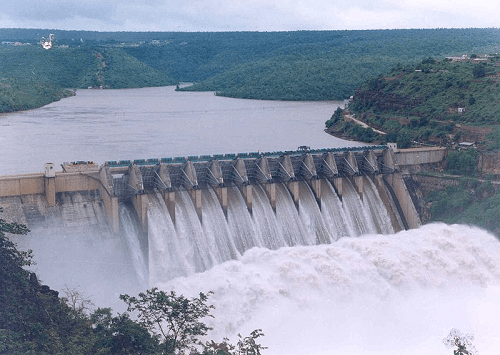
Srisailam Dam on Krishna River (Source: Wikipedia)
Cauvery Basin
Cauvery upper
Cauvery middle
Cauvery lower
Subernarekha Basin No sub-basins.
Brahmani & Baitarani Basin
Brahmani
Baitarani
Mahanadi Basin
Mahanadi Upper Sub- basin
Mahanadi Middle Sub- basin
Mahanadi Lower Sub- basin
Pennar Basin
Pennar Upper Sub-basin
Pennar Lower Sub-basin
Mahi Basin
Mahi Upper Sub-basin
Mahi Lower Sub-basin
Sabarmati Basin
Sabarmati Upper Sub- basin
Sabarmati Lower Sub-basin
Narmada Basin
Narmada Upper Sub-basin
Narmada Middle Sub-basin
Narmada Lower Sub-basin
Tapi Basin
Upper Tapi Sub- Basin
Middle Tapi Sub- Basin
Lower Tapi Sub- Basin
West flowing rivers from Tapi to Tadri Basin
Bhastol & other Sub- basin
Vasisthi & other Sub- basin
West flowing rivers from Tadri to Kanyakumari Basin
Netravati and others Sub- basin
Varrar and others Sub- basin
Periyar and others Sub- basin
East flowing rivers between Mahanadi & Pennar Basin
Vamsadhara & other Sub- basin
Nagvati & other Sub- basin
East Flowing River between Godavari and Krishna Sub- basin
East flowing River between Krishna and Pennar Sub- basin
East flowing rivers between Pennar and Kanyakumari Basin
Palar and other Sub-basin
Ponnaiyar and other Sub-basin
Vaippar and other Sub-basin
Pamba and other Sub-basin
West Flowing Rivers of Kutch and Saurashtra including Luni Basin
Luni Upper Sub-basin
Luni Lower Sub-basin
Saraswati Sub-basin
Drainage of Rann Sub-basin
Bhadar and other West Flowing Rivers
Shetrunji and other East Flowing Rivers Sub-basin
Area of inland drainage in Rajasthan Due to very flat terrain and non-existence of permanent drainage network, this basin has not been further sub divided.
Minor rivers draining into Myanmar and Bangladesh
Imphal and Others sub basin
Karnaphuli and Others sub basin
Mangpui Lui and Others sub basin
Muhury and Others sub basin
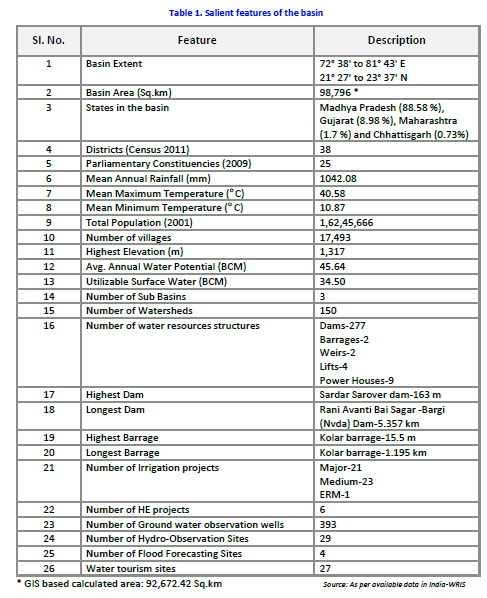
Narmada Basin: Some details To understand the compiled information at the basin level, we take a look at the one of the basin level reports, the Narmada Basin Report[v] (dated March 2014) as an illustrative example. An overview of the basin area right at the beginning, gives its geographical location, shape, size, topography, climate & population. This basic relevant information is tabulated in a concise table for easy access, as given below:
Salient Features of Narmada Basin from WRIS Basin Report
River information The major river flowing in the basin, the Narmada River (also called Rewa) that flows through the 3 states of Madhya Pradesh, Maharashtra & Gujarat, its length (1333 km) and the length of its 19 major tributaries out of a total of 41 is given, based on GIS calculations. There is also a clear river network map of the Narmada basin that demarcates the 3 sub basins along with the watersheds, and shows the dams / weirs /barrages and the rivers in the basin.
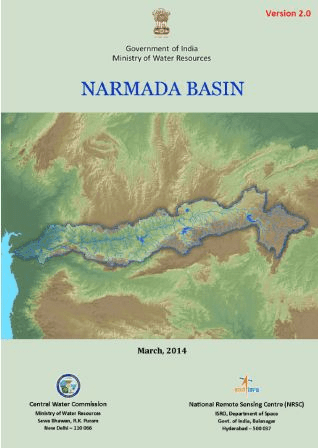
Narmada Basin Report Cover Page (Source: WRIS)
Narmada Upper Sub-Basin, with 16 watersheds
Narmada Middle Sub-Basin, having 63 watersheds
Narmada Lower Sub-Basin, with 71 watersheds
The surface water bodies details include the size (less than 25 ha to more than 2500 ha) and type (Tanks, lakes, reservoirs, abandoned quarries or ponds) of existing bodies. Nearly 91.8% of these are tanks.
Irrigation Projects The water resource projects in the basin are as follows:
21 Major Irrigation Projects
23 Medium Irrigation Projects
1 ERM Project
6 Hydro-Electric Projects
Interestingly description is only of the major and medium irrigation projects, information on minor projects is completely absent. An attempt to include the details of minor irrigation projects would have made the report more useful. The reports seem to not understand the significance of the smaller projects and their importance for the people and in the conext of the River Basin too.
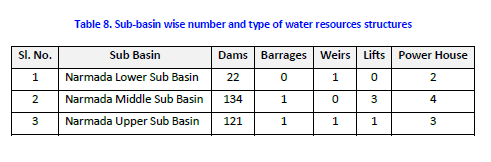
Water resource structures The number and type of big manmade structures in the basin is given. These are a total of 277 dams, 2 barrages, 2 weirs and 4 lifts, of which again the major structures are marked on a map, and details given as in table below. Dams are classified on the basis of storage and purpose they are used for, and the dam numbers are available at sub basin level.
Narmada Sub Basin details from WRIS Basin Report
The report gives tabulated data for each of the dams, which is supposed to have name of the river, height, length, purpose, year of commissioning, etc. Since GIS is the strength of ISRO, they could have easily given latitude and longitudes of each dam, but they have not. Shockingly, in case of 186 of the dams, name of the river on which it is built is given as ‘Local Nallah’, and in case of 10 they have left the column blank. This means for nearly 71% (196 out of 277) of the dams they do not even know the name of the river they are build on. This is actually an improvement over the performance of CWC. The CWC’s National Register of Large Dams[vi], we just checked, mentions Narmada only 13 times (for 12 dams of Gujarat and 1 dam of Madhya Pradesh).[vii]
It is well known that Narmada Basin is the theatre of India’s longest and most famous anti dam movement, Narmada Bachao Andolan. The movement involves opposition to Sardar Sarovar, Indira Sagar, Omkareshwar, Maheshwar, Jobat dams, among others. Such social aspects should also form part of any river basin report.
Surface water quality There are 19 surface water quality observation sites in the basin, that collect water data and the report spells out , “As compared to the other rivers, the quality of Narmada water is quite good. Even near the point of origin, the quality of river water was in class ‘C’ in the year 2001 while it was in class ‘B’ in earlier years. As was observed for most other rivers, in case of Narmada also, BOD and Total Coliform are critical parameters.” This shows that even in Narmada Basin, water quality is deteriorating. The statement also remains vague in absence of specifics.
Inter basin transfer links Details of the Par-Tapi-Narmada Link, which is a 401 km long gravity canal and its proposal to transfer 1,350 MCM (Million Cubic metre) of water from ‘surplus rivers’ to ‘water deficit’ areas is given, along with a map. How has the conclusion of surplus or deficit been reached? Does the assessment exhaust all the options including rainwater harvesting, watershed development, groundwater recharge, better cropping patterns and methods, demand side management, optimising use of existing infrastructure, etc? Is this is the least cost option? Does the water balance include groundwater? Who all will be affected by this or even how much land area will be affected by this proposal, there is absolutely no talk of this? No answers in the report.
India River Basins Map (Source – WRIS)
There’s more to a river There is no information in basin reports on the regulating or statutory bodies that have a say in the basin in the report. However, some information on the existing organisations and inter-state agreements at the various basin level is given at another WRIS location.[viii]
The Basin reports for 20 basins are clearly an asset for understanding and analysing water resource situation. However, there is no mention of the numerous ecological, social and environmental services these rivers provide us with. The demographic details of the basin are available, but there is no information on the flora and fauna, who also need and thrive on the river waters. A good navigation tool for water resource information and river management projects at basin level, nevertheless, for a broader and more comprehensive outlook these reports should have included the following essential aspects too:
River status: The present water quality & pollution level of the major rivers as well as their tributaries
River governance: The local committees, civil bodies and institutions that play a role in river basin development
River safety measures: Effect of the existing and planned river management projects on the state of the river, people and society.
River ecology: Status of biodiversity, and other ecological aspects of the rivers




 SANDRP