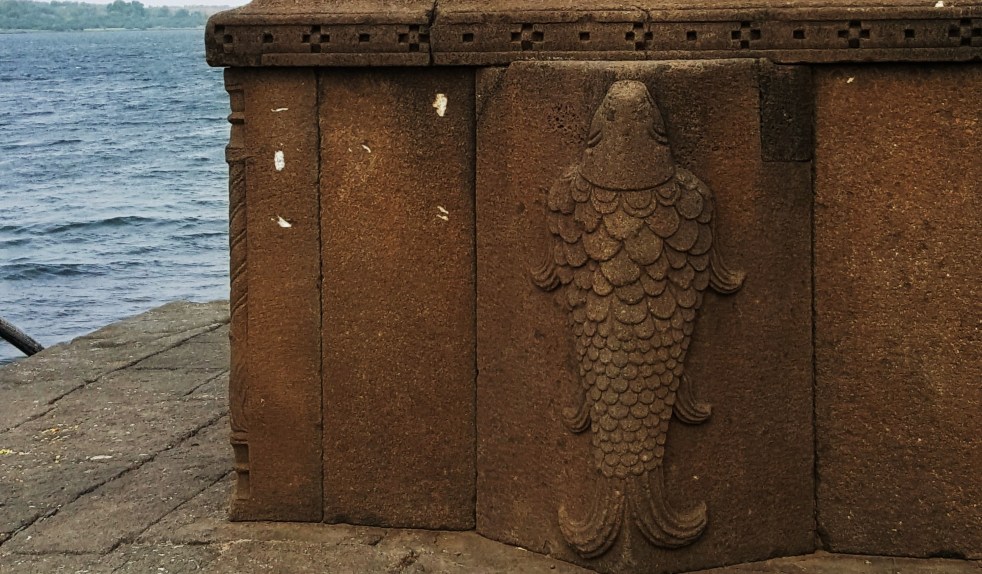
What separated Maheshwar Ghats on the mighty Narmada from most other rivers I have seen was the sheer gaiety and joy which people were experiencing, jumping in the Narmada. The beautiful, jutting steps of the ghats were designed (and used) like diving boards by men, boys and women. For someone who had just seen a dry Godavari and drier rivers of Marathwada, this mirth was therapeutic. Ferry Boats and laidback ferrymen were relaxing on the river, bobbing up and down rhythmically. In the distance was a tiny sailboat, held together by white fluttering sails, zipping through the waters at a startling speed without the din of a diesel engine. A fisherman and his daughter were returning to their village, taking stock of their catch.. Occasional fish rose above the waters and glistened in the evening sun. Continue reading “नदी के बदले नदी दे सकते है? ..on Maheshwar, Narmada and fishing communities of India”
Tag: Narmada

CWPRS: A 100-year-old institute remains uni-dimensional; has no achievement to show
Jawaharlal Nehru who famously celebrated large dams as “temples of modern India” later termed them as “disease of giganticism”.[i] The fascination wore out after witnessing the huge sacrifice of the vulnerable and unfulfilled promises. Government of India however has continued with the worship of giant structures such as big dams, ports, hydropower projects etc. Even after nearly seven decades of independence, ‘engineering approach’ still dominates the idea of river planning which views river as an entity to be engineered and planned for irrigation, hydropower, industrial and urban water use rather than as a living eco-system. 17 study models that were displayed at Central Water and Power Research Station (CWPRS) open house day at Khadakwasla near Pune on June 14, 2016, its completion of 100 years of existence, stood testimony to this. Continue reading “CWPRS: A 100-year-old institute remains uni-dimensional; has no achievement to show”

Borewell water in a concretized Ramkund: Has religion helped Rivers at all?
A couple of years ago, we were travelling from Dehradun to Delhi and on my left was the massive Bhimgouda barrage which diverted the Ganga through Upper Ganga Canal at Haridwar. The barrage diverted the entire river, so that the downstream of the barrage, Ganga River was bone dry. Even for an agnostic like me, it was disturbing to see the mighty Ganga dried out like this so close to her origin. But just a couple of hundred meters ahead on the right were Har ki Pauri Ghats where Pilgrims were religiously performing Ganga Arati. There was a highly colored cement statue of Ganga precariously balancing on her gharial, in the middle of the canal. Continue reading “Borewell water in a concretized Ramkund: Has religion helped Rivers at all?”

DRP: 6 June 2016 (India to be power surplus for next 3 yrs: why govt continue to pursue hydro projects)
India will not have power deficit situation in FY17 India won’t need any new power plants for the next three years as it is flush with generation capacity, according to a government assessment. The country can manage for the next three years with existing plants that are currently under-utilised, and those that are under construction and upcoming renewable energy projects, assessment made by the power ministry for reviewing the National Electricity Policy shows. Govt declares for the first time in history that India is POWER SURPLUS in 2016-17 with 3.1% power surplus in peak hours and 1.1% power surplus in off peak hours, both figures in 2015-16 were -3.2% during peak hours and -2.1% in peak hours. The western and Southern regions will be power surplus, but Northern, Eastern and Northeastern regions will have deficits. At the same time Power Minister Piyush Goyal says that Big hydro power units may come under renewable energy According to Minister the Centre has begun studies to decide whether to include big hydro power plants under the ambit of renewable energy. When India will be energy surplus for next three years why then Govt. of India is continue to pursue disastrous hydro projects on ground. Where ASSOCHAM is asking Arunachal govt. to do away with adverse tax policies on Hydro power to boost construction of hydro projects in the State. NHPC has also raised relief amount for Kishanganga HEP around Rs 60 lakh and Rs 70 lakh to each family for the land acquired. And despite Delhi Govt. openly rejecting water from Renuka dam NGT panel has visited the area to look into the rehabilitation issue.
Continue reading “DRP: 6 June 2016 (India to be power surplus for next 3 yrs: why govt continue to pursue hydro projects)”DRP: 30 May 2016 (Centre’s new wetland protection rules reinforces the stereotype: wetlands = wastelands)
Centre’s new wetland protection rules reinforces the stereotype that govts see wetlands as wastelands The draft Wetlands (Conservation and Management) Rules, 2016 which replace the existing Wetland (Conservation and Management) Rules, 2010, are up for public comments till June 6, 2016. While wetlands nationwide are threatened by encroachment, pollution, catchment degradation and mindless development, the Narendra Modi government’s draft rules show no indications of acknowledging this threat. The draft rules, environmentalists say, reinforces the stereotype that governments see wetlands as wastelands. The essence of the new rules is to decentralise wetlands management to states. The Centre will have a say only in ‘exceptional cases’ While the 2010 rules gave some role to states, the draft rules gives them all powers. But in the process, the whole conservation process has been weakened. The period for public comments on the draft notification ends by the month. Several organisations, including BHNS, WWF, LIFE, International Rivers, INTACH, YJA & SANDRP have sent, or are in the process of sending, representations to the environment ministry. Among the concerns is that the 2010 rules itself were barely getting implemented. No state has identified a wetland yet, and few have made state-level nodal agencies mandated by the 2010 rules. In an ongoing case before the NGT, it emerged that states had not notified wetlands under the 2010 regulations. This forced the tribunal to demand that states begin to do so in at least 5-10 districts in a time-bound fashion. The Union meanwhile has proposed to substantially change the existing regulations. The new regulations do away with the elaborate list of activities that are prohibited or restricted. It prohibits reclamation of wetlands, conversion to non-wetlands, diversion or impediment of inflows and outflows from the wetland and ‘any activity having or likely to have adverse impact on ecological character of the wetland’. The need for the environmental impact assessment before permitting such activities is to be done away with. The earlier regulations allowed appeals against the decisions of the central wetlands authority with the NGT. This, too, is to be done away with, though aggrieved entities could continue to file cases against violations of these rules. The concerns were also raised during a discussion organized in Jodhpur on May 23 by three NGOs EIA Resource and Response Centre, Libra India and Life on Draft Wetland Rules 2016 issued recently by the environment ministry seeking suggestions and comments.
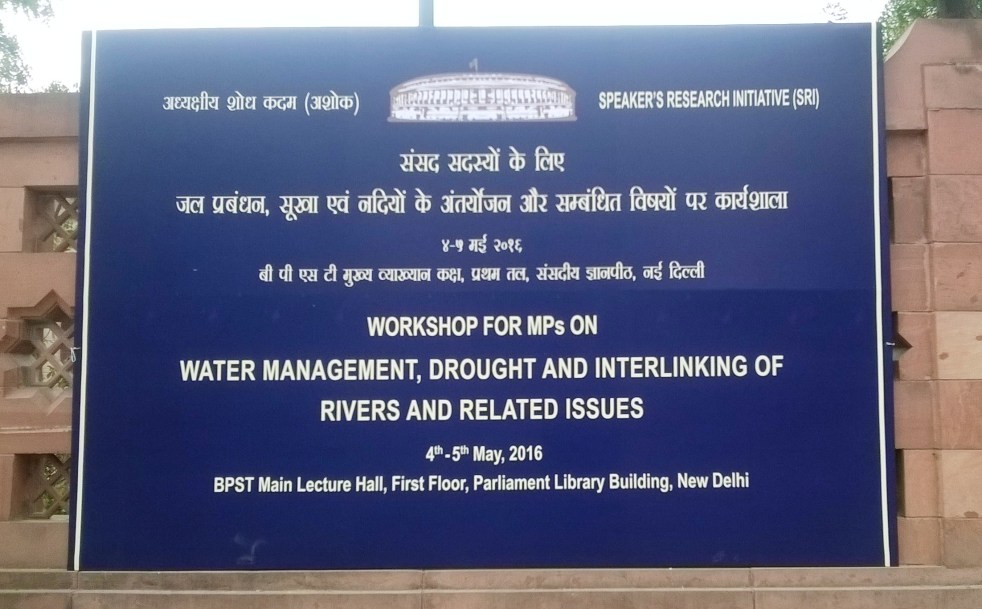
DRP: 9 May 2016 (Welcome initiative by Lok Sabha Speaker on draught and ILR)
On May 4-5, 2016, Lok Sabha Speaker Smt Sumitra Mahajan took the lead in organising a workshop for Members of Parliament on Drought, Agrarian Crisis and ILR. As part of the newly constituted Speaker’s Research Initiative’s (SRI for short) work, Smt Mahajan inaugurated the workshop at 4 pm on May 4, 2016, where a panel of eight speakers were invited (4 on each day, SANDRP coordinator was one of the invited speakers on 1st day) to share their views, followed by questions from Members of Parliament. The idea was that on these important issues, Parliament Members are better equipped to raise the relevant issues when debating and raising questions in Parliament. It was heartening to see that at least 90 MPs (88 from Lok Sabha and 2 on Rajya Sabha) were present for 2.5 hours on first day, and they wanted to ask so many questions that there was not sufficient time to allow all of them to ask, nor sufficient time for speakers to make full presentations or answer all the questions. Similarly on second day too Speakers showed lot of interest on these issues. While inaugurating the workshop, Smt Mahajan mentioned how in Solapur, Maharashtra, because of the work of the collector and his team of officials, the impact of drought is lower than that in other districts. This was certainly heartening since it was SANDRP Associate Coordinator Parineeta Dandekar who first wrote on this issue, following her visit to Solapur and interview with the district collector. The workshop highlighted the need for many such workshops, possibly more focussed, but the impact of the workshop was already visible in the (as yet unfinished) debate under section 193 that started in Lok Sabha on May 5, 2016, hopefully to be continued in current week.
Continue reading “DRP: 9 May 2016 (Welcome initiative by Lok Sabha Speaker on draught and ILR)”
DRP: 11 April 2016 (Harsh Summer: In Search of Green Pastures)
With ponds and lakes drying up, cattle in Telangana are forced to travel long distances for fodder and water. Here, buffaloes are moving towards a water source near Medipalli in Adilabad district on 09 April.
Continue reading “DRP: 11 April 2016 (Harsh Summer: In Search of Green Pastures)”
DRP: 4 April 2016 (India Water Week shows absence of fresh thinking from water resources establishment)
SANDRP Comments India Water Week continues to show absence of any fresh thinking from water resources establishment The 4th India Water Week being organized by Union Ministry of Water Resources, River Development and Ganga Rejuvenation during April 4-8, 2016 in Delhi shows continued absence of any fresh thinking from water resources establishment.
The Information Brochure of the event says: “Ministry of Water Resources, RD & GR is to organize the India Water Week -2016 between April 4-8, 2016 to use it as a platform to elicit ideas and opinions from global level decision makers, politicians, researchers and entrepreneurs in the field of water resources for mutual benefit and goodwill… This is the fourth event of its kind with the theme “Water for all : Striving together” focusing on improving efficiencies of water use across all sectors… ”
DRP: 7 March 2016 (Sudden water discharge from Chamera-II hydro Project in Himachal killed 2 Air Force jawans)
Sudden water discharge from Chamera-II hydro project killed 2 IAF jawans In the evening of 05 March, 2 Indian Air Force (IAF) personnel posted at the Pathankot airbase were washed away by sudden rise in Ravi’s water level from Chamera-II hydro project in Chamba, Himachal Pradesh while 3 other personnel had a close shave. According to Sudesh Mokhta Deputy Commissioner Chamba the 5 IAF personnel on a weekend holiday trip were clicking pictures on the river bank at the time of the incident when the water of the river rose suddenly after discharge from upstream Chamera-II project. The incident happened around 6.30 pm and due to darkness, the search operation remained unsuccessful. It was only on 06 March that the bodies were fished out. Mokhta further stated that a magisterial probe has been ordered to ascertain if the NHPC authorities, which man the Chamera-II project, followed the guidelines laid down by the high court for the discharge of water. On 08 June 2014 also during a similar accident, 24 students from Hyderabad were killed by sudden discharge of water from Larji hydel project dam in Mandi district.
DRP: 22 Feb. 16 (Unprecedented water crisis in Delhi due to Jat quota stir)
Unprecedented water crisis in Delhi due to Jat stir Terming the water crisis in the national capital as “unprecedented”, Delhi minister Kapil Mishra has warned that the situation might worsen in the next few days if the supply from Haryana is not immediately restored. He said the Delhi Jal Board (DJB) had almost run out of water and advised people to use water judiciously. Delhi gets its bulk of water supply from Haryana and the stir has affected 65% of water supply in Delhi has been cut with the shutting down of seven water treatment plants— Wazirabad, Chandrawal, Dwarka, Okhla, Haiderpur, Nangloi and Bawana which provide around 500 million gallons per day (MGD). In all Delhi has nine water treatment plants which together produce 820 MGD of potable water. Of these, only two Sonia Vihar and Bhagirathi fed by water from Uttar Pradesh are operational. The current production is only 240 MGD. Among the areas affected were Dwarka, Janakpuri, Munirka, Palam, Rajouri Garden, Punjabi Bagh, Vasant Kunj, Saket, Green Park and Lodhi Colony, where residents complained of little or no water. In another news report DJB is reported to have made 140 water filling points functional to feed tankers which would be sent across the city, reeling under an unprecedented water crisis. Water Minister Kapil Mishra reviewed the contingency plan for water management in West, North, North-west, Outer and Central Delhi and said tankers will deliver water at 663 points to partially meet the shortage of 480 MGD. These points will keep rotating. Plan is to cover around 2,000 points by Monday evening. The DJB supplies around 900 MGD of water daily out of which around 600 MGD of raw water come from Munak Canal. Even if Haryana releases water immediately, it will take at least 24 hours to restore the supply. Meanwhile Supreme Court on 22 Feb.16 scolded Delhi government. for approaching the court instead of resolving the water crisis with Haryana. The Kejriwal government had approached the top court on in view of the severe water crisis in the national capital after Jat protesters blocked water supply through Munak canal in Sonipat. During the hearing on government’s plea, the court took strong objection to Water Minister Kapil Mishra’s presence inside the courtroom. On the other hand, the minister accuses Haryana & Central Government for providing no official information on the crisis He said the Delhi government was “repeatedly trying to communicate” with the two governments to find out when will the supply resume, but without much success. Also see Jat quota stir: Water supply cut, Delhi may go dry
Continue reading “DRP: 22 Feb. 16 (Unprecedented water crisis in Delhi due to Jat quota stir)”
 SANDRP