DRP News Bulletin

DRP NB 150523: Will the govt listen to caveats against Ken Betwa Project?

The following report raises three caveats regarding Ken Betwa River Link Project, among others. Firstly it urges that the substantial impact of climate change on the rivers needs to be taken into account, particularly the need for accurate hydrological assessment. It underlines that the project themselves are accelerating the climate change impact on monsoons as they are reducing freshwater flows to the oceans, which in turn has an impact on the ocean’s thermal and salinity gradients, both of which are drivers of monsoon.

Secondly, it rightly says that the impact of projects on adaptive capacity of areas like Bundelkhand needs to be taken into account. In Bundelkhand, climate adaptation can be harnessed using rain water harvesting, rejuvenation of traditional water systems, less water intensive crops and alternative agricultural practices. Thirdly, the water sharing issues that may worsen with both climate change and big projects, need to be kept in mind while taking up mega projects, particularly its impact on water and other security issues.

Continue reading “DRP NB 150523: Will the govt listen to caveats against Ken Betwa Project?”
Dams · DRP News Bulletin

DRP News Bulletin 02 October 2017 (New Rules Disastrous For India’s Wetlands)

The wetlands are the hotspots of biodiversity, act as carbon sinks, act as buffers against floods and are essential for groundwater recharge. With groundwater reservoirs in the country heavily exploited, this last function has assumed greater importance. http://www.hindustantimes.com/environment/centre-notifies-wetland-rules-environmentalists-unhappy/story-3MoGp9D8eSzHI90zfOXWSO.html

Wetlands can be defined as lands transitional between terrestrial and aquatic eco-systems where the water table is usually at or near the surface or the land is covered by shallow water.

But they are threatened by reclamation and degradation due to activities like drainage and landfill, pollution, hydrological alteration (water withdrawal and changes in inflow and outflow), over-exploitation resulting in loss of biodiversity and disruption in ecosystem services provided by them.

DRP 12

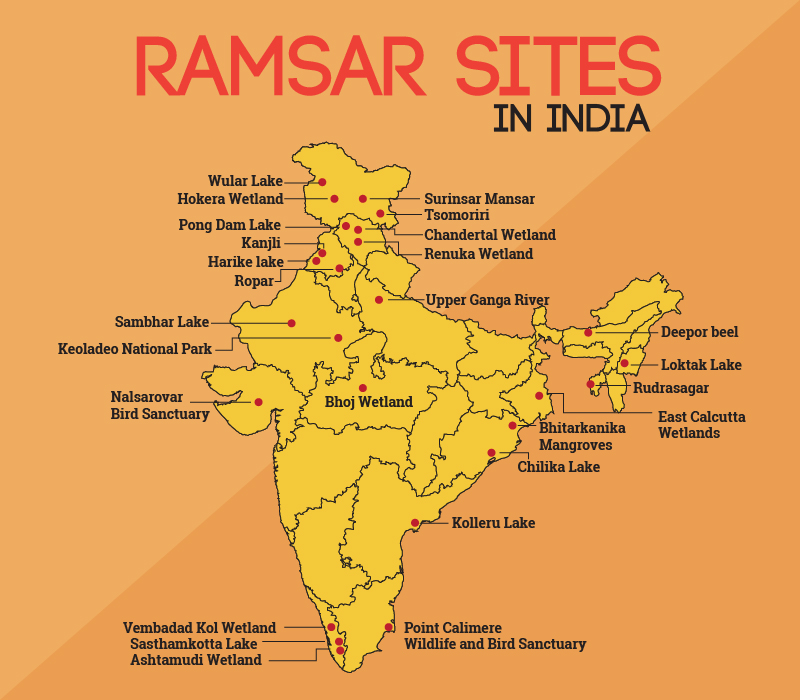
There are at least 115 wetlands that are officially identified by the central government and of those 26 are identified as wetlands of international importance under Ramsar Convention which is an international intergovernmental treaty for conservation of wetlands. India is a party to the treaty. http://www.livemint.com/Politics/y6Tr3tkrr3q28AmGKaBFII/Environment-ministry-notifies-new-wetland-rules.html

The Centre on September 26 notified a new set of rules under the head Wetlands (Conservation and Management) Rules, 2017 replacing the Wetlands (Conservation and Management) Rules, 2010. http://www.thehindu.com/news/national/kerala/new-wetland-conservation-rules-notified/article19779100.ece

It is worth to mention that under the 2010 rules, not a single water body was notified as a wetland over and above the ones already recognised as such by the Centre and the Ramsar Convention, defeating its purpose in a way. http://www.zeebiz.com/agencies/centre-notifies-new-rules-for-preservation-of-wetlands-26312

Similarly, despite country’s space agency ISRO had in 2011 mapped over two lakhs of wetlands across the country, the centre has, so far, notified only 115 wetlands and 63 lakes in 24 states and 2 UTs for conservation and management.

Continue reading “DRP News Bulletin 02 October 2017 (New Rules Disastrous For India’s Wetlands)”