DRP News Bulletin

DRP NB 131123: Another Himalayan Disaster: 40 workers trapped in a tunnel in Uttarakhand

Continue reading “DRP NB 131123: Another Himalayan Disaster: 40 workers trapped in a tunnel in Uttarakhand”
DRP News Bulletin

DRP NB 231023: Need to be a little serious about Dam Safety, Flood Forecasting, Use of Early Warnings

Continue reading “DRP NB 231023: Need to be a little serious about Dam Safety, Flood Forecasting, Use of Early Warnings”
DRP News Bulletin

DRP NB 161023: Kaddam Dam Rehabilitation in Telangana: Many more will need this

Continue reading “DRP NB 161023: Kaddam Dam Rehabilitation in Telangana: Many more will need this”
DRP News Bulletin

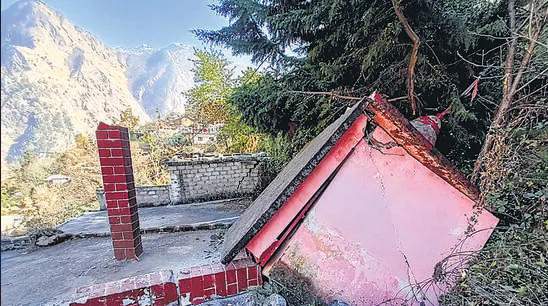
DRP NB 021023: Why this culture of opaque governance around Joshimath?

Continue reading “DRP NB 021023: Why this culture of opaque governance around Joshimath?”
DRP News Bulletin

DRP NB 110923: Another independent institution-CEC destroyed

Continue reading “DRP NB 110923: Another independent institution-CEC destroyed”
DRP News Bulletin

DRP NB 030723: Peak Hour Tariffs to be implemented from April 2024

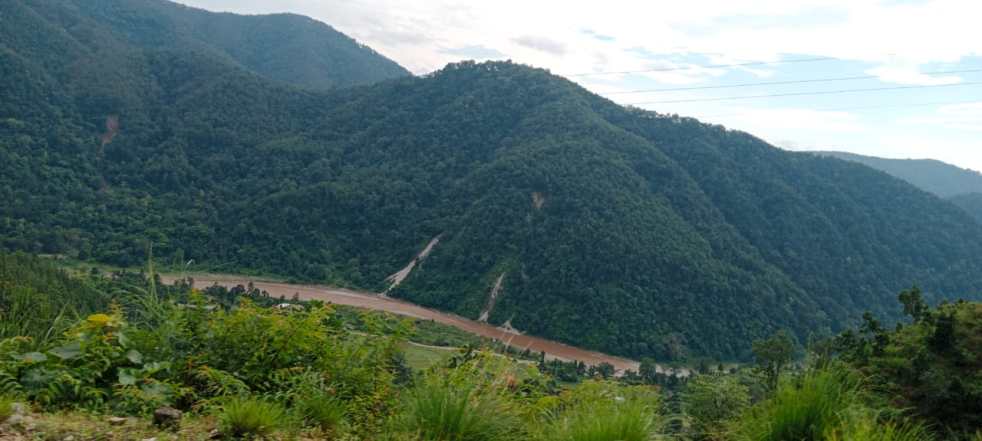
(Feature Image: Vyasi HEP power station at Hathyari, Dehradun. SANDRP, June 2023)

This announcement by the government is indeed much belated but welcome step that India plans to increase peak hour power tariff compared to non-peak hour power tariff, beginning with commercial and industrial consumers from April 2024 a year later for others excluding agriculture consumers. The notification mentions it as daytime tariff (during solar hours) and night time power use, but this essentially also helps peak management.

This will not only put a premium on peak hour power consumption and hence generation, but also hopefully ensure that assessment of impacts of the peak hour power generation including at hydropower projects is done and done in a credible way, along with compensating those affected. It will also hopefully ensure that existing hydro capacity is used optimally for peak hour power generation before going for new hydro projects in the name of increasing peak our power generation.

One also hopes that it will lead to better peak hour power management and also considering all the options for such power generation rather than pushing hydro projects blindly in the name of peak hour power generation.

Continue reading “DRP NB 030723: Peak Hour Tariffs to be implemented from April 2024”
DRP News Bulletin

DRP NB 190623: Ten years of Uttarakhand Flood disaster

(Feature Image: Thousands of people have been rescued but the inability of rescue teams to navigate disaster-struck areas has left over 60,000 people stranded in Uttarakhand. The Hindu, 19 June 2013)

This week marks ten years since the Uttarakhand flood disaster of June 2013, the worst recorded disaster in the state. The deaths and destruction in the disaster were unprecedented. Large parts of the deaths and destruction were due to man-made causes. Climate Change played its anthropogenic role too as the unprecedented rainfall happened even before the monsoon was set in. Even the Supreme Court took suo motu cognizance of the disaster and ordered halt to all hydropower projects and independent review of them. One of the major human causes that worsened the disaster was the lack of credible disaster prevention and management systems.

One expected that we and particularly our all powerful governments in the state and the Centre would learn lessons from such an unprecedented, such a massive destructive disaster. The first step to that would have been credible reporting of what exactly happened during the disaster, which agencies played what role and how the destruction could have been reduced. That such a report does not exist even today says a lot.

Continue reading “DRP NB 190623: Ten years of Uttarakhand Flood disaster”
DRP News Bulletin

DRP NB 150523: Will the govt listen to caveats against Ken Betwa Project?

The following report raises three caveats regarding Ken Betwa River Link Project, among others. Firstly it urges that the substantial impact of climate change on the rivers needs to be taken into account, particularly the need for accurate hydrological assessment. It underlines that the project themselves are accelerating the climate change impact on monsoons as they are reducing freshwater flows to the oceans, which in turn has an impact on the ocean’s thermal and salinity gradients, both of which are drivers of monsoon.

Secondly, it rightly says that the impact of projects on adaptive capacity of areas like Bundelkhand needs to be taken into account. In Bundelkhand, climate adaptation can be harnessed using rain water harvesting, rejuvenation of traditional water systems, less water intensive crops and alternative agricultural practices. Thirdly, the water sharing issues that may worsen with both climate change and big projects, need to be kept in mind while taking up mega projects, particularly its impact on water and other security issues.

Continue reading “DRP NB 150523: Will the govt listen to caveats against Ken Betwa Project?”
DRP News Bulletin

DRP NB 240423: The world is moving away from Big Dams: Are we?

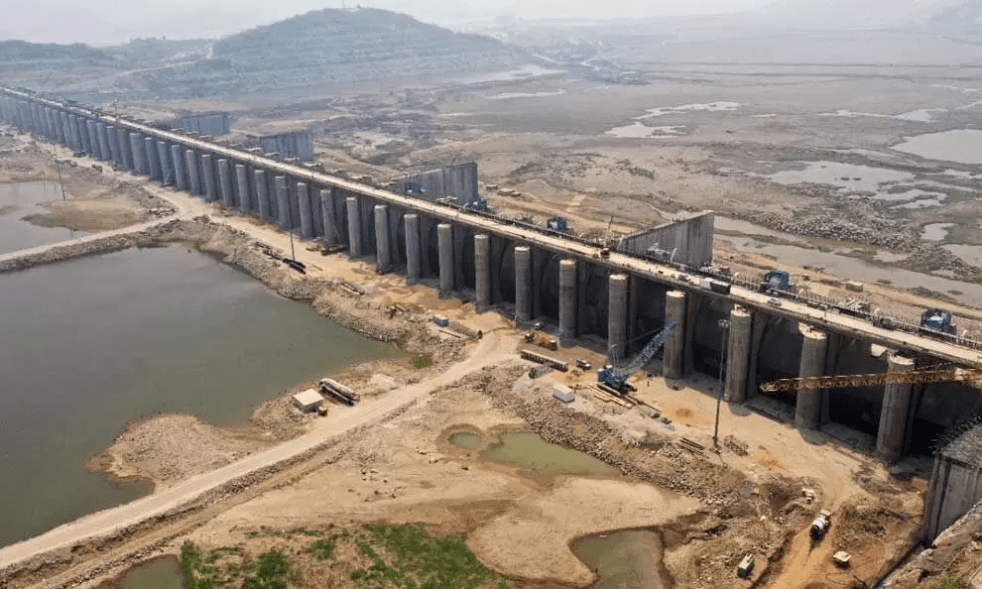
(Feature Image: Construction works going on at Polavaram Dam site. Source: The Hans Media, May 2021)

This well substantiated report from Yale School of Environment this week shows that the end of the big dam era is approaching. The well argued report from Jacques Leslie uses the reports from UN University, International Renewable Energy Agency, Oxford University, Inclusive Development International, China, among others to show how the pace of construction of dams and hydropower projects and also pace of financing such projects have hugely reduced in recent years and decades.

Even the International Hydropower Association, sensing the change, is now advocating pump storage hydro rather than conventional hydro and that too off stream version, to complement the power from solar and wind. Emerging economics with rising cost of hydropower projects and rising cost of power from such projects compared to solar, wind (onshore and offshore) are a major reason for the massively slowing pace of new hydropower projects.

Continue reading “DRP NB 240423: The world is moving away from Big Dams: Are we?”
DRP News Bulletin

DRP NB 030423: IRENA confirms bleak future of Large Hydro globally

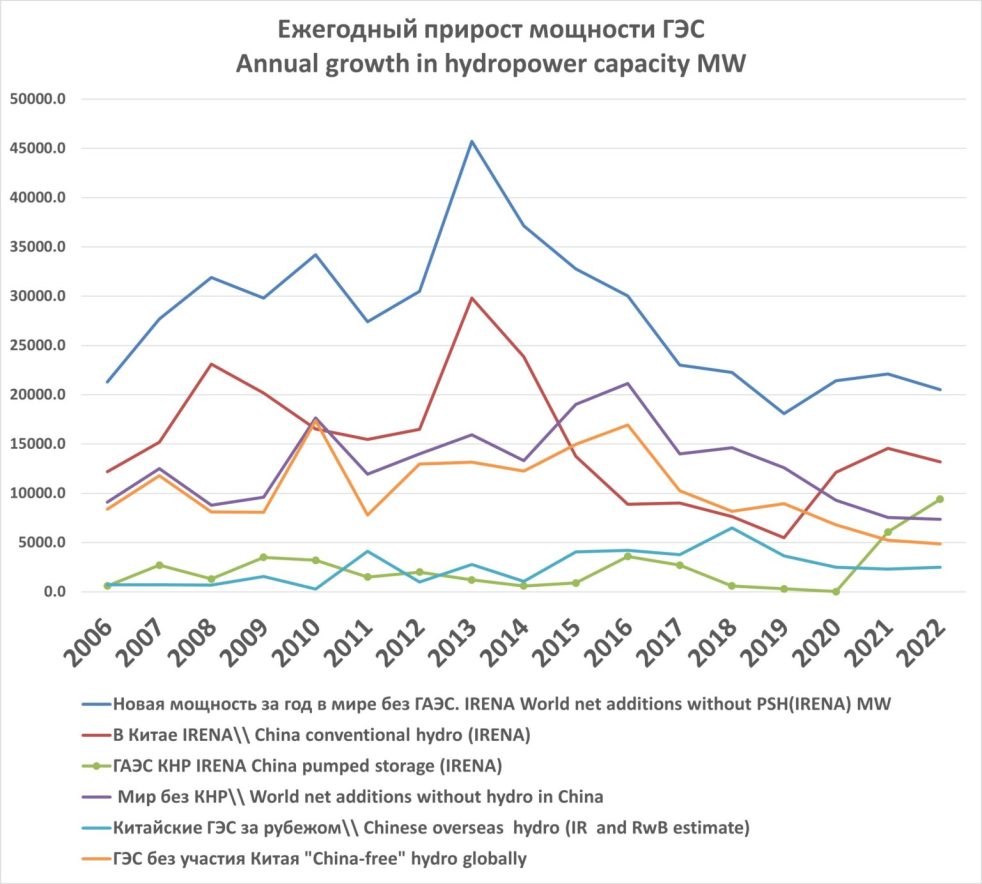
(Feature Image: Graph showing annual growth in hydro power capacity in MW. Source: Rivers Without Boundaries, April 01, 2023)

The annual Renewable Statistics 2023 report from IRENA (International Renewable Energy Agency) says that globally, only 1.6% was added to the hydropower capacity in 2022, that too two thirds in non-democratic China. The capacity added in rest of the world outside China in 2022 was 7.3 GW, lowest figure in last 15 years. Similarly 99% of additional capacity added in pump storage projects in 2022 was in China. The report from IRENA also says that 97% of hydropower finance comes from public or government sources and private sector seems to have little enthusiasm for this sector. The projections for future painted in the report is no better. This is broadly in line with our lead story in DRP News Bulletin last week (dated March 27 2023) painting bleak future of large hydropower projects.

Continue reading “DRP NB 030423: IRENA confirms bleak future of Large Hydro globally”