Dams · DRP News Bulletin

DRP News Bulletin 02 October 2017 (New Rules Disastrous For India’s Wetlands)

The wetlands are the hotspots of biodiversity, act as carbon sinks, act as buffers against floods and are essential for groundwater recharge. With groundwater reservoirs in the country heavily exploited, this last function has assumed greater importance. http://www.hindustantimes.com/environment/centre-notifies-wetland-rules-environmentalists-unhappy/story-3MoGp9D8eSzHI90zfOXWSO.html

Wetlands can be defined as lands transitional between terrestrial and aquatic eco-systems where the water table is usually at or near the surface or the land is covered by shallow water.

But they are threatened by reclamation and degradation due to activities like drainage and landfill, pollution, hydrological alteration (water withdrawal and changes in inflow and outflow), over-exploitation resulting in loss of biodiversity and disruption in ecosystem services provided by them.
DRP 12

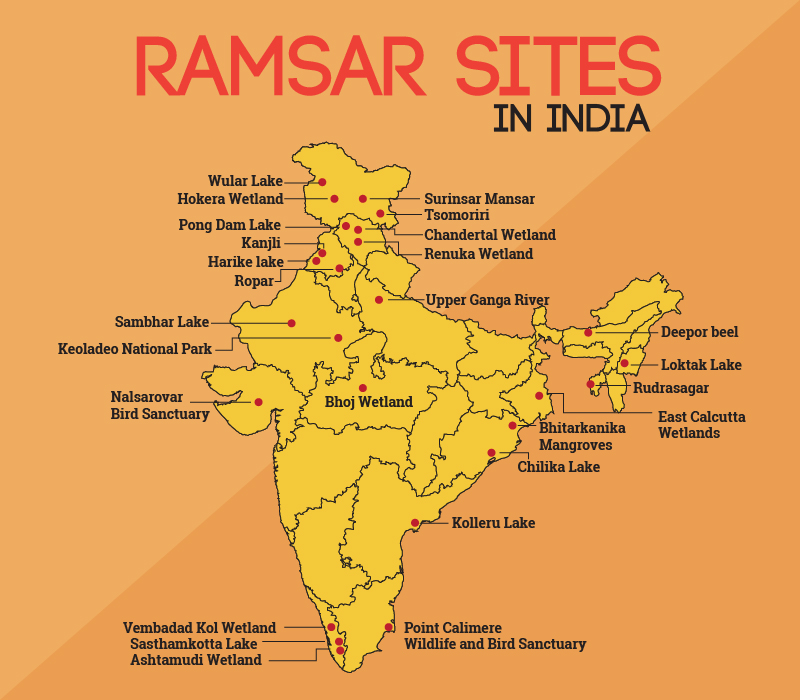
There are at least 115 wetlands that are officially identified by the central government and of those 26 are identified as wetlands of international importance under Ramsar Convention which is an international intergovernmental treaty for conservation of wetlands. India is a party to the treaty. http://www.livemint.com/Politics/y6Tr3tkrr3q28AmGKaBFII/Environment-ministry-notifies-new-wetland-rules.html

The Centre on September 26 notified a new set of rules under the head Wetlands (Conservation and Management) Rules, 2017 replacing the Wetlands (Conservation and Management) Rules, 2010. http://www.thehindu.com/news/national/kerala/new-wetland-conservation-rules-notified/article19779100.ece

It is worth to mention that under the 2010 rules, not a single water body was notified as a wetland over and above the ones already recognised as such by the Centre and the Ramsar Convention, defeating its purpose in a way. http://www.zeebiz.com/agencies/centre-notifies-new-rules-for-preservation-of-wetlands-26312

Similarly, despite country’s space agency ISRO had in 2011 mapped over two lakhs of wetlands across the country, the centre has, so far, notified only 115 wetlands and 63 lakes in 24 states and 2 UTs for conservation and management.

Continue reading “DRP News Bulletin 02 October 2017 (New Rules Disastrous For India’s Wetlands)”

Dams · DRP News Bulletin

DRP News Bulletin 11 September 2017 (Why This Rally Won’t Help The Rivers?)

The news media is filled with this new kid on the block, trying to wake the nation about the need to save our rivers… amazing to see so many film stars, politicians, governments, and public personalities, many of them rather innocently joining the band wagon… some friends were pleading that see, he is able to take the message of rivers to so many people, including lakhs of children… let us try and see if there is something positive here… may be, may be this is just the entry point, but the guy and his team have bigger vision? May be we need to give him longer rope, be more charitable and not jump to negativity?

We have kept all this in mind while writing this.

We see nothing from the people who are leading the rally, or their websites or messages that they understand the real threats faced by and reasons for the state of our rivers, are ready to even list such causes or protest any further move to destroy our rivers. The website claims it is “a nationwide awareness campaign to revive our rivers”. Can missed call save our rivers?

Continue reading “DRP News Bulletin 11 September 2017 (Why This Rally Won’t Help The Rivers?)”

Dams · DRP News Bulletin

DRP News Bulletin 04 September 2017 (Uma Bharti Shifted, But Do Ganga Or India Have Better Hopes From Gadkari?)

In the Cabinet Reshuffle on Sept 3, 2017, Uma Bharti has been removed as Union Ministry of Water Resources, River Development and Ganga Rejuvenation, for what media is widely calling as her non-performance (http://indiatoday.intoday.in/story/uma-bharti-ganga-experts-cabinet-reshuffle/1/1039555.html).

Unfortunately, some in Media are rather valiantly trying to show that she did achieve something (see for example: http://indianexpress.com/article/india/nitin-gadkari-60-minister-water-resources-river-development-ganga-rejuvenation-ganga-clean-up-the-biggest-challenge-4827277/), when what they are showing only the claims of expenditure or achievement of the ministry, no real achievement on ground based on independent scrutiny or evidence.

Mr Nitin Gadkari has been given the charge of this ministry in addition to his current charge of Ministry of Surface Transport. The first thing that strikes about Mr Gadkari is that as minister in current government he has been strong advocate for use of rivers for inland navigation and he also achieved through an act in Parliament, listing of 111 main stretches of rivers for this purpose. In the initial few months of this government in power, he actually publicly said that he wants to build a barrage every 100 km along Ganga, which he latter said could be done every 50 km. The impact of one existing such barrage on Ganga for navigation, namely Farakka is well known, and it is so severe that MPs and now even Bihar’s current Chief Minister have been demanding decommissioning of the barrage. Indeed, there are huge social and environmental impacts of use of rivers for navigation, but Mr Gadkari’s ministry has been pushing the case that there is no need for even social and environmental impact assessment of the inland navigation plans or activities. Now it will be interesting to see what does Mr Gadkari says about this as Minister of Water Resources, River Development and Ganga Rejuvenation. If past is any guide, it does seem that Ganga, Brahmaputra and other rivers on the list of inland navigation could be in for greater deterioration rather improvement.

Continue reading “DRP News Bulletin 04 September 2017 (Uma Bharti Shifted, But Do Ganga Or India Have Better Hopes From Gadkari?)”

Dams · DRP News Bulletin

DRP News Bulletin 03 July 2017 (Panna Villagers Oppose Ken-Betwa Link Project)

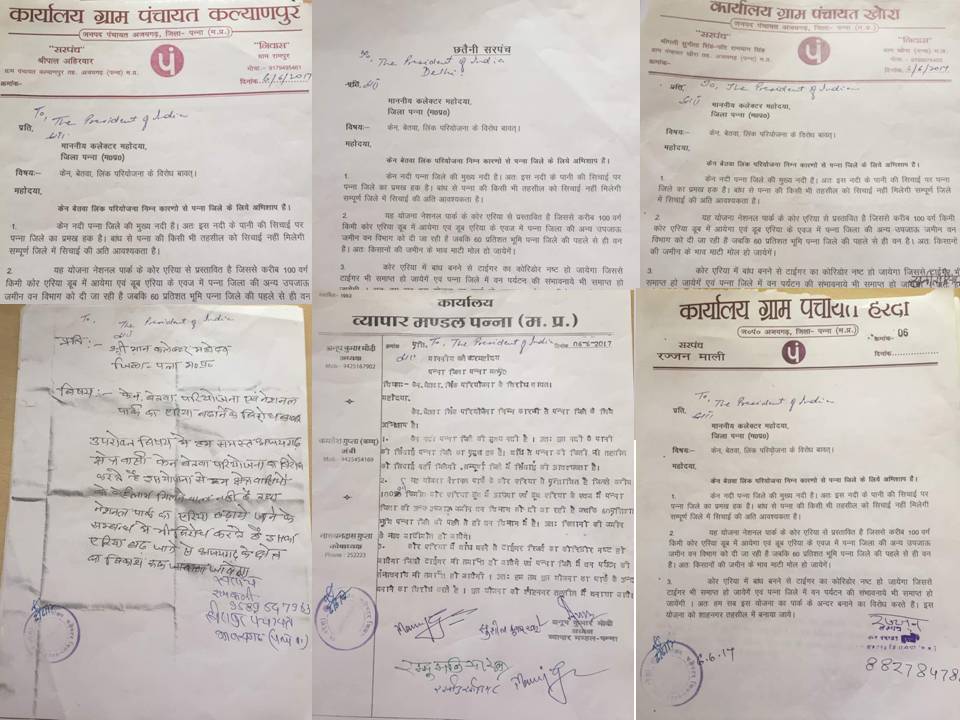
In the month of June 2017 several villages in Panna district Madhya Pradesh have opposed the controversial Ken-Betwa interlinking project. According to locals the project will destroy the Ken River which is the life line of area. Numbers of Village Panchayats have sent their memorandums to District Collector citing negative impact of the project on Panna Tiger Reserve. Many individuals and social groups including trader’s body have also criticized the project. As per locals, Panna district lacks irrigation facilities but the project proposes to transfer Ken river water to other areas. Local political parties have also supported the villagers opposition.

KBL Letters 1

Similarly worried over the scale of destruction, a group of concerned people in Panna have recently organized a meeting on the issue. Discussing the side effects of the project, the group fears that Ken Betwa interlinking project will make the Ken River dry and as a result ground water level in the area will also go down. The people revealed that there is no surplus water in the river on the basis of which the project was planned. They also cited several shortcomings in the planning of the project and stated that downstream impacts of the project has not been studied at all. The group has collectively decided to take up necessary actions to convey their opposition to the project. 

Continue reading “DRP News Bulletin 03 July 2017 (Panna Villagers Oppose Ken-Betwa Link Project)”

Dams · DRP News Bulletin

DRP News Bulletin 12 June 2017 (Rain Bearing Clouds Thinning Out Over India: IMD Study)

A recent IMD study has found that rain-bearing clouds have been thinning out across the country over the last 50 years. The study, published in the IMD journal Mausam, shows that between 1960 and 2010, annual mean low cloud cover (responsible for the bulk of the rainfall) over India has been decreasing by 0.45% per decade on an average.

According to the study, the number of rainy days is also declining during the monsoon season at an average rate of 0.23 days for every decade. This means that the country has lost approximately one rainy day over the last five decades. The study found that while the number of rainy days is decreasing, there is not much change in the total amount of rainfall. This shows a trend towards shorter, heavier bursts of rain.

That is bad news, because heavier raindrops can dislodge wheat and rice grains from their stalks while on the farm. It also means rainwater flows down a slope that much faster instead of percolating underground.

Meanwhile, a new NASA study has warned  the amount of rainfall in the Earth’s tropical regions will significantly increase as the planet continues to warm. As per study rainfall is not related just to the clouds that are available to make rain but also to Earth’s “energy budget” — incoming energy from the Sun compared to outgoing heat energy. High-altitude tropical clouds trap heat in the atmosphere. If there are fewer of these clouds in the future, the tropical atmosphere will cool.

Continue reading “DRP News Bulletin 12 June 2017 (Rain Bearing Clouds Thinning Out Over India: IMD Study)”

Dams · DRP News Bulletin

DRP News Bulletin 05 June 2017 (Agitation To Stop Illegal Mining Of Ganga)

Today is 13th day of the Swami Shivanand fast unto death to protect Ganga River from illegal mining. The health of 70 years old Marti Sadan head is turning critical with each passing hour. If no intervention is done immediately, the Saint’s life will be in danger.  

Matri Sadan resumed its fight against rampant mining in Ganga on  May 13th, 2017 after State Government opened Ganga riverbed mining which the Ashram is strongly opposing for last many years.  

For first eleven days two disciples of the Ashram observed hunger strike. But seeing no response from Govt, Swami Shivanand himself sat on fast unto death on May 24, 2017 against indiscriminate mining of national river.  Still the Govt went ahead with Ganga mining activities stating that it was necessary to protect the city from flood. 

In response the Saint shunned even taking water. But instead of communication with the protesters, the State Govt reportedly on May 28, 2017 tried to force feed the saint to fail the agitation for which the Govt was criticized greatly.

After mounting pressure the CM of Uttarakhand is learnt requesting to stop hunger strike. Following this mining was stopped in Ganga and the saint started taking water after six days but decided to continue fast as long as Government imposes complete ban on mining in writing. 

On June 02, 2017, accusing the State Govt of blatant apathy towards Swami Shivanand’s hunger strike against illegal mining on the Ganga riverbed in the Kumbh Mela area, a group of scientists,  activists and followers have written to the PM Modi requesting the PM to intervene without delay to stop unscientific mining of the Ganga.

Continue reading “DRP News Bulletin 05 June 2017 (Agitation To Stop Illegal Mining Of Ganga)”

Dams · DRP News Bulletin

DRP News Bulletin 29 May 2017 (Drought Options: Lessons from Rajasthan)


Rajasthan Lessons from a reborn river The district of Alwar in Rajasthan is water-stressed, receiving less than 650 mm of rainfall in a year, most of which falls during the Southwest monsoon. But Alwar exists in a stable equilibrium, where even if there is a drought, the Johad’s and the forests make it possible for water to be stored underground. Because of strong communal interdependencies, all villagers stuck to sensible crops for the region, and maintaines the Johads. The community, the Forests, the Johads, the choice of crops, all worked together and reinforces one another. Equilibriums are maintained by such reinforcing activities that fortify status quo. FASCINATING account of how Arvari community rejuvenated their rivers and what are the lessons.

Continue reading “DRP News Bulletin 29 May 2017 (Drought Options: Lessons from Rajasthan)”

Dams · DRP News Bulletin

DRP News Bulletin 22 May 2017 (SOLVE SILTATION PROBLEMS OF GANGA OR REMOVE FARAKKA DAM TO REVIVE GANGA: NITISH KUMAR)

Bihar Chief Minister Nitish Kumar again has urged the central govt to remove the Farakka barrage in West Bengal and make a countrywide policy on silt management for letting river Ganga to flow freely.

“Siltation is destroying Ganga’s ecology and health. It’s due to heavy deposits of silt on the riverbed that stream of the river is being badly affected,” Kumar said at a two-day national seminar on ‘Obstacles in the Incessant Flow of the Ganga’.

Speaking on the occasion, Swami Avimukteshwara Anand criticised Union Water Resources Minister Uma Bharati for doing absolutely nothing for the cause of the river Ganga and said she seems more interested in her chair rather  than the river. He also criticised  Prime Minister Modi for claiming that he is son  of Ganga, but doing nothing positive for the river. Swami ji said Nitin Gadkari seems bent on further destroying the river in the name of National Waterway.

Addressing the seminar Nitish Kukar said that Bihar’s demand for the framing of national policy on desiltation of the Ganga and clearance of silt in the state is not a political issue, as the matter is related to larger environmental and biodiversity issues facing the people.

He added, “Concrete steps have to be taken to ensure incessant flow of the Ganga. Otherwise, cleanliness of the river is not possible.” Referring to the need to protect biodiversity, he said conservation of the Ganga dolphins is dependent on the cleanliness of its water. He added the Farakka barrage constructed across the river in West Bengal has led to slow flow of water between Buxar to Bhagalpur, and consequent annual flood and waterlogging during the monsoon.

Nitish recalled the devastating flood that the state had witnessed in the Ganga basin last year and said Bihar had spent Rs 1,058 crore over the last five years to prevent soil erosion. He appealed to the Centre to frame a sound policy on silt management, stressing that it should be prepared by making on the spot survey and assessment of the prevailing situation. Nitish said even the report of the committee headed by Madhav Chitale had accepted the problem of siltation facing the Ganga.

Continue reading “DRP News Bulletin 22 May 2017 (SOLVE SILTATION PROBLEMS OF GANGA OR REMOVE FARAKKA DAM TO REVIVE GANGA: NITISH KUMAR)”

Dams · DRP News Bulletin

DRP News Bulletin 01 May 2017 (Ken Betwa won’t help, but here is what can REALLY help Bundelkhand)

Union Water Ministry has launched an extensive water conservation program for drought prone areas of Bundelkhand, Marathwada, Kalahandi, Bolangir and Koraput in Odisha on April 28, 2017 at Bandri, Sagar Madhya Pradesh. As per report, the Water Ministry has prepared a master plan for artificial recharge of ground water in Bundelkhand region.

In UP region of Bundelkhand, around 1100 percolation tanks, 14000 small check dams/Nala bunds and 7200 Recharge pits/shafts have been identified. In MP region of Bundelkhand, around 2000 percolation tanks, 55000 small check dams/Nala bunds and 17000 Recharge shafts have been identified. She said as a part of ground water exploration, 234 wells in UP are proposed to be constructed in five districts of Bundelkhand i.e., Banda, Hamirpur, Jalaun, Chitrakoot and Mahoba. As a part of ground water exploration, 259 wells in MP are proposed to be constructed in six districts of Bundelkhand.

Continue reading “DRP News Bulletin 01 May 2017 (Ken Betwa won’t help, but here is what can REALLY help Bundelkhand)”

Dams · DRP News Bulletin

DRP News Bulletin 06 March 2017 (Farm Ponds In Maharashtra Causing Groundwater Decline)

SANDRP Blog Farm ponds in Maharashtra Causing Groundwater Decline Farm ponds recognized as a drought proofing measure have received a great push from the central Govt recently. On the flip side however serious concerns are being raised over implementation of the farm ponds and more importantly –their use. Civil society organizations like Watershed Organization Trust and also SANDRP have been pointing out that the use of farm ponds has long drifted from its objective of storing rainwater for protective irrigation. Most of the farm ponds are instead being used as storage tanks for pumped out groundwater exposing this underground resource to losses through evaporation, etc. In the process they are accelerating the rate of groundwater exploitation multi fold.

Continue reading “DRP News Bulletin 06 March 2017 (Farm Ponds In Maharashtra Causing Groundwater Decline)”