Dams · DRP News Bulletin

DRP: 3 April 2017 (India: Power Surplus & Exporter, Record Solar-Wind Growth, Need Not Push Destructive Hydro)

Power surplus, power exporter India, with record solar& wind wind generation trend, why push more destructive hydro projects According to power ministry statement on March 29, 2017, India for the first time became NET EXPORTER OF ELECTRICITY during 2016-17, it exported 4% more power during last 11 months (April-Feb), that what it imported from Bhutan. At the same time, power plants, on a national average, are opera ting at roughly 60%, down from nearly 65% in 2014-15.

Meanwhile, the Cabinet Committee on Economic Affairs has approved the amendments in the Mega Power Policy to push 31 GW stuck projects entailing an investment of Rs 1.5 lakh crore. The stuck projects in mega power policy include hydro projects of above 350 Mw in designated states (J&K and eight NE states) and above 500 Mw in other states.

Amid this, New and Renewable Energy Ministry has added over 5400 Mw wind energy capacity in 2016-17 against the target of 4000 Mw. This year’s achievement surpassed the previous higher capacity addition of 3.423 Mw achieved in the previous year. The leading States in the wind power capacity addition during 2016-17 are Andhra 2190 Mw, followed by Gujarat 1275 Mw and Karnataka 882 Mw.

In the last couple of years, India has not only seen record low tariffs for solar power but wind power too has seen a significant drop in tariffs. The onshore wind power potential alone is about 302 Gw. Preliminary estimates show the Gujarat coastline has the potential to generate around 106,000 Mw of offshore wind energy and Tamil Nadu about 60,000 Mw.

Continue reading “DRP: 3 April 2017 (India: Power Surplus & Exporter, Record Solar-Wind Growth, Need Not Push Destructive Hydro)”
Dams · DRP News Bulletin

DRP: 27 March 2017: (WE NEED TO LEARN TO TRULY CELEBRATE OUR RIVERS)

This is about the proposed Brahmaputra Festival being planned by the Assam Govt from March 31 to April 4, 2017. The five-day festival will witness significant participation from China. Various other countries such as Vietnam and Singapore are also reported as attending the program. It is scheduled to be inaugurated by President Pranab Mukherjee.  

It is true that the word business appears four times on the opening page of this festival website, but the word flood, erosion and people do not appear even once. This is relevant since for very large sections of people of Assam, the river also means floods, erosion, displacement and disaster on regular basis and not just “lifeline of Assam” or “life-giving prosperity and countless blessings”.  

The festival website also errs in many ways, including when it claims “India’s only male river”, since there are several male rivers, including Damodar, Ajoy, Pagla, Gadadhar, among others. It is true that even the word Nemami is copied from the Nemami Gange, but that should not be such a big issue?

It is true that people also suffer when river dries up or is polluted or is encroached or unsustainably mined, and none of these issues are highlighted by the festival website. It is true that the the Assam also means all the communities, including the bodos and mishing and many others, not just Guwahati or Dibrugarh or Majuli. The festival organisers may argue that we are taking the festival to all 21 districts, but it is important to recognised all communities of Assam.

This is in addition to the fact that Brahmaputra includes all the states of North East India, and more. The Brahmaputra, 2,900 km long, is an international river with 918 km of it flowing in India, 1625 km in China and 337 km in Bangladesh.

It is true that the festival is more about attracting tourists, business and transport along the river. And so it is not even giving a comprehensive picture of the rivers of Brahmaputra basin in Assam, nor is there attempt to do anything to improve the state of the rivers. Similarly, the destruction of the rivers of Guwahati and Assam needs to be halted and reversed, and may be this occasion can be used to push that advocacy?

Continue reading “DRP: 27 March 2017: (WE NEED TO LEARN TO TRULY CELEBRATE OUR RIVERS)”
Dams · DRP News Bulletin

DRP: 6 March 2017 (Farm Ponds In Maharashtra Causing Groundwater Decline)

SANDRP Blog Farm ponds in Maharashtra Causing Groundwater Decline Farm ponds recognized as a drought proofing measure have received a great push from the central Govt recently. On the flip side however serious concerns are being raised over implementation of the farm ponds and more importantly –their use. Civil society organizations like Watershed Organization Trust and also SANDRP have been pointing out that the use of farm ponds has long drifted from its objective of storing rainwater for protective irrigation. Most of the farm ponds are instead being used as storage tanks for pumped out groundwater exposing this underground resource to losses through evaporation, etc. In the process they are accelerating the rate of groundwater exploitation multi fold.

Continue reading “DRP: 6 March 2017 (Farm Ponds In Maharashtra Causing Groundwater Decline)”
Dams · DRP News Bulletin

DRP: 13 Feb 2017 (Oroville Dam Disaster, USA: A Wake up Call for India’s aging big Dams)

Finally the Oroville Dam spillway damage has turned into a disaster. Report at this time (01:00pm, Feb. 13, 2017) finds dam level rising about 1 feet above the danger level. Water currents have started pouring out all over and around the emergency spillway which has never been put in use for last half a century. Meanwhile, more water is gushing in the dam reservoirs due to recent heavy rainfall in catchment areas upstream.

Continue reading “DRP: 13 Feb 2017 (Oroville Dam Disaster, USA: A Wake up Call for India’s aging big Dams)”
Dams · DRP News Bulletin

DRP: 6 Feb 2017 (MSPCB Directs Reduction in Water Supply to Polluting Industries)

Maharashtra SPCB cuts 40% water supply to Taloja industries After the pollution board identified that chemical effluents from common effluent treatment plant (CETP) at Taloja were polluting the Kasadi river, the Maharashtra Pollution Control Board (MPCB) have directed to Maharashtra Industrial Development Corporation (MIDC) to cut 40 per cent of the water supply to industrial plants from February 1.

According to the letter issued to the industrial plants, earlier they were receiving 24-hour water supply but after MPCB’s directive, the plants would not receive water from 12am to 8am, effective from February 1.

Last year fishermen from the local Koli community had complained of decline in 90 per cent of fish catch from Kasadi river due to pollution. They had also alleged of inaction by authorities despite several complaints.

To highlight their plight, the fishermen then collected water samples in August 2016 from the Taloja CETP pipeline areas discharging treated waste and samples from the banks of the Kasadi river, and submitted them for a water quality test at Navi Mumbai Municipal Corporation’s (NMMC) environmental laboratory.

The samples were found failing several crucial parameters and having high levels of chloride , which is toxic to aquatic life and impacts vegetation and wildlife. Several reports had also mentioned that the pumping of industrial waste into the river had raised pollution levels 13 times higher than the safe limit. 

Taking cognizance of the complaints, MPCB issued a notice to MIDC highlighting the pollution problem on Jan. 31 2017 and informing the MIDC that until the Taloja industrial area does not start online pollution monitoring, adequate water supply would not be provided to them. The plants have two months to comply or else further action would be taken.

Continue reading “DRP: 6 Feb 2017 (MSPCB Directs Reduction in Water Supply to Polluting Industries)”
Dams · DRP News Bulletin

DRP: 30 Jan 2017 (After 31 years, SC transfers Ganga case to NGT without achieving clean river)

SC transfers PIL on cleaning Ganga to NGT In a major development, after monitoring Ganga cleaning work for last 31 years and without achieving any cleaner river,  the Supreme Court on January 24, 2017 wrapped up a PIL on cleaning of river Ganga and sent it to the National Green Tribunal (NGT) for more effective adjudication. The apex court had been monitoring the issue for 31 years. A bench of Chief Justice J S Khehar and Justice N V Ramana said that since issues relating to municipal solid waste and industrial waste were already being heard by the NGT on a day-to-day basis, all other issues relating to sources of polluting the river should also be heard by the NGT.

The bench said that the tribunal will be required to submit an interim report to it every six months, only to give an idea about the progress made and difficulties, if any. It also granted liberty to the petitioner, environmentalist M C Mehta, to approach the court if he had any grievances in consonance with the law.

During last week hearing (January 17, 2017), the SC bench has directed the government to file a report on the construction and functioning of STPs alongside the river, which runs through five States.

It has been almost two years after the SC has voiced scepticism about the government’s self-proclaimed promise to clean up the Ganga River. Before this, in 2014, the apex court had voiced its reservations about the various efforts over the decades to return the Ganga to its pristine self, once even saying that it “does not expect Ganga to be cleaned up even after 200 years.”

Continue reading “DRP: 30 Jan 2017 (After 31 years, SC transfers Ganga case to NGT without achieving clean river)”
Dams · DRP News Bulletin

DRP: 23 Jan. 2017 (Unjustified Ken-Betwa Link Costs: Bundelkhand To Gain Nothing, Panna To Lose Its Tigers)

SANDRP Blog Little for Bundelkhand, lot for contractors in Ken Betwa river-link The official executive summary of the Detailed Project Report of KBLRP on NWDA website says: “The main objective of the Ken-Betwa link project is to make available water to water deficit areas of upper Betwa basin through substitution from the surplus waters of Ken basin.” Upper Betwa basin (Raisen and Vidisha districts of MP) is not in Bundelkhand. So KBLRP is essentially facilitating export of water from drought prone Bundelkhand to area outside Bundelkhand, which, in fact is well endowed with over 900 mm of average annual rainfall.

The DPR further says, a third o the surplus water will be utilized for “enroute irrigation of 0.60 lakh ha. in the districts of Tikamgarh and Chhatarpur of MP and Mahoba & Jhansi of U.P.” The claim in the minutes of Expert Appraisal Committee meeting of Dec 30, 2016 that “It is proposed to provide irrigation facility in 6,35,661 ha of area in Panna, Chhatarpur, Tikamgarh Districts of Madhya Pradesh and Banda, Mahoba and Jhansi Districts in Uttar Pradesh” needs to be put in context here. Firstly, this claim is far in excess of what the presumed surplus water can irrigate.

Continue reading “DRP: 23 Jan. 2017 (Unjustified Ken-Betwa Link Costs: Bundelkhand To Gain Nothing, Panna To Lose Its Tigers)”
Dams · DRP News Bulletin

DRP: 16 Jan. 2017 (MoEF’s Expert Committee Shows Biases)

EAC against entertaining ‘anti-development’ representations The expert appraisal committee (EAC) on river valley and hydel projects of the Union Environment Ministry has decided “not to take any cognizance of such representations” received by its members. In its Dec. 30, 2016 meeting, the committee concluded that once a project proposal reaches the EAC for appraisal, it has crossed the stage of public consultation and “the EAC should not go back in time, and should not reopen it, by entertaining unsubstantiated representations received from the people”. 

The EAC noted that in case of any clarification regarding action taken on such representations under the RTI Act, the EAC prescribed that a standard reply “action has been taken in accordance with the decisions taken in the 1st meeting of the EAC for River Valley and HEP on 30.12.2016” should suffice. “It was also felt that many of the objections raised are repetitive. Many such kind of representations have an anti-development attitude so that the projects are kept on hold or delayed. This has financial implications to the developers in particular and to the nation in general.

The committee emphasized that relevant ministries scrutinised every aspect of a project and proposed it for final appraisal only when all details were in place. If not satisfied that public consultation had been completed properly, the EAC said it could ask the project promoter to do the needful. The committee also made allowance for representations with “new points” and “grave consequences” on which comments from project proponents could be sought. The EAC considered 13 projects in its December 30 meeting and cleared eight of them.

Environmental activists, however, pointed out the impracticality of the contention that representations should be restricted to the 30-day public consultation window. Sripad Dharmadhikari also, in his blog has mentions various reasons to counter the EAC’s suspicious justifications. He also says that the fact that a body which is supposed to represent the environmental perspective displays such an attitude is the biggest critique of the EAC and the environmental clearance process that it is a part of. The newly constituted MOEF’s EAC on River Valley Projects has in their very first meeting shown anti people, anti democratic and anti environment attitude.

Continue reading “DRP: 16 Jan. 2017 (MoEF’s Expert Committee Shows Biases)”
Dams · DRP News Bulletin

DRP: 9 Jan 2017 (India Groundwater Continues to Decline: Govt Report)

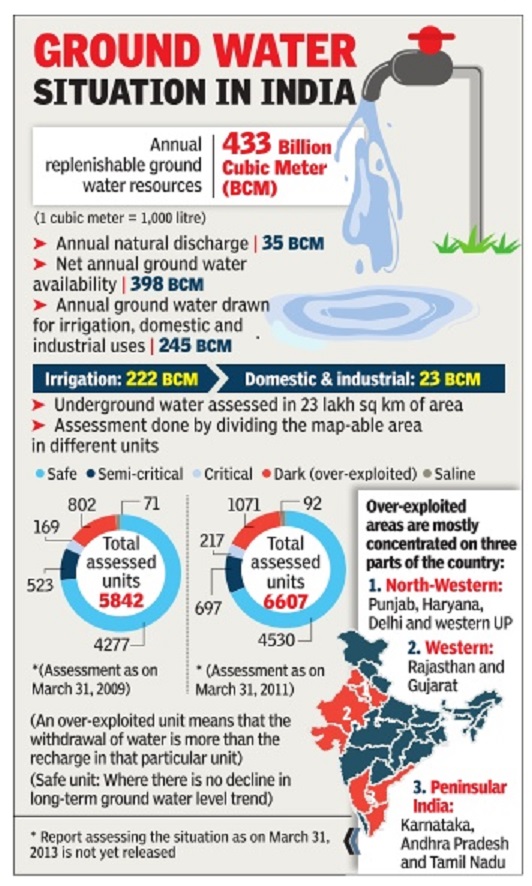
Ground water recharge plan is a non-starter Though the latest report, covering assessment of ground level situation as on March, 2013, is still being compiled, sources in the Central Ground Water Board (CGWB) hinted at further increase in the number of `dark’ (over-exploited) units. Decline in ground water level due to over exploitation of available resources had prompted the Centre in 2013 to come out with a master plan for artificial recharge of ground water, specifying how different states would go about it on priority. But majority of the states have, so far, not implemented the master plan. Only six states -MP, Gujarat, W-Bengal, UP, Chhattisgarh and Karnataka have taken follow-up actions despite the fact that the number of `dark’ units increased from 802 in March, 2009 to 1,071 in March, 2011. This not only says what the title mentions, but also shows how slow our official agencies are in even coming up with groundwater data, the latest data is for March 2011! 

Continue reading “DRP: 9 Jan 2017 (India Groundwater Continues to Decline: Govt Report)”
Dams

एसवाइएल विवाद:  जल संरक्षण में पिछडे़  पंजाब ओर हरियाणा

Guest Blog by Manoj Thakur 

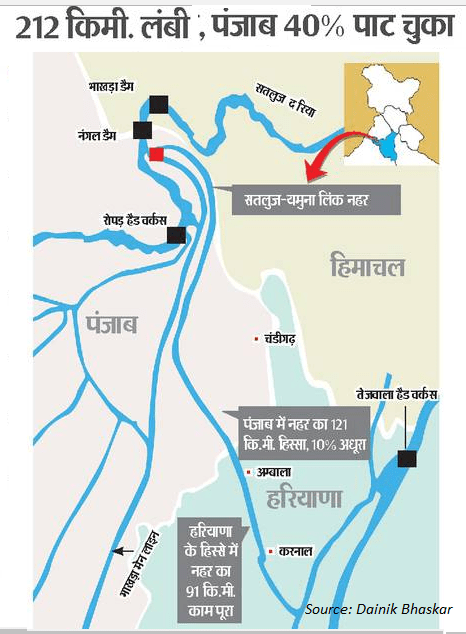
सतलुज यमुना नहर (एसवाइएल ) पर हरियाणा के पक्ष में निर्णय आते ही पंजाब ओर हरियाणा में राजनीति तेज हो गई। पंजाब का कहना है वें अपनी जान दे देंगे लेकिन पानी नहीं देंगे। इधर हरियाणा का कहना है कि उन्हें पानी चाहिए क्यांकि यह पानी उनका हक है। अब सवाल यह उठ रहा है कि दोनों राज्यों में से कोई एक राज्य तो गलत बोल रहा है। लेकिन हकीकत यह है कि एसवाइएल पर दोना ही राज्य झूठ बोल रहे हैं।

Continue reading “एसवाइएल विवाद:  जल संरक्षण में पिछडे़  पंजाब ओर हरियाणा”