Dams

River Sand Mining in India in 2015 – II – Government acts of omissions and commissions

Unsustainable sand mining from riverbeds can have huge social, environmental, geomorphic and disastrous impacts for rivers. In this three part reports; SANDRP is trying to provide a picture of what happened on this issue in 2015 in India.

In the first part SANDRP has published the detail of illegal sand extraction that was found rampant across many Indian States in 2015. It specifically covered the increased numbers of attacks on Govt. officials including common men against their attempt to expose and oppose illegal removal of sand from riverbeds. 

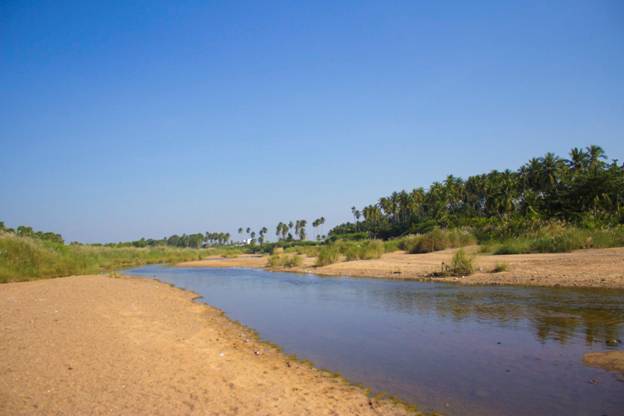
This second part presents detail of some of the significant steps taken by Central and various State Governments (Govt.) to control and regulate unsustainable excavation of riverbed sand mining.
Continue reading “River Sand Mining in India in 2015 – II – Government acts of omissions and commissions”

Dams · DRP News Bulletin

DRP: 1 Feb 2016 (Experts suggest ways to revive Madurai’s dying rivers)

Tamil Nadu Experts suggest six ways to revive dying Madurai’s rivers According to a paper entitled Future Proofing Indian Cities: Towards an approach to spatial and social analysis for sustainable development of Madurai by Jayaraj Sundaresan Development Planning Unit, University College London J. Kanagavalli DHAN Foundation, Madurai their documentation has revealed the significant role of Kruthumal River in the historic, cultural, ecological and economic growth of Madurai. Centuries ago, Madurai city developed as a small urban settlement on the banks between the rivers Kruthumal and Vaigai. Appearing in epics and sacred texts such as Srimad Bhagavatham and Narayaneeyam, Kruthumal has significant presence in the written history of Madurai. It was also known as Narayana Cauvery. It supplied water to the Ahazhi (moat) around the Tirumalai Nayakkar palace in Madurai. The paper gave six methods to look after Vaigai and Kruthumal Rivers in Madurai.  Looking at the condition of the rivers one feels it is hopeless, but there is hope if together with the government, something is done to control the destruction of the river, by law. And with organizations like DHAN Madurai can hope for a clean Vaigai in the future.

Continue reading “DRP: 1 Feb 2016 (Experts suggest ways to revive Madurai’s dying rivers)”

Rivers · Sand Mining

River Sand Mining in India in 2015

Unsustainable sand mining from riverbeds can have huge social, environmental, geomorphic and disastrous impacts for rivers. In this three part report, SANDRP is trying to provide a picture of what happened on this issue in 2015 in India.

This first part looks into 2015 putting together instances of illegal sand mining that occurred throughout the year in different Indian States. The successive blogs would make an attempt to cover all governmental measures and judicial interventions taken in 2015 to reign in uncontrolled extraction of this possibly most consumed natural resource after air and water.

Illegal mining of sand is profoundly linked to growth in construction industry that have accelerated in recent decades. Since then demand for this mineral is only going up. Today possibly there is not a single river in the country that is not ruined by sand mining. As a result, while the state of rivers has gone worse, the number of violent instances around illegal sand mining is on the increase.

Continue reading “River Sand Mining in India in 2015”

Dams · DRP News Bulletin

DRP: 25 Jan. 2016 (FAO supports SRI)

“Save & Grow” FAO supports SRI A new FAO book out on 18 Jan.16 takes a close look at how the world’s major cereals maize, rice and wheat can be grown in ways that respect and even leverage natural ecosystems.  FAO also underscores that “Save and Grow” farming systems are knowledge-intensive, and need to be built on local knowledge and needs, recognizing the important role of farmers as innovators. GREAT to see that this FAO publication (http://www.fao.org/3/a-i4009e.pdf ) contains a very detailed discussion and presentation on SRI, the first time that there has been such an endorsement of SRI (System Rice Intensification). With this publication, FAO joins the World Bank (http://info.worldbank.org/etools/docs/library/245848/) and IFAD (http://www.ifad.org/english/sri/  and http://www.ifad.org/english/sri/documents.html).

Continue reading “DRP: 25 Jan. 2016 (FAO supports SRI)”

Dams · DRP News Bulletin

DRP: 18 Jan. 2016 (MoEF Expert Committee on Dams continues to ignore democratic norms)

MoEF Expert Committee on Dams continues to ignore democratic norms  The minutes of the 90th meeting of the Expert Appraisal Committee on River Valley and Hydropower projects held on Dec 22-23, 2015, made available today (January 18, 2016, see: http://environmentclearance.nic.in/writereaddata/Form-1A/Minutes/0_0_11118122212121Minutes-90EAC.pdf), shows how the committee continues to ignore basic democratic norms. Here are some key issues about the minutes of this latest meeting:

Continue reading “DRP: 18 Jan. 2016 (MoEF Expert Committee on Dams continues to ignore democratic norms)”

Dams · DRP News Bulletin

DRP: 11 Jan. 2016 (Punjab Villagers oppose Dam on Ghaggar River)

86 Villages rise in protest against dam on Ghaggar  A dam is proposed to be constructed on the Ghaggar, near Banur, at a cost of Rs 75 crore. An agreement was signed between representatives of various villages located downstream and the Irrigation Department in 2006 promising 200 cusecsto irrigate fields in thesevillages. Villagers now fear that they will not get the promised 200 cusecs after the construction of the dam. Their claim is that the water flow in the river is much lower than 400 cusecs, as claimed by the irrigation department. The department, on the other hand, sticks to its stand that the water flow in the river is sufficient enough to feed the canal and the villages downstream. However, a perusal of the monthly average discharge data of the river for the past 10 years, defies the department’s claim. It revealed that the average yearly discharge barely crossed 400-cusec mark over the past 10 years, excluding the peak period (July to September). Interestingly NABARD and the State Irrigation department had separately conducted studies of the project well before giving it a green signal.

Continue reading “DRP: 11 Jan. 2016 (Punjab Villagers oppose Dam on Ghaggar River)”

Dams · DRP News Bulletin

DRP: 04 Jan. 2016 (Rivers are soul of India: PM Narendra Modi)

Rivers are soul of India: Prime Minister Narendra Modi  Excerpts From text of PM’s inaugural address at 103rd session of Indian Science Congress, Mysuru Rivers have played as important a role in human history as oceans. Civilisations have been nurtured by rivers. And, rivers will remain critical for our future. So, revival of rivers is an essential part of my commitment for a cleaner and healthier future for our society, economic opportunities for our people, and renewal of our heritage. We need regulations, policy, investments and management to achieve our objective. But, we will succeed only when we integrate technology, engineering and innovation into our efforts, not just to clean our rivers now but to keep them healthy in the future as well. For this, we also need scientific understanding of the impact of urbanisation, farming, industrialisation and groundwater use and contamination on the river eco-system. River is the soul of Nature. Their renewal must be an element of a larger effort to sustain Nature.

Continue reading “DRP: 04 Jan. 2016 (Rivers are soul of India: PM Narendra Modi)”

Dams · Ganga

Four Boats at a River Crossing along Ganga

Above: A fisherman crosses the river with his boat. Photo: © Sameer Kumar/VBREC.

-Nachiket Kelkar (rainmaker.nsk@gmail.com)

It was a pleasant November afternoon when we were travelling down the Ganga River by boat, surveying river dolphins. Tall grass had grown on both banks through the flood recession period. The water level had become very low already. Two magnificently large concrete buildings; one, the agricultural college, and the second, the industrial office, stood precariously by the edge of a rapidly eroding bank. At the turn of this bank, the Ganges Voyager appeared in a sudden sight. British tourists with gleaming shades, sunning their fair skins to balanced tan tempered by muslin umbrellas put over brick-red wooden tables, waved at us from the deck of the Voyager. Uniformed Indian attendants confirmed that they were not waving out to any dangerous people, in a re-enactment of the old colonial days. The Voyager had fifty air-conditioned luxury rooms. Their windows were made translucent by pale mauve and white chiffon curtains artistically tied in an hourglass shape. Continue reading “Four Boats at a River Crossing along Ganga”

Dams · DRP News Bulletin

DRP: 28 Dec. 2015 (Farmers field school in Jharkhand shows the way in integrated farming)

AGRICULTURE

Farmers field school in Jharkhand shows the way in integrated farming The School has taught farmers how to use waste from their farms as inputs in their farming system. Other organic practices have improved the soil profile and water holding capacity of the fields. The schools are run throughout the cropping season. Farmers receive training on how to manage crops, waste and pests. Meaningful discussions are held in the farms on crop growth, climate, soil conditions and constraints to crop production. Based on these observations, farmers make informed decisions to increase yields and improve the soil fertility of their fields. These schools now serve as the training ground for new farmers. Indeed, improving water holding capacity of the soil is much neglected issue.

Organic manure saves crop from floods For the second year in succession, Velu, a farmer in Morappakkam near Madurantakam, has become the envy of other farmers as the organic crop raised by him survived the inundation during the recent rains.  Continue reading “DRP: 28 Dec. 2015 (Farmers field school in Jharkhand shows the way in integrated farming)”

Dams

DRP: 21 Dec. 2015 (100 people have a narrow escape as Ganga level rises after sudden release from Tehri Dam)

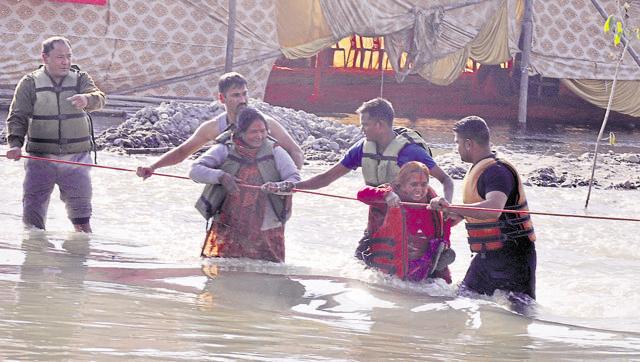
100 people have a narrow escape as Ganga level rises after sudden release from Tehri Dam More than a 100 people who were attending a religious discourse had a narrow escape when the water level rose suddenly in the Ganga River in the temple town of Rishikesh. According to the police, the water level increased after Tehri Dam released water, a routine exercise that is done after informing officials concerned. CD Anthwal, circle officer Rishikesh told HT that the people attending the religious discourse were rescued with the help personnel of the Jal Police (water police).

Continue reading “DRP: 21 Dec. 2015 (100 people have a narrow escape as Ganga level rises after sudden release from Tehri Dam)”