
India will not have power deficit situation in FY17 India won’t need any new power plants for the next three years as it is flush with generation capacity, according to a government assessment. The country can manage for the next three years with existing plants that are currently under-utilised, and those that are under construction and upcoming renewable energy projects, assessment made by the power ministry for reviewing the National Electricity Policy shows. Govt declares for the first time in history that India is POWER SURPLUS in 2016-17 with 3.1% power surplus in peak hours and 1.1% power surplus in off peak hours, both figures in 2015-16 were -3.2% during peak hours and -2.1% in peak hours. The western and Southern regions will be power surplus, but Northern, Eastern and Northeastern regions will have deficits. At the same time Power Minister Piyush Goyal says that Big hydro power units may come under renewable energy According to Minister the Centre has begun studies to decide whether to include big hydro power plants under the ambit of renewable energy. When India will be energy surplus for next three years why then Govt. of India is continue to pursue disastrous hydro projects on ground. Where ASSOCHAM is asking Arunachal govt. to do away with adverse tax policies on Hydro power to boost construction of hydro projects in the State. NHPC has also raised relief amount for Kishanganga HEP around Rs 60 lakh and Rs 70 lakh to each family for the land acquired. And despite Delhi Govt. openly rejecting water from Renuka dam NGT panel has visited the area to look into the rehabilitation issue.
Continue reading “DRP: 6 June 2016 (India to be power surplus for next 3 yrs: why govt continue to pursue hydro projects)”Tag: Flood

DRP: 23 May 2016 (WHY LARGE HYDRO IS NOT JUSTIFIED)
Chenab river runs its course amid spate of threats Chenab river’s money-spinner hydropower fate appears to run parallel to that of Sohni-Mahiwal – the legendary lovers who drowned into the river because their love was unacceptable. The govt as usual has shut its eyes to the needs of the river and its catchment area. There are multiple factors hidden below its surface. One is melting of glaciers sooner than anticipated. If glaciers lose their ice cover quicker, the Chenab would swell up abruptly before hitting a cruel, dried-up phase in as much deathly suddenness. There are several hydro projects coming up on the river which don’t have the approval of the Geological Survey of India. Once all the identified hydroelectric projects are installed, it will have a negative impact on the river. It may not get even a kilometre free space for running the course. At that point of time, it will not be a river, but a small stream. Meanwhile scientists have warned of large scale earthquake in J&K. The situation in Arunachal Pradesh is also grim. And yet the Parliamentary committee recommends further sops for Hydr. Misguided recommendations, to put is most charitably. There should be no question of subsidies to destructive Hydropower projects. Continue reading “DRP: 23 May 2016 (WHY LARGE HYDRO IS NOT JUSTIFIED)”
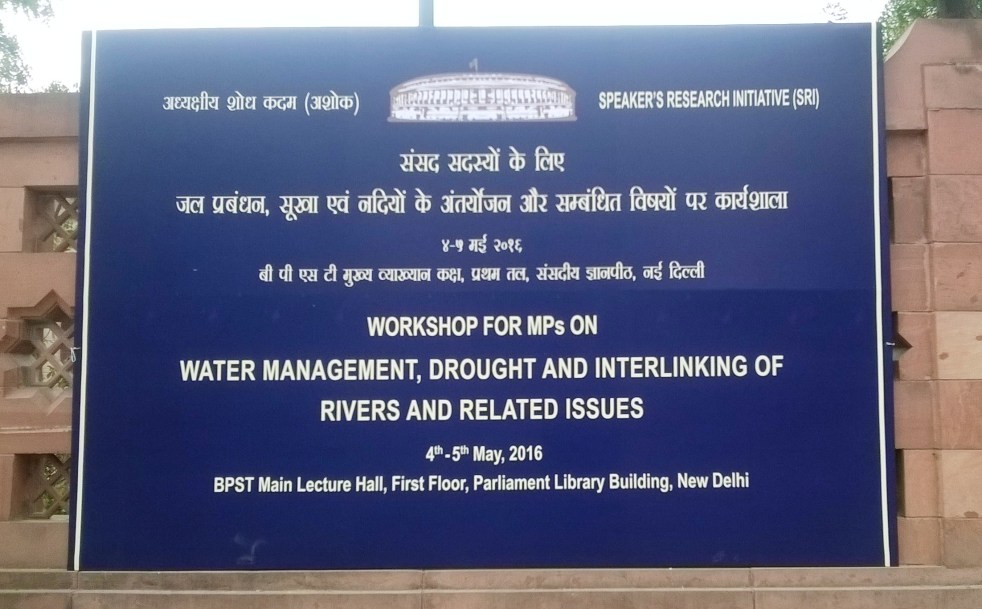
DRP: 9 May 2016 (Welcome initiative by Lok Sabha Speaker on draught and ILR)
On May 4-5, 2016, Lok Sabha Speaker Smt Sumitra Mahajan took the lead in organising a workshop for Members of Parliament on Drought, Agrarian Crisis and ILR. As part of the newly constituted Speaker’s Research Initiative’s (SRI for short) work, Smt Mahajan inaugurated the workshop at 4 pm on May 4, 2016, where a panel of eight speakers were invited (4 on each day, SANDRP coordinator was one of the invited speakers on 1st day) to share their views, followed by questions from Members of Parliament. The idea was that on these important issues, Parliament Members are better equipped to raise the relevant issues when debating and raising questions in Parliament. It was heartening to see that at least 90 MPs (88 from Lok Sabha and 2 on Rajya Sabha) were present for 2.5 hours on first day, and they wanted to ask so many questions that there was not sufficient time to allow all of them to ask, nor sufficient time for speakers to make full presentations or answer all the questions. Similarly on second day too Speakers showed lot of interest on these issues. While inaugurating the workshop, Smt Mahajan mentioned how in Solapur, Maharashtra, because of the work of the collector and his team of officials, the impact of drought is lower than that in other districts. This was certainly heartening since it was SANDRP Associate Coordinator Parineeta Dandekar who first wrote on this issue, following her visit to Solapur and interview with the district collector. The workshop highlighted the need for many such workshops, possibly more focussed, but the impact of the workshop was already visible in the (as yet unfinished) debate under section 193 that started in Lok Sabha on May 5, 2016, hopefully to be continued in current week.
Continue reading “DRP: 9 May 2016 (Welcome initiative by Lok Sabha Speaker on draught and ILR)”
DRP: 25 APRIL 2016 (One Year After Nepal Earthquake, Has the World Learnt Any Lesson?)
On this day in 2015, the massive Nepal earthquake of 7.9 intensity (Richter scale) shook the scenic Himalayan Nation. The earthquake left a major trail of destruction affecting over 20 districts and killing over 9 thousand people. According to expert Dave Petley, Langtang rock and ice avalanche was the most dramatic and significant landslide, that killed the most individuals. The earthquake killed over 9000 people, with 255 still missing. The severity of the quake can be gauged from the fact that more than a third of the disaster related deaths in 2015 occurred in Nepal’s April 25 earthquake. The earthquake-induced flash floods, landslides and aftershocks also damaged up to 15 hydropower plants, which has not been still restored fully. Surprisingly despite the increasing number of disasters taking place across the globe, world only spends less than a fifth of the money on Disaster Risk Reduction Compared to Disaster management. Nepal will still take years from recovering socio-economic losses caused by the quake. But it is pertinent that in the wake of the quake and other disasters, human civilisation must learn its lesson. It’s true that development and disaster cannot be stopped but we must make our developmental decisions more informed, rule based and democratic so that it helps us deal better with disasters by decreasing their intensity and velocity and our short-sighted developmental choices do not get translated into a disaster itself. Continue reading “DRP: 25 APRIL 2016 (One Year After Nepal Earthquake, Has the World Learnt Any Lesson?)”
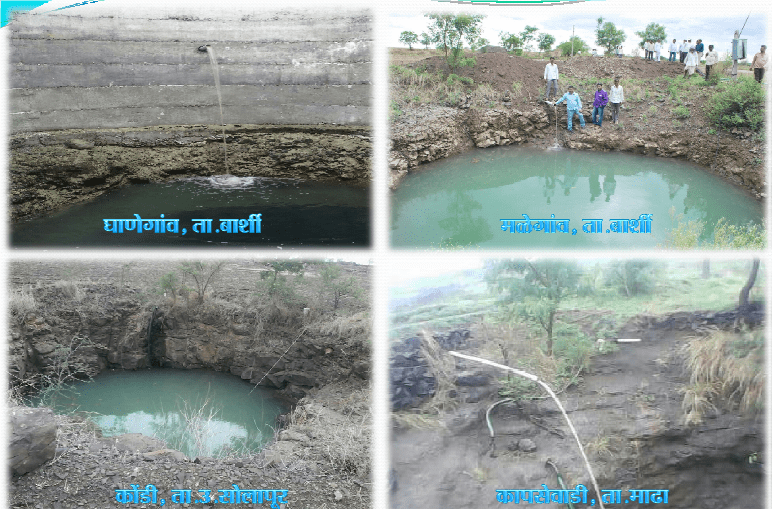
DRP: 18 April 2016 (Prior action & planning can reduce Drought impact: Solapur shows)
Union Water Resources Minister Uma Bharti in an interview tried to refute charges that the Centre reacted late to India’s drought crisis. Water minister makes strange statements that one cannot do any planning about drought & her govt is the first govt to provide water through tankers. However, Solapur, a chronically drought-hit district in Maharashtra was serviced with more than 200 tankers in 2013-14, even when the monsoon rainfall was better than this year. In this drought, there are only 16 tankers plying in Solapur. Drinking water sources have been secured, water from Ujani dam for and sugar cane has been disallowed. The district leads the way in Jal Yukta Shivar Program in the state, new avenues of Agricultural credit are opening, options to sugarcane are being developed, errant sugar factories are being fined for polluting drinking water sources. Will the Union Government accept its mistakes and make amends?
DRP: 11 April 2016 (Harsh Summer: In Search of Green Pastures)
With ponds and lakes drying up, cattle in Telangana are forced to travel long distances for fodder and water. Here, buffaloes are moving towards a water source near Medipalli in Adilabad district on 09 April.
Continue reading “DRP: 11 April 2016 (Harsh Summer: In Search of Green Pastures)”
DRP: 28 March 2016(Is India facing its worst-ever water crisis?)
Is India facing its worst-ever water crisis? On 11 March first time in 30 years history power generation at Farakka power plant in West Bengal was suspended for 10 days due to non-availability of water in Ganges. Nobody is sure why but the evidence about the declining water levels and waning health of the 2,500km long Ganges is mounting. Monsoon rains have been scanty for the second year in succession. The melting of snow in the Himalayas has been delayed. Water tables have also been declining in the Ganges basin due to the reckless extraction of groundwater. The 3-month-long summer is barely weeks away but water availability in India’s 91 reservoirs is at its lowest in a decade, with stocks at a paltry 29% of their total storage capacity, according to the Central Water Commission. Thousands of villagers in drought-hit region of Maharashtra depend on tankers for water & authorities in Latur district, fearing violence, have imposed prohibitory orders on gatherings of more than 5 people around storage tanks. Tens of thousands of farmers and livestock have moved to camps providing free fodder and water for animals in parched districts. The govt has asked local municipalities to stop supplying water to swimming pools. States like Punjab are squabbling over ownership of river waters. In water-scarce Orissa, farmers have reportedly breached embankments to save their crops. Realy the waning health of the sacred river underscores the rising crisis of water in India.
Continue reading “DRP: 28 March 2016(Is India facing its worst-ever water crisis?)”
DRP: 22 Feb. 16 (Unprecedented water crisis in Delhi due to Jat quota stir)
Unprecedented water crisis in Delhi due to Jat stir Terming the water crisis in the national capital as “unprecedented”, Delhi minister Kapil Mishra has warned that the situation might worsen in the next few days if the supply from Haryana is not immediately restored. He said the Delhi Jal Board (DJB) had almost run out of water and advised people to use water judiciously. Delhi gets its bulk of water supply from Haryana and the stir has affected 65% of water supply in Delhi has been cut with the shutting down of seven water treatment plants— Wazirabad, Chandrawal, Dwarka, Okhla, Haiderpur, Nangloi and Bawana which provide around 500 million gallons per day (MGD). In all Delhi has nine water treatment plants which together produce 820 MGD of potable water. Of these, only two Sonia Vihar and Bhagirathi fed by water from Uttar Pradesh are operational. The current production is only 240 MGD. Among the areas affected were Dwarka, Janakpuri, Munirka, Palam, Rajouri Garden, Punjabi Bagh, Vasant Kunj, Saket, Green Park and Lodhi Colony, where residents complained of little or no water. In another news report DJB is reported to have made 140 water filling points functional to feed tankers which would be sent across the city, reeling under an unprecedented water crisis. Water Minister Kapil Mishra reviewed the contingency plan for water management in West, North, North-west, Outer and Central Delhi and said tankers will deliver water at 663 points to partially meet the shortage of 480 MGD. These points will keep rotating. Plan is to cover around 2,000 points by Monday evening. The DJB supplies around 900 MGD of water daily out of which around 600 MGD of raw water come from Munak Canal. Even if Haryana releases water immediately, it will take at least 24 hours to restore the supply. Meanwhile Supreme Court on 22 Feb.16 scolded Delhi government. for approaching the court instead of resolving the water crisis with Haryana. The Kejriwal government had approached the top court on in view of the severe water crisis in the national capital after Jat protesters blocked water supply through Munak canal in Sonipat. During the hearing on government’s plea, the court took strong objection to Water Minister Kapil Mishra’s presence inside the courtroom. On the other hand, the minister accuses Haryana & Central Government for providing no official information on the crisis He said the Delhi government was “repeatedly trying to communicate” with the two governments to find out when will the supply resume, but without much success. Also see Jat quota stir: Water supply cut, Delhi may go dry
Continue reading “DRP: 22 Feb. 16 (Unprecedented water crisis in Delhi due to Jat quota stir)”

DRP: 15 Feb. 2016 (Govt plans National Water Commission)
Govt plans National Water Commission In one of the most significant reforms in the water sector in a long time, the govt is in the process of ordering a complete restructuring of the organisations responsible for regulating the use of water resources, with the objective of bringing in greater efficiency, better planning and increased emphasis on conservation of water. According to news report the Central Water Commission (CWC), which oversees irrigation projects, flood management and drinking water supply, and the Central Ground Water Board (CGWB) are likely to be disbanded, and a National Water Commission is proposed to be set up in their place. A few other smaller organisations with specialised mandate like data gathering and analysis are also likely to be created.
A team under Mihir Shah, a former member of the then Planning Commission of India, is already preparing a blueprint for better management of water resources. The idea of institutional restructuring is said to have the backing of this panel. It is likely to submit its report in the next two months. In the new scheme of things, more emphasis is being given to judicious use, and conservation, of ground water. It is estimated that despite elaborate irrigation projects, about 60 per cent of irrigation during the non-rainy season is still done by pumping out ground water. The large irrigation projects, meanwhile, have given sub-optimal results.
A large number of sewage treatment plants, being built as part of the Clean Ganga initiative that will eventually spread to other rivers as well, will provide a new source of water that is fit not only for industrial use but also for irrigation and many other purposes. The river rejuvenation plans, not just of Ganga but others as well, will become an integral part of overall water resources management. Apart from reducing pollution in the rivers, and maintaining a minimum ecological flow, the rejuvenation plans would also ensure that the rivers are able to adequately recharge the aquifers in its basins.
Allocation of water resources to each state is also on the agenda. But this process is likely to take time as it would involve extensive consultations with the state governments. Once a consensus emerges, a central legislation on allocation of water resources is planned to be brought in. This is aimed at reducing inter-state water disputes.
Continue reading “DRP: 15 Feb. 2016 (Govt plans National Water Commission)”
DRP: 8 Feb.2016 (Hiding Environment Information-Against Sabka Sath, Sabka Vikas?)
SANDRP Open Letter to MoEF&CC Is Not Hiding Environment Information Against Sabka Sath, Sabka Vikas? Even as the Ministry of Environment, Forests and Climate Change has been sanctioning cascades of hydro power projects on here-to free flowing rivers in the Himalaya and North East India, Cumulative Assessment of the Impacts of these projects became a crucial area of concern. The cumulative impacts of these projects on the hydrology, downstream flow, sudden water releases, deforestation, muck disposal, influx of migrant workers, seismicity of the region etc. is huge as compared to individual impacts. The projects together stand to change the social and ecological fabric of these regions.
Cumulative Impact Assessment (CIA) studies are a part of the Environment Impact Assessment Process under the EIA Notification (2006) and Environment (Protection) Act 1986. The documents of these CIAs have been uploaded on the Environment Clearance website in the past, as was required under number of laws. However, as the EAC is slated to consider whopping 4 CIAs in its upcoming meeting on the 8 and 9th Feb, not a single CIA-related document is available on the MoEF and CC website! We are told that these may not be made available in the future.
Continue reading “DRP: 8 Feb.2016 (Hiding Environment Information-Against Sabka Sath, Sabka Vikas?)”
 SANDRP