Dams

DAM BUILDING MUST BE HALTED FOR A SAFE AND SECURE WORLD

Guest Blog by Manoj Misra

Rivers in different parts of the world have been dammed to fulfill human needs like water for irrigation, industries and domestic supplies. Then there are dams that have been raised to control floods or to produce electricity.

These have often been celebrated as human victory over nature, glorified as engineering marvel and claimed variously as highest, longest etc as a matter of national pride.

But rarely has there been a holistic assessment or appreciation of what a dam does to the natural entity called river and its adverse impacts on all the associated life forms, including humans.

Continue reading “DAM BUILDING MUST BE HALTED FOR A SAFE AND SECURE WORLD”

Dams · DRP News Bulletin

DRP: 2 October 2017 (New Rules Disastrous For India’s Wetlands)

The wetlands are the hotspots of biodiversity, act as carbon sinks, act as buffers against floods and are essential for groundwater recharge. With groundwater reservoirs in the country heavily exploited, this last function has assumed greater importance. http://www.hindustantimes.com/environment/centre-notifies-wetland-rules-environmentalists-unhappy/story-3MoGp9D8eSzHI90zfOXWSO.html

Wetlands can be defined as lands transitional between terrestrial and aquatic eco-systems where the water table is usually at or near the surface or the land is covered by shallow water.

But they are threatened by reclamation and degradation due to activities like drainage and landfill, pollution, hydrological alteration (water withdrawal and changes in inflow and outflow), over-exploitation resulting in loss of biodiversity and disruption in ecosystem services provided by them.

DRP 12

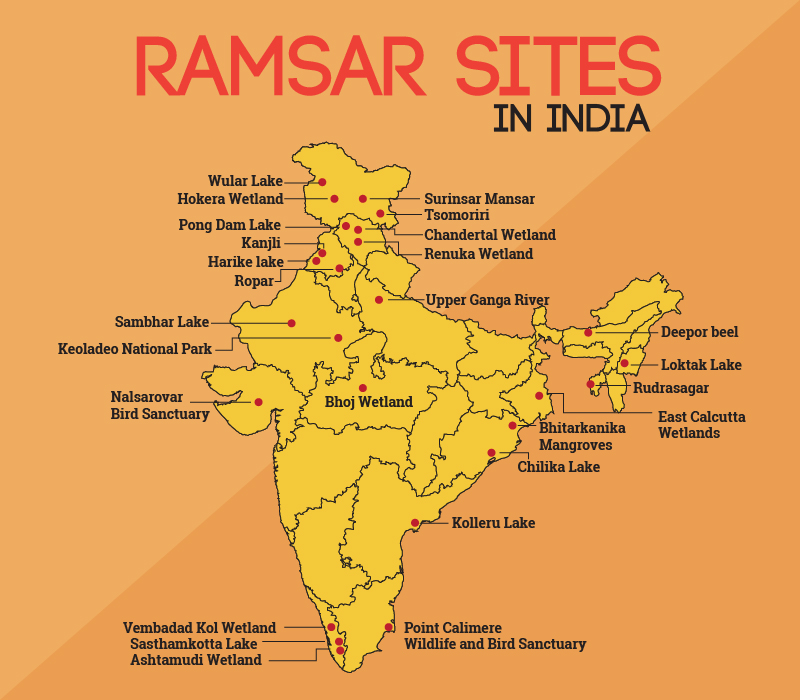
There are at least 115 wetlands that are officially identified by the central government and of those 26 are identified as wetlands of international importance under Ramsar Convention which is an international intergovernmental treaty for conservation of wetlands. India is a party to the treaty. http://www.livemint.com/Politics/y6Tr3tkrr3q28AmGKaBFII/Environment-ministry-notifies-new-wetland-rules.html

The Centre on September 26 notified a new set of rules under the head Wetlands (Conservation and Management) Rules, 2017 replacing the Wetlands (Conservation and Management) Rules, 2010. http://www.thehindu.com/news/national/kerala/new-wetland-conservation-rules-notified/article19779100.ece

It is worth to mention that under the 2010 rules, not a single water body was notified as a wetland over and above the ones already recognised as such by the Centre and the Ramsar Convention, defeating its purpose in a way. http://www.zeebiz.com/agencies/centre-notifies-new-rules-for-preservation-of-wetlands-26312

Similarly, despite country’s space agency ISRO had in 2011 mapped over two lakhs of wetlands across the country, the centre has, so far, notified only 115 wetlands and 63 lakes in 24 states and 2 UTs for conservation and management.

Continue reading “DRP: 2 October 2017 (New Rules Disastrous For India’s Wetlands)”
Dams

पंचेश्वर बॉध की अनुचित, अन्यायपूर्ण एवं गैरकानूनी पर्यावरण जनसुनवाई रद्द हो

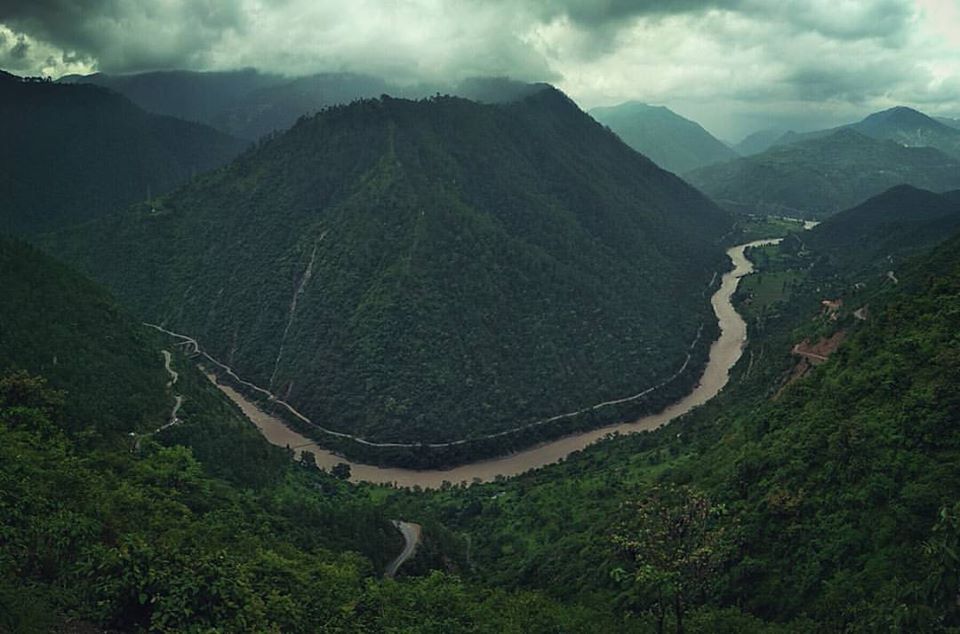
Featured Image: Saryu River winding through Pithoragarh by Sumit Mahar, HIMDHARA

This is Hindi version of SANDRP petition submitted to District Magistrate Almora, Pithoragarh and Regional Official, Environment Protection and Pollution Control Board, Uttarakhand pleading them to postpone the unfair and unjust public hearing of Pancheshwar Multipurpose Project on Mahakali River. The English version of same can be seen here https://sandrp.wordpress.com/2017/08/10/cancel-pancheshwar-dam-public-hearings-it-involves-too-many-violations-and-illegalities/

भीम सिंह रावत, सैनड्रप,

we4earth@gmail.comhttps://sandrp.wordpress.com/

पंचेश्वर बॉध पर्यावरण जनसुनवाई, 

अल्मोडा, उत्तराखण्ड, 17 अगस्त 2017 

सेवा में, 

अध्यक्ष पंचेश्वर बॉध पर्यावरण जनसुनवाई, 

एवं जिलाधिकारी, अल्मोडा उत्तराखण्ड

dm-alm-ua@nic.in

  
अध्यक्ष क्षेत्रीय कार्यालय प्रभारी

उत्तराखण्ड पर्यावरण सुरक्षा एवं प्रदूषण निंयत्रण बोर्ड देहरादून, 

dkjoshi21@yahoo.com

आदरणीय पंचेश्वर बॉध पर्यावरण जनसुनवाई अधिकारिक सदस्य दल,  

आज पंचेश्वर बॉध परियोजना की अल्मोडा जिले में तय तीसरी एवं अंतिम पर्यावरण जनसुनवाई, पूरी तरह से पर्यावरण प्रभाव आकलन Environment Impact Assessment (EIA) राजपत्र 2006 के नियमों के विपरीत है। अतः इस जनसुनवाई को निरस्त कर, प्रभावित गॉववासियों से समोचित चर्चा के बाद, भविष्य में यथोचित स्थान पर जनसुनवाई कि जानी चाहिए। 

इस जनसुनवाई को निरस्त करने के अनेक कारणों में से कुछ मूल कारणों को निम्नांकित किया जा रहा है।  Continue reading “पंचेश्वर बॉध की अनुचित, अन्यायपूर्ण एवं गैरकानूनी पर्यावरण जनसुनवाई रद्द हो”

Dams · DRP News Bulletin

DRP: 10 July 2017 (Private Companies Exit Unviable Large Hydro Projects)

In a remarkable trend emerging in hydro sector in Himachal Pradesh, many leading private companies have started surrendering hydro power projects allotted to them by State Govt. As per the news report, Tata Group, Reliance, Jindal and Larsen & Toubro have either surrendered or are in process of surrendering numbers of hydro projects given to them over past one and half decade. These companies are now increasingly terming the projects as  non-viable and unprofitable. 

In the last week of June, 2017, Tata group reportedly has written to Directorate Energy, expressing its desire to surrender the 450 MW Duggar power project in Pangi area of Chamba district. The project had been allotted to them in 2007-08 and post feasibility study done by its consultants the group has found the unviable. http://www.tribuneindia.com/news/himachal/tatas-give-up-chamba-power-project/428456.html

Before this the Reliance group had declined to set up  300 Mw Purty and 130 Mw Sumte Kothan hydro projects in Spiti. Following this, the State Cabinet on June 24, 2017 meeting agreed to return Rs 85 crore paid as upfront money by Reliance group. 

Similarly in recent past, the Jindal group, which was allotted the 250 MW Kutehar power project in Chamba, put the project on hold for some time without citing specific reasons. http://www.tribuneindia.com/news/himachal/reliance-power-to-get-back-rs-85-cr-it-paid-to-govt-for-2-projects/427112.html

In the latest incident, anticipating problems in evacuating power, with the market being very grim as far as buyers and power rates are concerned, Larsen and Toubro (L&T) is reported to have urged the state govt to enter into a power-purchase agreement (PPA) with it for two of its hydel projects — Reoli Dugli (Lahaul-Spiti) and Sach Khas (Pangi), located in the arduous Chenab basin.

Continue reading “DRP: 10 July 2017 (Private Companies Exit Unviable Large Hydro Projects)”
Dams · Indus

Haryana Rivers Profile: (Part-I – Indus Basin)

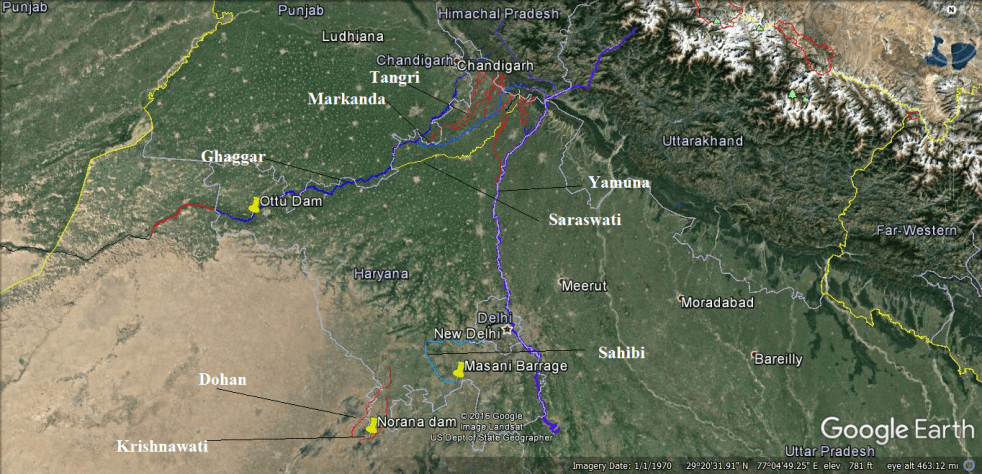
India is a land of several great rivers[1]. Haryana[2] the 20th Indian state has also been enriched by numbers of rivers, streams and rivulets.  These rivers only strike public discourses during monsoon when they flood human habitations although pollution and sand mining incidents are routinely covered. Moreover there is no Government Department in the State which is in control or possession of complete information on the rivers of the State, as the various State Government Agencies in limited manner deal with specific issues affecting the rivers and there are Government Agencies also whose plans or projects impact the rivers in adverse manner. This two part blog report from SANDRP strives to present a picture on the rivers of Haryana. The State is broadly divided by two basins: Indus and Ganga. This first part of the blog mainly focuses on rives which are part of Indus basin. The second part will bring information of other rivers in the State which join the Ganga basin.  Apart from putting together the basic facts, the blog series also highlights the key issues and present day status of these river systems.

Continue reading “Haryana Rivers Profile: (Part-I – Indus Basin)”

Dams · DRP News Bulletin

DRP: 11 Oct 2016 (Is there any justification for DESTRUCTION of Panna Tiger Reserve?)

Is there any justification for DESTRUCTION of Panna Tiger Reserve? Can we save our Natural Heritage like the Panna Tiger Reserve (PTR) from being destroyed in the name of baseless, questionable, non transparent, undemocratic and manipulated projects like Ken Betwa inter linking ? It will facilitate export of water from Bundelkhand to OUTSIDE Bundelkhand. Whatever little benefits are claimed, some of them are already available and much more can become available at much lower costs, faster and without destroying the Forests and Tiger Reserve. The project will actually lead to destruction of Ken catchment and hence the Ken River itself. Watch this FASCINATING, AWESOME story of tigers of PTR. This BBC film where Raghu Chandawat is the story teller and Pradip Kishen is lending his voice, tells the story of Tigers of Panna till 2003, it seems. Please watch and let us all try to save it from destruction that is now writ large in terms of Ken-Betwa Link Project (KBLP). One more short film by wildlife biologist Koustubh Sharma illustrates how the Daudhan Dam under KBLP will submerge and destroy the PTR.

Meanwhile, a new analysis of rainfall data reveals that monsoon shortages are growing in river basins with surplus water and falling in those with scarcities, raising questions about India’s Rs 11 lakh crore plan to transfer water from “surplus” to “deficit” basins. According to Himanshu Thakkar of SANDRP river basin interlinking should be considered only after exhausting the local potential for harvesting rain, recharging groundwater, watershed development, introducing better cropping patterns (non water-intensive crops) and methods (such as rice intensification), improving the soil moisture-holding capacity and saving and storing water. Raising alarm over significant increase in ground water use, increasing reliance and fast declining ground water table, he warns that inter-basin links would actually reduce groundwater recharge because forests would be destroyed, the river flow stopped and the local systems neglected.

Continue reading “DRP: 11 Oct 2016 (Is there any justification for DESTRUCTION of Panna Tiger Reserve?)”
Dams · Ganga

दो बाॅधों की कहानीः क्या बिहार की अप्रत्याशित बाढ़ एक टाली जा सकने वाली मानव जनित त्रासदी है?

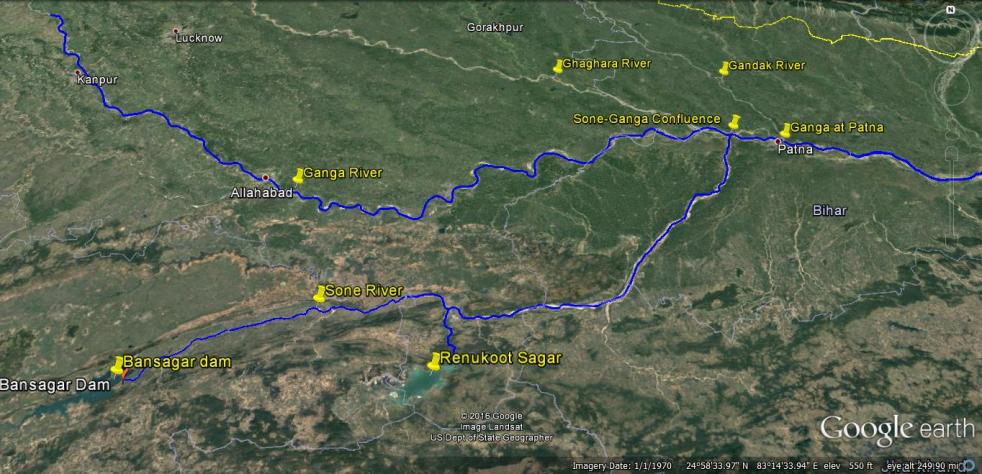
बाणसागर बाॅध, सोन नदी, गंगा नदी और पटना को दर्शाता मानचित्र

21 अगस्त 2016 की सुबह, गंगा नदी का जलस्तर लगातार बढ़ते हुए, पटना में 50.43 मीटर पर पहुॅच गया। जिससे पटना में गंगा नदी अपने पहले के उच्चतम बाढ़स्तर 50.27 मीटर से 16 सैंटीमीटर ऊपर बह रही थी। 22 अगस्त 2016 तक पानी का जलस्तर गंगा नदी के किनारे तीन अन्य स्थानों पर उच्चतम बाढ़स्तर को पार कर गया। जिसका विवरण निम्न हैः-

       स्थान                        22.08.2016 को उच्चतम बाढ़स्तर                      पुराना उच्चतम बाढ़स्तर
बलिया उत्तरप्रदेश                         60.30 मीटर                                     60.25 मीटर (14 सितंबर 2003)
हाथीदाह, बिहार                           43.17 मीटर                                      43.15 मीटर (07 अगस्त 1971)
भागलपुर बिहार                           34.55 मीटर                                      34.50 मीटर (05 सितंबर 2013)

इस तरह से हम देखते हैं कि पटना में उच्चतम बाढ़ का रिकार्ड तोडने के बाद, अब यह बाढ़ गंगा नदी के किनारे बसे बिहार और उत्तरप्रदेश के अन्य इलाकों में पहुॅच रही है। यहाॅ यह बात उल्लेखनीय है कि बिहार में अब तक वर्षा औसत से 14 प्रतिशत कम हुई है। सवाल यह उठता है कि इसके बावजूद गंगा में रिकार्ड तोडने वाली बाढ़ क्यों आयी?

Continue reading “दो बाॅधों की कहानीः क्या बिहार की अप्रत्याशित बाढ़ एक टाली जा सकने वाली मानव जनित त्रासदी है?”

Dams

Was Not Sudden Flood In Subarnrekha Jharkhand Avoidable?

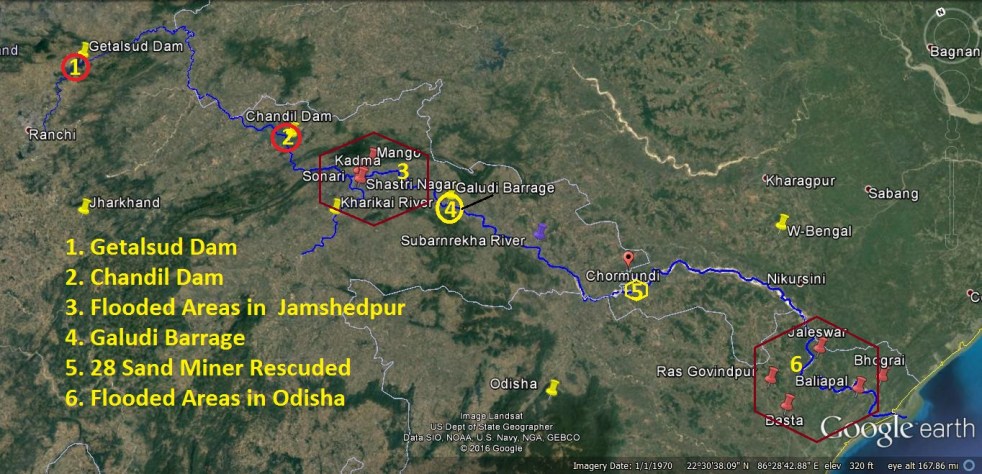
Following heavy rainfall, on August 17, 2016, Chandil dam, Jharkhand released huge amount of water in Subarnrekha River. As a result there was sudden surge of waters in Subarnrekah River causing worrisome situation in Jamshedpur town and in areas further downstream along the river in West Bengal and Odisha States.

Superficially the incident may appear a natural incident. But analysis of available information indicates that the flood impact could have possibly been reduced or  avoided.

The incident:- On August 17 and 18, 2016, the ongoing South West Monsoon brought heavy rainfall in Jharkhand. The evenly distributed showers were measured as 80 mm across the State with Jamshedpur town located on the bank of Subarnrekha River recording maximum rainfall of 270 mm in 24 hours. 

Continue reading “Was Not Sudden Flood In Subarnrekha Jharkhand Avoidable?”

Dams · DRP News Bulletin

DRP: 16 Aug 2016 (When shall We Start Respecting Our Rivers & Provide Space to Them)

In absence of clear and strict laws to define the rivers zone and demarcate flood plains, our rivers are increasingly becoming subject to exploitation. When the river spaces of our National River Ganga & Yamuna River which flow through National Capital are not well protected, then the plight of other rivers across country can be understood.

This week, there are two news reports which again are highlighting this cause. Interestingly in both cases, legal fight is going on in green tribunal which indirectly deals with the issue though with no success so far. In  fist case, NGT has directed Govt. of Uttarakhand to demarcate floodplains of Ganga river from its origin in Gomukh till Roorkee, a 65-km long stretch in the state. The tribunal has posted the matter for the next hearing on Oct 20 and asked the state government to submit its compliance report by then. The bench also sought a report on the total number of hotels on the 65-km stretch from the govt. The green panel allowed the state govt to take the help of Roorkee-based National Institute of Hydrology for identification of flood plains. Construction on flood plains and inside river zones is a sure invitation to disaster such as Kedar Nath Floods in 2013 when human made infrastructures erected very much inside river zones were raised down like sand dunes  by enraged rivers. It is sad and even more worrisome that we have learnt nothing from such events.  

In second incident Govt. of Uttar Pradesh has drawn green tribunal’s ire over constructions in floodplainsThe apex court for environmental issues, expressed its dissatisfaction over the manner in which State Govt filed its report on the distance of various real estate projects from the Yamuna flood plain zone in the city. Coming down heavily in the state govt and various Agra authorities, Agra Development Authority (ADA) & irrigation department, it stated that “authorities were expected to act fairly and judicially while complying with its directions.” The tribunal appointed registrar general Mukesh Kumar Gupta as local commissioner and asked him to file a correct position of flood plains and the distances of the various projects. Meanwhile,  ADA has been asked to produce the original records before the tribunal on the next date of hearing, Aug 19.

Floods & floodplains are integral part of a river eco-system. Both has essential role to play in smooth functioning of multiple ecological processes that takes place throughout  the journey of a river. It is abused of floodplains that our cities are facing flood threats. It is surprising to see how govts have so far failed in protection of flood plain.

With incidents of excess rainfall, cloud burst & land slides happening at increased frequency, it is time to define our river zone and flood plain clearly in the own interest of human being.

Continue reading “DRP: 16 Aug 2016 (When shall We Start Respecting Our Rivers & Provide Space to Them)”
Dams · DRP News Bulletin

DRP: 4 July 2016 (In Proposed Hydro Policy, Govt Pushing Hydro Through Subsidies)

New Hydro Policy: Govt unjustifiably pushing hydro through subsidies A comprehensive policy to promote hydropower generation is set to be announced by September—with viability gap funding for projects, compulsory hydropower purchase obligations for distribution companies and a set of good practices that states have to follow. The idea is to address factors that currently drive hydropower costs up way above those of other sources of power and give policy support in its market development, according to a government official, who asked not to be named. The policy being prepared by the power ministry will have provisions for viability gap funding, which will help in meeting the shortfall in project costs and reducing hydroelectricity tariffs for consumers. Hydropower is expensive and in some cases more than double the cost of power from coal-based thermal plants, which is available at Rs.3-5 per unit.The ministry will also expand the scope of power distribution companies’ renewable power purchase obligations to include hydropower from projects with a capacity greater than 25 Mw. At the moment only power from those with less than 25MW is considered renewable power. According to officials, compulsory hydropower purchase from large projects will either be made part of the existing renewable power purchase obligation of distribution companies or a separate requirement, so that its inclusion does not affect the market for other renewable sources of energy like wind, solar or biomass. Govt unjustifiably pushing hydro through subsidies in proposed new hydro policy can be lead story. It is not going to help push hydro.  

Continue reading “DRP: 4 July 2016 (In Proposed Hydro Policy, Govt Pushing Hydro Through Subsidies)”