DRP News Bulletin

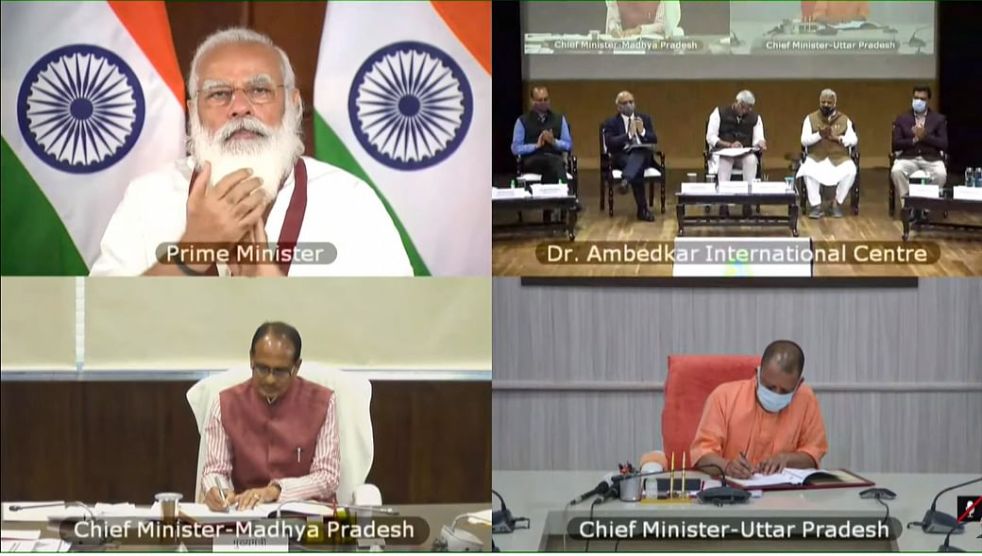
DRP 220321: PM presiding over proposal for destruction of 46 lakh trees, Bundelkhand & Panna Tiger Reserve on World Water Day?

There cannot possibly be any worse news on World Water Day for India than that the Prime Minister is presiding over the agreement between Uttar Pradesh and Madhya Pradesh Chief Ministers to destroy some 46 lakh trees, Panna Tiger Reserve, Ken River, Bundelkhand and also downstream Banda district. All to export water from Bundelkhand to Upper Betwa basin.  All this in the name of pushing the mindless project called Ken Betwa River Link Project. Why is the government pushing this destructive project, a Rs 38 000 Crore proposition? The answer to that question is in that question: it is a Rs 38 000 Cr proposition!

There is still some hope though for the people of Panna, Banda and Bundelkhand if there is any respect for the law of the land. This is because the project does not have final forest clearance and the conditions of the stage I forest clearances are not implementable. The Wild Clearance of the project is challenged by the Central Empowered Committee of the Supreme Court, following a petition. The Environment Clearance to the project has also been challenged before the National Green Tribunal. Let us hope there is sufficient respect for the law of the land, to ensure that the project does not go ahead even with the agreement signed. But a key propriety question arises is, should the prime minister endorse a project that does not have all the statutory clearances and legal challenge to whose clearances are before the judiciary?

But the prime minister’s advocacy for rainwater harvesting on the same also loses a lot of its credibility, seeing that he is presiding over this destruction that goes totally against the central message of harvesting rain where it falls, when it falls.

Continue reading “DRP 220321: PM presiding over proposal for destruction of 46 lakh trees, Bundelkhand & Panna Tiger Reserve on World Water Day?”
Dams, Rivers & People

DRP 150221: Why Mangshri Devi of Tapovan Should Head Uttarakhand’s Disaster Management Department?

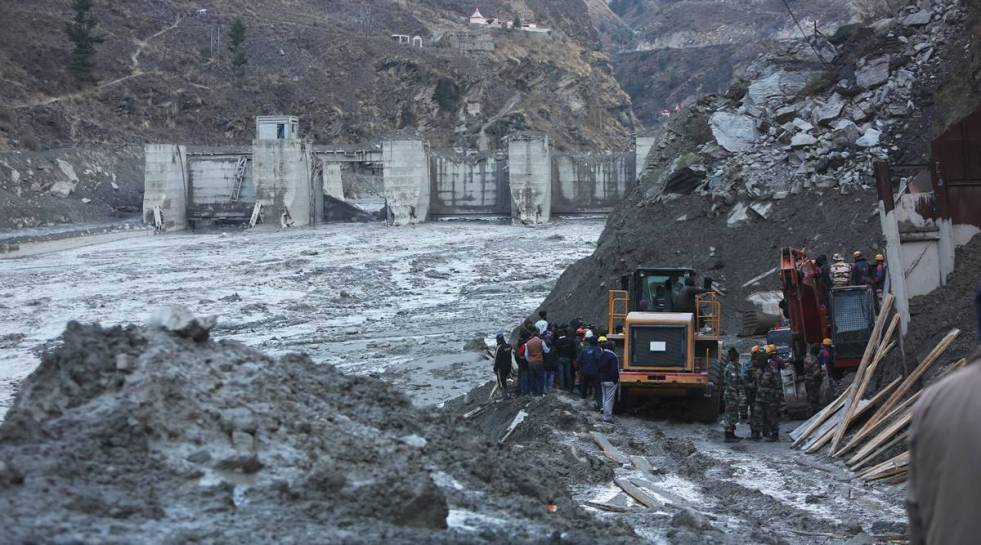
Feature image Tapovan-Vishnugad hydropower project in Chamoli district on Feb., 7 by Gajendra Yadav, Express Photo

In a fantastic story, Shivani Azad of The Times of India has reported possibly the most remarkable story of the Chamoli avalanche disaster that started on Sunday morning on Feb 7, 2021. She reported that Vipul Kairuni of Dhaak village in Tapovan, working at the time at the now destroyed Tapovan Vishnugad project, got saved thanks to frantic calls by his mother Mangshri Devi as she and his wife saw from their village home, situated at a height from the river, that a massive flood is approaching the dam site. It was thanks to frantic, repeated calls by Mangshri Devi that not only Vipul, but at least two dozen more people could run to safety of a ladder and saved their lives.

So effectively, Mangshri Devi has saved at least two dozen lives in Chamoli disaster. Who else can claim to have achieved anything like that in the disaster? The disaster management department seems completely absent from the scene either in terms of pre disaster monitoring or in taking steps to save lives during the disaster. In fact, there should have been an early warning system in place that could have saved many more lives. But it does not exist. Either in Rishiganga/ Dhauliganga basin or anywhere else in Uttarakhand. NTPC’s Tapovan Vishnugad Project has faced so many disasters already since 2008, but is only now talking about putting in place early warning system. Should not the NTPC and power ministry top brass as well as Uttarakhand disaster management department held accountable for that?

Continue reading “DRP 150221: Why Mangshri Devi of Tapovan Should Head Uttarakhand’s Disaster Management Department?”
Dams, Rivers & People

DRP 080221: Will NITI Aayog study the costs of overturning the Radhakrishnan Judgement on Uttarakhand?

NITI Aayog, we learn, has started studies of implications of the Supreme Court and NGT orders on environment issues. In the context of the massive Chamoli disaster now unfolding in Uttarakhand, NITI needs to urgently institute an inquiry as to who all are responsible for overturning the Justice Radhakrishnan led verdict of Aug 13, 2013 about the June 2013 Uttarakhand disaster and role of hydropower projects in the disaster and the costs of overturning that verdict. In fact if the Justice Radhakrishnan verdict were to have been sincerely and honestly implemented to its logical conclusion, the proportions of the current Chamoli disaster and others would have been majorly reduced. So the costs are no doubt huge and mounting. Will NITI Aayog institute such an independent inquiry urgently?

Continue reading “DRP 080221: Will NITI Aayog study the costs of overturning the Radhakrishnan Judgement on Uttarakhand?”
Wetlands

World Wetlands Day 2021: Five new Ramsar sites in 2020 but threats remain

On the Feb 2 2021, the World Wetlands Day, the Ramsar Convention on Wetlands would also complete its 50 years. The global treaty popularly known as Ramsar Convention was adopted in 1971 and came into force in 1975 following decades of negotiations.

The main objective of the treaty is to promote conservation and wise use of all wetlands through regional actions and international cooperation. Currently, the treaty has been accepted by 171 nations including India. There are 2414 Wetlands of International Importance under Ramsar treaty spreading over 254,540,512 ha of lands across the globe.

Continue reading “World Wetlands Day 2021: Five new Ramsar sites in 2020 but threats remain”
Urban Rivers

South India Urban Rivers Overview 2020

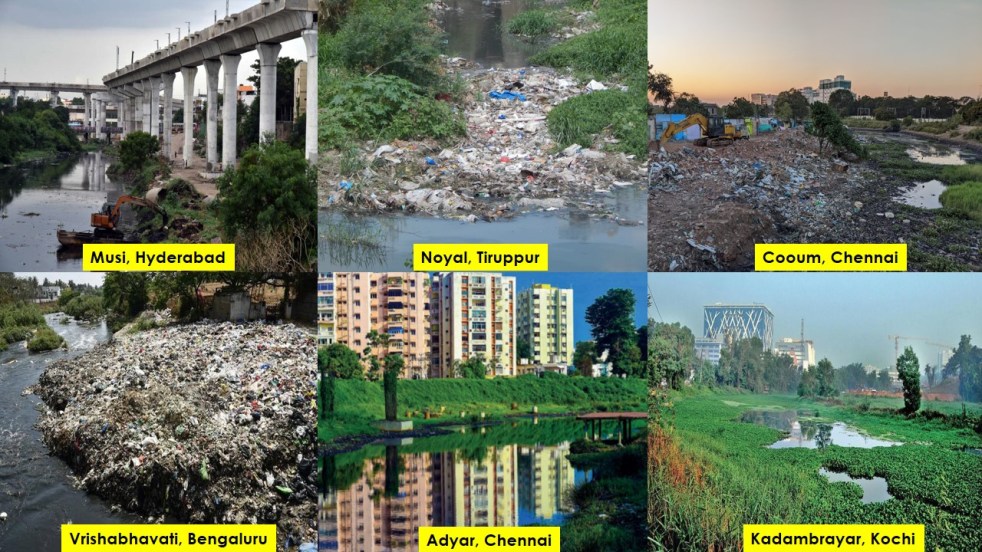
Urban rivers provide a lot of services, but the urban areas are inviting major trouble by destroying them through dumping of solid and liquid waste, encroachments, river front developments, unsustainable mining among others. The urban areas also operate in almost total policy vacuum and none of the cities under smart city programs are dealing with Urban rivers with any smartness.

This overview includes some key developments about Urban Rivers in 2020 from the South Indian states of Karnataka (Vrishabhavati in Bengaluru; Swarna-Netravati in Udupi), Tamil Nadu (Adyar, Buckingham Canal and Cooum rivers in Chennai; Kiruthumal in Madurai; Noyyal in Tiruppur; Bhavani in Coimbatore; Palar in Vellore; Vasishta in Salem), Telangana (Musi in Hyderabad), Andhra Pradesh (Tungabhadra in Kurnool), Kerala (Periyar, Kadambrayar & Konthuruthy in Kochi; Kodoor in Kottayam) and Puducherry (Sankarabarani).

Continue reading “South India Urban Rivers Overview 2020”
DRP News Bulletin

DRP 250121: UN warns about aging Dams & Floods in changing climate

A new UN report released on January 21, 2021 UN has warned the major big dam owning counties about the aging population of fast silting up dams in changing climate and urgent need to start working on decommissioning of uneconomical large dams. Among the few countries that UN has warned includes India with its third largest number of big dams. The added problem in India is the ill maintained and ill operated large dams that UN report did not look into. Indian dams are sanctioned based on highly under estimated siltation rates, there is practically no transparency and accountability in operation of Indian dams and dam almost every year get away with creating avoidable flood disasters. This latest problem is not just related to old dams, but even the newest celebrated ones like the Sardar Sarovar Dam as happened in Gujarat in late August-early Sept 2020. No legal regime exists in India for dam safety, either structural safety or operational safety. And in changing climate, with increasing frequency of higher intensity rainfall events, such risks are already increasing multi-fold.

Continue reading “DRP 250121: UN warns about aging Dams & Floods in changing climate”
DRP News Bulletin

DRP 180121: Is there any hope for Yamuna from Delhi, SC actions?

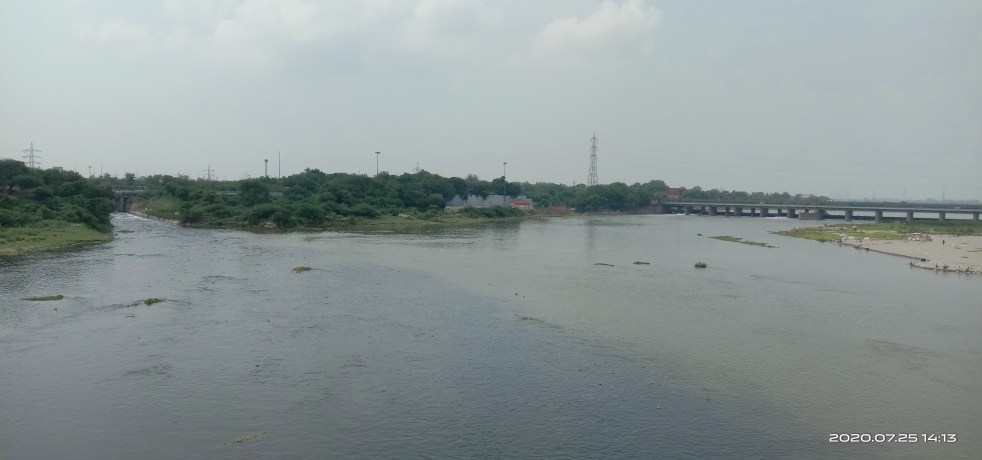
Yamuna is again in headlines in this week’s Bulletin. It carries the Nov 2020 announcement of Delhi Govt plan to clean river by 2023 and the action by the Supreme Court. There is nothing very convincing, path breaking or new in what the Delhi Govt has announced, such announcements keep coming every few years and then tend to be forgotten, to be renewed with announcement of new deadlines in this case. Unfortunately, the Supreme Court action is not particularly different. One only needs to remind the apex court and everyone else that in 1994, the SC had taken up Yamuna case suo moto. No impact on the river could be achieved till around 2017, when the SC decided to handover the case to NGT. It is not clear what exactly has prompted SC to take it up again, but the move does not inspire confidence considering the past track record.

We hope we are wrong and the Delhi Plans and the SC move does lead to better days for Yamuna. In the meantime, the Yamuna Monitoring Committee set up by the NGT is doing its role, but one wishes, their hands and plans as strengthened and pushed by the NGT, which does not seem to be the case currently.

Continue reading “DRP 180121: Is there any hope for Yamuna from Delhi, SC actions?”
Wetlands

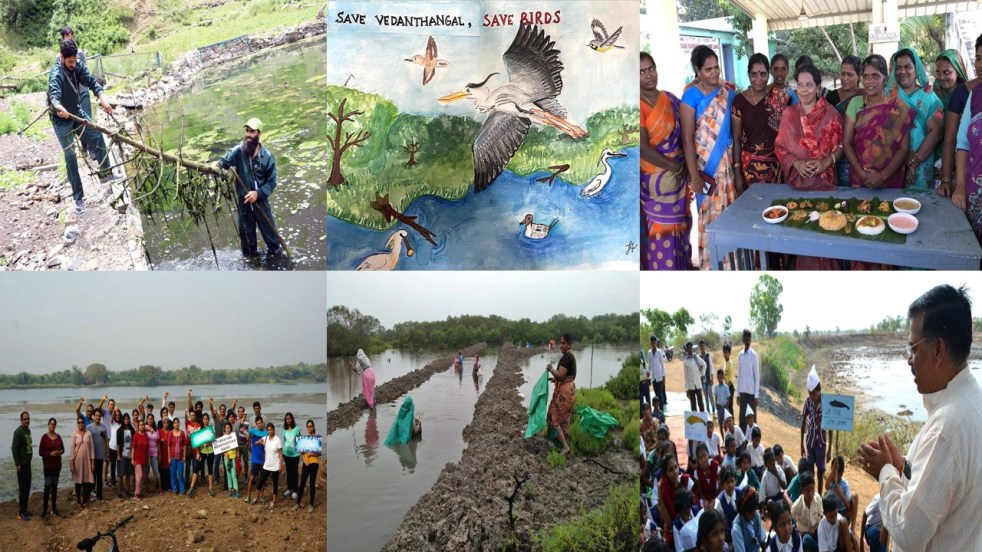
Wetlands 2020: Positive Developments

Pondicherry Collector led the revival of over 300 waterbodies The then District Collector and present Secretary to the Chief Minister, A. Vikranth Raja, stepped in with the idea of digging into revenue records to locate the region’s traditional water bodies.  It all started with a query raised at the meeting. When someone asked if Karaikal had the capacity to store 7 tmcft of river water allotted by the Cauvery Water Disputes Tribunal, “the response from officials was an emphatic no,” says Selvaganesh, Assistant, District Collectorate of Karaikal.

In June 2019, in the tiny coastal enclave of Karaikal, administration officers brainstormed about putting in place a sustainable water resource management model for the town’s two lakh people. They found 549 ponds within a small territory spread over 157 sq. km. 40% of these water bodies were in various stages of extinction. Most of them turned out to be dumping yards.

Continue reading “Wetlands 2020: Positive Developments”
DRP News Bulletin

DRP: 14 Dec 2020: Constitution of EAC for River Valley Projects Challenged in High Court

The Karnataka High Court has taken up the petition challenging the constitution of the Expert Appraisal Committee (EAC) on River Valley and Hydropower projects. Notices have been issued to MoEF and also all the members of EAC on a petition filed by the United Conservation Movement Charitable Welfare Trust. Such a scrutiny of the appointment of the EAC was long overdue and urgently required. One hopes the High Court will take the matter to its logical conclusion and ensure that MoEF has a credible, transparent process of appointment of these committees as without such a process, the MoEF gets away with appointing only yes people on the committee who are happy to tow the government line. That nullifies the whole purpose of the constitution of the committee, the EIAs, the public consultations, the appraisals, the clearances and even credible monitoring and compliance. It is complete failure of environment governance and laws and MoEF even gets away with appointment of people with clear conflict of interest. MoEF has no process of selection of the chair and members of these committees. Hoping for the best for the case to correct all this.

Continue reading “DRP: 14 Dec 2020: Constitution of EAC for River Valley Projects Challenged in High Court”
DRP News Bulletin

DRP: 30 Nov 2020: J&K SEAC denies EC to sand mining

In otherwise bleak governance of sand mining in India, J&K State Expert Appraisal Committee (SEAC) has denied environment clearance to sand mining projects on Jhelum river, since the proposals were not in conformity with the MoEF’s 2016 Sand Mining Management Guidelines, involved in-stream mining, did not have proper District Survey Reports, proper Sand Mining Plan or Replenishment studies. One hope this is emanating from genuine concern for proper governance and this needs to spread to more areas so that at least the guidelines get properly implemented.

Continue reading “DRP: 30 Nov 2020: J&K SEAC denies EC to sand mining”