DRP News Bulletin

DRP 250923: World Rivers vs Indian Rivers on Rivers Day 2023

Continue reading “DRP 250923: World Rivers vs Indian Rivers on Rivers Day 2023”
DRP News Bulletin

DRP 180923: Floodplain loss, the biggest in Asia, disaster in the making

Continue reading “DRP 180923: Floodplain loss, the biggest in Asia, disaster in the making”
DRP News Bulletin

DRP 110923: Another independent institution-CEC destroyed

Continue reading “DRP 110923: Another independent institution-CEC destroyed”
DRP News Bulletin

DRP 04092023: Will National Ganga Mission too fail to clean up Ganga?

Continue reading “DRP 04092023: Will National Ganga Mission too fail to clean up Ganga?”
DRP News Bulletin

DRP 280823: Defund nature destroying activities

Continue reading “DRP 280823: Defund nature destroying activities”
Yamuna River

The 2023 Yamuna floods of Delhi only a trailer of bigger floods to come in future?

Continue reading “The 2023 Yamuna floods of Delhi only a trailer of bigger floods to come in future?”
DRP News Bulletin

DRP 310723: Disastrous SHORT TERMISM in Urban India

Continue reading “DRP 310723: Disastrous SHORT TERMISM in Urban India”
Dams

DRP 240723: Urgently need parameters that will truly reflect rainfall pattern

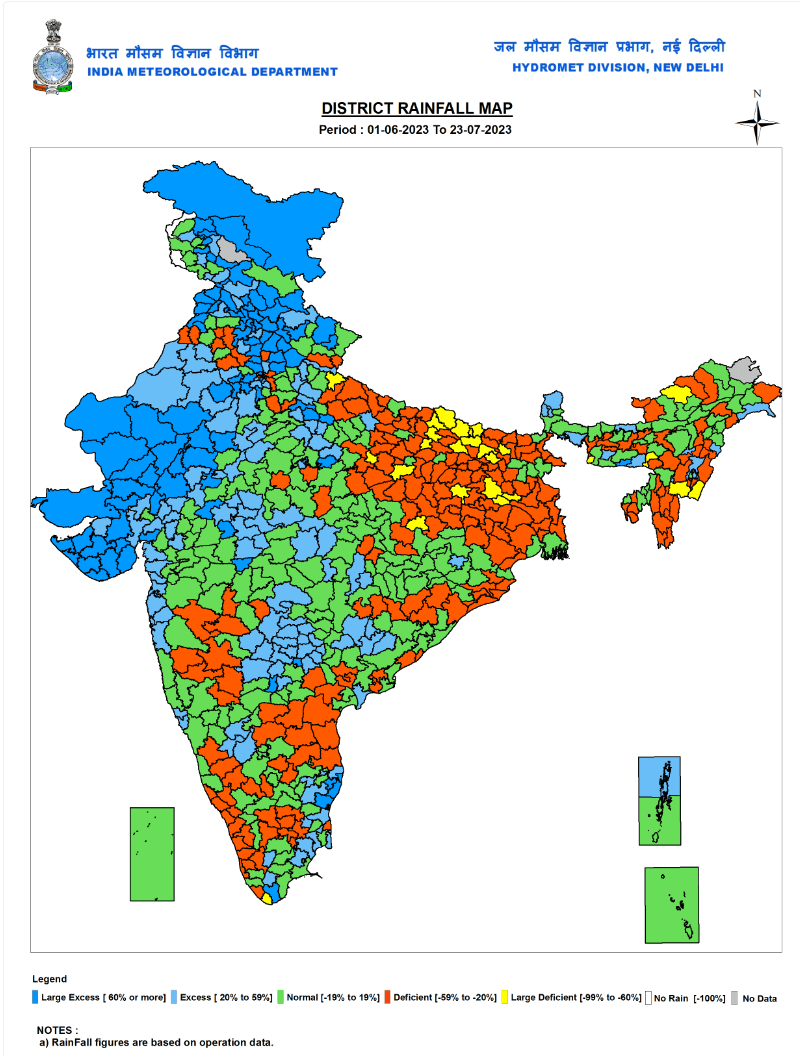
(Feature Image: – IMD’s District Wise Cumulative Rainfall Map for 01 June to 23 July 2023)

India received 389.2 mm rainfall till 0830 hrs on July 23, 2023 in SW monsoon. This being 5% above the normal rainfall till this date of 370.9 mm, India Meteorological Department and with it, the whole nation calls it Normal Monsoon. But anyone who is familiar with the rainfall pattern across India will not call it Normal.

We must urgently develop new parameters for describing the monsoon that also take into account spatial (across states, districts, Tehsils, blocks) and temporal variability. These parameters should take into account the departure from normal for each unit of space for each day and combine such departures to arrive at a figure that will better describe the monsoon for each unit of space. It can also take into consideration the high intensity rainfall events as also the longer dryer patches. This will help us understand not only the nature of monsoon rainfall, but also alert the farmers and everyone else but also help us understand how this pattern is changing over the years. This should not be so difficult for IMD to initiate and accomplish quickly. When aggregated at river basin level, this will also help us understand the actual rainfall pattern in each river basin but also how it is changing. Is this too much to ask?

Continue reading “DRP 240723: Urgently need parameters that will truly reflect rainfall pattern”
DRP News Bulletin

DRP 260623: National Framework for Sediment Management

A National Framework for Sediment Management is certainly a long standing requirement and any move in that direction would have been welcome. Not only because the sediment accumulation destroys storage capacity of India’s Dams, created at such massive costs. But also because sediment is an integral part of river flow and also very important for the rivers to stop or reduce erosion at deltas. There are other issues related to sediment including creation and disposal of toxic sediment and impact of sediment free water flowing downstream from the hydropower projects.

But we need much more serious and sincere efforts in this direction than what has been suggested in following government press release. The movement on such an important subject is so snail paced, half hearted, non-comprehensive, unscientific and non-sincere that it is not clear how this is going to help.

Continue reading “DRP 260623: National Framework for Sediment Management”
Yamuna River

Vyasi Hydro: Village Drowned; River Dried but little power generation

(Featured Image: Submerged Lohari village houses in Vyasi HEP ‘RoR’ dam reservoir. SANDRP, June 2023)

The 120 Mw Vyasi HEP built by Uttarakhand Jal Vidyut Nigam Ltd (UJVN Ltd.) in Vikas Nagar tehsil of Dehradun is on its way to become the textbook example of how thoughtlessly pushed hydro power projects are proving a nightmare for local people, a costly affair for the state and the nation and a disaster for free-flowing living river.

The project offers some bitter lessons for the policy-makers, experts and society who have been assuming that hydro power is a cheap, green source of energy and the Run of River (RoR) projects don’t dam and cause much harm to the environment, people or rivers.

Continue reading “Vyasi Hydro: Village Drowned; River Dried but little power generation”