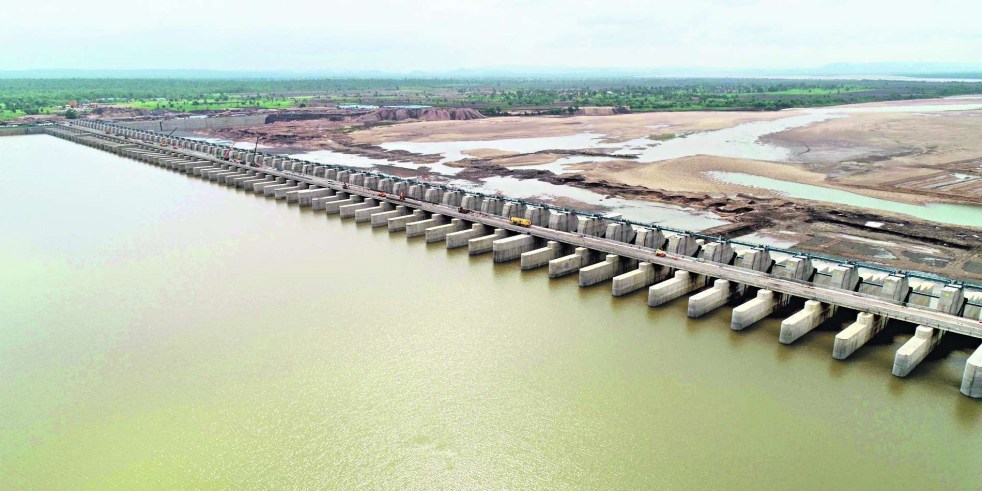
At a well-attended meeting at India International Centre in Delhi on Feb 20 2025, organised by VIDHI Centre for Legal Policy, a panel of speakers including Shri Shashi Shekhar (former secretary, Union Ministry of Water Resources) and Shri Jasbir Singh Chauhan (former Principle Chief Conservator of Forests, Madhya Pradesh) and Himanshu Thakkar of SANDRP, a number of fundamental questions were raised about the controversial Ken Betwa River Link Project. Unfortunately, no clear answers are forth coming from the authorities.
Continue reading “DRP NB 240225: Unanswered questions on Ken Betwa Project”Tag: EIA
DRP NB 100225: EAC & MoEF’s shocking decision to clear Teesta 3 Dam raises a stir
(Feature Image: Teesta III HEP dam was washed away on the intervening night of Oct. 3-4, 2023 on account of a GLOF. The flood in the downstream was magnified by the dam disaster. Photo: Mayalmit Lepcha/Source: Sanctuary Nature Foundation)
The decision of Union Ministry of Environment and Forests (MoEF)’s Expert Appraisal Committee (EAC) on River Valley Projects on Jan 10 2025 has understandably raised a stir and earlier the EAC and MoEF reviews and reverses this decision, better it will be. The decision is shocking on a number of counts. The EAC itself had raised a number of issues related to the project in its earlier meeting, but decided to clear the project without getting satisfactory resolution of the issues.
Continue reading “DRP NB 100225: EAC & MoEF’s shocking decision to clear Teesta 3 Dam raises a stir”DRP NB 200125: Whither Env Clearance Rejection rate from Expert Appraisal Committee or MoEF?
A detailed review of functioning of Union Ministry of Environment and Forests’ (MoEF) Expert Appraisal Committee (EAC) on River Valley Projects (RVP) for 2024 by SANDRP shows that the committee or for that matter MoEF has almost non-existent rejection rate. Even when a project is not cleared, when it applies again, it gets clearance, whether the application if for stage I (Terms of Reference) or Stage II (Environment Clearance- EC) clearance. Even in some cases like Pump Storage Projects (PSP) in Western Ghats or the Hydropower projects in disaster prone Himalayas, including the disaster-stricken projects like the 1200 MW Teesta III projects in Sikkim, the scrutiny including field visits by the EAC Sub committees is minimal, not worthy calling even scrutiny.
Continue reading “DRP NB 200125: Whither Env Clearance Rejection rate from Expert Appraisal Committee or MoEF?”2024: People’s Resistance against Dam, Hydro Projects in Himalayan States
(Feature Image: Tribals in Siang river belt in Arunachal Pradesh demonstrating against a proposed mega hydropower dam. Photo Credit: Special Arrangement/The Hindu)
All through 2024, the vulnerable communities across Himalayan states have continued their resistance and struggles against proposed, under construction & damaged hydro and dam projects as can be seen in this yearend roundup.
The tribals in Siang valley have been urging Central and State govts to stop pushing the giant SUMP. In Teesta valley the GLOF, flood and landslide though have served as wake-up call, the planners seem to ignore the warnings. Facing adverse impacts, the native people in Manipur have resolved to stop further extension to Loktak lake HEP. In Nagaland, fearing damages, the villagers have made the future of Dikhu HEP uncertain.
Continue reading “2024: People’s Resistance against Dam, Hydro Projects in Himalayan States”DRP NB 091224: “Kale Pani Da Morcha”: A Landmark people’s movement
(Feature Image: Women activists who were standing and displaying placards were detained by the Ludhiana police during the protest. Photo: By special arrangement/The Wire)
‘Kale Pani da Morcha”, the people’s movement against Pollution of Buddha Nallah, a tributary of Sutlej River in Ludhiana (Punjab) is a landmark movement in more than one sense. Firstly, while severe pollution of rivers is the usual story from across the country, a courageous people’s movement to address is the issue is such a rare event.
The fact that the industries association actually threatened this movement with a counter from the industries and their workers is shocking and shows the impunity of these industries. While the state government has to take quick action to address the issue, there is also a huge role for the central government, which has abjectly failed to perform its basic duty of providing credible governance of rivers, including their pollution in India. They including CPCB and MoEF know since decades that CETPs are completely failed model, and no worthwhile action has been taken to address the failure, including by the World Bank which has funded many of them. The filthy rivers all over India are violating the fundamental rights of millions of people, without any credible action even by the judiciary.
Continue reading “DRP NB 091224: “Kale Pani Da Morcha”: A Landmark people’s movement”DRP NB 14×24: Big Dams, Long distance water will not solve Urban Water Crisis
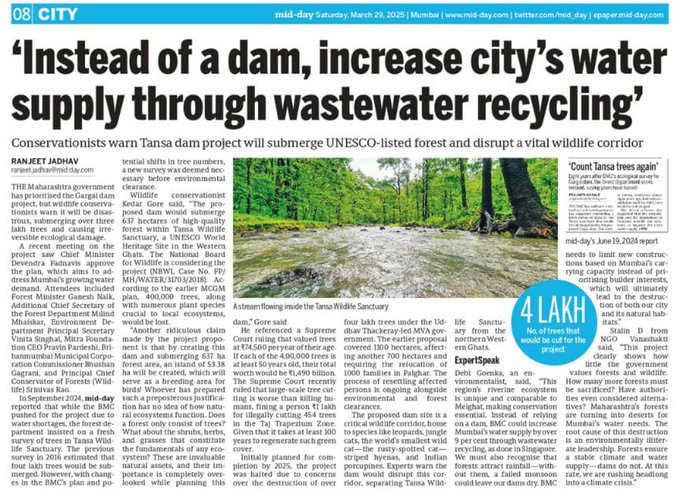
In a pointed article this week, Sachin Tiwale rightly writes that Mumbai does not need more dams, but needs to fix the distribution of more than enough water that it gets currently. Same is the case with highly capital and energy intensive 5th stage of Cauvery Water Supply being inaugurated on Oct 16 by the Karnataka Chief Minister and Deputy CM for Bangalore, advertised through full page advertisements today (Oct 14) in newspapers in Bangalore.
What the India’s cities need is to exhaust the potential of local water resources, including rain water, local water bodies including rivers, groundwater recharge, recycle and reuse of treated sewage and also demand side measures, including fixing the distribution and reducing transmission and distribution losses. All of this needs attention through a National Urban Water Policy that will also fix the Urban Water Governance.
Continue reading “DRP NB 14×24: Big Dams, Long distance water will not solve Urban Water Crisis”DRP NB 300924: Focus on River Studies
Rivers are the most important ecosystems (eco here includes ecology and economy) and yet possibly least studied entities. Some news below this week about some river studies brings the focus on need to take up many more river related studies.
Most important aspect of river related studies is the need for credible, independent studies, not influenced by the needs of the governments. Otherwise, the government is likely to not only influence the study, but also decide not to make it public as they did in case of the studies related to Joshimath town and role of Chamoli disaster.
Continue reading “DRP NB 300924: Focus on River Studies”DRP NB 160924: Urban Flood lessons from Vadodara, Vijaywada
(Feature Image: Vadodara: A flooded area after heavy monsoon rainfall, in Vadodara, Tuesday, Aug. 27). Photo Credit: PTI/The Hindu)
Like every monsoon, a number of cities have faced catastrophic floods in SW monsoon this year. Vadodara and Vijaywada have got the media attention more than any other city for urban floods this year. In both cases a number of factors are common: role of upstream dams, encroachment on water bodies including rivers, lakes, streams, role of illegal sand mining particularly in Vijaywada, not having learnt any lessons from past flood disasters.
It is interesting to see Andhra Pradesh CM hinting at bringing HYDRAA like enforcement institution to remove encroachments on Budameru and other water bodies. Considering the nature of his politics and track record, it is doubtful if this NDA CM will take such a bold step, but it is certainly worthy of consideration for almost all urban areas in India.
Continue reading “DRP NB 160924: Urban Flood lessons from Vadodara, Vijaywada”DRP NB 090924: Question marks over Yettinahole should not be buried under money spent
(Feature Image: File photo of Yettinahole Project. Source: Daijiworld)
The Yettinahole project has seen protests and question marks right from the time when the project was proposed, none of them have been convincingly answered. As the Karnataka Chief Minister and his deputy commissioned a small part of it, those question marks remain as relevant today, including its hydrological viability, environmental impact assessments and sustainability, with hugely weakening of the western ghats by such major interventions without any credible impact assessments. (see: https://sandrp.in/2013/09/18/yettinahole-diversion-an-imprudent-rs-100-billion-proposition/)
It is good to see CWC and MoEF have also raised some questions and asked report even at this stage. One however expects CWC to raise such questions much earlier in the project cycle and before the project becomes fait accomplice. Else, it seems more like politicking. MoEF could have raised issues of violations before the violations happened on ground and should have refused to provide piece meal forest clearances as it has alleged.
Continue reading “DRP NB 090924: Question marks over Yettinahole should not be buried under money spent”Yamuna Manthan 050924: Changing parameters of Ken-Betwa Project needs fresh appraisal?
(Feature Image: Dry Ken river beneath bridge at Pandvan in Amanganj, Panna in April 2018. Image taken during Ken river walk by SANDRP & Veditum India)
The controversial Ken-Betwa Interlinking project is undergoing several changes being proposed by central and state governments of UP and MP. Firstly, there are plans to build two new barrages at Pailani and Banda and renovate Beriyapur and Pariksha weirs and Barua Sagar dam apart from renovation of 15 dams and large ponds in Mahoba district. Then, the construction of a 21 km link channel will require 271 ha of forest land.
Similarly, the CM of MP has requested to increase irrigation capacity of Patne-Biarma Irrigation Scheme from 90,100 ha to 2,50,000 ha under the interlinking plan. On the other hand, the CM of UP has suggested inclusion of Hamirpur district in the plan.
Continue reading “Yamuna Manthan 050924: Changing parameters of Ken-Betwa Project needs fresh appraisal?”