Dams · DRP News Bulletin

DRP News Bulletin 11 Oct 2016 (Is there any justification for DESTRUCTION of Panna Tiger Reserve?)

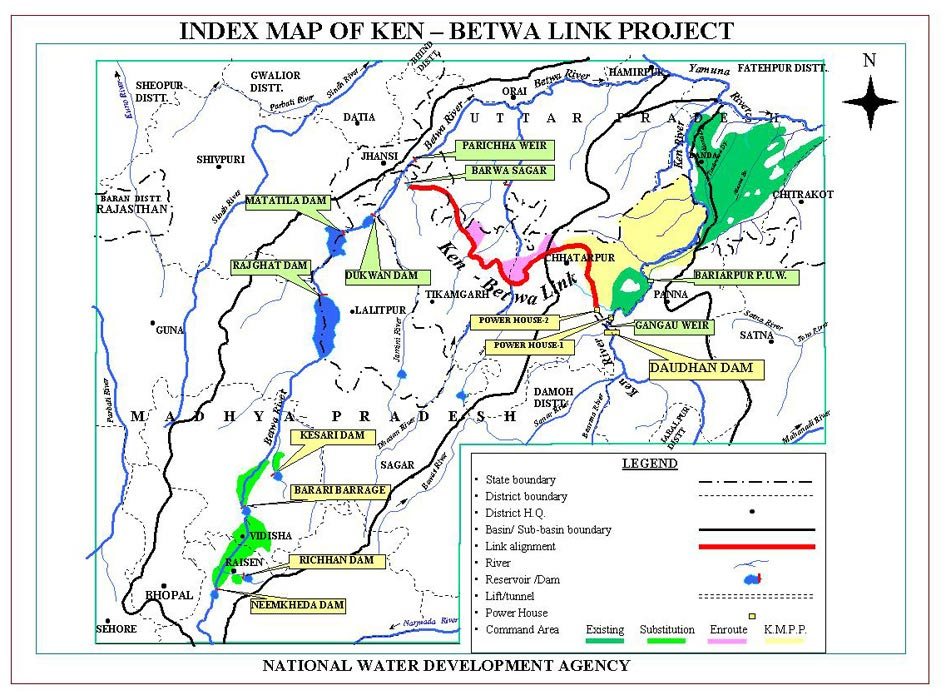
Is there any justification for DESTRUCTION of Panna Tiger Reserve? Can we save our Natural Heritage like the Panna Tiger Reserve (PTR) from being destroyed in the name of baseless, questionable, non transparent, undemocratic and manipulated projects like Ken Betwa inter linking ? It will facilitate export of water from Bundelkhand to OUTSIDE Bundelkhand. Whatever little benefits are claimed, some of them are already available and much more can become available at much lower costs, faster and without destroying the Forests and Tiger Reserve. The project will actually lead to destruction of Ken catchment and hence the Ken River itself. Watch this FASCINATING, AWESOME story of tigers of PTR. This BBC film where Raghu Chandawat is the story teller and Pradip Kishen is lending his voice, tells the story of Tigers of Panna till 2003, it seems. Please watch and let us all try to save it from destruction that is now writ large in terms of Ken-Betwa Link Project (KBLP). One more short film by wildlife biologist Koustubh Sharma illustrates how the Daudhan Dam under KBLP will submerge and destroy the PTR.

Meanwhile, a new analysis of rainfall data reveals that monsoon shortages are growing in river basins with surplus water and falling in those with scarcities, raising questions about India’s Rs 11 lakh crore plan to transfer water from “surplus” to “deficit” basins. According to Himanshu Thakkar of SANDRP river basin interlinking should be considered only after exhausting the local potential for harvesting rain, recharging groundwater, watershed development, introducing better cropping patterns (non water-intensive crops) and methods (such as rice intensification), improving the soil moisture-holding capacity and saving and storing water. Raising alarm over significant increase in ground water use, increasing reliance and fast declining ground water table, he warns that inter-basin links would actually reduce groundwater recharge because forests would be destroyed, the river flow stopped and the local systems neglected.

Continue reading “DRP News Bulletin 11 Oct 2016 (Is there any justification for DESTRUCTION of Panna Tiger Reserve?)”
Inter State Water Disputes

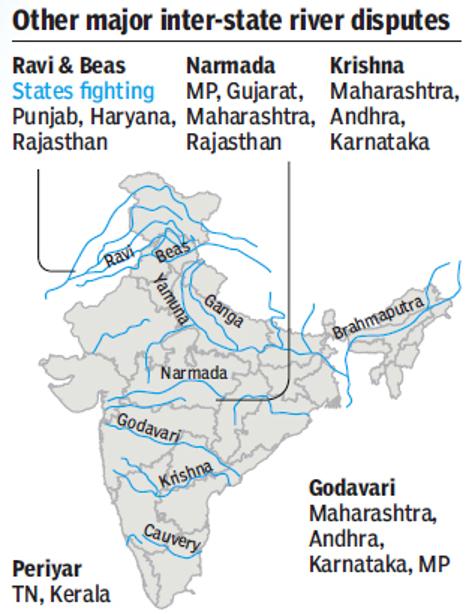
Inter state River Water Disputes in India: History and status

Water sharing disputes across the country (and even beyond) are only going to escalate with increasing demands, and also with increasing pollution & losses reducing the available water. Climate change is likely to worsen the situation as monsoon patterns change, water demands going up with increasing temperatures, glaciers melt and sea levels rise. The government’s agenda of interlinking of rivers would further complicate the matters.

The ongoing Cauvery Water Dispute [iv] has once again brought the focus on interstate river water sharing disputes in India and what has been our experience so far. There is no solution of Cauvery water dispute in sight and the engineer-dominated Cauvery Management Board that the Cauvery Water Dispute Tribunal Award has recommended is unlikely to help matters. Continue reading “Inter state River Water Disputes in India: History and status”

Dams · Indus

So who will suffer in the Indus water imbroglio?

Diplomatic and military strategies, by definition, are not decided through public debates. So the jingoism around Indus treaty with Pakistan seems more like an attempt at sending threatening signals. But it will have multiple serious ramifications in any case, so it is worth deliberating about.

The 1960 Indus treaty has allocated rights of development on three eastern tributaries (Sutlej, Beas & Ravi) to India, and we have exhausted that entitlement almost fully. Attempts to use the occasional remaining flow will mean a huge impact in Indian Punjab, which is unlikely to resonate well with the people of Punjab.  The treaty gave Pakistan dominant right of development of the three western tributaries (Chenab, Jhelum and Indus), India has limitations about water use (both in terms of quantity and manner of use) in case of the western rivers. India has not yet exhausted the entitlement in this case.

Continue reading “So who will suffer in the Indus water imbroglio?”

DRP News Bulletin

DRP News Bulletin 5 Sept 2016: Is there hope for India’s Environment from Mr Anil Dave?

ENVIRONMENT GOVERNANCE

Is there hope for India’s Environment from Mr Anil Dave? Most shocking statements from India’s environment Minister. He says let us do Ken Betwa link when the project has NONE of the statutory clearances from his own ministries. The independent committees are yet to appraise the project and yet he is saying: “This Ken-Betwa river link we should do it and have an impact assessment after five years. If it is good, then great, if not they don’t go for other linkages.” Is there any hope for India’s environment? As he says, YE SAB CHALTA HAI!!

http://www.dnaindia.com/india/interview-won-t-put-a-cap-on-new-dams-in-uttarakhand-river-linking-should-go-ahead-anil-dave-2251391 Continue reading “DRP News Bulletin 5 Sept 2016: Is there hope for India’s Environment from Mr Anil Dave?”

Dams · DRP News Bulletin

DRP News Bulletin 22 August 2016(NGT failed its mandate by allowing AOL event)

Op-Ed NGT failed its mandate by allowing AOL event This is such an amazing editorial on the issue of destruction of floodplain by Art of Living, whose behaviour is brazen, but predictable, it says! So amazingly forthright, it says “ Far more unfortunate, however, is the manner in which the NGT appears to have conducted itself in this affair. It is a sad commentary on the state of environmental governance n the country that its premier green body”, NGT, “ has to prevaricate on its earlier order”. It concludes. NGT failed to protect such an ecologically sensitive area.  It is deeply disturbing that the country’s apex environmental tribunal allowed itself to be pressured and intimidated. Salutes to the Author of this forthright editorial! Meanwhile, the  committee of experts, appointed by Green has found that the “entire floodplain area used for the main event site” has been “completely destroyed” causing “invisible loss of biodiversity” that “may never be able to return”. In its 45 page report, submitted to the NGT on July 28, the seven-member panel, said “the entire floodplain area used for the main event site, i.e. between the DND flyover and Barapullah drain (on the right bank of river Yamuna) has been completely destroyed, completely destroyed not simply destroyed. The ground is now totally levelled, compacted and hardened, totally devoid of water bodies or depressions, and almost completely devoid of any vegetation (except a few large cattails at the base of of the DND flyover)”. On the contrary AOL alleged that NGT appointed committee is biased, unscientific and lacks credibility. 

Continue reading “DRP News Bulletin 22 August 2016(NGT failed its mandate by allowing AOL event)”

Dams · DRP News Bulletin

DRP News Bulletin 08 August 2016 (Aug 06, ILR meeting is no dialogue)

SANDRP BLOG Aug 06, ILR meeting is no dialogue  While dialogue is necessary and welcome in any democracy, the meeting that was organized on Aug 06 at Constitutional Club is certainly not the right step in almost every sense. We hope MoWR and those who gather at the constitution club today will deliberate on these issues and resolve to correct them before a dialogue can really begin on the issue of ILR, and in fact Rivers. SANDRP coordinator was invited at this meeting on ILR being held at Constitution Club at 4 pm today as a speaker, but have decided to decline the invite, as elaborated in the note here. Please help us spread the word. Feedback is welcome.  As was expected, Minister Uma Bharti reiterated that the Ken Betwa Link project will be implemented, even though the project has none of the clearances as yet! The reporter should have mentioned that. 

Continue reading “DRP News Bulletin 08 August 2016 (Aug 06, ILR meeting is no dialogue)”

Dams · DRP News Bulletin

DRP News Bulletin 11 July 2016 (Namami Gange proving mere an extension of Ganga Action Plan)

Ganga Manthan to Ganga Act: No progress made Chairing the 6th meeting of the National Ganga River Basin Authority on July 04  Water Minister Uma Bharti has said that a new act will be formulated for speedy implementation of Namami Gange programme. On July 06, giving a major boost to Namami Gange Programme Ms Uma Bharti has also announced that 231 projects will be inaugurated at various locations in Uttrakhand, UP, Bihar, Jharkhand, West Bengal, Haryana and Delhi on July 07. Incidentally, on July 07, 2014 NDA Govt. launched the Namami Gange programme to rejuvenate the river to be executed over five years. The project has a budget outlay of Rs 20K crore which is 10 times more than what was allocated in previous Ganga Action Plan (GAP) phase I and II. But more money and the PM minister’s zeal, notwithstanding, Namami Gange seems a carryover from its predecessor in one crucial respect.  The overwhelming emphasis on pollution abatement that had led to the GAP’s failure bedevils Namami Gange as well. In certain respects, Namami Gange is an improvement on the GAP. It seems that the govt has not learnt lessons from the GAP’s failure. The lag between sewage generation and treatment has remained between 55% & 60% even as new STPs were built under the GAP. This is because a lot of the waste is generated outside the sewerage network and is not conveyed to the STPs. A large section of the country’s urban population lives outside this network. Moreover, the STPs can only do so much. The official statistics show that the STPs are currently running at a deficiency of 55%. The problem of STPs is three-fold: underestimation, shortage and underutilization due to lack of a well-connected underground sewage system.

The problems associated with river Ganga, however, do not end or begin in its middle course dotted by factories. The upstream of the river, where Bhagirathi and Alaknanda join to form the Ganga, is part of a very fragile Himalayan ecosystem. Caution is needed in implementing the Namame Gange projects along this stretch. The Kedarnath flood of Uttarakhand is an example of what a combination of melting glaciers and mindless construction can do to a sensitive geological zone. With more than 40 dams, barrages and weirs  and many more planned aviral Ganga seems nothing more than an empty catchphrase. Ganga is the sum total of the contribution of some 12 major tributaries. Without a rejuvenation strategy for each of Ganga’s tributaries, there can be no Ganga rejuvenation.

Meanwhile, increased fishing activity and vessel traffic are proving to be the disturbing element downstream. Deploying more scientific methods for fishing and limiting it to levels enough for species’ sustenance might help without significantly affecting livelihoods. The direct consequences of climate change are also felt in the lower belts, around the Ganga Sagar region. Land is disappearing but no comprehensive plans have emerged as yet to provide for the rehabilitation of the region’s inhabitants.

Continue reading “DRP News Bulletin 11 July 2016 (Namami Gange proving mere an extension of Ganga Action Plan)”

Dams · DRP News Bulletin

DRP News Bulletin 02 May 2016 (Patoda: How a village in drought hit Maharashtra achieved water independence)

Patoda: How a village in drought hit State turned water self-reliant  At a time when almost every village in drought-hit Marathwada is facing acute water scarcity tiny Patoda, on the fringes of water-starved Aurangabad city, is offering valuable lesson in water management conservation and harvesting. Though it is surrounded by arid villages but Patoda’s residents regard water as more precious than money. They follow strict rules about usage and strictly carry the water audits. Water meters are installed in every households and entire village recycles each drop of waste water it generates. Today no rain water flows out of the village. Percolation has recharged the aquifers and the water table has risen. So effective is its water conservation model that Patoda has now become a model for the rest of Marathwada and has won 22 state & national awards. But it did not happened over nights. In fact it is a result of over 10 years joint efforts done by villagers.

Continue reading “DRP News Bulletin 02 May 2016 (Patoda: How a village in drought hit Maharashtra achieved water independence)”

Dams · DRP News Bulletin

DRP News Bulletin 08 Feb.2016 (Is Not Hiding Environment Information Against Sabka Sath, Sabka Vikas?)

SANDRP Open Letter to MoEF&CC Is Not Hiding Environment Information Against Sabka Sath, Sabka Vikas? Even as the Ministry of Environment, Forests and Climate Change has been sanctioning cascades of hydro power projects on here-to free flowing rivers in the Himalaya and North East India, Cumulative Assessment of the Impacts of these projects became a crucial area of concern. The cumulative impacts of these projects on the hydrology, downstream flow, sudden water releases, deforestation, muck disposal, influx of migrant workers, seismicity of the region etc. is huge as compared to individual impacts. The projects together stand to change the social and ecological fabric of these regions.

Cumulative Impact Assessment (CIA) studies are a part of the Environment Impact Assessment Process under the EIA Notification (2006) and Environment (Protection) Act 1986. The documents of these CIAs have been uploaded on the Environment Clearance website in the past, as was required under number of laws. However, as the EAC is slated to consider whopping 4 CIAs in its upcoming meeting on the 8 and 9th Feb, not a single CIA-related document is available on the MoEF and CC website! We are told that these may not be made available in the future.

Continue reading “DRP News Bulletin 08 Feb.2016 (Is Not Hiding Environment Information Against Sabka Sath, Sabka Vikas?)”

Dams · DRP News Bulletin

DRP News Bulletin 18 Jan.16 (MoEF Expert Committee on Dams continues to ignore democratic norms)

MoEF Expert Committee on Dams continues to ignore democratic norms  The minutes of the 90th meeting of the Expert Appraisal Committee on River Valley and Hydropower projects held on Dec 22-23, 2015, made available today (January 18, 2016, see: http://environmentclearance.nic.in/writereaddata/Form-1A/Minutes/0_0_11118122212121Minutes-90EAC.pdf), shows how the committee continues to ignore basic democratic norms. Here are some key issues about the minutes of this latest meeting:

Continue reading “DRP News Bulletin 18 Jan.16 (MoEF Expert Committee on Dams continues to ignore democratic norms)”