Bihar · Floods · Kosi

1948 Floods in Bihar-3 Inaugural flood in Bihar after Independence – Assembly Debate

-Guest blog by Dr Dinesh Kumar Mishra (dkmishra108@gmail.com)

This years’ flood[1] was discussed in the Bihar Legislative Assembly on the 18th September, 1948 from a different angle than what is common to political forums. Dip Narayan Singh initiated the debate saying, “…I have a feeling that the floods cannot be stopped altogether and therefore I will request the Government to find ways to reduce the losses caused by floods, provide succor to the people at the time of their emergencies and this process should continue to find innovative means to deal with floods. At the moment this job is assigned to the Sub-divisional Officer or the District Magistrate. When the floods arrive then the victims neither get boats nor the relief reaches them in time. I will request the Government, therefore, to initiate a permanent procedure to deal with floods.” He continued, “Let the Government of India constitute a Commission to go into the details of the floods in the Ganga basin and devise strategies for facing the floods so that the miseries caused by it can be reduced.”

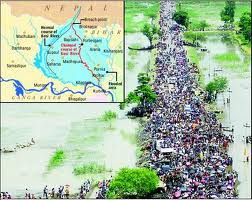
Then and Now. 2008 Kosi Floods, in perspective if the 1948 Floods. Photo: Times of India

Prabhunath Singh suggested that,  “…all the embankments running along the Ghaghara from Darauli in the west to Kasmar in the east via Agampur, Tajpur, Naini Bundh, Sonepur Seva Samiti should be raised and strengthened. Along with this sluice gates should be installed on all the small rivers like Tel and others coming from Naini and Brahmapur to facilitate drainage of the stagnating water.”

He charged the Railway Company of obstructing the process for it felt that if all the other embankments are raised and strengthened, the railway embankments will be adversely impacted. That is the reason this district has to face floods year after year. He suggested to the Government that if it really wanted to help the people in their moment of crisis, it should help the flood victims in rebuilding their houses and arrange seeds for them to put agriculture back on rails. If the Government decides to advance loans for the purpose, it will require nearly Rs 30 million for Saran district alone. With that money it would be better for the Government to device means to make Saran a flood free district for all times to come. He further suggested that the Government must realize the money from the people that it gives to them as help and take advice about the costs involved from the engineers[2]. Saran was a rural district with high population density which was unmatched elsewhere. The villages there were beautiful with rich cultural background. The people there have a high degree of self respect. Gratutious relief should be given only to them who really need it. There are people in our villages who would prefer to die than to queue up for relief.
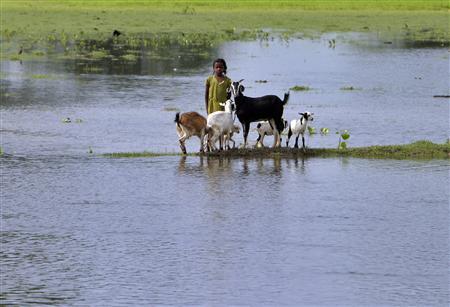
Timeless flood suffering in Kosi. 2008. Photo: Reuters

Girish Tiwari, also from Saran, said, “…Yesterday someone was asking what is the amount of money orders received in Saran from different places? I want to tell him that the people in Saran will have to starve if their loved ones didn’t send money orders here. The people need relief but there are various ways of providing relief. The places where there is a need of employment, open work there.”

He continued, “There is a stretch of Diyara land starting from Darauli till Sonepur. Let me tell you about Sitab Diyara, the village of Jay Prakash Narayan, which is now located west of the Ghaghara in Balia district of Uttar Pradesh. Many people from this village have shifted to Balia in Uttar Pradesh and some have moved to Rivelganj. People from Nagar Diyara have no place to go and they need land from the Government to settle down somewhere and the Government should acquire land for them. That will be a help.”

Ram Bonod Singh from Chhapra claimed that, “Not an inch of dry land is available from Manjhi to Sonepur. The current of water was so strong that all the mud houses collapsed. Cattle were in deep trouble. Most of them died or swept away and those survived fell sick. There was no fodder as all the land was under water. Fodder needs to be arranged for them and the Government must open cheap husk and straw shops to save the cattle.
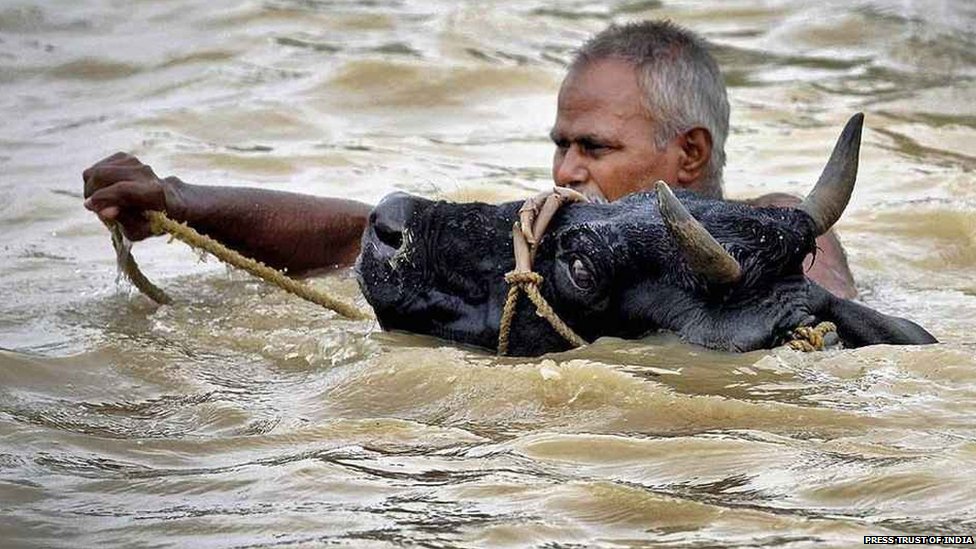
Not much has changed..cattle battling the Bihar Floods now. Photo: BBC News

Dip Narayan Singh lamented that boats were not available normally when the floods struck and the officers had no clue how to face the emergency. Many boats of the traders were parked at Mahnar and Hajipur and had the officers known about their availability they could have helped in rescuing a good number of people from the flooded areas and thus saved their lives. Insisting on the opening of cheap grain shops in the flood ravaged areas he told that a huge amount of food grain was buried under the debris of the collapsed houses and the seeds for the next crop also got trapped there. Such people needed to be helped by ready to eat food and also with seedlings of paddy for immediate transplantation from the areas that were not flooded this year. This should be done without any further loss of time. Some people might need loans for house building and that should be made available to them on deferred payment. Cooperatives could also advance loans to such people wherever they existed. Crop loan might be needed for some and that should be arranged for those who asked for it.

Murli Manohar Prasad talked about floods as a long term problem and said that some years ago there was a meeting with the Government of Uttar Pradesh when it was decided that the Railway Bridge at Majhi on the Ghaghara will have to be extended and embankments should be built on the river from Dhanawari till Chinwari like that built on the Gandak. Uttar Pradesh had opposed this embankment on the ground that the proposed embankment will have adverse impact on the Balia district. He wanted to know from the minister about the fate of those discussions. He also wanted that the issue of deforestation should also be discussed with Uttar Pradesh as massive felling of trees had aggravated the flood situation in Bihar while maintaining that not much benefit is expected from the restoration of forests as, “Unfortunately, the topography of Saran is quite unique. The level of the Gandak river is above the level of its surrounding, the river flows in many streams that take off at various points from the main stream. The level of these streams is also higher than the adjoining land and embankments are built on them also (He was referring to Zamindari embankments.). The local people had developed a very efficient system of irrigation and drainage that worked well till the Moghul Rule. Sluice gates were built on the embankments at various places on the Gandak which helped in controlling various smaller rivers taking off from the Gandak. Whenever people apprehended floods, they used to drop the shutters of the sluice gates. Besides, they have connected the chaurs (depressed lands) with these rivers and could take water from the rivers or discharge water into it with the help of sluice gates. Their drainage channels used to run parallel to the embankment of the river and were connected to the chaurs and the people could manipulate the direction of flow water as they desired. Almost whole of the Saran district was somehow connected to many of its major rivers namely the Ghaghara, the Gandak and the Ganga. Unfortunately, this amazing set up of irrigation and drainage got ruined with time and the sluice gates that were functional till 1878 ceased to function because the indigo planters who were paying the water rates based on the expenses incurred on running the set up to the Government refused to pay it anymore which they were paying so far. That led to the death of a good irrigation and drainage system. When water ceased to flow through these channels then not only the zamindars but rayyats also started encroaching the river bed and the local officers of the Government helplessly watched the proceedings of dismantling law and order situation of the district. His appeal to the Government was that, “it should not end up only distributing relief to the flood victims but should think seriously over the flood problem of the district.”
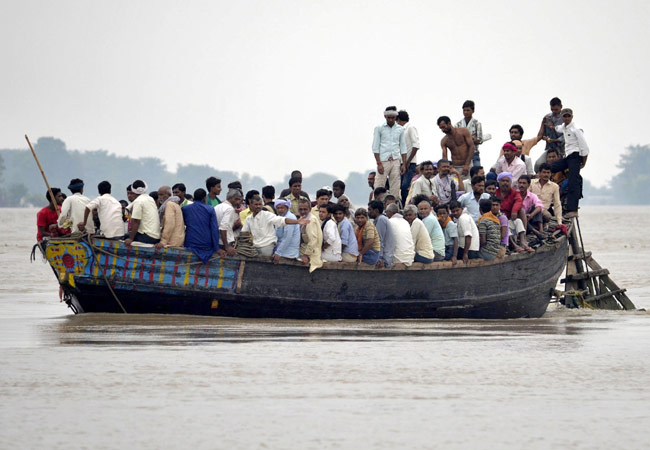
2013 Kosi Floods Photo: India Today

Prabhunath Singh intervened once again to say that, “The land between Darauli to Sonepur is quite fertile. The district of Saran is rated as a deficit district not because its land is inferior but because its population is very large and per capita availability of land is too small. I want to reiterate, therefore, that the damage inflicted by floods on the district is the only reason of the misery here and the Survey and Settlement Reports confirm it.” The embankment built in Kasmar Pargana from Sonepur to Darauli was earlier looked after by the Zamindars but their attitude changed and they had virtually abandoned the maintenance of those structures which were in ruinous state. He wanted the Government to take over the up-keep and maintenance of these structures. He added that an embankment existed earlier on the left bank of the Ghaghara from Sonepur to Kasmar and all that was needed to be done was repairing this structure.  If the Government of Uttar Pradesh objected to it then Bihar Government could always tell them that the embankment already existed and the State was only repairing it. The Survey and Settlement Report records stand a testimony to that effect.

Most of the members of the Assembly were of the view that the policy hitherto adopted of ‘no embankments’ along the rivers should be revisited, should now be changed and embankments must be built wherever needed or demanded by the people. The Government, however, was still not decided and used to pass the buck on the experts’ advice as it very well knew the consequences of embanking of heavily silt laden rivers.

Two ministers in the Government replied to this entire debate in the Assembly and their statements are worth studying minutely. First to reply was Ram Charitra Singh who said, “… It is quite likely that the reason for the floods in North Bihar are the people themselves living in the State.  Almost all the rivers of North Bihar have their origin in the Himalayas that are covered with ice. All the rivers that discharge their water into the sea bring a lot of sediments in their flow and deposited it on their path to the sea. That is how the land was formed in this region. Then came the human race which started tampering with the rivers for its own benefits and its lack of foresight resulted in the situation that we are faced with now. The debate that has taken place in the House establishes that we are still trapped in the same mindset.   The result is that many embankments have been built and many others are in the process of being built. The debate today in this House has revealed that many of our friends desire that we should continue building the embankments and they believe firmly that this will benefit them and improve the flood situation. I must say that, scientifically, had these embankments not existed the problem of this magnitude were not going to be there but what has happened has happened. We now better concentrate on the future course of action. Our policy is to control the construction of embankments.  Wherever these embankments are built, their construction is illegitimate and a vigil has got to be kept on them. At some places there were constraint and embankment had to be built there although it creates problems.”

He continued, “…I went to the Saran district recently and stayed there for three days (watching the flood situation) and immediately after my return here I got 14 embankments built along the Ganga for flood protection including Dighwara, Shitalpur and Kaudimal. I am not upset that so many embankments have been destroyed this year and a sum of Rs. Two lakhs twenty thousand has been wasted but I don’t regret it and should our engineers suggest that an embankment is essential, I will not hesitate helping them build it.” He admitted that the kind of damages due to floods that were seen in Saran this year were not seen elsewhere and assured all his help to the district. Emphasizing the need for drainage of the Chhapra town he had already instructed the Chief Engineer, Special Officer and the District Magistrate to repair the roads, railway line in collaboration with the District Board even if it amounted to cutting the railway line immediately. The Kharif crop was already lost and if the water is not drained out, the chances of Rabi would also recede.

Another minister, KB Sahay had this to say. “…The problem of floods is very critical. If we construct embankments in Saran, what impact will it have on the other districts? If we control the Ganga in Saran, how will that effect the other districts in UP? I want to put all these facts before the House and want to assure you that the Government will appoint a Commission whose job will be to tell that if an embankment is to be built in Muzaffarpur, it should tell us where and how?…If in Patna then where and how and so on.”

2008 Flood Photo: Bihar Days

Dinesh Kumar Mishra, Convenor-Barh Mukti (dkmishra108@gmail.com)

END NOTES:

[1] This is Third part of a series of articles Dr Dinesh Kumar Mishra has written for SANDRP based on his month long research at the National Library, Kolkata recently.

For Part 1 see: https://sandrp.wordpress.com/2015/03/09/1948-floods-in-bihar-1-inaugural-flood-after-independence-view-from-press-gallery/

Part 2: https://sandrp.wordpress.com/2015/03/10/1948-floods-in-bihar-2-inaugural-flood-after-independence-official-version-of-floods-and-its-aftermath/

[2] He meant that the Government should not give money to the flood victims just as a dole. It was to be a soft loan and the estimates etc should be suggested by engineers.

Bihar · Floods

1948 Floods in Bihar-2 Inaugural flood after Independence – Official Version of Floods and its Aftermath

Compiled[1] by Dr Dinesh Kumar Mishra (dkmishra108@gmail.com)

Government of Bihar, Revenue Department, Report on the Flood and Relief Operations in Bihar for 1948-49. Superintendent, Government Printing, Bihar, Patna, 1951.

Muzaffarpur [2]“During the August floods water from the River Narayani flooded the village Fatehabad. About 100 houses are reported to have collapsed as a result of the breach in the bundh due to change in course of the River Gandak. There were heavy showers and considerable damage was caused to the paddy crops and certain parts of the Sadar and major parts of Katra, Minapur and Sakra thanas experienced floods… During floods in the Ganges, Hajipur sub-division was badly affected and steps had to be taken to arrange relief.” P-15 Continue reading “1948 Floods in Bihar-2 Inaugural flood after Independence – Official Version of Floods and its Aftermath”

Bihar · Floods

1948 Floods in Bihar-1 – Inaugural flood after Independence – View from Press Gallery

Guest blog by Dr Dinesh Kumar Mishra (dkmishra108@gmail.com)

Background Bihar is long known for its floods. The British had left India but their legacy of looking at rivers and their floods was still continuing in 1948[1]. They always favored ‘leaving the rivers to their own devices’ and did precious little to tame the rivers. The zamindars used to put temporary and not so temporary embankments along the rivers to provide some flood protection to their ‘ryots’ which used to breach quite often to the detriment of the people living in the flood plains of the river. The repairs of such breaches were the responsibility of the zamindars but if they did not repair the same, the British establishment used to repair it and realize the cost of it from the zamindars. There were only 160 kilometers of ‘well designed and equally well constructed’ embankments on Bihar Rivers then. Zamindars had got a hint from the Government of India that their days were numbered and had little interest in maintaining the embankments in order. It was under these circumstances that the Government of Bihar (GoB) was expected to face the floods for the first time in independent India. Continue reading “1948 Floods in Bihar-1 – Inaugural flood after Independence – View from Press Gallery”

Bihar · Embankments

Response to SANDRP blog: On Sediments & Rivers

Satellite image of Brahmaputra River From: Wikimedia Commons

Dr Dinesh Kumar Mishra (dkmishra108@gmail.com)

Read the article by Thakkar and Dandekar[1] on sediments with great interest. The basic duty assigned by nature to any river  is to build land (nearest word is delta formation), transport the water falling on its catchment to the master drain or the sea and keep the ground water level intact besides saving its fertility. Scriptures define river in many other ways. The basic reason for that was, probably, to discourage tempering with the river. The rivers flow for the good of all the living beings (paropakaray bahanti nadyah), they are cited as an example for continuity. Our ancestors used to bless the younger ones that their name and fame will last till the rule of forests, mountains and rivers are there. There are strict restrictions about polluting rivers and the punishment is also prescribed for doing so. That provides enough food for thought about rivers to us. When we recall our rivers to grace any religious or social ceremony, the emphasis is never forgotten as to what should be our attitude towards rivers. Most of our festivals are held on the bank of the rivers (barring Karmanasa) in Bihar which is called tirthas i.e, the sacred places.

We care too hoots about our rivers now.

An engineer or a trader looks at the rivers about the profits that can be made by the existence of the rivers and they rightly use the word ‘exploitation’ which we all know what it means. As engineers, we all are trained to look into the Benefit Cost ratio and are never taught about the social costs. That is not our job. We tell the politicians where the profit and votes lie. They, in turn, tell all others that they have a team of world class engineers who have advised this or that. The implementers (the contractors) intervene in the mean while. Then there may be financers, promoters, consultants and what not, each with some vested interest or the other. Some of them are for money, some for power, some for name and fame and some for merely impressing others of their proximity with the sources of power.

Each one of them has an insurance that by the time the ill effects of their wrong doing come to the fore, they will not be there in this world. That sets the tone for discussions now.

Let us look at the physical characteristics of river water. The river water contains sediments of all kinds and their shape and size depends on the locations that they are transported to by the river water. The ultimate destination, however, is the sea.  I have read considerable literature about sediments and floods and I know that at least since middle of the 19th Century, the British engineers in India have been telling that water is not the problem and it is the sediment that is responsible for flooding. This should be treated first if the floods are to be avoided.

Unfortunately, we are not taught how to deal with sediments and we read about it as a passing reference.  Water flows downstream but the sediments remain where the water no more is in a position to push it further down.

Structurally, if you intercept water by a dam, the sediment will collect in the reservoir area.  I had read a report of Central Water Commission a few years ago (I should be having a copy of it somewhere in my collection) wherein they had studied the sedimentation of  64 reservoirs in India but only in two of them their prediction of sedimentation was near to reality. Rest all the dams were in pathetic situation. Trap the river within embankments, the sediment will settle within the embankments and raise the bed level of the river. Kosi is a good example of mishandling of sediments. This river was flowing in 15 different channels some 60 years ago. The engineers embanked just one of these channels and forced all the water and sediments into that channel. The result is that the bed of this channel is higher than the adjoining ground. In lower reaches, the river is aggrading at a rate 12.03 centimeters every year. The engineers and the State is busy raising the embankments without realizing that they are ‘storing disasters for the future generation.’ Construct a ring bundh round a settlement to protect it from the floods of river, the sediment will settle outside the ring to the detriment of the community in future.

Many settlements in Bihar were encircled by such rings in the past.  These are all a false security for the people. There is sand casting within the protected area and boats ply there during the rainy season. Some of these rings do not exist anymore because the river has wiped them out. Every step of mishandling sediments leads to a disaster situation which we do not know how to cope with and do away with the sediment.

Look at any silt laden river. It used to spread the sediments free of cost all over the area which is what we call the land building by a river. You disturb a river and this quality is lost.

Then starts the famous debate on forests. The engineers are again confused over the issue and they are not sure whether restoration of the forests can be of any use. Once the ground is saturated due to rains, the role of forests is over, they say. Fortunately such conclusions are not available freely in vernacular. I shudder to think how the masses will react to such wisdom.

I had a chance meeting with the Minister of Water Resources of Bihar before this election and he wanted me to suggest something to combat floods. The discussion boiled down to sediments and the quantity of sediments that passes through Bihar every year.

Irrigation Commission Report of Bihar (1994) talks vaguely about sediments and no inference can be drawn out of it. This may be willful that a reader may not decode the information contained in the report.

Now, if it is understood that sediments are the problem, do we know the amount of it? The answer in ‘No’.

Or, even if it is available, it is not in public domain. We keep on telling that rivers have become shallow but its extent is not known in most cases. I suggested to him that if the government was really serious about the issue, let us take cross section of the river at strategic points that the WRD must have been taking before independence or after the establishment of the Planning Commission and check what is the extent of aggradation of the river bed and what have been the change in the cross section. This will tell us the sediment retained in the river bed and give a hint about its transportation to the sea. It will also tell us that if we pursue the policy of flood control as we are doing at the moment, what will be the fate of the river after say 50 years. He very kindly phoned his principal secretary who, probably, told him that this was possible.

Two questions arise from this discussion, (i) does it require an outsider like me with little access to information that these august bodies dealing with rivers have to tell the minister what should be done to assess the sediments? And (ii) what on earth the responsible engineers of the WRD have been doing all these years? Do they know their job and responsibility well?

kosidisaster

Former chief minister of Bihar had announced in May 2009 after the breach at Kusaha on the Kosi (in Aug 2008) was plugged that the embankment is not going to breach for thirty years, at least. Everybody interested in the Kosi issue knows that the breach had occurred because the river was pushed towards eastern embankment of the river by sediment deposition on the west and this was not given the attention it deserved.

I wonder since when the rivers have started taking command from the chief ministers. Even if they do, what will happen in thirty first year?

I am of the opinion that a peon in government is more powerful than a Noble Laureate outside for the peon can get something done through his contacts but the latter can only make a request. It is up to the establishment whether it heeds to his/ her advice or not.

3rd July 2014. Jamshedpur

END NOTES:

[1] https://sandrp.wordpress.com/2014/07/03/what-do-rivers-have-to-do-with-silt/

Bihar · CAG Report · Floods

CAG Review of Flood Control measures in Bihar: When will Auditors learn about ecology?

CAG Review of Flood Control measures in Bihar:

When will the auditors learn about Ecology?

Image

Recently tabled CAG (Comptroller and Auditor General of India) audit report on Bihar contains a performance review of implementation of flood control measures[i] in this most flood prone state. Most of the rivers in North Bihar originate in the Himalayan range in Nepal and cause floods in downstream Bihar with recurrent frequency. 73 percent of geographical area in Bihar is said to be under the threat of flood every year and 16.5 percent of total flood affected areas of India is located in this state.

On reading this performance review, one gets an idea of how CAG audit teams’ knowledge base on flood issue in Bihar relied heavily on Ganga Flood Control Commission (set up by Government of India in April 1972) recommendations, Bihar Flood Management Rules of 2003, Guide on Flood Management Programmes issued by Govt of India etc. However, the performance audit fails to draw upon the numerous writings by Dinesh Mishra of Barh Mukti Abhiyan (Freedom from Floods campaigns) and others. The performance audit also fails to draw upon the recommendations in the civil society fact finding mission following the massive floods due to Kosi embankment breach at Kusaha in Nepal[ii], Kosi Deluge: the Worst is Still to Come.

So when a performance audit report fails to draw upon the writings from ecologists and environmental historians, what recommendation flows from it? The same that would have flowed from the various official Ganga Flood Control Commission (GFCC) reports: build high dams in Nepal to trap the silt, at Barah Kshetra and on the tributaries of the river Kosi, a reservoir with adequate flood cushion at Noonthore on the Bagmati river, three dams over the river Gandak and a multipurpose reservoir at Chisapani on the river Kamla Balan. It is out of this blind faith in looking at high dams as providing flood control and flood cushion solution that CAG audit raised an audit observation that Bihar had failed to prepare even the Detailed Project Report on these proposed dams. The reply that state flood control department filed in November 2012 stated that a Joint Project Office was established at Biratnagar (Nepal) to study the feasibility of proposal of dam on Bagmati, Kamla Balan and Kosi rivers and the DPR of dam at Barah Kshetra was expected to be prepared by February 2013. The audit could have raised the question about the appropriateness of spending money on such futile exercise.

Misplaced faith in structural solutions Dinesh Mishra responds to this fallacy of the auditors stating, “The CAG report repeats what is told to it by the Govt. of Bihar (GoB) as the long term plan that was proposed for the first time in 1937 and nearly eight decades later the proposal is still under ‘active’ consideration of the two governments. Neither the GoB nor the CAG brings out this fact that there is massive resistance to any dam building in Nepal and more so if it is done by India. That is the reason why it has taken 16 years to work on the DPR so far without getting the same ready for any negotiation.” Dinesh Mishra adds, “There is no talking about seismicity, downstream impacts of large dams and strategic defence of the dam itself. We are not sure whether these structures would ever be built, but it is a carrot dangled before the flood victims of the state as if once the dam is built, all the flood problems of the state will be solved” (emphasis added).

No review of reasons for the Kosi disaster of 2008 Also missing from performance review are references to reasons for massive floods in the year 2008 following the breach in Kosi embankment at Kusaha and the pending recommendations by the still ongoing enquiry committee of Kosi High Level Commission. The audit fails to go indepth into how improper maintanance of the embankment lead to this flood disaster, who were responsible for improper maintanance and what system is needed to ensure such blunders are not repeated in future. The audit could have also gone into the role played by GFCC, Kosi High Level Committee and others in the Aug 2008 Kosi flood disaster. The audit continues to display an understanding that looks at more and more embankments straight jacketing the river, or unproved technological remedies such as Intra Linking of Rivers as potential solutions. Hence it raises questions on the non-completion of DPRs on Intra-linking of rivers and on completion of only 61.47 kms embankment against the target of 1535 kms as envisaged in the 11th Five Year plan.

Need to audit CWC’s flood forecasting performance The audit report does however mention those long term non-structural measures, such as flood plains zoning bill and establishment of flood forecasting units at field levels in upstream Nepal that were also recommended in 2004 by GFCC. The audit scrutiny showed that the state water resource dept had failed to enact flood plain zoning bill as well as in establishing flood forecasting units at field levels in all 16 test checked divisions out of 60 flood control divisions. The Audit should have also looked at the quality and use of flood forecasting by the state government and central agency like the Central Water Commisssion. CWC’s flood forecasting and its role in other aspects of flood management in Bihar also need a performance appraisal urgently. The Role played by Farakka Dam in creating backwater effect in Bihar, thus prolonging the flood duration in Bihar and also increasing the height of floods is another aspect that needs scrutiny.

Non implementation of Flood Plain Zoning Bill The flood plain zoning bill would have provided framework for regulation of development activities with the help of flood management maps. In November 2012, replying to this audit observation, department sought to justify its inaction by arguing that flood plain zoning is “impracticable and hindrance in the pace of development of state”. In the wake up of recent disaster in Uttarakhand, Bihar as well as other states would do well to give up on this misconceived tactic of shooting down any advocacy for environmental regulations by terming it as arresting ‘the pace of development’.

Bihar evaluating detention basin DPRs? The audit also pointed out that the suggestion of creating detention basins, i.e. adapting natural depressions/ swamps and lakes for flood moderation was not implemented by the dept as they had neither identified any sites nor released any funds to any divisions to undertake this work during 2007 to 2012. When this was pointed out by CAG auditors, the dept replied in August 2012 claiming that the DPRs of detention basins was under evaluation and final plans would be prepared by December 2012. However, till February 2013, no further progress on this was communicated by dept.

The audit also observed very serious deficiencies in financial management by the department. During the five year period 2007 to 2012, the dept had failed to utilise 11 to 44 percent of the available funds mainly due to delayed/ non-sanctioning of the schemes, delay in land acquisition, opposition by local people and non-passing of bills by the treasuries. Worse still, audit scrutiny showed that the dept had made 30 allotments amounting to Rs 47.47 crore to divisions on the last day of financial year.

Audit scrutiny of flood protection scheme revealed that the contract management of the dept was deficient as was evident from the cases of non-publicity of tender, allotment of works to ineligible contractor, loss to government owing to undue favour extended to a particular contractor and loss of Rs 103 crore due to non-availing of the benefit of competitive bidding in execution of Bagmati extension scheme. Audit also noticed other deficiencies such as non adherence to flood calendar in 44 percent of test-checked works, infructuous expenditure worth Rs 68.50 crore in four test-checked divisions and excess payment of Rs 6.25 crore in two test-checked divisions. Audit also pointed out that dept had incurred an unfruitful expense of Rs 20.21 crore due to abandoning, closure/ postponement of zamindari bandh in two test-checked divisions.

The office of CAG of India has indulged in lot of talk around the idea of environmental auditing. An International Centre for Environment Audit and Sustainable Development was inaugurated at Jaipur in May 2013 and the office of the CAG of India has held a few consultations on environment auditing in recent past. However, performance reviews such as this one clearly points out the need for CAG auditors to equip themselves better in the realm of understanding the ecological aspects around flood, flood plains and flood management; rather than simply drawing up from the reports in official domain such as Ganga Flood Control Commission etc. Will the newly appointed head of India’s Supreme Audit Institution devote his labour to this urgent tak?

Himanshu Upadhyaya

(Author is a research scholar at Centre for Studies in Science Policies, JNU, New Delhi.)