Dams · Maharashtra

Concerns about unplanned River Widening, Deepening and Straightening Works being undertaken under Jal Yukta Shivar and other projects


(This Note is followed by a letter to Maharashtra Chief Minister Devendra Fadnavis in Marathi, which is endorsed by several organisations)

In the past two years, Jal Yukta Shivar Abhiyan has been implemented in many districts of the State. A Government Resolution was issued on the 5th December 2014 to implement Jal Yukta Shivar Abhiyan (JYS from hereon) to make “Maharashtra Drought Free by 2019”. The GR lists out a 13-point program to be implemented, which lays stress on watershed works, deepening and widening of canals, cement nalla bunds, reinstating old water structures, tree plantation, well recharge, etc. The Chief Minister has supported the small scale water harvesting through JYS strongly, as one of the main solutions to water security for farm and villages. Continue reading “Concerns about unplanned River Widening, Deepening and Straightening Works being undertaken under Jal Yukta Shivar and other projects”

Dams · Hydropower · Maharashtra

“Water is not a private property of some groups”: Bombay High Court directs release of water from Private Dams like the Tata Dams

In a welcome move, Hon. Bombay High Court vacation bench of Justices Bhushan Gavai and Shalini Phansalkar-Joshi, while hearing multiple clubbed petitions about drought and the state’s response, has passed a strong order recommending release of water stored in PRIVATE DAMS and sources for drinking water purposes of drought hit region.

“Observing that natural resources are property of the entire nation and not just an individual or a private entity, the Bombay High Court directed the state government to consider supplying water from privately operated dams and wells to water-scarce areas.”   Continue reading ““Water is not a private property of some groups”: Bombay High Court directs release of water from Private Dams like the Tata Dams”

Dams · Drought · Interlinking of RIvers · Jammu and Kashmir · Uttarakhand

India facing its worst water crisis ever: Himanshu Thakkar

Find below interview of SANDRP coordinator Himanshu Thakkar by Aditi Phadnis, Business Standard. The interview was published in Business Standard on the 14th May 2016 (http://www.business-standard.com/article/opinion/india-facing-its-worst-water-crisis-ever-himanshu-thakkar-116051400704_1.html)

~~

Environmental activist and water expert Himanshu Thakkar tells Aditi Phadnis that India needs a comprehensive water-use policy immediately.

You are quoted as saying that India is in the grip of its worst hydrological crisis ever. Isn’t that a bit drastic? After all, India has endured endemic in many parts of the country for several years now. What makes you so pessimistic?

I do not think it is statement of pessimism but possibly reflects a reality. What we are seeing this year is unprecedented in many respects: major perennial rivers like the Ganga, Godavari, and have dried up at several locations, which was unheard of earlier. Groundwater levels are at a record low. In many places hand pumps have dried up completely. The number ofimpacted, the intensity of the impact are huge. This is only the fourth time in a century that there has been a back-to-back drought, but on all previous occasions groundwater, an insurance in times of drought, had provided relief. That is no longer an available option in several places. Our rivers are in a much worse situation today than ever in the past, due to all the ill treatment we have meted out to them, including multiple and often unnecessary, unjustified damming. All this makes the situation this year much worse.

You are credited with making public a lot of information and anlysis about the circumstances of the current shortage of water in Maharashtra. What do your findings tell us about the issue of water in the state?

The first thing that strikes you about is that it has, by far, the highest number of big dams in India. According to the National Register of Large Dams of the Central Water Commission, of the total number of 5,100 big dams 1,845 are in Maharashtra. So about 35 to 36 per cent of all big dams in India are in the state. Yet Maharashtra is in the headlines for drought and water scarcity today. While nationally, 46 per cent of cropped area is irrigated, in Maharashtra the figure is hardly 18 per cent. There is a lot of evidence here that big dams have proved to be a failed water resources development model. The current chief minister did say in his famous Assembly speech on July 21, 2015, that farmers need irrigation, not dams, and dams are not the only means to achieve irrigation. Unfortunately, one of the major planks used by his party to achieve power in Maharashtra, the Rs 70,000-crore irrigation scam, seems to have been totally forgotten by the state government.

Parts of Maharashtra are facing multiple agrarian and hydrological crises this year. Rainfall deficits have been as high as 40 and 42 per cent in the last two years in Marathwada. In some districts and blocks the figure is even higher. So rain-fed kharif crops in many parts have failed for the last two years. The rabi crops were also hit by unprecedented hailstorms in 2014 and 2015. The 2016 rabi season has been hit by unusually dry conditions.

During the 2015 monsoon, we (my Pune-based colleague Parineeta Dandekar does most of our Maharashtra-related work) realised in mid-July that this year is going to be a crisis for most of Maharashtra, in addition to some other adjoining areas. So we wrote to the chief minister in August that the state needed to take certain measures urgently. This included stopping the diversion of about three billion cubic metres of water from the Bhima and Krishna basins to the high-rainfall Konkan area, stopping non-essential water-use activities, taking stock of available water and deploying it for priority needs, and so on.

The did not wake up to this situation then or at the end of the monsoon or even now. While the Jalyukt Shivar Abhiyaan, the flagship scheme of current Maharashtra government, is welcome, leaving aside some problematic work they are doing in terms of deepening, widening and straightening of rivers, it cannot be a fig leaf to hide its incompetence in handling this crisis.

In Marathwada and western Maharashtra (similarly, also northern Karnataka) sugar cane cultivation on about four to five per cent of cropped land takes up about 70 per cent of available irrigation water. We have been saying that considering the rainfall, weather situation and water availability, sugarcane is not a sustainable crop in these regions. However, even when 2014 and 2015 monsoon had major deficits in Maharashtra, the area under sugarcane remained at record levels. This was after the 2012 drought in Maharashtra, when the same issues had cropped up and the government, including the then Union agricuture minister Sharad Pawar promised intervention. We saw no implementation of those promises then. The situation is the same now.

Industry and agriculture are both responsible for the water crisis. But industries can’t be shut and farmers can’t be told to stop farming. So what is the answer?

I won’t say industry and agriculture are responsible. The kind of industries we set up and the kind of agriculture we do in any region has to keep in mind the various factors prevailing in the region, including water. When we conduct water-intensive activities in water-starved regions, that is an invitation to an inequitable, unsustainable, conflict-generating situation and sooner or later we will face the consequences. We have seen this happening in Maharashtra over the last decade most starkly.

Shouldn’t everyone be made to pay for water? Punjab has 98 per cent irrigation. It has spent money over the years, setting up irrigation channels, etc. Nobody has paid for those. Worse, the water running in those channels is not paid for either. By contrast, Maharashtra has barely 18 per cent irrigated land. What is the solution?

About 80 per cent of the water we use is supposed to be used by farmers, and I think there is national consensus that farmers in most places are not in a position to bear additional input costs in the current situation. Farmers need to be guaranteed much better returns on their produce than they are getting now. Say, if the Bharatiya Janata Party is able to implement the promise it made to farmers in its election manifesto that they should get 50 per cent return on investment, then maybe we can start talking about making farmers pay for the water, as that cost will then be included in the input cost calculations.

Moreover, a lot of users of water even in urban and industrial areas are not paying for the water they use or pollute. For example, a lot of groundwater gets used up by them, but there is no payment or regulation of this. Nor are they being made to pay for the pollution their effluents lead to.

We also need more participatory decision-making in water resources development before we can start asking farmers to pay for all the wrong decisions that are being taken now.

In the midst of all this gloom over lack of water, some states -Telangana and Maharashtra, for instance – have signed a pact to interlink rivers (ILR). Andhra Pradesh and Telanagana have already effected the interlinking of two rivers. Is this the way forward?

Today groundwater is India’s water lifeline, as most of our water comes from it and in every water sub-sector the dependence on groundwater is increasing with each passing year. So whether we like it or not, whether we want it or not, groundwater is our water lifeline. Our water policy, programmes and projects need to focus and prioritise how to sustain the groundwater lifeline. Will ILR help achieve that? The answer is no. In fact, we also need to prioritise optimisation of use of our existing water infrastructure; second, making rainwater harvesting the central focus as that can help sustain groundwater. ILR is costly, environmentally destructive, socially disruptive and a non-optimum option, particularly in view of the changing climate, in addition to other issues.

In hill regions like Uttarakhand and Kashmir, the frenzy of the floods can hardly be forgotten. What is happening there?

Yes, all across the Himalayas, the high disaster vulnerabilities (to earthquakes, floods, landslides, erosion and flashfloods) have deepened because of the changing climate and the kind of interventions we are doing there. Our disaster management infrastructure remains a rather weak link, as the Supreme Court order on on May 11, 2016 about the current drought pointed out. We seem to have learnt little from the Uttarakhand disaster of June 2013 and the Jammu and K ashmir floods of September 2014 and March 2015. As the Nepal earthquake of April-May 2015 showed, these regions are prone to major seismic shocks. All this demands urgent action and possibly course change.

Original link: http://www.business-standard.com/article/opinion/india-facing-its-worst-water-crisis-ever-himanshu-thakkar-116051400704_1.html

Maharashtra

Medigadda Kaleshwaram Project: Prompt Repetition of Old Mistakes

A lot has been happening with waters of Godawari on Maharashtra-Telangana border. Telangana has proposed a series of dams in order to harness water allocated to it by the Godawari Tribunal Award. Many of these projects are being proposed hastily without carrying out detailed studies as well as obtaining requisite clearances like environmental clearance. One such project named “Kaleshwaram Project” was recently inaugurated in first week of May by Chief Minister of Telangana K. Chandrasekhar Rao. The project is being proposed as a part of “Dr. Babasaheb Ambedkar Sujala Shravanti Project” or ‘Pranahita-Chevella Project’ as it is popularly known. Continue reading “Medigadda Kaleshwaram Project: Prompt Repetition of Old Mistakes”

Dams · Karnataka

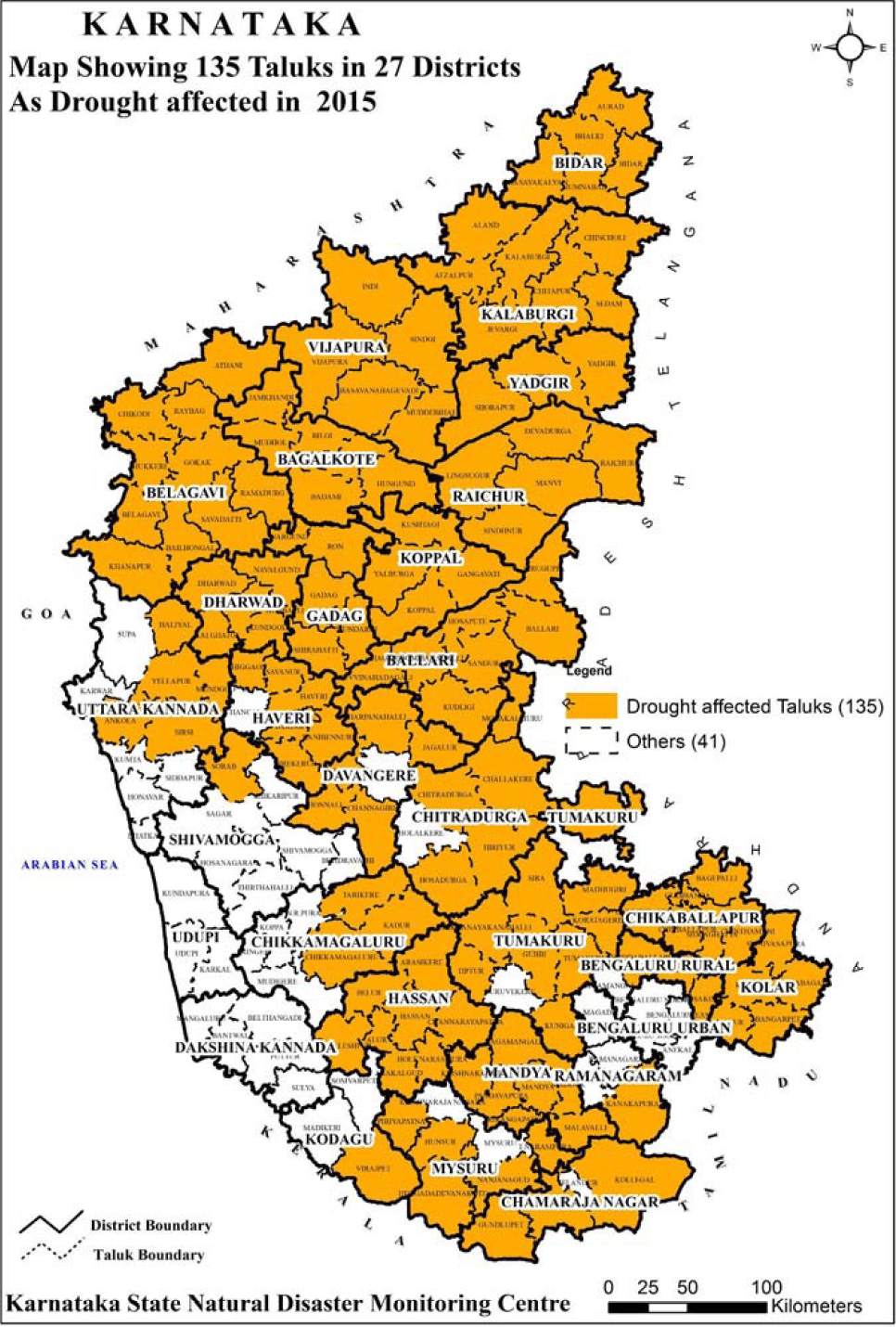
Karnataka: Profile of 2015-16 Drought

Karnataka is witnessing drought for the third successive year; rainfall has been deficient since 2012-13. Because of the rainfall deficit, reservoirs did not fill up completely. Coupled with the hot summer temperatures in March and April 2016, the stored water has now almost depleted. Groundwater, the saviour in times of failure of rainfall, has dipped severely because of years of reckless exploitation for irrigating water guzzling crops in semi arid soils. With even drinking water becoming scarce, agricultural activity has come to a standstill in the region. The drought in 2015 was preceded by unseasonal rains damaging the previous harvest. The monsoon deficit led to a dip in kharif output throughout the State in 2015.  The drought spread even to the normally lush Cauvery basin prompting digging and deepening of borewells. While southern Karnataka received some heavy rains in November, districts in Northern Karnataka again saw failure of rains with some districts such as Kalaburagi, Koppal and Yadgir registering over 70% deficiency in rainfall. There has been a near complete failure of crops in Northern Karnataka, with both rabi and kharif crops being wiped out, even as area under sugarcane has gone up! The northern region, which also lags in development indices, is in the clutches of rural distress – over a thousand farmers have committed suicide. Mass migration to cities is being witnessed.

Continue reading “Karnataka: Profile of 2015-16 Drought”

Bihar · Floods

Bihar Floods of 1987- V – District Khagaria

Above: Cover photo and map from NIDM report of Bihar floods 2007

Guest Blog by: Dr. Dinesh Kumar Mishra

Khagaria faced the first round of floods starting 8th July this year when the floodwaters of the Kosi, the Kareh and the Bagmati had engulfed large number of villages in the district. The Ganga and the Burhi Gandak was relatively quiet at this time despite heavy rainfall locally. It took towards the end of July that the flood level of the rivers started rising alarmingly and the Kazijaan embankment on the Burhi Gandak breached on the 2nd August in Alauli block of the district. The flood water emanating out of the gap created thus engulfed the Panchayats of Raun, Sahasi, Budhaura, Mujauna, Bhikhari Ghat, Shumbha and Burhawa Haripur. The road connecting Alauli to Khagaria was submerged in flood water and its connection with Khagaria was snapped. There was an untimely flood in the Kosi and all the Panchayats of the Beldaur block came under a sheet of water. The blocks of Chautham, Parbatta and Gogri were still spared by floods as the Ganga was maintaining its low profile. So far only 14 Panchayats of Alauli, 5 Panchayats of Chautham, 13 Panchayats of Gogri, 11 Panchayats of Beldaur, 3 Panchayats of Khagaria and only one Panchayat of Kosi was flooded. Relief programs were started in this district on the 4th August but its coverage was meager according to the local people. Rise in the levels of the Badla-Karachin embankment on the Kareh and Badla- Nagarpara embankment on the Kosi/Bagmati was causing concern among the local people. Continue reading “Bihar Floods of 1987- V – District Khagaria”

Bihar · Floods

Bihar Floods in 1987 – IV – Sitamarhi

Above: Cover photo and map from NIDM report of Bihar floods 2007

Guest Blog by Dr. Dinesh Kumar Mishra

Till the end of the third week of July, rains in Sitamarhi were normal and whatever flood that normal water could cause was there in the district. But when it stared raining in the fourth week of July then just within three days, on the 27th July, the Bagmati overtopped the Muzaffarpur-Sitamarhi Road at three places and the road communication between the two towns was snapped. The road communication, however, was quickly restored on the 31st July.  On the 28th July, the Bagmati breached its right embankment near Belwa Ghat in a length of 400 meters. A flood regulator was being constructed here for the past many years to divert part of the river flow (50,000 cusecs)and make it rejoin the river downstream thus delaying this portion of the flow by 16 hours when it rejoined the mainstream. Engineers hoped that by so doing they will be able to control the floods of the river to a great extent. The under construction regulator used to get washed away every year during the rains and this was not a new thing that it was damaged this year also. Water coming out of the damaged regulator submerged the villages on the western bank of the river. The rains of the past 4-5 days were enough to flood hundreds of villages in the blocks of Bairgania, Majorganj, Shivhar, Tariyani, Piprahi, Belsand and Runni-Saidpur of Sitamarhi and Katra and Aurai of Muzaffarpur district. The river water had entered the Sub-divisional HQ of Shivhar on the right bank and on the left bank in the block HQ of Belsand and the thana there through the gaps left in the embankment for constructing sluice gates in future.. The water of the Bagmati had entered every house of Sugia, Katsari, Sugia Bazar, Shahpur, Pokharbhinda, and Bisahi etc and it was flowing one and half feet above the Sitamarhi-Muzaffarpur road near Kataunjha where the river crosses this road that was closed for the vehicular traffic. There was a simultaneous flood in the rivers of the Adhawara Group and a causeway connecting the villages Chilara and Parchhaiyan was washed away. This meant that the road connection between Sitamarhi and Sonbarsa block was also lost. The rail line between Sitamarhi and Darbhanga was overtopped at many places and the train services were suspended between the two stations. Continue reading “Bihar Floods in 1987 – IV – Sitamarhi”

Bihar · Floods

Bihar Floods in 1987 – III – West Champaran

Above: Cover photo and map from NIDM report of Bihar floods 2007

Guest blog by: Dr. Dinesh Kumar Mishra

West Champaran district of Bihar is located in the Northwestern corner of the state and is surrounded by the Gandak and the Burhi Gandak along with their tributaries. Two of its blocks, Madhubani and Thakaraha, are located on the western bank of the Gandak and are adjacent to the Deoria district of Uttar Pradesh.  There used to be a rail line connection between Chhitauni Ghat of Uttar Pradesh and Bagaha in Bihar. A bridge connecting these two towns was washed away during the floods in 1924 and the British Government did not restore this bridge as the train service was coming handy for the freedom fighters to travel to UP and vice versa. This bridge and the rail service were restored a few years ago. The administration of these two blocks (these are split into four now) is run from Padarauna in UP during the flood season as the blocks get thoroughly disconnected from Bihar. To prevent the westward movement of the Gandak and embankment named Pipra-Piparasi Ghat embankment (PP Embankment) was constructed in 1960s as the river has a tendency to shift towards the west and there is a constant pressure of the river on this embankment during the rainy season. At times, the safety of this embankment is threatened and there is long history of its breaches and the engineers of the Irrigation Department face a tough time maintaining the embankment. When the rail bridge was not there on the Gandak one had to go to Madhubani and Thakaraha by crossing the Ganga via Chhapra, Siwan and Gopalganj. Continue reading “Bihar Floods in 1987 – III – West Champaran”

Dams · Maharashtra · Marathwada

Latur Drinking Water Crisis highlights absence of Water Allocation Policy and Management

Above: The dried up Manjara Dam near Latur. Photo: Vivek Bendre, The Hindu

On the 16th of January 2016, when Latur City in the heart of Marathwada was receiving drinking water once in 15 days and when plans of bringing water from Ujani Dam, about 300 kms away were being mulled upon, I was standing on the wall of the Lower Terna Reservoir in Osmanabad, about 40 kms from Latur. The dam has been at dead storage for the past 3 years. There are a string of jackwells inside the dam, to take water to rural drinking water supply schemes in Osmanabad and Latur for Nilanga, Killari and recently Ausa in Latur and Makani and Omerga in Osmanabad. Water Filtration System which is supposed to supply drinking water to 14 villages in Osmanabad lies defunct for years, even as the Revenue Minister inaugurated a brand new system for Latur City. Villages supposed to receive water from the dead stock stay thirsty. This is also the same Lower Terna Dam from where water is being taken for the Latur city in tankers now. Continue reading “Latur Drinking Water Crisis highlights absence of Water Allocation Policy and Management”

Bihar · Floods

Bihar Floods in 1987 – II – East Champaran

Above: Cover photo and map from NIDM report of Bihar floods 2007

Guest blog by Dr. Dinesh Kumar Mishra

Floods in East Champaran started following the heavy rainfall in the last week of July 1987. There was a sudden rise in the flood levels of the tributaries of the Burhi Gandak (Sikrahana) like the Sarisawa, the Tilawe, the Gaadh, and the Bangari leading to submergence of lower areas of Raxaul town where flood water of depth up to two to two and half feet was spread all over. This initial flood had also affected 25 Panchayats and 125 villages in the blocks of Raxaul and Ramgarhawa. The rains that set in on the 26th July, 1987 continued unabated and by the time of the beginning of August all the major rivers –the Gandak, the Burhi Gandak and the Bagmati were in spate. Road communication of Motihari, the district HQ of East Champaran, was disrupted fully in this very first spell of floods. There was three feet deep water passing over NH-28 near Chhapwa. The road to Bettiah and Areraj was too badly damaged to afford vehicular traffic to pass through. Road from Pipra Kothi to Siwan was already damaged much before the rains and its condition deteriorated further after rains.  All the three rivers were flowing above danger mark on the 2nd August, 1987 and a vast cultivated area along with hundreds of villages came under a sheet of flood water of these rivers. The train service between Sugauli and Darbhanga was suspended because of flood water on the railway track. Continue reading “Bihar Floods in 1987 – II – East Champaran”