Beas · Disasters · Himachal Pradesh · Hydropeaking · Hydropower

Nadiya Bairi Bhayi…

In a classical Thumri rendition, Ustad Rashid Khan sings about how a river, which was once a friend, has turned into a foe…Nadiya Bairi Bhayi.. Something similar is happening at a number of places in India, where the river, a life giving friend, is turning into a deadly force.

~~

Drowning of 25 students following sudden water releases from the 126 MW Larji Dam in Mandi, Himachal Pradesh is one more saddening and shocking incidence in the long list of hydropower-release related disasters in India where rivers are turned into death traps.

On the 1Radhika8th April 2014, 11 year old Radhika Gurung studying in standard fourth was accompanying her sisters Chandra and Maya along the river Teesta near Bardang, Sikkim. Suddenly, without having any time to respond, all three school girls were washed away by a forceful water released by upstream 510 MW Teesta V Hydropower project in Sikkim. While Maya and Chandra were lucky to be saved, Radhika was not so lucky. She lost her life. Residents here say that NHPC, the dam operator, does not sound any sirens or alarms while releasing water in the downstream for producing hydroelectricity and villagers live in constant fear of the river.[1] Residents demanded strict action against NHPC, but no action has been taken.

On the 28th March 2013, 5 people, including two small children aged 2 and 3 drowned in the Bhawani River near Mettupalayna when 100 MW Kundah IV HEP (Tamil Nadu) on the Pillur Dam suddenly released discharge of about 6000 cusecs water. The family was sitting on the rocks in the riverbed when water levels started rising, and they did not get enough time even to scramble out of the river with the two children, says the sole survivor. Tangedco officials stated that although alarm is sounded at the nearest hamlets, it does not reach the downstream regions.[2] Local villagers say no alarm is sounded. No action has been taken against Tangedco.[3]

On 8th JaSearchforbodiesnuary 2012, a family of seven people, including a child, drowned in the Cauvery River when water was released from the 30 MW Bhavani Kattalai Barrage-II (BKBII in Tamil Nadu). The same day, two youths were also swept off and drowned in the same river due to this release.[4] There are no reports of any responsibility fixed or any action taken against the Barrage authorities or Tangedco, although it was found that there was not even a siren installed to alert people in the downstream about water releases.[5]

Uttarakhand has a history of deaths due to sudden releases from its several hydropower dams. In April 2011, three pilgrims were washed away due to sudden release of water from Maneri Bhali-1 Dam on the Bhagirathi in Uttarakhand.[6] In 2006 too, three women were washed away by such releases by Maneri Bhali.[7]  The district magistrate of Uttarkashi district ordered filing a case against the Executive Engineer of the dam after a number of organisations demanded action against the guilty.  Again in November 2007, Uttarakhand Jal VIdyut Nigam Limited was testing the opening and closing of gates of Maneri Bhali Stage II, when two youths were washed away by these releases. [8] Following a protest by locals and Matu Jan Sangathan, the Executive Engineer and District Magistrate simply issued a notice which said that “Maneri Bhali Hydropower Projects exists in the upstream of Joshiyada Barrage and water can be released at any time, without prior notice from here”.

Similar notice is also given by NEEPCO, which operates the Ranganadi Dam and 405 MW Dikrong Power House in Arunachal Pradesh, on the Assam border. “The gates of Ranganadi diversion dam may be opened at any time. NEEPCO will not take any responsibility for any loss of life of humans, animals or damage to property”.

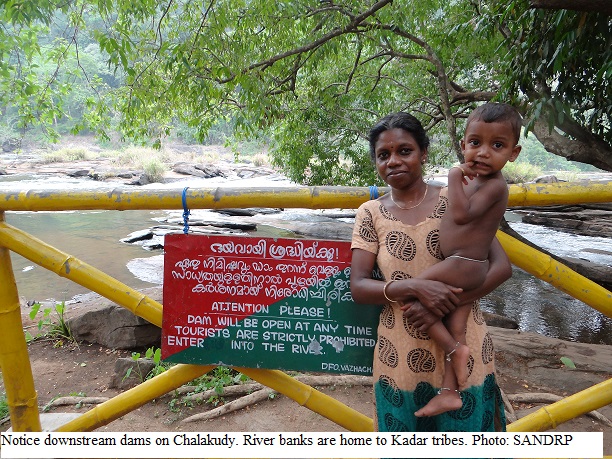
Similar notice sits on the bankAthirappillys of the Chalakudy River near the Athirappilly falls in Kerala and the Kadar tribes, which traditionally stay close to the river and are skilled fisher folk too, are fearful of entering the river.

Chamera HEP in Himachal Pradesh has been held responsible for sudden water releases and resultant deaths in the downstream. As per retired IAS Officer Avay Shukla who resides in Himachal, similar incidences which resulted in loss of lives have also happened due to Nathpa Jhakri and other dams in the state.

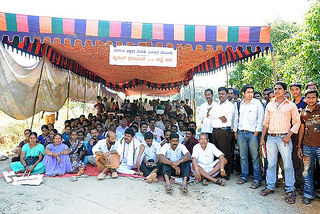
In December 2011, three youth were drowned in the Netravathi River when water was released by the fraudulently combined 48.50 MW AMR project (Karnataka) now owned by Greenko[9]. Villagers protested at the site, but this has not been the first instance of drowning because of this project. Villagers accuse the dam for the deaths of as many as 7 unsuspecting people in the downstream. This dam is now increasing its height and one more project is being added to it.

Protest against sudden water release by fradulently combined 48.50 MW project in Bantwal, Dakshin Kannada by Greenko Photo: Daiji World
Protest against sudden water release by fraudulently combined 48.50 MW project in Bantwal, Dakshin Kannada by Greenko Photo: Daiji World

On October 1, 2006, at least 39 people were killed in Datia district in Madhya Pradesh when suddenly large amount of water was released from the upstream Manikheda dam on Sind River in Shivpuri district. There was no warning prior to these sudden releases and hence unsuspecting people crossing the river were washed away[10]. Chief Minister Shivraj Chauvan ordered a judicial probe into this incidence in 2006, however, and a report was submitted by retired High Court Judge in 2007. Since then, the report has been buried and several attempts of RTI activists to access the report have been in vain. The government has not released the report, forget acting upon it or fixing responsibility after 8 years[11].

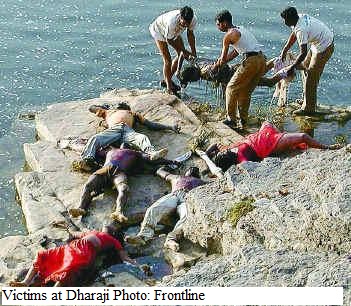
In April 2005, at lDharajiDewas Frontlineeast 70 people were killed at Dharaji in Dewas district of Madhya Pradesh due to sudden release of huge quantity of water from the upstream Indira Sagar Dam on Narmada river. Principal Secretary Water Resources Madhya Pradesh inquired into the incident and found that “there was no coordination between agencies”[12]. No accountability was fixed and no one was held responsible. NHPC, who operated 1000 MW Indira Sagar Project, simply claimed that it was a case of miscommunication and that it was not aware of the religious mela in the downstream of the river. As SANDRP observed then, “ It just shows how far removed is the dam operator from the welfare of the people in Narmada as the fair annually gathers more than 100,000 people of the banks of the river. It is a scandal that no one was held responsible for the manmade flood which resulted in the mishap[13].”

Above incidents make it clear that incident at Larji is not the first and will not be the last, if we continue non transparency and non accountability in hydropower dam operations.

Some Questions that arise from these events:

Do sanctioning authorities and dam operators reaslise that each of these projects convert an entire river ( not limited to the hydropower project) in the downstream area into a potential death trap? Do they assess the impacts of the various possible operations of the projects in the downstream area and envisage, plan and implement measures to avoid death and destruction in the downstream areas?

Can cordoning off and alienating a river, indicating that it is dangerous, be a solution to this? Are measures like alarms, sirens, lights enough when a river experiences order of magnitude sudden change in its flow due to dam and hydropower releases?

Is it ok to have hundreds of dam-related deaths in the recent years due to irresponsible and non-transparent dam operations and not have any responsibility fixed?

The obvious answer to the above seems NO.

Some Recommendations: As we have seen above, many man made disasters have happened in India over the last decade and governments  and dam operators have learnt no lessons. The avoidable tragedies are repeating without any change. India is possibly the only country in the world where such events have been happening in such large numbers. Here we are recommending some basic steps if we want to avoid or minimise occurrence of such tragedies in future.

MEASURES FOR TRANSPARENT, INCLUSIVE MANAGEMENT NORMS IN OPERATION OF ALL EXISTING DAMS AND HYDROPOWER PROJECTS:

For every operating Dam and Hydropower project in India there should be clearly defined operating procedure in public domain. This operating procedure will include the steps taken before release of water from dam or power house, how the releases will be increases (the increase should be in steps and not suddenly releasing huge quantity) or decreased, how these will be planned in advance, who all will need to be informed about such plans in what manner and what safety measures will be taken. This will also include who all will be responsible for designing, monitoring and implementing these measures. There should be boards at regular  intervals  in the downstream area in language and  manner that local people and outsiders can understand and the boards should also indicate the danger zone and what kind of sirens and hooters may blow before the releases.

The operating procedure will take into account where there are upstream projects and how the upstream projects are going to influence the inflow into the project and  how information will be shared with upstream and downstream projects and in public domain. The Power Load Dispatch Centres should also remember that when any hydropower project is asked to shut on or off, there are consequences in the river and they should be asked to keep such consequences in mind and time required to alert the regions in risk.

For every dam there should be a legally empowered official management committee for the project management, in which 50% people should be from govt and 50% should be non govt persons, including local community representatives and this committee should be in charge of providing oversight over management, including operation of the project and should have  right to get all the information about the project.

Hourly water levels and release data of hydropower dams be made available in public domain on daily bases. Water levels corresponding to discharges (and possible timings where applicable) should be physically marked on the river banks, local communities should be involved in this, evacuation methods and mock drills should be organised by dam proponent from time to time in all places along the river where the impacts reach.

THE EXISTING DAMS AND HYDROPOWER PROJECTS SHOULD BE MANDATED TO PUT ALL THIS IN PLACE WITHIN A PERIOD OF NEXT THREE  MONTHS THROUGH A LEGALLY EMPOWERED STEP IN ALL STATES.

SANCTIONING PROCESS FOR NEW PROJECTS, INCLUDING FOR UNDER CONSTRUCTION PROJECTS:

Safety measures related to, including water releases for all kind of eventualities and their downstream impacts and management plan should be an integral part of EIA and EMP. The aspect should be thoroughly discussed while appraising the project, and clear cut roles and responsibilities fixed. Mitigation measures should include proper siting of the project, gradual upramping & Downramping of releases in a clearly defined way and where planning is mandatory, safe operation of discharges through dams, etc.

Entire clearance mechanism for cascade hydropower projects in the Himalayas and elsewhere needs to be revisited to include the operational safety measures considering the cumulative operation of the projects. Projects where operational safety measures alone will not be sufficient due to massive fluctuations/location/upstream projects, etc., should be urgently dropped.

Peaking power projects should be restricted to certain locations like deep mountain gorges, after proper studies. Such projects should not be permitted as rivers enter into floodplains, due to their significant impact on the downstream and also in biodiversity rich river stretches.

SAFETY MEASURES BEFORE AND DURING WATER RELEASES: 

Primary safety measures like informing the administration well in advance before release, sirens, hoots, alarms, lights, buoys should be strictly enforced and a clear responsibility of these measures should be adopted, for the entire zone in risk, sign boards at every 50 mts interval in such zones in languages and manner that local people and outsiders can understand, and which also show the specific risk zone. Where sudden unseasonal releases are likely, include police surveillance of the risk zone during danger period.

WHEN THERE IS DEATH AND DESTRUCTION IN THE DOWNSTREAM AREA:

Exemplary punishments should be fixed not only for dam operators,but also engineers and dam companies in case of negligence. Independent inquiry will be required since departmental or inquiries by District administration or government officials are not likely to be credible.

Since the designed safety measures in case of Larji were clearly inadequate, not just the operational staff but all those responsible for such shoddy safety plan should be held accountable.

It is unacceptable that a life giving and beautiful entity like a river should be converted into a dangerous and deadly force for our energy needs, without even the most basic precautions in place.

-Parineeta Dandekar,  Himanshu Thakkar


END NOTES:

In 1999, 39 people and hundreds of animals and livestock in Cambodia was washed away and drowned by the release from Yali Falls Dam on Sesan in Vietnam. Mekong River Commission took a strong view on this. http://www.threegorgesprobe.org/pi/Mekong/index.cfm?DSP=content&ContentID=8946

Just last month, two people were washed away and drowned in Belize due to releases from a dam owned by Canadian company Fortis. Here too early warning systems, alarms and accountability are being discussed:. http://journal.probeinternational.org/2014/05/07/did-a-dam-cause-water-surge-ending-in-multiple-deaths/


References:

[1] http://sikkimfirst.in/2014/04/20/11-year-old-girl-drowns-in-teesta-river/

[2] http://www.newindianexpress.com/states/tamil_nadu/article1519865.ece?service=print

[3] http://archives.deccanchronicle.com/130328/news-current-affairs/article/five-drown-bhavani

[4] http://www.ndtv.com/article/tamil-nadu/toll-of-those-drowned-in-cauvery-rises-to-nine-165935

[5] http://lite.epaper.timesofindia.com/getpage.aspx?articles=yes&pageid=6&max=true&articleid=Ar00600&sectid=2edid=&edlabel=TOICH&mydateHid=10-01-2012&pubname=Times+of+India+-+Chennai+-+Times+Region&title=A+siren+could+have+saved+seven+lives&edname=&publabel=TOI

[6] http://www.tribuneindia.com/2011/20110524/region.htm

[7] https://sandrp.in/drp/July2006.pdf

[8] Matu Jan Sangathan, http://hindi.indiawaterportal.org/node/47403

[9] http://www.daijiworld.com/news/news_disp.asp?n_id=124216, http://www.indiawaterportal.org/articles/1-dam-2-projects-many-fools

[10] https://sandrp.in/drp/June_July-2008.pdf

[11] http://timesofindia.indiatimes.com/india/2006-tragedy-re-run-at-Datia-but-MP-govt-yet-to-release-probe-report/articleshow/24120250.cms,

http://archive.indianexpress.com/news/judicial-probe-into-datia-drowning/13990/

[12] https://sandrp.in/drp/jul_aug05.pdf

[13] http://www.internationalrivers.org/files/attached-files/nhpc_people_don27t_matter.pdf

PS:

http://www.newindianexpress.com/states/odisha/7-Students-Get-Justice-16-Yrs-after-Meeting-Watery-Grave/2014/09/18/article2437008.ece

7 Students Get Justice 16 Yrs after Meeting Watery Grave

By Express News Service Published: 18th September 2014 06:03 AM

BHUBANESWAR: In a significant judgment, a civil court on Wednesday awarded a compensation of `25 lakh each to the families of seven students of University College of Engineering (UCE) of Burla __ now VSS University of Technology __ who were swept away by unannounced and untimely release of water from Hirakud dam 16 years ago.

Civil Judge (Senior Division), Bhubaneswar, Sangram Keshari Patnaik, who pronounced the verdict in his 31-page judgement, ordered that the compensation be paid with 6 per cent interest effective from 2001, the year when the case was filed before the court.

The tragic incident had occurred on January 30, 1998 when eight students of the UCE of Burla were taking pictures on a sand bar of Mahanadi as part of the Spring Festival activity. The water flow of the river rose menacingly and barring Soubhagya Barik, the rest seven second-year engineering students were swept away and met their watery grave.

The Hirakud Dam authorities had allegedly opened nine gates during the non-monsoon season which led to the tragic incident as no caution was sounded before the release of the water.

The State Government ordered a Revenue Divisional Commissioner-level inquiry into the incident and the then RDC Hrushikesh Panda submitted the report to the Government on March 29, 1998. The Government accepted it on May 19.

The RDC, in his report, had examined 77 witnesses and 31 affidavits were filed. Panda, in his report, had highlighted the irresponsibility of the engineers and stated that even the Sambalpur Collector and the Superintendent of Police were not intimated about the  release of water, let alone the public.

Basing on the report, the State Government had announced a compensation of `3 lakh each to the family of seven students. However, considering the compensation inadequate, a petition was filed before the Orissa High Court. In 2001, the HC directed that the case must be filed before a civil court since it pertained to compensation.

According to Madhumadhab Jena and Sidharth Das, counsels for the deceased’s families, the Civil Judge Court took into account various aspects, including the academic background of the students of UCE.

Himachal Pradesh · Himalayas · Hydropower

The Socio-Ecological Impacts of Small Hydropower Projects in Himachal Pradesh Part-2

-Prof J. Mark Baker (JMark.Baker@humboldt.edu), Humboldt State University, Arcata, CA, USA

Introduction

This post is the second of a two part summary of the results of a study on the socio-ecological impacts of privatized, small, run-of-the-river hydropower projects in Himachal Pradesh.[1]  The study is based on field research conducted in 2012 on all 49 completed small hydropower projects in the state.[1]  Part one, posted here on 8 June, reviews the implementation of the Himachal Pradesh power policy governing privatized small hydropower development and examines the local social and environmental effects of commissioned small (defined as 5 MW or less) hydropower projects.  This part will address two of the claimed local benefits of small hydropower development, namely monetary contributions by the project developer to local community development projects through the Local Area Development Authority (LADA) and local employment generation.  After a brief discussion of the relationship between small hydropower projects and carbon credits through the Clean Development Mechanism, the article reviews two promising institutional models for small hydropower development and concludes with a set of recommendations.

Local Area Development Authority– Implementation and Accountability Challenges

The 2006 Hydropower Policy includes provisions for tangible local benefits, in part to foster local support for power projects.  One primary mechanism is the requirement that project developers deposit one percent of the project cost into an account with the district commissioner.  These funds, known as Local Area Development Funds, are to be allocated by the Local Area Development Authority (LADA) to support local development activities, particularly related to infrastructure and services.[2]

In our survey of the 49 commissioned small hydropower projects we found that the LADA program was not working as well as intended.  Inconsistent record keeping by district authorities, the lack of clearly defined project affected areas, and uneven levels of awareness among local pradhans about the program have enabled some project developers in Himachal to avoid fulfilling their obligations to local communities.  The district revenue department office in Kangra was the only district office that maintained a comprehensive record of LADA obligations and tracked how much the project developer had paid and how much was still owed.  Without such a record, officials in the remaining six districts found it extremely difficult to hold the project developer accountable for their LADA payment obligations.  For example, in District Chamba, ten small hydropower projects together owe Rs 247 lakhs.  However, as of the summer of 2012 they had paid only Rs 70 lakhs and the developers of three projects had contributed nothing at all.  District administrators seem to have little authority or recourse, beyond personal persuasion, to compel the project developer to make the required contributions.

There are also challenges with defining the Project Affected Area (PAA) and Project Affected Zone (PAZ), which is important because 70% of the LADA funds are earmarked for projects in the PAA and 30% for projects in the PAZ.  Very few small hydropower projects have defined PAAs and none had defined a PAZ.  The lack of clearly defined affected areas raises questions about whether or not the authorized development projects actually reach those households and hamlets most affected by the hydropower project.

A related concern is the unevenness of awareness about the LADA program among village pradhans.  Several village pradhans, especially in the remote areas of the state, had never heard of the LADA program, even though one or more small hydropower projects were located within their panchayat boundaries.  Where the program was functional, there are sometimes disputes between the LADA committee and the district commissioner concerning which projects to fund and whether to prioritize projects oriented towards strengthening local employment generation or hard infrastructure development.

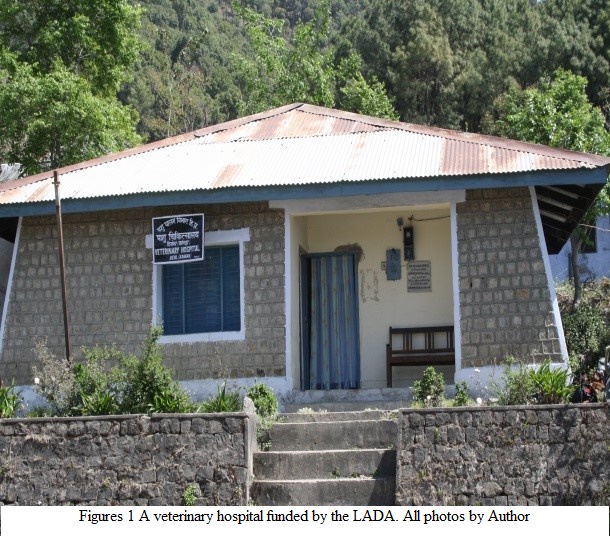
We did encounter one example of a panchayat in which the LADA program was working as intended.  The pradhan of the panchayat, located in District Kangra, was a retired military officer.  Well aware of the LADA obligations of the small hydropower project developers in his panchayat, he maintained close communication with the district commissioner’s office in order to ensure that the required deposits were made.  The pradhan also pressured the LADA committee to identify potential projects in a timely fashion and he followed up with the district commissioner to ensure that the expenditure of the requisite funds was authorized.  As a result, in this panchayat LADA funds had been used to construct a cricket playing field, veterinary dispensary, and a handsome hall for village meetings and social functions (figures 1 and 2).  Furthermore, in part due to the effective implementation of the LADA program and the fact that the small hydropower project did not annex cultivated areas, local opposition to the projects was virtually nonexistent.  This example suggests that the LADA can offer tangible local benefits if accurate records are kept, if the project developers are compelled to contribute the requisite amounts, if village pradhans know about the program and their entitlements under it, and if the district administration supports program implementation.

Mark1

Mark2

Employment Generation –Unrealized Potential for Secure Jobs

In addition to requiring project developers to contribute to the Local Area Development Authority, the 2006 Hydropower Policy seeks to generate local benefits by stipulating that 70% of the project’s workers be from Himachal Pradesh.  Because the lack of local employment opportunities is one of the primary drivers of migration from hill areas, the provision of permanent jobs through small hydropower projects could be a significant benefit.  In addition to a steady income, permanent regular employees participate in government-approved pension plans, receive compensation for work-related accidents and injuries, and are protected from arbitrary dismissal.  The project developer is also required to register all workers with the Labour Department and the local police station on a monthly basis.

While the 49 commissioned small hydropower projects in the state generate significant employment, more than half of project developers evade complying with labor law.  All told, the 49 projects employ a total of 951 people, 603 of whom come from the panchayat(s) in which the project is located.  On average, a 5 MW project employs approximately 20 people.  While the total employment these projects generate is substantial, only 22 project developers have registered their employees with the state Labour Department as regular employees.  These workers do receive the protections and benefits of the state’s labor laws, and some of them (in three projects) are also provided subsidized lodging and meals.  However, the workers in the remaining 27 small hydropower projects, while doing the same work as regular employees in other projects, are hired on a daily wage basis and are thus excluded from the benefits and security of regular employment.  A further disjuncture arises from the fact that only 11 project developers have established provident fund contributions for their employees, the remaining 38 have not.  For the majority of workers in small hydropower projects, one of the most important potential local benefits – secure employment – has not been realized.

Given the significant risk of injury or death in this sector, it is of particular concern that unregistered workers are less likely than registered workers to receive compensation should an accident occur.  While we did not develop comprehensive information about accidents and injuries, we did confirm worker deaths, the great majority of which occurred during the project construction phase due to tunnel collapses, falling rock, landslides, and tractor accidents.  A total of 40 people died in accidents related to the construction of the commissioned small hydropower projects in the state, 18 were Himachali and 22 were from neighboring states or from Nepal.  Only three of the families of the forty workers who died in fatal accidents received some form of compensation.  The lack of proper registration and the general absence of compensation suggests the extent to which project developers and their contractors treat workers as a disposable labor force.

The common practice of contracting out project construction work to subcontractors who hire large numbers of employees challenges the ability of unions to advocate for project workers.[3]  Questions arise concerning who is ultimately responsible for following the relevant labor laws and protections – the project developer or the developer’s subcontractors (figure 3)?  Project developers can evade accountability through the use of subcontractors or by creating subsidiary companies.  For example, in District Kangra in May, 2010 the local construction worker union notified a small hydropower project developer of its intent to strike due to violations of labor laws and working conditions.  In a letter the developer responded that the strike was “totally illegal and off the mark” as the developer was not the owner of the plant but was “merely the contractor.”  Furthermore the developer noted that the project was “generating power in the interest of the public of Himachal Pradesh,” and was “a property of the State and a national asset,” and thus the calling of the strike was “illegal from all perspectives.”  While it is true that the developer to whom the labor union had sent the notice of intent to strike is not the company listed as the owner of the project in the state of Himachal Pradesh’s records, it is also true that the listed company is actually a subsidiary of the developer, whose address is the same as the developer and whose website leads directly to that of the developer.  Furthermore, the power project is showcased on the developer’s website as one of four small hydropower projects they have constructed and are currently operating in District Kangra.  The developer’s attempt to evade accountability for labor law violations by creating a fictitious subsidiary demonstrates the challenges unions face when they seek redress for labor law violations and demand worker rightsMArk3NEW


Payments to Developers for Renewable Energy Production

Part One of this article discussed the economics of small hydropower development.  Clearly, the primary source of income developers receive is the guaranteed purchase price that the Himachal Pradesh State Electricity Board provides.  A second, and much smaller, source of revenue for some projects derives from the sale of carbon credits through the Clean Development Mechanism of the Kyoto Protocol, administered under the United Nations Framework Convention on Climate Change (UNFCCC).  The Clean Development Mechanism allows countries in the global south to sell carbon credits in the form of Certified Emission Reductions (CERs) to countries in the global north that need to purchase such reductions in order to meet emissions reduction limits that the Kyoto Protocol has imposed.  Projects in the global south may be eligible for registration under the Clean Development Mechanism if it can be demonstrated that their implementation will prevent carbon (measured in metric tons of carbon dioxide equivalents) from entering the atmosphere.  The resulting emission reductions can then be sold by the project developer to a carbon generating entity in the global north that needs to purchase such carbon credits.  In the context of small scale hydropower projects, developers argue that if they did not produce electricity using hydropower, the equivalent amount of electricity would be generated primarily through the burning of fossil fuels.  Thus, by producing electricity through hydropower, they are “preventing” a measureable amount of carbon from going into the atmosphere.  If their projects are registered under the Clean Development Mechanisms, then project developers may sell credits to entities in the global north.

Of the 49 commissioned small hydropower projects, approximately 27 are registered under the Clean Development Mechanism.[4]  According to documents relating to these 27 projects on the UNFCCC Clean Development Mechanism website, these hydropower projects are credited with generating 447651 metric tons of carbon dioxide emissions reduction equivalents per year.  Project developers may sell these emissions reductions equivalents (carbon credits) to entities in the global north.  There are at least three points worth noting about these carbon credits.  Firstly, the value of carbon credits has dropped precipitously in the last few years, from a high of approximately rupees 760 in 2008 to its current price of less than rupees 50 per metric ton of carbon equivalent (redd-monitor.org 2013).[5]  The essential collapse of the international carbon credit market has been attributed to an oversupply of credits and weak demand (Singh 2014).  Secondly, there are serious concerns about the ethics of generating marketable carbon equivalents from projects that severely disrupt the livelihoods of communities as described in part one of this post.  Thirdly, there are questions about the integrity of the calculations and procedures employed to calculate the carbon equivalents of such projects and to justify project inclusion in the UNFCCC registry.  One of these questions centers on the requirement of additionality.  Additionality, as the Kyoto Protocol specifies, is the principle that projects are eligible for international support through the Clean Development Mechanism only if they would be uneconomical without such support.  Thus, a small hydropower project that is economically viable without the revenue from selling carbon credits is in principal barred from participating in the carbon credit program.  On the other hand, private sector loan officers will not approve financing for projects that are not economically viable.  At least some project developers resolve this contradiction by developing two sets of project documents.  As one project manager told me, “we prepare two DPRs (Detailed Project Reports), one for CDM and one for the banks.”

In light of the poor remuneration developers receive from the sale of carbon equivalents, at least some project developers expressed the desire to participate in the Government of India’s Renewable Energy Certificate (REC) program, which has its roots in the 2003 Electricity Bill and is part of the country’s renewable energy policy (Carbon Credit Capital 2011).  By becoming designated as “eligible entities” within the REC program, developers would receive one renewable energy certificate for every megawatt hour (MWh) that they sell to the state electricity grid.  Purchasing electricity produced by an eligible entity enables state utilities to meet their Renewable Purchase Obligation, which is the proportion of electricity they purchase that must come from renewable sources.  Eligible entities may trade renewable energy certificates on one of India’s two electricity exchanges.  As of 2012, no small hydropower developer had become an eligible entity within the REC program.  Several developers were interested in joining this program, however the fact that they already have power purchase agreements to sell electricity to the HP State Electricity Board renders them ineligible for the REC program.

Two Alternative Institutional Models for Future Small Hydropower Development

The track record of the 49 commissioned small hydropower projects in Himachal Pradesh is cause for concern.  Patterns of disruption to farmer-managed irrigation systems as well as water mills (gharats), environmental and infrastructural damage from landslides in some regions (especially Chamba District), negative effects on fisheries and the livelihoods that fish farming and sport and subsistence fishing activities support, systemic problems with the Local Area Development Authority, significant uncompensated worker deaths during project construction and on-going concerns regarding labor relations, all comprise the local track record of small hydropower development in the state.  Leaving aside the broader question of whether or not small hydropower projects should be developed, it is clear that if they are going to be developed, then an alternative institutional framework is called for.

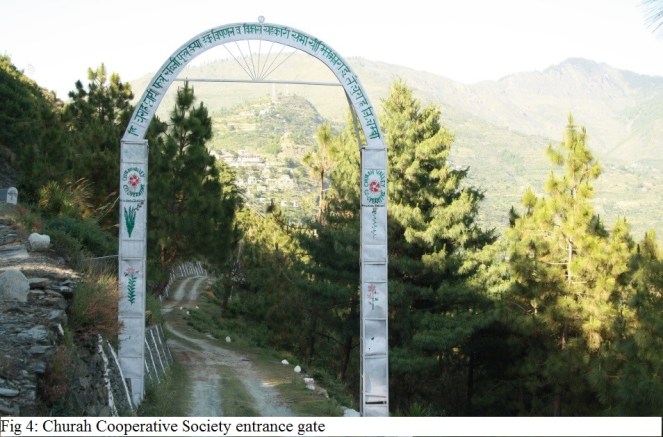
Two institutional models for small hydropower development exist that have the potential to realize more sustainable, effective and equitable hydropower outcomes.  These models are represented by the Sai Engineering Foundation (figure 4) and the Churah Cooperative Floriculture Society (figure 5).  Inspired by the teachings of the religious leader Bhagwan Sri Sathya Sai Baba and the religious ideals of Gandhian social service, Sai Engineering Foundation is a registered charitable foundation that promotes social welfare.  They have been involved with hydropower development since the first India Hilly Hydel demonstration projects in the 1990s.  They both own and manage their own projects and provide consulting services for other private power developers.  They invest the revenue from hydropower production in social service and welfare programs in Himachal Pradesh.  These activities include medical and blood donation camps, financial assistance to low income students, community-based welfare programs, working with government programs to deliver services to low income communities, and promoting cooperative societies in the field of power generation, construction, and floriculture (Sai Engineering Foundation 2011).  Because of the social service ideology that informs this organization, when the Sai Foundation develops small hydropower projects, it does so in a manner that prevents or mitigates the negative impacts on local livelihood strategies and is responsive to local concerns and issues.

The second alternative institutional arrangement is the Churah cooperative society.  Although the 2006 Hydropower Policy specifically addresses the need to prioritize working with cooperative societies, and despite repeated calls by community members for more support for local cooperative society involvement in hydropower development, our research revealed only one community-based cooperative society working on small hydropower development.  Since 1996 the Churah Valley Fruits, Vegetables, and Flowers Growers Marketing and Development Cooperative Society (Churah Floriculture Cooperative Society) has worked to promote the economic development of low income families in the Churah Valley, a remote area in Chamba District, not far from the border with Jammu and Kashmir.  The cooperative’s initial and on-going work involves developing floriculture using greenhouses, and marketing cut flowers to cities in north India, as well as off-season vegetable production in neighboring Pangi Valley.  Interestingly, they are also working to develop a small hydropower project under the framework of the 2006 Hydropower Policy.  Four hundred Below Poverty Line (BPL) households, all members of the cooperative society, are involved in this effort.  In order to qualify for the necessary loans, each household is putting up their house and land as collateral.  The cooperative society is currently securing the necessary funding and moving ahead with efforts to secure the required No Objection Certificates.  The revenue from the small hydropower project, once it is commissioned, will be shared among the participating families.

Feature


Both the Sai Engineering Foundation and the Churah Floriculture Cooperative Society represent viable alternatives to the current approach, which emphasizes corporate ownership of small hydropower facilities.  Both of these organizations are accountable to local concerns and interests and prioritize local social and environmental sustainability.  However, both the Sai Engineering Foundation and the Churah Floriculture Society face an uphill battle to get their projects approved and the requisite NOCs obtained.  Both organizations have fewer financial resources to offer in exchange for obtaining NOCs than do private companies; they are thus at a disadvantage when competing with private corporations for bureaucrats’ attention and willingness to provide NOCs.

Concluding Recommendations

Insights from this study provide the basis for proposing concrete steps that together could help small run-of-the-river hydropower projects realize their purported, but not realized, benefits.  Three broad categories of recommendations exist.  Firstly, the process through which potential hydropower sites are identified must include key elements of the agrarian landscape as well as the cumulative effects of multiple projects along a common stream reach; furthermore, when negative social and environmental effects are anticipated, they should be adequately mitigated.  Settlements, networks of kuhl irrigation systems, strings of gharats along streamcourses, irrigated and unirrigated cultivated areas, and proximity to adjacent projects, in addition to hydrological information, should be incorporated into the site evaluation and identification process.  Using this information to avoid siting projects in densely managed landscapes, or too close to each other, would help eliminate many of the negative project impacts on local livelihoods and communities.  In cases where projects do negatively affect local livelihoods, e.g. when a project renders gharats defunct, disrupts a community-managed irrigation system, or disturbs grazing or cultivated areas, then adequate compensation should be provided through a government-facilitated process.  Similarly, negative environmental effects should be mitigated, for example by requiring manual cleaning of desilting tanks, installation of fish-friendly diversion weirs, adequate water (quality and quantity) to support ecosystem needs, and effective muck management approaches.

Secondly, policy implementation and enforcement need to be strengthened.  While the 2006 HP Power Policy and state labour laws contain important safeguards for local communities and workers, implementation and enforcement need strengthening.  For example, district authorities need to be required and empowered to collect the mandatory developer contributions to the Local Area Development Authority.  LADA funds should be allocated in a manner that maximizes local benefits for project-affected households and communities. Similarly, labour laws requiring that workers doing regular work should be hired on a permanent, not a daily wage, basis should be enforced, and workers should receive the perquisites concomitant with regular employment, including compensation in the event of injury or death.  Projects that disrupt local livelihoods and generate unmitigated negative environmental effects should not qualify for carbon credits under the Clean Development Mechanism.  Greater policy and bureaucratic support also needs to be directed towards supporting alternative institutional models for small hydropower development, such as cooperative societies and social service foundations

Thirdly, governance measures that strengthen small hydropower projects’ accountability should be developed.  The record of negative social and environmental effects and the extent of local opposition, attests to the unsustainable nature of the current approach to small hydropower development.  Identifying and implementing governance measures to minimize these negative socio-ecological effects will likely provide a more informed and democratic basis for decision-making.  Measures such as requiring Environmental Impact Assessments, along with the requisite public hearings, as well as obtaining environmental clearance from the state, would go a long way to improving the sustainability of small hydropower in Himachal Pradesh.  If developers, after completing such assessments and hearings, and receiving clearance, were able to more easily obtain the necessary No Objection Certificates, then project delays would also be reduced.

Clearly, alternatives do exist for advancing institutional approaches to small hydropower development that are accountable to local communities and environmental concerns.  Whether or not the state of Himachal Pradesh (and other states since this is likely to be equally applicable to other states where such projects are taken up) chooses to embrace these approaches remains to be seen.  If the next 450 planned or under-construction small hydropower projects in the state generate a track record similar to the first fifty, then regional society and environment will be much the poorer for it.  However, if civil society mobilizations and resistance are sustained, and governance measures strengthened, then power developers will be held more accountable for the local impacts of their activities.  If the state government chooses to offer more support and capacity building resources for entities like cooperative societies and Sai Engineering Foundation, or at least removes some of the barriers they currently face, then these alternate institutional approaches to power development may proliferate.  And if in response to electoral pressures within the state, Himachal Pradesh decides to put more teeth into its currently progressive, but not enforced, power policy, then perhaps the future will be brighter than the recent past.

Please see Part I of the piece here:https://sandrp.wordpress.com/2014/06/08/the-socio-ecological-effects-of-small-hydropower-development-in-himachal-pradesh/

References

Carbon Credit Capital (2011) “India’s Renewable Energy Certificate Market” (New York).  Viewed on 9 June 2014.  Website: http://carboncreditcapital.com/dev/wp-content/uploads/resources/InFocus8.pdf

Newing, Helen (2011): Conducting Research in Conservation: Social Science Methods and Practice (New York: Routledge).

Redd-Monitor.org (2013) “Clean development mechanism: zombie projects, zero emissions reductions and almost worthless carbon credits”.  Viewed on 9 June 2014.  Website: http://www.redd-monitor.org/2013/07/12/clean-development-mechanism-7000-projects-zero-emissions-reductions-almost-worthless-carbon-credits-and-zombie-projects-increasing

Sai Engineering Foundation (2011): “Karmayoga”, Quarterly Newsletter of Sai Engineering Foundation, 1(11) (New Shimla, Himachal Pradesh).

Singh, Namrata (2014) “Companies holding carbon credits stare at ‘real loss’”.  Times of India.  Viewed on 9 June 2014.  Website: http://timesofindia.indiatimes.com/business/india-business/Companies-holding-carbon-credits-stare-at-real-loss/articleshow/31803387.cms

United Nations Framework Convention on Climate Change (2014). “Project Cycle Search.” Viewed on 9 June 2014.  Website: http://cdm.unfccc.int/Projects/projsearch.html.

END NOTES:

1] This study is based on six months of mixed methods, qualitative and quantitative field research that I and two research assistants.  After an initial exploration of the relevance of this topic in 2009, field research commenced in January, 2012.  We began by meeting key state level bureaucrats in Shimla and collecting secondary documents concerning all of the 49 commissioned small hydropower projects from the Himurja (Himachal Pradesh Energy Development Agency) office in Shimla.  We then turned to the district and project level research.  In each district where commissioned small hydropower projects were located, we interviewed district officials and collected secondary information concerning the projects.  We met with district commissioners, sub-division magistrates, tehsildars, and other concerned district officers.  We informed officials of our research, garnered key insights about small hydropower development from them, and collected relevant information and project related records and documents.  We then focused our research efforts on each commissioned small hydropower project.  At each project location, we interviewed project representatives (generally the project manager and occasionally the project owner) and the panchayat pradhans of affected panchayats.  We conducted structured and semi-structured survey interviews with project-affected households and other key informants.  We checked all the information we obtained using between-subject, cross-method, and cross-researcher triangulation (Newing 2011).  We ground truthed what we learned through meetings, surveys and interviews by walking transects from the diversion weir down to the tail race of every commissioned project.  We also photocopied key documents such as petitions, correspondence, court documents, and judicial papers.  Near the completion of the fieldwork, I met the same state level officers and bureaucrats with whom I had met at the beginning of the fieldwork in order to share preliminary research findings and conclusions.

[2] The Local Area Development Authority is a committee, comprised of the sub-district magistrate, other subdivisional officers, affected area panchayat pradhans, and a representative of the project developer.  The committee identifies and prioritizes potential projects, and then submits the prioritized list of projects to the district commissioner, who is to then approve and authorize the necessary expenditure.  Examples of projects include a veterinary dispensary, ayurvedic dispensary, cremation ground, village meeting hall, furniture for meeting hall, irrigation system (kuhl) repair, culverts and road repair, footbridges and playing field for youth.

[3] The labor-intensive project construction process lasts at least two years and often significantly longer.  To accomplish specific tasks, subcontractors hire large numbers of workers.  The majority of these workers live in temporary tin shed housing located along the banks of the stream or river from which the project diverts water.  These “labor camps” often house one hundred or more workers.  The fuelwood consumption for cooking and heating (notwithstanding attempts to provide LPG cylinders) associated with these camps poses a significant environmental concern, as does the fact that most of these labor camps do not have adequate provision for wastewater and sewage.  Consequently the adjacent stream, which is invariably used downstream for washing, irrigation and other purposes, and stream bank, are severely contaminated.  While this research focused on already constructed projects, local residents nevertheless often complained about the negative environmental, health, and social impacts of these labor camps.

[4] This is based on a comprehensive review of the Project Cycle Search webpages of the Clean Development Mechanism segment of the UNFCCC website, accessed on 9 June 2014.

RELATED SUBSEQUENT STORIES:

[5] http://www.indiawaterportal.org/articles/irrigation-systems-himachal-threatened-hydropower-projects


Himachal Pradesh

The Socio-Ecological Effects of Small Hydropower Development in Himachal Pradesh

J. Mark Baker (JMark.Baker@humboldt.edu), Humboldt State University, Arcata, CA, USA

Introduction

This article is part one of a two part summary of the results of a study on the socio-ecological impacts of privatized, small, run-of-the-river hydropower projects in Himachal Pradesh.[1]  It is based on field research conducted in 2012 on all 49 commissioned small hydropower projects in the state.
Map 1

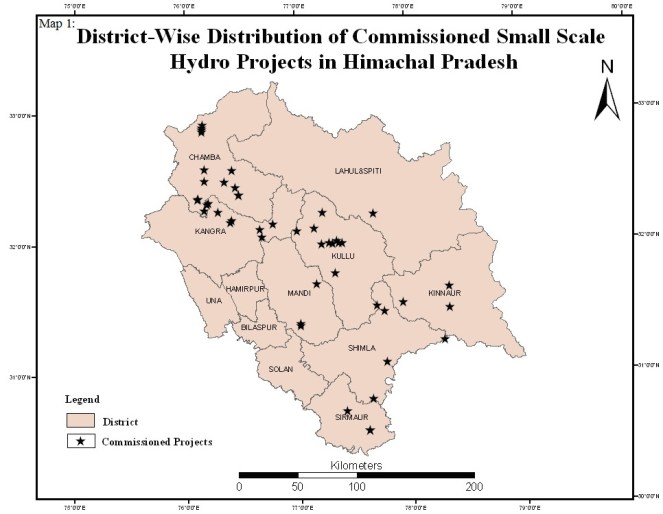
In the late 1990s Himachal Pradesh, as did other states in this region, launched a series of initiatives to privatize and promote small hydropower production (Sinclair 2003).  In 2006 these initiatives were incorporated into a new hydropower policy that aimed to generate revenue through the sale of surplus power to neighboring states and to promote the state’s own development (GoHP 2006).  Because the levels of investment necessary to develop hydropower exceed the state’s financial resources as claimed by the policy, Himachal Pradesh’s power policy provides for private sector involvement and uses central government subsidies.  Small hydropower project construction and operation in Himachal Pradesh is entirely privatized (GoHP 2006).  Small hydropower projects mostly utilize run-of-the-river power generation technologies to convert hydropower into electricity; this study uses the Himachal Pradesh government definition of small as 5MW or less (though the Government of India defines small as below 25 MW capacity).[2]  By 2012, only six years after the implementation of the policy, there were a total of 49 small hydropower projects generating electricity in the state (including the approximately 8 projects commissioned before 2006) (map 1).  Additionally, approximately 50 more projects were under construction, and approximately 400 were in various stages of planning and approval (GoHP 2012) (map 2).[3]
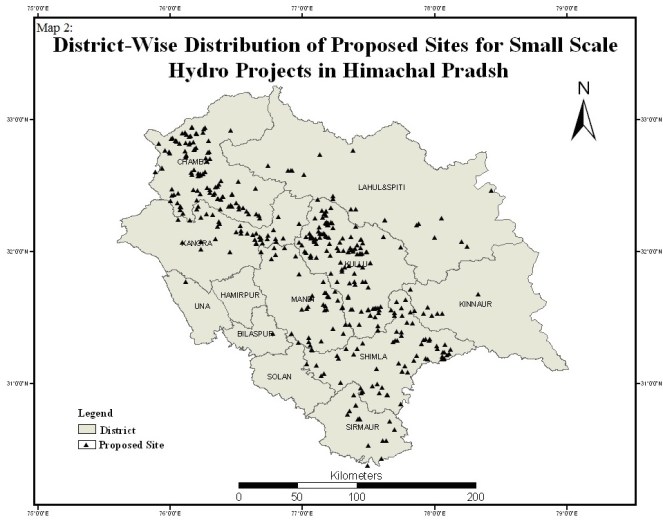
Map 2

The state established a nodal agency, Himurja, to oversee the private development of the state’s small hydropower potential, and to promote utilization of renewable energy more generally.  In 2006 the state formalized the processes and mechanisms that govern private sector involvement in electricity production by passing the Hydropower Policy.  Himurja plays a central role in this process by allocating government-identified small hydropower project sites to private corporations.  After receiving an allotted project site, the corporation (referred to as the project developer or independent power producer) must prepare a series of detailed project reports that include, for example, two years of streamflow data and analysis of the engineering, economic, hydrological, geological, and environmental characteristics of the project.  Once Himurja officers approve these reports, they and the project developer sign a Memorandum of Understanding, a Techno-Economic Clearance document and eventually an Implementation Agreement.  At that point the developer begins the work of securing the required No Objection Certificates (NOCs) from the relevant state and local government entities including the Wildlife Department, Forest Department, Irrigation and Public Health Department Fisheries Department, Public Works Department, Pollution Control Board, Revenue Department, and affected Panchayats.  After obtaining the required certificates, the power producer may commence project construction.

Construction costs generally range from Rs 6-8 crores per megawatt, but these are quickly recouped through the sale of electricity to the Himachal Pradesh State Electricity Board.  Once the project is commissioned, the HP State Electricity Board guarantees the independent power producer a purchase price of Rs 2.50 per kilowatt hour – the equivalent of approximately Rs 2.2 crores per megawatt per year.[4]  The project reverts to the state government free of cost after 40 years of operation.  The developer pays the state government no power royalties for the first 12 years of the project’s life.  However, for the next 18 years the developer must provide 12% of the power it produces free of charge to the state; for the remaining 10 years it must provide 18% free electricity to the state.

For small hydropower projects, there is no requirement that the project developer prepare a formal environmental and social impact assessment or environmental and social management plan subject to public review.  Nor is the developer required to hold public hearings about the proposed project.  This is a serious issue because the absence of a formal environmental assessment and hearing process prevents members of project-affected communities and other civil society groups from sharing concerns about the projects’ anticipated effects.  This is one of the reasons for the growing and significant level of local opposition to small hydropower development in the state.  A significant amount of the local opposition to small hydropower projects stems from the ways in which such projects disrupt rural livelihoods, combined with the inadequacy of local benefits such as rural employment generation and other forms of direct compensation.  The next sections describe some of the livelihood disruptions the commissioned small hydropower projects have caused.  The discussion is organized district by district, reflecting the geographical pattern of these disruptions.

District Kangra – disruption to local irrigation systems and farmer collective action

The majority of District Kangra lies on the southern side of the Dhaula Dhar mountain range, from where it extends across Kangra Valley and into the Sivalik Hills.  The district is notable for its extensive network of community-managed gravity flow irrigation systems (kuhls).  In Kangra Valley alone 750 large and more than 2100 small kuhls irrigate approximately 40000 hectares (Baker 2005) (figure 1).[5]  Kuhl irrigation water is crucial for both kharif crops (rice and corn) and rabi crops (wheat and potatoes).  These crops, except for potatoes, are almost entirely used for home consumption.  Historically, kuhl irrigation water was essential for driving water-powered mills (gharats) and other machines, as well as irrigating home gardens, watering livestock, and meeting household needs for non-potable water.  The importance of ensuring the continuity of these kuhl irrigation systems is reflected in the language of the No Objection Certificates that project developers must obtain from the Irrigation and Public Health Department as well as from village panchayat pradhans.  These certificates contain language that protects community-managed kuhls from disruptions by small hydropower projects and requires the developer to pay full compensation if a project damages or disrupts a community-managed kuhl.

Fig 1

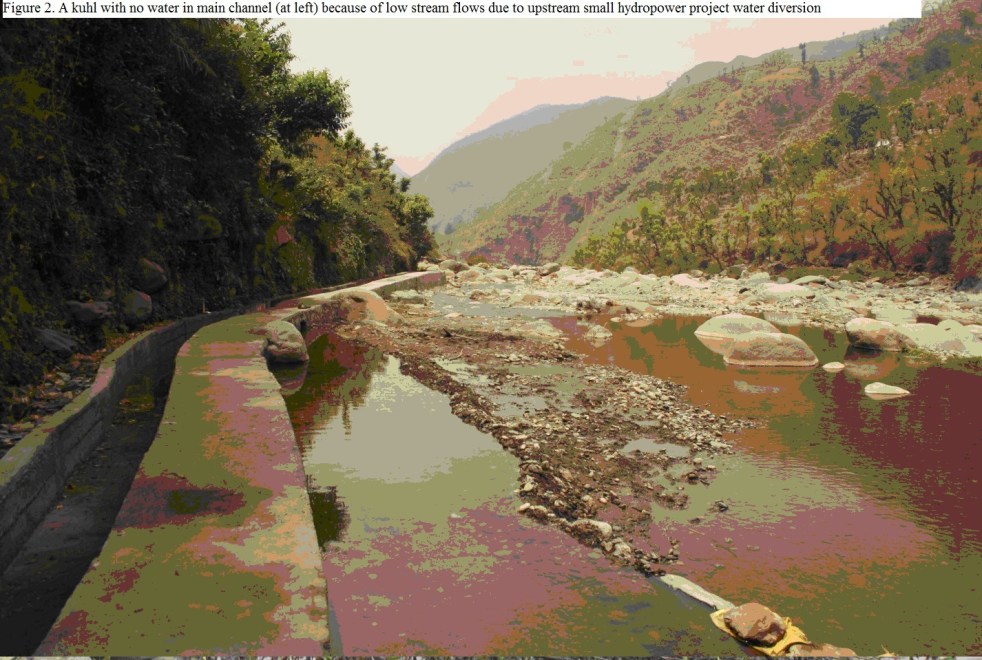
Despite the protections delineated in the No Objection Certificates, small hydropower projects commonly disrupt kuhl irrigation systems or cause them to cease functioning altogether, either by physically damaging the irrigation system or by diverting the water on which the irrigation system relies (figure 2).  When a kuhl is damaged or deprived of water, farmers must shift to rainfed cultivation.  Output from rainfed crops is invariably much less than for irrigated crops, in part due to unpredictable rainfall, increased vulnerability to drought, and damage from hailstorms at harvest time.  Throughout the state, small hydropower projects have disabled a total of at least 13 kuhl irrigation systems; in none of these cases did the project developer compensate farmers for their losses.  This level of disturbance to irrigation is significant – for example, one of the disabled kuhls was the primary source of irrigation water for approximately 2000 households.

Fig 2

Not all local farmers have not stood by idly, watching the lifeline of their subsistence agricultural economy go dry.  Our research documented countless visits from village representatives to district administrative authorities petitioning them to intercede on their behalf in order to seek redress, compensation, and/or release of adequate water flows necessary for irrigation.  Despite these frequent and often repeated requests, we did not encounter one instance in which the district administration prevailed upon the power producer to either compensate for disruptions to these irrigation systems or reduce water diversion to provide adequate water supply.[6]

Seeing the futility of seeking redress for damage or guaranteed minimum flows from already-constructed projects, farming communities in Kangra have started blocking construction of hydropower projects until the power developer agrees to binding conditions.  One example of this concerns Ganetta Kuhl, which diverts water from the Baner stream and conveys it 22 kilometers to the cultivated lands of more than 500 households in 12 different villages.  The diversion weir for a partially completed small hydropower plant is located upstream of the kuhl’s diversion point.[7]  Farmers worried that the project’s water diversion would reduce the water available to them.  When letters outlining farmers’ concerns sent to Prodigy Hydro Power, the deputy commissioner, and even to the chief minister by the panchayat pradhan and kuhl committee president did not produce results, the irrigators used the threat of opposition and civil disobedience to block further project construction (figure 3).  As a result, project construction work was halted for many months.  Finally, in 2013, the project developer agreed to the farmers’ demands, including that their water rights be guaranteed, and in return the farmers rescinded their threats; construction work on this project is currently underway.
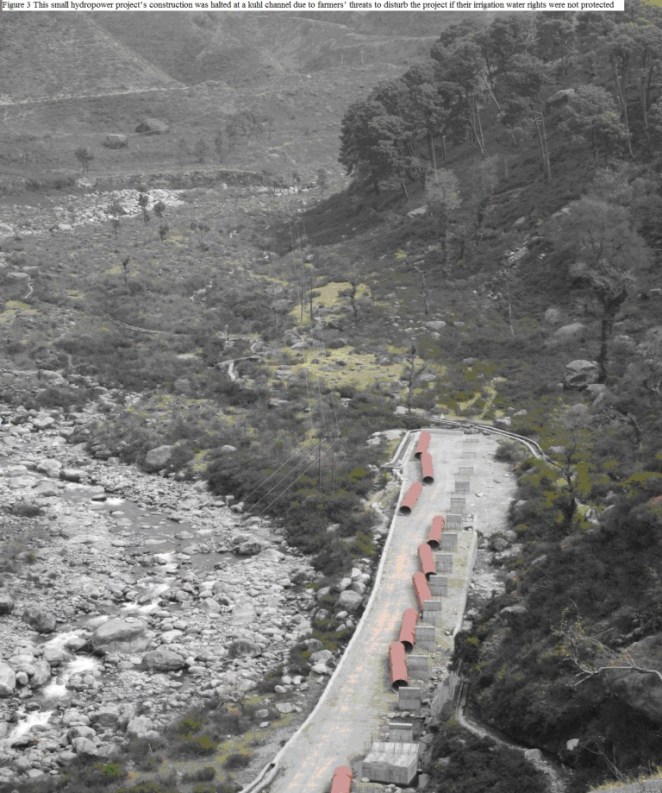
Fig 3

The problems associated with project disruption of traditional irrigation systems are most pronounced in District Kangra due to the large number of kuhl irrigation systems.  However, our research revealed that any location in the state in which kuhl diversion structures are located between a project’s trench weir and tail race were liable to experience water shortages during the year.

Chamba District – landslides, damaged watermills, and local activism

District Chamba lies to the north of District Kangra and contains the headwaters of the Ravi River and key tributaries, all of which have cut deeply into the Himalayan mountains.  Because it lacks the broad arable plains that characterize the kuhl-irrigated Kangra Valley, farmers in Chamba combine rainfed cultivation on terraced fields carved into steep slopes with a high level of dependence on timber and non-timber forest resources, which meet both subsistence needs and generate revenue.  The streams that flow from the forests down through the cultivated fields and villages to eventually join the Ravi River often power 10, 20, or more gharats (water-powered mills).

One of Chamba District’s defining characteristics is its steep topography.  Not only are the roads carved, at times precariously, into steep mountain faces, but there are also numerous signs of natural and human-caused landslides.  In some instances the failure of a terraced field has initiated a landslide whose head swale climbs higher upslope each monsoon season.  In other cases road construction is clearly the culprit, especially where roads traverse steep, unstable slopes or cross ravines that may washout during monsoon storms.
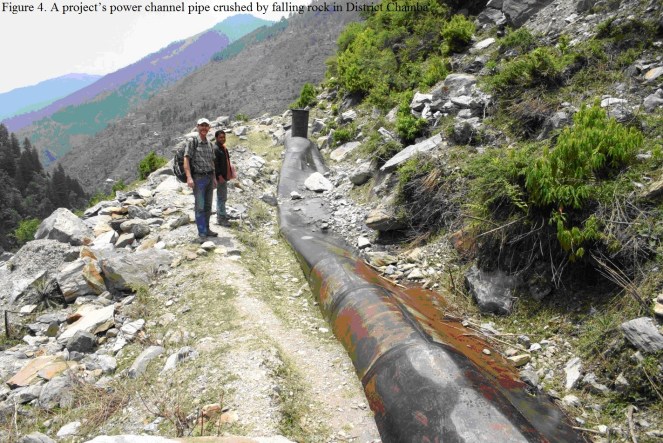
Fig 4

In steep, geologically unstable terrain such as this, small hydropower projects trigger large landslides that not only cause extensive environmental damage but may also damage or destroy the project itself.[8]  The Terailla Project is a case in point.  Located beyond the small town of Tissa in a remote area of Chamba District, this is one of four small hydropower projects that take turns diverting and returning the Terailla River’s water in quick succession.  The power channel of the Terailla Project is carved from a steep, unstable slope containing loose gravel and large rocks and boulders.  After the project was commissioned in 2007, landslides destroyed large sections of the power channel.  Car-size boulders slid downslope and deformed the one meter diameter pipe near the upper end of the power channel (figure 4).  Two other landslides carried large sections of the concrete box power channel down the slope towards the source stream (figure 5).  As of the summer of 2012 this power project had been nonoperational for one year due to the landslide damage.[9]

Fig 5

The upper edge of the growing landslide continues to move upslope and is now destroying the common grazing grounds of the adjacent village; if the rate of the slide’s uphill movement continues, then it will begin approaching the village itself.  Additionally, project roads constructed across adjacent steep slopes to provide access to the diversion weir and to the power house have themselves triggered further landslides.  Despite the clear potential for landslides in this area, the Detailed Project Report submitted by the power developer to HIMURJA states that there is no landslide risk in the project area.  That this faulty assessment was accepted and the project approved suggests there are problems with the government review process.

The four tightly spaced small hydropower projects along the Terailla River have triggered numerous small and large landslides and wrought negative environmental and livelihood impacts.  These include damage to grazing land and cultivated areas, destruction of gharats and other landslide-related damage.  The cumulative negative effects of these projects have generated significant local opposition.  Local community members have protested on numerous occasions and filed multiple court cases against these projects.   Some protesters, including local village women, have been arrested and detained overnight in jail.  The close proximity of these projects along one stream reach raises concerns about the cumulative impacts of clustered small hydropower projects.  This is especially troubling because the project review process contains no mechanism for assessing the cumulative impacts of multiple projects located along the same stream or river.

Damage to gharats from small hydropower projects occurs commonly in Chamba.  Gharats are the most common method for grinding corn, wheat, and occasionally rice.  In exchange for grinding neighbors’ grain, the gharat owner usually receives 10% of the volume of grain they grind.  These in-kind payments support the gharat owner’s family.  Interestingly, in our surveys we found many examples of woman-owned and managed gharats; in most of these cases the woman was either a widow or the head of her household.  Thus gharats are an important livelihood source for this otherwise disadvantaged group of people.
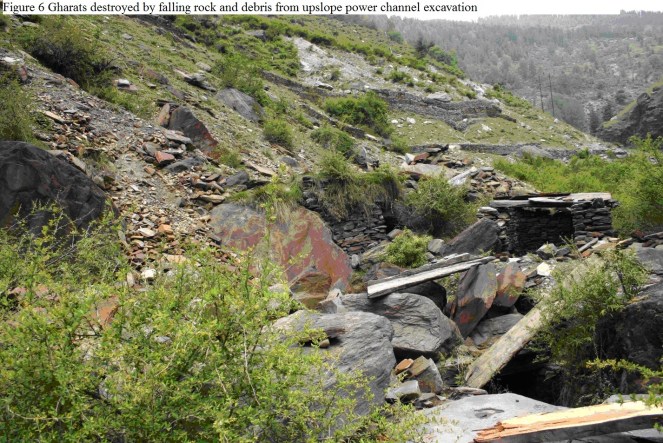
Fig 6

The 49 commissioned small hydropower projects in the state have stopped 104 gharats, either by destroying them due to land and rockslides or by diverting so much water that the gharat had to be abandoned due to lack of water (figures 6 and 7).[10]  The elimination of these 104 gharats weakens the economic stability of the large number of households whose livelihoods they previously sustained.  Although the Irrigation and Public Health Department No Objection Certificate directs the power developer to provide adequate water flows for gharats, the policy contains no requirement that compensation be paid gharat owners if the project damages their gharat or restricts the water available for diversion.  This gap in the hydropower policy, which stems from urban policy makers’ general dismissal and undervaluation of gharats’ importance, suggests why the owners of many of these gharats received no compensation.[11]

Fig 7

Seeing the pattern of uncompensated damage, gharat owners in one stream in Chamba decided on a proactive strategy.  For six months, using threats of direct action against a newly-commissioned small hydropower project, the owners of 12 project-affected gharats stopped the power project from operating until an acceptable compensation agreement was successfully negotiated.  Eventually, through negotiations between the gharat owners, the power developer and the district commissioner, an agreement was reached that ensured acceptable levels of compensation for affected gharat owners.  Based on the assumption that the gharat contributed the equivalent of a daily wage for the household (Rs 120), and the expected life of the power project (40 years), the negotiated settlement consisted of a series of five annual payments which together would total the equivalent of 40 years of daily wage labor.  After the first payment had been made to the concerned gharat owners, they removed their opposition to the project and it began producing and selling electricity.  However, as one gharat owner noted, if their payments cease, they will again stop the project through direct action.

The ability of these gharat owners to successfully engage in direct action and then negotiation reflects the pre-existing patterns of social activism and strong local governance traditions prevalent in Chamba.  Local leaders, inspired by Gandhian ideologies of self-governance and sustainable local livelihoods, have worked to strengthen village panchayat institutions over the last two decades.  This awareness building and social mobilization has centered on defending village community timber and non-timber forest product rights, advocating for community-based medicinal herb collection, and strengthening village level democratic institutions (Gaul 2001).  The resulting awareness and knowledge concerning local rights and democratic process has empowered local communities to defend against livelihood threats, including threats from small hydropower projects.

Kullu District – threats to apple wealth, tourism

Kullu District’s fame, which extends throughout India and indeed the world, stems from a variety of characteristics that also influence the pattern of socio-economic and environmental consequences of small hydropower development.  The district, located to the east of Districts Kangra and Chamba, tends to be relatively wealthy, in part due to the revenue from the cultivation of apples and stone fruit.  Other key sources of local revenues include the film productions that regularly occur in the picturesque mountainous scenery, year-round tourism resulting from Kullu’s attraction to honeymooners and outdoor sports enthusiasts, and Kullu’s prominent pilgrimage destinations, which attract large numbers of pilgrims from throughout north India.  The streams and rivers of Kullu District also support the largest number of private trout farms in the state as well as the Fisheries Department’s fish stocking program, which in turn attracts anglers from around the world and whose efforts are supported by the Himachal Angling Association.  Lastly, parts of the district possess unique ecological and biodiversity values, which conservation efforts within the Forest Department, and especially the creation of the Great Himalaya National Park, seek to conserve and maintain.

The diverse elements of the economic foundations of the district – fruit cultivation, commercial film production, tourism, pilgrimage, fisheries opportunities, and conservation values – also heighten the stakes associated with the proliferation of hydropower projects.  The cumulative impacts of the 11 completed small hydropower projects in the district (with many more under construction and planned) undermine the integrity and value of these elements.

The cumulative effects of transmission line infrastructure threaten the aesthetic and economic values of the Kullu landscape.  As noted previously, private power developers are responsible for constructing power towers and installing transmission lines to convey the electricity they produce to the nearest HPSEB substation.  This is a significant undertaking as the distance between power projects and substations ranges from 3 to 15 kilometers.  When multiple power projects are located in one valley, each must separately construct transmission infrastructure; as the density of power projects increases, so does the resulting network of transmission lines spreading across the picturesque mountain landscape.  Already this density has created negative effects.  Residents we surveyed decried the ugly transmission lines that cut through the fruit orchards in the main Kullu Valley and also traverse the deodar forests and cultivated areas of the tributary watersheds of the Beas River.  Many Kullu residents link the area’s natural beauty with the tourism and film industry and are worried about the negative effects on it of hydropower development.  For example, a panchayat pradhan likened the white boulders of the dewatered reach of the Beas River to bleached bones and asked whether tourists would like to see those instead of clean, free running water.  Regarding transmission lines, one local film production manager noted ruefully that the density of transmission lines in the valley has already disrupted shooting operations and is challenging the ability of film crews to obtain sequences not marred by transmission lines. Seeing the damage to apple orchards from transmission line construction and the fact that at least one person has died from electrocution from a low hanging power line, families that own land where towers need to be constructed are increasingly reluctant to sell the small plot of land necessary to construct the power tower.

Kullu District – threats to fisheries-based livelihoods

The negative effects of small hydropower development on water quality and fisheries-based livelihoods were also particularly evident in Kullu District.  In addition to reducing the quantity of water available for kuhl irrigation systems and for gharats, as discussed above, small hydropower projects also affect water quality.  Project managers clean desilting tanks by flushing the accumulated silt directly back into the source stream, thus creating a slug of sediment that harms downstream water quality and aquatic habitat and species.

These sediment slugs negatively affect downstream fisheries operations, both private and government.  The Himachal Pradesh Fisheries Department’s oldest trout hatchery is located at Patlikuhl in Kullu Valley (figure 8).  Established in 1909, the hatchery diverts water from the Sujan stream before it joins the Beas River.  In 1988 a joint Indo-Norwegian effort was initiated to commercialize trout production (Sehgal 1999).  The hatchery now operates independently of Norwegian support.  In 2009-2010 it produced 3.75 lakhs of fish ova, 80 metric tons of fish feed (sold to local fish farmers and as far away as Sikkim, Bhutan, and Uttarakhand), and 12 metric tons of fish (Fisheries Department records 2012).  This fish hatchery operation anchors the state’s fish stocking program and supplies fingerlings and other inputs to the growing number of households in Kullu that have established fish farming operations.  The hatchery depends on clean, cold, oxygenated water to successfully manage the large number of tanks where fish eggs are fertilized and the ova are reared to become fingerlings or adults.  Already, commissioned power projects (small and large) have increased sedimentation in the Sujan stream and more projects are planned.  Hatchery managers are concerned about the threats to their source water posed by upstream hydropower development; they have written letters expressing this concern to the Director of the Fisheries Department.

Fig 8

When asked about the Fisheries Department’s ability to require water quality protection measures as a condition for approving the No Objection Certificate, the Fisheries Department official in charge of the Patlikuhl fish hatchery stated that initially department officers had attempted to restrict the proliferation of small hydropower projects due to their negative effects on fisheries and aquatic ecology.  In some instances they had refused to provide a No Objection Certificate or they had required stringent water quality protection measures.  However, the officer noted in a resigned manner that eventually they “had to give the NOC; it is the policy of the government” (to promote small hydropower).

Many local communities share the Fisheries Department’s concerns about the negative water quality impacts of small hydropower projects, especially given the recent growth of fish farming.  The fingerlings and fish food from the Patlikuhl Fish Hatchery have enabled fish farming in Kullu District to grow rapidly from only four or five small private fish farms a few years ago to 52 farms.  In 2011 these farms produced more than 50 metric tons of trout, which were sold to local and more distant markets at Rs 250-350 per kilogram and netted each of these 52 families approximately Rs 3 lakhs.  This scale of economic production is significant.  And, given the market and transportation linkages with large cities such as Chandigarh, Delhi, and even Mumbai, the potential demand for farmed trout far exceeds current production.  However, the negative effects on water quality from hydropower development could significantly limit realization of this potential.

The potential threat small hydropower development poses for fish farming has strengthened local community opposition, which occasionally manifests as local panchayat refusal to grant the No Objection Certificate.  One example of this concerns the controversy over small hydropower development planned for Haripur Nullah, a tributary of the Beas River on the east side of Kullu Valley.  A project developer had been seeking the requisite NOCs from the three panchayats within whose boundaries the project fell.  Concerned residents, including retired government officers and educators, had earlier formed a local organization (Jan Jagran Vikas Sanstha, JJVS) to successfully oppose a planned ski resort in their area (Asher 2008).  This same group of individuals mobilized against the proposed small hydropower project, due to the anticipated damage to the private and government fish farms the stream supports and the negative effects on the four affected kuhls, the numerous gharats along Haripur Nullah, and the local government seed farm and private agricultural production in the project affected area.  Due to this well organized local opposition, at eight different meetings the developer was unsuccessful in obtaining the NOC.  Finally, just prior to a panchayat election (which the pradhan was not planning to contest) the developer, through a “miracle” (as recounted by JJVS members), managed to obtain a signed NOC from the pradhan.  JJVS members rejected the validity of the NOC, which they claimed was obtained through undue influence, and sought redress through the district administration as well as the local courts.[12]  Meanwhile, despite continued local opposition, the project developer has begun construction.

The intersections between fish, livelihoods, and small hydropower development extend to both sport fishing and subsistence fishing.  Individuals that engage in subsistence fishing obtain cast net licenses from the Fisheries Department.  In 2011 there were 350, 200, and 2000 cast net license holders in Districts Kullu, Chamba, and Kangra, respectively.  The Fisheries Department estimates that in the state overall approximately 10000 households depend entirely or significantly on subsistence fishing for their livelihood.  Sport fishing is also a significant and growing source of economic revenue, especially for those who operate fishing lodges and otherwise cater to sport fishers.  In 2011 the Fisheries Department allocated 752 sport fishing licenses in Kullu District, the center of sport fishing for Himachal Pradesh.  The Tirthan River, which flows out of the Great Himalaya National Park and travels approximately 16 kilometers before it joins with the Sainj and then the Beas Rivers, is one of the centers of sport trout fishing.  The Himachal Angling Association, an active organization that promotes sport fishing, held its 2012 Trout Anglers Meet at Sai Ropa on the Tirthan River.  The keynote address at the angling competition, given by the Association’s Secretary General, advanced strategies for strengthening “Angling Tourism” and denounced the negative impacts of small hydropower development on fisheries and the livelihoods they support.

Fig 9

The competition was attended by Mr. Dilaram Shabab, the retired MLA from this area who had spearheaded the successful effort to have the Tirthan River watershed declared off limits to small hydropower development (figure 9).  Local panchayats, community members, and fishing lodge owners, with the able support and vision of Mr. Dilaram Shabab, as well as eventual backing from Fisheries Department, Forest Department and Great Himalayan National Park officials, launched a five year court battle against small hydropower development in this watershed.  After three years of arguments and rulings in the Kullu District Court and more than one year in the High Court in Shimla, the High Court presiding judge ruled in favor of the arguments set forth concerning the negative effects on the environment, fisheries, and affected communities of the planned small hydropower projects in the watershed.  The court declared the Tirthan off limits to all hydropower projects, and it cancelled the 9 previously approved small hydropower projects (Civil Writ Petition 1038 2006).[13]  This is the only example in Himachal Pradesh of a watershed being declared permanently off limits to hydro development.

This concludes part one of this two part article.  The second part will address labor issues related to small hydropower development and the functioning of the Local Area Development Authority (LADA).  It will also discuss two promising institutional models for small hydropower development and offer a set of recommendations.

J. Mark Baker (JMark.Baker@humboldt.edu), Humboldt State University, Arcata, CA, USA

Please see Part II of this piece here: https://sandrp.wordpress.com/2014/06/11/the-socio-ecological-impacts-of-small-hydropower-projects-in-himachal-pradesh-part-2/

References:

Asher, Manshi (2008): “Impacts of the Proposed Himalayan Ski Village Project in Kullu, Himachal Pradesh – A Preliminary Fact Finding Report” (Himachal Pradesh: Him Niti   and Jan Jagran Evan Vikas Samiti).

Baker, J Mark (2005): The Kuhls of Kangra: Community Managed Irrigation in the Western Himalaya (Delhi: Permanent Black).

Gaul, Karen K (2001): “On the Move: Shifting Strategies in Environmental Activism in Chamba District of Himachal Pradesh”,  Himalaya, 21(2):70-78.

Government of Himachal Pradesh (2006): “Hydro Power Policy”, (Shimla).

Government of Himachal Pradesh (2012): “Memorandums of Understanding”, Himachal Pradesh Energy Development Agency (Himurja).  Viewed on 25 May 2012. Website: (http://himurja.nic.in/moutilldate.html).

Payne, Adam (2010): “Rivers of Power, Forests of Beauty: Neo-Liberalism, Conservation and the Governmental Use of Terror in Struggles Over Natural Resources”, Columbia Undergraduate Journal of South Asian Studies, 2(1):61-92.

Sehgal, KL (1999): “Coldwater Fish and Fisheries in the Indian Himalayas: Culture” in T Petr  (ed.), Fish and fisheries at higher altitudes: Asia. FAO Fisheries Technical Paper. No. 385. (Rome: FAOF).

Selvaraj, S and A Badola (2012): “Validation of the Small Hydro Power Project by Prodigy Hydro Power Private Limited”, (Neuilly Sur Seine, France: Bureau Veritas Certification).

Sinclair, John (2003): “Assessing the Impacts of Micro-Hydro Development in Kullu District, Himachal Pradesh, India”, Mountain Research and Development, 23(1):11-13.

END NOTES:

[1] The material presented here is partly excerpted from a recent article in Economic and Political Weekly, “Small Hydropower Development in Himachal Pradesh: an Analysis of Socioecological Effects,” vol XLIX no 21, pages 77-86.

[2] Run-of-the-river power small hydro projects divert water from a source stream or river through a dam or trench weir into a settling tank where the silt and sediment load settles to the bottom.  From there the water is conveyed through a power channel (usually a large diameter pipe or concrete box tunnel) away from the source stream along a slight downhill gradient.  The power channel length varies from one to as long as eight kilometers.  From the power channel the water flows into the forebay and then passes into the steeply sloped penstock and then inside the power house where the force of the water is used to drive one or more turbines.  The electricity the turbines produce is monitored and managed through a complex set of operating controls.  Power lines one to fifteen kilometers in length convey the generated power to the nearest HP State Electricity Board substation, at which point the power joins the state’s power grid.

[3] The 49 commissioned power projects have a total generating capacity of about 200 MW, which represents about 20% of the small hydropower potential in the state.  Some of these projects were commissioned prior to the 2006 Hydropower Policy.  This article restricts its focus to small (5 MW or less, as defined by the Himachal Pradesh Power Policy) hydropower projects, which are often considered socially and environmentally benign.  Large hydropower projects are also proliferating across the state, and have their own socio-ecological impacts.  Sometimes small and large hydropower projects are located on the same stream or river; however, most of the commissioned small hydropower projects in Himachal Pradesh are located in different watercourses, and generally upstream, of medium and large hydropower projects.

[4] This rate of return assumes the power project operates at full capacity year round.  However, even at half capacity, these projects still fetch a handsome return on investment, especially when central government subsidies are taken into account.

[5] A large kuhl may be defined as irrigating land in more than one village while a small kuhl irrigates land within one village.

[6] This is primarily due to the reluctance of power producers to allow water to flow across their diversion weir without capturing it and harnessing it to generate power and revenue.  Farmers, especially subsistence farmers using traditional irrigation systems, generally do not have the political power and access to the district’s administrative machinery to force power producers to forego potential revenue in order to allow local traditions of water management to flourish.  While some farmers in Sirmaur District resorted to the purchase of diesel pumpsets to lift water to irrigate cash crops (bell peppers, green beans and tomatoes), these efforts also failed due to the lack of water in the stream reach between the hydroproject’s diversion weir and tail race.

[7] Interestingly, and perhaps ironically, this same project received validation through a third party assessment under the Clean Development Mechanism of the Kyoto Protocol for producing Certified Emissions Reductions and satisfying the criteria for being a quality project (Selvaraj, S. et al. 2012).

[8] Indeed, the destructive landslides and other environmental degradation associated with this form of hydropower along the Alaknanda and Bhagirathi river basins resulted in the August 2013 Supreme Court stay on further hydropower development in neighboring Uttarakhand (Hon K S Radhakrishnan 2013).

[9] The Detailed Project Report for this project should have identified these landslide and slippage risks.  In this case the report did not mention this risk.  In the conclusion of the “Geological and Geotechnical Studies” chapter, the report notes that “on the basis of geological investigation carried out it is recommended that weir site, feeder channel, desilting tank, power channel, forebay, penstock and powerhouse sites are geologically suitable for construction.  There is no major geological problem around the study area.”  The next line notes that “there is no landslide zone.”  Clearly this report, upon which approval was granted to the project developer to construct the project, contained inaccurate information about landslide risk.  This raises the issue of how much review of the Detailed Project Reports Himurja officers should undertake.  At least in this case, ground truthing could have avoided these severe and ongoing problems.

[10] In more than one instance, though the power developer told us that no gharats were located between the project’s diversion weir and tail race, site visits to the stream reach revealed this not to be true.

[11] Compensation rates for those gharat owners that did receive some form of compensation varied widely and seemed to depend on the relative bargaining power of gharat owners.  Compensation ranged from monthly payments of Rs 3000 to lump sum payments of Rs 2 to 16.5 lakhs.

[12] The members of JJVS hypothesized that the pradhan had either been paid or coerced into authorizing the NOC, though there is no evidence to support this since there has been no investigation into this issue.  Using monetary incentives to obtain the necessary no objection clearances is common practice.  We heard many instances in which a No Objection Certificate was obtained from a panchayat for a payment of between Rs 30000 to 50000.  As discussed above, NOCs must be obtained from a number of different government agencies, in addition to the project-affected panchayats.  A general rule of thumb appears to be that obtaining NOCs from all the necessary entities usually costs approximately Rs 50 lakhs per megawatt of installed capacity.

[13] The court decision hinged on the anticipated negative effects of the projects on trout and other Tirthan River fisheries, anticipated local livelihood disruptions related to damage to gharats and kuhl irrigation, the fact that the projects would provide little local benefit (minimal local employment would be provided, electricity was not needed locally), and claims that the project documents lacked a real assessment of the burdens of the project on local communities.  The proximity of the projects along the Tirthan River to the Great Himalaya National Park, with its populations of threatened Western Tragopan, Monal and other pheasants, Musk Deer and other species, also influenced the court’s judgment concerning the relative merits and demerits of these small hydropower projects (Payne 2010).

Related subsequent stories:

[14] http://www.indiawaterportal.org/articles/irrigation-systems-himachal-threatened-hydropower-projects