Free flowing rivers

Community Fish Sanctuaries: Protecting the fish….and their rivers

21 November 2013: World Fisheries Day 

A small bus load of pilgrims descended at Walen Kondh and bought the usual Prasad from a shack by the river. They crossed a suspension bridge over a deep gorge of Kal Nadi and went to the derelict temple of Vardayini Mata on the other bank.

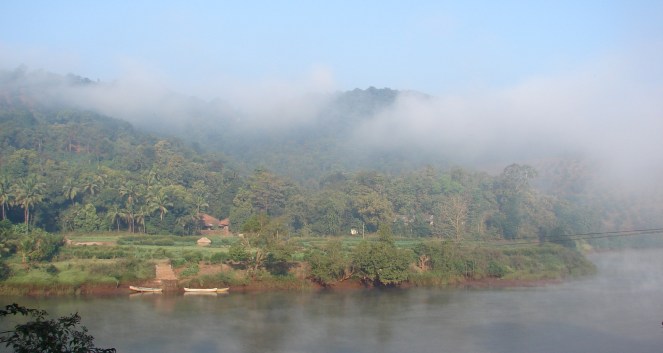
Kal River at Walen Kondh. Photo: Author

Then a few girls among them did something unusual. Instead of offering the Prasad at the temple, they came to the ridge of the gorge and clapped a few times, peering into the river below. In a matter of seconds, there was frantic thrashing in the waters as a huge school of endangered Mahseer fish congregated swiftly. The devotees then threw in fistfuls of puffed rice to hundreds of Mahseer below. For the devotees, these fish are sacred:  the children of Varadayini Mata.
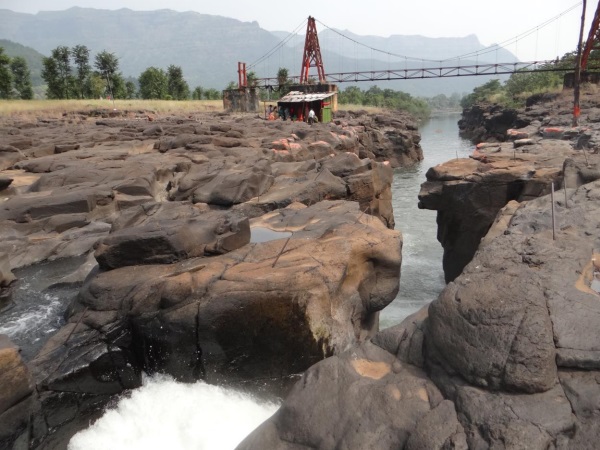
Temple of Varadayini Mata . Photo: Author

Walen Kondh in Mahad Taluka of Raigad District in the Western Ghats of Maharashtra is one of the several critical community fish sanctuaries of India that protect the Mahseer fish. These sanctuaries have been successful in conserving not only the fish, but also stretches of rivers through their unique actions which find no support from the establishment and limited recognition from the conservation community.

Devotees offering puffed rice to Mahseer below. Photo : Author

Deccan Mahseer (Tor Khudree) is classified as an endangered specie by IUCN[i]. It does not feature in the schedule of species protected under the Wildlife Protection Act (1972) which is not a surprise as the Act represents freshwater diversity very poorly. However, many researchers, fisher folk and anglers have recorded that Tor Khudree and associated Mahseer species (Tor tor, Tor putitora, etc) which were once plentiful in rivers across Western Ghats, peninsular and central India, HimalayanRivers as well as floodplains, has now reduced drastically.

One of the major reasons behind the collapse of fish species like Mahseer is dam construction. Mahseer species migrate in the upstream to smaller streams for spawning (breeding). They need a flood pulse to undertake this migration. While other factors like pollution, overfishing, etc. have contributed to the decline, the multiple impacts of dams in terms of blocking migration paths, reduction of water levels in the downstream, submergence of pools in the upstream, changes in natural hydrograph and flood pulses, changes in sedimentation, etc., have been the primary reasons behind this collapse. (SANDRP’s report on Impact of Dams on Fisheries: sandrp.in/dams/Impacts_of_Dams_on_Riverine_Fisheries_in_India_ParineetaDandekar_Sept2012.pdf)

Fall of Mahseer has affected the ecology, local livelihoods, angling and recreational fishing in the rivers. While Hoshangabad on the banks of Narmada recorded 5-6 tonnes of Mahseer landings every year, it has been nearly wiped out from these places now[ii]. Mahseer used to form the majority of catch in these parts and has been severely affected by reservoirs like Tawa, Bargi, Sardar Sarovar and other Naramada projects. However, hardly any efforts are being made to reverse this situation. According to Shashank Ogale, who set up and managed Mahseer hatcheries in Tata Dams for more than 20 years, there are next to none functional Mahseer hatcheries in the country. This is despite the fact that dam proponents show an expense of crores of rupees to set up hatcheries as a part of their Environment Management Plan. After granting clearances, which are also based on these EMPs, MoEF does not bother to monitor the functioning and efficiency of these hatcheries or the impacts of dams on fish diversity and fisheries[iii].

In such a scenario, community conserved fish sanctuaries which are scattered across the country are playing a very important role in conserving various species of Mahseer as well as stretches of rivers. Unfortunately, most of these sanctuaries get no protection by the State Governments, Forest Departments or the Ministry of Environment and Forests. This is at a time when freshwater diversity is declining at the fastest rate globally[iv]. Ministry of Environment and Forests has done precious little in conserving or protecting riverine diversity, fisheries or rivers from the onslaught of dams. These sanctuaries keep getting submerged, dried up or fragmented by newly planned dams and State Fisheries Departments don’t bat an eyelid before giving a no-objection certificate (NOC) to projects which will spell doom for these sanctuaries.

Renole Pujari from Walen Kondh tells me that they have received no support or protection from the government to conserve Walen Kondh Sanctuary, however the community sanctions are so strong that not only is fishing banned across 2 kilometers from this stretch, but people are not even allowed to get down to the water, near these fish. He only hopes that this stretch of Kal nadi[v] is not destroyed by dams and chemical pollution like the neighboring Savitri River which flows through the chemical MIDC at Mahad.  Fish kills are a regular feature of Savitri River.[vi]

In Maharashtra, Tilase is one more such small village in Wada Taluka of Thane district which protects Mahseer fish in Vaitarna River. The stretch is downstream of Upper Vaitarna Dam which supplies water to Mumbai. Local youths told me that fish kills occur here when water releases from Upper Vaitarna decrease. Downstream this stretch, Middle Vaitarna Dam has now come up and the sanctuary is now sandwiched between the two projects. Social sanctions here are so strict that a net cannot be put in the waters, even to check the species. Fish Sanctuaries also existed in Alandi and at Pandharpur along teh Bhima, but have been wiped out. In Vidarbha, several Dev dohs (Sacred Pools) exist in Rivers like Adan, Kathani, Wainganga, etc., where fishing is banned.

Small community fish sanctuary on Vaitarna River Photo: Author

Accoridng to Rajendra Kerkar, Goa too has community conserved fish sanctuaries protecting the Mahseer at ‘Pistyachi Kon’ nesteled between Bhimgad and Mhadei Sanctuaries. It receives no protection.

In Orissa, along the Mahanadi on the banks of the leaning temple of Huma exists the Huma Mahseer Sanctuary. On the banks is a stone statue of a lady cutting a Mahseer fish. Legend goes that the one who fishes in this stretch will meet the same fate, like King Midas! Hirakud Dam has already affected this sanctuary and the proposed Lower Suktel Dam will make things worse.

Stone Statue at a fish sanctuary on the banks on mahanadi in Orissa Photo: Wikimedia
Stone Statue at a fish sanctuary on the banks on Mahanadi in Orissa Photo: Wikimedia

Karnataka possible has the highest number of community fish sanctuaries in the Western Ghats. Nakur Gaya and Yenekkal fish sanctuaries exist on the banks of Kumardhara in Dakshin Kannada. In Yenekal, local gram panchayat has built a small weir with wooden gates for maintaining water levels for the fish. The weir is so small that the fish can migrate over it in the monsoons. Both these sanctuaries are threatened by the numerous mini hydel projects coming across the region, especially the 24.75 MW Kukke Mini Hydel Project near Hosmata[vii]. Fisheries Department however has given an NOC to this and many other mini hydels coming across the region without even attempting to study their impacts on Mahseer and other fish.

Congragation of Mahseer at Yenekkal Fish Sanctuary on Kumardhara River Photo: Author
Congregation of Mahseer at Yenekkal Fish Sanctuary on Kumardhara River Photo: Author

200 MW Gundia Hydel project will also affect the entire hydrograph of Kumaradhara-Gundia rivers. Here. The EIA done by KPCL (Karnataka Power Corporation Limited) says that there are no rare and endangered fish in the area. 5 new fish have been discovered in the region just in the past one year!

Child feeding fish at Shringeri fish sanctuary, Tunga River Photo: Author

Karappura Fish Sanctuary in Mysore was submerged by the Kabini reservoir while the Shimoga Agrahara Sanctuary collapsed due to dwindling water levels which resulted after construction of Tunga Anicut 12 kilometers upstream from here.[viii]

Lovely Tunga River at Chippalgudde fish Sanctuary Photo: Author

Uttarakhand and Himachal Pradesh too have temple fish sanctuaries, notably the Baijanath Temple complex on the banks on River Gomti in Uttarakhand conserves Golden Mahseer (Tor putitora) and supports a small fish sanctuary on its banks. Many isolated fish sanctuaries are also reported from the Ramganaga and Kosi area near Corbett. However, it is also reported that now these sites are used by anglers and the temples receive revenue in return. In Jogindernagar, a town in Mandi distirct of Himachal Pradesh, lies a lake known as Machchiyal, fed by River Uhl. This lake is supposed to be the abode of Machendru Devta, the Fish God. Fish are fed and worshipped here regularly and fishing is strictly prohibited in the lake.  Machchiyal supports a large population of the Himalayan Mahseer. There is a Temple of Machendru Devta on the lake bank with ancient idols of fish-god.
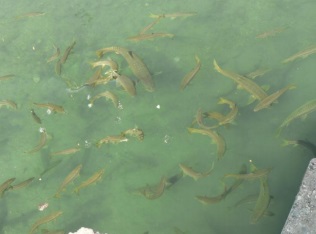
Congregation of Mahseer at Baijnath Temple Sancatury on Gomti RIver Photo: Malvika Chauhan

In the remote Tawang in Aruncahal Pradesh in the North East corner of India flows a beautiful river Nyamjangchu. Buddhist Monpas rever the river as well as the fish in Nyamjangchu. Fish in the Nyamjangchu are not hunted. The river is threatened by the proposed 780 MW Nyamjangchu Hydel project which will divert or submerge nearly the entire length of this river flowing through India. Even premier research institutes like CIFRI (Central Inland Fisheries Research Institute) have done a shoddy study and supported the project and have not raised the issue of impact of this dam on fish diversity.[ix]

On the occasion of World Fisheries Day 2013, we urge to the MoEF to document the existing sanctuaries and grant immediate protection to all the existing fish sanctuaries in the country, protecting them from the onslaught of dams and other pressures.  We had sent a similar submission to the moEF which was endorsed by several Fisheries Scientists and activists across the country in 2012, we’ve received no response from the MoEF on it till date (https://sandrp.in/rivers/MoEF_EAC_Submission_Fisheries_Nov2012.pdf, sandrp.in/rivers/World_Fisheries_Day_PR_Nov2012.pdf).

These sanctuaries stand testimony to the fact that community conservation is one of the most sustainable and effective ways of protecting ecosystems. The sanctuaries and their keepers deserve respect and recognition.

– Parineeta Dandekar ( parineeta.dandekar@gmail.com)

________________________

Additional Information:
1. IISC Bangalore has developed an excellent data base on the status of fish sanctuaries in Western Ghats. This needs more updation. http://www.ces.iisc.ernet.in/biodiversity/sahyadri_enews/newsletter/issue11/hotspot/fish/

[iii] sandrp.in/dams/Impacts_of_Dams_on_Riverine_Fisheries_in_India_ParineetaDandekar_Sept2012.pdf

[v]

[viii] Shyama Bhat Kolari, Development and management of Freshwater Fish Sanctuaries in India, 2005
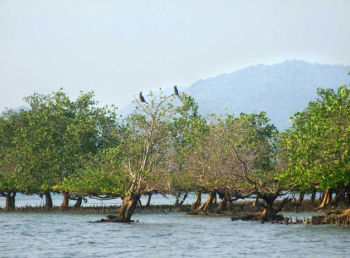
Free flowing rivers · Western Ghats

Ecological value of free flowing Aghanashini for estuarine communities and beyond

Comparing ecological goods and services of a dammed Vs undammed river estuary is important for a number of reasons. This sort of post facto analysis is seldom done in our country. That is why a case study by Mahima Bhat, V. N. Nayak et al (Mahima Bhat, 2012) comparing Aghanashini and Sharvathi estuaries titled “Impact of Hydroelectric Dams on Fisheries in the Sharavathi Estuary of Uttara Kannada District, South-West India” is an important study (http://www.ces.iisc.ernet.in/energy/lake2012/fullpaper/mahima_fullpaper.pdf). The researchers are a part of Wetlands and Energy Group of the Centre for Ecological Science, Indian Institute of Sciences, Bangalore. The study went on for one year in which the researchers studied and compared productivity, ecological goods and services and fish diversity of Aghanashini and Sharavathi Estuaries. They have talked with the fisher folk and listened to what they had to say about impacts of dams on Sharavathi on the fish catch and productivity of the Sharavathi estuary.

Estuary of River Aghanashini Courtesy; The Hindu

Due to a number of peoples protests supported by some well-researched studies by Centre for Ecological Sciences, IISc, Aghanashini River, small west flowing river of the Western Ghats is as yet in a free flowing, undammed condition. The stretches river also has recently been declared conservation reserve. In many senses, West-flowing River basins of Western Ghats in Karnataka have set inspiring examples. Plans of building a hydel dam on BedthiRiver, also in coastal Karnataka were dropped due to extensive studies and advocacy of groups which demonstrated that the river is of higher value than the dam. (Read Vijay Paranjpye’s book on the subject: Foresight at Bedthi)

Free flowing rivers are the rivers which do not have any dams or barrages on their course. In its dam onslaught, India has few free flowing rivers left. We do not have any policy or law to protect these last remaining free flowing rivers. Many countries across the world have specific laws to protect free flowing rivers that they have. To know more about free flowing rivers and policy tools across the world to protect these, see: http://www.internationalrivers.org/resources/where-rivers-run-free-1670

Western Ghats has few free flowing rivers like Shastri (Ratnagiri district of Maharashtra) and Aghanashini (Uttar Kannada district of Karnataka). The range of services provided by these rivers is often neglected. In reality, they support livelihoods of communities around them as well as rich biodiversity. Studies indicate that free flowing rivers are more resilient to challenges posed by Climate Change than their dammed counterparts.

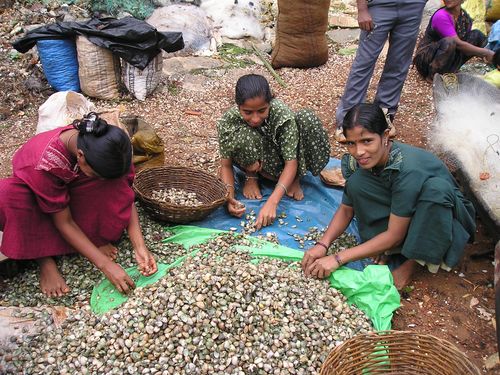
Collection of mussels from Aghanashini Estuary. Not only a significant source of income, but also protein
Collection of mussels from Aghanashini Estuary. Not only a significant source of income, but also protein Photo: CES, IISc

The paper tries to evaluate the ecological as well as economic status of Aghanashini/ Tadri river estuary and that of Sharavathi Estuary. River Sharavathi has cascade of hydel dams on its main stem and tributaries, most of them belonging to the Karnataka Power Corporation Limited, together with an installed capacity of 1469.2 MW (for a map of the basin with HEP locations, see: https://sandrp.in/basin_maps/Sharavathy150411.jpg). The dam that is closest to the estuary is the Gerusouppa HEP (240 MW), the dam that is farthest is Linganamakki (55 MW).

Table 1Flow Chart of 1469.2 MW Sharavathi Hydroelectric Projects Source: KPCL

 flowchart

These dams submerged a huge area of land, forests and villages. Linganmakki Dam submerged 326.34 sq km, Talakalele: 7.77sq km and Gerusoppa submerged 5.96 sq. km respectively. The Linganamakki reservoir resulted in the full or partial submergence of 99 villages in the Sagar and 76 villages in the Hosanagar taluks of Shimoga district, also causing the displacement of 12000 people. The Talakalale reservoir resulted in the full or partial submergence of 3 villages in the Sagar taluk. Whereas, the Gerusoppa reservoir the submerged 5.96 sq. km of tropical evergreen to semi-evergreen forests. In addition, for the Sharavathi Tail Race project, 4.72 sq. km of forest and 0.08 sq. km of other lands was also acquired for the township, roads, etc. (http://www.ces.iisc.ernet.in/energy/water/paper/Cumulative/studyarea.htm) The land taken for Chakra dam, Savehaklu dam (both upstream of Linkanmakki dam) and Kargal Anicut and Sirur balancing reservoir would be additional.

Submergence area of Linganmakki Reservoir Photo: Sabarish Raghupathy

The dams have no system of releasing environmental flows, mimicking the natural hydrograph of the river for people and communities in the downstream.

Geographically the Uttar Kannada district of Karnataka has 4 estuaries. From north to south, these are Kali, Bedthi/ Gangavali, Aghanashini/ Tadri and Sharavathi estuaries. Distance between Kali and Bedthi estuary is 32 km, just 10 km further south, we have Aghanashini/ Tadri estuary and further 24km south we have Sharavathi estuary.

Projects on Sharavathi Map: SANDRP
Sharvathi Projects: CES, IISc

Important findings of the study:

Please note that the comparison given below is only with respect to some specific aspects of estuaries of the two river basins and not with respect to the whole river basins and cost benefits of the hydropower projects in case of Sharavathi basin. The implied impacts mentioned here on the Sharavathi basin is not with respect to what was the situation before the projects were taken up. It needs to be added that such impacts were not taken into account while taking decisions about the projects, while doing cost benefit analysis of the projects, while undertaking social and environmental impact assessments or while formulating social and environmental management plans.

1.    Free flowing river supports more biodiversity:

90 fish species were observed in Aghanashini estuary while the number of different fish species observed in Sharavathi estuary is only 43, nearly 50% less than Aghanashini. Sharavathi had specifically lower populations of marine species migrating up river. This is attributed to near-freshwater salinity of Sharavathi Estuary, maintained due to constant inflow of water from upstream hydel projects, even in peak summer.

2.    Free flowing River supports more river dependant livelihoods, than its dammed counterpart

Aghanashini Estuary supports 20 fishing villages, while there are only 10 fishing villages in Sharavathi Estuary. Fisherfolk in Aghanashini are more than 6000, while Sharavathi estuary supports only 283 fisherfolk. Gathering of edible bivalves, a major economic activity in Aghanashini estuary has gone extinct in Sharavathi.

3. Estuarine salinity is highly modified in the river with hydel projects:

Aghanashini’s salinity increases during non-monsoon months – since it is a rain-fed river. This salinity makes conditions favorable for marine fish and other animals to travel upstream the estuary. The salinity of the Aghanashini reaches the peak value of 24-34 ppt[1] during April- May.

Sharvathi: the study finds that even in peak summer months, the salinity of Sharavathi Estuary remains under 1 ppt, due to the continuous release of dammed freshwater from the turbines into the river while producing power. Hydropower projects affect the hydrograph as well as salinity in a river. Due to this drastic change in salinity, only the organisms which have a high tolerance for freshwater are found in Sharavathi estuary. Fishes and estuarine organisms such as crabs, bivalves etc. have a specific range of tolerance towards salinity.  These freshwater conditions affect the species of fish that migrate upstream in the Sharavathi estuary.

4.    Estuary of a Free flowing river is highly productive in ecological terms than its dammed counter part

The open estuarine part of Aghanashini, measuring 1977 ha, excluding saltpans, rice, and aquaculture, has annual fisheries (including bivalves) income to the tune of estimated Rs 1,095,072,000 or about Rs 1095 million, at Rs 553,905/ ha, in Sharavathi, 977 ha of open estuary produces only Rs 12,852,500 income or Rs 12.85 million, at an abysmally low rate of Rs 13,155/ ha in comparison. Shrimp aquaculture is widespread in Aghanashini, while practically non-existent in Sharavathi.

The study recommends exercising caution in “execution of hydroelectric projects in the west flowing rivers from Western Ghats to avoid fisheries collapse and dislocations in local livelihoods and economy.”

The study mainly attributes fall in fisheries to salinity changes in Sharavathi following cascade of dams. There may be other major underlying reasons contributing to this, including change in entire hydrological regime of the river and estuary, which affects fisheries, change in sediment load, sediment trapping by upstream dams, blockage to upstream and downstream migration of fish, pollution, differing and changing water use pattern, including groundwater uses, etc. The study mentions some of these reasons, although it’s done rather sketchily. There needs to be more thorough analysis of these factors.

In conclusion Value of a river is not only limited to the hydropower it can produce. Rivers have been providing free and invualble services to communities and societies at large since time immemorial. These services cannot always be converted into monitory terms, due to their complex and interconnected nature. At times, it is also not advisable to attempt that. However it is high time that free flowing rivers are at least recognized as important repositories of biodiversity and as highly useful ecosystems from anthropogenic view, offering goods and services for free, in addition to providing habitat for aquatic and terrestrial biodiversity.

Unfortunately, India’s environmental impact assessments, costs and benefit analysis surrounding dams and hydel projects do not give any value to a flowing river. The value of a river is assumed to be zero! The social impact assessment also needs to take into account the impact of the project on livelihoods of the people dependent on downstream river and rehabilitation plans needs to take such impacts into account. None of this is happening today.

There is an urgent need of a policy to protect the last remaining free flowing rivers in our country and understand the range of goods and services such Rivers can provide to communities and ecosystems currently and in future with changing climate.

Estuary of the free flowing Shashtri River in Maharashtra
Estuary of the free flowing Shashtri River in Maharashtra Photo: SANDRP

About Wetlands and Energy Group, CES, IISC: Wetlands and Energy Group of the IISc, currently under the leadership of Dr. T.V. Ramchandra has been working on groundbreaking research which is connected to the real challenges faced by regions like Western Ghats.  When the gap between research and challenges faced by biodiversity on the ground is widening day by day, such research by IISc is indeed laudable.

Their initial study on Aghanashini Estuary: http://wgbis.ces.iisc.ernet.in/biodiversity/pubs/ETR/ETR35/ETR35.pdf

On impacts of Gundia Hydel Project: http://www.ces.iisc.ernet.in/biodiversity/pubs/ces_tr/TR122/introduction.htm

On Cumulative Impact Assessment of Sharavathi projects: http://wgbis.ces.iisc.ernet.in/energy/sharavathi/svati.htm

On impacts of Kukke I and Kukke II Hydel projects: http://wgbis.ces.iisc.ernet.in/biodiversity/pubs/ETR/ETR54/intervention.htm


-Parineeta Dandekar, Damodar Pujari


[1] Parts per trillion: 1 ppt= 10-12