Dams · DRP News Bulletin

DRP: 20 Feb. 2017 (Bihar Govt Demands Decommissioning of Farakka Dam)

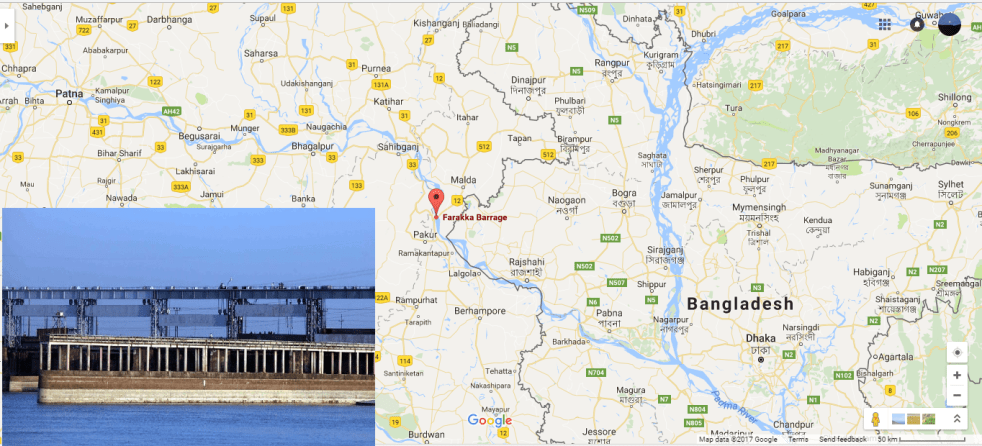
Bihar wants Farakka barrage to be decommissioned The Nitish Kumar govt has held the Farakka barrage in West Bengal responsible for heavy floods in Bihar and asked the Centre to decommission it to de-silt the heavily loaded upstream of Ganga River. The state has made the recommendation, observing that the dam is the “genesis of severe” flood consequences and responsible for “alarming” silt increase in the river’s upstream. According to sources, Nitish Kumar dispensation has made the demand before an experts’ committee formed by the Centre to work out guidelines for de-silting Ganga following last year’s devastating floods. 

As per the statement, decommissioning the barrage will help automatically de-silt the heavily loaded upstream, allowing silt to move to deltas before the sea thus helping  in restoration of deltas and its eco-system which is also getting adversely affected due to this barrage. To buttress its point, the state government has referred to Kolkata Port Trust’s data, which suggests that silt dredging at the port has increased from 6.40 million cubic metres annually from pre-Farakka days to four times, i.e. at 21.88 MCM annually, during 2003. The state government has also recommended the panel to come up with ‘National Silt Policy’ to address the problem. Bihar faced one of its worst floods as Ganga swelled in August last year, claiming lives of over 20 persons and affecting 20 lakh people.

Bihar Government has rightly asked for decommissioning of Farakka barrage and held it as the genesis of severe, destructive and prolonged floods that Bihar and other regions upstream from Farakka face year after year. Good to see that Bihar government has officially demanded decommissioning of the Farakka barrage before an expert committee of Ministry of Water Resources. Hope this starts the ball rolling to remove this unnecessary and giant dam on Ganga, which will also help the cause of fisheries (including Hilsa), downstream Bengal and also the river in general. The road cum rail line on the  barrage can continue to exist.

Continue reading “DRP: 20 Feb. 2017 (Bihar Govt Demands Decommissioning of Farakka Dam)”
Dams · DRP News Bulletin

DRP: 13 Feb 2017 (Oroville Dam Disaster, USA: A Wake up Call for India’s aging big Dams)

Finally the Oroville Dam spillway damage has turned into a disaster. Report at this time (01:00pm, Feb. 13, 2017) finds dam level rising about 1 feet above the danger level. Water currents have started pouring out all over and around the emergency spillway which has never been put in use for last half a century. Meanwhile, more water is gushing in the dam reservoirs due to recent heavy rainfall in catchment areas upstream.

Continue reading “DRP: 13 Feb 2017 (Oroville Dam Disaster, USA: A Wake up Call for India’s aging big Dams)”
Dams

Ground Water 2016: India’s water lifeline continues to bleed

Summer of 2016 saw thirteen Indian states grappling with severest drought greatly fueling the ongoing depletion of aquifers. Then the supposedly surplus southwest monsoon also fell short by 3 per cent further stressing the falling groundwater table. At the same time the pollution of surface water sources, which function as recharge point for ground water, went uninterrupted.

All through the year, Central and many State Governments unveiled several new plans and projects targeting the sustainable consumption of groundwater. The judiciary made various orders to reign in illegal extraction of the finite resource. However, the situation continued to deteriorate.

Continue reading “Ground Water 2016: India’s water lifeline continues to bleed”

Dams · Yamuna River

Yamuna Jiye Abhiyan: A Decade in the Service of River Yamuna

At least since 1994, ever increasing pollution of River Yamuna had ballooned into a national concern, with Supreme Court of India taking up the case of Mailee Yamuna. The authorities lacked a holistic view of a river system. Essential issues like unhindered flow and intact floodplain were seldom discussed and debated. Thus, cleaning of pollution through infrastructure and technologies had become the central theme of saving Yamuna River. As a result, the cleaning efforts got no success and Yamuna River health kept worsening.

Amid this scenario, a group of Delhi citizens in 2006 woke up to impact of a 10 days shopping event to be organized on annual basis in the floodplain of Yamuna River at Delhi- Noida, Uttar Pradesh border. The event faced criticism and was resultantly called off.

But the incident just proved a tip of iceberg for the concerned group who after sometimes came across a list of permanent and commercial structures, being proposed within ecologically valuable and sensitive floodplains of River Yamuna in Delhi as a part of Common Wealth Games 2010.

The prevailing ignorance towards importance of floodplains of River Yamuna in Delhi and blatant encroachment of it, led to formalization of the group into Yamuna Jiye Abhiyan (YJA) on 07 February 2007.

Continue reading “Yamuna Jiye Abhiyan: A Decade in the Service of River Yamuna”

Dams · DRP News Bulletin

DRP: 6 Feb 2017 (MSPCB Directs Reduction in Water Supply to Polluting Industries)

Maharashtra SPCB cuts 40% water supply to Taloja industries After the pollution board identified that chemical effluents from common effluent treatment plant (CETP) at Taloja were polluting the Kasadi river, the Maharashtra Pollution Control Board (MPCB) have directed to Maharashtra Industrial Development Corporation (MIDC) to cut 40 per cent of the water supply to industrial plants from February 1.

According to the letter issued to the industrial plants, earlier they were receiving 24-hour water supply but after MPCB’s directive, the plants would not receive water from 12am to 8am, effective from February 1.

Last year fishermen from the local Koli community had complained of decline in 90 per cent of fish catch from Kasadi river due to pollution. They had also alleged of inaction by authorities despite several complaints.

To highlight their plight, the fishermen then collected water samples in August 2016 from the Taloja CETP pipeline areas discharging treated waste and samples from the banks of the Kasadi river, and submitted them for a water quality test at Navi Mumbai Municipal Corporation’s (NMMC) environmental laboratory.

The samples were found failing several crucial parameters and having high levels of chloride , which is toxic to aquatic life and impacts vegetation and wildlife. Several reports had also mentioned that the pumping of industrial waste into the river had raised pollution levels 13 times higher than the safe limit. 

Taking cognizance of the complaints, MPCB issued a notice to MIDC highlighting the pollution problem on Jan. 31 2017 and informing the MIDC that until the Taloja industrial area does not start online pollution monitoring, adequate water supply would not be provided to them. The plants have two months to comply or else further action would be taken.

Continue reading “DRP: 6 Feb 2017 (MSPCB Directs Reduction in Water Supply to Polluting Industries)”
Dams · Wetlands

Wetlands Review 2016: Legal Interventions

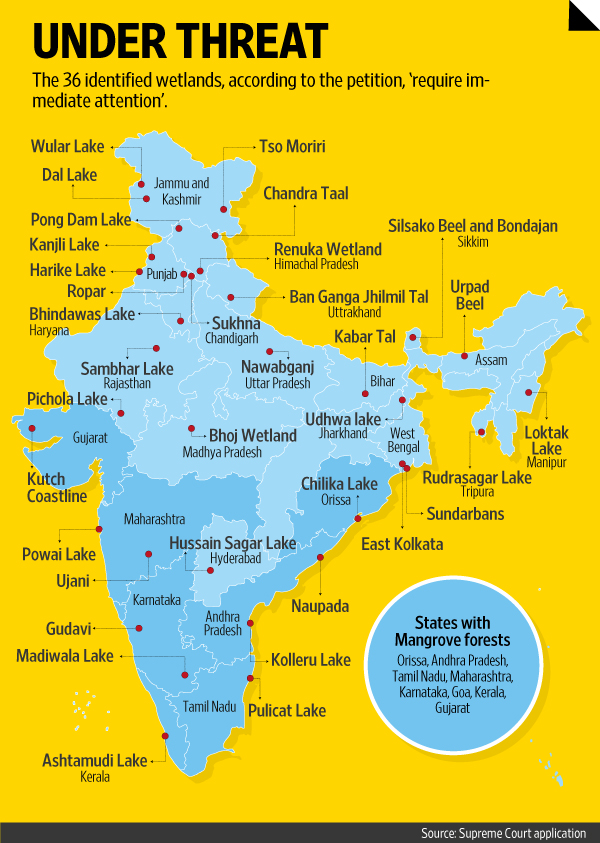
Featured image showing  36 Wetlands in India requiring urgent attention as per a 2014 petition filed in apex court (Image Source: Live Mint

In the third part of Wetlands Review 2016, SANDRP presents an account of major decisions taken by respective Courts for the protection of Wetlands in India. 

In a significant development in April 2016, the National Green Tribunal (NGT) directed all State Governments to submit a complete list of Wetlands[1] under their jurisdiction. The green court was hearing a plea alleging commercial conversion and resultant destruction of several large ecologically important Wetland areas across the country in absence identification and notification by respective State Governments. 

The court also asked the Ministry of Environment, Forest and Climate Change (MoEF&CC) to submit the list of States that had approached it with Wetlands conservation plans.

Continue reading “Wetlands Review 2016: Legal Interventions”

Dams · Wetlands

Wetlands Review 2016: Government Actions

India is one of the 169 signatories to the Ramsar Convention on Wetlands, signed in Ramsar, Iran, in 1971, an intergovernmental treaty that provides the framework for national action and international cooperation for the conservation and wise use of Wetlands and their resources. There are 2,241 Ramsar sites across the world, including 26 spread across India from Wular Lake in Jammu and Kashmir to Ashtamudi Wetland in Kerala, and from Deepor Beel in Assam to Nal Sarovar in Gujarat.

Despite their vital importance to humans, across India, Wetlands are seriously threatened by reclamation and degradation through processes of drainage, land filling, discharge of domestic and industrial effluents, disposal of solid waste, and over-exploitation of the natural resources that they offer.

Here is an account of major decisions and actions by Central as well as State Governments on wetlands related issues in 2016.

Continue reading “Wetlands Review 2016: Government Actions”

Dams · Wetlands

India’s Wetlands 2016: Encroached and Polluted

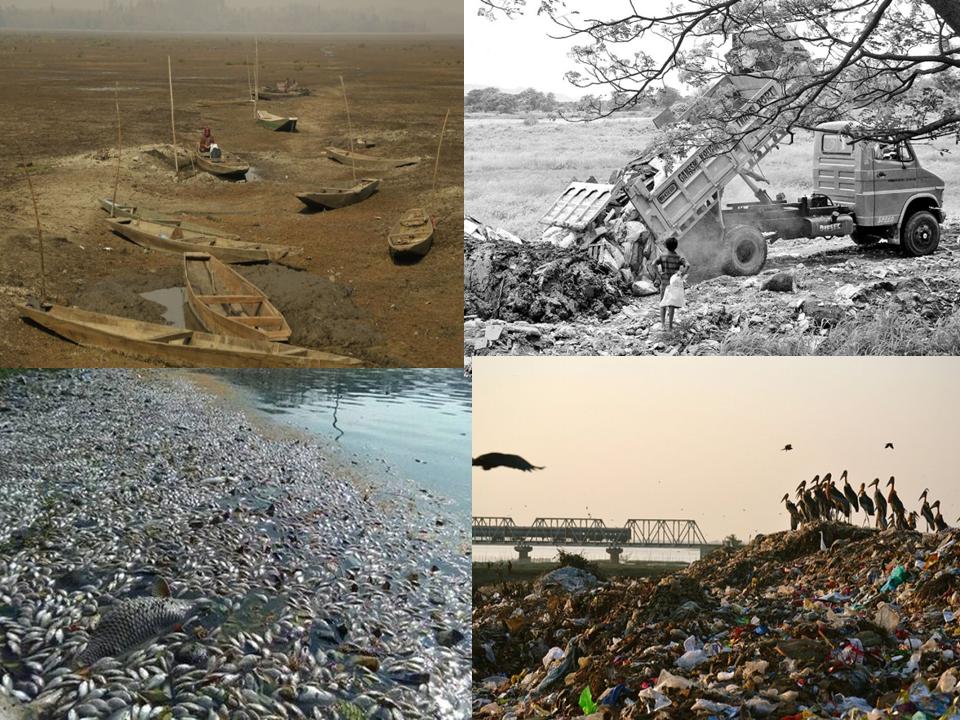
In the picture-Drying Wular lake in  J&K; Mass dish death due to pollution in Ulsoor Lake, Karnataka; Filling up of Wetlands in Maharashtra and Waste dumping on  Deepor Beel in Assam

Wetlands are vital for human survival. They are among the world’s most productive eco systems[1]. Wetlands are crucial for the survival of variety of plants and animals. They are indispensable for the countless services ranging from freshwater supply, food, sustainable livelihood options and groundwater recharge. They also host a huge variety of life, protect our coastlines, provide natural sponges against river flooding and store carbon to regulate climate change.

Here is an account on status of India’s wetland in 2016 underlining their ecological importance and urgent need of conservation of Wetlands across the country. 

Continue reading “India’s Wetlands 2016: Encroached and Polluted”

Dams · Wetlands

WORLD WETLANDS DAY 2017: Man made Disaster for Wetlands that protect us from Disasters

The World Wetlands Day, celebrated around the world on 2nd February each year, marks the adoption of Ramsar Convention on Wetlands in Iran in 1972. The Convention came into force in India since 1982. The theme for this year’s World Wetlands Day is “Wetlands for Disaster Risk Reduction.”[i]

During floods, wetlands can act as natural sponges and absorb intense runoff and discharge, holding more water than most soil types.[ii] This role of wetlands has been demonstrated most powerfully in India in the past few years. Chennai deluge in Nov-Dec 2015 highlighted what happens when wetlands in a city reduce by 2/3rds in just 20 years. Similarly, Kashmir valley lost 50% of its riverine wetlands in just over 30 years, which was one of the main reasons behind the extensive losses during the Sept 2014 Jhelum floods, as corroborated by Dr Asam Rahmani of Bombay Natural History Society (BNHS)[iii]. In 40 years, Bangalore has lost 79% of its wetlands, similar is the case with Mumbai, Hyderabad, Kolkata and New Delhi. Bhopal, a city of relatively sloping profile, faced floods twice in 2016, and wetlands, including the rivers in the city are facing existential risks in terms of encroachments[iv].

Continue reading “WORLD WETLANDS DAY 2017: Man made Disaster for Wetlands that protect us from Disasters”

Dams · DRP News Bulletin

DRP: 30 Jan 2017 (After 31 years, SC transfers Ganga case to NGT without achieving clean river)

SC transfers PIL on cleaning Ganga to NGT In a major development, after monitoring Ganga cleaning work for last 31 years and without achieving any cleaner river,  the Supreme Court on January 24, 2017 wrapped up a PIL on cleaning of river Ganga and sent it to the National Green Tribunal (NGT) for more effective adjudication. The apex court had been monitoring the issue for 31 years. A bench of Chief Justice J S Khehar and Justice N V Ramana said that since issues relating to municipal solid waste and industrial waste were already being heard by the NGT on a day-to-day basis, all other issues relating to sources of polluting the river should also be heard by the NGT.

The bench said that the tribunal will be required to submit an interim report to it every six months, only to give an idea about the progress made and difficulties, if any. It also granted liberty to the petitioner, environmentalist M C Mehta, to approach the court if he had any grievances in consonance with the law.

During last week hearing (January 17, 2017), the SC bench has directed the government to file a report on the construction and functioning of STPs alongside the river, which runs through five States.

It has been almost two years after the SC has voiced scepticism about the government’s self-proclaimed promise to clean up the Ganga River. Before this, in 2014, the apex court had voiced its reservations about the various efforts over the decades to return the Ganga to its pristine self, once even saying that it “does not expect Ganga to be cleaned up even after 200 years.”

Continue reading “DRP: 30 Jan 2017 (After 31 years, SC transfers Ganga case to NGT without achieving clean river)”