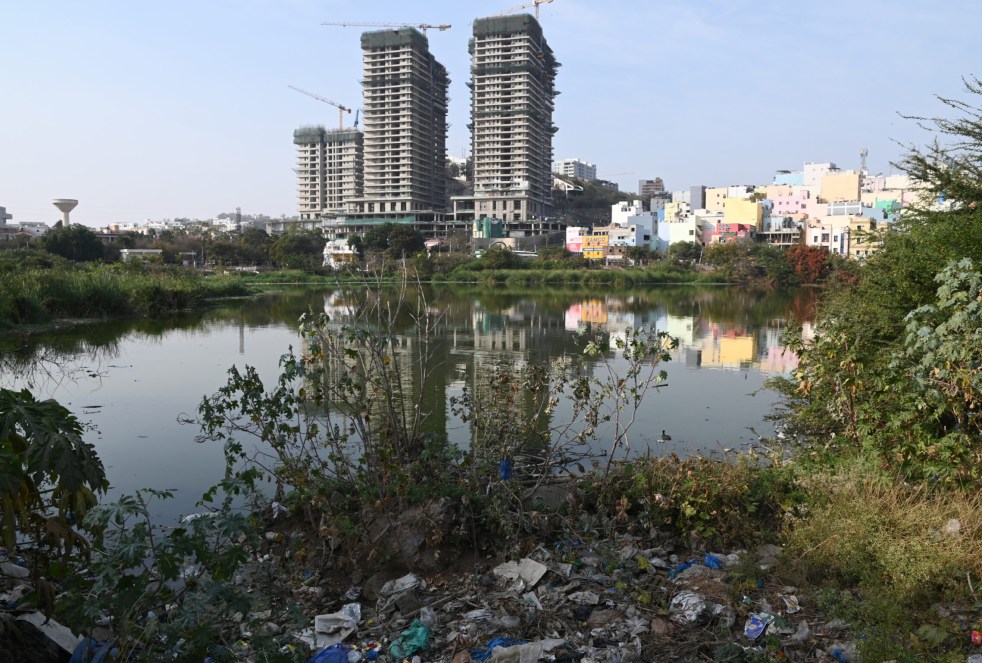
(Feature Image: Lakes in Hyderabad are infested with heavy growth of hyacinth and algae, reflecting the terrible condition of the water bodies. Surya Sridhar/Telangana Today)
The historic network of lakes in Hyderabad city has been under stress from increasing pollution and encroachment for past many years. In response, the govt in July 2024 formed Hyderabad Disaster Response and Asset Protection Agency (HYDRAA) to protect lakes, nalas and public assets from encroachments and address urban flooding problems. Since then, the agency is actively involved in lakebed reclamation, demolition of illegal structures, desilting, flood-management interventions and selected lake rejuvenation projects. So far, it has attracted both support for removing encroachments from several lakes and criticism for lacking holistic approach and sustainable outcome.
Despite visible physical interventions in some cases, the HYDRAA initiative has failed to stop the sewage inflows, remove all encroachments, reclaim their hydrological channels and faced challenges in inter-agency coordination. Similarly, even after one year of undertaking revival of six lakes namely Bum‑Rukn‑ud‑Daula Lake, Thammidikunta Lake, Sunnam Cheruvu, Nalla Cheruvu, Pedda Cheruvu and Bathukamma Kunta on priority basis, their restoration remains incomplete. Through top ten reports from last one year this overview tries to capture the present status of Hyderabad lakes. It also covers some lake specific cases highlighting their plight, restoration efforts & governance challenges affecting the future of city lakes.
1 STPs fail to stop lake pollution Crores of public money have been spent on sewage treatment plants (STPs) across Hyderabad to revive its fast-degrading lakes. Yet the latest pollution data shows the strategy has failed to halt the decline, with untreated and partially treated sewage continuing to flow into several waterbodies, raising questions about how STPs are planned, designed, operated and monitored.
Data released by the Telangana Pollution Control Board (TGPCB) shows lake water quality across the Hyderabad Metropolitan Area remains critically poor. Of the 185 lakes, at least 23 have dried up completely, while dissolved oxygen (DO) levels in 25 lakes have fallen below 1 mg/l. Key indicators such as DO, BOD and heavy metal concentrations point to persistent sewage inflows despite the presence of STPs. In Mir Alam Tank, Kotha Cheruvu in Alwal, Pedda Cheruvu in Khajaguda, Kamuni Cheruvu and Banjara Cheruvu, oxygen levels have dropped far below acceptable limits.
Even Hussainsagar and Durgam Cheruvu, often projected as showcase urban lakes, record DO levels of just 1.1 to 2.7 mg/l. Recent lake rejuvenation projects linked to nearby STPs have also failed to yield improvements. Bathukamma Kunta in Amberpet, restored by HYDRAA in Oct 2025, recorded DO level of 0.6 mg/l in Sep 2025, which fell further to 0.3 mg/l in Oct 2025.
Environmentalists say the issue lies not in the number of STPs, but in the flawed model behind them. Donthi Narasimha Reddy, environmentalist said that sewage management continues to be treated as an afterthought in urban planning. Narasimha Reddy pointed out that many STPs are designed without factoring in future population growth and rising sewage generation.
Operational constraints further limit STP effectiveness. “Lake protection cannot be done by one agency in isolation. Sewage diversion, stormwater management and enforcement involve multiple departments. If agencies work in silos the system will fail,” environmentalist Madhulika Choudhary said. She also criticised capacity planning.
Maintenance failures worsen these structural flaws. In several areas, pipelines feeding STPs are clogged with plastic waste, construction debris and sludge, preventing sewage from reaching treatment plants. HYDRAA officials acknowledge that STPs alone cannot revive lakes unless sewage diversion works are end-to-end. “Even where diversion channels exist, they are often ineffective. In many locations, untreated sewage still flows into lakes. In some cases, STPs themselves are not functioning optimally,” a senior HYDRAA official said.
The agency has also flagged instances where sewage diverted from one lake is discharged into another, merely shifting pollution. “Diversion alone is not a solution. STPs must be established where required and, more importantly, must function consistently. The infrastructure exists in many places; the issue is ensuring it works as intended,” he said, acknowledging DO readings as low as 0.3 mg/l in some restored lakes. (Jan. 2026)
2 Hyacinth eats away lakes Hyderabad’s lakes are increasingly being swallowed by thick mats of water hyacinth, turning once-open waters into green, stagnant stretches that breed mosquitoes and pose serious health risks to residents. Despite residents notifying Greater Hyderabad Municipal Corporation (GHMC), the body appears largely inactive in clearing the hyacinth and controlling the mosquito menace.
Lakes in many parts of the city, including Kamuni Cheruvu in Moosapet, Fox Sagar Lake in Kompally, Neknampur Lake near Manikonda among others are heavily covered in hyacinth. The weed has spread across large surface areas of the lake, stalling water flow and creating perfect conditions for mosquitoes to breed. Manikanta, a resident of Raghavendra Colony near Kamuni Cheruvu, said “Almost 50-60 per cent of the lake is now covered with the weeds. Every evening the mosquitoes swarm over the lake, and it genuinely gets scary to live here. We have complained to GHMC many times, but nothing seems to change.”
Residents near Neknampur lake also described a similar plight. “Both the Neknampur lake and Ibrahim lake are breeding grounds for mosquitoes. Both are covered in deep hyacinth, which is blocking the lake’s flow, causing the water to become stagnant. The smell is also unpleasant”, said Srikanth Yadav, a local resident. “Whenever we complained, officials used to come and spray disinfectants into the lake. But nothing is being done to remove the hyacinth, which is causing all of this problem. No one from the authorities has explained why nothing is being done about that,” he said.
The problem is not restricted to smaller lakes. Durgam Cheruvu, located in the heart of the city & a favourite spot for visitors & onlookers, has seen more than half of its surface swallowed by hyacinth. Despite repeated public complaints, GHMC has remained largely silent on the crisis. Although there have been initiatives to clear hyacinth using floating trash collectors and drones before, citizens and local residents said that none of these are being implemented on ground. GHMC officials have not responded to calls about the issue. (Jan 2026)
Lakes cry for attention Several city lakes, which once thrived with life, have become a dire reflection of official apathy, poor maintenance and pollution. Some such lakes – Rangadhamuni near IDPL, Malkam Cheruvu and Film Nagar lake in the city – are infested with heavy growth of hyacinth and algae. Such growth decreases the dissolved oxygen in the water bodies thereby affecting aquatic life. Making things worse, a large amount of plastic waste – bags and bottles – littered around the banks further pollute the lakes. (Feb. 2025)
3 Environmentalists slam ‘institutional silence’ Experts noted that both Asanikunta and Sunnam Cheruvu, major lakes in the city, have been classified as Grade E, the worst possible water quality, since Jan 2025. Yet, no public alert was issued. Activists said the six-month delay in disclosure endangered public health and ecological balance. Grade E signifies water unfit for drinking, bathing, irrigation or industrial use, essentially biologically dead. “This isn’t just pollution, it’s institutional silence,” said Lubna Sarwath, lake conservationist. “Communities around these lakes were exposed to health and ecological risks without any warning.”
As pressure mounts, environmentalists and civil society groups are now urging the Telangana High Court to take suo motu cognisance of the issue. Their demands include real-time water quality data for all lakes, a complete forensic audit of Hyderabad’s urban lakes and public advisories when water quality falls to C, D or E grade.
With more lakes reportedly showing signs of degradation, they call for a city-wide lake health review, involving an independent monitoring system. “This city is losing its lakes; not just to pollution, but to secrecy,” said an environmentalist. “If we don’t treat this as an emergency, there will be nothing left to protect.” (July 2025)
4 Revival of stepwells, Bowlis Three decades ago, the combined percolation capacity of lakes and open porous land areas with soil that allows water to seep through easily was around 60%, while concretised spaces accounted for only 40%, shared Prof TV Ramachandra from the Indian Institute of Science, Bengaluru. “With urbanisation accelerating, the concretised area now exceeds 75%, leaving less than 25% of land available for percolation,” he said. According to National Remote Sensing Centre (NRSC) data, between 1979 and 2024, Hyderabad lost 61% of its lake area, with nearly 40 of its 185 notified lakes drying up completely. These include Ibrahim Cheruvu, RK Puram, and Gurram Cheruvu.
B Malav, an urban planner said that many cities are also exploring the ‘sponge city’ model, which focuses on absorbing, storing, and reusing rainwater. Other features of sponge cities include bioswales and urban wetlands — landscaped drainage channels that filter stormwater. Another key solution lies in restoring the city’s historic water-holding structures, such as stepwells and Bowlis. “In ancient times, people dug stepwells and Bowlis,” said Kalpana Ramesh, a conservationist leading effort to revive Hyderabad’s stepwells.
Hyderabad is home to over 6,000 Bowlis & over 100 stepwells. About 20 have been restored, many others are in various stages of revival. “Bansilal Stepwell, which was recently restored, can hold 22 lakh litres of water. A 900-year-old stepwell near Shamshabad remains fully functional, with a storage capacity of 30-35 lakh litres,” Kalpana said, adding, “Other revived stepwells include those in Kokapet (15 lakh litres), Kondapur (9 lakh litres), HPS, and ITC Kakatiya, both of which can store over 10 lakh litres each.” (Mar 2025)
5 Dying lakes turn cooler spots into heat islands It’s set to be a particularly sweltering summer for residents of Jubilee Hills, Kapra, and the Hayathnagar–Saroornagar belt with the three emerging as the hottest pockets of Hyderabad. And while the temperatures reflect a broader climate crisis, experts attribute the heat pattern in these neighbourhoods to their “unique geography, urban planning flaws, and ecological neglect”.
In the case of Kapra, located in the city’s north-east, it’s the disappearing water bodies. Home to one of the highest concentrations of lakes in the region— including the Kapra Lake, Banda Cheruvu, RK Puram Lake, Safilguda Lake, and several smaller tanks — it’s now all dry land. “These lakes were natural heat moderators,” said Manognya Reddy, from the Kapra Revival group that has worked extensively on preserving the water body in the Kapra region. “They absorbed heat, maintained humidity, and cooled down the surrounding air. But most of them are now either polluted, encroached, or have disappeared entirely.” She added that Kapra Lake currently holds only 20% of its earlier water capacity. (April 2025)
6 When a lake becomes real estate Misunderstood, misinterpreted and misguided governance and management of urban lakes in India—illustrated here through Hyderabad -demands urgent attention from Urban Local Bodies (ULBs), the political establishment, the judiciary, the builder – developer lobby, and most importantly, the citizens of Hyderabad. Fundamental misconceptions about urban lakes have shaped policies and practices that systematically misuse, abuse & finally erase them – often in the name of urban development.
Between 2000 and 2020, the city’s water bodies reportedly shrank from 12,535 ha to 2,280 ha. As of 2025, the Hyderabad Metropolitan Development Authority records 2,959 lakes in the metropolitan area and 27 within the city limits. The HYDRAA states that over 61 % of the city’s lakes are already encroached upon, warning that without immediate corrective measures, the remaining 39 % could disappear within 15 years. The underlying stark reality: a lake lost is treated as land gained. This transactional logic defines contemporary lake governance.
The question is not merely what action must be taken, but what actions must be reversed or discontinued. Any rushed interventions—particularly demolition or redevelopment drives carried out without ecological clarity—risk accelerating the extinction. The city must work to preserve both its “green” & its “blue,” ensuring that lake restoration does not become another form of lake transformation.
The erosion of Hyderabad’s lakes is therefore not merely a technical failure but a governance failure rooted in misunderstanding. Unless lakes are restored to their ecological identity—rather than repackaged as recreational real estate—the city risks losing both its environmental resilience and its historical wisdom. (Dr Mansee Bal Bhargava)
7 HYDRAA: Saviour or disruptor of lakes? The HYDRAA, has emerged as both saviour and disruptor, reclaiming encroached lakes even as its methods draw scrutiny. So far, HYDRAA forces have entered 39 lake beds, cleared 233 acres in the full tank level, and earned both praise and criticism for its uncompromising approach. People as well as Opposition parties have labelled it a ‘demolition squad’.
Skepticism grew when HYDRAA Commissioner A.V. Ranganath announced that the agency would go beyond demolition and take up the development of six lakes it had cleared, transforming them into urban retreats. Citizens and activists doubted the promise.
Since the formation of the Lake Protection Committee in 2010 under the Hyderabad Metropolitan Development Authority, lake rejuvenation efforts have largely failed. At the beginning of 2024, about 3000 water bodies were awaiting final notification of their boundaries. A project in 2018 under Urban Mission Kakatiya to restore 20 lakes proved to be a dud.
Another initiative led by then Municipal Administration and Urban Development Minister KT Rama Rao involving private realty firms in lake development under corporate social responsibility, failed amid resistance from owners of patta lands within lake limits. (Nov 2025)
8 Avoid buying properties built on encroached nala: HYDRAA The Commissioner of HYDRAA, A V Ranganath, on June 16, 2025 urged people planning to invest in apartments or independent houses to first verify whether the structure is built on encroached nala land. Interacting with petitioners during HYDRAA Prajavani, Ranganath said, “It is important to be cautious while purchasing property. Properties built on encroached nala can lead to legal and environmental issues. These properties may face demolition orders from the govt, resulting in financial loss for the owners.” At Prajavani, the authorities received 47 petitions, the majority of them related to encroachments on nalas and old layouts, HYDRAA PR said. (Jun 2025)
9 HYDRAA starts work to restore 6 city lakes HYDRAA initiated a rejuvenation project to restore six lakes – Bum-Rukn-ud-Daula (Shivrampally, Old City), Thammidi Kunta (Madhapur), Sunnam Cheruvu (Guttala Begumpet, Madhapur), Nalla Cheruvu (Kukatpally), and Nalla/Pedda Cheruvu (Uppal). “The restoration is being funded by Hyderabad Metropolitan Development Authority,” HYDRAA commissioner A V Ranganath said.
He said that the first step in the rejuvenation process involves dewatering and desilting, with excavation work already underway. “HYDRAA aims to complete the revival of all six lakes by June 2025. Detailed project reports (DPRs) have been prepared, and tenders would soon be issued to expedite the work,” he added. A 3D development model has also been prepared for Nalla Cheruvu in Uppal, showcasing the lake’s transformation after restoration. (Feb. 2025)
Race to restore lakes ahead of kite festival Ahead of Sankranti, HYDRAA Commissioner A V Ranganath has directed officials to ensure lakes are fully restored and ready to host kite festival celebrations from Jan. 13-15, 2026. As the state govt plans to extend festivities to HYDRAA-restored lakes this year, the commissioner inspected works at Thammidikunta Lake in Madhapur and Nalla Cheruvu in Kukatpally on Dec. 24, 2025.
He instructed officials to prevent untreated sewage from entering lakes and ensure that only treated water flows in through STPs, while maintaining clean and green surroundings around STPs. Several lakes once plagued by sewage, foul odour and encroachments are now being turned into public celebration spaces. With restoration still underway at some lakes, he directed officials to sprinkle water to control dust, establish immediate STP connections to ensure inflow of treated water, and develop proper inlets and stormwater channels. (Dec 2025)
10 Kancha Gachibowli; April 2025 SC stops tree felling Expressing shock at the large-scale felling of trees in hundreds of acres of land in the Kancha Gachibowli area in Hyderabad, the Supreme Court on Apr 3, ordered to stop all sorts of developmental activities carried out there. The PIL argued that the government was proceeding in blatant disregard of two Supreme Court judgments where all states were directed to form committees for identification of forest and forest-like areas as per the dictionary meaning of forest. It was further their case that the land was being auctioned to set up an IT park, yet no environmental assessment was conducted. The Court further warned that in case its directions are not complied with in letter and spirit, the Chief Secretary of State would be personally held responsible.
The MoEF sought a ‘factual’ and an ‘action taken’ report on the “illegal” felling and “removal” of vegetation in 400 acres of Kancha Gachibowli by the Telangana Industrial Infrastructure Corp (TGIIC), on April 3, 2025. ASG of Forests S. Sundar stated that there have been various reports in the print and social media alleging damage to wildlife found in the said land, its lakes and unique rock formation.
The Telangana govt announced the constitution of a ministerial committee to resolve the long-pending Kancha Gachibowli land dispute. After days of protests by students and environmentalists, the Telangana govt was looking to scrap its original plan to auction 400 acres of land at Kancha Gachibowli. Instead, the entire 2,000 acres, including the University of Hyderabad (UoH) campus, will now be turned into what the govt calls, “one of the world’s largest eco parks”. The govt’s decision to mortgage 400 acres of prime Kancha Gachibowli land to raise Rs 9,995 cr loan has sparked fresh concerns over the staggering financial burden it imposes on the public exchequer.
The CEC on April 10, 2025 began inspection at Kancha Gachibowli following allegations that the authorities resorted to tree cutting in violation of environmental norms. The state govt on April 10 categorically told the CEC that the 400 acres of land adjacent to the University of Hyderabad at Kancha Gachibowli belonged to it and the development works were taken up recently as per existing laws.
The CEC came to the conclusion that the entire 2374 acres which the Telangana govt wanted to take over for industrialisation prima facie “appears to have all characteristics of a forest.” In its 60-page interim report, submitted in response to a suo motu case taken up by the Supreme Court, the CEC stated that the clearing of the forest was done in “unexplained haste” and caused “irreversible damage” to a landscape rich in flora, fauna, and unique rock formations.
While posting the matter for the next hearing on May 15, the SC bench orally said, “In the meantime, not a single tree will be felled there.” It asked the Telangana government to explain the “compelling urgency” for clearing the large tree cover and stayed any future activity till further orders. On May 15, the apex court gave the state govt a choice between restoring the ruined acres of Kancha Gachibowli forest (KGF) where trees were felled for an IT infrastructure project during an extended weekend or face the prospect of its Chief Secretary and “half a dozen officials” being sent to a “temporary prison” near the bulldozed green cover.
Crisis of urban planning Hyderabad’s conflict is now part of a larger national pattern—one where citizens are reclaiming the right to shape sustainable, humane urban futures. In a time of climate emergency and civic disconnection, the Kancha Gachibowli resistance reminds us that progress must be rooted in care, conscience, and community. The fight is not just to save a forest but to reimagine the city itself—as a shared space where nature and people coexist. (Amal Chandra) As per an Ecological Heritage report KGF prepared by a researcher Arun Vasireddy, the KGF is home to 233 bird species, while KBR National Park’s diversity has 150, and much lesser for Mrugavani National Park and others around Hyderabad. Preserving KGF ensures the well-being of the lake and hillock ecosystem that Hyderabad thrives upon.
Lake Specific Reports
Durgam Cheruvu; June 2025: Hydraa’s official visit Hydraa Commissioner A V Ranganath on Jun 9, 2025 visited the lake in Madhapur. He invited key departments, including the HMWS&SB, GHMC and Irrigation, to formulate a comprehensive action plan to mitigats the threat of inundation from Durgam Cheruvu to nearby colonies. He emphasised the need to widen the lake’s flood canal to accommodate heavy inflows. The senior officials noted trucks illegally dumping mud towards the Inorbit Mall. He instructed officials to track such vehicles and take measures to divert floodwater released from Durgam Cheruvu to Malkam Cheruvu.
Dec. 2025: HYDRAA removes 5 acres of encroachments Acting on a Prajavani complaint, HYDRAA commissioner ordered a field inquiry, after which officials confirmed the encroachments on the Inorbit Mall side of the lake. The land was filled with soil and converted into a parking space, allegedly generating rental income of up to Rs 50 lakh per month. HYDRAA officials cleared the area on Dec 30, 2025, evacuated vehicles, and erected fencing. Steps are being taken to remove the dumped soil. “We are assessing the lake’s original boundaries using NRSC data, Survey of India maps, and revenue records. Further action will be taken to clear remaining encroachments within the lake limits,” Ranganath added.
Once spread over about 160 acres, Durgam Cheruvu has shrunk to about 116 acres due to decades of encroachments. Satellite images from NRSC show that the lake has been encroached from 3 sides, with only the north side remaining relatively free of illegal structures.
Jan. 2026 ‘Can’t allow surplus sewage’ Nearly half of Durgam Cheruvu is covered in water hyacinth, a clear indicator of nutrient overload caused by untreated sewage entering the lake, officials found during an inspection by HYDRAA on Jan. 20, 2026.
The inspection was carried out by HYDRAA commissioner following media reports and complaints from local residents over a persistent foul smell from the lake in Madhapur. The team found that untreated sewage was discharged directly into the lake through a stormwater drain, despite the presence of STPs.
When irrigation officials cited excess sewage inflow beyond STP capacity as the reason for diverting wastewater into the drain, the commissioner objected, stating that surplus sewage must be routed through sewer lines and not allowed to enter water bodies directly. Ranganath also added that rejuvenation cannot be limited to cosmetic beautification.
Ranganath said poor coordination and lack of accountability among the GHMC, HMWSSB, Irrigation department and private agencies operating the STPs were responsible for the lake’s deterioration. He expressed displeasure that all surrounding sewage lines had not been connected to the STP network and directed officials to send treated water samples to the Pollution Control Board for testing.
Feb. 2026: A glittering view, a gasping lake The gem-like appearance of Durgam Cheruvu hides a sinister, calculated assault. As evening lights and rooftop views sell the lake as a tourist spot, a multi-agency process seems to be killing it softly. One civic body lowers the water level to free up land, another lays a 10-metre-wide walking track on the exposed lake bed and yet another releases organically loaded effluents that fuel decay. Once a source of drinking water and part of Golconda Fort’s hydrological system, the lake is now trapped in a bureaucratic tic-tac-toe, writes Serish Nanisetti.
Bathukamma Kunta lake; July 2025 HC refuses to grant relief in land dispute The High Court on Jul 8, 2025 refused to grant any interim relief to a petitioner who claimed that land in his possession is now submerged and located inside the recently restored Bathukamma Kunta lake in Bagh Amberpet area. While the petitioner contended that the disputed land was a low-lying area that was dug up further and subsequently collected rainwater to form a lake, the court looked at recent photographs of the lake restored by the HYDRAA to refuse interim relief. The core of the argument is that if the land was never legally acquired, the govt has no right to alter its classification or ownership status in official records or planning documents.
Lake filling up after years of drought and doubt Bathukamma Kunta, which has had a water body merely in the name for past two decades, now shows an actual ‘Kunta’, which in Telugu means pond. The HYDRAA on Jul 8, 2025 shared pictures of the water body, with ongoing embankment works taken up by the agency.
HYDRAA chief A. V. Ranganath said the lake rejuvenation works are expected to be completed by Sep 2025. Works at Bathukamma Kunta started around Feb 2025. Towards the last week of April 2025, the city civil court ruled in favour of HYDRAA, after which the works gathered pace. Constructed on all four sides and devoid of vegetation, the water body, despite all the efforts by the agency, looks more like an artificial pool of the sort created in a resort as of now.
According to the maps displayed on the website of the HMDA, Bathukamma Kunta was first surveyed in 2013, when its full tank level (FTL) perimeter was determined as about 1.4 kms. No water spread was mentioned, nor the FTL in acres, but the area surveyed by the consultant was over 14 acres. Historical satellite images since 2010 show that the lake never had water, with all inlets and outlets closed on all sides. It remained dry even during the 2020 floods when several lakes overflowed. The survey of India maps, however, vouch for the existence of a water body there.
Feb. 2025: Bathukamma resurfaces On Feb. 18, 2025 after digging through the thick layers of soil, Bathukamma Kunta Lake began to emerge, reigniting hope for the revival of the once-vital water body. “If all the soil that has been filled over the years is removed, the pond will be filled with water once again,” Hyderabad residents stated. However, the situation surrounding the ownership of the land remains contentious. Local leader Edla Sudhakar Reddy had previously approached the Telangana High Court, claiming the Bathukamma Kunta land as his own, but was advised to take the matter to a lower court.
Bathukamma Kunta often referred to as Gangamma, located in Bagh Amberpet, Hyderabad was officially recorded in Survey No 563 of Amberpet Mandal during the 1962-63 census. The lake originally covered 16.13 acres, including the buffer zone. However, due to encroachments and ongoing land disputes, only 5.15 acres remain today.
Bam Rukn-ud-Daula Lake; Oct 2025: Revival underway HYDRAA is restoring the historic Bam Rukn-ud-Daula lake in the Old City. Works are expected to be completed by the end of Nov 2025. HYDRAA Commissioner said encroachments were cleared in Aug 2024.
Once spread over 18 acres, the lake had shrunk to 4.12 acres due to illegal occupation. HYDRAA has now restored it to its original size and strengthened flood control and groundwater recharge systems. Inlets and outlets have been redesigned to ensure natural rainwater flow, while bunds, walking tracks, fencing and green zones are being developed.
Still, the restoration story has its downside. Of the original 17.5 acres of Bam Rukn-ud-Dowlah, HYDRAA has so far managed to recover only 11-13 acres. The rest remains occupied by residential buildings, apartment complexes and a mosque, apart from a large sewerage line laid by the HMWSSB that still cuts through the lake area. HYDRAA’s latest additions include a walking track laid inside the FTL area and a few isolated pockets earmarked for amenities such as parks and recreation zones. The lake’s capacity is said to have increased from 8 million litres to 108 million litres post restoration.
Restoration nearing completion The restoration and rejuvenation of the Bum Rukn-ud-Dowla Lake, once a primary drinking water source for the Nizams, is nearing completion and is expected to be inaugurated by the end of Nov or in early Dec. This is the first lake restoration project undertaken by HYDRAA, which began by clearing encroachments and launching large-scale cleanup and beautification efforts.
Spread across 18.575 acres within its FTL area, with a water spread of 8.915 acres, the Bum Rukn-ud-Dowla Lake dates back to the 18th century. On August 10, 2024, HYDRAA launched a demolition drive, clearing illegal constructions within the FTL and buffer zone.
Nalla Cheruvu; Nov. 2025 Area reduced? Nalla Cheruvu in Kukatpally was among the 20 lakes taken up for beautification in 2018. Except a walking track lined with greenery, little was done to improve its hydrology. In Sept. 2024, barely two months after its formation, HYDRAA razed 16 temporary structures and walls from within the lake, reclaiming 12 acres of encroached land. A HYDRAA worker recalls carting away nearly 9,000 truckloads of silt, at the rate of 300 trucks a day. Some of the dredged material has been used to build an inner walking track and fortify the island.
Historical satellite images show that the previous walking track encroached into the lake’s FTL, and the latest one has further reduced its perimeter. The bund separating the sedimentation tank and the island fortification also limit natural water spread. Environmentalists warn that during heavy rain, sedimentation tanks may prove ineffective as overflowing water could still carry silt and sewage right into the lake. Ranganath defends the walking tracks, terming them ‘peripheral bunds’ designed to contain flooding in surrounding colonies during heavy rain.
Sunnam Cheruvu; June. 2025 Contaminated water poses health risks Water tanker suppliers are found to be providing contaminated water from Sunnam Cheruvu in Madhapur, posing health risks to consumers. Based on the water samples analysis report released by the TGPCB, the Hydraa on June 27, 2025 revealed that “these suppliers are drilling borewells illegally near Sunnam Cheruvu and supplying contaminated water, jeopardizing public health.” The stench near Sunnam Cheruvu is unbearable, yet the water is being supplied as drinking water to educational institutions, hostels, and hotels in the vicinity, posing a threat to lives.
Asanikunta Lake; July 2025 Pollution off the charts Asanikunta Lake isn’t just polluted; it’s clinically dead, say experts. Situated on the outskirts of Hyderabad, the lake has remained in the worst water quality category – Class E – for three months (Jan – March 2025). Meanwhile, experts have raised serious concerns over the level of contamination and warned the general public against using its water for any purpose.
Asanikunta was once a seasonal recharge lake vital for agriculture and groundwater. The degradation, activists say, is the result of systemic neglect. Asanikunta is among several sites under study for contamination. Similar findings of heavy metals like chromium, lead and nickel have been reported in Maheshwaram, Chevella, LB Nagar, Moula Ali and Gundlapochampally.
Banjara Lake; April 2025 Neglect fuels mosquito menace Banjara Lake in Hyderabad’s Banjara Hills has fallen into neglect following the closure of the Taj Banjara Hotel. The hotel was shut down on Feb. 21, 2025 due to unpaid property taxes. Since then, no agency has taken over the upkeep of the lake.
Banjara Lake was part of a Rs 4.3 crore conservation project under the National Lake Conservation Plan between 2002 and 2009. An 800-mm RCC ring drain was constructed to divert sewage from entering the lake. During the time of united Andhra Pradesh, the ministry of environment and forests noted that the Andhra Pradesh Tourism Development Corp, in collaboration with Taj GVK, had prepared a conservation plan for the Banjara lake.
Gopi Lake; Feb. 2025 HMDA rezone plan sparks row The HMDA move to convert parts of Gopi Cheruvu Lake, a notified water body, its full tank limits and its buffer zone, into a residential zone, has drawn sharp criticism. Activists say that the move is illegal and is in contempt of Supreme Court orders. Activist Lubna Sarwath flagged a government memo, issued by the HMDA on Jan. 10, 2025 inviting objections or suggestions regarding the proposal of re-designating parts of Gopi Cheruvu in Serilingamapally (Village & Mandal), Ranga Reddy District, and its buffer zone into a residential use zone.
Neknampur Lake; Jan. 2025 HYDRAA razes villas in FTL The HYDRAA on Jan 10, 2025 demolished illegal under-construction villas in the Neknampur area of Manikonda, Rangareddy district. This comes following the complaints of illegal structures occupying the FTL in Neknampur Lake. 13 villas were found to be constructed in violation of regulations, with each villa comprising one ground floor and two upper floors, covering an area of 400 sq m.
Masab Cheruvu; Jul 2025 HYDRAA inspects drains HYDRAA commissioner inspected the 7.5 km nala connecting Masab Cheruvu, Dilawar Khan lake and Pedda Amberpet lake on Jul 9, 2025 & proposed in its place a model drainage system. The nala lacks proper width & structural strength. It will be redesigned to hold stormwater & prevent flooding in nearby areas.
During the inspection, locals complained that the drainage systems from Masab Cheruvu and Dilavarkhan Cheruvu were not functioning properly, leading to the flooding of several colonies during the monsoon. These constructions were halted after rainwater flooded the basement areas. He asked officials to propose a plan to widen the nalas to avoid future waterlogging. The commissioner also inspected tank embankments at the Raviryala lake, where upstream houses are at risk of being submerged.
Kothakunta Lake; March 2025 ‘Remove silt in 4 days’ HYDRAA commissioner ordered Vamsiram Developers to remove the soil and silt dumped into Kothakunta at Khajaguda within 4 days. He threatened strict action if the developers failed to comply. He was inspecting the site after receiving complaints of unauthorised constructions within the full tank level.
After the order, Vamsiram Developers assured officials that the dumped soil would be removed. The commissioner also instructed officials to conduct a joint inspection to demarcate the lake’s FTL boundary. Later, Ranganath reviewed ongoing lake restoration projects at Madhapur’s Tammidikunta and Borabanda’s Sunnam Cheruvu. He directed the authorities to look for ways to enhance greenery and beautification around the lakes. He ordered officials to ensure that all works are completed before the monsoon season without any delays.
Suram Lake; Feb 2025 HYDRAA saves 15 acres from encroachment The sleuths of HYDRAA demolished boundary walls constructed by encroachers at Suram (Suroni) Cheruvu in Tukkuguda municipality of Rangareddy district on Feb. 8, 2025. Encroachers moved into the lake spread across 60 acres, and occupied 15 acres. They built boundary walls in the encroached land, out of which layouts were made to be sold. Drainage pipelines were also laid by the encroachers. On complaints from locals on encroachment, HYDRAA commissioner inspected the lake, spoke with the residents, after which demolition was ordered.
Komati Kunta Lake; Feb 2025 Prakruti Resorts demolished for FTL violations Taking cognisance of the complaints of construction within Komati kunta’s FTL areas by Prakruti Resorts and Prakruti Convention (PRPC) centre, HYDRAA demolished its structures in Devaryamjal village, Thumkunta municipality of Medchal-Malkajgiri district on Feb 13, 2025. Prior to demolishing the structures, HYDRAA conducted a full investigation with irrigation, revenue & municipality officials. PRPC did not have the necessary approvals.
PRPC representatives approached the Telangana HC regarding the HYDRAA notices. Based on reports submitted by irrigation, revenue and municipality officials, the HC ruled that the structures built within the lake’s FTL limits must be demolished. The representatives then requested the HC to grant them 30 days to remove the structures themselves. When the structures remained after 30 days, HYDRAA on Feb 13, 2025 and carried out the demolition.
Gachibowli; May 2025 Demolition at Sandhya Conventions The HYDRAA on May 6, 2025 conducted demolitions at Sandhya Conventions at Gachibowli after receiving complaints during the HYDRAA Prajavani program. HYDRAA stated that interlopers have encroached upon lands and plots of the Fertilizer Corp of India Employees Cooperative Housing Society’s layouts, and have undertaken illegal constructions on the property.
Malkam Cheruvu; HYDRAA visits after flood HYDRAA Commissioner visited Malkam cheruvu in Gachibowli on Aug 8, 2025 to assess the causes of recent flooding. Officials explained that the problem arose due to a large inflow into the lake and insufficient outflow. They mentioned that currently, water is only being drained through an overflow channel, and installing sluice gates would help manage water levels during the rains.
Mella Cheruvu; Jan 2026 HYDRAA clears encroachments HYDRAA officials removed encroachments on Mellacheruvu in Tellapur municipality & erected fencing to protect the lake from future encroachments. Following complaints from citizens, HYDRAA Commissioner visited the water body & directed Raju Yadav, who had lands close to the lake, to vacate the land. However, he did not obey the orders, prompting officials to act. The HYDRAA officials, under full police security, demarcated the boundaries of the lake and erected the fencing.
SANDRP

 SANDRP