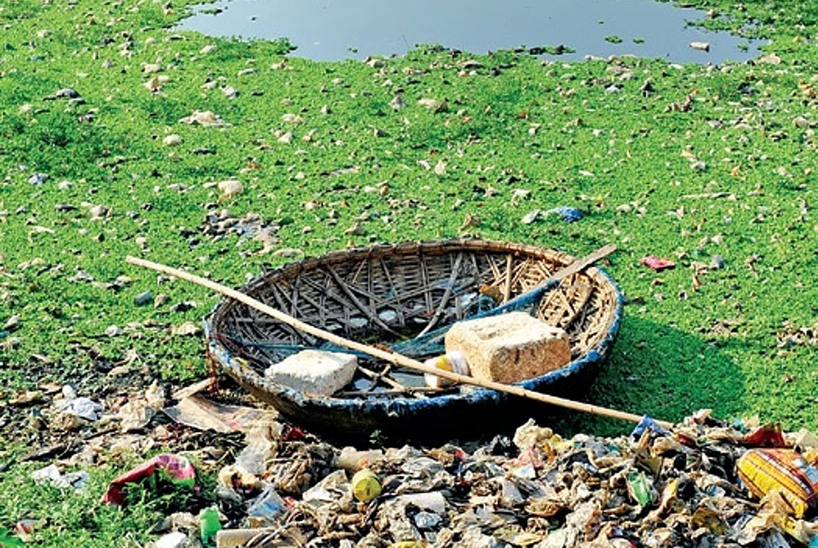
(Feature Image: Garbage and untreated sewage have reduced Ulsoor Lake, a major water body in Bengaluru, to a sewage pond. Source)
Bengaluru’s lakes, once central to the city’s water security and flood control have been under stress due to rapid urbanization, rising pollution and weak governance. The year 2025 has seen no major change in the scenario. This overview presents top ten reports from the yearlong developments affecting the water bodies including proposed amendments which could reduce lake buffer zones, prevalent encroachments, delay in restoration projects and deteriorating water quality in most of the lakes.
It highlights specific cases where lake’s health has been adversely affected by sewage inflows, industrial pollution, illegal constructions signifying governance failures. While citizen groups and experts continued to advocate holistic approach, coordination among concerned agencies and public participation, the govt seemed prioritizing cosmetic beautification over ecological restoration. In the new year, govt is expected to align its policy decisions and restoration projects with ground realities, else the lakes will keep suffering fragmented governance.
1 Concerns over amendment in KTCDA bill The State Cabinet’s approval of the Karnataka Tank Conservation and Development Authority’s (Amendment) Bill, 2025, in July 2025 left ecologists, limnologists, and lake activists concerned. As per the amendment, the buffer zone will now be down to 3 metres from the boundary of a lake measuring up to one acre. It will be 6 metres for lakes between one and 10 acres, 12 metres for lakes between 10 and 25 acres, 24 metres for lakes between 25 and 100 acres, and 30 metres for lakes above 100 acres. This implies the 30-metre uniform buffer zone rule around every lake will be replaced with the new rule, redefining the size of buffer zones based on size of the lakes.
Experts say the Bill is unrealistic and is a classic example of an amendment made sitting in ivory towers. They say a scientific approach should be used to arrive at buffer zone areas, considering Bengaluru is going to get a World Bank loan. Experts say the purpose of the lake buffer zones is to safeguard both the surrounding communities and the biodiversity that depends on it, but this scientific and nature-based approach is being overlooked or defied, with potentially severe long-term consequences.
The Federation of Bengaluru Lakes (FBL) has expressed concern over the proposed amendments. While acknowledging the practical challenges of implementing uniform buffer zones, FBL warns against any blanket regularisation that could weaken environmental safeguards. “The government should consult citizen groups, adopt lake-wise assessments, and focus on enforcement, not rollback. This is not the time to legalise past neglect, but to restore trust and ecological balance through transparency and science-based policymaking,” said a spokesperson of FBL, an association of more than 47 citizen lake groups.
The decision alarmed lake protection volunteers. They fear the move could weaken environmental safeguards, legitimise past violations, and allow new encroachments. The FBL criticised, “Buffer zones are not just empty spaces – they are vital for flood control, pollution prevention & preserving lake ecology”. It blamed enforcement failures — not rules – for encroachments.
By proposing to amend the KTCDA, the state has not only undermined Supreme Court & NGT orders but also given in to the very forces that have historically plundered the water bodies.
Following the bill introduction, the Urban Development Department issued a draft notification reducing the buffer zones of storm-water drains. On Oct 8, 2025, the Minor Irrigation Minister NS Boseraju said that most of the 187 lakes in Bengaluru were bigger than 100 acres and would remain unaffected by the new bill. He also said that an explanation regarding the lakes’ buffer zone amendment bill will be submitted to Karnataka Governor Thaawarchand Gehlot shortly after consulting legal experts. A Bengaluru-based organisation had submitted a memorandum to Governor seeking rejection of bill. The group had warned that reducing lake buffer zones to 30 m violates constitutional and environmental safeguards, and urged reconsideration to expand them to 100-300 m.
2 472 acres of lake land encroached According to data, 472 acres of lake land encroachment have been identified by BBMP, and the civic body has so far managed to reclaim only 17.38 acres. Officials from the civic body’s lake wing say that once the survey by the Revenue department on lake land is completed, officials will start a reclamation drive and notices have already been issued to some of the encroachers.
“BBMP has 183 live lakes under its jurisdiction, and following a Supreme Court directions on July 21, 2023 & August 1, 2023, the govt has taken up lake land and rajakaluve survey for protection of water bodies, and is also sending notices and removing encroachments. A senior official said that among the bigger encroachers are government agencies on 288 acres, while 188 acres are encroached by private persons. When the survey and marking is completed in 33 more lakes, more encroachment details are likely to emerge.
BBMP is also awaiting completion of the lake land survey and marking of encroached areas by surveyors from the Revenue department. According to a BBMP source, the Palike legal team is a big letdown as it is unable to get a court stay vacated against removal of encroachments in a number of cases, and the lake wing department is contemplating escalating the matter with the Chief Commissioner for a major overhaul in the BBMP legal dept. “Among the surveys done on 136 lakes, BBMP managed to remove encroachments on 29 water bodies. On 31 lakes, only govt encroachments have been recorded,” said the source.
Disappearing lakes According to Dr. Ramachandra, Bengaluru had 1,452 water bodies and 80 per cent green cover in the 1800s, which helped maintain its cool climate. However, rapid urbanization and encroachment have drastically reduced these numbers. By the 1970s, the city had around 760 lakes, and today, only 216 remain. In the episode he talks about how his research team has studied 193 of these lakes, leading to the development of the Bangalore Lake Information System, which maps the city’s diminishing water bodies.
3 Seven lakes set for revival by Nov. 2025: BBMP Activists have raised concerns about possible oversights that could harm the ecological balance of these water bodies and undermine years of rejuvenation efforts. The lakes approaching completion include Kacharakanahalli Lake, Hulimavu Lake, Doddabidarakallu Lake, Gunjur Mouji Lake, Carmalaram Lake, Hoodi Giddanakere, and Vengaiahnakere (K.R. Puram Lake).
Spanning over 240 acres collectively, these lakes have faced significant delays, some extending across five monsoons. Community groups, which have been advocating for their revival for years, now hope to see the return of nesting birds and revival of fisheries.
Activists pointed out that lake rejuvenation tends to be human-centric, focusing on beautification & recreation rather than ecological purpose. Ironically, even this approach is often inconsistently executed. For example, work on Hulimavu Kere only accelerated after the area experienced severe flooding, attracting public attention and criticism of BBMP.
V. Ramprasad, of Friends of Lakes, emphasised that proper rejuvenation should meet three main objectives: improving groundwater, facilitating rainwater harvesting, and flood mitigation. “Several lakes lack sluice gates and STPs, which hampers these goals and reduces the work of beautification,” he said. He stressed that lakes should only be considered rejuvenated if they are managed under proper Standard Operating Procedures and meet BIS 17663 norms.
In addition to these seven lakes, BBMP is also rejuvenating over 20 more lakes with a budget of ₹50 cr. Another ₹65 cr, allocated under the National Disaster Mitigation Fund (NDMF), will be used to rejuvenate seven additional lakes: Hebbal, Nagawara, Sompura, Chikkabellandur, Arekere, Halsur, and Kalkere lakes.
A trickle of renewal, a long way ahead The restoration of lakes is at a crucial juncture. As the authorities announce plans to rejuvenate more of the nearly 300 lakes in the city, the experience of volunteer groups, individuals who have done the work so far, and the traditional knowledge of local communities will be important. Most critical, as Bengaluru expands, is for the BBMP to stock-take its approvals for construction that threaten lakes and getting its act together on the sewerage disposal system.
4 Lake care plan in limbo The draft BBMP Community Involvement for Lake Conservation Policy, 2024, has been submitted to the court; however, acceptance is pending as the case is pending. The policy is a formal framework designed to enable corporations, citizen groups, NGOs, and other stakeholders to contribute legally to the development and maintenance of lakes in Bengaluru through CSR funding or voluntary efforts, under the BBMP’s custody. It mandates that such contributions align with the BBMP Act, 2020, and the KTCDA Act, 2014.
The policy prohibits the privatisation or commercial control of lakes and outlines clear terms for oversight, accounting, termination for violations, and legal liability. It effectively prohibits any citizen group or private body from accepting CSR funds to rejuvenate lakes and routes all money through the BBMP. Now, with the BBMP transitioning to GBA and the possibility of multiple corporations, the policy will need to change accordingly, leading to further delays.
Governance missing Rapid urbanisation, encroachment, and poor governance have led to the degradation of Bengaluru’s lakes. 85% of the 183 remaining lakes are severely polluted, with rejuvenation efforts not yielding consistent results. Citizen-led efforts have gained traction, but scientific planning, stakeholder collaboration, and stronger governance are essential. Efforts need to consider the lakes’ function, usage, maintenance & socio-economic relevance.
5 Activists call out govt’s apathy Lake activists emphasised on increased public involvement and tighter environmental laws. Joy VR, secretary and co-founder of Sarjapur Resident Welfare Association: “Despite us raising issues related to lakes (encroachments, sewage entering), authorities turn a blind eye, which is one of the biggest obstacles. Currently, no efficient agency protects waterbodies. From MLAs to panchayat members, their focus is on commercially beneficial projects, not conservation. Allowing lakes to die serves long-term vested interests, forging deals with land mafias and builders.”
Ram Prasad, founder of Friends of Lakes: “The govt has to involve existing lake conservation groups in governance rather than selecting participants randomly. Lakes must not be treated in isolation — the Rs 3,000 cr allocated for nala rejuvenation should be linked to improving lake water quality, which is currently ignored while lakes are turned into concrete tanks. The KTCDA has legal power but lacks staffing and capacity. If empowered, it can restore lakes.”
Priyanka Jamwal, water quality scientist, ATREE: “Lake restoration initiatives are hindered by competing interests of multiple govt and non govt agencies. Unscientific alterations, like raising outlet levels for groundwater recharge, disrupt inflow and cause backflow issues. Poorly designed past interventions add to restoration challenges. We rely on impractical US and European water quality standards, lacking localised benchmarks. A coordinated approach is needed with clear, realistic targets as lakes sustain biodiversity, fisheries and groundwater recharge, crucial for Bengaluru city.”
6 Pollution rises post monsoon: Study A new lake health study, covering three major water bodies in Bengaluru -Ulsoor, Doddabommasandra and Shivapura – has revealed dangerous levels of pollution and a clear link between rapid urbanisation and deteriorating water quality. The study – Lake Health Index by Friends of Lake found across all three lakes, pollution levels worsened post-monsoon. The study attributes this to rainfall flushing industrial chemicals, sewage and surface pollutants into the lakes, especially from concretised urban catchments.
The report notes that Bengaluru’s lakes, historically built to harvest rainwater and support agriculture, are now reduced to sewage holding ponds. Encroachment, solid waste dumping, untreated sewage inflow and lack of accountability among agencies have prevented meaningful restoration. The report concludes that lakes surrounded by industrial activity and dense concretised development show the most severe degradation, with most parameters exceeding permissible limits. The study emphasises that lake revival cannot be piecemeal – it must consider the entire ecosystem, biodiversity, water chemistry & land use patterns.
Identify source of lakes pollution: CPCB The CPCB has yet again directed the SPCB to identify the source of pollution in stagnant water bodies in Bengaluru and across the state to improve water quality. CPCB has raised the issue in a letter dated Jan. 6, 2025, after reviewing water quality data of lakes, tanks, and ponds, submitted under the National Water Quality Monitoring (NWMP) program. Notably, the monthly water quality reports of Bengaluru lakes and tanks by the SPCB show that the city’s water bodies are increasingly getting toxic. The number of lakes in the city with the worst water quality (Class E) over the years has only doubled in some months, even during monsoon.
Dying lakes need immediate restoration In a report filed with the NGT on Apr 16, 2025 the CPCB highlighted that over 90% of the water bodies in Karnataka, with the majority located in Bengaluru, are in a state of neglect and fail to meet the standards prescribed by the Board. 172 out of 187 lakes studied have unacceptable water quality. The CPCB filed the report after the NGT took sue motu cognisance of the issue, following an article on Mar 2, 2024.
7 Science of Bengaluru’s Lakes In this first episode of The WELL Labs Show, host Pavan Srinath sits down with Dr. Veena Srinivasan, socio-hydrologist and Executive Director at WELL Labs, to unpack the science behind these Bengaluru’s lakes. They dive into lake hydrology, lake chemistry and biology and explore how urbanisation, sewage bypasses, wetland design, and silt/sludge management changes how lakes function today. Veena also suggests what could be the possible studies that need to be conducted to solve this problem.
8 Bellandur & Varthur Lakes: Jan. 2026 Residents meet BDA chief The residents of Varthur and Bellandur held a detailed meeting with the Bengaluru Development Authority Commissioner, engineer member and other senior officials, and appealed for a review of the rejuvenation Varthur & Bellandur lakes, and address the recurring flooding in E Bengaluru.
Jagadish Reddy from Varthur Nagarikara Hitharakshana Vedike said completion of work on the two lakes has missed multiple deadlines, hence they told BDA officials to hold a meeting with stakeholders. “There are 11 parastatal agencies and there is no coordination between them which has led to the delay, hence we met BDA Commissioner and appealed to him to call a meeting and ensure completion of the rejuvenation in 2026,” said Reddy.
Reddy said the Vedike also brought up the issue of unscientific inlet design allowing sewage-laden storm water, garbage and silt to enter Varthur Lake directly, negating earlier rejuvenation efforts. That apart, growth of water hyacinth, other floating invasive plants, indicating high sewage and nutrient load, incomplete STPs and UGD networks resulting in continuous inflow of untreated sewage into the lake system, reduced rajakaluve widths and encroachments, identified as a primary cause of recurrent flooding, poor SWD connectivity and inadequate maintenance, including siltation and vegetation choking drains, illegal garbage segregation units operating near drains and lakes, and worsening pollution were brought to their notice.
“The vedike demanded a comprehensive white paper involving all stakeholders, disclosure of NGT directions, missed deadlines and revised timelines, scientific redesign of lake inlets with proper pre-treatment systems, time-bound utilisation and public disclosure of the Rs 576 crore earmarked in BBMP’s escrow account as per NGT orders, and a transparent monitoring framework with periodic water quality reporting,” he said.
BWSSB’s pipeline work illegal: Activists Representatives of the Varthur & Bellandur Lakes Rejuvenation Initiative have alleged that Bangalore Water Supply and Sewerage Board is blatantly violating environmental laws. They said the water board is currently executing sewage pipeline works inside Varthur Lake boundary, without mandatory authorisation from the BDA and in clear violation of binding NGT guidelines, which strictly prohibit any construction or permanent infrastructure activity within lake beds and buffer zones.
“Despite repeated objections and explicit directions from local stakeholders to realign the pipeline outside the lake buffer zone, BWSSB has continued its operations within the lake area, causing irreversible ecological disturbance. Such actions directly undermine lake conservation efforts, groundwater recharge, flood mitigation, and biodiversity protection,” the representatives said. Varthur Lake is part of Bengaluru’s interconnected lake system, and any disturbance in one lake has a cascading impact on downstream lakes, rajakaluves, and surrounding residential areas. They said unauthorised work within the lake threatens to worsen urban flooding, pollution, and public health risks.
9 Doddaballapur & Chikkatumakuru Lakes; Jan. 2026 Severely polluted One of the largest lakes in Bengaluru Rural, Doddatumakuru Lake, spread across 326 acres, and the other water body Chikkatumakuru Lake, covering 75 acres, are severely polluted and contaminated. In the absence of a scientific treatment plant, untreated sewage from the entire Doddaballapur town, along with chemical effluents from 52 industries in the Bashettihalli Industrial Area flows into these lakes, from where, polluted water reaches Bengaluru.
The Arkavathy river, born on Nandi hills, flows to Doddaballapur uncontaminated. But at Doddaballapur lake, industrial effluents and sewage of Doddaballapur town flow into it, polluting the water body. The same water flows to Chikkatumakuru lake and then to Doddatumakuru lake, from where it flows through aquifers to Hesaraghatta and Tippagondanahalli, reaching Sangama and Cauvery, then reaching Bengaluru.
The villagers say just ten years ago, the lake water was potable. But as factories mushroomed, they let out industrial residues into these lakes, severely polluting the water body. Also, sewage from Doddaballapur town is diverted into these lakes, while the existing STP, constructed in 2017, is unscientific and not serving its purpose.
Vasanth Kumar PK, a member of the Arkavathy Horata Samithi, says the lake is part of the Arkavathy river system. “We have been protesting for a scientific solution and a full-fledged STP for Doddatumakuru and Chikkatumakuru lakes. More than 12 MLD of toxic effluents are released into these lakes, contaminating several villages and putting thousands of lives at risk,” he says.
10 Hosakerehalli Lake: Feb. 2025 NGT’s eviction notice on lake SWD Residents of two multi-storey buildings and 63 houses are facing eviction after the NGT ordered authorities to issue notices for the removal of encroachers from the buffer zone of a stormwater drain (SWD) that connects to Hosakerehalli Lake. The tribunal’s order followed a report by K Jagadeesh, Deputy Commissioner of Bengaluru Urban district, which detailed encroachments on the SWD’s buffer zone. Based on a spot inspection by the Bangalore South taluk tahsildar, the buffer zone requires a 15-meter clearance and is classified as a tertiary drain.
The Deputy Commissioner further informed that the multi-storey buildings were also owned by the Karnataka Slum Development Board. He requested at least two months to identify an alternative site for relocating the residents of these slums. The bench directed authorities to begin the preliminary eviction process. The tribunal scheduled a further hearing on April 16.
The NGT is hearing an application from the Neighbourhood Watch Committee, which has raised concerns about the conservation of Hosakerehalli Lake. The encroachment of drains in the area has led to multiple instances of flooding, causing significant damage and loss. Although eviction drives have been conducted in the past to clear sheds, the construction of multi-storey buildings has continued.
Other Relevant Reports
Madiwala Lake: Feb. 2025 Lake cleaned up The Indian Ploggers Army, an environmental conservation organisation, conducted a lake cleaning drive at Madiwala Lake on Feb. 16, 2025, collecting over 20 bags of trash. The Indian Ploggers Army will next be cleaning Chunchaghatta Lake this weekend.
March 2025 Remains neglected Ever since Palike took over, lake not cleaned; officials await approval. In Nov. 2023, the Karnataka Forest Department (KFD) handed over Madiwala Lake to BBMP. More than a year has passed, yet the Palike has struggled to address the lake’s deteriorating condition. The water body remains in a state of neglect, almost entirely covered in water hyacinth, while facilities for walkers have been left unattended for months.
April 2025: De-weeding operation throws up refrigerator A Jaldost team, operating under the banner of National Aerospace Laboratories (NAL), stumbled upon the unexpected ‘catch’ while clearing overgrown water weeds. Among the other items retrieved were heaps of plastic bags, milk packets, mugs, books, pens & even steel vessels, turning the lake into what locals call a ‘miniature junkyard’. Residents said that the waste disposal is BBMP responsibility.
Hadosiddapura Lake; Feb. 2025 Scene set for land grab The residents and lake activists of Kodathi and Halanayakanahalli have been running pillar to post to prevent what they believe will turn out to be a land grab at Hadosiddapura Lake premises. The lake spreads to 36 acres and 30 guntas in Hadosiddapura village limits and two acres and 14 guntas in Kodathi village limits. Citizens fear that the land mafia have an eye on about three acres of this prime land. Lake activists have complained that a portion of the lake land has become vulnerable to encroachment as it is not fenced off. They said that some volunteers have developed a Miyawaki forest in between the lake land and the water body. It was suspicious activity that caught the attention of these citizens.
Mullur Lake; Feb. 2025 Untreated sewage discharge The entry of untreated sewage into Mullur Lake has sparked health concerns among residents. Located along the 100 Feet Road connecting Sarjapur Road with Gunjur-Doddakannelli Road, the lake, once considered a hidden jewel, was rediscovered after the road’s construction two years ago. However, rapid development in the area has led to sewage inflows, reportedly from buildings lacking STPs. The situation is equally dire at Dorekere Lake near Kumaraswamy Layout, where sewage inflow and garbage dumping have led to eutrophication and poor maintenance.
Shanky Tank; June 2025 BBMP’s gabion wall proposal sparks outrage Residents & experts expressed concerns that this could threaten the last remaining mudbank in the lake, a vital ecological zone that supports bird species such as cormorants, herons and moorhens.
Jakkur Lake; July 2025 10-acre pond to treat waste water The BBMP developed a 10-acre ‘constructed wetland’ (waste stabilisation pond) near the Jakkur lake in Byatrayanpura to treat waste water before it enters the main water body. As per officials, the site will treat about 7 MLD waste water. “The 163-acre lake, including the wetland, was in the BDA’s custody. In 2015, the lake was transferred to the BBMP. However, 30 acres of lake area were encroached and coconut palms were planted. The 30 acres were later reclaimed and fenced. As there was no wetland near the lake, a 10- acre artificial wetland was created and six months ago, work to remove the slush and deepen the wetland was taken up.
Saul Kere; Dec. 2025 From biodiversity haven to construction zone Saul Kere lake faces threats from sewage inflow and illegal construction. Unless all illegal works halted, Saul Kere may soon lose its wetland character. What was once a sanctuary for birds and biodiversity could become yet another example of how Bengaluru’s lakes are being engineered to death.
Harohalli Lake; Jan. 2026 Fishes found dead Around a dozen fish were found dead at Harohalli Lake in Yelahanka on Jan. 17, 2026 morning, raising concern among walkers and environmental activists, though officials attributed the incident to seasonal factors. The residents urged authorities to conduct an immediate inspection, suspecting low dissolved oxygen levels or possible sewage pollution. V Selvarajan, chairman of Green Circle, said the situation was disturbing. “What is shocking is that two spot-billed pelicans were also found dead,” he said, adding that while low oxygen could be a reason, repeated incidents made him suspect that sewage from nearby residential areas gets mixed with lake water.
Yelahanka Puttenahalli Lake; Feb. 2026 SPCB flags 6-month timeline to divert sewage About six months are required to complete the works diverting sewage flowing into the Yelahanka Puttenahalli Lake from its northwestern neighbourhoods, a report by the Karnataka State Pollution Control Board (KSPCB) has said, recommending temporary measures to avoid pollution. The lake made headlines in 2024 when sewage from several upstream areas was brought in by a storm water drain ending at its boundary. The Yelahanka Puttenahalli Lake and Bird Conservation Trust approached the NGT. The sewage from the area will be processed in a six-mld sewage treatment plant downstream of the lake. About 85 per cent of the civil work is complete and the rest is expected to be finished in another four to five months, the report said.
Govt Actions WB approves $426 million loan The World Bank on June 23, 2025 approved a $426 million (Rs 3,700 cr) loan for the ‘Karnataka Water Security and Resilience Programme’ to help revive the city’s 183 lakes. These lakes act as natural sponges during heavy rainfall. The programme will construct 9 STPs to prevent sewage from entering lakes and drains. The treated wastewater will be reused for industrial purposes, as well as for recharging groundwater in the greater Bengaluru area. Over 100,000 households will get sewerage connections for the first time. The loan from the International Bank of Reconstruction and Development (IBRD) has a maturity of 20 years with a grace period of 5 yrs.
BBMP plans 47 flood-mitigation works A total of Rs 75 cr has been earmarked for BBMP’s Lake department. Funds have been allocated for the development of eight lakes: Chikkabegur (Rs 10 cr), Hebbal (Rs 20 cr), Nagawara (Rs 20 cr), Chikkabellandur (Rs 10 cr), Kalkere (Rs 2.5 cr), Arekere (Rs 2.5 cr), Ulsoor (Rs 4 cr), and Sompura (Rs 6 cr). Some of the works will include the construction of wetlands, sluice gates, and de-silting. This is the largest grant the lake department has received in a long time.
Treated water to fill 30 lakes Buoyed by the success of filling up 14 parched lakes with tertiary treated water from its STPs to tide over the summer water crisis of 2024, BWSSB says it will now fill up over 30 lakes across the city by drawing treated water from nearby apartment complexes. The water authority’s plans come even as apartment complexes have been complaining that the ambitious plan announced last year to facilitate diversion of treated water to industries hasn’t made any headway. The utility, however, said it would lay dedicated pipelines from these apartments to nearby lakes. According to Prasath Manohar, BWSSB chairman, most apartments are reusing up to 50% of their treated water for non-potable purposes while releasing the rest into stormwater drains as they have no storage space.
SANDRP

 SANDRP
One thought on “Bengaluru Lakes 2025: Buffer Zone Amended, Pollution Rising”