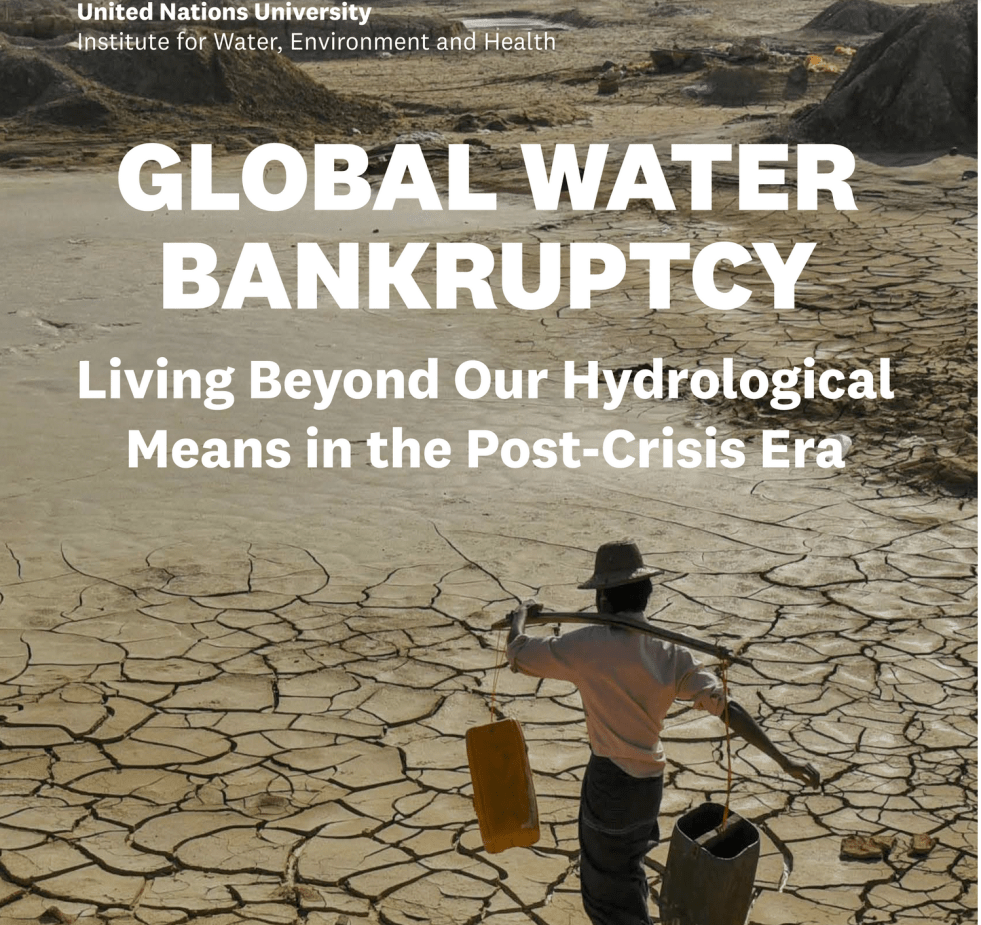
The new report released by United Nations University last week describing the global water situation in climate change context as water bankruptcy may seem like a bit of exaggeration for many places. In any case, it is not possible to describe the water situation across the globe in a couple of words.
But the report once again provides a wake-up call, considering the stark figures given by the report and considering the varied and rapidly increasing incidents of manifestations of the water crisis in different parts of India as we can see in this week’s DRP. This includes the increasing incidents of Indore like situation, depleting groundwater levels, destruction of lakes and wetlands, increasing pollution of all kinds of water sources, dry winter for Himalayan regions till last week, among others. Even if there is more snowfall in the second half of winter, the benefits of such late snowfall are far fewer than those of early and more regular snowfalls as described by the Indian Express editorial quoted below. Incidentally, not all of the instances of water crisis mentioned here are entirely due to climate change, most of them are in fact entirely or mostly due to our other activities.
The key message from this report, as mentioned by the editorial is: “Even then, initiatives on prudent use play second fiddle to supply-side measures. The UN report makes a case for transparent water accounting, protection of aquifers, and enforceable limits on extraction, along with ensuring equity in water distribution.” One can only hope that the turnaround will happen sooner rather than latter.
CLIMATE CRISIS
The world has entered a new era of ‘water bankruptcy’? The global situation is so severe that terms like “water crisis” or “water stressed” fail to capture its magnitude, according to the report published on Jan 20 by the United Nations University and based on a study in the journal Water Resources.
The statistics in the report are stark: more than 50% of the planet’s large lakes have lost water since 1990, 70% of major aquifers are in long-term decline, an area of wetlands almost the size of the European Union has been erased over the past 50 years, and glaciers have shrunk 30% since 1970. Even in places where water systems are less strained, pollution is reducing the amount available for drinking.
“Many regions are living beyond their hydrological means” and it’s impossible now to return to conditions that used to exist, Kaveh Madani, director of the UN University’s Institute for Water, Environment and Health, and the report’s author said. It brings human consequences: nearly 4 billion people face water scarcity for at least one month every year. He referred to cities like Los Angeles, Las Vegas and Tehran, where expansion and development have been encouraged, despite limited water supplies.
The US Southwest is another a hotspot, according to the report. Madani pointed to the Colorado River, where water sharing agreements are based on an environmental situation that no longer exists. Drought has shrunk the river, but it’s not a temporary crisis, he said, “it’s a permanent new condition, and we have less water than before.”
EDIT: Water Bankruptcy calls for water accounting Climate-induced precipitation vagaries are, in fact, one of the major features of the current winter in the Himalaya. Uttarakhand, Himachal Pradesh and Jammu and Kashmir are facing a snow drought. Meteorologists have ascribed the dry season to the weakening of the western disturbances. The latter part of the season may well be less dry. But the benefits of snowfall in late January or early February are likely to be far fewer. Late snow melts quickly, preventing soils from deriving the maximum benefit of its moisture-replenishing quality. Early snow, in contrast, melts slowly, providing a steady supply of water to rivers.
Global Warming induced water scarcity hot spots identified ABSTRACT: Anthropogenic global warming is projected to disrupt the hydrological cycle, leading to water scarcity. This paper estimates the Time of First Emergence (ToFE) of drought-driven water scarcity events, referred to as “Day Zero Drought” (DZD), which arises from hydrological compound extremes, including prolonged rainfall deficits, reduced river flow, and increasing water consumption. Many regions, including major reservoirs, may face high risk of DZD by the 2020s and 2030s. Despite model and scenario uncertainties, consistent DZD hotspots emerge across the Mediterranean, southern Africa, and parts of North America. Urban populations are particularly vulnerable at the 1.5 °C warming level. The length of time between successive DZD events is shorter than the duration of DZD, limiting recovery periods and exacerbating water scarcity risks. More proactive water strategies are urgently needed to avoid severe societal impacts of DZD. (By Vecchia P. Ravinandrasana & Christian L. E. Franzke, Sept 23 2025)
2026 the ‘Year of Water’ 2026 will be an important year for freshwater and ocean ecosystems, culminating in Dec’s UN Water Conference. At the World Economic Forum’s Annual Meeting in Davos a blue thread will connect a host of events and announcements, highlighting the vital role of water ecosystems — from ocean to freshwater — in global stability, trade, livelihoods, food systems, & climate resilience.
Himachal’s Gaddis: The story tellers of the Ravi Basin This fascinating photo essay with text by Prineeta Dandekar of SANDRP and photos by independent photo journalist Abhay Kanvinde illustrates the trials and tribulations that the Gaddis (shepherds) of Ravi Basin in Himachal Pradesh are going through due to various reasons including mega infrastructure projects including hydro projects, climate change, among other reasons. They can be such a rich source of environmental and other information & wisdom, but there is no place for that in any official or other media, nor are they considered a stake holders. Their numbers and viability of their livelihoods are declining rapidly.
HYDROPOWER PROJECTS
CEA Report Released Roadmap to 100 GW PSP by 2035–36 Union Power Minister Shri Manohar Lal, on Jan 23 2026, second day of Chintan Shiver on India’s Power Sector, released the CEA report titled “Roadmap to 100 GW of Hydro Pumped Storage Projects (PSPs) by 2035–36,” which outlines India’s plan to increase in non-fossil fuel capacity to 500 GW by 2030 and 701 GW by 2035. The report projects storage requirements of 62 GW by 2029–30 and 161 GW by 2034–35, with long-duration storage becoming critical beyond 2030, leading to a target of commissioning 100 GW of PSPs by 2035–36.
DAMS
Expert Panel flags construction issues at Polavaram Project An independent panel of foreign experts and Central Water Commission (CWC) engineers monitoring the progress of Polavaram major irrigation project on Godavari River in Andhra Pradesh, have raised a series of concerns in the construction of earth-cum-rock-fill (ECRF) dam, the most crucial component of the entire project. The panel of experts raised technical red flags concerning the alignment between the CWC observations and the ECRF dam design proposed by consultant AFRY. “This scrutiny focuses on ensuring the structural integrity of the dam, which is tasked with withstanding extreme flood pressure, as was witnessed in August 2020,” the official said.
The experts expressed directed concern over “bleeding issues” observed in the wall, prompting a call for stringent remedial implementation. They also instructed contractor – Megha Engineering & Infrastructures Limited (MEIL) and the state irrigation department to present comprehensive data from sample ECRF sections, as they flagged a deficiency in compaction methodology. The CWC authorities asked the authorities to ensure that the core, filter, shell, and foundation of the ECRF dam are fully protected against internal erosion and piping, even if there are extremely heavy floods. “This step will ensure that internal erosion cannot emerge as a potential failure mechanism for the dam,” the panel said in its report.
Experts have recommended a fresh derivation of the diaphragm wall’s top elevation using rigorous seepage and piping. If required, the thickness of the clay cap above the wall must be increased. “This will prevent under-seepage of water and sinkholes or blowouts at the core–foundation,” the report said. The experts panel also called for a stringent seismic analysis study, followed by rechecking dam stability and deformations under Maximum Credible Earthquake (MCE) conditions. “This will confirm that the dam can safely withstand strong earthquakes without relying on non-conservative or insufficiently explained assumptions,” the panel said.
Polavaram: 4-day technical review by panel of foreign experts A foreign Panel of Experts (POE) will inspect Polavaram Project construction works from Jan 19 to 22 2026 as part of a technical review. The team will assess progress, examine critical components, and provide advisory inputs to ensure quality, safety, and timely execution during the four-day visit. The POE includes international dam safety experts Sean Hinchberger, David B Paul, and Gian Franco Di Cicco, accompanied by senior officials from the Central Water Commission, CSMRS, CWPRS, and the Polavaram Project Authority, Special chief secretary (water resources) G Sai Prasad, advisor M Venkateswara Rao, and representatives of Megha Engineering and Infrastructures.
The team will cover Gap-1, D-Hill, Gap-2, G-Hill, upstream and downstream portions of the main dam, the D-Wall, dewatering channel, rock fill areas, and clay stockyards. They will review sand reach, construction materials, and ECRF dam plans, along with spill channel and approach channel works.
1. Veeraballi Closed Loop Pumped Storage Project (1800 MW) in 489.91 ha at Village Vangimalla, Sub-District Veeraballe, District Annamayya, Andhra Pradesh from Annamayya Pumped Storage Project Pvt Ltd- Environmental Clearance: Deferred as PP absent.
2. Assam/PSP-02 Closed-Loop Pumped Storage Project (1000 MW) in 259.6 Ha at Village Baithalangso and Sardangang, Sub Dist Donka, Dist West Karbi Anglong, Assam by Assam Power Distribution Company Ltd – Terms of References: a site visit be undertaken by a sub-group of the Committee to physically assess the ecological character of the area and verify forest dependencies before considering the proposal for grant of TOR
3. Assam/PSP-01 Off-Stream Closed Loop Pumped Storage Project (900 MW) in 308.79 Ha at Village Tharakhunji, Sub Dist Baithalangso, Dist West Karbi Anglong, Assam by Assam Power Distribution Company Ltd- Amendment in Terms of References: APPROVED
4. Ratle Hydro-electric Project (850 MW) in 567.22 Ha at Village Drabshala, Sub Dist and Dist Kishtwar and Doda, Jammu and Kashmir by Ratle Hydroelectric Power Corp Ltd – Validity Extension of EC: APPROVED
5. Balimela Open Loop Pumped Storage Project (2 x 250 MW) in 248.03 Ha at Village Khilaguda, Tarapur, etc., Sub Dist Chitrakonda and Orkel, Dist Malkangiri, Odisha by Odisha Hydro Power Corp Ltd – Terms of References: APPROVED
6. Varikapudisela Lift Irrigation Scheme (CCA: 34,196Ha) in 249.13 Ha at Village Adigoppula, Atmakuru, Darivemula, etc., Sub Dist Veldurthi, Durgi, Macherla, Pullalacheruvu etc, Dist Prakasam, Palnadu and Nagarkurnool, Telangana by Water Resource Department, Andhra Pradesh– Terms of References: APPROVED
7. Rajupalem Close loop Pumped Storage Project (800 MW) in 334.8 Ha at Village Musalreddipalle, Reddicherla, etc, Sub Dist Kalasapadu, Komarolu and Porumamilla, Dist Y.S.R. & Prakasam, AP by APGENCO NHPC Green Energy Ltd – Terms of Reference: APPROVED
8. Demwe Lower Hydroelectric Project (1750 MW) in 1589.97 Ha at Sub Dist Tezu HQ, Hayuliang ADC and Wakro Circle, Dist Anjaw and Lohit, Arunachal Pradesh by Greenko Demwe Power Ltd- Validity Extension of EC: APPROVED
DAM SAFETY
TEG set up for Srisailam dam plunge pool repair The Ministry of Jal Shakti has constituted a Technical Expert Group (TEG) comprising experts from CWC, CSMRS, CWPRS, GSI and the Project Authorities to provide technical guidance and advice on remedial measures for the rehabilitation of the plunge pool of the Srisailam project.
As the rehabilitation work would be interdisciplinary, the ministry, through a letter on Jan. 20, informed AP and Telangana about the constitution of an expert group. The work also includes the preparation of a comprehensive report with designs, drawings, and an implementation plan, and providing continuous technical advisory support during execution. Representatives from Telangana and the Krishna River Management Board will also be included in the TEG.
It may be recalled that officials of the National Dam Safety Authority (NDSA) visited the dam site on April 29, 2025 and inspected the plunge pool, after Telangana Irrigation officials raised serious concerns about the safety of the project. Subsequently, the engineer-in-chief (Irrigation) of Andhra Pradesh expressed willingness for constitution of an expert group by the CWC for providing technical support for implementing long-term rehabilitation measures for the plunge pool.
Last June, a detailed scientific study commissioned by the AP irrigation department and conducted by Visakhapatnam-based Sea Lion Offshore Diving Ptv. Ltd., found that the damages were not just limited to erosion resulting in the plunge pool formation but was also extending towards the dam, and even caused serious damages to the apron structure attached to the dam.
The Andhra Pradesh govt is laying a road downstream of the river at a cost of ₹25 cr to enable experts to reach the plunge pool area of the Srisailam dam and to the cylinders. The experts are set to make a study and recommend a plan for their repair and replacement to ensure the dam’s safety. The state govt recently called for tenders for developing road connectivity and a Hyderabad based firm has been selected to take up the works. The govt is verifying the bank guarantee submitted by the firm.
After this, an agreement would be signed with it to take up the works with a timeline of six months. The firm has been given six months to lay the road but it might be completed in 2-3 months. Similarly, cylinders at the dam were also found to be in a damaged condition. These were erected 30 years ago. A technical study would lead to the preparation of the DPR with a cost estimate before the work is taken up.
‘Withholding of funds may cripple TB dam crest gate works’ Dam expert Kannaiah Naidu on Jans 22 warned that the installation of new crest gates at the Tungabhadra (TB) Dam could be delayed or even suspended due to the Karnataka govt’s failure to release funds. The installation of all 33 crest gates at the dam is currently underway. Naidu, who inspected the work two days ago, said the Karnataka govt had initially sanctioned Rs 10 cr as the first instalment but later withdrew the amount. He pointed out that the Andhra Pradesh govt has already transferred its share of Rs 35 cr to the Karnataka treasury. Expressing shock over the lack of cooperation from the Karnataka govt, Naidu said contractors had raised serious concerns about fund shortages.
GROUNDWATER
Illegal extraction in Kondhwa: NGT seeks response from Pune collector The NGT Western Bench on Jan. 21 directed the Pune district collector and authorities with groundwater regulation to submit responses in a case alleging unauthorised extraction of groundwater by a Kondhwa-based private water supplier. The tribunal gave the instruction on an application filed by Ganesh Salunke of Pune, who raised concerns over large-scale groundwater depletion in Kondhwa Budruk due to alleged illegal commercial water supply operations. Salunke also sought criminal action against the tanker operators involved.
The plea claimed that the respondents own at least five water tankers and, along with other private parties, are extracting around three lakh litres of groundwater every day. This has resulted in significant depletion of groundwater levels, adversely affecting residents and posing a serious environmental risk. Futher hearing on Feb 16, 2026.
MP: Amrit Sarovar failed to recharge GW A follow-up visit to Gunga village in Bhopal shows how poor design, seepage and administrative delays rendered a community-funded water project ineffective.
Strengthening GW Management India has a network of 43,228 groundwater level monitoring stations, 712 Jal Shakti Kendras, and 53,264 Atal Jal Water Quality Monitoring Stations. Initiatives such as the Jal Shakti Abhiyan: Catch the Rain (JSA: CTR), Jal Sanchay Jan Bhagidari (JSJB), Atal Bhujal Yojana (Atal Jal), and Mission Amrit Sarovar are supposed to achieve progress in groundwater management. Effective groundwater management is essential for advancing the Sustainable Development Goals, particularly SDG 6, SDG 11, and SDG 12.
WATER OPTIONS
Tribal farmers in Koraput are using SRI to grow more rice with less water And Reviving Indigenous Varieties. Abhijit Mohanty’s story revisits the early efforts of PRAGATI, an NGO in Koraput. Since 2007, PRAGATI has promoted the System of Rice Intensification (SRI) amongst the small-scale tribal farmers. The approach has improved yield of traditional rice varieties using less water and fewer external inputs. In December 2025, he conducted an interview with Prabhakar Adhikari, founder of PRAGATI, and spoke to few model farmers. The story shows how SRI helped conserve traditional rice varieties in Koraput, one of the oldest origin centres of Asiatic rice. The story also examines the challenges and ground realities of scaling up the SRI model in rainfed areas.
Bihar’s Makhana Economy Bihar leads India’s makhana production as farmers and fisherfolk revive pond-based cultivation amid water dependence, labour challenges, and policy support. Bihar produces nearly 90 percent of India’s makhana, with the pond-rich Mithila region at its heart. Darbhanga, Madhubani, Purnia, and Katihar form the core belt, where ponds shape both landscape and livelihoods. The scale of expansion has been striking. Bihar’s makhana cultivation area grew from 13,000 hectares in 2012-13 to 35,000 hectares in 2021-22. Seed production increased from 20,800 tonnes to 56,400 tonnes over the same period. Under state-supported schemes, cultivation spread from 10 districts to 16, marking a decisive shift from subsistence livelihoods to commercial farming.
URBAN RIVERS
Musi Jan Andolan members explain concerns to ADB team Members from Musi Jan Andolan, a civil society group representing the communities living on the Musi river bank, on Jan. 22 met the team from the Asian Development Bank (ADB) on a visit to Hyderabad with regard to the Musi Riverfront Development project, and gave a representation seeking an appointment to meet and explain their concerns in detail.
The civil society group has already been in contact with the ADB through email, flagging issues such as lack of public consultation before taking up the project. In the latest representation, the issues raised included absence of Detailed Project Report (DPR) in the public domain, arbitrary demolitions & continued pollution of the river.
There have been no inclusive and democratic public consultations and hearings with the affected families, riverbank residents, displaced persons, farmers, civil society organisations and environmental groups, as per the letter addressed to Mio Oka, the Country Director (India).
Apart from DPR, there is no comprehensive Environmental Impact Assessment (EIA), even while the demolitions displaced over 400 families including vulnerable groups such as old, women, children & persons with disabilities, without adequate prior notice, meaningful rehabilitation plans or effective livelihood restoration support, it said.
Further, the river continues to be polluted by untreated industrial effluents with no clear, substantive plan in the public domain to address the root causes of pollution or to ensure long term ecological restoration of the river and its basin. The delegation agreed to meet the members of the group on Jan. 23.
48K kg defoamer used in Yamuna over 63 days: DJB A total of 48,000 kg of defoamer chemical was used in Yamuna over 63 days between Oct and Dec 2025, as per Delhi Jal Board’s response to a question raised in the Delhi legislative assembly. The board further mentioned that around ₹80 lakh was spent on the procurement of chemicals in the drive to remove froth near Kalindi Kunj. It was also the longest-ever anti-froth drive in Yamuna. Official on condition of anonymity said that in previous years 12-15 tonnes of chemical have been used – making the chemical use in 2024 three to four times higher than the previous years.
Interestingly, the 63 days trend also shows that more quantum of defoamers was being sprinkled when the foam levels were less during Oct 15-Nov 15 period when the flow in the river was better due to larger quantities of water being released from Hathnikund barrage. The daily utilisation decreased when the frothing increased later.
High ammonia levels in Yamuna Water supply has been disrupted to various parts of the city due to the presence of high ammonia levels, indicating presence of pollutants, in the raw water in Yamuna upstream of Wazirabad, said senior officials on Jan. 21. The pollution spike has impacted operations of the Wazirabad and Chandrawal water treatment plants where the operations are curtailed by 25-50%.
Delhi faces a worsening water crisis with only 3 of 9 treatment plants fully operational. About 1000 MGD shortfall affects many areas, including Lutyens’ Delhi. Unscheduled maintenance on Haryana’s Munak canal has exacerbated the water crisis in Delhi.
Yamuna Cruise: A leisure ride on a polluted river? Yamuna River Cruise set for Feb 2026: Explore Delhi from the water on eco-friendly boats – but can a river this polluted really host a tourist attraction? The project, estimated to cost ₹20 cr, promises modern boats, onboard services, and multiple daily trips for residents and tourists alike. But as excitement builds, a more pressing question arises: Do we really need a river cruise when the Yamuna is still one of the most polluted rivers in India?
RIVERS
India’s major deltas sinking due to human activity The analysis also indicated that the Ganges-Brahmaputra and Cauvery deltas are particularly affected by unsustainable groundwater extraction while the Brahmani delta bears the brunt of rapid urbanisation. The sinking of the Mahanadi and Kabani deltas is driven by a combination of groundwater extraction, drop in sediment flux, and population pressure. The study also found that the Ganges-Brahmaputra delta has shifted from being a “latent threat” in the 20th century to an “unprepared diver” in the 21st, meaning risk has increased significantly while the institutional capacity to manage it has stagnated.
Can Bharathapuzha survive Maha Magha? Bharathapuzha now survives on seasonal rains declining at 2.9 mm per year, with severe droughts, shortened bursts of rainfall, and floods. Research indicates a consistent decline in its baseflow, the underground water that keeps a river alive during dry months. The Central Groundwater Board (2017) reported Bharathapuzha’s basin as “overexploited” due to indiscriminate sand mining, waste dumping, unscientific construction, and deforestation. And as water volume shrinks, toxin concentration rises.
In Jan and Feb, the Bharathapuzha is largely a series of stagnant pools connected by minimal current. When thousands of pilgrims enter stagnant water for ritual bathing, dissolved oxygen plummets as organic matter (skin cells, oils, bacteria) accumulates faster than it can be dispersed. Ritual offerings introduced into warm, slow-moving water cause algal blooms which deplete oxygen, triggering hypoxic mass killings of aquatic biodiversity (such as from garbage accumulation in Ponnani, May 2025).
Bureaucratic chaos has erupted days before thousands converge at Thirunavaya, but environmental safeguards are yet to be discussed. Ecological impact assessments, waste management plans, or guidance on preventing pollution spikes from both organisers and the government are absent. The recent stop memo controversy demonstrates performative activism rather than proactive environmental planning.
NGT flags alleged illegal road work in Papum Pare The NGT, Kolkata has taken suo motu cognisance of an alleged illegal road construction in environmentally sensitive catchment areas of Papum Pare district in Arunachal Pradesh, following a report published in a local daily. The NGT examined the report of 22 Apr 2025, which alleged that road construction was being carried out in sensitive catchment stretches between Ganga-Taipu and Ganga-Tago without proper environmental safeguards.
The report highlighted fears of landslides, disruption of natural water flow and long-term ecological damage if such activities continue without statutory clearances. The publication had also underscored the need for strict compliance with environmental norms in hill districts like Papum Pare, where unregulated infrastructure projects can have severe consequences.
Taking note of the seriousness of the allegations, the tribunal observed that the presence of the principal secretary of the Environment, Forest and Climate Change department, and the PWD through its secretary and commissioner, was necessary for effective adjudication. The tribunal directed all respondents to submit their replies within a month. The matter has been posted for further consideration on 27 March.
Jeremy Wade’s Mighty Rivers – The Ganges Revered as a living goddess by a billion Hindus, the Ganges is among the planet’s most iconic rivers. But recent reports paint a troubling picture of a waterway hit by industrial pollution, waterborne diseases, and plummeting fish stocks. Jeremy Wade travels to India to uncover the truth.
Protest at Manikarnika Ghat in Varanasi 18 persons were detained on Jan 19 when they attempted to stage a protest at the Manikarnika Ghat in Varanasi alleging that a statue of Rani Ahilyabai Holkar had been damaged during the ongoing redevelopment work. The protesters are believed to be from the Pal community.
RIVERS BIODIVERSITY
4 Black-necked cranes arrive in Chug Valley Four black-necked cranes arrived in the Chug Valley of West Kameng district on Jan. 18. The group comprises three adults and one juvenile. Dr Darge, Senior Veterinary Officer, expressed excitement after spotting the highly revered winter guests of the Himalayan region, “This is the first time four cranes have been recorded here. Earlier, only a pair, or sometimes three cranes, were observed in the region.”
Invasive turtles pose a threat to Coimbatore water bodies After water hyacinths, another invasive species is posing a threat to tanks and other wetlands in Coimbatore. Red-eared slider turtle, an invasive turtle species that got circulated across countries through pet trade, is the new entrant as two reptiles were accidentally captured by fishermen from a tank in the city recently. The turtles were later handed over to the Forest Dept. The incident has renewed attention on the ecological risks associated with the release of exotic pets like the red-eared slider turtle into natural water bodies.
SAND MINING
‘Illegal mining rampant in Karur’ Environmentalists have alleged that Illegal sand mining is rampant at various places on Cauvery and Amaravati Rivers in Karur district. Ever since the ED carried out simultaneous searches at various sand quarries in Sept. 2023, no legal quarries are functioning in the district. After the ED searches, the WRD closed its sand quarries at Nanniyur and Mallampalayam. However, it is alleged that illegal mining is going on at several places on the riverbed of the Cauvery and the Amaravathi.
ENVIRONMENT GOVERNANCE
Env and Forest Clearance decisions in India in 2025 Of total 70 proposals, the EAC considered 42 PSP proposals for ECs (8) and ToRs (34) of which ECs were granted to all 8 PSP proposals while ToR was approved for 28 PSP proposals during 2025. The Kandhaura PSP (1680 MW) in UP was first granted ToR on June 17 and then EC on July 30, 2025. Similarly, the Saidongar 1 – Karjat PSP (3000 Mw) in Maharashtra was first approved for ToR on Jan. 17 and then for EC on Oct. 13, 2025.
SC extends stay on Aravalli hills definition Noting that illegal mining can lead to “irreversible damage”, the Supreme Court on Jan. 21 extended its order, which kept in abeyance its Nov. 20 directions that accepted a uniform definition of Aravalli hills and ranges for mining regulation. A Bench led by CJI Surya Kant said it would constitute an expert committee of domain experts to undertake an exhaustive and holistic examination of mining and related issues in the Aravallis.
The Bench asked ASG Aishwarya Bhati, amicus curiae K Parameshwar and others to suggest in four weeks names of environmentalists and scientists having expertise in mining for setting up the panel. The committee would work under the direction and supervision of the top court, the CJI said.
Till the expert body is formed, a comprehensive study is conducted and recommendations submitted to the court, the states shall “take all possible steps to stop illegal mining activities and prosecute the offenders,” the court said. Refusing to entertain multiple intervention applications, the bench said it would not allow certain vested interests to derail the attempts to preserve and protect Aravali ranges, which is the last defence against Thar desert extending its debilitating influence on the fertile Gangetic plain.
As some lawyers said illegal mining was taking place at various places in the Aravallis, ASG KM Nataraj assured on behalf of the Rajasthan Government that “no unauthorised mining shall be allowed”. During the hearing, the Chief Justice observed that some illegal activities were continuing in the region and cautioned that illegal mining could lead to irreversible consequences. The Court specifically asked Rajasthan to ensure that no mining activities occur in the Aravalli area, an assurance that was recorded by the Bench.
Greens urge PM to ban mining in Aravallis Environmental activists have petitioned PM Modi to declare the Aravalli hill range a no-mining zone, highlighting past destruction and future threats from unregulated mining. Led by the Aravali Bachao Trust, protesters submitted a letter emphasizing findings from the CAG reports of 2017 and 2022, which documented illegal mining in the region.
The activists warned that mining in the Aravalli Biosphere is destroying over 120 catchments feeding rivers and streams in Delhi, Haryana, Rajasthan, and Gujarat. Rampant mining is damaging the hydrological foundations of rivers in the Ganga and Narmada basins and threatening the last remaining forests and wildlife habitats in extensively cultivated plains.
Saving the Aravallis with songs, poems and art People, including professional artists, have been using every medium at their disposal to draw attention to the Aravallis. While locals across Rajasthan and Haryana have taken to songs, poems, and art works to protect Aravallis, activists in Delhi, Gurugram and Mumbai-Kalyan are using rap and good old placards to make their concerns about the Aravallis more visible. Across places and people, the protest echoes are getting louder and the demands to protect the Aravallis stronger.
Aravalli Verdict: Watershed Moment in Ecological Jurisprudence The Aravalli controversy ultimately raises a deeper question: can environmental law rise above technical classifications to reflect the constitutional vision of ecological stewardship? The Supreme Court’s stay suggests that it must. How the Court resolves this issue in the coming months will shape not only the fate of one of the world’s oldest mountain systems but also the contours of India’s environmental jurisprudence. If approached with constitutional seriousness, scientific rigour and doctrinal coherence, the Aravalli case may become a landmark in affirming that in India’s constitutional order, nature is not a resource to be narrowly defined, but a trust to be robustly protected. (Dr. Rafique Khan)
MoEF dilutes land acquisition rules for EC In an office memorandum of Dec 18, 2025, the ministry listed four sets of projects, which could be cleared without the need for land acquisition details. Among other things, the exempted projects include “mining of minerals, slurry pipelines (coal, lignite and other ones)” passing through national parks/ sanctuaries/coral reefs, ecologically sensitive areas and highways. The relaxation comes in the wake of recommendations by an expert appraisal committee for non-coal mining projects.
Karnataka, Centre at odds over Western Ghats Karnataka and the Centre are in a tiff again over the implementation of the Kasturirangan report for the protection of the Western Ghats landscape. MoEFCC officials and Central government constituted a committee, and held a meeting with the state forest department to discuss the sixth time prepared draft for the implementation of the report. The meeting was held earlier this week in Bengaluru, where delegates from other states participated online.
Ministry sources said, “While other Western Ghats states expressed confusion over the implementation of the report, Karnataka, expressed its strong rebel. It outrightly rejected it. We were trying to find a middle path to implement it. We are not forcing anyone to accept the report.”
Karnataka forest officials put forth the stand of the state government, stating that the Cabinet has taken the decision to reject the report. “We cannot go against the state government. Around 70% of the Western Ghats is a part of the forested area, which also includes reserve forests. The remaining are exploited for multiple purposes. Just like the Centre, we also want to protect the Western Ghats, but our method is different. We have to abide by the Cabinet’s decision,” an official said.
NGT cannot decide disputes relating to building plan violations: SC The Supreme Court on Jan 20 held that NGT cannot adjudicate disputes which are essentially related to land use, zoning regulations, and town-planning compliance, even if such disputes are projected as environmental concerns.
JJM/ RURAL WATER SUPPLY
₹21cr water tank collapsed in Surat on day one Surat Rural Police has arrested 7 people in connection with the collapse of a newly constructed water tank at Tadkeshwar village in the district. 3 labourers were injured in the incident that took place on Jan 19 evening. “Contractors of Jayanti Super Construction, Mehsana, the JV contractor, and the PMC agency Mars Planning Pvt. Ltd., Ahmedabad, along with the site engineer and executive engineer of the Water Supply Department, were arrested,” said an official release. Efforts were underway to apprehend Deputy Executive Engineer Jay Chaudhari, it added. The 15-m-high tank, constructed at a cost of ₹21 cr, collapsed before being put for public use. It had been filled with 9 lakh litres of water for testing when the incident took place.
INDUSTRIAL WATER USE
AI’s growing thirst for water is becoming a public health risk As water-intensive data centres expand worldwide, their impact on sanitation, inequality and disease is emerging as a serious and under-examined threat.
MONSOON
Snow Droughts in the Himalaya For environmental journalists, drought has always been a summer story. But a silent ‘snow drought’ is unfolding in the Himalaya with grave repercussions for both economy and ecology. (Nidhi Jamwal)
Snow cover declining in Himachal The snow cover is steadily declining in Himachal Pradesh. The total snowfall area in the four river basins of Chenab, Beas, Ravi and Satluj reduced to 17,437.4 sqkms in 2023-24. It was 12.72 per cent lower than in the winter of 2022-23, noted a report of Himachal Pradesh State Centre on Climate Change (SCCC). The report states that the findings are based on mapping of the four river basins using Advanced Wide Field Sensor (AWiFS) satellite data.
Uttarakhand’s hills are without snow for the first time in 40 years The lack of snow still raises alarms and renews the focus on the effects of climate change being felt across habitats and regions in India.
Lack of winter rain, snow threatens agriculture The absence of winter rain and snowfall has emerged as a serious threat to Uttarakhand’s agriculture and horticulture sectors, particularly apple cultivation in the higher reaches of the state, officials said. December rainfall has remained weak over the past five years, with normal or above-normal precipitation recorded only once during this period.
No winter rain in sight, farmers left high & dry The Kanpur division is likely to miss seasonal winter rains this year due to prevailing climatic conditions, raising concerns among farmers who hoped for precipitation to support their crops. Weather experts say there are no indications of winter rainfall in Uttar Pradesh, including the Kanpur division, forcing farmers to opt for alternative irrigation arrangements.
The W Himalayan region witnessed a severe “snow drought”, with almost no rainfall or snowfall in Dec 2025 & early Jan 2026. The absence of snow in the hills reduced the formation of induced cyclonic circulations that usually trigger rainfall over UP.
Possibility of El Nino from June There is a possibility of drought-bearing El Nino weather developing from June, but data from past ENSO (El Nino Southern Oscillation) events show that predictability beyond May (southern hemisphere autumn) is low at this time of the year, Australia’s Bureau of Meteorology (BoM) has said. However, La Niña continues to persist in the tropical Pacific.
Evolving El Nino The APEC Climate Center (APCC) has announced the likely emergence of El Niño towards the end of July 2026. This is expected to impact the quantum of rainfall the country receives during June-Sept. The phenomenon is known to bring drought and prolonged dry spells across Asia, particularly India. Historical records of such events validate the disruption of monsoon rainfall on more than one occasion. Associated complexities include late onset of the monsoon, prolonged dry spells, lopsided rainfall distribution, and above-normal temperatures.
URBAN WATER
HC prioritises steps for safe water in Indore Dealing with the a lawyer’s plea concerning the recent water crisis in Indore, the Madhya Pradesh High Court on Jan. 20 emphasised that ensuring the immediate supply of clean drinking water and medical treatment to affected residents must take precedence. The division bench deferred the consideration of demand for independent probe by a retired High Court judge into the water contamination incident. Next hearing on Jan 27, 2026.
22 fall ill in Indore in fresh spate of cases At least 22 people fell ill after consuming contaminated water in Indore, Madhya Pradesh, just weeks after at least 23 people died and several others were hospitalised by water-borne diseases. The latest cases were reported mainly from the Mhow area, where 22 residents complained of illness after consuming contaminated drinking water. Of them, nine have been admitted to hospital, while the remaining patients are being treated at home under medical supervision. Authorities said the number of affected people could rise.
Residents have alleged that muddy and foul-smelling water had been supplied for weeks and that people, including school-going children, fell ill after consuming it, forcing many to miss classes and examinations. Several residents said they had complained repeatedly about contaminated water supply, pointing out that in some areas pipelines passed through sewage pits or drains, but no action was taken.
Why did Indore get the science of safe water wrong and why this is not rare Comparative analysis: WHO standards vs. Indore crisis realities.
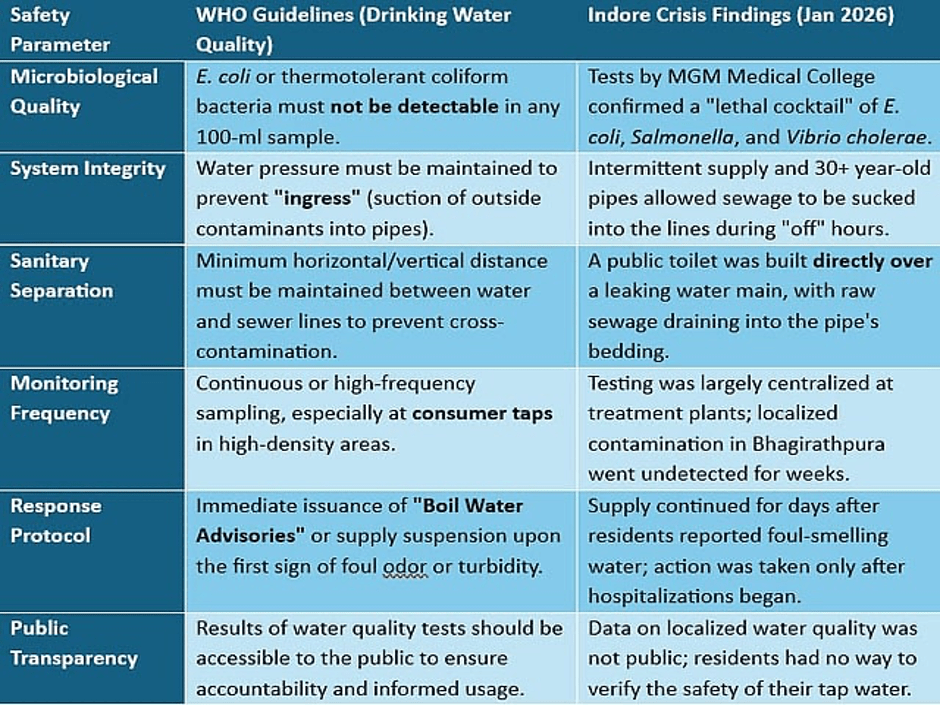
Is it a question of science or governance?
Chennai: CM lays foundation stone for 342cr Mamallan reservoir on ECR CM M K Stalin on Jan 19 laid the foundation stone for the Mamallan reservoir project at Nemmeli on the East Coast Road (ECR) in Chengalpet district, a 342.6 cr water resources dept project to augment water supply to Chennai’s southern suburbs.
BWSSB invites tenders to supply STP water to Peenya industrial area BWSSB Chairman stated that tenders have been invited to supply 4 MLD of ultra-pure treated water from Nagasandra STP to Peenya Industrial Area. The project aims to supply uninterrupted treated-water to one of Asia’s largest industrial hubs. To ensure the water remains uncontaminated, a Dedicated Distribution Network, is being laid. The 27-km HDPE pipeline will be installed to reach industrial units. A 5 Lakh Litre capacity Overhead Tank (OHT) will be put in place supporting storage and pumping along with the construction of a sump cum pump house and installation of pumping machinery.
Hyderabad’s groundwater Three months before summer sets in, and in the heart of winter, Hyderabad is already staring at a groundwater crisis. Data from the Telangana groundwater department shows that by Dec, groundwater levels in Quthbullapur and Kukatpally had dropped to depths of 18 m and 16 m, respectively. In Patancheru, another rapidly urbanising hub, the water table fell to 10 m.
In the north-eastern belt, Malkajgiri recorded groundwater at around 13 m. Similar depletion trends were seen in Bandlaguda, Medipally, Gandipet and Rajendranagar. Even Ameerpet, which faced repeated flooding during the monsoon, reported low groundwater levels of about 16 m, highlighting the city’s poor recharge capacity.
Across Greater Hyderabad, 13 of the 46 mandals recorded alarming groundwater levels. On average, the city’s groundwater dropped by 1 metre in just one month, from 5.9 metres in Nov to 6.9 metres in Dec. In Dec 2024, the average depth to groundwater in Hyderabad stood at around 8 m.
Microsoft project in G Noida faces action UP authorities have issued a notice to a Microsoft project in Greater Noida over alleged unauthorised groundwater extraction. Inspectors found 10 borewells operating without mandatory permits.
Site of Noida techie’s death was under CBI investigation The pit, which was dug up for the construction of a mall, has been lying unattended for over three years after the project was abandoned. Since then, rainwater and sewage from nearby residential societies have been accumulating there. Satellite images of the spot reveal some construction activity in 2021 — it’s possible the pit was dug up for the construction of a basement area. However, since 2022, the spot has been filled with water.
NGT initiates suo motu case over techie drowning The tribunal took note of the incident through a news report and said the circumstances called for scrutiny of stormwater management and adherence to environmental regulations.
Delhi colony battles knee-deep sewage for 9 months Lanes filled with sewage, knee-deep water inside houses, several grocery stores shut, and cabs declining bookings. These have been part of the lives of people living in Sharma Enclave in Northwest Delhi’s Mubarakpur for the last nine months.
Govt announces time-bound plan to ease woes at Kirari Water minister Pravesh Verma also referred to the Kirari sewerage project, which was approved in Dec 2020 with a deadline of Dec 2024, but remained stalled. He said the sewer line coverage in Kirari had increased from 70% (286km) to 84% (340km). He claimed that notable progress was made in localities such as Pratap Vihar, Prem Nagar and Bhagya Vihar sewage pumping stations. The revised deadline for completing the Kirari project is June 2026. Citing audit observations that highlighted planning lapses, Verma said that while sewage generation in Kirari was about 36 MGD, only a 15 MGD STP is operational and a proposed 25 MGD STP is still pending.
An integrated approach, he said, is now being followed, with the irrigation and flood control department handling drain remodelling and Public Works Department executing related works. Key projects include a Rs 220-crore drain from Mundka halt to the supplementary drain, a Rs 250-crore Kirari-Rithala trunk drain, and remodelling of the KSN and Rohtak Road drains.
Century-old Etsu-Cukha well dries up A key water source feeding Wokha town has begun to dry up, with the town’s historic Etsu-Cukha well – used for more than a century – running dry even before the onset of the dry season, triggering fresh concerns over water security and the long-term sustainability of the dist headquarters.
WETLANDS
Ranganathittu Bird Sanctuary: When Small Wetlands Matter Most Ranganathittu Bird Sanctuary quietly is an example of small wetland that matter. Nestled amid the Cauvery’s riverine islets, this compact sanctuary sustains thousands of wintering and breeding waterbirds, from spot-billed pelicans to painted storks. As threats mount from altered river flows and unchecked tourism, Ranganathittu stands as both sanctuary and lesson — that even modest wetlands are indispensable to life and must be defended with urgency and respect. (by Dr Renu Kohli)
Wular lake is losing its fish From 70 species of fish to just four. That’s the state of Wullar lake, say worried fisherfolk. Fifteen species exist, says the Department of Fisheries. Fisherfolk say no, they can spot just four. But what is indisputable is the terminal decline of the picturesque Wullar lake, one of India’s largest freshwater lakes, in North Kashmir’s Bandipora district. Sullied by pollution, throttled by encroachments, and scuffed by sand mining, the lake’s ecosystem is being further ruined by a mafia that kills fish with electric shocks instead of using nets to catch fish, say fisherfolk. The local fisherfolk’s union and the Nature Conservancy Alliance (NCA) have expressed alarm over the state of the lake and of the Jhelum river which feeds it freshwater.
In October 2025, the sight of a large number of dead snowtrout (Schizothorax) floating in several stretches of the Jhelum caused widespread alarm. “This cold-water fish species, once abundant, has been declining rapidly due to water pollution, habitat loss and unregulated sand extraction. The Department of Fisheries has failed to conduct or make public a scientific investigation into the cause of this worrying incident,” points out Ghulam Hassan Bhat, president of the Mahigeer and Singhara Association. (By Jehangir Rashid)
Keshopur wetland, a testament to nature’s resilience Keshopur supports critical functions like flood control, groundwater recharge, climate regulation and provides habitats for innumerable species, sustaining livelihoods through fishing and agriculture. Also known in local parlance as ‘chhumb’, old-timers maintain that it is a bridge between land and water ecosystems. It is managed by residents of five villages, Keshopur, Dalla, Matwa, Miani and Magarmudian. It comprises marshes, ponds and agricultural land. Birdwatchers from faraway places make it their abode in the winter, during which birds fly in from Siberia, Scandinavian and Central Asian countries.
URBAN LAKES, WETLANDS
Hyderabad STPs fails to stop pollution in lakes Crores of public money have been spent on STPs across Hyderabad to revive its fast-degrading lakes. Yet the latest pollution data shows the strategy has failed to halt the decline, with untreated and partially treated sewage continuing to flow into several waterbodies, raising questions about how STPs are planned, designed, operated and monitored.
Data released by the Telangana Pollution Control Board (TGPCB) shows lake water quality across the Hyderabad Metropolitan Area remains critically poor. Of the 185 lakes, at least 23 have dried up completely, while DO levels in 25 lakes have fallen below 1 mg per litre — a level at which aquatic life cannot survive. Key indicators such as DO, BOD and heavy metal concentrations point to persistent sewage inflows despite the presence of STPs.
In Mir Alam Tank, Kotha Cheruvu in Alwal, Pedda Cheruvu in Khajaguda, Kamuni Cheruvu and Banjara Cheruvu, oxygen levels have dropped far below acceptable limits. Even Hussainsagar and Durgam Cheruvu, often projected as showcase urban lakes, record DO levels of just 1.1 to 2.7 mg/l.
Recent lake rejuvenation projects linked to nearby STPs have also failed to yield improvements. Bathukamma Kunta in Amberpet, restored by HYDRAA in Oct. 2025, recorded a DO level of 0.6 mg/l in Sept., which fell further to 0.3 mg/l in Oct.
Environmentalists say the issue lies not in the number of STPs, but in the flawed model behind them. Donthi Narasimha Reddy, environmentalist and policy expert, said that sewage management continues to be treated as an afterthought in urban planning. “When permissions are granted for buildings and layouts, sewage systems should be planned and implemented simultaneously. Instead, due to a lack of space, STPs are constructed inside or along lakes. With no proper sewage disposal system in place, wastewater is diverted into lakes, leading to pollution,” he said.
He said that many STPs are designed without factoring in future population growth and rising sewage generation: “Land should be earmarked for STPs in advance. Area-specific sewage plans must be mandatory when granting construction permits”.
Operational constraints further limit STP effectiveness. Most plants in Hyderabad are designed with fixed capacities of 10–15 MLD. During monsoons, stormwater mixes with sewage, pushing inflows beyond capacity and forcing operators to bypass treatment. In dry months, inflows often fall below minimum operating levels, leading to shutdowns. “As a result, STPs function efficiently only for limited periods, while untreated sewage enters lakes for the rest of the year,” said environmentalist Madhulika Choudhary. “Lake protection cannot be done by one agency in isolation. Sewage diversion, stormwater management and enforcement involve multiple departments. If agencies work in silos or publicly blame one another, the system will fail,” she said.
Choudhary pointed out that creating new authorities without clear roles and accountability had only compounded confusion. “Taxpayers end up funding multiple agencies that pass responsibility instead of delivering results,” she added.
Maintenance failures worsen these structural flaws. In several areas, pipelines feeding STPs are clogged with plastic waste, construction debris and sludge, preventing sewage from reaching treatment plants.
Hyacinth eats away lakes in Hyderabad City’s lakes are increasingly being swallowed by thick mats of water hyacinth, turning once-open waters into green, stagnant stretches that breed mosquitoes and pose serious health risks to residents nearby. Despite residents notifying Greater Hyderabad Municipal Corp, the body appears largely inactive in clearing the hyacinth and controlling the mosquito menace.
Lakes in many parts of the city, including Kamuni Cheruvu in Moosapet, Fox Sagar Lake in Kompally, Neknampur Lake near Manikonda among others are heavily covered in hyacinth. The weed has spread across large surface areas of the lake, stalling water flow and creating perfect conditions for mosquitoes to breed. The problem is not restricted to smaller lakes. Durgam Cheruvu, located in the heart of the city has seen more than half of its surface swallowed by hyacinth. Visitors complain of strong odours and reduced water quality, yet clean-up efforts are absent.
Despite repeated public complaints, GHMC has remained largely silent. Although there have been initiatives to clear hyacinth using floating trash collectors and drones, citizens and local residents said that none of these are being implemented on ground.
Can’t allow surplus sewage into Durgam Cheruvu: HYDRAA About half of Durgam Cheruvu is covered in water hyacinth, a clear indicator of nutrient overload caused by untreated sewage entering the lake, officials found during an inspection by the Hyderabad Disaster Response and Asset Protection Agency (HYDRAA) on Jan 20.
When irrigation officials cited excess sewage inflow beyond STP capacity as the reason for diverting wastewater into the drain, HYDRAA commissioner AV Ranganath objected, stating that surplus sewage must be routed through sewer lines and not allowed to enter water bodies directly. Ranganath also added that rejuvenation cannot be limited to cosmetic beautification. “We also asked Raheja, the agency executing the lake development works, about steps taken to prevent sewage inflow and control the spread of water hyacinth,” he said.
Ranganath further said the foul smell and ecological degradation of Durgam Cheruvu were the result of poor coordination and lack of accountability among multiple agencies, including GHMC, the water board, the irrigation dept, Raheja Mindspace and Ramky, which manages the STPs. He directed officials to collect treated water samples from the STPs and send them to the Pollution Control Board for testing.
Environmentalists slam ‘institutional silence’ as lakes turn toxic On July 8, 2025, TNIE published a report – Asanikunta is ‘dead’, pollution off the charts – highlighting the poor water quality of the Asanikunta lake. Experts noted that both Asanikunta and Sunnam Cheruvu, major urban lakes in the city, have been classified as Grade E, the worst possible water quality, since January 2025. Yet, no public alert was issued.
Activists said the six-month delay in disclosure endangered public health and ecological balance. Grade E signifies water unfit for drinking, bathing, irrigation or industrial use, essentially biologically dead. “This isn’t just pollution, it’s institutional silence,” said Lubna Sarwath, lake conservationist. “Communities around these lakes were exposed to health and ecological risks without any warning. The fact that this condition continued for six months without any public alert is not negligence; it borders on environmental misconduct.
An environmental lawyer said withholding such information may violate the Water (Prevention and Control of Pollution) Act. “The public has a legal right to know the state of local water bodies. This lack of disclosure breaches both legal and ethical duties.” Urban health expert Dr Meera warned that if such lakes recharge borewells or lie close to residential zones, they could pose a silent but severe health threat.
Bengaluru residents meet BDA chief over Varthur-Bellandur lakes The residents of Varthur and Bellandur held a detailed meeting with the Bengaluru Development Authority (BDA) Commissioner, engineer member and other senior officials, and appealed for a review of the rejuvenation status of Varthur and Bellandur lakes, and address the recurring flooding in East Bengaluru.
Jagadish Reddy from Varthur Nagarikara Hitharakshana Vedike said completion of work on the two lakes has missed multiple deadlines, hence they told BDA officials to hold a meeting with other stakeholders. “There are 11 parastatal agencies and there is no coordination between them which has led to the delay hence we met BDA Commissioner P Manivannan and appealed to him to call a meeting and ensure completion of the rejuvenation project in 2026,” said Reddy.
Reddy said the Vedike also brought up the issue of unscientific inlet design allowing sewage-laden storm water, garbage and silt to enter Varthur Lake directly, negating earlier rejuvenation efforts. That apart, growth of water hyacinth, other floating invasive plants, indicating high sewage and nutrient load, incomplete STPs and UGD networks resulting in continuous inflow of untreated sewage into the lake system, reduced rajakaluve widths and encroachments, identified as a primary cause of recurrent flooding, poor SWD connectivity and inadequate maintenance, including siltation and vegetation choking drains, illegal garbage segregation units operating near drains and lakes, and worsening pollution were brought to their notice.
BWSSB’s pipeline work in Varthur Lake illegal: Activists Representatives of the Varthur & Bellandur Lakes Rejuvenation Initiative have alleged that Bangalore Water Supply and Sewerage Board (BWSSB) is blatantly violating environmental laws. They said the water board is currently executing sewage pipeline works inside Varthur Lake boundary, without mandatory authorisation from the BDA and in clear violation of binding NGT guidelines, which strictly prohibit any construction or permanent infrastructure activity within lake beds and buffer zones.
“Despite repeated objections and explicit directions from local stakeholders to realign the pipeline outside the lake buffer zone, BWSSB has continued its operations within the lake area, causing irreversible ecological disturbance. Such actions directly undermine lake conservation efforts, groundwater recharge, flood mitigation, and biodiversity protection,” the representatives said. They said unauthorised work within the lake threatens to worsen urban flooding, pollution, and public health risks.
Doddaballapur lakes contaminated One of the largest lakes in Bengaluru Rural, Doddatumakuru Lake, spread across 326 acres, and the other water body Chikkatumakuru Lake, covering 75 acres, are severely polluted and contaminated. In the absence of a scientific treatment plant, untreated sewage from the entire Doddaballapur town, along with chemical effluents from 52 industries in the Bashettihalli Industrial Area flows into these lakes, from where pollution reaches Bengaluru.
The Arkavathy river, born on Nandi hills, flows to Doddaballapur uncontaminated. But at Doddaballapur lake, industrial effluents and sewage of Doddaballapur town flow into it, polluting the water body. The same water flows to Chikkatumakuru lake and then to Doddatumakuru lake, from where it flows through aquifers to Hesaraghatta and Tippagondanahalli, reaching Sangama and Cauvery, then reaching Bengaluru.
The villagers say just ten years ago, the lake water was potable. But as factories mushroomed, they let out industrial residues into these lakes, severely polluting the water body. Also, sewage from Doddaballapur town is diverted into these lakes, while the existing STP, constructed in 2017, is unscientific and not serving its purpose.
Fish found dead in Harohalli Lake Around a dozen fish were found dead at Harohalli Lake in Yelahanka on Jan. 17 morning, raising concern among walkers and environmental activists, though officials attributed the incident to seasonal factors. According to morning walkers, around 12 common carp fish were found dead along the edges of the lake. Each fish, measuring between 12 and 18 inches, were mostly of the same species. They urged authorities to conduct an immediate inspection, suspecting low dissolved oxygen levels or possible sewage pollution.
Interim stay on storing sewage water in Coimbatore’s Chinnavedampatti Lake Following a petition by local farmers, the Madras High Court has issued an interim stay restraining the Coimbatore City Municipal Corp (CCMC) from storing treated sewage water in the Chinnavedampatti Lake. The issue traces back to a promise made by CM MK Stalin during the 2024 Lok Sabha election campaign, when he assured voters that surplus water from the Bhavani River would be diverted to replenish the Chinnavedampatti Lake. However, the Corp later proposed a different plan, to treat sewage collected from surrounding areas and reuse it by supplying 50% of the treated water to industries, while storing the remaining 50% in the lake. Govt orders were issued, funds were allocated, and preliminary works were initiated.
Farmers in the region strongly opposed the move, insisting that only rainwater should be stored in the lake and not treated wastewater, citing concerns over soil health, groundwater contamination, and long-term ecological impact. With no response from authorities, Kalichamy, coordinator of the Chinnavedampatti Lake Protection Committee, approached the Madras High Court. He alleged that the STP was being constructed without obtaining mandatory permission from the Tamil Nadu Pollution Control Board (TNPCB).
The judges directed the CCMC to clarify whether pollution control approvals had been obtained and strictly instructed that no construction should proceed without such clearance. The Corp has been asked to file its response. When the case came up for hearing on Jan. 5, the WRD sought time to respond, following which the matter was adjourned for two weeks.
Untreated sewage discharged into lake in Tiruvallur Untreated sewage water is being discharged into Putlur Lake in Tiruvallur district and in-turn polluting the Cooum, according to the TNPCB. The discharge originates from a STP in Periyakuppam, which handles the sewage from Tiruvallur municipality areas. In an RTI reply, TNPCB noted that during their inspection conducted between Sept. 24 and Oct. 15 at the STP in Periyakuppam, which is under the municipality’s control, improper sewage management and untreated sewage discharge into Putlur lake were observed.
The construction of the STP had begun in 2010 under the underground sewerage scheme at Rs 54.8 crore. The plant, with a treatment capacity of 6.2 MLD, was established in 2014 without the ‘consent to operate’ from TNPCB. An official working at the STP said that the facility currently receives an inflow of about 5.5 MLD of sewage. “However, as the existing plant has failed and the sewage is not being treated properly. As a temporary measure, we are adding bacteria to the sewage at pumping stations before it is pumped to the plant. Extreme greenish discharge from STP was suspected to be due to excessive bacterial growth,” the official said.
Prosopis invasion leaves Panamarathupatti Lake dry The Panamarathupatti Lake, once a major source of drinking water for Salem city, now remains choked with the Prosopis juliflora trees invading vast stretches of the lake bed. The waterbody, spread over nearly 2,400 acres, has remained dry for more than two decades, with residents and environmental activists raising concerns for several years.
Located on the outskirts of Salem, Panamarathupatti Lake has historically played a key role in supplying drinking water to the city. Activists & residents said the lake has not held water for over 20 years, during which Prosopis juliflora spread extensively across the lake bed, altering its natural landscape & water-holding capacity.
Pon Saravanan, coordinator of the Tamil Nadu Lake Protection Movement, said multiple petitions and protests had been organised over the years seeking the restoration of the lake, and officials routinely met protesters, offering assurances of immediate action. “However, no substantial restoration work has taken place so far, and most promises remain only on paper,” he said. Saravanan added that several announcements were made during different election periods regarding lake renovation and the development of tourism-related facilities, but no visible progress followed.
Responding to the concerns raised by residents and activists, Salem corporation commissioner M Elangovan said steps were being taken to address the issue. 3 tenders were floated earlier for the removal of Prosopis juliflora trees, but contractors did not come forward to take up the work. Stating that discussions were ongoing regarding the beautification of Panamarathupatti Lake on the lines of projects implemented at Kumaragiri & Mookaneri lakes, “The proposed project is estimated to cost around Rs 54 crore, and a detailed project report is currently under preparation.”
Kolhapur activists raise questions over water pollution Rankala Over the past five days, 12 swans and a few other birds, including river turners and storks, have been found dead in Kolhapur’s famous Rankala lake. Officials from the zilla parishad’s animal husbandry department suspect these birds died due to poisoning from food, and said the actual reason will be known only after the postmortem reports are received. Activists and environmentalists, however, blame water pollution.
There have been several recent reports of pollution affecting aquatic life in the lake. Kolhapur Municipal Corp has not been able to prevent sewage from the Sham Society nullah from mixing into the Rankala water, even after various measures were adopted to stop it. Cases of dead fish and tortoises floating on the water have been common. In Nov 2025, water hyacinth was also seen floating over the lake after over 10 years.
SC’s sharp words on Sukhna lake during Aravalli hearing The apex court on Jan. 21 expressed concerns over the drying up of Chandigarh’s iconic Sukhna Lake to raise the issue of illegal construction while hearing the Aravalli Hills case. While warning the Haryana govt against repeating past mistakes, a Supreme Court bench led by Chief Justice of India Surya Kant said the Sukhna Lake had been “completely damaged” due to the connivance of officials and the builder mafia. “Kitna sukhaoge Sukna Lake ko (How much will you dry up Sukhna Lake) due to connivance of state officials, builder mafia is operating… You have damaged the lake completely,” the CJI-led bench said.
The rain-fed Sukhna Lake has long seen dipping water levels. The lake has become a far cry from the picturesque water body that used to daily attract thousands of people. While the SC blamed “builder mafias” and bureaucratic collusion, environmental experts are demanding retrospective action and accountability for officials responsible for degradation. They emphasize swift measures to protect the lake and its catchment area, stressing that safeguarding water bodies is a constitutional duty.
FLOOD MANAGEMENT
Household level flood loss assessment in Bihar in 2024: Phase 2 floods This report presents a flood loss assessment covering 2,290 households across 134 Wards in 21 Panchayats of seven Districts of Bihar affected by the Phase 2 floods in 2024, conducted by Megh Pyne Abhiyan.
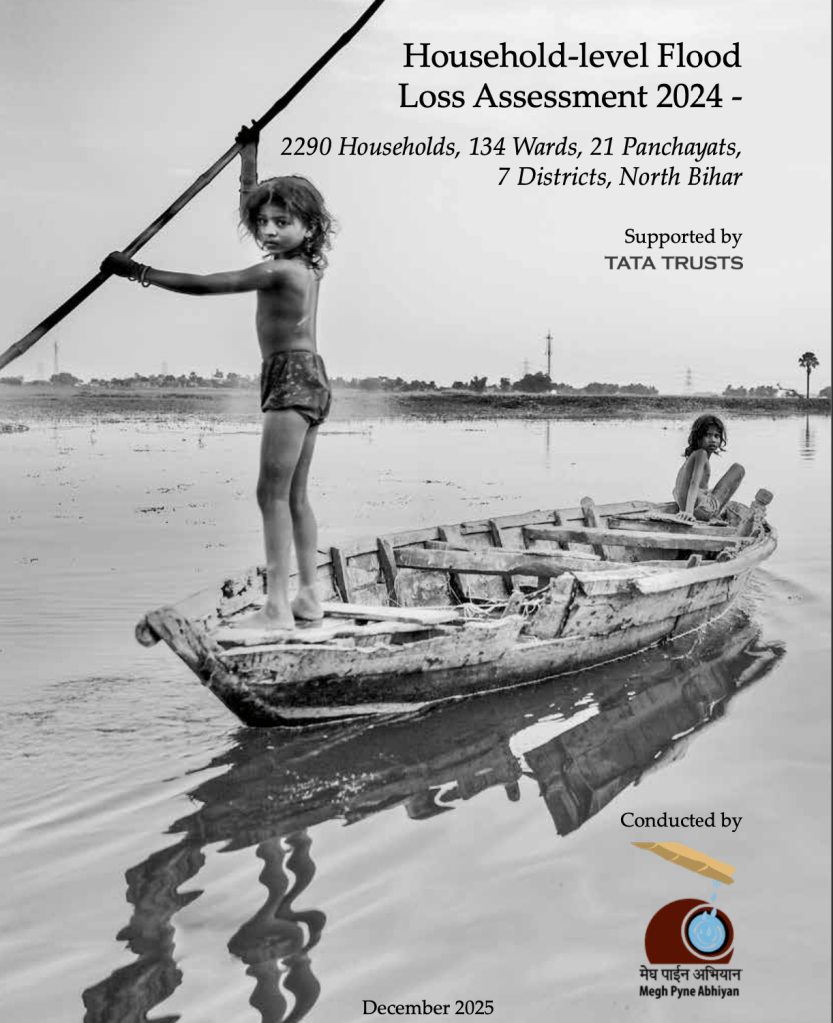
Conclusion: The 2024 floods exposed the fragility of current systems, the inequities embedded in disaster impacts, and the urgent need for transformative, community-centered approaches. Moving forward, Bihar’s flood management strategy must shift from reactive, infrastructure-heavy approaches to proactive, inclusive, and typology-sensitive planning. This means centering community knowledge, prioritizing vulnerability over absolute losses, and integrating social protection with structural interventions. The findings can help chart a path where floods, while inevitable, no longer translate into cycles of devastation and despair, but instead catalyze resilient and equitable development. The result is a living archive of community knowledge, detailed, nuanced, and anchored in local agency.
WATER POLLUTION
Contempt petition in Mumbai HC about Godavari pollution in Nashik Petitioner Rajesh Pandit filed a contempt petition in the Bombay High Court PIL No 176 of 2012, following which the High Court called for the status report from the committee headed by Nashik Divisional Commissioner Praveen Gedam, which is to be submitted on Jan 28 2026. Gedam, the chairman of the High Court-appointed panel to implement its directions as recommended by the National Environmental Engineering Research Institute (NEERI) for making the Godavari pollution-free, asked govt agencies to file their reports on the action taken so far.
“There are 83 different measures broadly classified in 34 govt offices, and I sought the report from all of them,” said Gedam. “The NEERI recommendations are about upgrading the existing sewage treatment plants and collecting 100% sewage through channels. The issue of contempt is that they failed to take steps in the appropriate period allowed by the High Court,” said Pandit. Some other issues include a Common Effluent Treatment Plant (CETP), which is to be raised by the MIDC. “The work started on the CETP to treat the effluent, but the orders were issued only after the contempt was filed by the complainant,” said another officer from the divisional commissionerate. There is also the issue of the police being ordered by the High Court to deploy 4 sub-inspectors and 30 constables for permanent river patrolling to prevent Godavari pollution. The police still did not reply about compliance with the orders.
SOUTH ASIA
China’s Medog Dam: India’s options The India could pursue several strategies. First, insist on a formal trans-boundary water agreement that mandates information-sharing, environmental impact assessments, and prior consultation before major projects. This requires diplomatic capital and leverage, but it should be a non-negotiable demand. Second, invest heavily in monitoring infrastructure—satellite surveillance, hydrological sensors, and predictive modeling—to reduce dependence on Chinese data.
Next, internationalize the issue. The Brahmaputra’s fate matters to Bangladesh, and joint India-Bangladesh advocacy could amplify pressure on China. Engaging international environmental organizations, highlighting climate and biodiversity impacts, and framing this as a global concern about trans-boundary river governance could mobilize broader support. China is sensitive to reputational costs, even if it rarely changes course because of them. Finally, India must prepare for the worst. Build flood resilience infrastructure, develop drought-resistant agriculture, create early warning systems, and plan for displacement scenarios. Hope for Chinese cooperation, but plan as if it will not materialize.
China’s mega-dam on the Yarlung Tsangpo is a unilateral assertion of power over a shared resource. Its assurances of “no adverse impact” are worth little given past behavior and the inherent impossibility of such a massive intervention having zero downstream effect. The Brahmaputra has sustained civilizations for millennia, flowing free and wild through mountains and plains. Its taming by China, without consent or consultation from those downstream, is a theft of common heritage dressed up as development. Complacency is not an option; the river, and the millions who depend on it, deserve better.
WB loan for 1125 MW Dorjilung HEP in Bhutan The Board of Executive Directors of the World Bank has approved long-term financing for the 1,125 MW Dorjilung Hydropower Project (DHPL). DHPL is a Special Purpose Vehicle (SPV) jointly owned by Bhutan’s Druk Green Power Corp (60 %) and Tata Power (40 %). The financing package includes a $150 million grant and a $150 million credit from the International Development Association (IDA) and a $15 million enclave loan from the International Bank for Reconstruction and Development (IBRD) to DGPC (Government of Bhutan), as well as a $200 million IBRD enclave loan and a $300 million loan from the International Finance Corporation (IFC) to Dorjilung Hydro Power Limited (DHPL). The balance funding requirements for the project will be arranged from various market participants.
Bangladesh plans Padma Barrage Officials from the Bangladesh Water Development Board (BWDB) said the proposal was reviewed at a recent Project Evaluation Committee meeting chaired by Mustafizur Rahman, Member for Agriculture, Water Resources & Rural Institutions. While the overall cost is Tk 50 443.64 cr, the committee has advised starting with a first phase with cost Tk 34,608 cr.
The revised plan is expected to go before the Executive Committee of the National Economic Council (Ecnec) on Jan 25 for final clearance. A senior BWDB official said that the interim government is planning to begin construction using domestic financing, with foreign loans, including from China, to be explored later.
After carrying out detailed feasibility studies, BWDB selected Pangsha in Rajbari district as the preferred location for the structure. According to the design blueprint, the proposed barrage will stretch 2.1 km and house 78 spillway gates measuring 18 metres each, along with 18 undersluice gates. It will include a 14-metre navigation lock for vessels, two 20-metre fish passes and a railway bridge of the same length built over the structure.
MEKONG
In this book ‘The Surge: The Race Against the Most Destructive Force in Nature’ climate editor Jeevan Vasagar explores the costly and complicated choices governments face: fight the water with ever- expanding defences, or adapt and move? Drawing on groundbreaking engineering solutions, Vasagar argues for a radical rethink ― combining resistance and accommodation as we reimagine our cities.
Dams can destroy lives, ecosystems Thirty years after the Pak Mun dam was built in Thailand, the traditional way of fishing in the Khong Chiam district has completely stopped as the dam blocks the seasonal migration of a wide range of fish. Many men have had to leave their homes to find work elsewhere because they couldn’t fish or farm locally anymore, while their wives are often left alone to look after their children. People with disabilities and the elderly have not been included in compensation and livelihood rehabilitation programmes, even though they are among the groups most affected by changes in mobility, access to water and food systems.

 SANDRP