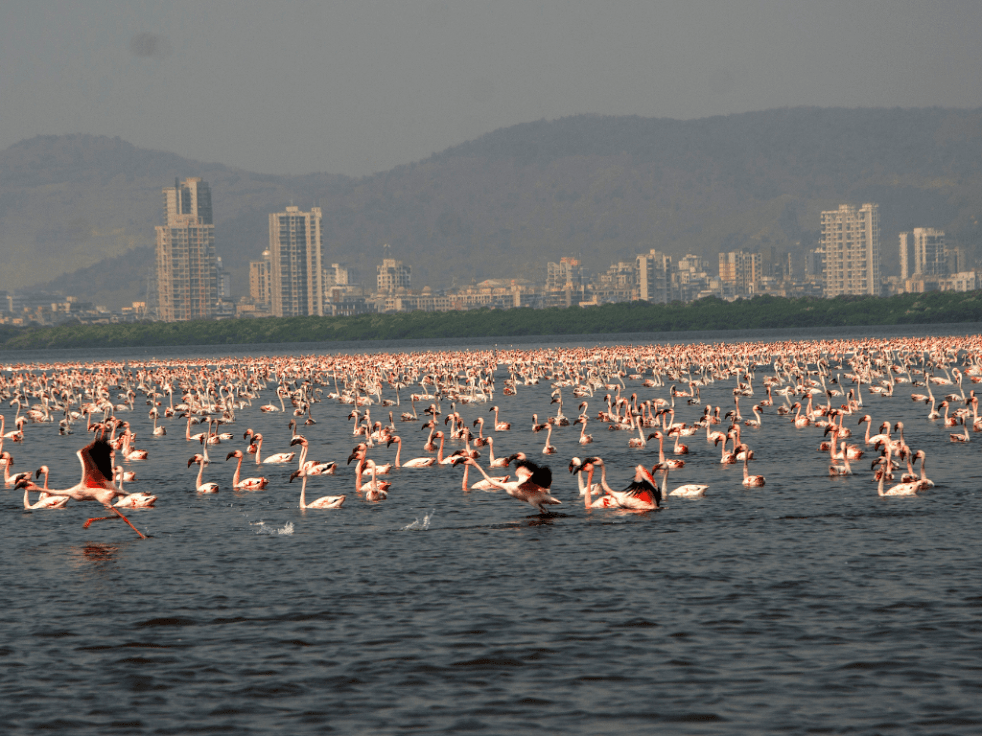
The uproar against the Govt of India and Supreme Court on Aravalli and stay on the decision by the Supreme Court is welcome. However, similarly absurd decision of the Maharashtra Govt, approved by the Bombay High Court on allowing cutting of 45675 mangroves in Mumbai’s northern stretch for a coastal road that makes no public interest sense did not invite similar reactions, as highlighted by the Question of Cities. (Feature Image above from the Question of Cities website)
The absurdity multiplies when we note that the compensatory afforestation for the mangrove destruction will happen in far away Chandrapur district. It’s disturbing how the high court agreed to such a proposal that clearly has no backing of science, public interest or understanding of climate science or even climate change.
One hopes citizens and groups in Mumbai will rise up and write to the apex court to review this decision urgently. That would be an appropriate start for a Happy New Year.
Mumbai HC approves cutting of 45675 mangoves for non-sense road project: Question of cities Edit on Jan 3 2026 If the Supreme Court’s acceptance of the ‘uniform definition’ of the Aravalli hills (later held in abeyance) was absurd, then the earmarking of 45,675 of the 60,000 mangroves in Mumbai’s northern stretch to be destroyed for a 26 km road at a cost of Rs 20 000 Cr with the permission of the Bombay High Court is no less so. This is the extension of the coastal road from Versova to Bhayander in the suburbs; the coastal road is being built in sections in the Arabian Sea to reduce travel time mainly for private cars or semi-private transport like taxis. It’s a case of public money, private gain. But its ecological cost has hardly been counted.
On its own strength, the project makes little sense. Factor in the destruction of the vast stretch of mangroves – a coastal city’s bulwark and natural barrier against floods, sea level rise, erosion, rising incidences of cyclones – and the coastal road looks ludicrous. Hold your breath: The compensatory afforestation will be in Chandrapur, approximately 850 kilometres away in a densely forested part of Maharashtra, bearing little ecological relevance to the coastal city of Mumbai. How the coastal ecology of mangroves can be taken to the hills and forests and, even if done, how it will protect Mumbai’s coastline are questions that have no cogent answers. This is not “balance” between mega infrastructure projects and environmental protection; this is an absurd and brazen discrepancy between words and actions on environmental protection.
HYDROPOWER PROJECTS
2025: People’s Resistance Against Hydro Projects in Himalaya The local communities have continued their collective resistance against destructive hydro power (HEP) projects in North East and North West Himalayan states in India all through 2025. These projects are either proposed or under construction or built and in Teesta case even destroyed. The concerns include adverse impacts over river ecosystem, water sources, damage to community and forest land, degradation of environment and biodiversity, flood threats in downstream areas. The demands are genuine and basically asking for honest appraisal, informed and participatory decision making, exploring alternatives and providing promised compensation, rehabilitation and employment, ensuring monitoring and compliance.
The climate change impacts have already turned the fears into realities which can not be ignored anymore under the grab of strategic or national interest projects and the demand for credible cumulative basin level assessment is basic need. While MoJS Minister has openly accepted the unviability and unfeasibility of large dam projects due to huge cost, time, land issues and gradual decline in river flows, it’s time to walk the talk.
Dec 2025: Vishnugad Pipalkoti HEP Tunnel Accident in Uttarakhand Collision between two loco trains inside the tunnel of Vishnugad Pipalkoti HEP in Uttarakhand around 9.30 pm on Dec 30 2025 has left over 60 workers injured. The accident occurred during change in work shift about 7km inside the tunnel near the tunnel boring machine (TBM). About 109 workers were working inside the 13km long tunnel at the time of the accident. The trains are deployed to transport the workers. The 444 Mw project is being built by Tehri Hydro Development Corporation (THDC) on Alaknanda river in Chamoli district. The construction work is going on since 2013-14.
In white-bellied heron habitat, Kalai-II project gets nod What sort of appraisal is the MoEF’s Expert Appraisal Committee on River Valley Projects is doing and taking decisions when even the expert member from Wildlife Institute of India is absent, while clearing the Kalai HEP in Arunachal Pradesh.
Pump Storage Project at Karapuzha in Wayanad hits a dead end The proposed 30 MW Pump storage project on irrigation department owned existing Karapuzha Dam has hit a dead end. It was one of the ten such pump storage projects proposed in Kerala. It was proposed to install solar panels on the reservoir to generate power to pump back the water during off peak hours.
Ladakh’s dying glaciers leave villages without electricity This explains how melting glaciers and storms in Ladakh are making even micro hydro and solar projects inconsistent and unreliable when the electricity is most needed in winter.
DAMS
Dam Protest 2025: People Demands Development Not Displacement The annual overview tracks top ten people’s resistance stories against large dam projects in India during 2025. It is encouraging to see that the year ended with the Odisha CM announcing scrapping of Samakoi dam project after strong opposition by local villagers. Interestingly, the NTCA and CEC have boldly underlined the threats to tribal people, tigers and forest biodiversity from proposed Morand-Ganjal dam in Madhya Pradesh and dams in Shivalik national park in Haryana. During the year, the villagers have organized mass protests against massive Guna and Dongari dams under PKC link project. Demanding basic information and consultation, the affected tribals have halted ground surveys for Basania dam project.
Kovalam fishers write to IWAI against reservoir project The residents of Kovalam Kuppam and surrounding villages in Chengalpattu district have argued that the project, spearheaded by the Tamil Nadu WRD, could severely impact the livelihood of fishing communities and marginalised groups. In a letter, they have highlighted the potential threat posed by Chennai’s 6th reservoir project, saying it will block the natural flow of the canal, a key part of National Waterway-4 (NW-4). The petition was submitted to the Secretary of the Union Ministry and the Chairman and Regional Director of the Inland Waterways Authority of India (IWAI).
The residents have called for a restraining order to halt the project, requesting that the Tamil Nadu govt be prevented from interfering with the natural flow of the Buckingham Canal. They have also demanded protection of the traditional fishing rights of these communities and have urged the IWAI to conduct an on-site inspection and organise a public hearing to address the concerns of the local population.
Farmers raise concern over illegal water drawal from Bhavanisagar Dam While farmers in Erode district wait their turn for limited water supply during notified irrigation periods, a few farmers have reportedly been drawing several lakh litres of water every day from the Bhavanisagar Dam by installing two 3 HP motors in the water spread area. Farmers’ associations have expressed shock over the alleged preferential access and raised concerns over lax enforcement and monitoring by the authorities.
Decisions of MoEF’s Expert Appraisal Committee meeting on River Valley Projects held on Dec 19 2025
1. Kalai II Hydro (1200 MW) in 869.3503 Ha at Village Kamdi, Tehsil Hawai Town, Anjaw District of Arunachal Pradesh by THDC India Ltd – Environmental Clearance: APPROVED
2. Dulhasti-II Hydro Project (260 MW) in 60.3 Ha at Village Hariyal, Pakalan, Poochal, Seergwar etc, Sub-dist &Dist Kishtwar, Jammu & Kashmir by NHPC ltd – Environmental Clearance: APPROVED
3. Pane Open Loop Pumped Storage Project (1500 MW) in 293.5 Ha at Village Khanu, Vagheri, & Pane, Sub-district Mahad and Velhe, District Pune and Raigarh, Mah by JSW Energy PSP Seven Limited- Environmental Clearance: APPROVED
4. Rewa Closed Loop Pumped Storage Project (600 MW) in 449.47Ha Village Nevrhiya, Uprohit Pura, Bajara, Chaura & Chhataini etc., Sub-dist Teonthar & Hanumana, Dist Rewa, Madhya Pradesh by Dhakara Energy Psp Pvt Ltd – Terms of References: Deferred as PP absent
1. Veeraballi Closed Loop Pumped Storage Project (1800 MW) in 489.91 ha at Village Vangimalla, Sub-District Veeraballe, District Annamayya, Andhra Pradesh from Annamayya Pumped Storage Project Private Limited – Environmental Clearance
2. Assam/PSP-02 Closed-Loop Pumped Storage Project (1000 MW) in 259.6 Ha at Village Baithalangso and Sardangang, Sub District Donka, Dist West Karbi Anglong, Assam by Assam Power Distribution Company Ltd – Terms of Reference
3. Assam/PSP-01 Off-Stream Closed Loop Pumped Storage Project (900 MW) in 308.79 Ha at Village Tharakhunji, Sub District Baithalangso, Dist West Karbi Anglong, Assam by Assam Power Distribution Company Ltd- Amendment in Terms of Reference
4. Ratle Hydroelectric Project (850 MW) in 567.22 Ha at Village Drabshala, Sub District and District Kishtwar and Doda, Jammu and Kashmir by Ratle Hydroelectric Power Corporation Limited – Validity Extension of EC
5. Balimela Open Loop Pumped Storage Project (2 x 250 MW) in 248.03 Ha at Village Khilaguda, Tarapur, etc., Sub District Chitrakonda and Orkel, District Malkangiri, Odisha by Odisha Hydro Power Corporation Ltd – Terms of Reference
6. Varikapudisela Lift Irrigation Scheme (CCA: 34,196Ha) in 249.13 Ha at Village Adigoppula, Atmakuru, Darivemula, etc., Sub Dist Veldurthi, Durgi, Macherla, Pullalacheruvu etc, Dist Prakasam, Palnadu and Nagarkurnool, Telangana– Terms of Reference
7. Rajupalem Close loop Pumped Storage Project (800 MW) in 334.8 Ha at Village Musalreddipalle, Reddicherla, etc, Sub Dist Kalasapadu, Komarolu and Porumamilla, Dist YSR & Prakasam, Andhra Pradesh by APGENCO NHPC Green Energy Ltd – Terms of Reference
8. Demwe Lower Hydroelectric Project (1750 MW) in 1589.97 Ha at Sub District Tezu HQ, Hayuliang ADC and Wakro Circle, District Anjaw and Lohit, Arunachal Pradesh by Greenko Demwe Power Limited- Validity Extension of EC
INTERSTATE WATER DISPUTES
MoJS forms committee on water management between AP & Telangana The Committee has been entrusted with the task of addressing key issues concerning water management in a comprehensive and technical manner and to study the outstanding concerns. It would also have to suggest viable solutions to ensure equitable and efficient water sharing. The panel will submit its report within three months, an order from the Ministry of Jal Shakti said.
The decision to constitute a committee was taken in pursuant to the meeting held on July 16, 2025 under the leadership of Union Minister of Jal Shakti CR Patil, involving CMs of Telangana and Andhra Pradesh. CWC Chairman will head the Committee, while four senior officials will represent from each State. This apart, chairmen of Krishna River Management Board, Godavari River Management Board (GRMB), Chief Engineer of NWDA and Chief Engineer (PAO), CWC, are members of the panel. The Committee may also decide inviting officers or experts from other organisations during the proceedings.
WATER OPTIONS
MoJS clairification on Jal Sanchay Jan Bhigadari Awards: How convincing it is? The Jal Sanchay Jan Bhagidari (JSJB) initiative, launched on 6 September 2024 by the Ministry of Jal Shakti is a campaign designed to turn water conservation into a mass movement… Implementation is monitored via the JSJB Dashboard, an online platform that tracks every recharge structure using GIS coordinates, geo tagged photographs and financial details. Entries submitted by districts are subjected to multi tier scrutiny by district authorities and the Ministry, and at least one per cent of the works are independently field verified to ensure quality and authenticity and remaining 99% percent are desk verified to rule out any manipulation . Based on these verified entries, the Ministry of Jal Shakti presented the First JSJB Awards on 18 November 2025 at Vigyan Bhawan, recognising districts, NGOs, individual philanthropists and industry associations for exemplary water conservation efforts… Recently, certain social media posts have alleged that the National Water Awards were secured by uploading AI generated or duplicate images, invitation cards, or by portraying minor pits as larger water bodies. Some posts have even circulated screenshots and old unrelated images from the Catch the Rain (CTR) portal to suggest that the awards were based on these images. These allegations are factually incorrect and misleading. Evaluation for the JSJB Awards is conducted solely on the basis of entries available on the JSJB Dashboard… The Ministry of Jal Shakti therefore categorically rejects claims of manipulation or misuse of images in the JSJB Awards… The Ministry remains committed to transparency and accountability, rigorous verification of works and corrective action wherever irregularities are detected.”
How convincing this PR dated Dec 30 2025 from the MoJS in absence of any element of credible independent scrutiny of the award and its evaluation process?
At least 20 teachers, including the District Education Officer (DEO) have been served notices in Madhya Pradesh’s Khandwa for allegedly uploading AI-generated images as part of a water conservation project. The district went on to receive a ₹2-crore award at the sixth National Water Awards ceremony held in New Delhi in November. The Kaveshwar gram panchayat in the district also won second prize in the best gram panchayat category.
AGRICULTURE
How Rice Farmers can earn Carbon credits through methane emission reduction It isn’t easy to get farmers to buy into cutting greenhouse gas emissions and other climate action goals, especially when this requires investing in new machinery (Happy Seeders, balers and straw choppers to manage and not burn crop stubble) or results in yield loss (replacing urea with organic fertilisers). The difficulty is more in countries like India, which has over 86% farmers with small or marginal holdings of 2 hectares (5 acres) or less. That’s where “low effort, high impact” agricultural practices can make a difference. One such practice, specific to rice cultivation, is Alternate Wetting and Drying (AWD) [Another is System of Rice Intensification, not mentioned in the report.].
“We tell farmers to flood their fields for the first 20 days. But for the next 45 days (from the 21st to the 65th), they should dry it out for 12 days. We recommend two such dry-downs of six days each (for draining out the water to 10-15 cm below the soil surface) within the 45-day window,” says Devdut Dalal, co-founder of Mitti Labs Ltd. The Bengaluru-based climate-tech startup conducted a detailed study to quantify the water savings, methane emissions reduction and grain yields from AWB during the 2024 kharif (monsoon) cropping season. It covered 30 farmers’ fields across three supersites (villages) in the Warangal district of Telangana. Paddy was grown through the AWDcmethod in 15 of these fields and through traditional continuous flooding (CF) in the other 15.
The Mitti Labs study found the average water consumption to be only 3.14 million litres per acre in the AWD fields, as against 4.96 million litres for CF. The average methane emissions, likewise, worked out to 3.5 tonnes of CO2 equivalent per hectare (1.4 tonnes per acre) from AWD, compared to the baseline number of 6 tonnes (2.4 tonnes/acre) in CF paddy cultivation. More importantly, from a farmer’s perspective, the average grain yield was the same, roughly 2.5 tonnes per acre, under both AWD and CF.
In 2023-24, Mitti Labs signed up with 850 farmers – 600 from Telangana and 250 from Andhra Pradesh – for them to implement AWD, alongside installing 30-cm-long perforated pipes (to monitor water table depths) and closed acrylic chambers (to collect gas samples for measuring methane emissions) in their fields. The number of farmers onboarded rose to 11,300 (Telangana: 6,000, AP: 4,000, Odisha: 800 and Tamil Nadu: 500) in 2024-25 and further to 69,000 (Telangana: 35,000, AP: 25,000, Odisha and TN: 4,000 each, and Karnataka: 1,000) in 2025-26, over both the kharif and rabi (winter-spring) crop seasons.
Carbon credits from methane abatement are now trading at $15-25 dollars per tonne of CO2 equivalent. At 2.5 tonnes (6 minus 3.5) per hectare, a single paddy crop can, thus, generate at least $37.5 of carbon credit. That, at current exchange rates, translates into Rs 3,367 per hectare or Rs 1,363 per acre. While Mitti Labs is planning to ramp up to 300,000 farmers in the next two years, it isn’t alone. The Good Rice Alliance – a partnership of the German life sciences major Bayer with Shell Energy India and Singapore’s Tamasek-owned GenZero investment platform – is promoting paddy cultivation through both AWD and direct seeding of rice (which bypasses nursery preparation and transplanting). The alliance claims to have enrolled 12,000-plus farmers across 13 states, covering 35,000 hectares and reducing methane emissions equivalent to around 120,000 tonnes of CO2 per year.
India’s Rice Records and Water Crisis India overtook China as the world’s largest producer of rice this year. India has nearly doubled the amount of rice it exported over the past decade, with shipments crossing 20 million tons in the latest fiscal year. Interviews with growers, government officials and farm scientists, as well as a review of groundwater data, reveal widespread concern that thirsty rice crops are unsustainably draining India’s already-low aquifers, forcing farmers to borrow heavily to drill ever-deeper borewells, particularly in rice basket areas of Punjab and Haryana.
Government subsidies incentivize rice cultivation discourage farmers from switching to less water-intensive crops. The subsidies – some of them a legacy from past decades when India struggled to feed its growing population – include a state-guaranteed minimum price for rice that has climbed by around 70% over the past decade, as well as heavy power subsidies that encourage extracting water for farm use. The net effect is that one of the world’s most water-stressed countries is paying farmers to consume vast amounts of precious groundwater.
India accounts for 40% of the world’s rice exports, so any changes in production will have global implications, Kishore said. The sheer volume of rice India produces and exports gives it a pivotal role in global trade. But it also raises a question: should the country be growing and selling so much rice? Producing a single kilogram of rice consumes 3,000–4,000 litres of water, which is 20-60% higher than global averages.
The Haryana government last year began offering a subsidy of 17,500 rupees per hectare to encourage farmers to switch to crops such as millets, which require significantly less water. The incentive however, is available only for one growing season and has so far failed to drive large-scale adoption. Punjab spends about 39,000 rupees on fertilizer and power subsidies for each hectare of rice grown, but redirecting 35,000 rupees to pay farmers who grow less thirsty crops would be enough to let them maintain their income levels. The government would also save by paring back on the amount of rice subsidies paid out.
Natural Farming in Betul The Saigohan Watershed in Madhya Pradesh’s Betul shows how a farmer-centric programme sparks a people’s movement. It is reversing crop loss, soil degradation, and distress migration. It shows how farmer-centric programmes can evolve into people-led agroecological movements. By prioritising peer learning and local institutions over external inputs, the initiative is rebuilding resilient farming systems.
URBAN WATER
The TOI Edit: Indore’s tragedy a familiar story of apathy pan-India the “The tragedy unfolding in Indore – repeatedly ranked as India’s cleanest city – due to contaminated tap water exposes the huge gap between rankings and civic realities… Safe, potable water ought to be a basic utility across the country. That even the cleanest city can’t ensure this exemplifies apathy and lack of accountability… India ranked 120 out of 122 countries on the water quality index with nearly 70% of water being contaminated.”
The Hindu Edit: The Water Divide: Quality of Urban Piped Water The key sentences in this The Hindu edit on Jan 2 2026: “The incidents in Madhya Pradesh should be taken as a wake-up call for India’s water management… All States should immediately check water supply sources for chemical and sewage contaminants. Old infrastructure including pipes must be repaired or replaced. There should be strict enforcement of policy and monitoring of practice along with awareness campaigns… It is a development steeped in irony because Indore has been voted India’s cleanest city for several years in a row…” Unfortunately, we have yet to get a sense of the proportion of this tragedy from any of the triple engines of the governance in this city.
Indore Contaminated Water Crisis Indore, often celebrated as India’s cleanest city for its sanitation achievements, is facing a shocking public health emergency in early 2026. In the Bhagirathpura locality, unusual water quality – foul smell, bitter taste and visible discoloration – preceded reports of widespread illness. Local residents began developing symptoms of vomiting, diarrhoea, dehydration and high fever after consuming municipal drinking water, prompting mass hospital visits. The crisis quickly escalated into a waterborne disease outbreak with confirmed 10 deaths and 200 patients admitted for treatment.
Leakage in water pipeline under toilet led to diarrhoea outbreak An official laboratory test has verified that a diarrhoea outbreak was caused by contaminated drinking water. The findings verified that a life-threatening drinking water supply system prevails in Indore. Officials have informed that a leakage was found in the main drinking water supply pipeline near a Bhagirathpura police outpost at a spot over which a toilet has been constructed. They said the leakage resulted in the contamination of the water supply in the area.
Indore’s water becomes a killer If even Indore cannot guarantee safe drinking water, the claims of governance elsewhere ring hollow. The tragedy of Bhagirathpura was foreseeable, preventable, and therefore indefensible. Cleanliness rankings and promotional campaigns cannot mask corroded pipes, vacant posts, lax inspections, and a culture of denial. Indore’s poisoned taps have stripped the sheen off official narratives. Until accountability travels upward—beyond suspensions and transfers—and systems are rebuilt with seriousness, sadak, bijli aur pani will remain political slogans, not constitutional guarantees. (Deshdeep Saxena)
Trust on IMC supply dries up The water contamination tragedy in Indore has triggered widespread distrust of municipal tap water, forcing residents to rely on bottled water and adding to the financial burden of low- and middle-income households. The loss of trust is so severe that even tea stall owners are using bottled water to reassure customers. Residents claim the toll is as high as 16, including a six-month-old infant.
Water contamination scare now in Gandhinagar While a sudden surge in typhoid cases has been reported in several localities of Gandhinagar, residents of KSFC Layout in Bengaluru’s Lingarajapuram area have been reporting symptoms like gastrointestinal pain, vomiting and diarrhoea over the past few months, with some requiring hospitalization. Sewage leak into drinking water pipelines has triggered the crisis in these two cities, too.
In Bengaluru, at least 30-40 households have been forced to switch to private water sources for over a week. Although many residents had been falling ill frequently, the scale of water contamination became evident only this week, when they noticed foul-smelling, frothy water and found thick layers of dark sewage silt while cleaning underground sumps.
GBA invites objections to felling of 665 trees for BWSSB STPs The Greater Bengaluru Authority (GBA) has issued public notices inviting objections and suggestions to a proposal to remove 665 trees for the construction of 2 STPs planned by the Bangalore Water Supply and Sewerage Board (BWSSB) on the city’s outskirts. The 100 MLD STPs are proposed at Doddabele and Mailasandra villages.
Hyderabad: Robots to detect contamination To prevent contaminated water supply, the Hyderabad Metropolitan Water Supply and Sewerage Board (HMWSSB) is using robotic technology. The water board has prepared a special action plan aimed at turning the city into a pollution-free water zone, said Ashok Reddy. Steps will be taken to bring contaminated water complaints down to ‘zero’, the official added. He instructed officials to gather details of areas where complaints are frequent and analyse the root causes and prepare to assess and replace pipelines in such locations. Officials were also instructed to make arrangements for laying new pipelines to replace outdated ones and to submit an appropriate action plan immediately.
JDA to use technology to recharge GW The Jaipur Development Authority (JDA) will use the Eco Block technology as part of the drainage project for residents of Kalwar Road and Khirni Phatak areas of the city. While the National Highways Authority of India (NHAI) has implemented this technology on highways running along Delhi and Agra, recently the same technology has also been adopted inside the compound of Rasthrapti Bhawan in New Delhi.
JDA will spend Rs 25.50 cr to lay the 8.75 km-long drainage line, of which Rs 2 cr will be spent on the recharge technology. The civic body is roped with a Chennai-based firm to implement the technology. Engineers claimed, the technology is cost-effective and requires nominal space. Under this, the civic body will install paver block-like structures concealed in geo-textile membranes. The membranes will filter solid particles such as plastics and will allow only water to flow into the blocks. The blocks will recharge the groundwater level and divert the surplus water into the drainage lines.
No relief from sewer mess in G Noida Residents of Sector Beta 1 stated that after the main sewer line was repaired near Sector P3 nearly 15 months ago, the sewage system has not been properly maintained, resulting in sewage overflowing onto their roads and green belts repeatedly. Similarly, on Jan. 01, complaints regarding sewer overflow poured in at the GNIDA office.
RIVERS
Odisha villagers rise to protect riverine landscape Villagers near the Mitkundri bridge on the outskirts of Rourkela on Dec. 30 blocked a key road to protest growing ecological damage caused by unchecked picnic activities, particularly during weekends and holidays. Hundreds of residents from nearby villages gathered, voicing concern over the degradation of agricultural land, pollution of the riverine ecosystem and increasing public nuisance linked to picnics.
‘Cancel forest clearance in Bhagirathi ESZ’ Several environmental and social organisations in Dehradun on Dec 1 demanded the immediate cancellation of the forest clearance granted for the felling of thousands of trees within the Bhagirathi Eco-Sensitive Zone. The activists pointed out that the project, which involves the diversion of 42 hectares of reserve forest near the Gangotri Glacier, entails the felling of 6,675 trees, including 4,070 ecologically invaluable deodars. They alleged that the move is a violation of a 2020 Supreme Court undertaking where the road width was supposedly restricted to 5.5 metres, whereas the current plan proceeds with a 10-metre design that threatens irreversible damage to the sensitive landscape.
‘Rakshasutra’ against mindless development The demolition of the Himalayas, and now the ancient Aravalli, and the excavation of Badrinath without any EIA, or the damming of the Ganga, is the demolition not just of life-sustaining ecology, but of Indian identity. We should stop calling what empties us, what weakens us, “progress”.
MoRTH minister Nitin Gadkari, in Parliament, assured the nation that there would be no tree felling in the CDP. Yet today, we are on the brink of losing another pristine forest. The Rakshasutra tied by citizens around magnificent cedars on Dec 6, 2025, is a call for protection against all mindless & self-destructive development. (Priyadarshini Patel)
68th meeting of executive committee of NMCG The 68th meeting of the Executive Committee of the National Mission for Clean Ganga (NMCG) was held with the objective of ensuring uninterrupted (aviral) and unpolluted (nirmal) flow of the Ganga and its tributaries. The meeting was chaired by Shri Rajeev Kumar Mittal, Director General, NMCG. The focus of the meeting included ecological restoration of river, biodiversity conservation, innovations through Nature based Solutions, conservation of rich cultural heritage and facilitating prompt execution of infrastructure projects.
For conservation of endangered bird species in the Ganga basin, a new project has been approved to protect breeding habitats of sandbar-nesting birds, including the Indian Skimmer. In line with Namami Gange Mission–II, the project focuses on long-term monitoring, community participation, and evidence-based conservation. Nest monitoring will continue in the Chambal and Lower Ganga and will be initiated in Bijnor, Narora, and Prayagraj. Trained local communities will help protect sensitive sandbars, reduce human disturbance, and support awareness and capacity-building initiatives.
The projects include the 10 KLD Faecal Sludge and Septage Treatment Plant in Mirzapur district of Uttar Pradesh; rehabilitation of existing sewerage infrastructure and renovation of the main sub-station in Kanpur; and the trash skimmer project for maintaining the cleanliness of the Ganga surface in Varanasi, Interception and diversion and STP projects in Danapur, Phulwari Sharif, and Fatuha in Bihar; the interception and diversion and STP project in Phusro, Jharkhand; and minor modifications in two major Ganga pollution abatement projects in W Bengal at Garden Reach and Kooraapukur.
NMCG approves Gomti master plan The NMCG has approved multiple projects including a master plan to restore the cultural identity of the Gomti river’s origin site at Pilibhit, protect breeding habitats of sandbar-nesting birds and deploy nature based solutions for in-situ treatment of certain drains, falling in Yamuna, in Delhi.
2 MLD Gyansu STP in Uttarkashi is found dumping untreated sewage in Ganga river. Govt in May 2017 had approved Rs. 2 crore to upgraded the STP in July 2025.
Life on the banks of the Yamuna The toxic foam in the Yamuna River originates from a combination of untreated domestic sewage and industrial waste. Bhim Singh of SANDRP explained that this mixture generates intense pollution, and that the phenomenon is especially visible where the river leaves the city of New Delhi.
This foam, the expert points out, is the obvious result of the accumulation of chemicals and waste, which come from both the Indian capital and surrounding industrial areas, and which reach the river without any treatment. Pankaj Kumar, a renowned Indian activist who leads a group of volunteers in cleaning the river every Sunday, said that these boats use a non-biodegradable, silicone-based chemical to remove the foam, which can remain in the water for more than ten years.
HC stops new construction near dargah, graveyard in floodplain A bench of Justices Prathiba M Singh and Manmeet Pritam Singh Arora of Delhi High Court on Dec. 22 issued the interim order while hearing a petition regarding alleged illegal constructions on the Yamuna river bank near the dargah and the adjoining graveyard. It directed the Delhi Development Authority and Land and Development Office to fence the graveyard within one week to ensure no further encroachment happens in the area and to jointly file an affidavit on the status of the land by the next date of hearing.
It also said that no person, including the caretaker, would be allowed to live on the land which is adjacent to the Nau Gaza Peer Dargah and ordered that all occupants of the said area could remove their belongings by Jan 10, 2026. “If any burial has to take place, the same shall be within the fenced area, and after the burial, no people shall be allowed to stay or live there. This would be an interim arrangement subject to further orders to be passed by this court,” the court said. Next hearing on Jan 27, 2026.
SC to examine: Who owns flood waters in an inter-state river? No mechanism exists in the country to determine whether a project utilises flood water or the assured share of water allocated to states by the award of a water disputes tribunal award, the A Revanth Reddy-led Congress govt said. The Supreme Court is to examine this matter now following a petition by Telangana against Andhra Pradesh’s proposal to utilise what it calls flood waters of Godavari River. The Godavari Water Disputes Tribunal award does not seem to have clarified this. Maharashtra has also questioned AP’s stance on this issue.
सिंधु घाटी सभ्यता कैसे ख़त्म हुई थी, नई रिसर्च में जानिए वजह हिरेन सोलंकी के अनुसार, “हमने देखा है कि कैसे हड़प्पा सभ्यता एक स्थान से दूसरे स्थान पर चली गई? इसके पतन या विलुप्त होने के क्या कारण थे? लेकिन सभ्यता के पतन का एकमात्र कारण पर्यावरण नहीं था. इसके और भी कई कारण थे क्योंकि बीच के वर्षों में भी सूखा पड़ा था.” साउथ एशिया नेटवर्क ऑन डैम्स, रिवर एंड पीपल के कोऑर्डिनेटर हिमांशु ठक्कर कहते हैं, “यह शोध उस प्राकृतिक घटना की बात करती है जिसमें कई दशकों में चार सूखे पड़े.” वह कहते हैं, “आज, हमारे भूजल, नदियों और जंगलों का तेज़ी से क्षरण हो रहा है. तब जो हुआ वह प्राकृतिक था लेकिन आज जो हो रहा है वह मानव निर्मित स्थिति है. यह ज़्यादा ख़तरनाक है.”
State of Bhagirathi and other glacier and also other forest and spring birthing Ganga tributaries, by well known journalist Hridayesh Joshi, dated Sunday, January 4 2026: “Frozen Bhagirathi, Melting Glaciers”
RIVER-BIODIVERSITY
UP: 10-foot-long Gangetic dolphin found dead A 10-foot-long Gangetic dolphin was found dead under the Ganga bridge in the Jajmau area of Kanpur on Jan 2. Forest department officials suspect pollution in the Ganga may have caused its death, though the exact reason will be confirmed after a post-mortem. They said the dolphin weighed around 3.5 quintals. Local residents also said pollution could be the cause, as water quality in this stretch of the Ganga is usually poor. Due to high pollution levels, aquatic animals often suffer from oxygen deficiency, they added. The discovery comes ahead of the Magh Snan, which is set to begin on January 3 in Prayagraj. As part of preventive measures, tanneries have been shut since Dec 31 due to the Magh fair.
SAND MINING
W Bengal: ED submits charge sheet in ₹145-cr illegal sand mining case The ED on Jan. 03 submitted a charge sheet at the special CBI court in connection with illegal sand mining in Bengal, pegging the total financial irregularities at nearly Rs 145 crore. The charge sheet named 14 companies and 4 individuals, including businessman Arun Saraf and three of his employees. Businessman Anuran Kumar Senapati, who was earlier questioned by ED, was named as a witness in the case. “My client cooperated with the investigating agency,” said Senapati’s lawyer Sanjib Dan.
The ED probe revealed that illegal sand mining and sales were going on for a long time under the guise of several specific companies. ED claimed Saraf conducted financial transactions through indirect means without maintaining direct accounts in his name. The investigation found that although Saraf admitted to selling sand worth Rs 103 cr, around Rs 130 cr was deposited into his account. While Saraf was in ED custody, sand stocks at 13 locations in the state were verified. Next hearing on Jan 5.
Odisha: IIC salary stopped for releasing seized sand vehicles Jagatsinghpur collector J Sonal on Jan 3 stopped the Jan salary of inspector in-charge (IIC) of Tirtol police station, Pradip Sethy, for allegedly releasing seized sand-laden vehicles in violation of an Orissa high court order. The collector also issued a show-cause notice to the police officer for misuse of power and directed him to explain within two days, failing which action as per law shall be taken against him. Police had launched a drive against illegal sand mining sites across Jagatsinghpur district in Nov and Dec 2025 and seized around 80 trucks at Kilipal ghat under Tirtol block for illegal sand quarrying. All the seized vehicles were in the custody of Tirtol police station.
Mining officer suspended for alleged nexus with sand mafia The Jagatsinghpur district mining officer has been suspended on charge of collusion with leaseholders and sand mafia in illegal sand mining. The suspension of Satish Kumar Tarai came 17 days after the Sub-Collector flagged the matter and District Collector J Sonal wrote to the state government seeking action against the officer on December 16. The department ordered the suspension on Saturday as part of disciplinary proceedings.
Punjab: Illegal mining poses threat to Sutlej bridge Tensions have escalated along the border areas of the Ropar and Anandpur Sahib Assembly constituencies following allegations of rampant illegal sand mining in the Sutlej riverbed. Officials from the Mining Department have filed a police complaint, warning that continued excavation poses a grave threat to the safety of the Agampur bridge and nearby habitations. An inspection report by the WRD has also flagged serious risks to the Agampur bridge. Officials said that illegal mining along the right bank of the Sutlej could undermine the bridge’s foundations, particularly during the monsoon season when erosion intensifies. Despite the complaint, police officials are yet to take action in the matter.
Miners found digging Yamuna in Noida Illegal mining activity was detected along Yamuna riverbed in Raipur Khadar village, Sector 126. A penalty of Rs 5 lakh was imposed on the leaseholder and an FIR was registered. The action followed a field inspection by the deputy collector of GB Nagar, Dadri tehsildar and district mining officer. Officials said evidence of unauthorised extraction of minor minerals from the riverbed was found during the inspection, prompting immediate action. The complaint stated that a joint inspection of the sand mining lease granted to Balaji Enterprises revealed illegal mining in a partially submerged portion of 58.969 ha riverbed area.
WETLANDS, LAKES, WATER BODIES
Need to designate Sangetsar Tso as Ramsar sites Incessant deposition of silt and littering at Sangetsar Tso – one of the high-altitude lakes, located at 12,165 feet, and an important habitat for many rare migratory birds – in Tawang district calls for immediate attention and designation of the lake as a Ramsar site, conservationists have said. Wakro (Lohit)-based Kamlang Tiger Reserve Range Forest Officer Bunty Tao, who is also the president of the Ranger Federation of Asia and a member of the International Ranger Federation, said that active siltation would destroy the lake due to sediment deposits and other non-degradable elements. He added that microorganisms, which form the primary food source for these birds, would be damaged.
URBAN LAKES, WETLANDS
HYDRAA removes 5 acres of encroachments from Durgam Cheruvu Acting on a Prajavani complaint, HYDRAA commissioner AV Ranganath ordered a field inquiry, after which officials confirmed the encroachments on the Inorbit Mall side of the lake. The land was filled with soil and converted into a parking space, allegedly generating rental income of up to Rs 50 lakh per month. HYDRAA officials cleared the area, evacuated vehicles, & erected fencing. Steps are being taken to remove the dumped soil.
Officials said the latest encroachments were carried out by dumping soil up to 10–15 metres deep, gradually extending into the lake’s full tank level. The occupied land was reportedly used for parking school buses and vehicles belonging to software companies, as well as obstructing the development of a walking track around the lake. “We are assessing the lake’s original boundaries using NRSC data, Survey of India maps, and revenue records. Further action will be taken to clear remaining encroachments within the lake limits,” Ranganath added.
Once spread over about 160 acres, Durgam Cheruvu has now shrunk to around 116 acres due to decades of encroachments. Satellite images provided by the National Remote Sensing Centre (NRSC) show that the lake has been encroached on from three sides, with only the northern side remaining relatively free of illegal structures.
ENVIRONMENT GOVERNANCE
Aravalli: Independent study refutes Centre’s claim A people-led conservation collective, ‘We Are Aravalli’, on Jan. 03, 2026 released a satellite audit claiming that nearly one-third of the Aravalli mountain range is under ecological risk, and demanded a complete ban on mining across the region. According to the collective, an independent forensic analysis using satellite data and the Bristol FABDEM bare-earth model has found that 31.8 percent of the Aravalli hill area lies below 100 metres in height, making it vulnerable to loss of legal protection under existing classifications. The group said the government’s assessment of the affected area at 0.19 percent does not reflect the geological reality of the range.
Aravalli mining curbs may not apply to atomic, critical minerals The technical committee constituted by the court to come out with a uniform definition of the Aravallis noted a request of the mines ministry that the Aravalli Hills are host to several important major minerals such as lead, zinc, silver, copper etc. The Aravalli–Delhi system has been identified as having significant potential for critical minerals such as tin, graphite, molybdenum, niobium, nickel, lithium, and rare earth elements (REEs), all of which are of growing strategic relevance for energy transition, high-technology manufacturing, and national security.
These are “essential for the economic development of the country and transition to cleaner sources of energy”, are “site specific” and “the country is presently reliant on imports to meet the demand” the technical committee said in its report to the court.
Env protection is every citizen’s duty: Abhay Oka The pollution issues cannot be resolved unless every citizen realises it is their duty to improve and conserve the environment, retired Supreme Court judge Abhay S Oka has said. Otherwise, the former Supreme Court judge said, the responsibility would be solely confined to climate activists. “It is about the approach.
SOUTH ASIA
India, Bangladesh begin talks on Ganges treaty India and Bangladesh have begun talks on renewing the Ganges Water Sharing Treaty, set to expire in Dec 2026 – 30 years after it was signed. On Jan 1, both started measuring water levels in the Ganga and Padma, with measurements to be recorded every 10 days till May 31. CWC deputy director Saurabh Kumar and CWC assistant director Sunny Arora are in Bangladesh, while a four-member Bangladeshi team is in India.
HT EDIT: China’s dam on Yarlung Tsangpo Two sentences from this The Hindustan Timeseditorial on Jan 2 2026 that inform and provide proper perspective: “China’s construction of what is being billed as the world’s largest dam on the Tibetan plateau was one of the highlights of a New Year’s address by President Xi Jinping… It is imperative for Beijing, Delhi and Dhaka to have a conversation on China’s Brahmaputra dam.” For that to happen, Delhi, along with others will need to loudly advocate that it is the right of the downstream countries and duty of the upstream country to share all information about the dam that China is building.
China’s dam plan raises fresh fears over Brahmaputra control Analysts warn that large-scale hydropower development in such a volatile zone could significantly alter river flow patterns and increase disaster risks. Environmental experts have highlighted that the river cuts through one of the world’s deepest gorges, making the region especially vulnerable to landslides and earthquakes. Critics fear that the dam could disrupt delicate ecosystems while threatening the livelihoods of downstream communities dependent on the river for agriculture and drinking water.
REST OF ASIA
UAE water supply Despite this prosperity, the UAE faces one of its biggest challenges: freshwater scarcity. Situated in the arid desert of the Arabian Peninsula, the country has no permanent rivers or natural lakes. Minimal rainfall and high evaporation mean it relies on rainwater from the Hajar Mountains, which feeds seasonal wadis and underwater gorges. While natural sources once met all water needs, today desalination provides the majority of supply, as rising urbanisation, population growth, climate change, and over-extraction of groundwater place increasing strain on this vital resource.
USA
Large Dams Unstable? Plain Language Summary: “Many dams in the United States are old and not in good condition, especially as extreme weather becomes more common. Over 16,700 dams are considered high hazard, and more than 2,500 of them are in poor shape. Many are located near communities that would be affected if a dam failed… We found that many high-risk dams are located near vulnerable communities, and some do not have updated emergency plans. Satellite data even showed signs of ground sinking at some dams, which might mean they are unstable. Our results show the importance of monitoring these dams more closely and making sure communities downstream are protected. This approach can help government agencies decide which dams need attention first and plan for safer infrastructure in the future.” The key surprising finding of this paper dated Dec 18 2025 is that many US dams are unstable. These will possibly need more urgent attention.
The Storm Water Credit Program in Washington DC, USA Washington D.C. faces considerable challenges with stormwater runoff. Some 43% of the District’s land is impervious, meaning that a single 1.2 inch storm can produce 525 million gallons of stormwater runoff. Up to three billion gallons of polluted stormwater enters D.C.’s local rivers each year. An additional challenge is the sewer system itself.
In 2013, to meet its Clean Water Act obligations, the DOEE created new stormwater management regulations, requiring large development sites to reduce stormwater runoff by installing new green infrastructure onsite. Developers can comply with regulations in a number of ways. They can either install green infrastructure on-site or pay an in-lieu fee (paying a fee in-lieu of constructing onsite stormwater controls). However, the DOEE recognised that some developers may not be able to meet all their obligations onsite and created the Stormwater Credit Market, allowing developers to purchase Stormwater Retention Credits (SRCs) in order to meet part, or all of their stormwater requirements off-site.
The Stormwater Credit Trading Programme is a credit scheme designed to reduce the amount of polluted stormwater entering waterways in Washington D.C., United States. Implemented in 2013, the scheme was designed to support developers to meet all or part of their stormwater obligations. Developers can purchase credits from property owners who have installed green infrastructure in sites across D.C. One credit equates to one gallon of stormwater retention for one year. As of 2024, more than USD 1.7 million worth of credits have been sold.
SANDRP

 SANDRP
One thought on “DRP 050126: Mumbai HC approval for cutting 45675 mangroves for road that does not make public interest sense”