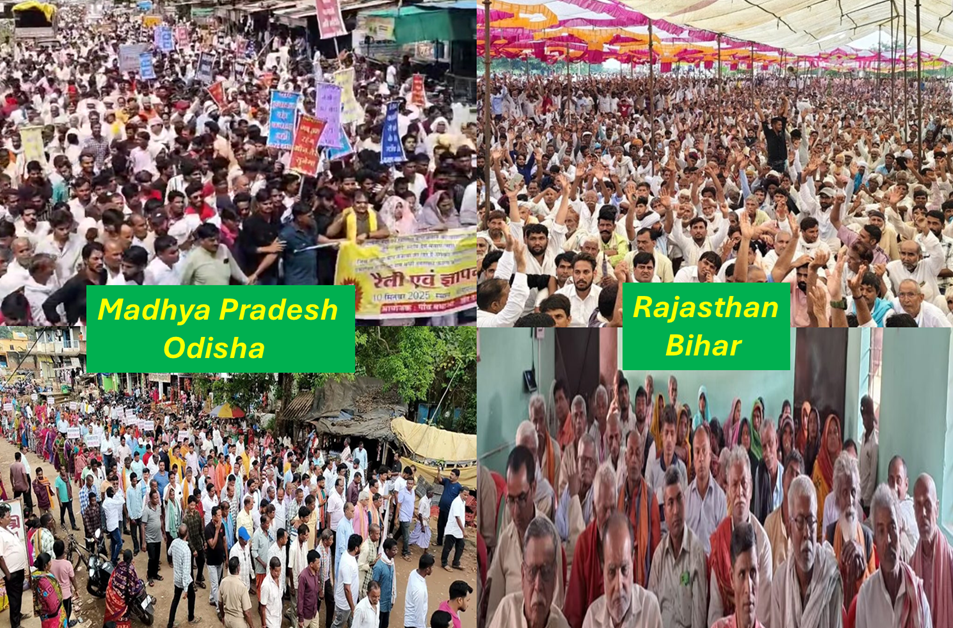
The annual overview tracks top ten people’s resistance stories against large dam projects in India during 2025. It is encouraging to see that the year ended with the Odisha CM announcing scrapping of Samakoi dam project after strong opposition by local villagers. Interestingly, the NTCA and CEC have boldly underlined the threats to tribal people, tigers and forest biodiversity from proposed Morand-Ganjal dam in Madhya Pradesh and dams in Shivalik national park in Haryana. During the year, the villagers have organized mass protests against massive Guna and Dongari dams under PKC link project. Demanding basic information and consultation, the affected tribals have halted ground surveys for Basania dam project.
The Maheshwar dam saga is reminder of how ill convinced dam projects lead to destruction of river eco-system, wastage of thousands of crores of rupees apart from affecting the riverine communities. Sadly, even after 40 years, the Chandil dam displaced villagers are forced to stage protests for rehabilitation and employment. In Bihar, even before the expert committee report, the govt has moved ahead with barrage projects on Kosi which the farmers have opposed. The year 2025 also marked the 25 years of World Commission on Dams Report with still relevant recommendations.
The overview has some more stories mostly from Madhya Pradesh where dam affected people have been struggling hard to make authorities address their just demands and concerns. MoJS minister has acknowledged non-feasibility of dams & need for work on alternatives. However, the picture on ground is quite the opposite.
1 Odisha: Samakoi Project scrapped after public outrage The proposed irrigation project on Samakoi River in Telkoi block of Keonjhar district will not be executed, following strong opposition from local residents. CM Mohan Charan Majhi announced cancellation of the project on Dec. 28, citing public concerns. Fearing large-scale displacement, local residents had been opposing the project for nearly four decades. Despite sustained protests, there had been no clear communication on whether the project would be dropped or implemented. The CM, while addressing the public, officially declared that the project stands scrapped. The CM assured that any future development project would be undertaken only at locations chosen by the Telkoi residents, and the State govt would prioritize the interests of local people.
Villagers oppose Samakoi project Residents of Chakadar panchayat staged a protest on Nov 3 against a proposed irrigation project on the Samakoi River. The villagers organised a rally and submitted a memorandum to CM Mohan Charan Majhi through the local tehsildar, demanding that the project be halted immediately. The protest has also received support from Naba Nirman Krushak Sangathan, a local farmers’ organisation.
2 Madhya Pradesh: PKC Link ‘Give development not displacement’ The proposal of a massive dam under the Parvati-Kalisindh-Chambal Link Project has become a major point of contention among farmers in Guna. On Sep 10, a large number of farmers from more than 60 villages to be affected by the dam submergence organized a mass protest rally in Binaganj. They marched with placards, banners and submitted a memorandum to the SDM. The petition addressed to the CM, clearly stated that they want development, not displacement. They explained that the plan involves constructing a 30-m high dam by drawing about 5 km long line from Ghatakhedi to Radhepura-Chitaura village. They said that this will completely submerge five village panchayats & inundate the fertile, irrigated land of more than 60 villages.
The farmers questioned, “What kind of development will this be if our ancestral land and homes are destroyed?” They stated that the original plan proposed two smaller dams, Kumbhraj-1 & Kumbhraj-2, but the state govt later amended it to a massive dam. According to the farmers, if the govt truly wants development, it can build smaller dams which would provide irrigation without displacing villages. The farmers warned of a prolonged agitation.
3 Rajasthan: PKC Link Protest intensifies against Dungari dam The Dungri Dam Mahapanchayat issued a Dec. 1 ultimatum to the govt. The Mahapanchayat, held on Nov. 21 at Jodli village, resonated with political disputes and loud slogans. Thousands of farmers and local residents gathered, worried about the submergence of their land and villages due to the dam’s construction. Ultimately, it was decided that if a positive dialogue with the Chief Minister was not reached by Dec 1, an intensified agitation would begin on Dec 10.
The PKC ERCP project, known as the Ramjal Setu Project, proposes the Dungri Dam in Dungri village, between Karauli and Sawai Madhopur dists. The estimated cost of this dam is ₹10,450 cr, and it will be one and a half times larger than the Bisalpur Dam, making it the third largest dam in Rajasthan. Prime Minister Narendra Modi laid the foundation stone for the first phase of the PKC ERCP project on Dec 17, 2024, when he visited Dadiya, Jaipur, to mark the completion of the first year of the Rajasthan govt. The Dungri Dam is to displace 76 villages.
In July 2025, a mahapanchayat at Doongri Kuti in Khandar saw protesters submit a memorandum to the local tehsildar, directed to the chief minister, requesting immediate cessation of dam-related work. According to local inhabitants, the authorities proceeded without conducting public consultations or obtaining approval from gram panchayats or residents in the affected Sawai Madhopur and Karauli districts.
The structure would submerge crucial sections of the Ranthambhore-Kailadevi corridor, an essential tiger movement route in eastern Rajasthan. The PKC-ERCP project encompasses 408.86 sq km of submergence area, with 227 sq km under the proposed Banas River dam reservoir. The planned 39-metre-high, 1.6-km-long structure will be situated near Doongri village, 30 km from Sawai Madhopur.
“The project details show, 37.03 sq km belong to Ranthambore National Park (392 sq km) and Keladevi Wildlife Sanctuary (674 sq km), both part of the Ranthambhore tiger reserve (1,113 sq km).” An official stated, “The canal project is to channel surplus water of the Chambal river basin for irrigation, drinking & industrial use to 23 dists of Rajasthan, to benefit 3.45 cr people.”
4 Madhya Pradesh: Basania Survey team return after facing villagers’ anger An official team that arrived to survey the proposed Basania-Audhari dam project in Paganiya village on Sep 6 faced strong opposition from the villagers. The villagers prevented the team from even entering the village. Villagers say if this dam is built, 13 villages in Dindori district and 18 villages in Mandla district will be completely affected. When the survey team arrived, the villagers came out in large numbers to protest.
The project has not been able to move forward due to repeated opposition from the villagers. The villagers allege that neither the govt nor the officials associated with the project have come to the village to provide clear information. No concrete assurances have been given regarding compensation, rehabilitation and livelihood. The village elders say that it is impossible for them to leave the land with which their lives have been intertwined for generations. The younger generation believes that if the government wants to bring in a project in the name of development, it should first have an open discussion with the people of the affected villages.
Basaniya dam sparks displacement fears In May 2025, villagers in Mandla and Dindori districts opposed the Basaniya Dam. Despite laws requiring Gram Sabha consent, surveys began without approval; tribal rights remain ignored.
5 Morand-Ganjal Dam will destroy tiger habitat, displace tribals: NTCA The National Tiger Conservation Authority (NTCA) warned the Morand-Ganjal Project would destroy tiger habitats and disrupt ecological connectivity between the Satpura and Melghat Tiger Reserves. During a meeting on Jan 27, the Forest Advisory Committee discussed a proposal to divert 2,250.05 ha forest land for the project. The NTCA has stressed that the submerged area is home to diverse wildlife and rich biodiversity. The authority has strongly recommended exploring alternative sites to balance development with conservation efforts.
According to NTCA’s analysis, based on the National Tiger Estimation 2022, the proposed project site is a vital tiger-occupied habitat. The project involves dams on the Morand & Ganjal rivers. The NTCA has cautioned that it could affect “genetic exchange & population stability.”
“Any disruption to this ecological connectivity will likely have long-term detrimental impacts on the viability of tiger populations and the broader wildlife community within this landscape,” the NTCA stated. The authority also noted that both the Satpura and Melghat Tiger Reserves are in a recovery phase, with tiger populations increasing due to voluntary village relocations. It warned that losing this corridor could reverse those gains.
Tribals oppose in Harda to save their land. Thousands of tribals in the Harda and Narmadapuram (Hoshangabad) districts are currently facing two separate crises. On one hand, they face the threat of displacement due to the Morand-Ganjal dam, and on the other hand, their livelihoods are threatened by the proposed Dr. Rajendra Prasad Sanctuary in the forest villages of Rahatgaon. In protest against both these projects, villagers took to the streets on Sept. 12 under the banner of the Jai Adivasi Yuva Shakti organization.
6 Maheshwar NBA PR: Order for liquidation of project assets by NCLT In a significant order, the National Company Law Tribunal (NCLT) in its order of July 11 directed the liquidation of the Shree Maheshwar Hydel Power Corp Ltd, promoter company of Maheshwar Project. This means the Maheshwar project’s assets will be auctioned and the proceeds will be distributed among the lending institutions. The Indore bench of NCLT stated in its order that, as no resolution has been reached for the Maheshwar Project, the liquidation of its assets should commence under Section 31 of the Insolvency and Bankruptcy Code, 2016.
The NCLT bench stated that, despite granting excessive time, no resolution was achieved, proving that a resolution is not possible, and the process remains where it began. The order also noted that information regarding the rehabilitation of affected communities and land acquisition was not provided to the lenders by the SMHPCL. Consequently, NCLT dismissed the application and ordered the liquidation of the project’s assets under Section 31 of the Insolvency and Bankruptcy Code, 2016.
The Narmada Bachao Andolan and the people of the Narmada valley demand that given the project’s harmful nature, an investigation should be conducted into the decisions that led to the loss of ₹5,000 cr of public money, and that those responsible should be held accountable and face punitive measures. The movement also clarifies that, as the affected communities have not been rehabilitated, their acquired lands cannot be auctioned or sold to other parties.
Maheshwar dam will have to be abandoned With decades of resistance from the Narmada Bachao Andolan, the project faced insurmountable challenges, including incomplete rehabilitation efforts and financial insolvency, leading to its liquidation by the NCLT. Not only has the Govt of Madhya Pradesh said that it will not take over the project, but it had also earlier abrogated in April 2020 the Power Purchase Agreement (PPA) that SMHPCL had with it. Therefore, there will be no buyers for the bare dam structure, without a PPA. The structure will stand as a mute testimony of India’s disastrous dam centric water and river management. (Rahul Banerjee)
7 Haryana Building dams in Kalesar NP will cause irreversible damage: CEC to SC Allowing construction of four dams inside Kalesar Wildlife Sanctuary in Yamunanagar is likely to cause “irreversible ecological damage, including the loss of critical habitat” for endangered species, the central empowered committee has recommended to the Supreme Court. CEC’s advice to the top court came on a plea filed by lawyer Gaurav Kumar Bansal, who last year challenged Haryana govt’s approval for the project despite earlier warnings by experts.
“Permission to build the four dams inside the sanctuary should be denied. The interim stay on construction, already in place, should continue. The wildlife clearance given by the National Board for Wildlife (NBWL) should be withdrawn because it was granted without considering these issues properly,” CEC said in its July 9 submission to the top court. Additionally, it said, Haryana’s forest department should prepare an alternative watershed management plan to conserve water and prevent flooding without harming the sanctuary.
A five-member team of CEC in Oct 2024 visited the sanctuary and noted that there were already eight earthen dams built by the forest department near the proposed sites for the new dams. These structures, the committee’s report signed by member secretary Banumathi G said, are being used by wildlife and blend into the habitat without disrupting it. The committee also raised legal concerns and said that Haryana govt’s proposal was not approved by the State Dam Safety Organisation (SDSO) or the National Dam Safety Authority (NDSA). This approval is mandatory under the Dam Safety Act, 2021.
Most importantly, the committee said, the dams are not unavoidable and don’t have to be built inside the sanctuary. According to environmental laws, diversion of forest land in protected areas should be allowed only if there is no other option.
8 Jharkhand: Chandil Dam displaced demand rehabilitation rights On Nov 4, a one-day protest and gate blockade was organized under the banner of the Displaced Rights Forum Foundation to demand a permanent solution to the problems of the Chandil Dam displaced people in the Seraikela-Kharsawan district. The protesters appealed to the government to immediately fulfill their demands for rehabilitation and employment, which have been pending for 43 years. Foundation officials stated that families from 116 villages displaced due to the Chandil Dam project are still deprived of their legitimate rights and rehabilitation benefits. Despite repeatedly bringing the matter to the government’s attention through protests, demonstrations, and hunger strikes, no concrete solution has been found so far. The displaced had also staged one day protest for their demands on April 30.
Chandil dam: A case study of forced displacement Abstract: The social structure is torn apart by forced displacement, scatters family groupings, disperses communities, and destroys patterns of social organization and interpersonal relationships. This paper argues that conflict takes place when the state’s developmental strategies dismantle the socio-economic, ecological, and cultural structure of the indigenous community who have customary right over the river and forest resources. The case is of Chandil dam displacees who have the least political orientation and are still struggling for a sustainable livelihood more than 40 years of the commencement of the dam construction over the Subarnarekha River. Employing the mixed-method approach, the author tried to map the contestation and dissonance aroused due to forced displacement practices and the involvement of the different actors directly or indirectly in the long-drawn conflict based on existing literature, ethnographic household surveys conducted in three phases, focus group discussions, and personal interviews.
9 Odisha: Pipalapanka Dam plan revival sparks outrage The Odisha govt’s revived proposal to construct a dam at Pipalapanka in Sorada block in Ganjam district at the confluence of the Rushikulya and Odangi rivers triggered fresh protests from environmentalists and local communities in April 2025, who allege the project prioritizes industrial interests over ecological and human concerns. While local officials and politicians claim the project aims to provide irrigation to farmers, environmentalists alleged a hidden agenda – to supply water to industries, including the Adani Group’s port at Gopalpur.
Prafaull Samantara recently led a 10-day padayatra to raise awareness about the ecological damage the Pipalapanka dam could cause and to demand the withdrawal of the project. Activists also joined the march. The Rushikulya river, which originates from the Rushimala hills in Kandhamal district, is considered the lifeline of Ganjam. Several of its tributaries – Jarau, Badanadi, Baghua, Dhanei, and Ghodahada – once ensured year-round flow but had been dammed, weakening the river from November to June.
Patkar urges people to protect river Rushikulya NBA activist Medha Patkar on Jun 1 appealed to the people of Odisha for protection of Rushikulya river. The govt planned to construct a dam in the river Pipalapnaka. While participating in the Save Rushikulya river movement in Ganjam district, she said, “Rivers are our mother. We have to protect the rivers.”
10 Bihar Farmers oppose Bagmati barrages Two new barrages will be constructed on the Bagmati River in Sitamarhi district near Dheng and Kataunjha. A budget of ₹25.37 crore has been allocated for this. The govt claims that the barrages will control the water level of the Bagmati River and reduce the severity of floods.
On March 25, a farmers’ convention was held at the Basbitta Panchayat Bhavan in Dheng, near the proposed barrage site, to protest against the project, citing the devastation caused by the Bagmati River in Sitamarhi. Farmers from 109 villages have been protesting against the embankments on the Bagmati since 2012, but the govt is pushing hard to build them.
The farmers believe that the embankments will deprive them of the fertile soil that the Bagmati brings every year. The fertility of the fields where embankments have already been built on the Bagmati has decreased. In 2018, when embankment construction began despite public protests, thousands of farmers blocked the highway. Following this protest, the govt stopped the work and formed a three-member committee to review the project. Anil Prakash, a key member of that committee says that the committee was not allowed to function properly, and its report was never completed. Besides Anil Prakash, the committee included renowned river expert Dinesh Kumar Mishra and Professor Rajiv Sinha from IIT Kanpur.
Anil Prakash says that the committee has held only one meeting so far. Its term has been extended repeatedly. According to the latest information, its term was extended until Dec 31, 2020. No information is available after that. Even before the committee could submit a report on whether or not the embankments should be built, preparations are now underway for the construction of the barrages.
Relevant Reports
The World Commission on Dams is eminently relevant at 25! 2025 marks the 25 years of the publication of the World Commission on Dams Report in Nov 2000, the report and its recommendation are as eminently relevant as they were ever earlier including in 2000.
As the World Bank returns to financing mega-dams and governments worldwide falsely tout hydropower as a climate solution, Rivers, Rights, Resistance report published on June 16, highlights lessons learned from the World Commission on Dams. Three key takeaways from the report are: -Hydropower still destroys rivers and lives. It continues to displace communities, threaten biodiversity, fuel the climate crisis, and spark conflict over scarce water resources.
-Twenty-five years after the WCD report, implementation of the recommendations is still lacking– decision-makers need to act urgently to prevent further harm.
– Justice for communities must be at the centre true energy transition. That means moving away from centralized, top-down to rights-based, community-led, and decentralized solutions.
The 25th anniversary is an opportunity to reflect on the Commission’s report and developments since then – but above all to look ahead. Because despite all the damage, numerous new dams are still being planned, which are touted as climate protection measures. Why should these plans be critically scrutinized? What does hydropower have to do with the climate crisis? What alternatives are there? These questions are explored in the publication.
MoJS Minister says new dams no longer feasible Jal Shakti Minister C. R. Paatil on Nov. 28 said that high costs, acquisition delays and declining river flows were major obstacles. He claimed the govt had shifted focus to water conservation, community participation & groundwater recharge through the ‘Jal Sanchay Jan Bhagidari’ (JSJB) initiative and the Jal Shakti Abhiyan. “In the first 10 months, against the target of 10 lakh structures, people built 27.5 lakh,” he said, adding that this year’s target was one crore. He also urged states to make full use of MGNREGA funds allocated for water conservation.
Citing examples from Gujarat & Rajasthan, he said community-led work was showing results. In Banaskantha, he said, the NGO Vantara and farmers built 30,000 recharge structures, helping revive drying wells. “Govt alone cannot do this. Water is not just a state subject, but it is the responsibility of all of us,” he said. He urged officers to prioritise work over positions.
Madhya Pradesh Book on Indira Sagar dam displacement miseries Dr. Shriram Parihar’s essay collection, “Vyatha Katha Doob Ki” (The Pain of Submergence), offers a poignant portrayal of the people affected by the Indira Sagar Dam project on the Narmada River, who were forced to abandon their homes, fields, and culture due to the dam. The book released in May 2025 also highlights the challenges of resettling these displaced communities.
Harsud Asia’s largest dam affected town Harsud town, 245 villages with over 2.5 lakh people were displaced from Harsud town for the Indira Sagar dam. The town was totally submerged in dam’s back water on June, 30, 2004. A plan was made to resettle the people. They were given land near Chanera, but many people still do not have legal title to their land. They did not receive compensation, which is why they are still fighting a legal battle even after 20 years of submergence. The reportedly 700 year old habitation Harsud was also known as the city of King Harshavardhana. Now, it is remembered primarily for being the site of one of Asia’s largest displacement events.
Pangri dam: Farmers demand fair compensation Alleging discrimination against tribals, Burhanpur farmers in large number gathered along the banks of the Utavali River and smeared their faces with black paint in second week of Dec. 2025. They say that while they were promised double the compensation for the agricultural land acquired under the Pangri dam project, they have not received fair compensation even after losing their land. The protesters say that there has been a lack of transparency regarding the Pangri dam project from the very beginning. Officials have not yet given clear answers to questions about whose land will be acquired, how much compensation will be given, and what alternative arrangements will be made. The Pangri dam dispute has been ongoing for a long time, but the administration’s continued silence is only making the situation worse.
The farmers have been raising the issue since July 2025. The dam has affected nearly 300 families. Many of these families have lost all their agricultural land. The district administration is offering the farmers the land price at the collector’s rate, along with an equal amount as compensation. However, Ravi Patel argues that the land acquisition law clearly states that twice the market value of the land should be paid as compensation and a bonus. He explained that the submerged land was used for cultivating sugarcane, bananas, and cotton. The price the administration is offering is insufficient to purchase equivalent agricultural land elsewhere.
Banda dam affected farmers insist on meeting DC Farmers affected by the Uldan irrigation project in Sagar district staged a protest in front of the Collector’s office, raising slogans. The farmers reached the district administration on Aug. 19 to register their complaints regarding their demands. The Pithauli villagers were adamant about meeting the Collector and holding a sit-in protest at the Collectorate. When the police prevented the farmers from entering, a scuffle broke out between the police and the villagers, the police forcibly removed the villagers.
The Uldan project, a large-scale irrigation project in Banda tehsil, involves a dam. However, during the 2025 monsoon, the dam has caused Pithauli village in Malthon tehsil to be surrounded by water, turning it into an island. This resulted in flooding of the villagers’ fields and homes. The farmers launched a protest against the irrigation project, demanding that either the dam’s location be changed or its height be reduced so that their fields and houses remain safe from flooding.
Protesting farmer Raghavendra Singh said, “We have been coming to the Collectorate for the past several months regarding our problem. But we have not been able to meet the Collector till date. We had boycotted the elections and then the SDM had promised that our demands would be fulfilled. But after the elections, the dam work is continuing as before and our village and fields are getting submerged.”
Why are Banda dam affected aggrieved? Under Banda irrigation project a 661.50-m-long and 28-m-high dam is to be constructed on the Dhasan River, a tributary of the Betwa River. The project, which was proposed approximately seven years ago, aims to provide water to two districts of Bundelkhand. Financial approval for the project was granted on June 26, 2018. Although construction has been underway for several years, the project is now expected to be completed by 2026. However, 28 villages will be submerged as a result. With the new deadline and the commencement of canal construction, the villagers’ anger and insecurity over displacement and inadequate compensation have intensified.
50-year-old Shyam Bai Gond hasn’t been able to sleep properly for the past 10 months. She lives with her only son and daughter-in-law in a mud house built on leased land in Hanota Uwari village. She has received only Rs 94,000 as compensation. She says, “My husband died many years ago. Now I’m getting such a small amount of compensation. How can we rebuild our lives with this money?” Since January, she has been visiting various govt offices, including the Collector’s office, hoping to receive at least enough compensation to start a new life in a new place. It’s worth noting that the govt is also providing plots for resettlement 20 km away from her current residence. However, Shyam Bai has refused to accept even that, protesting against the inadequate compensation.
Protest against Tapi Recharge Project Tribals and farmers of Maharashtra and Madhya Padesh Tapi basin took out a protest demonstration in Dharani in Melghat, Mah against the proposed Tapi Recharge project on Apr 18 2025.
KBL Dhodan dam affected stop work Construction work on the Dhodan dam, being built under the Ken-Betwa river linking project in Khajuraho was stopped on Apr 3 by displaced villagers. People from several villages, including Dhodan, Palkoha, Khariyani, Mainari, and Sukwaha, reached the construction site and removed the laborers and staff. Their demand was that they be given compensation packages first. They forced the machinery and workers involved to move outside the Bhusor barrier of the Panna Tiger Reserve. The villagers warned that they will launch a more aggressive protest if the construction work continues.
The villagers also raised concerns about the problem of wild animals. They said that due to the work, wild animals are entering the villages, resulting in injuries to several villagers. They demanded that all young people up to the age of 18 be included in the rehabilitation package. They demanded that the administration stop removing names from the package list without the consent of the Gram Panchayat (village council). The villagers demanded 10-20 acres of land downstream of the dam where they can build their houses and establish religious sites. Furthermore, they demanded that affected villagers be given priority for employment in the dam construction and that their vehicles be hired for the work.
Sardar Sarovar Project Court seizes SSPA office chairs, television Office chairs, including that of the Chief Executive Officer (CEO) and Chairman of the Sardar Sarovar Punarvasahat Agency (SSPA), as well as computers and television sets were confiscated by the bailiff of Dabhoi civil court as per a court warrant to recover a compensation of Rs 30 crore due to nine villagers, who had parted with their lands for the Sardar Sarovar Narmada Nigam Ltd (SSNNL) to rehabilitate the Narmada dam oustees. As the bailiffs and the petitioners – all senior citizens – seeking compensation arrived at the SSNNL office in Narmada Bhavan compound in Vadodara city to execute the court warrant, they were met with vacant offices.
On Mar 20, the Dabhoi civil court bailiff, along with petitioners, arrived at the office of the SSNNL and SSPA at Narmada Bhavan in Vadodara. Bailiff Sanjay Solanki said that as per the court warrant, the process was to attach “whatever movable items are available in the office”.
Kerala Tribes rise again; vow to block dam revival A decade after they believed they had buried the threat of the 163 MW Athirappilly hydroelectric project for good, its resurrection has jolted the indigenous people back into action – once again, they are on their toes, ready to defend their land. At a recent gathering, the leadership of the Vazhachal CFR Coordination Sangham – representing the nine tribal hamlets entrusted with the care of over 400 sq km of forest under the Forest Rights Act, 2006 – vowed to resist Kerala State Electricity Board’s (KSEB) latest move, renewing their pledge to defend the land they hold sacred.
Impact of Silent Valley Protest The success of the Silent Valley movement kindled the environmental consciousness of a whole generation of people. And as a result, the Ministry of Environment and Forests became a strong regulatory body with far more powers, new environmental guidelines were written into government statutes, environmental impact assessments became mandatory and environmental costs were weighed against development rewards for ascertaining the risks and rewards of all programs.
However, in the past couple of decades we have increasingly squandered away the policy gains that we had made through these struggles. The checks and balances we had erected in our environment-development paradigm have been eroded. (C. J. Punnathara)
Chhattisgarh Protest against Chhai Dam In July 2025, villagers in Patratu Balkudra, Ramgarh district protested and halted the construction of the Chhai Dam by PVUNL. People from four villages associated with the Displaced Affected Struggle Front staged a demonstration at the dam site. The displaced villagers said that earlier talks at the district collectorate were unsuccessful. They alleged that the company had forcibly started work after turning the area into a police camp.
SANDRP

 SANDRP