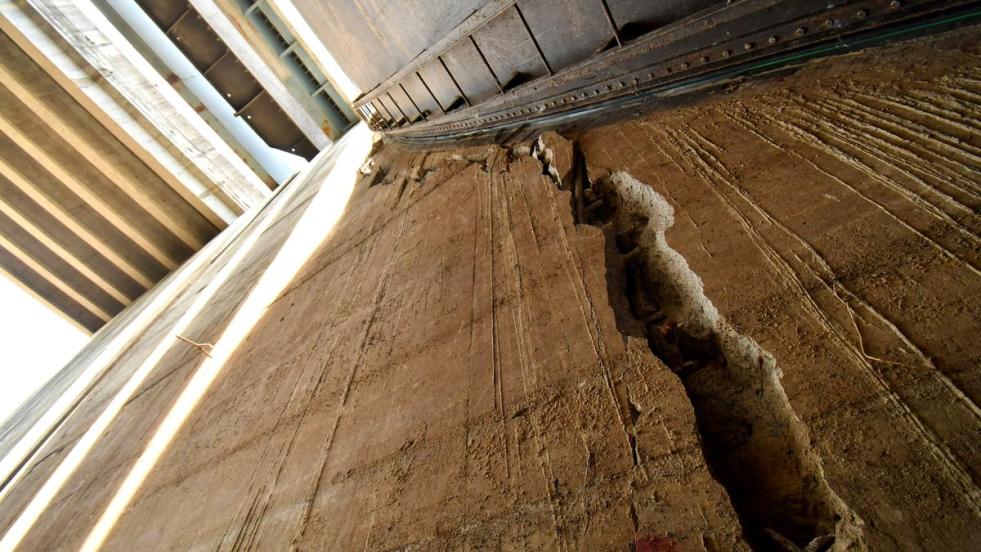
(Feature Image: Wide crack in Medigadda (Lakshmi) barrage of Kaleshwaram. Credit: Nagara Gopal)
The year 2025 has seen revealing information on three inquiry reports highlighting how the Kalewshwaram project have become a massive failure on all fronts be it designing or implementing the dam project or even acting on probe reports. While govt seems to reverify liability of officials indicted in V&E report, it ended up seeking CBI investigation after tabling Ghose panel report in state assembly in Aug 2025. Similarly, the NDSA report is being followed only for fixing the damages while action against the responsible govt officials and private players is clearly missing.
The NDSA 365 page report and Ghose commission 650 page report on KLIP disaster were given to govt April 24 and July 31 this year respectively after V&E report in Oct. 2024. While NDSA had submitted to its report to MoJS in Dec. 2024, the agency handed over same to state govt after for month of delay for unknown reasons.
V&E Report Recommends criminal action against 17 officials, L&T PES On 5 March, the Vigilance and Enforcement Director General submitted a report which flagged serious lapses in design, supervision, quality control, and execution. In its report to the govt, the commission also stated that criminal action should be taken against L&T PES, the company which was involved in the construction of the barrage. The report named several former Engineers-in-Chief and current Chief Engineers, and Superintending Engineers and suggested that penalties be imposed on 33 engineers. It also recommended that the government take action against seven retired engineers. The commission has stated in its report that there was complete negligence at the field level.
No action against ‘erring’ engineers for now As per Aug 2025 report, Irrigation department has kept the State Vigilance Commission’s report on hold for the time being and reportedly decided to take more time to act against the “erring” engineers. It may be recalled that the Vigilance Commission, which submitted its report in March this year, recommended action against 57 serving and retired engineers for irregularities.
-The state govt had ordered a vigilance probe into the KLIS’s irregularities in January 2024. It has been close to six months since the Commission submitted its report, but the department is yet to initiate action against the engineers mentioned by the Commission. A senior official of the department told that they had to verify the “liability” of the engineers once again. The Commission’s recommendation was “en masse”, the official said and added that there was no involvement of some of the engineers mentioned by the Commission. Thus, the department had decided to verify the actual “liability” of the engineers named by the Commission. Any action would be initiated only after that, the official added.
V&E report spotlights design flaws, rush, cutting corners The V&E had reportedly submitted its report to the govt in last week of Oct 2024. There were several damning findings in the report, it was learnt, among which were the option to go with what is known as the ‘secant pile system’ and poor supervision of the construction using this system. The govt was expected to hand over the report to the Justice P.C. Ghose commission of inquiry which has asked for the V&E report along with the report from the National Dam Safety Authority (NDSA) among many other documents pertaining to the planning, construction and maintenance of the Kaleshwaram barrages.
NDSA Report MoJSdelayed submission? The NDSA expert committee report on the controversial Kaleshwaram project was submitted to the Telangana govt on April 24, 2025, while the NDSA had submitted the report to the Ministry of Jal Shakti (MoJS) in Dec 2024. Why should it take any time at all for the NDSA expert committee report to reach the state government, leave aside the 4 months it has taken.
This becomes even more intriguing considering that monsoon was less than two months away, and no work was possible related to repairing the damaged three barrages of (Medigadda, Annaram and Sundilla) and the time now left before monsoon is possibly totally inadequate to complete, for example the removal of the damaged block 7 of Medigadda barrage as recommended by NDSA expert committee. The NDSA expert committee report is also not available in public domain, which must be as all issues related to dam safety are public interest issues.
Irreversible damage to barrages: NDSA report Stating that the damage to the raft and piers of block 7 of the Medigadda barrage of the Kaleshwaram Lift Irrigation Scheme (KLIS) are irreversible, NDSA recommended that the govt should not use the (block 7) structures for the operation of gates again. They may be safely disposed of or stabilized, in situ, based on the experience of the executing agency. NDSA also said while carrying out the works, the adjacent blocks should not be damaged in any manner.
– On Annaram and Sundilla, which have also developed structural issues, the NDSA said the two barrages have also experienced distress conditions and damages “rendering them unserviceable” and were also vulnerable. “All three barrages need to be thoroughly and entirely investigated from all angles,” NDSA added.
– The NDSA committee, led by J Chandrashekhar Iyer and member secretary Amitabh Meena, along with other members, investigated sinking of some piers of block 7 of the Medigadda barrage and problems in the Annaram and Sundilla barrages. They submitted a 365-page report to the Union ministry of jal shakti in Dec last, which has been sent to the Telangana govt for further action. Three piers were completely damaged, while some others were partially affected in block 7 of Medigadda in Oct 2023.
– Regarding the reasons for the sinking of piers in Medigadda and other barrages, NDSA, in its report, stated that the sand piping phenomenon, cavity formation underneath the raft, construction defects, design deficiencies, structural distress, and other downstream damages experienced by block 7 rendered it unserviceable. These issues could manifest in other blocks of the Medigadda barrage as well. The committee noted that the geophysical investigation report reveals that cavities underneath the raft had formed not only in block 7 but also in other blocks.
– “The damages to block 7 have resulted in the barrage becoming non-functional for diverting water. Even the bridge that spanned over it has become non-functional. Since this block is not the first or last block of the barrage, the movement of the gantry crane over the whole barrage width has also been stopped. Due to such sinking, not only has block 7 suffered irreversible damages, but its safe removal would also pose challenges as it may cause damage to adjacent blocks,” the report stated.
-The committee mentioned that the flexible protection works of the barrage, such as CC blocks and the launching apron in the downstream, have either settled, been damaged, dislodged, or washed far away at many locations along the length of the barrage.
Barrages need extensive repair: NDSA “Extensive debilitating damages.” With these three words in its 378-page report on the state of three barrages, the NDSA issued a damning indictment of planning, executing, constructing, and maintaining the three barrages.
-It further made it clear that the condition of the barrages was such that they require “immediate stabilization measures” adding that they are experiencing “ongoing distress.” In short, the NDSA made it clear that irrigation department engineers will have to go back to their drawing boards if these barrages were ever again to be put to use. And that they do not have much time to lose. The NDSA said all three barrages had construction defects, design deficiencies, structural distress resulting in the phenomenon of sand piping, cavity formation underneath the raft, and other downstream damages rendering them “unserviceable.”
-It further warned that the damages seen in Block 7 of Medigadda. “The two upstream barrages at Annaram and Sundilla, which have similar deficiencies in design and construction, have also experienced distress conditions and damages rendering them unserviceable.” The NDSA said all the three barrages were vulnerable, can experience catastrophic failure, and hence, they need to be thoroughly and entirely investigated in right earnest.
– The NDSA raised the question of ethics that were probably given a go by saying “in the larger interest, it is important that engineering ethics take lead, and no bias creeps into the investigations and studies.”
Medigadda beyond repair It is learnt to have concluded that the partial collapse of the Medigadda barrage, as well as problems at its sister barrages at Annaram and Sundilla, resulted from poor planning, faulty design, and the abuse of the structures for storing water despite the fact that they were not to be used as dams to store water.
– Sources said that the NDSA also noted that repairs to the three barrages – in the form of grouting the voids that were formed due to the stored water forcing its way from under their foundations – were taken up without its approval. The report is expected to be sent by the NDSA to the state government in the next few days. The government has been waiting for it before taking any action on the way forward with the barrages and their repairs.
Flaws at all level The NDSA in final report stated that there were flaws at all levels, from design to construction, quality and maintenance of the three dams. It also stated that diverting water from Annaram and Sundilla dams was not safe, as the barrages have been damaged.
-It stated that the design, hydraulic models, gate operations were not proper, and that there were design flaws in energy dissipation and gate seat positioning. It stated that the model studies were not done properly, and the hydraulic-structural design was not adequate. It stated that the construction of the barrages started while the detailed project report (DPR) was still under the scrutiny of the Central Water Commission (CWC), and that the construction areas and designs of the Annaram and Sundilla dams were changed without prior geotechnical studies.
L&T, Afcons write to govt on NDSA report After submission on NDSA final report, the L&T-PES JV, which constructed Medigadda, and AFCONS-VIJETA-PES-JV, which constructed Annaram barrage, have written to the govt on the investigations and rehabilitation. The state govt earlier shared the NDSA report with the agencies seeking their opinion on going ahead with repairs and rehabilitation of the three barrages.
– L&T has said there were certain inconsistencies in the NDSA final report on various issues. In the letter (May 24), L&T said there were contradictory points in the report, including inadequacy in geo-technical investigations for design to find out the variability of the foundation strata and related geotechnical uncertainties, deficiencies in model studies by TSERL, inadequacy in hydraulic and structural design aspects, specifically regarding the design of energy dissipation mechanisms and structural components, lapses in operation and maintenance (O&M), absence of an O&M manual, lack of quality control and O&M challenges, non-compliance with provisions of the Dam Safety Act, 2021.
-Afcons said the NDSA recommended holistic rehabilitation design, which includes detailed assessment of the structural health and safety of the barrages, comprehensive geo-technical studies and advances geo-physical assessment, etc. For carrying out that, the agency asked the irrigation department to engage an irrigation department designer or qualified agency and design consultant for taking up rehabilitation works as suggested by the NDSA. It also asked drilling pattern, depth, diameter, location of holes etc., to be drilled for geo-technical studies and other investigations. “After finalization and approval of the design and drawings, the contractor is also prepared to execute the construction under a separate agreement,” the letter on May 23 said. Afcons also requested the govt to release 176 crore pending payment, 4.45 crore towards NDSA recommended interim measures and works and also release 43 crore back guarantee.
L&T claims ‘certain inconsistencies’ L&T referred to point five of the executive summary of the report, which stated that the original ground conditions and the state of structures could not be assessed due to premature grouting, which altered critical sub-surface geotechnical conditions beneath the raft and along the secant pile cut-offs. “However, in contrast, page 283 of Chapter 11.2 noted that the Quality Management Program (QMP) documents had been submitted by the construction agency, and that these documents helped project teams establish quality planning, quality control, and assurance procedures,” the letter said.
-L&T also cited pages 64 and 65 of the report, which acknowledged that grouting activities carried out by the Irrigation and CAD department had altered the upstream and downstream plinth slabs and secant piles, making it impossible to evaluate their original condition. “Additionally, page 145 of Chapter 6 noted that premature grouting was performed before seismic investigations could be conducted, resulting in the loss of information regarding the secant pile cut-offs and parametric joints,” the letter said.
-With regard to the observation on quality control, L&T referred to its responses to 31 questions submitted to the NDSA on March 29, 2024. “Despite this, the NDSA’s executive summary, point 13, stated that no quality control procedures had been implemented to ensure the watertightness of the cut-off walls,” the letter said, claiming that this contradicted the report’s own earlier observations and the submitted documents.
Afcons, L&T agree to help repairs The contacting agencies came forward to cooperate with Irrigation department in restoring the Annaram and Medigadda barrages as suggested by the NDSA.
NDSA suggests rebuilding Medigadda However, it seems that it has been suggested that the responsibility of preparing the design required for the reconstruction of this block be entrusted to the CWC. The expert committee formed under the leadership of former CWC Chandrashekhar Iyer explained the important aspects of it to the Jal Shakti officials through a presentation.
Govt seeks CWC help to restore Medigadda The state govt sought the CWC assistance to address severe structural issues in the Medigadda barrage, following damning findings by the NDSA report. Irrigation Minister N Uttam Kumar Reddy met newly appointed CWC Chairman Atul Jain on May 7. The Minister requested the CWC to carry out a comprehensive geotechnical and structural review and advise on the restoration and safety of the project.
NDSA offers to work as design consultant Telangana Irrigation minister N. Uttam Kumar Reddy on June 25 said restoration works at the Medigadda, Annaram, and Sundilla barrages of the Kaleshwaram Lift Irrigation Scheme should proceed on a war-footing in accordance with the Central Water Commission guidelines and called that officials submit weekly progress reports to him on this matter. Uttam Kumar Reddy, at a meeting with senior irrigation officials, directed officials to implement the NDSA’s recommendations. Officials responded that the NDSA itself has offered to work as the design consultant for restoration works.
Minister seeks weekly reports on restoration work On June 25, Irrigation minister N. Uttam Kumar Reddy reviewed the findings of the NDSA on damaged barrages, and directed officials to implement the NDSA’s recommendations without delay. When officials responded that the NDSA itself has offered to work as the design consultant for restoration works, the Minister emphasized the urgency of the situation and sought weekly progress reports.
Govt invites EoI to repair barrages The govt in first week of Oct. 2025 invited Expressions of Interest (EOI) from reputed design agencies for preparing rehabilitation and restoration designs of the three barrages. A notification issued by the Irrigation and Command Area Development (I&CAD) Department said that the EOIs must be submitted by October 15. Chief Engineer of the Central Designs Organization said the empaneled agencies will be tasked with preparing rehabilitation designs based on the investigations conducted by the NDSA committee.
Ghose Panel The State Cabinet on June 23 decided to submit all the information sought by the Kaleshwaram Commission by June 30. This is part of ongoing efforts to address concerns related to the project and ensure transparency.
Key findings Stating that cabinet approvals were not taken for the three critical barrages Justice (retd) PC Ghose’s one-man commission came down heavily on the procedural violations, faulty planning, inflated estimates and irregular approvals that dogged the KLIP. In its scathing 650-page report, the panel found fault with virtually every aspect of the barrages, including site selection, execution, quality control, financial sanctions, operation and maintenance.
-Calling the project a case of “rampant and brazen procedural and financial irregularities,” the commission concluded that what was touted as Telangana’s lifeline had turned into a colossal waste of public money due to a complete breakdown of governance, planning, technical oversight and financial prudence, driven largely by individual discretion and political interference.
-The panel noted that the administrative approvals granted on March 1, 2016 (GO Nos. 231, 232 and 233) were neither placed before nor ratified by the state cabinet. Instead, they were unilaterally approved by the irrigation minister and the CM, in clear violation of govt business rules. The commission flagged further irregularities: KCR wrote to PM Modi pegging the project cost at ₹71,436 crore without a finalized DPR from WAPCOS. The specially created SPV, Kaleshwaram Irrigation Project Corporation Limited, meant to oversee implementation and financial oversight, merely acted as a loan-raising entity, it said.
-Design-wise too, the barrages were flawed – built on permeable foundations and used as storage structures against best engineering practices. Critical studies like backwater, tailwater and geophysical surveys were not conducted at Annaram and Sundilla, and designs were made “without proper studies and inexplicable delay,” the commission found.
– The barrages were also kept at full capacity throughout to lift water through pumps, even as the barrages “were diversion structures and not storage structures”. Running the barrages at full capacity seemed to have caused the distress, the commission noted.
₹612cr excess payments made to L&T, others “Post-tender inclusion of price adjustment clauses in five agreements led to an avoidable payment of price escalation of Rs. 1,342.48 crore. Other inflated rates, undue benefits/excess payments to contractors, including L&T company, amounted to Rs. 612.51 crore”, the Ghose Commission report said. The panel has asked the govt to investigate this.
-The Ghose Commission report included an analysis of the escalation of the project cost from Rs 38,500 crore to Rs 71,436 crore for Kaleshwaram (as per CM’s letter in 2016), and later saw revised administrative approvals totalling over Rs.1,10,248.48 crore by March 2022. The Commission also pointed to the Expert Committee’s view that shifting of the project from Tummidihetti to Medigadda would render “approximately Rs. 6,000 crore” of work already done as “infructuous”, plus an additional Rs. 1,500 crore for tunnel lining/filling, and extra land acquisition cost.
L&T hid facts about Medigadda barrage: Ghose panel L&T had itself designed the barrage, according to Justice PC Ghose Commission. The report also said that the Certificate of Completion of Medigadda Barrage works was issued on March 30, 2021, by the Irrigation Department’s Executive Engineer T Tirupathi Rao. Interestingly, the same engineer wrote a letter to the contract agency a week later on April 6 that “It was requested to mobilize men, material, and plan for taking up works for rectifying all the machinery damages occurred in the CC blocks, wearing coat, etc, and also to take up the balance original works i.e., approach roads to barrage, construction/erection of maintenance bays for gantry cranes on both sides of the barrage etc.” But it seems no efforts are made to take up the rectification of all the damage and completing the balance of the original works. This report shares some details on the findings of the commission.
Ghose Commission blames KCR Recommending that the state govt take appropriate action against the KCR in accordance with law, the one man Justice (Retd) PC Ghose commission observed that it was ‘conclusively established’ that the then CM’s direct involvement and minute directions in the planning, construction and operation of the three barrages were the root cause of irregularities and distress.
-“The then CM KCR took every decision upon himself. In all aspects of the construction of these barrages, beginning with conceptualizing the Kaleshwaram project under the guise of re-engineering the Dr BR Ambedkar Pranahitha-Chevella Sujala Sravanthi Scheme, he personally intervened. This included entrusting consultancy services to WAPCOS on nomination, proceeding without its final DPR, directing preparation and approval of estimates without cabinet sanction, ordering impound of water, and relaxing contract conditions to favour agencies unduly,” the Ghose commission said. The state govt has tabled the 650-page report in the assembly on Aug 31 after the cabinet earlier accepted the report of the commission submitted the report on July 31.
-Apart from KCR, the commission recommended action against former ministers T Harish Rao and Eatala Rajender, as well as against engineering officials associated with administration, quality control, operations and maintenance, designs, and the Kaleshwaram corporation.
Commission finds Kaleshwaram Unviable The PC Ghose commission also found the three barrages of Kaleshwaram unviable to continue and stated that the irrigation department now faces a power dues burden of Rs 9,735 crore to the power department, as it consumed 8,450 Mw, compared to 3,400 Mw required for the Pranahita Chevella project.
-Claiming that KLIS did not bring any additional crop area under irrigation, the WRD Minister Uttam Kumar Reddy said the state recorded a record harvest of 26.1 Mil Tonnes in 2024-25, after the barrage collapsed and with no net water usage for crops. In contrast, when Kaleshwaram was operational, paddy harvests were 18.6 MT in 2021-22, 23.8 MT in 2022-23, and 25.3 MT in 2023-24, he said during debate on the report in assembly on Aug 30. He said: The net water available after evaporation losses was only 114 tmc ft and of which only 101 tmc ft water was used. The new ayacut created was less than 1 lakh acres and stabilisation too less than 1 lakh acres.
Govt orders CBI probe The CM announced that the investigation into the alleged irregularities in the construction of the KLIP will be handed over to the Central Bureau of Investigation (CBI). He announced the decision in the Assembly on Aug 31 midnight after a marathon discussion over 10 hours after placing the report by the Commission of Inquiry, headed by former Supreme Court judge Justice Pinaki Chandra Ghose on the table of the House.
CBI probe: Less about dams, more about political gains Significantly, the commission found “rank irregularity from the conceptualization stage of the KLIP until administrative approvals were issued on March 1, 2016.” It documented how project costs spiraled dramatically. Initially conceived at Rs 38,500 crore, expenses escalated to Rs 71,436 crore and later reached over Rs 1,10,248.48 crore by March 2022 through revised administrative approvals.
-The KIPCL secured loans totaling Rs 87,449.15 crore with state govt guarantees. As of September 2024, Rs 29,737.06 crore had been paid toward principal and interest, leaving a balance of Rs 64,212.78 crore plus approximately Rs 41,638 crore in additional payable interest, a massive burden on the state budget.
-The Kaleshwaram saga, initially intended as Telangana’s lifeline, appears to have now become a symbol of governance failures and financial irregularities. Whether the CBI probe will deliver accountability or become another political chess piece remains to seen. (SNV Sudhir)
2 months on, CBI drags its feet Despite writing to the central agency on Sept 2 seeking a full-fledged probe into the alleged irregularities in the construction KLIS barrages, the govt has not received a response for over two-and-a-half months. In this instance, the delay is believed to be linked to the probe agency awaiting clearance from the Union home ministry.
Multiple probes, including Justice PC Ghose’s one-man commission, the NDSA and the vigilance and enforcement department, have already documented critical failures in design, construction quality, operations and maintenance practices and financial oversight. They also flagged lack of responsibility at multiple levels, from a retired chief secretary and engineers-in-chief to assistant engineers.
After the Reports: KLIP to be abandoned? The recommendation of irrigation experts and others to the Telangana govt is to prioritize Tummidihatti project, rather than spending limited available resources on repair of KLIP barrages is alarming. The reasoning seems to be apparent difficulty to rehabilitation of the barrages with inherent unstable foundation on sand beds.
-This apparent recommendation translates into abandonment of the Kaleshwaram project. This also gets strength from the huge delay by the NDSA to submit its report and then Ministry of Jal Shakti sitting on it for 4-5 months and no movement towards the repair of the barrages first damaged with a big bang on Oct 21 2023.
-If this is indeed the case, this project and its fate will be recorded in the history as the evidence of complete failure of so many aspects of India’s dam projects, that too the costliest project, most corruption ridden project which was publicly praised by the engineers of the CWC.
Focus on Tummidihatti Speaking at a round table discussion titled ‘NDSA Final Report–Future of Kaleshwaram Project,’ on May 15, Irrigation expert PG Sastry, presenting an analysis of the Kaleshwaram project and the NDSA report, highlighted that constructing barrages on sand beds poses significant engineering challenges compared to rocky terrain. He said that the barrages were all built on sand beds. “These barrages were designed to hold only 2.5 to 3 tmcft of water, but the previous govt stored far more -16 tmcft in Medigadda, 12 tmcft in Annaram, and 8 tmcft in Sundilla. When such large volumes are stored, the structure functions more like a dam than a barrage. This excessive storage caused serious damage to the spillways and foundation,” Sastry explained.
Ignore advice of politicos: CM A Revanth Reddy advised irrigation engineers not to take instructions from political leaders, who have limited knowledge on irrigation issues, on how and where to build barrages, dams and reservoirs, otherwise they will have to face the music and go to jail, if something goes wrong like Kaleshwaram project. “Kaleshwaram project is the only irrigation project in the world that collapsed within three years of construction and inauguration even after spending over 1 lakh crore. Even soil tests of the three barrages were not done properly. Other project Sitharama Sagar has also some structural issues.”
Govt warns L&T to repair or face black listing The govt threatened to blacklist L&T, as well as take steps to have the company blacklisted in rest of India if it does not issue “a favorable response within one week,” to the demand that the company cooperate with the government in all steps needed for repairs and rehabilitation of the Medigadda barrage. The government has also made it clear that L&T PES-JV which built the barrage, that any repair and rehabilitation work must be taken up and completed at its own cost.
The unprecedented ultimatum to L&T was in a letter dated Nov. 03, sent by the irrigation dept’s Ramagundam Circle’s superintending engineer. The 14-page letter also warned L&T PES-JV that if it fails to agree to the terms set by the irrigation department, then the company could also face “recovery of costs and damages under the Revenue Recovery Act, as per prevailing Government rules in vogue,” and risks the “forfeiture of all deposits and pending payments” due to it.
HC seeks implementation report In a separate case, the Chief Justice Aparesh Kumar Singh and Justice G.M. Mohiuddin of the Telangana High Court on Aug 12 directed the State govt to file an implementation report detailing the measures taken to protect the Kaleshwaram project and the steps initiated under Section 39 of the Disaster Management Act. The Bench was hearing a PIL seeking enforcement of the provisions of the Act in the wake of the 2023 floods. The petitioners also sought directions for safeguarding the barrages of the Kaleshwaram project from further damage. Further hearing on Aug 28.
SANDRP

 SANDRP