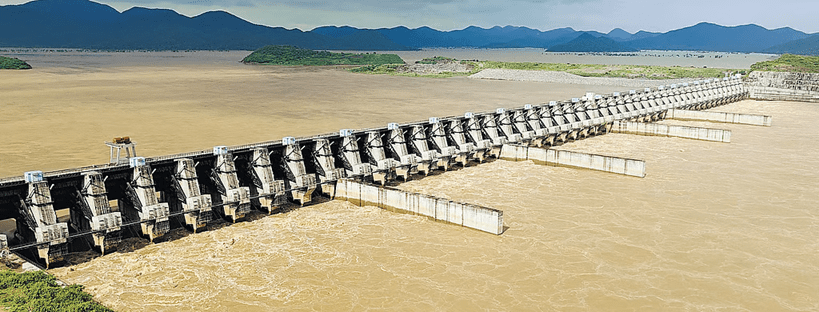
(Feature Image: Godavari river in flood spate at Polavaram project site in Aug 2025. Source)
Amid concerns over safety and construction quality, the Polavaram project work has moved during 2025 to achieve Dec. 2027 completion target. However, not much progress has been made regarding the backwater study and addressing the issues of affected tribals and areas in Telangana, Odisha and Chhattisgarh. Meanwhile, after failing to push PBLP (Polavaram Banakacherla Link Project), the Andhra govt has proposed another contentious PNLP to divert Godavari River waters. The Stop Work order issued by the MoEF in 2011 remains suspended for all these years, making a mockery of the MoEF regulations. Wrapping up the available information, this overview shares the year-round updates on safety, progress, backwater study and linking plans related to the controversial Polavaram dam project in 2025. Our previous overview on the project can be seen here.
Safety: Quality concerns continue to haunt As per July 2025 report, despite repeated recommendations from a team of international experts, it appears no significant steps have been taken to implement quality control measures in the Polavaram project. The Union Ministry of Jal Shakti (MoJS) has been persistent in pushing for action, but progress on this front remains sluggish. Six months after the work began on the reconstruction of the diaphragm wall, only 30% of the structure has been completed, and critical quality control mechanisms are yet to be fully operationalized.
The manual & guidelines relating to quality control are yet to be published. A draft manual prepared by the Andhra Pradesh Engineering Research Institute is still awaiting approval from several Central & State-level agencies, including the MoJS, Central Water Commission (CWC), Polavaram Project Authority (PPA), and the A.P. Water Resources Dept (WRD). The delay in approval of the draft manual is due to objections raised by some agencies.
Mud slip at upper cofferdam As per Aug. 2025 report, the under-construction project, battered by continuous rainfall and a flood surge of nearly 8 lakh cusecs in the Godavari River, suffered another setback. The cofferdam is crumbling.
Continuous rainfall over the past 10 days has inundated the site, adding to the seepage issues and necessitating constant dewatering. Despite emergency repair efforts, officials’ claims of stabilizing the impacted cofferdam have proven ineffective, raising doubts about the structure’s ability to withstand ongoing flood pressures. The slide, initially reported to be 10 feet wide and 7 to 8 feet deep, has worsened, becoming a major source of worry for project.
Hyderabad-based intellectuals have questioned what they perceive as a biased narrative surrounding infrastructure projects in the Telugu States. They point to the contrast in how setbacks are portrayed in Telangana and Andhra Pradesh, while the Polavaram cofferdam’s repeated failures are downplayed as a “sinking” or minor issue, similar incidents at Telangana’s Medigadda Barrage were labeled as a “collapse” and heavily criticized.
In August 2020, massive floods with a flow of 21 lakh cusecs washed away the half-built upper cofferdam and caused severe scouring at two points of the diaphragm wall, constructed 90 feet deep into the riverbed. These recurring structural failures have sparked concerns about the project’s construction quality and its ability to withstand the Godavari’s frequent floods, casting a shadow over its promised irrigation benefits.
There was a 10 X 10 mud slip between the 80–90 stretch at the left bank of the upper coffer dam of the Polavaram irrigation project on Aug 15, 2025. It has been repaired. Earlier, when the Godavari River witnessed floods, a scoured portion of the upper coffer dam witnessed seepage of water. During the unprecedented Godavari floods of August 2022, the cofferdam’s height was raised by two metres and widened to nine metres. Aug. 15 slide occurred in the very portion where this extension had been carried out.
Later the engineers of WRD stated that it was a minor incident and has no bearing on the project works. They explained that on August 15, the river water level stood at 28.5 metres, while the cofferdam’s top stands at 44 metres. A minor mass slide occurred on a 3-metre by 2-metre section on the downstream side of the cofferdam’s top portion, which was unrelated to water flow, according to an official.
Govt to outsource construction quality testing to pvt agency After months of delay, the Andhra Pradesh in April 2025 decided to entrust quality standards testing at the Polavaram project to a private expert agency. The agency will establish an international-standard laboratory on-site to assess construction quality, following strong recommendations from the Panel of Experts (PoE), which includes dam safety specialists.
The PoE submitted its report to the govt and the Centre six months ago, urging immediate action. After a series of discussions, the MoJS directed the state to make a final decision. The dam safety experts raised concerns about how such a massive project commenced without an integrated quality standards unit. They emphasized the importance of an on-site laboratory to ensure no compromises during construction. The urgency of this decision heightened after damage was discovered in the diaphragm wall of the Polavaram project.
In Jan 2025, contractors resumed construction after receiving clearance from the Centre in Dec 2024. However, laboratory operations remain pending as tender finalization continues.
Progress: Polavaram stop work order: AP wants permanent stay In Nov. 2025, the AP govt urged the Centre to grant a permanent stay on the “stop work” order issued in 2011 by the Union ministry of environment, forest and climate change (MoEFCC) for the Polavaram project. Although the current stay – allowing work to continue -remains valid until June 2026, the state govt has insisted that a long-term solution is essential to speed up construction and avoid repeated delays caused by annual procedural clearances.
A CWC team visited the project site on Nov. 21, 2025 to review the ongoing construction works. After inspecting the activities, they sought detailed updates on the progress and technical parameters of the works. On Dec 4, 2025, the WRD Minister Nimmala Ramanaidu inspected the project works and directed officials and engineers to accelerate so that the project can be dedicated to the nation (on occasion of Godavari Pushkarams July-Aug 2027) before the originally set deadline of Dec 2027.
Providing updates, the minister revealed that 950 metres of the diaphragm wall have been constructed, marking 75% completion. He noted that overall project progress now stands at 88% – 72% achieved during the 2014–2019 TDP govt, and an additional 12% completed in the past 17 months under the current coalition. Ramanaidu highlighted that right canal connectivity works are 82% complete, while left canal connectivity has reached 62%.
He announced that the left main canal works, costing Rs 600 cr, will be completed to carry Godavari waters to Anakapalli by the 2026 irrigation season. He added that despite damage to the diaphragm wall during the previous regime, reconstruction is underway at a cost of Rs 900 cr and will be finished by Feb 2026. Ramanaidu confirmed that the hydel power project linked to Polavaram will also be completed simultaneously.
The minister also pointed out that rehabilitation efforts have advanced significantly, with Rs 2,000 crore disbursed to displaced families within a single year. Later, a senior water official said, “Given the rate of progress, we would complete all major works by July 2027.” As per the latest schedule, Diaphragm Wall works have been completed to an extent of 50,858 sq-m against a total quantity of 65,352 sq-m, showing completion of 78%. The target is to complete the works by Feb, 2026. Similarly, the ECRF Dam Gap-1 works, covering the embankment from +25m to +38.32m, are to be completed by Mar 2026. The ECRF Dam Gap-II embankment works would be completed by Jul 2027, though targeted is Dec. 2027.
As for land acquisition, out of the 1,00,099 acres targeted, acquisition of 91,127 acres is completed and the remaining land would be acquired by Mar 2026. On resettlement and rehabilitation, 38,060 Project Displaced Families have been included; and, of these, 14,385 families have been shifted while 23,675 PDFs are to be shifted by Mar 2027. Housing is provided to 15,439 PDFs and 18,921 PDFs would get this by March 2027.
A team of scientists from the CSMRS on Dec. 12, 2025 visited the ECRF dam site from where soil, rock, gravel and other components will be excavated. Detailed quality assurance studies are to be carried out on these materials to determine their suitability for building the ECRF dam.
The project work reached 55.90% completion as of Feb 2025 and construction of the Gap 1 Rockfill Dam of the project started on Apr 3 2025. On July 31 2025 the WRD minister stated that the diaphragm wall would be completed by Dec 2025. As per the officials Gap-1 Earth-cum-Rock Fill Dam is expected to be completed by March 2026, while Gap-2 dam work will begin once designs are approved by the CWC and the PDA. The CM in state assembly on July 19 2025, stated that govt was spending ₹1000 cr to construct a new diaphragm wall for Polavaram, which would be completed by Dec 2025. On Oct 3, 2025, the CM directed officials to complete the project by Godavari Pushkarams in 2027. The govt had on Jan 30 2025 accorded administrative approval for ₹990 cr for the construction of a new diaphragm wall.
Back Water: Halt of work till submergence issues are sorted out: Odisha affected This was demanded by delegates from the submerged areas of Motu Tahsil and Malkangiri district in Odisha, along with representatives from Chhattisgarh, Andhra Pradesh, and Telangana, who in Feb. 2025 end met under a joint action committee (JAC) at Motu to discuss the implications of the ongoing Polavaram interstate water project.
“Independent backwater studies should be conducted, with representation from all affected states, to evaluate the potential impacts more accurately. Moreover, a mandatory public hearing must be held in Malkangiri, Odisha, before granting any further environmental clearances or approvals for the project,” representatives demanded. Expressing concern over granting of environmental and forest clearances without conducting a mandatory public hearing in the proposed submerged region in Odisha, the JAC said that these clearances, based on inaccurate assumptions about submergence, were detrimental to the environment and the indigenous tribal communities who will be severely affected.
The Telangana irrigation dept on Jan 29 wrote to IIT-H to take up the study and submit its report in a month, following a directive from CM, who had expressed concern over the potential threat Polavaram poses to Sri Sita Ramaswamy temple at Bhadrachalam. The temple town experienced severe flooding in 2022 when the river recorded inflow of 27 lakh cusecs.
Over the past three decades different studies had projected flood flows in the river ranging from 28 to 58 lakh cusecs. If a 50 lakh cusec flood occurs in the river, the backwaters from the project could extend up to 146 km behind the dam up to Dummugudem in Telangana.
During the 2022 floods, Godavari, which recorded 24.5 lakh cusecs flow, reached a height of 71 feet resulting in submergence of 102 villages in Telangana impacting 16,000 houses. In view of these different figures, the department is learnt to have suggested that the new study in addition to examining the likely flood scenarios and impacts, also look into the submergence scenarios resulting from congestion of local natural drainage in the state.
On Apr 7, 2025, the Andhra Pradesh govt reportedly agreed to a joint survey on the backwaters issue after Telangana govt raised concerns with the CWC. The PPA, led by its chairman Atul Jain and irrigation officials of both states, held a meeting in Hyderabad on Apr 7. In the meeting, it was decided to request the CWC to conduct the survey. The state govt said the CWC, PPA, and Andhra govt agreed to a joint survey at the full reservoir level. Data revealed that an extent of 954 acres faced submergence threat in Telangana, which was shared with the PPA & AP govt. However, there was no response from the neighbouring state.
The PPA, in a letter dated Apr 21 2025, formally requested the CWC to undertake the study. The PPA was earlier in favour of a survey concerning 6-7 big streams joining below FRL and near the heavy water plant so that a clear picture would emerge. However, the Andhra govt argued that all the procedures were followed before taking up the Polavaram project and there is no need for a public hearing.
As per Apr 23 2025 report, the CWC was quite unhappy with the delay in conduct of the backwater impact studies which is seen as a big threat looming large over Telangana. Though it is an issue to be addressed with a sense of urgency, the seriousness is missing in the approach of the PPA. It has been accused of adopting dilatory tactics, raising concerns about the safety of vital installations like the Manuguru Heavy Water Plant, the pilgrim town of Bhadrachalam and tribal settlements along the river in Telangana & parts of Andhra Pradesh.
CWC sources clarified that the primary responsibility for conducting backwater impact studies lies with the PPA, although it has pledged to provide necessary support. Despite this, the PPA has repeatedly attempted to shift the responsibility to the CWC. When contacted, CWC sources responded with frustration, emphasizing that this issue could not be postponed any longer. The matter has lingered despite Supreme Court directions on Sep 6, 2022, which led to multiple technical meetings chaired by the CWC.
In response to backwater study, the CWC’s Hydrology (South) Directorate issued a letter on May 23, 2025, requesting specific cross-sectional and geographical data for the six streams. The data include detailed cross-sections of the streams at specified intervals, along with latitude and longitude coordinates at their confluences with the Godavari and, for Domalavagu, its confluence with the Kinnerasani river.
The study aims to evaluate drainage congestion in six streams – Turubaka Vagu, Yetapaka, a local stream, Edullavagu, Peddavagu and Domalavagu – due to the backwater effects of the Polavaram reservoir, which could lead to submergence and flooding in Telangana.
The BJD on Aug 21, 2025 urged Ministry of Tribal Affairs (MoTA) to re-examine and revisit its statutory R&R clearance accorded to the project. Submitting a memorandum to Union Tribal Affairs Minister Jual Oram, the party said lives and livelihood of thousands of people in Malkangiri district were at stake. A day before, the party leaders met MoJS minister C.R. Patil and Chairman of the CWC, expressing concerns over reported arbitrary expansion and unregulated implementation of the project.
The party demanded initiation of a comprehensive backwater study with regards to its potential impact of the project on thousands of tribal populations. Besides, the affected tribal communities of Malkangiri must be consulted and their concerns are incorporated into the R&R plans, in line with the consultation and legal obligation to protect tribal rights.
At a PPA meeting on Nov. 07, 2025, both Andhra and Telangana agreed to the Authority’s proposal to take up the survey. During the meeting, the Authority proposed that it would itself carry out the survey. Telangana official said the backflow will block 2 streams and 6 drains in Bhadrachalam. PPA under CWC supervision had done joint survey on Kinnerasani and Murredu steams following NGT direction and there are six more streams in Telangana.
Linking: PBLP: Another Kaleshwaram in the making? The Andhra Pradesh’s proposed Polavaram Banakacherla Link Project (PBLP) to transfer Godavari flood waters to Rayalseema region through massively power consuming multi stage lift irrigation projects has all the signs like the ill-fated and controversial Kaleshwaram project of Telangana.
Like Kaleshwaram, it is also hugely expensive. Like Kaleshwaram, it is also based on using Godavari waters. And like in case of Kaleshwaram, the ruling party of AP is in tearing hurry to push the project even before basic studies are done. In case of Kaleshwaram, CWC engineers were singing praise for the project before the project’s central piece, the Medigadda barrage collapsed on Oct 21, 2023.
Is there surplus water at Polavaram? Strangely, in case of PBLP, centre seems to have promised to fund 50% of the cost of the project even before project’s prefeasibility report is approved and before the project gets any of its statutory approvals. Will PBLP face the same fate as that of Kaleshwaram?
In July 2025, the expert appraisal committee (EAC) denied clearance for the terms of reference required to conduct the environmental impact assessment (EIA) for the project. The committee argued that the Godavari Water Disputes Tribunal award must first be examined and that the CWC should be consulted before any environmental approvals are granted.
The EAC has highlighted unresolved submergence concerns in Odisha and Chhattisgarh tied to the Polavaram project, which are still under judicial review. The CWC’s 2018 report, stating no surplus water at Polavaram at 75% dependability, contradicted Andhra Pradesh’s floodwater diversion claims. The EAC has instructed AP to resolve interstate disputes, and secure CWC clearance before resubmitting it. Experts also noted that the proposed project would take at least three years to obtain mandatory approvals and an additional decade to complete the 25-km tunnel through the ecologically sensitive Nallamala forests.
Objecting to the link, the Telangana govt at the 17th meeting of the Godavari River Management Board (GRMB) on Apr 7, asked the GRMB to share the project details submitted to it by AP as also the letters received from the Centre on it. During PPA meeting on Nov 7, the govt strongly opposed the project warning that it could seriously harm the state’s water interests and lacked statutory clearances. The PPA said that the link was outside its purview.
Amid backlash, Andhra govt cancelled the tender process for the DPR of the PBLP. Irrigation officials confirmed that AP had withdrawn the tender notice issued on Oct 11 after reviewing technical and financial parameters. The decision to cancel stemmed from the need to re-evaluate the project scope as its integration with the main Polavaram dam system was strongly opposed by Telangana.
However, in Dec. 2025, theAndhra Pradesh has proposed a new Polavaram–Nallamala Sagar Link Project (PNLP) to divert Godavari waters. The state is now preparing a DPR for the PNLP in line with the CWC guidelines, 2017. The project aims to divert 200 tmcft of Godavari floodwater at 2 tmcft per day (23,000 cusecs) to drought-prone areas. The latest tenders cover all required investigations and other works. Following this, the Telangana govt has written a letter to the GRMB asking it to ensure that no appraisal of the PNLP is carried out in violation of the Andhra Pradesh Reorganisation Act, 2014 and the GWDT award.
SANDRP

 SANDRP