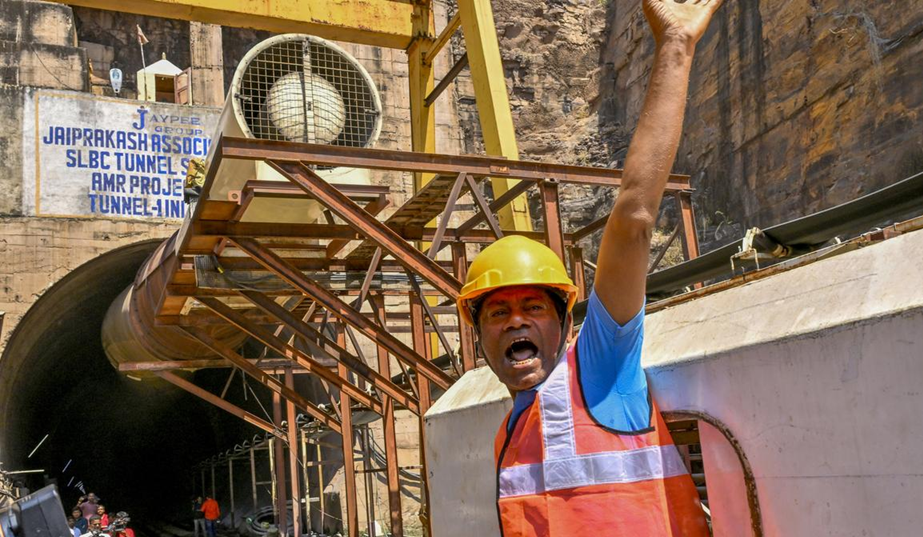
(Feature Image: A rescue worker at the SLBC tunnel. Credit: Nagara Gopal)
The SLCB tunnel collapse in Feb. 2025 is among worst dam-tunnel disaster this year in India. The incident occurred just four days after resuming tunneling work after a long halt killing at least 8 workers. Despite, two-month long multi agency search operation only two bodies were retrieved while mortals of six still remain buried inside the tunnel. The TBM involved in tunnelling has also been damaged. Given risky situation the rescue work was stopped in April end and there is no update on the same so far. Nearly 10 months after the disaster, there is no official report probing the reasons and addressing the concerns over inadequate geological, geotechnical inspections.
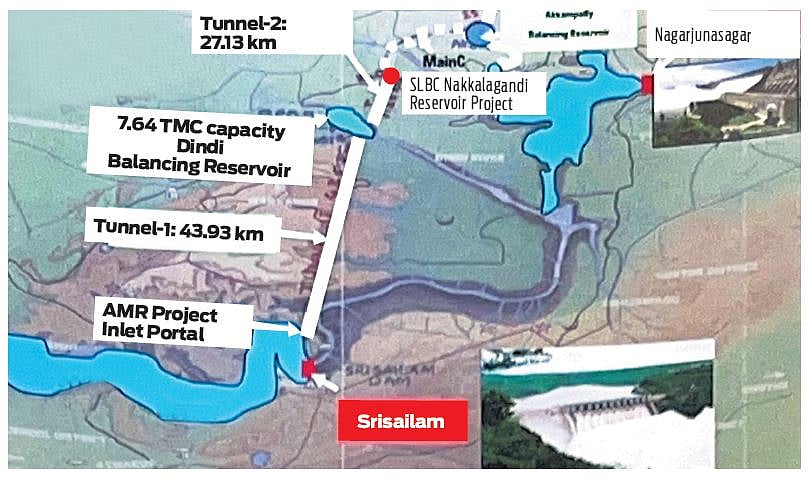
The 44 km long tunnel project was planned in 1983. It proposes to divert waters from Srisailam dam built on Krishna river. The project was formally sanctioned in 2004-05 with an estimated budget of ₹1,950 crore. In Aug. 2005, JAL was contracted to complete it in five years. Two decades later, the project stands unfinished but the cost has now spiraled to ₹4,600 crore with Dec. 2027 as revised completion target.
About the disaster: At least 8 workers were feared trapped after a section of the under-construction Srisailam Left Bank Canal (SLBC) tunnel near Domalapenta collapsed in Nagarkurnool district at around 08:30 hours on Feb. 22, 2025. This happened when employees were performing their duties at the site. In particular, at the 14th km point, the roof of the left-side tunnel collapsed for three meters behind the Srisailam dam. Two rescue teams from the company handling the irrigation project had entered the tunnel to evaluate the situation.
Feb. 23: The collapse occurred just four days after construction work had resumed following a lengthy hiatus. While some workers managed to escape, the eight remained trapped. Both the National Disaster Rescue Force (NDRF) and State Disaster Rescue Force (SDRF) teams faced challenges in reaching the collapsed section. “There’s no chance to go to the spot inside the tunnel. It has completely collapsed and mud is reaching up to the knees. We will have to take another step,” an SDRF official said.
“Three teams of the state and national disaster response contingents assessed the tunnel to check if it is strong enough to let rescuers travel a distance,” Vaibhav Gaikwad, Superintendent of Police Nagarkurnool. A team of engineers and miners from the state’s Singareni Collieries, too, reached the spot to assess the situation. On Feb. 22 night, rescue teams reached the location of the collapse and called out to the eight men trapped inside but received no response.
An expert said JP Associates, one of the construction companies whose workers are also trapped in the tunnel, is in the process of pumping out the water. The trapped men include two Indian engineers of American tunnelling firm The Robbins Company, while the rest are employees of JP Associates Ltd. “There is a 15-metre working area between the rock which has collapsed and the tunnel boring machine (TBM). They are stuck there,” an official told.
Feb. 23: There is water in the tunnel because it is being built to carry Krishna river water to Nalgonda district. The work has been going on for the past 5 years. “There is water all around the tunnel and there has been seepage into the tunnel from the hillocks above. This seepage is reduced to some extent by the roof of the tunnel, and it is this roof which has caved in,” a senior rescuer explained.
The first step in the rescue will be “dewatering” or pumping out water from the tunnel, the official said. For this, two pumps with horsepower of 100 and 70 have been brought to the spot. Once the water is drained, the next task is to use the conveyor belt used for excavation to send people about 9 kms into the tunnel. “Thick rock sheets above the head of the tunnel structure mean rescuers have ruled out the possibility of drilling from the top to reach the location of the collapse,” a senior official said.
To add to this, there were two collapses inside the tunnel, rescuers said. “There were 50 people in total in the tunnel. When the first collapse happened and 42 people were retreating, about 150 metres away, there was another collapse. So, the overall stability of the tunnel has to be assessed by the engineering team,” the rescuer said.
Muck mixed with water spread over 200 metres poses a challenge to the rescuers. A brief report on the collapse said that noises of shifting boulders indicate the roof in the collapsed site is unstable. Water is gushing out from a fracture on the side of the tunnel wall, the report said, due to which dewatering is needed before the rescue operation.
Minister Jupally Krishna Rao stated that rescue teams from the NDRF, Army and Singareni were actively working and the efforts accelerated following the dewatering process. He emphasized that it was an accident and not the result of human error. Minister Uttam Kumar Reddy and HYDRAA chief were overseeing the rescue operations.
The NDRF teams travelled into the tunnel in vehicles upto 12 km and trudged for another 2 km, but found the collapse site completely submerged and full of slush, making it difficult for them to move ahead. The team had returned after preliminary inspections. The trapped included 2 engineers, 2 machine operators and 4 workers.
Feb. 24: On third day, a team of rat miners who rescued the construction workers trapped in the Silkyara Bend-Barkot tunnel in Uttarakhand in 2023, joined the rescue teams. According to the DC, the seepage continued but the authorities were taking all precautions to prevent any further damage.
Meanwhile, the other workers at the site complained about non-payment of wages and the management’s high-handedness. They stated that they did not want to return to work on the tunnel. One of the workers who was present at the time of the tunnel collapse said: “We heard a loud noise and noticed a heavy flow of water and mud, after which we started running. We have not been paid our wages for the past three months, and now the management is forcing us to go back to the same spot. We are not willing to return after witnessing the accident.”
Feb. 25: In a huge setback to the rescue operations, a decision was learnt to have been arrived to suspend rescue attempts until the stability of the hills above was established, especially at the 13.9-km point where the collapse had occurred. Contributing to the decision was the finding that the levels of water and slush were rising significantly inside the tunnel. The assessment of the conditions inside the tunnel was made after teams of the NDRF, SDRF, Army & Marcos (Marine Commando) divers from the Navy ventured inside at 3 am on Feb 24.
With regard to the assessment of conditions inside the tunnel, a source told: “When the first team went in around 3 am, on Feb. 23, it found that there was some 5 metres of soil and rock slush at the visible tail end of the TBM. The team that went in just after Feb. 23 midnight, found that just in 24 hours, around 3 am, on Feb. 24, the slush rose to 7 metres indicating continuing pouring in of soil, and possibly rocks into the tunnel from the collapsed section. The water level too was rising and pushing towards the tunnel mouth as is the slush.”
“This can mean two things. One, the section where the collapse occurred may have become larger, letting in more soil, rocks and water into the tunnel, or that another ‘geological event’ – or a fresh breach in the tunnel – may have occurred. Since this may be the case, it is best that prudence and caution be the choice for the time being,” the official explained.
Incidentally, earlier it was claimed that Geological Survey of India (GSI) experts had visited the tunnel site two months ago and gave the go-ahead for resumption of operations that started on Feb. 17. However, sources confirmed that no official team from the GSI had visited the site in the recent past and if anyone had done so, it was possibly retired GSI scientists who were privately engaged by the contractor. The sources were emphatic that GSI had not sent anyone officially until Feb. 24, the day when two of its scientists were deployed.
Rescue officials estimated that approximately 3,200 litres of water per minute is flooding the tunnel, combining with sand, rock, and debris to create more mud and slush. While this is neither unusual nor unexpected, efforts to de-water the tunnel are ongoing. However, concerns remained as the flow of slush persists.
NDRF’s 10th Battalion Commandant Prasanna Kumar informed forces had tried to reach the trapped persons “but were not equipped for this kind of a wall of mud.” He said, “It is like a large quicksand pit. The visibility has gone to zero. We have deployed probe scopes and sonars, which revealed the presence of dangerous debris like twisted metal, concrete chucks and other materials. Anyone who ventures into it will be seriously injured. A rat hole worker has arrived, but he cannot help either because he can work only in dry conditions.”
“Here, we are dealing with a thick wall of mud-water mix. Right now, we do not have any technology to help us make our way through this wall of slush to reach the men. We have not been able to establish contact with the trapped persons so far,” Kumar added.
Feb 26: There had been no contact with the trapped persons though oxygen was being pumped into the tunnel continuously. Total 11 agencies such as Indian Army, the Marine Commando Force of Navy, NDRF, SDRF, GSI, Rat Miners and Singareni Collieries Company Ltd were working round the clock to save the 8 lives. The collapse might have taken place due to a slight tectonic shift and as some geological fault lines have given way. Rescue teams were able to go up to the TBM. But, after the TBM, at a stretch of 40-50 meters, there is 4-5 meter height of sludge accumulation which was impeding further movement of the teams.
Feb 27: As hopes of finding the trapped alive slowly faded, a multi-agency rescue team continued Feb. 26 to devise a plan for the best method to cut across the slush and reach them. This came as hundreds of tunnel workers still living in labour colonies inside the SLBC demanded payment and release from work.
The ground conditions were a little drier compared to what they were a day before, when the rat miners succeeded in making their way up to the last point. The overall situation remained unpredictable, as the tunnel end was littered with massive boulders that rolled down during the landslide. Rescue operations required the use of heavy machinery to move the boulders, as human intervention alone was insufficient.
“We located the TBM. We cleared the rear section of the machine and shifted the surrounding mud and debris. We created a path for further entry. We checked under the TBM for any trapped individuals. The machine’s front end was completely damaged as the roof collapsed. Mud and water were constantly flowing from the collapsed area. We are also repairing the conveyor belt. The NDRF and SDRF teams are working alongside us,” said Muna Qureshi of the Rat Miners team.
Feb. 28: The week-long rescue operation ended in tragedy as all 8 trapped were confirmed dead. The rescue teams used advanced radar and scanning equipment to locate the bodies three meters deep inside the collapsed tunnel. Officials stated that process of recovering the bodies was still underway and will take time.
As the experts from the National Geophysical Research Institute (NGRI) confirmed the stability, authorities decided to cut through the TBM and also clear the concrete debris and the huge mound of mud. Irrigation Minister N Uttam Kumar Reddy had on Feb. 26 said the TBM that was stuck inside will be cut into pieces by using gas cutters and removed. After this, the Army, Navy, Rat Miners, and NDRF teams will make another serious effort to rescue the eight people.
“Removing all the soil in the tunnel could take weeks. Therefore, experts are using Ground Penetrating Radar (GPR) technology to locate the workers. By sending reflected waves through the accident site, there’s a chance to detect traces of workers if they are buried in the soil. If workers are confirmed to be in a specific location, excavations can be carried out only in that area to rescue them. In this context, it seems that traces of 5 people have been found in the front part of the TBM,” said a member of the rescue team.
The rescue teams succeeded in reaching the last 50 metres from the spot of collapse on Feb 27. However, they found that the tunnel was almost completely plugged with debris such as soil, broken parts of the supporting system of the TBM. There was not even a half-metre gap between the debris and the roof. Since the infrared cameras could not trace the trapped persons in the debris in the last 50 metres of the tunnel, the agencies have now shifted focus to removal of the debris.
The work agency is continuously blowing fresh air into the tunnel as long as the air tube provided for the purpose is intact. Making the conveyor belt completely functional has also become imperative to bring out the debris after cutting the TBM parts into pieces with the help of gas cutters. The rescue agencies, with the help of other expert agencies are also examining whether it is safe to remove the debris to trace the trapped persons, or if it could lead to further collapse of the tunnel in the last 50 metres area as they are not aware of the cavities formed in the roof. As the water seepage in large volume is continuing, the process of dewatering was also going on continuously to ensure free and safe movement of the rescue teams inside the tunnel, particularly in the last 2 km stretch.
Was there a collapse on Feb. 17 as suggests this report? Dewatering the became a big challenge for the rescue team. “The seepage is constant, 365 days a year,” a senior irrigation department engineer said. During the rainy season, the flow can increase up to 7,000 litres per minute. “Before Covid struck, we encountered heavy flows of 10,000 litres a minute,” the official said when asked about the seepage.
After the Feb. 17 collapse, seepages varied between 3,200 and 5,000 litres per minute posing a challenge with the water column rising in the tunnel making it extremely difficult and hazardous for anyone to go to the 13.9 km marker in the tunnel where the collapse occurred. An engineer from Jaiprakash Associates, who was tasked with running the dewatering pumps, said one of the biggest challenges was that the pumps were getting jammed because of the enormous amount of very fine silt that filled a large section of the tunnel.

March 1: This is very elaborative report sharing workers version on how the disaster unfolded and exploitative and risky nature of work -Phoolchand Sahu, 26, a worker from Gumla district, says while he was going to work that morning, he met some workers who were returning from night duty. They warned him and several other workers that water was seeping into the tunnel. Since seepage incidents were not uncommon in the tunnel, the workers cautiously went inside.
“We arrived at the tunnel entrance at around 7 in the morning and entered it using a locomotive as usual,” says Sahu. After an hour and a half, when the tunnel boring machine was being operated, Sahu recalls hearing a thundering noise. In an instant, cement and concrete blocks fell on the tunnel boring machine and water from the hole in the roof gushed down. “We saw that a portion of the tunnel had collapsed, burying the tunnel boring machine,” he says. “We just ran.” The tunnel had collapsed 14 km from its mouth.
A senior State government official coordinating the rescue mission says the incident happened in phases. “It occurred on a minor scale at 8:22 a.m. and then again at 8:40 a.m.,” he says. Due to the strong water current, Sahu recalls nearly being swept away in the tunnel. “The power supply had stopped and the tunnel was engulfed in darkness. But we just kept running towards the entrance. Some people held the pipelines and some got onto the conveyor belt. We then saw the locomotive, jumped into it, and came out of the tunnel,” he says.
It was only when Sahu and the others exited the tunnel and checked the register that they realized that eight men who were closest to the tunnel boring machine were missing and 13 others were injured.
The Chairman and MD of Singareni Collieries, N. Balaram, said the TBM broke into two due to the impact of the roof collapse, which further complicated rescue efforts. The other workers remain skeptical about the possibility of the trapped labourers’ survival. “We don’t think they are alive,” says Sahu.
Around 800 workers have been hired for this project. While 300 are from the region, the rest hail from Jharkhand, Odisha, Punjab, and Uttar Pradesh. The workers live in tin sheds, about 4 km away from the tunnel entrance, where they are provided with steel or iron beds, fans, and power points for charging phones. “We are forced to work for 10 hours instead of 8. Moreover, if an accident occurs inside the tunnel, there is no way out,” says another worker. Workers say they are not sure whether they want to continue working for the project once the rescue operation is completed.
The chief engineer of the project, V. Ajay Kumar, says there was no human error involved in assessing the safety conditions of the tunnel. However, the formation of fresh cavities in the roof of the tunnel could have led to increase in seepage, leading to the collapse of the reinforced cement concrete slabs used as revetment, he explains. “The work agency took all precautions before resuming work. We arrested the seepage with cement mixed with specified chemicals for grouting. But the intensity of seepage increased all of a sudden and a few roof slabs fell on the front portion of the TBM before those deployed there could react and come out to safety,” he says.
March 2: The incident also triggered a heated debate on the management of the irrigation sector by the BRS during the last 10 years, and its handling by the Congress govt during the last 14 months. Minister Uttam Kumar Reddy pointed out that in 2020, during the Srisailam Left Bank Power Station blast, which claimed 9 lives, no BRS leader visited the site. He further noted that when the Devadula Lift Irrigation Project tunnel was flooded (July 2011), resulting in the deaths of 7 workers, their remains were recovered only after 5 years. He alleged that the Kaleshwaram project, on which the BRS spent more than Rs 1 lakh cr, had collapsed & that the Palamuru-Rangareddy project, which cost Rs 27,500 cr, had not irrigated even 1 acre.
The CM visited the tunnel site to assess the ongoing rescue operation, as efforts to save eight workers trapped inside continue for the ninth day. Krishna Rao, who attended a meeting with officials said, “In my view, the whereabouts of four persons have been located through radar,” he told reporters at the tunnel. He expressed hope they would be extricated by March 2 evening. The other four appear to have been stuck beneath the TBM, he said.
During the last 72 hours, the rescue team of SDRF and Singareni Collieries engineers were chipping away parts of the TBM 120 metres in length and desilting and dewatering through slush. “We had to stop many times because the machine parts were blocking the way. Finally, we managed to remove the machine parts for about 200 meters,” the top rescuer explained.
The South Central Railways (SCR) team also did their bit to cut through dangled wires and pipes. “They cut through 60 pipes to reach the dead-end,” the rescuer said. When there was no sight of the men despite reaching the last 100 meters, the rescuers called in the National Geophysical Research Institute (NGRI).
The NGRI team brought in a GPR machine which scanned the area, thick with silt. After the scan, four points where bodies of the men could be found were identified. On March 1 morning, however, the situation remained grim. “We knew that two people were inside the boring machine when the accident took place. So, we are cutting through more parts of the machine to find them,” the rescuer said. To speed up the digging process, two excavators were sent into the tunnel on March 1 morning.
March 3: The workers location remained unknown and it may take 2-3 more days to pinpoint the spot, CM A Revanth Reddy said after visiting the site on March 2. After a review meeting with 11 expert agencies, the CM said that rat-hole miners had drilled where the NGRI GPR showed possible human remains, but they found only metals.
On March 2, the work to find the workers was in full swing, but continuous water flow along with sludge was impeding the operations. The work was expected to speed up by Mar 3 evening when the crucial conveyor belt to carry out the sludge and muck was expected to be in working condition again, the CM said after being briefed by the rescue team representatives. “They are not able to come to a full understanding of where the humans and the machinery got stuck,” he said.
Soft rock problems force rethink: The SLBC tunnel is being dug simultaneously from two sides – Tunnel-I, which is the inlet near the Srisailam reservoir, where the collapse occurred, and Tunnel-II, which is the outlet end in Nalgonda district. The plan that is being talked about is stopping digging the tunnel along the current alignment as there are serious and legitimate fears that the machines and the workers could encounter more fault, or shear, zones that may result in further collapses.
Of the 44-km-long tunnel, stated to be the world’s largest when completed, just around 10 km remains to be dug. Following the collapse at the Tunnel-I side, sources said there was concern over the presence of rocks along the route. Instead, the digging of two bypass tunnels, each 5 metres wide, is being considered. These tunnels will be dug in the hard rock portion under the Nallamala hills where the SLBC tunnel is being built. “This proposal will have to be fully studied. Geological studies will be required to be done by the likes of NGRI and GSI. This will take some time but it is an option that is being looked at so that the project can be completed safely,” a government official said.
March 4: The govt was exploring the option of deploying robots in the rescue operation to prevent any threat to the rescue personnel, officials said on March 3. The Telangana High Court on March 3 disposed of the PIL petition seeking a direction to State govt to expedite efforts to extricate the 8 workers, after taking into consideration the explanation by Advocate General A Sudershan Reddy over the steps taken by government in the matter.
March 06: SLBC’s troubled history Originally conceived in 1983 as part of the Alimineti Madhava Reddy Project (AMRP), the SLBC tunnel was designed to transport 30 TMCft of Krishna River water from the Srisailam dam to drought-prone Nalgonda and Nagar Kurnool districts. However, geological challenges, financial constraints, and bureaucratic delays plagued the project for decades. The 44-km-long tunnel, which relies on gravity to carry water, was particularly challenging to construct due to its location in a fractured rock zone and groundwater aquifer. Unlike many long tunnels, SLBC lacks intermediate access points, further complicating rescue efforts. The excavation was being carried out by the US-based Robbins Inc., in collaboration with contractor Jaiprakash Associates.
March 21: Govt planning alternative tunnel The govt was now considering building an alternative tunnel as an extension to the existing SLBC tunnel to provide additional entry and exit points for future emergencies. However, since the tunnel falls within the Amrabad Tiger Reserve, special environmental clearance from the Centre is required. The govt sees the SLBC tunnel collapse as a lesson, highlighting the need for a long-term alternative. Irrigation Minister Uttam Reddy stated that work on the project would resume in 2-3 months.
April 1: Focus on shifting out parts of TBM On the 39th day of the rescue operation on Apr 1, the rescue teams focused on cutting the damaged parts of the TBM with the help of technicians from the SCR and on restoring the conveyor belt for another 100 m inside – from 13.63 to 13.73 km. Removal of the parts of TBM became necessary to take up debris removal in the last 50 m stretch of the tunnel, where the remaining six persons were suspected to be buried on the day of the accident. The last stretch was highly risky with the chances of further caving in of the tunnel due to continuous seepage of water in a large volume.
According to official sources, the rescue teams had already come to a conclusion that they would not take up debris removal manually but would do it only with the help of the machinery, particularly with mini-excavators with extended arms. The Special Officer appointed to oversee the rescue operation and coordinate with the rescue teams, Siva Sankar Lotheti held a meeting with the heads of rescue teams and reviewed the progress of rescue work. The dewatering process with a multi-stage pumping system was also in progress.
April 7: MHA Current Situation Report: (i) The silt removal and cut metal transportation continues. (ii) Total mucking completed 174 m out of 253 m. (iii) Till now a total of 2 dead bodies have been recovered and approx 6 workers are still missing. (iv) Erecting ventilation duct for an additional 25 m have been made. (v) Rat Miners who had participated in Silkyara tunnel rescue are also present at the site. (vi) Search and rescue operation is under way by NDRF, Army, SDRF, Fire services, MORTH, IIT Chennai, HYDRA, RAT Miners, CSIR-NGRI, GSI, Navyuga Construction Company and local administration.
April 21: Lack of preparedness Structural vulnerabilities, including prolonged water seepage and geological risks, were overlooked in the rush to resume work. The absence of emergency audits or escape routes in the tunnel design came in as a rude shocker for organizations involved in the rescue operations. These are clear indicators of a lack of preparedness for potential disasters.
The rescue operations, lasting 58 days, were among the most prolonged and complex in recent history. Despite the involvement of over 12 mainstream specialized agencies, several factors hindered the efforts. The presence of a massive TBM weighing 1,500 tonnes complicated debris removal. There were no precautions or preplanning for an incident of this magnitude, leaving rescue teams unequipped to respond swiftly. Rescue teams had to painstakingly dismantle the TBM into smaller parts, delaying progress further. The collapsed section remained highly unstable, with continuous water seepage.
July 19: Plans to resume work This was decided at a meeting held by Irrigation Minister for an in-depth review of the pending work. The work was stopped in 2023 following a problem in the TBM from Dindi reservoir side. It was stopped in the Domalapenta side much earlier, again due to some problems in the TBM. It was resumed on Feb 22 after replacing some parts of the TBM in the Domalapent end, but within four days, the roof collapse incident took place.
The Minister stated that drilling and blasting (excavation) was to be taken up in an estimated 10 km length for completing the tunnel. Earlier in the day, he had a meeting with a team of NGRI scientists to finalize the technical modalities of the electromagnetic survey. He reiterated that cost would not be a constraint, but highest quality and speed must be maintained at every level.
Aug. 08: Administrative Approval The govt gave administrative approval to resume the SLBC project, declaring it a top priority. Rs 2.36 crore was sanctioned for a helicopter-borne VTEM Plus Magnetic Geophysical Survey to aid in the design and execution of Tunnel I and II, including the head regulator, under the AMR Project. Irrigation Minister said the work is resuming based on expert committee recommendations. The survey aims to detect structural weaknesses up to 1 km underground. Tunnelling operations covering 10 km will restart immediately, with completion targeted within the approved budget.
Sept. 4: Complete at any cost The CM directed the officials and contractors to ensure that SLBC project is completed before Dec. 9, 2027 at any cost. The ₹4,600 crore tunnel project aims to transfer Krishna river water from the Srisailam reservoir to provide irrigation to four lakh acres in the erstwhile combined Nalgonda district besides providing drinking water to 516 villages en route. Out of the total length of 44 km of the main tunnel, a 20.5 km stretch was completed from Devarakonda end and another 14 km from the inlet end at Domalapenta. Two tunnel boring machines were deployed from either side to expedite the work.
With only a 9.6 km stretch of tunnel being left to be drilled from the inlet side deep in the Nallamala forest range, the tunnel collapsed on Feb 22. After two months of laborious efforts, rescue teams could recover only two bodies – one that of Gurpreet Singh, the operator of TBM from Punjab on March 9 and that of project engineer Manoj Kumar from Lucknow on March 25. The rescue operations were abandoned in April, after the engineers found it dangerous to carry out digging as it would cause further disaster.
Oct. 12: Contractor faces insolvency The project is caught in the web of the financial overhaul process of its contractor, Jaiprakash Associates Limited (JAL). JAL’s long-drawn legal battle in court with lenders over unpaid debts may impact the progress. The company has fallen into insolvency, with creditors holding claims of roughly Rs 55,000 crore. They’ve spent months in talks over bailout plans. Vedanta Group seemed to lead the pack in early Sept with a Rs 17,000 crore bid. But the banks involved seem to be keen on concrete plans.
The Committee of Creditors had their 21st round of talks on Oct 6, and a vote on the top proposals could come any day now. To seal the deal, it needs approval from two-thirds of them. Insiders say the State is keen on keeping JAL to continue the project implementation in view of the huge financial support extended to it during the critical phases and the latest tunnel roof fall crisis. “We can’t switch contractors now,” one official said quietly.
Rescue teams worked for weeks but managed to recover two bodies (TBM operator, Gurpreet Singh, Punjab on March 9 and project engineer Manoj Kumar, Lucknow on March 25) while six remained missing to this day. Groundwork has come to a standstill. The govt had promised to resume excavation by July but the plans did not align with the ground reality.
The TBM was damaged beyond repair. So far, teams have completed work on a major portion of the tunnel, but a tough 9-km section that needed careful handling to prevent another disaster, still remains incomplete. Meanwhile, engineers from the NGRI geared up for aerial magnetic surveys to spot weak spots in the rock and map out any needed reroutes.
Oct. 24: NHRC Seeks Action Taken Report The National Human Rights Commission (NHRC) on Oct 10 directed the Chief Secretary to submit an action taken report within four weeks on the collapse in the SLBC tunnel, saying the delay in submitting the report “is causing delay in the assessment of responsibility and in the formulation of necessary remedial and preventive measures.”
NHRC said it had received a complaint on April 5 2025, raised questions including a lack of worker protections and how the labourers were reportedly not registered nor extended benefits and protections under the Unorganized Workers’ Social Security Act, 2008.
The NHRC said the complaint also pointed out that no geological or geotechnical analysis reports related to the tunnel collapse were made public, and that no action was initiated against the contractor under the Inter-State Migrant Workmen (Regulation of Employment and Conditions of Service) Act, 1979, despite apparent violations.
Nov. 03: Will complete SLBC tunnel The CM on Nov. 3, said that the state govt is committed to complete the pending work on the SLBC project, which is touted to be the world’s biggest 40 km tunnel work. The CM also announced that the govt will provide compensation and address the grievances of the dwellers of the submerged Marlapadu, Keshya tanda and Nakkalagandi habitations located close to the SLBC project.
The CM along with ministers visited the site as part to launch the Aerial Electromagnetic Survey for the SLBC tunnel works at Mannevari Palli. The CM said that the project cost is estimated at Rs 4600 crore. He claimed that the project would have been completed at the cost of Rs 2000 crore had the BRS government completed the works. According to a press release from his office, the SLBC project was sanctioned in 1983. During the time of the late Andhra Pradesh (joint state) CM YS Rajasekhara Reddy’s govt, work had started on Tunnel-1 and Tunnel-2 in 2004 at the cost of Rs. 1968 crore.
Failure to locate weak spot: Ex-GSI official A retired scientist from the GSI said that procedural challenges, coupled with the failure to locate the shear zones (weak spots), which are the fault-lines in the terrain where the tunnel was being built has caused the incident. The scientist also pointed out that that until ten years ago, the GSI used to give technical appraisal for all such projects, which was then discontinued, as almost all the contracting firms were now having their own geological wings comprising experts.
The scientist points out that in similar projects initiated by the Centre, such technical appraisals and reports from GSI and other agencies are taken from time-to-time before and during the progress of the construction. “If the SLBC tunnel project that was initiated more than 20 years ago had continued without any halt, such structural issue may not have happened. Whether it was a human error, negligence, or a procedural issue, unless one looks at the detailed project report (DPR) of the project, it will be difficult to understand accurately what caused the water to enter the tunnel in such massive quantities,” he added.
Meanwhile, reports have been speculating about heavy flow in Mallela Teertham and Thirumalapur Vagu (local stream) causing the springing up of water in such unexpected quantities inside the tunnel.
EDIT: The history of tunnel-linked disasters globally shows that while rare, they can often be catastrophic. A large proportion of these accidents, studies show, are due to a rupture in aquifers (underground water channels). It is to determine such risks that extensive studies are commissioned to understand the sub-surface geology of a site. While the rescue is paramount, there has to be a proper investigation by the authorities on the reasons for the collapse and action taken, if evidence emerges of tardy pre-tunnelling analysis.
SANDRP

 SANDRP