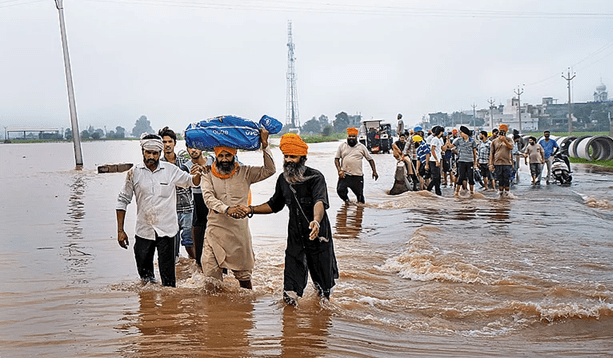
(Feature Image: Locals assist in moving flood affected people to a safer place as floodwater enters villages in Ajnala, near Amritsar. Source)
India has witnessed several incidents of dam induced floods during south west monsoon 2025. The most remarkable and devastating episode unfolded in Punjab and Himachal Pradesh states in August 2025 largely due to mismanagement of Bhakra, Pong and Ranjit Sagar dams by BBMB. While negligence of BBMB has invited FIRs in Himachal Pradesh, warnings by Punjab govt and petition in NGT, there is no report in public domain suggesting the authority taking any credible action to make its dam operation scientific and accountable after the disaster.
After Punjab, the untimely releases by Ranganadi, Kopili, Doyang hydroelectric project (HEP) dams of NEEPCO in Assam and Mapithel dam, Ithai barrage of NHPC’s in Manipur aggravated the flood destruction in downstream areas in North East during the monsoon season. Notably, these flood disasters occurred in quite early (May end) and late monsoon (mid Sept.) months hinting at changing rainfall patterns in the region. The over topping of Tala Dam in Bhutan led to scary situation for downstream areas of Bhutan and Assam.
The DVC dams have again blamed for worsening flood impacts in Balasore, Odisha in first week of June 2025 and in South Bengal in first week of Oct. 2025. The NEEPCO, NHPC and DVC dams have become notorious for causing avoidable flood destruction in East and North East regions for years, however, like BBMB they appear oblivious to any course correction.
The year has also seen the structural damages to Kalora dam in Madhya Pradesh (July 2025), Surwal dam in Rajasthan (Aug. 2025), Luti dam in Chhattisgarh (6 death, Sept. 2025) resulting in manmade flood disaster in downstream areas. The collapse of Madhopur barrage gates in Aug 2025 is also attributed to sudden excessive releases by Ranjit Sagar dam on Ravi river in Pathankot, Punjab.
Besides, the sudden releases from Kota Barrage in Rajasthan (6 death, July 2025), Kadana dam in Gujarat (5 death, Sept. 2025), Markonahalli dam in Karnataka (6 death, Oct. 2025) resulted in at least 17 human deaths. Similarly, the unwarned discharges from Dharoi dam in Gujarat endangered the lives of 25 workers and excess discharges from Panchna dam in Rajasthan damaged farm crops in Karauli and Bharatpur districts. The Ujani and Jayakwadi dams in Maharashtra were blamed for wrong operations this year. In Uttar Pradesh, the Chandraprabha, Ahraura and Jargo dams caused flooding in parts of Chandauli and Mirzapur districts in late Aug 2025.
While the changing climate has made prudent dam operation even more imperative, we continue to manage our dams with outdated approach and fail to maintain the carrying capacity of our rivers which is certainly going to increase the dam induced flood incidents in future as also warned by a latest study on the subject.
BBMB Dam Floods Himachal Pradesh; Punjab FIR against BBMB over excess water release from Pong Dam Speaking in state assembly, CM Sukhvinder Singh Sukhu said that continuous discharge of water from the Pong Dam on the Beas has created a flood-like situation in Fatehpur and Indora regions of Kangra district. He informed the House that a first information report (FIR) was registered against the Bhakra Beas Management Board (BBMB) management at the Sansarpur Terrace police station in Kangra on July 26 for its alleged failure to ensure dam safety protocols. “Despite repeated devastation, including the 2023 floods, BBMB has neither compensated victims nor created safeguards. Our people are paying the price,” said the CM. Congress MLA from Indora Malender Rajan said that 12-13 panchayats were hit, nearly 100 people rescued, 42 schools shut and critical infrastructure washed away.
5 FIRs filed against BBMB, others On the directions of the CM, the Himachal Energy Department has initiated FIRs against BBMB in Kullu, Kangra and Mandi districts. Of the five FIRs, three have been registered in Kangra and one each in Kullu and Mandi districts, based on detailed complaints filed by the Chief Engineer of the Energy Department. The cases pertain to the Pong Dam, Pandoh Dam, Parbati-III and Malana-II projects, where sudden and unregulated water discharge caused widespread damage and panic in areas downstream during the monsoon seasons of 2023 and 2025.
The FIRs cite violations under several sections of the Bharatiya Nyaya Sanhita (BNS), the Disaster Management Act, 2005, and the Dam Safety Act, 2021, which even entail imprisonment. The complaints accuse BBMB officials of failing to implement adequate early warning systems (EWS) despite repeated notices, and ignoring critical safety guidelines issued over the years.
PAC questions role of dams in Punjab floods On September 8, PAC, released month-long water discharge data from three major dams – Bhakra, Pong and Ranjit Sagar. The PAC alleged that dam authorities did not release water gradually. The process of a sudden discharge, combined with Punjab’s own torrential rainfall, culminated in the disaster – one that, PAC members said, could have been mitigated with timely action.
The PAC also alleged that advance warnings were missed when releasing water from the dams. Water discharge data, they also alleged, showed that rainfall prediction issued by the IMD as early as June was paid not much heed to. Economist R.S. Ghuman said that better management of water discharge from these dams could have mitigated the impact of the Punjab floods, which he said was largely caused by torrential rainfall in the region.
Flooding in Punjab began on August 25. Using this as a reference point, data from the Bhakra dam on the Sutlej river, as quoted in PAC report, shows that between August 1 and 24, the per-day average inflow was 57,430 cusec, while the average outflow was 27,100 cusec. Over the next 11 days, from August 25 to September 4, continuous rainfall in the catchment raised the average inflow by 30% to 73,400 cusec. In contrast, the average outflow nearly doubled to 53,000 cusec, peaking at 73,000 cusecs on September 4.
The situation was even more critical at Pong Dam on the Beas river where water inflow was more aggressive, the PAC finds. Between August 1 and 24, the average per day inflow was 77,000 cusec, against an outflow of 42,500 cusecs. From August 25 to September 4, the average inflow surged by 57% to 1,21,600 cusecs, while the average outflow rose 107% to around 87,500 cusecs, peaking at 1.09 lakh cusec on September 1. Both these dams are managed by BBMB in which Punjab is a member states along with Himachal, Haryana and Rajasthan.
The situation was no different with the Ranjit Sagar Dam, which is directly under the Punjab government’s control. The per day average inflow of Ranjit Sagar dam between August 1 and August 24 was 38,700 cusec against average outflow of 11,273 cusec, he said. Over 11 days between August 25 to September 4, it is not just the inflow that surged to 71,960 cusec, but the average outflow surged to 62,800 cusec, he added.
PAC moves NGT against BBMB “Calling the recurring floods in Punjab “man-made disasters”, the PAC on Sep 8 moved the National Green Tribunal, accusing the BBMB and the state government of systemic negligence. PAC members alleged that unscientific dam operations, coupled with the Punjab govt’s failure to curb illegal mining & encroachments, aggravated the situation. PAC members also alleged that BBMB’s premature release of water from the dams this year triggered sudden flooding in Punjab, even before reservoirs reached their maximum safe levels. “This was not a natural disaster but a human error.”
PAC warns about release from Bhakra-Pong dams The Public Accounts Committee (PAC) of Punjab citizens asked the authorities to remain alert in the discharge of water to avoid a repeat of the Aug 2023 events. At that time, a large quantity of water was discharged from the Bhakra and Pong dams without any warning, leading to floods in various parts of Punjab. Recalling the events of 2023, PAC member Jaskirant Singh said that on Aug 16 that year, 84,000 cusecs of water was suddenly released in the Satluj from Bhakra and 142,000 cusecs in the Beas from Pong, due to which Punjab faced floods.
Punjab Govt warns BBMB The state govt issued a stern directive to the BBMB, urging it to stop random fluctuations in water outflows from the Bhakra and Pong dams. The move comes amid concerns that erratic releases are exacerbating risks of bund breaches, threatening agriculture lands and crops, and infrastructure in downstream districts.
SKM seeks judicial probe Sanyukt Kisan Morcha (SKM) has stated it needed to be investigated whether floods occurred due to a natural calamity or if they are part of a manmade disaster. SKM also demanded the forgoing of central control of dams in riparian states under the Dam Safety Act. “By losing control over its dams, the state govt was being dictated to by people answerable to the central govt, which was like stepmotherly treatment towards Punjab,” said a statement by SKM.
Aug 2025: Ravi Flood damages Madhopur Barrage gates A severe flood spell in Ravi river has damaged at least three flood gates of Madhopur barrage in Pathankot district of Punjab. The incident occurred in the evening of Aug 27, 2025 amid an effort to open the jammed gates of the barrage. The situation became critical after 2.12 lakh cusecs of water discharged from the upstream Ranjit Sagar Dam dangerously increased the flood level at the barrage on Aug. 26. The flood spell brought silt in huge amount resulted in jamming of several gates of the barrage and overflowing of the flood water from the structure. The flood level at the barrage was just 2 feet below the historic floods of 1988.
The state govt ordered an inquiry into the collapse of three floodgates at the Madhopur Headworks and placed three of its officers posted at the barrage under suspension. The State Dam Safety Organisation has constituted a 5-member expert committee to hold an inquiry. Experts who were later called in to help open the gates got stuck in a building at the headworks, prompting the Army to rescue 22 persons from the structure, which collapsed soon after. An employee of the department was swept away and his body was found later. Demanding high level inquiry into the incident, the Gurdaspur member of Parliament Sukhjinder Singh Randhawa raised several key concerns, including the absence of senior officials at Ranjit Sagar Dam during the critical hours when water levels peaked. He also questioned why there was no prior coordination with downstream structures like Shahpur Kandi Dam and Madhopur headworks before the gates were opened. He asked why the gates at Madhopur were not opened in advance or in sync with the release from Ranjit Sagar Dam.
How to drown a state In recent years, every time there has been a heavy monsoon, Punjab’s farmers have found themselves at its mercy. But this year’s disaster was not inevitable, nor was it unpredictable. The flood was a “manmade disaster,” according to Hardip Singh Kingra, a former vice-chairperson of the National Environmental Appraisal Committee (Hydroelectric and River Valley Projects) and a retired additional secretary in the union government. “It can be proved beyond doubt,” he wrote, “that recent floods in Punjab are the result of excessive and untimely release of water” from the storage dams and barrages that sit on Punjab’s four rivers—the Beas, the Ravi, the Sutlej and the Ghaggar. When the worst of the flood hit, from 27 Aug to 5 Sept 2025, all four were in spate, flowing above their danger marks and breaching bunds built for flood control. Indeed, serving officials in the Punjab government and the official documents accessed, confirmed Kingra’s assessment that the floods could have been avoided if the union and state governments had acted with care and precision.
Punjab floods need independent inquiry It is clear from the following details that the massive floods that Punjab experienced and parts continue to experience even now has a lot to do with the way Bhakra, Pong and Ranjit Sagar dams were operated. There was sufficient actionable information that was available to take advance water release action. Had these actions been taken, the proportions of the disaster could have been reduced. The risk of further floods remains considering the IMD forecast of heavy rains in catchments of these dams during the remaining weeks of SW Monsoon 2025.
The spill-over effect of the sudden release of large volumes of water from Ranjit Sagar dam also affected the downstream Madhopur dam, damaging its gates and leading to washing away of one of the persons involved in trying to repair the damaged gate there. The areas downstream from the Madhopur dam also faced massive floods.
BBMB that operate the Bhakra and Pong dams and the Punjab government that operates the Ranjit Sagar dam have a lot to answer. Even Central Water Commission, the national flood forecaster, also has a lot to answer. There is not too much hope from either the central government as BBMB & CWC are central government organizations. Or from the state government that operates the Ranjit Sagar dam. The only hope is that may be Judiciary will set up such an inquiry.
Role of Bhakra, Pong and Ranjit Sagar Dams This analysis of operation of Bhakra, Pong and Ranjit Sagar Dams during Aug-Sept 2025 Punjab floods shows that the wrong operation and sub optimal power generation from these dams played a significant role in worsening the Punjab Flood disaster. The analysis also shows the steps we need to take to avoid repeated recurrence (this had already happened earlier in 1978, 1988, 2023) of this disaster. See here.
Make dam operations transparent: Experts SANDRP analysis revealed that the outflow from Ranjit Sagar Dam on the Ravi rose from 9,000 cusecs on August 24 to 1,73,000 cusecs by August 27 as the dam crossed the Full Reservoir Level (FRL) at 527 m. “From August 27, outflow exceeded inflow for five days, which by definition of Central Water Commission (CWC) means the dam had generated floods. Clearly, it ended up contributing to floods rather than moderating it,” it stated. Furthermore, according to it, by August 1, Bhakra Dam was already 53 per cent full, but outflow increased significantly only on August 19-20, when spillway gates were opened for the first time in two years. Early outflows would have aided power generations, which was often suboptimal. Between August 1-20, inflow exceeded outflow by 180 per cent, pushing the dam beyond prudent storage levels, it stated.
Mismanagement of dams “There is a clear mismanagement by dam authorities. Both Bhakra and Pong dams were past prudent storage by August 20, but the outflow of water was kept very low despite heavy rainfall in the catchment areas and forecast of more heavy rainfall days in both Himachal Pradesh and Punjab,” said Himanshu Thakkar, of SANDRP.
“They had to eventually release heavy quantities of water from August 26 onwards when Punjab was already facing floods due to local rainfall. Ranjit Sagar dam also released more water than the inflow from August 27 onwards, which technically means it contributed to flooding instead of moderating it,” Thakkar added.
In the early part of August, the release of water from these dams was kept low despite heavy rainfall in the catchment areas. This was a huge mistake. It ultimately led to the submergence of large parts of Gurdaspur and Pathankot districts.
Should Punjab & HP not have decisive say in Operations of Bhakra & Pong dams? One clear instance that emerged this year that justifies this demand is that during June 2025, when Bhakra level was already above normal and IMD had already predicted surplus monsoon, Punjab demanded more water release for irrigation needs. This was declined by BBMB since Haryana and Rajasthan opposed. These non-riparian states won’t suffer when the dams open spillway gates to release excess water during latter part of the monsoon, worsening floods in the downstream areas of Punjab and Himachal Pradesh. BBMB has proved to be most non-transparent dam operator in India.
However, this is not substitute to transparent and accountable dam operations during monsoon. On this subject the track record of both Punjab and Himachal Pradesh is very poor. This is apparent for example from the way Punjab operated Ranjit Sagar dam on Ravi River during the monsoon, that created huge, significantly avoidable flood disaster in downstream areas. Similarly, Himachal Pradesh dams have created avoidable floods in downstream areas on a number of occasions in recent years, with no convincing action from the state. Both Punjab and Himachal Pradesh dam operators have also been most non-transparent.
So, in any case, the updated rule curve of Bhakra, Pong, Ranjit Sagar and all other dams need to be in public domain along with daily inflow, outflow and dam storage level and status along with all the information that is used to decide about dam operations including upstream and downstream river flows, rainfall and forecasts of run off and rainfall. All this information for each dam must remain in public domain for at least five years. The BBMB Technical Committee meeting minutes and agenda should also be promptly in public domain since the Technical Committee decides about water releases from the dams. There is of course no substitute to transparent and accountable dam operations since these dams can potentially create serious disaster hazard for the riparian states.
DAM FLOODS IN NORTH EAST May 2025: NEEPCO’s Ranganadi Dam floods Lakhimpur Assam’s Lakhimpur district reeled under a severe flood crisis after the Ronganadi river overflowed, following heavy rains and a sudden release of water from the Ronganadi dam by North Eastern Electric Power Corporation’s (NEEPCO), opening all gates of the dam on May 30 night. More than 230 villages have been submerged, forcing residents to abandon their homes and seek shelter elsewhere since the early hours of the May 31 morning, with people struggling to save belongings and livestock. In the Naoboicha-Gendheli area, the National Highway-15 was under water, cutting off road connectivity and isolating entire regions. One person who was trapped inside his home died.
Who is responsible for Ranganadi dam flood? This report integrates data from the 2008 flood and the 2017 IIT Guwahati study to analyze the causes of the May 2025 flood and assign responsibility for the downstream devastation. The primary trigger was the NEEPCO release of excess water from the 405 MW Panyor Hydro Electric Project (PHEP), compounded by heavy monsoon rainfall, recurrent embankment failures, and ongoing environmental degradation. Historical floods in 2008 (695.20 cumecs, 22 deaths), 2017 (1,412.57 cumecs), and incidents between 2009 and 2015 highlight persistent vulnerabilities and systemic issues in dam management, inadequate warning systems, poor embankment maintenance, and ecological neglect, all contributing to the 2025 disaster.
Futile attempt to protect Ranganadi & Subansiri Lower HEP AN Mohammed in this article makes a rather futile attempt to show that neither Ranganadi nor SLHEP played any role in downstream floods starting on May 30 2025 in downstream Assam. In an article that seems to have a lot of information (all without any references), the mantra of the author is that dams do not create water or silt. He does not mention prudent dam operation, rule curve or how change in upstream & downstream conditions post dam construction changes the situation.
LoP on Floods Shri Debabrata Saikia, Leader of Opposition in Assam state assembly, on floods in Assam this year already and role of dams, embankments and failure of Dam Safety Mechanisms.
Impact of Ranganadi dam floods Districts like Lakhimpur and Dhemaji, downstream of the Ranganadi Dam, face devastating flash floods caused by sudden water releases from NEEPCO’s hydroelectric projects. These man-made disasters, compounded by a lack of early warnings and inadequate research, have turned fertile lands into zones of destruction. Families like Toramai’s lose not only their homes and livelihoods but also their sense of security. As infrastructure controls rivers without regard for communities, the floods in Assam reveal a deeper crisis—one where nature’s cycles are worsened by human hands, leaving millions to rebuild from nothing.
June 2025: Kopili HEP dam floods Kampur The Kopili Hydro Electric Project has opened seven sluice gates to release the excess water from its reservoirs causing flood in many parts of the Kampur district in Assam. The district administration declared red alert in the areas and urged the people living along the river banks to be vigilant as the water level of the Kapili river in Kampur rising since morning. Severe erosion has occurred near the Garokhanda embankment. As per an official bulletin, the overflowing water from Borapani river has submerged paddy field in 27 villages under Kachua as well as Kampur revenue circles.
Lower Subansiri HEP Flood Panic gripped residents of Dhemaji, Lakhimpur, and Majuli districts as the swelling Subansiri River reportedly threatens to unleash catastrophic floods near NHPC’s 2000-Mw Lower Subansiri HEP at Gerukamukh. The river was currently in spate due to continuous heavy rainfall in Arunachal Pradesh and Assam, raising fears of a possible deluge in downstream areas. NHPC issued an alert and temporarily halted work at the project.
As a precautionary measure, NHPC opened three gates of the dam to release excess water. However, officials warned that up to nine gates may need to be opened if rainfall continues. The situation had already sparked alarm, especially among locals who have long expressed concerns about the project’s safety and ecological impact. A massive landslide on the right bank of the fragile Gerukamukh hills has further intensified the crisis, reportedly causing flash flood-like conditions at the project site.
Sept. 2025: Doyang Dam releases floods Golaghat villages Heavy rainfall in neighbouring Nagaland and the release of water from NEEPCO’s Doyang hydroelectric project led to severe flooding across Golaghat district in Assam on Sept. 15, 2025, affecting thousands of residents and prompting large-scale rescue operations. The Dhansiri and Dayang rivers, along with their tributaries, have risen to dangerous levels due to continuous downpour in Nagaland and the discharge of water from Doyang HEP.
Several locals alleged that they received no prior warning about the sudden release of water from the Doyang project. “The water rose suddenly into our homes and fields, destroying our machines and livelihoods. Earlier, authorities used to give us warnings, but this time nothing was communicated,” said one resident of Sonalipathar No. 4. Others echoed similar grievances. “Around 3:30 am, the water started rising rapidly. We had little time to save our belongings, livestock, and machines. This is all because of the water released by NEEPCO. We hope the administration provides us with proper relief soon,” another resident added.
June 2025: NHPC, WRD blamed for flood damages in Manipur Loktak Project Affected Area Fanners and Land Owners’ Association questioned the belated opening of the sluice gates of Ithai barrage, while holding both the NHPC and the Water Resources Department (WRD) accountable for the flood situation and the resultant damages. Addressing media persons at Manipur Press Club June 03, 2025, Association’s general secretary Angom Tiken Singh said the inordinate delay in releasing the flood waters through the Ithai barrage is one of the factors for the widespread floods in the state.
He said that levels of major rivers in the state rose sharply due to incessant rainfall since May 26 with water level at Ithai barrage reaching 769.82 metres above mean sea level on May 29 against the normal level of 769.25 metres. Accordingly, local people, concerned for their safety, approached officials manning the Ithai barrage, requesting to release water in time to prevent flooding but their requests were declined, he recounted, adding that even officials of the WRD refused to release water despite water level rising alarmingly as on May 29 evening.
After the matter grabbed the attention of the media amid the continuing downpour, officials concerned issued order for opening sluice gates of the Ithai barrage May 29 midnight. However, the sluice gates remained shut the same night due to power outage and technical issue with the generator, he said. At 5 am on May 30, sirens were sounded and gate No 2 and 3 of the barrage were opened but gates No 1 and 5 remain closed, Tiken Singh said, strongly alleging that the untimely opening of Ithai barrage gates led to widespread flooding in the state.
Holding NHPC and the WRD responsible for the flood crisis, Tiken Singh said that more than 50,000 people affected by the present flood and the damages – including houses, farms and paddy fields must be compensated by the NHPC and the WRD.
Sept. 2025: Mapithel dam worsens floods On the afternoon of Sept 14, four gates of the Mapithel dam in Manipur were suddenly opened, leading to flooding in the downstream villages across the Thoubal river basin. The sudden release of water inundated paddy fields, fish farms, and households, sweeping away two elderly persons who later died.
The president of the Manipur Congress and an elected representative of the Manipur Legislative Assembly, Keisham Meghachandra, accused the WRD for creating a “man-made disaster” and noted that there was no proper communication between the govt institutes & the people residing downstream. But the clarification issued by the WRD signals that the discharge was mandatory in light of the “extraordinary inflow” and that adequate “mobile communication” was completed by field staff to communities downstream.
June 2025: Chandil dam floods Balasore At least one person drowned in Baliapal block due the sudden water release from upstream Jharkhand’s Chandil Dam in Suvarnarekha river in June 2025: “The flooding caught residents off guard as there were no local signs of heavy rainfall or impending disaster…The administration’s response has drawn heavy criticism. Despite warnings of water release from Jharkhand, authorities were unprepared. Of the 10 motorboats available at Jamkunda, only one was operational due to lack of trained staff. Essential relief, including dry or cooked food, has yet to reach many affected villagers.” Authorities of Chandil Dam in Jharkhand released excess water without informing Odisha, Balasore MP Pratap Sarangi alleged terming it a “criminal misconduct”, see here.
DVC Dam Flood DVC releases spark flood concerns The Damodar Valley Corporation (DVC) released 55,000 cusecs water from its Maithon and Panchet reservoirs on Oct. 06, raising fresh flood concerns in the southern districts of W Bengal. Irrigation Minister Manas Bhunia claimed the DVC is releasing water every day without any coordination with his govt. He said that there is no fixed “safe level” for DVC water release, as the risk of flooding depends on several factors, including discharge volume and the rivers’ current capacity to carry water.
“Years of neglect in dredging and desiltation at DVC’s Maithon and Panchet dams have drastically reduced their water-holding capacity,” he said.
The DVC released 70,000 cusecs water from its reservoirs on Oct 3, drawing sharp criticism from the West Bengal government as fears of flood gripped the downstream districts. DVC officials said flooding is not dependent solely on its water release but also on the water-holding capacity of downstream rivers, which are not under the corporation’s control or management.
Mamata blames Centre again for flood A day after rain-triggered landslides hit N Bengal, W Bengal CM Mamata Banerjee blamed the Central government for the situation while pointing out that 40 hydropower projects have been built on the Teesta in Sikkim even as she asked ‘where will that water drain?’ Banerjee on Oct. 06 reiterated her criticism of DVC, accusing it of “unilateral and wilful” release of water from its reservoirs and declaring that the state “doesn’t need dams” while blaming the Centre for its alleged lack of response in dredging operations of the rivers at several critical points.
“If the Central government did its job of dredging of the Ganga-Hugli river at several critical points, and if DVC did its desiltation works…our people would have been spared of the man-made flood that we are facing in large tracts of N and S Bengal. Our own irrigation works and check dams have been useful in arresting the damages in many areas,” she said.
Warning against high tides, she said, “And I want to warn everyone here, on the 7 and 8 (October), there will be high tides. Because of DVC’s Panchet and Maithon releases, waterlogging has occurred in Ghatal, which is a low-lying area. The Ghatal Master Plan has not been implemented even 20 years after the Centre promised it, so we are doing it ourselves. But even if that is completed, as long as DVC keeps releasing water like this, we will need another way to deal with it.”
The CM said, “I am tired of saying this for the past 20 years. Mython, DVC, Panchet: they don’t even have the capacity to hold water. Then what’s the point of keeping them? It would have been better if we didn’t have them. The water would have entered naturally and flowed out, everyone could have shared the pressure equally. But now we are facing the consequences, especially North Bengal. They are releasing water through the Durgapur Barrage, and the force of the water is destroying bridges and everything in its path.”
Oct 2025: Bhutan’s Tala Dam Floods Darjeeling In a major scary incident, the Tala Dam on Wangchhu River in Chukha district of south Bhutan has overtopped for the first time ever, on Oct 5 following unprecedented rainfall in western Bhutan, prompting flood warnings for downstream areas in India’s north Bengal. Bhutan’s NCHM confirmed that DGPC reported that the dam gates failed to open, leading to river water flowing over the dam, considered most dangerous situation for any dam as dams are not designed for such an eventuality.
Madhya Pradesh July 2025: Kalora Dam weir damaged in Guna In Guna, 12.92 inches of rain in just 24 hours damaged the Kalora Dam’s west weir by 15 feet on July 29, posing a serious threat to nearby villages. Authorities have deployed NDRF and army personnel for assistance. The west weir breach of the Kalora Dam in Bamori area led water to overflow into surrounding villages including Singapore, Tumda, Kurka, Bandha, Umardha, Baniyani, Mamli, and Biloda near the Rajasthan border.
The breach in Kalora Dam has raised fears of a complete collapse, threatening nearby villages. An NDRF team from Gwalior and an Army unit from Babina have reached the site. Kalora pond, constructed in 1956, has a storage capacity of 4.74 million cubic meters (MCM). It serves as a crucial irrigation source for the Padon area. Given the critical condition, the administration has issued alerts for 8 villages in Guna & 3 in Rajasthan, affecting 3,550 people.
Rajasthan July 2025: Six drowned in Kota barrage flood On July 14, 2025, after the sudden rise in water level in Chambal river after opening of 12 gates of Kota barrage, seven people in the downstream got stuck in the middle of the river, six of them washed away and one was saved by SDRF.
Aug 2025: Surwal Dam Floods in Sawai Madhopur While DDMP mentions that there has been no dam related disaster in the district so far, we hope after this disaster the state government will institute an independent inquiry to understand reasons and impacts related to this disaster and also suggest lessons and ways to fix accountability as necessary. It will also provide an opportunity to review the disaster potential in the context of changing climate, particularly intensification of rainfall in Eastern Rajasthan.
Sept 2025: Panchna Dam flood destroys farms in Karauli & Bharatpur The agrarian community in Bharatpur is reeling under severe losses after excess water released from the Panchna Dam in Karauli district flooded vast stretches of farmland. The sudden release of water into the Gambhiri river has submerged crops of millet, sorghum and chilli, leaving farmers in despair. This season, three times more water than the dam’s capacity was discharged, the gates of the dam have been opened seven times this season.
Gujarat Aug. 2025: 25 workers trapped after sudden release from Dharoi Dam On Aug 24, amid the rising water levels, 25 workers trapped near Bakrol village in Sarkhej were rescued. The workers, engaged in the construction of an overbridge on the Sabarmati, were caught in the sudden surge of water after release from the upstream Dharoi and Sant Sarovar dams. Near Subhash Bridge, equipment related to the Mumbai-Ahmedabad bullet train project was reportedly swept away. As of Aug 24, the Dharoi Dam is over 94% full, receiving 59,444 cusecs inflow. To manage water levels, authorities have opened four gates, releasing 58,880 cusecs into the Sabarmati.
Sept 2025: 5 died in Kadana dam floods On Sept 4, five workers died when water released from Kadana Dam on Mahi River in Gujarat entered the under repair 12 MW Ajanta power house about 20 km downstream from Kadana dam. An FIR for death due to negligence has been filed. The Mahisagar district administration formed a committee to investigate the death of five workers. Deputy superintendent of police Kamlesh Vasava said all documents and agreements related to the contract with Ajanta Energy Private Ltd are being collected to determine whether any violations occurred. The committee, headed by the sub-divisional magistrate of Lunawada, includes Vasava, engineers from the Kadana project, officials from the Gujarat Electricity Transmission Company, and other relevant personnel. This will not help. What is required to unearth the truth is an independent committee.
Mevasa Dam Breach in Kutch-Gujarat The earthen bund of the irrigation dam in Mevasa village in Rapar Taluka of Kutch district in Gujarat got washed away on Sept 8, 2025 and massive quantity of water started flowing out into the Gagodar River. The administration has alerted the downstream villages on the banks of Gagodar River that could face the impact of this sudden water release. Officials have issued an alert and some of the affected villagers in the downstream area have been asked to shift to safer places.
Chhattisgarh Sept. 2025: Six killed in Luti dam flood disaster A flash flood disaster caused by a significant breach in Luti dam bund has killed six people while one remained missing in Dhaneshpur village near Vishram Nagar under Balrampur district of Chhattisgarh. Six of the flood victims are members of a single-family living about 500 meter downstream from the dam area. About 11 villagers were swept away by strong current of waters. Some of them managed to save their lives by holding on to trees and swimming to their safety. Three persons also suffered injuries in this dam induced flood incident.
Maharashtra Jayakwadi dam releases record water The ongoing release of water from the Jayakwadi major irrigation project in Chhatrapati Sambhajinagar district reached a record discharge of over 3 lakh cusecs by Sept. 28 night, causing the displacement of more than 9,800 residents from Jalna district and other downstream areas due to further swelling of the Godavari River. Locals from villages in Partur, Ambad, and Ghansawangi talukas on the banks of the Godavari River were moved to safer locations and accommodated in Zilla Parishad schools and community centres by the Jalna district administration.
Jayakwadi dam storage 95% The Jayakwadi dam in Maharashtra is already 95.05 % full on Aug 20 afternoon. Water outflow from spillway have not yet been started.
Ujani dam released 1.5 L cusecs: Flood alert in Pandharpur The water discharge rate from Ujani dam (storage already 100% of its capacity) into the Bhima river was increased to 1.5 lakh cusec on Aug 21 (from 90 000 cusecs on Aug 20, 1.3 L cusecs on Aug 21 morning), leading to a flood alert for the temple town of Pandharpur in Solapur district. The situation was further aggravated because the said river also receives water discharged from Veer dam, which released 13000 cusecs on Aug 21. Veer dam is located near the areas of Shirwal and Khandala on the border of Pune and Satara districts on the Nira river.
It was the first time this season that water was released from Ujani dam on such a large scale. Officials from the state irrigation department said the sudden increase in discharge was mainly because of inflow of high volume of water from upstream dams in Pune district. Since the last three days, dams around Pune have been releasing water. Khadakwasla released water at a rate of 39,000 cusecs, while Mulshi and Pavana collectively discharged water at a rate of 35,000 cusecs on Aug 20.
Karnataka Oct. 2025: Six dead in Markonahalli Dam disaster In a dam induced tragedy, six people died, of them four bodies have been found and two more are being searched for. This happened after gates of the Markonahalli dam across Shimsha river (a 221 km long tributary of Cauvery River) in Mandya district in Karnataka suddenly opened on Oct 7 at around 3.30 pm. The tragedy occurred in a village near Yadiyur in Kunigal taluk of Tumakuru district on the border of Tumakuru and Mandya districts, about 100 km from Bengaluru. The Hindu reported earlier in Oct 2000 that the dam gates are poorly maintained.
Uttar Pradesh Dams release cause flash floods in Chandauli, Mirzapur On Aug 23, around 10,000 cusecs of water was released from Chandraprabha Dam in Chandauli district and 21 gates of Ahraura Dam were opened on Aug 23 in Mirzapur, leading to a flood in Jamalpur area, affecting more than 24 villages. Eight gates of Jargo Reservoir in Chunar of Mirzapur were opened, resulting in flood in areas including Bharpur and Lal Darwaza.
16 gates of Ahraura Dam were closed on Aug 24 afternoon and the orders were issues to close the rest on Monday. Mirzapur DM said after visiting the area that the water released disrupted transportation in several villages and caused difficulties for the people. Relief operations have been launched in affected villages by ensuring boarding arrangements in school buildings for those who needed relocation due to the inundation of their areas. Officials assured farmers who lost crops that they will be compensated. For poor families who lost their homes, he said, CDO was instructed to engage all block development officers to include them in the Chief Minister’s Housing Scheme to rebuild their homes.
Chandauli DM Garg said, “Due to incessant rainfall in hilly areas of the district, approximately 10,000 cusecs of water have been released from Chandraprabha Dam and 25,000 cusecs from Naugarh Dam, affecting about 15 villages.”
Relevant Reports
Study Dam floods set to rise with changing climate Abstract: Observations show that dams both mitigated and triggered floods across Indian river basins. However, their effectiveness in mitigating floods under current and future climates remains unknown. Using in-situ and satellite observations and model simulations for 178 major dams, we show that flood mitigation depends more on antecedent reservoir storage than upstream rainfall. Downstream floods are more likely when reservoirs exceed 90% of their full capacity. The duration with reservoir storage exceeding 90% is projected to increase threefold at 3 °C warming compared to 1 °C. A substantial rise in compound events of high inflow and high antecedent reservoir storage is also projected from 0.55 ± 0.22 events/year at 1 °C warming to 1.1 ± 0.4 events/year at 3 °C warming. Our findings highlight the need for advanced approaches for dam operations (maintaining buffer storage) integrated with early warnings of extreme inflow in India.
Report Do Hydro projects make the rivers more flood-prone? In a changing climate with variable and extreme precipitation patterns, increasing demand for energy and reduced storage capacity due to sedimentation, is it now timely to ask: ‘Has hydropower made the developing world more flood prone?’ The objective of hydropower often competes with flood management. Indeed, the authors call for a paradigm shift in hydropower planning and management, emphasizing the integration of adaptive flood risk mitigation into energy production strategies while also adapting to anticipated changes in climate and land cover with a robust sedimentation management strategy during the dam’s service lifespan. In recent years we note an alarming trend of many flooding events that have been reported where the failure to adjust reservoir levels in a timely manner was considered a root cause. (By Sarath Suresh and Faisal Hossain from the University of Washington in the US)
Threat of Dam Floods continue to be ignored Sudden release of large quantity of water from the dams has the potential of creating avoidable floods in the downstream areas as we could see in August 2025 in case of Ukai Dam water releases affecting Surat in South Gujarat, Ujani and Jayakwadi dam water releases in Maharashtra, Bhakra and Pong dam releases in Punjab and Himachal Pradesh, among others. In all these cases, we can show that earlier water release was warranted based on available information, considering the carrying capacity of the downstream river, but such action was delayed till either the dam was full before water started (e.g. Ujani and Jayakwadi) or too large water releases created avoidable flood impacts in case of Ukai Dam on Tapi River in South Gujarat and also in case of Bhakra & Pong dams.
Did Ichari, Vyasi dams influence Yamuna floods in 2025? The analysis suggests that sudden discharges (possibly for silt flushing) from Ichari & Vyasi dams in Yamuna led to increased flow in the river downstream during some periods. The filling of dams then resulted in reducing the natural flow of the river. Since, these dams, barrages have potential to turn a natural flood into disasters, their discharge data and operational procedures need to be in public domain in order to ensure their transparent and accountable operation during monsoon.
SANDRP

 SANDRP