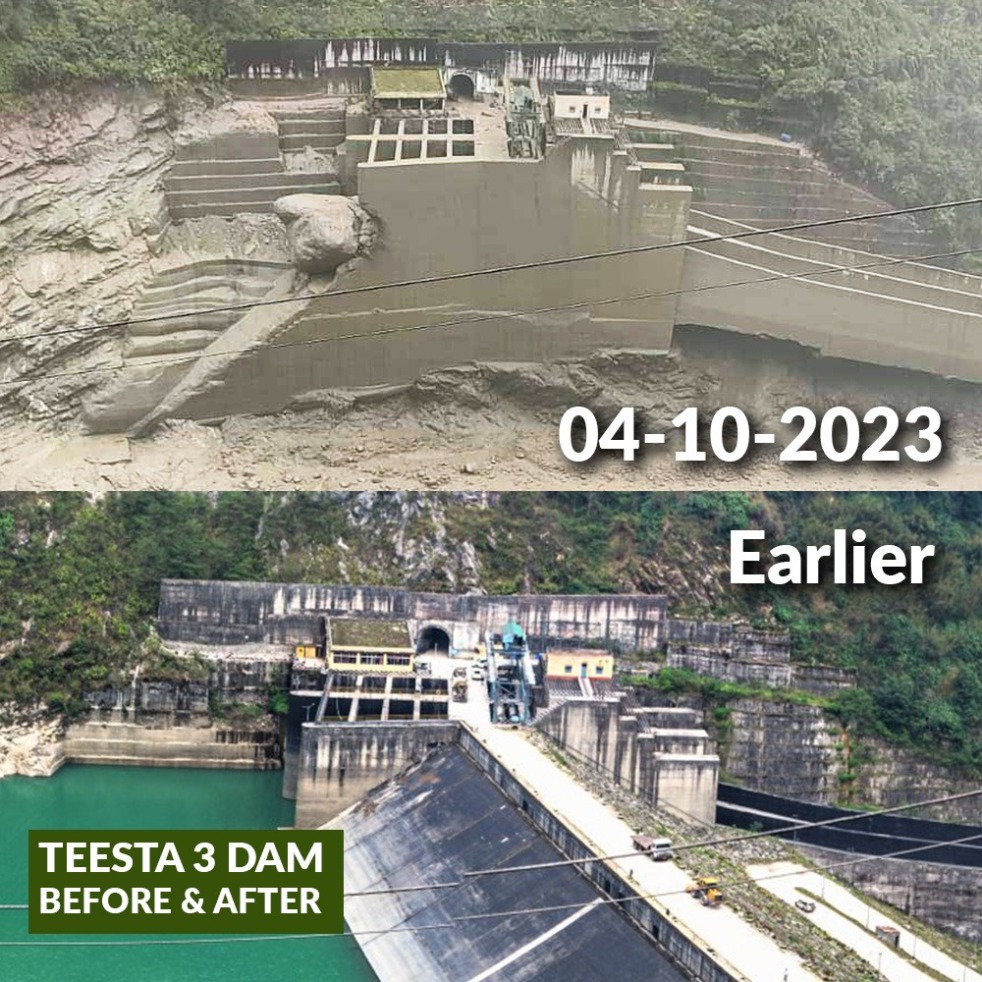
At a recent meeting in Pune, Secretary of Union Ministry of Jal Shakti said that safety assessment of about 5000 large dams, out of total around 6000 in India is pending as per the following PIB press release. He went on to urge acceleration of dam safety assessments across the country. This is a worrying situation, coming straight from the secretary of the concerned Union Ministry. It again underlines the sorry situation regarding dam safety in India.
It is not clear what does the report of the safety assessment of the 1000 dams already completed. From the available information about dam safety situation in case of some of the largest dams shows that these reports may also need indicate urgent action plan. An example is the Hirakud dam in Odisha where need for auxiliary spillway has been known for over a decade but we are far from achieving that. Another example is the Mullaperiyar dam in Kerala, the safety issue of which is again under scrutiny before the Supreme Court of India. Pending safety concerns of Chungthang dam in Sikkim, Srisailam and Singur dams in Andhra Pradesh-Telangana, the regular damage reports from Polavaram dam in Andhra Pradesh, Subansiri Lower HEP on Assam-Arunachal border, washing away of gates of Madhopur barrage in Punjab in 2025 monsoon, the pending issue of Kaleshwaram’s damaged barrages in Telangana are some of the other cases of concern.
In fact we urgently need audit of our dam safety institutional architecture to see how adequate are these institutions and their work on dam safety issues in India. We urgently need independent expertise both inside these institutions and all their regulatory bodies, we also need legal stipulations to make all information related to dam safety completely transparent and institutionalisation of accountability in structural and operational safety of dams. That is the least we can do if we value lives of our people, who are risk due to unsafe dams. Let us thank Mr Kantha Rao for initiating this debate.
Safety Assessment of over 5000 dams pending: Govt Shri V. L. Kantha Rao, IAS, Secretary (DoWR, RD & GR), Ministry of Jal Shakti, said at a CWPRS (Central Water and Power Research Station) meeting in Pune on Oct 29 that under the Dam Safety Act, 2021, the pace of assessments remains slow and called for concerted efforts to expedite the evaluation of about 5,000 pending dams (out of around 6000 large dams) by December 2026. The Secretary underscored that CWPRS, should play a key role in handholding and guiding State governments, private consultants and agencies involved in dam safety assessments. He suggested that CWPRS, in consultation with the National Dam Safety Authority (NDSA) could develop Standard Operating Procedures (SOPs) aligned with the 17 regulations issued by NDSA, drawing upon its extensive experience and technical capabilities. These SOPs, he said, would serve as a valuable framework to help States ensure uniformity, compliance and quality in their dam assessment practices. “We must accelerate dam assessments across the country… ”, he urged.
HYDROPOWER PROJECTS
Protest against 1650 Mw Subansiri Upper HEP A 12-hour bandh was observed on Oct 28 across Arunachal Pradesh’s Upper Subansiri district, called by the All Upper Subansiri District Students Union in collaboration with the All Tagin Students Union and other local groups. Protesters demanded the permanent cancellation of the 1,650 MW Subansiri Upper Hydro Project, citing threats to the region’s environment, culture, and livelihoods.
Consultative meet held over proposed SUMP The Upper Siang district administration on Oct. 31 held a consultative meeting with the residents of Komkar village to discuss the potential benefits, concerns, and long-term implications of the proposed Siang Upper Multipurpose Project (SUMP). The administration has emphasised that sustained community engagement will remain key to ensuring the project’s benefits are equitably realised. The consultative meeting concluded with a shared understanding of the opportunities and challenges ahead, reinforcing the district administration’s focus on informed and inclusive development.
Sawalkote HEP running dry on progress Despite being conceived way back in 1960s, the project, which will be the biggest hydroelectric project of J&K and third biggest in India, has not picked up desired momentum as it still remains entangled in procedural, technical and financial hurdles. To be built by the National Hydroelectric Power Corporation (NHPC) Limited at an estimated cost of ₹31,380 crore, the run-of-the-river project will straddle Ramban, Reasi and Udhampur districts of Jammu and Kashmir.
“In 1992, the NHPC quit the project because of peak militancy but took it over in 2021 from J&K Power Development Corporation Limited (JKPDCL). From 1992 to 2021, for over 30 years, it remained with JKPDCL and very little progress was made in the form of an unfinished tunnel and a 16 km long road from Dharamkund,” said the official. Year 2032 has been fixed as revised deadline but going by the delays, the project may miss it, he added. The road was damaged extensively due to landslides during heavy rains in August this year, he informed.
Snow leopard rescued from dam The rare snow leopard, usually found in high, snow-covered mountains, was reportedly sighted for the first time in Kinnaur district on Nov. 01. The animal was found trapped in the filter inlet at the dam site of the 120-MW Sanjay Hydroelectric Project in Bhaba Nagar and the forest department was alerted by project officials.
MNRE to launch new small hydro policy to boost capacity in North East The Union Ministry of New and Renewable Energy Sources is planning to launch a new small hydro policy to boost capacity of such projects in North East India.
Aranya Garjana against PSPs in Andhra Pradesh A massive “Aranya Garjana” (roar for the forests) rally was held in Paderu, Alluri Sitarama Raju district, opposing proposed hydropower projects in tribal regions. Organised by the Andhra Pradesh Girijan Sangham, the rally began at the govt junior college grounds and moved through the ITDA office to the district collectorate. Thousands of tribals and local leaders participated, raising slogans against forest land diversion.
At the protest meeting near the collectorate, CPM central committee member K Lokanadham demanded cancellation of hydropower agreements and immediate revocation of GO Nos 51 and 1302. He alleged that the orders permit corporate firms to build 7,400 MW projects in Ainathagiri, Yerravaram, and Sileru, threatening 20,000 acres of forest and 250 tribal villages. He said the projects violate constitutional protections under the Fifth Schedule, PESA Act, and Forest Rights Act, 2006.
KPCL officials defend Sharavathi PSP Following a series of protests opposing the Sharavathi Pumped Storage Project in the Western Ghats, a team of officers representing the Karnataka Power Corporation Ltd. (KPCL), the project implementing agency, defended it, stating that the project would be executed by acquiring minimum forest area.
DAM SAFETY
Singur project to be emptied for urgent repairs In response to recommendations from the National Dam Safety Authority (NDSA), the irrigation department has decided to keep the Singur multipurpose project empty to facilitate urgent repair work. Following an NDSA alert, water storage in the dam has already been reduced to 16 TMCft, compared to its gross capacity of 29.91 TMCft, despite the project receiving a record 220 TMCft of water during this year’s rainy season. During its inspection on June 23, the NDSA found severe damage to the dam’s earthen embankments and revetments, along with cracks in the parapet wall and the top of the embankment, posing serious risks to the dam’s stability.
DAMS
BBMB Members Row: Punjab seeks HM’s intervention The Punjab Government has now sought the intervention of Union Home Minister Amit Shah after the Union Government decided to appoint two new members to the Bhakra Beas Management Board (BBMB) from Rajasthan and Himachal Pradesh, terming it “incremental federal erosion”. CM Bhagwant Mann has written a letter to Amit Shah urging him to advise the Ministry of Power not to create additional posts of whole-time members. “Further, the ministry may fill the vacant posts of members following the earlier arrangement under which one member got appointed from Punjab and another from Haryana,” he wrote, adding that there could not be more than two whole-time members of the board.
On October 10, the Union Ministry of Power had written to the four partner states – Punjab, Haryana, Rajasthan, and Himachal Pradesh – seeking their comments on its proposal to increase the number of whole-time members from two (one each from Punjab and Haryana) to four. The ministry said that based on requests from Rajasthan and Himachal for increasing the number of whole-time members, it had proposed amendments to Section 79(2)(a) of the Punjab Reorganisation Act, 1966.
Telangana CM asks officials to plan transfer of 80 TMC from Tummidihatti The CM A. Revanth Reddy on Oct 27 directed the irrigation department to prepare comprehensive plans to draw 80 tmc ft of water from the Tummidihatti project to the Sundilla barrage, and to finalise estimations for repairing the damaged Sundilla barrage. The Chief Minister said that the works must be expedited to ensure water supply to the Sripada Yellampalli project and to provide irrigation and drinking water to the erstwhile Adilabad district.
Revanth Reddy reviewed the condition of key barrages of the Kaleshwaram lift irrigation scheme (KLIS) —Medigadda, Sundilla and Annaram —and instructed the officials to ensure that the contract agencies responsible for their construction also bore accountability for the repair works. He said repair plans must be prepared and executed without delay. Singur dam safety issues were also reviewed.
INTERSTATE WATER DISPUTES
Ignoring Kerala’s protest, TN proceeds with Aliyar project The Tamil Nadu government decision to implement a 2,400-Mw pumped storage project at Aliyar dam ignoring Kerala’s concerns has led to unease between the neighbours. While the two states are engaged in a perennial tussle over the Mullaperiyar dam, disputes over sharing of water from the Parambikulam-Aliyar Project (PAP) too have been simmering for decades.
Though Kerala Additional Chief Secretary Biswanath Sinha wrote to TN Water Resources secretary J Jayakanthan on October 18 expressing concern over the proposal, the neighbour is seemingly in no mood to listen. On October 26, the Tamil Nadu Infrastructure Development Board (TNIDB) invited application from empanelled consultants for selection of transaction advisor to assist the project. The TN government plans to implement the project in public private partnership (PPP) mode at an estimated cost of Rs 11,721 crore.
URBAN RIVERS
Kolkata riverfront to get a retail, office hub Calcutta port has awarded a four-acre plot on Strand Road to Srijan Realty to build retail and office space as part of a broader plan to transform the Hooghly riverfront on both banks. Srijan will hold a 60-year lease on the plot, near the erstwhile Armenian warehouse, where an 800,000sqft project will come up at an investment of ₹350 crore. The developer intends to complete the project in four years. The plot is one of at least 10 projects that the Syama Prasad Mookerjee Port, formerly Kolkata Port Trust, is tendering out for the redevelopment of both banks of the river, port deputy chairman Samrat Rahi told The Telegraph.
Call for conservation of Ganga ghats in Kolkata At a seminar on “The Riverbank City: Kolkata and its Ghatscape” in Jadavpur University, the experts said on Oct. 30 that the Ganga ghats in Kolkata were a living repository of India’s cultural and spiritual heritage of the community. They said rapid development and pollution were causing permanent damage to the Ganga river front that defines Kolkata’s identity and the country’s collective memory.
Kaberi Roy from the Kolkata Port Trust or Syama Prasad Mookerjee Port, Kolkata (SMPK), which is the custodian of the Ganga ghats in Kolkata, said the recent projects undertaken in partnership with other stakeholders to restore the ghats had been a positive move towards conserving the city’s heritage. However, multiple speakers raised questions about private entities working for the conservation and restoration of the historic Ganga ghats of Kolkata. They called for collaborations between conservation architects, archaeologists, researchers, and history experts to come together and ensure that the history of the ghats is not lost in the process of private entities modernising them.
RIVERS
Muddy Umngot river: MSPCB flags violation of env norms by NHIDCL The Meghalaya State Pollution Control Board (MSPCB) on Oct. 31 issued a directive to the Project Monitoring Unit (PMU) of the National Highways and Infrastructure Development Corporation Limited (NHIDCL) over environmental lapses detected in the implementation of the ongoing Shillong-Dawki Road project. In a letter addressed to the PMU General Manager under Section 5 of the Environment (Protection) Act, 1986, MSPCB Chairman R. Nainamalai cited multiple violations observed during an inspection conducted earlier in the day.
The Board noted that large quantities of excavated soil were being dumped along the roadside without adequate containment or stabilisation measures. The directives issued by the Board include immediate removal of construction and demolition waste dumped in the Umngot River, ensuring that all contractors apply for consent to establish/operate from the Board within 15 days, enforcing the Meghalaya stone crusher order among all contractors, especially regarding the use and sourcing of boulders. The MSPCB also directed NHIDCL to submit an action taken report at the earliest.
The NHIDCL asserted that it is taking precautions to protect the Umngot River while executing the work on the Shillong-Dawki Road project. Before this, Lok Sabha member from Shillong, Ricky AJ Syngkon petitioned Minister of Road Transport & Highways, Nitin Gadkari and MoEF Bhupender Yadav complaining about severe environmental degradation and pollution of the once-pristine Umngot River due to construction activities for the Shillong-Dawki Road Project.
The MP drew the attention of the central ministers to the severe environmental degradation of the Umngot River—once celebrated as “Asia’s cleanest river”—caused by ongoing construction activities under the project being implemented by NHIDCL and funded by Japan International Cooperation Agency (JICA).
He said that the Umngot River, a symbol of Meghalaya’s pristine natural heritage and a major tourism asset, has tragically turned muddy and lifeless this October, a period when its waters should be crystal clear. He highlighted a similar case involving the Bhagirathi River in Uttarakhand, where the NGT imposed a Rs 2-crore penalty for comparable offences.
Rs 3900 Cr plan for Ganga clean up in Bihar fails The river remains far from achieving the program’s stated goal of “Nirmal Dhara” (unpolluted flow). This is despite the central government having spent over Rs 3,900 crore in Bihar over the past decade.
Of the 13 newly installed STPs in Bihar by October 2024, Prime Minister Narendra Modi personally inaugurated seven last year. These seven plants, along with the interception and diversion networks essential for their operation, cost over Rs 2,100 crore. But multiple inspections and assessments carried out by the NMCG and the Bihar State Pollution Control Board (BSPCB) revealed three key problems: some of the sewage treatment plants were non-functional; all functional ones were not performing at maximum capacity; and some were performing below capacity while also violating standards.
While hearing a case on the prevention and control of Ganga pollution, the Tribunal criticised the NMCG for merely sending letters to Bihar authorities rather than taking action. The Tribunal reminded the mission that it holds strong legal powers under Section 5 of the Environment (Protection) Act, 1986, empowering it to undertake any measures deemed necessary to clean the river. At the time, faecal coliform concentrations were so high that the river water was unfit even for bathing, according to Central Pollution Control Board (CPCB) data.
Plan to prevent water pollution by oil-carrying vessels The government is preparing a special ‘Oil Spill Disaster Management Plan’ to prevent severe water pollution in the event of accidents involving oil-carrying vessels in rivers or the sea, a senior official said on Sept. 12. Chief Secretary Manoj Pant held a high-level meeting with the Disaster Management Department to discuss the plan, he said. “It has been decided that a committee, headed by the chief secretary and comprising senior officials from Disaster Management, Public Health Engineering, Irrigation, Transport, Home, and Environment departments, has been formed under the directive of Chief Minister Mamata Banerjee,” he told PTI. Coast Guard and Port Authority officials were also part of the discussions held at the state secretariat.
How to clean the river In the 4 years between 2017 and 2022, the Delhi government spent more than Rs 6,856 crore on cleaning the Yamuna. Delhi now has 37 STPs with a capacity to treat over 80-100 per cent of the generated sewage, and almost 80 per cent of the city is connected to sewer lines. In spite of all this, the river continues to run polluted and unclean.
SAND MINING
Kashmir: Mining threatens farmers & ecosystems Mining has stripped Kashmir’s riverbeds, eroding groundwater recharge, drying springs, shrinking trout habitats, and endangering the fragile Himalayan ecosystems. As extraction from rivers and streams continues unchecked, springs have dried and entire communities are losing dependable water. Sand and mineral extraction doubled from 4.74 lakh metric tonnes in 2021–22 to 11.42 lakh metric tonnes in 2022–23, driven by infrastructure projects like the Delhi–Katra motorway. Kashmir’s mining revenue touched Rs 181.04 crore over the past five years but the environmental costs may prove far greater. (Wahid Bhat)
Jhelum tributary gasps under illegal mining Originating from the Pir Panjal range, the Rambiara flows through several Shopian villages before joining the Jhelum. Over the years, it has turned into a hotspot for unregulated sand mining, often carried out during night hours despite repeated government warnings. Residents say rampant extraction has eroded riverbanks, damaged irrigation channels, and endangered farmlands.
Beas river system on brink The Beas river system defines Kangra’s landscape, carving fertile valleys that feed both agriculture and settlements. Along its tributaries, sand, gravel and boulders — classified as minor minerals — have long supported local construction. What began as small-scale extraction for village needs has, over two decades, turned into a commercial enterprise driven by rapid infrastructure growth and urban expansion.
Dozens of legally identified mining sites exist along the river courses. Yet, illegal and excessive extraction continues, often under the cover of darkness. Trucks laden with sand and stones ply rural roads, disturbing villages and damaging fragile riverbanks.
Illegal mining scandal rocks Moga The scheme, intended to help flood-affected farmers clear sand and silt from their agricultural land along the Satluj River, has become a cover for a lucrative black market operation. Following severe flooding two months ago, which deposited thousands of acres of sand in fields adjoining the Satluj, the Punjab government granted flood-hit landowners a special exemption: they could lift and sell the accumulated material without a permit or No-Objection Certificate (NOC) until December 31, 2025. The district administration has notified 29 such villages in the Dharamkot area. However, authorities are now finding that individuals are exploiting this relaxation, extracting sand from non-affected land and even commercial mining sites.
Goa CM urges central govt to allow manual sand mining CM Pramod Sawant urged Union govt to relax the guidelines for the state to carry out sand extraction in rivers through traditional methods. A senior officer said that sand extraction in CRZ areas is prohibited, which is why a lot of sand was transported at exorbitant prices from neighbouring regions. State urged Union govt to relax the sand extraction norms akin to those stipulated for the Andaman and Nicobar Islands. Sawant also sought amendments to the CRZ Notifications of 2011 and 2019, besides sustainable mining guidelines.
WETLANDS, LAKES, WATER BODIES
Study links land use to water pollution in Manipur’s Loktak Lake The findings of the study, undertaken by Eliza Khwairakpam of Nagaland University’s Department of Environmental Science, were published in the peer-reviewed International Journal of Environment and Pollution. The study pointed out that changes in land use – agriculture, settlements, and shifting cultivation – have been deteriorating the water quality of rivers feeding the lake, threatening its biodiversity and the livelihoods of the local communities.
The Nambul River was identified as the most polluted, with low oxygen levels and high organic contamination linked to 47% of the agricultural land, and 11% of the settlement areas in its sub-catchment. The Khuga River showed the second poorest water quality, despite having a higher forest cover. The researcher attributed this to extensive jhum, which was recorded at 42% in the region.
In contrast, rivers including Iril and Thoubal, which flowed through greater forest-dominated landscapes, displayed better water quality, highlighting the protective role of natural vegetation. “This study highlights the pressing environmental challenges arising from agricultural run-off, human settlements, and shifting cultivation, which are directly impacting the river water quality in the region,” Nagaland University’s Vice-Chancellor, Jagadish K. Patnaik, said.
Assam urges Ramsar tag for Rowmari–Donduwa wetlands Conservationists are pushing to list Assam’s Rowmari–Donduwa wetland as a Ramsar site, arguing its biodiversity, migratory bird populations and flood-buffering role meet international criteria — a push that would make it Assam’s second Ramsar wetland.
No restrictions on construction around Dal, Nigeen, Khushalsar lakes: Govt The Jammu and Kashmir government has denied that residents living around Mir Behri Dal Lake, Khushalsar, Gilsar and Nigeen lakes face severe restrictions in constructing residential houses or lack basic facilities. In a written reply to a question by MLA Tanvir Sadiq, the Housing and Urban Development Department said that all permissions in these areas are governed by the Srinagar Master Plan 2035 and court directions.
Bihar gets one more Ramsar wetland India’s one more wetland, Gogabeel Lake in Katihar district of Bihar, has got a tag of international importance as a Ramsar site, bringing the total number of such protected sites in the country to 94. Even the previous two wetlands (92nd and 93rd) – Gokul Jalashay of Buxar district and Udaipur Jheel of West Champaran district – added to the Ramsar list are in Bihar.
Bihar has now six Ramsar sites, standing at third position in the country after Tamil Nadu and Uttar Pradesh. India, meanwhile, continues to be at the top in Asia and third in the world after the UK (176) and Mexico (144) in terms of total number of Ramsar sites under a global convention. Globally, there are 2,546 Ramsar sites.
Wetlands remove nitrogen from surface water, leading to savings for municipalities A new study from the University of Illinois Urbana-Champaign finds that wetlands along the Mississippi River Basin effectively clean up nitrogen runoff from agricultural fields. The researchers also show this can lead to significant savings for local drinking water treatment facilities. The work is published in the Journal of the Association of Environmental and Resource Economists.
WATER OPTIONS
Bengaluru: Percolation wells lift groundwater levelsIn Lalbagh, close to 440 percolation wells have been dug by United Way of Bengaluru (UWBe), a nonprofit organisation, to capture runoff water, impacting the ground water levels directly. “Percolation wells have been able to collect close to 56,365 cubic metres of runoff rainwater which has percolated into the water table, improving the water levels,” said Sriram Ananthanarayanan, director, new initiatives and impact, UWBe.
As a result of the improvement in groundwater levels, the area which was once categorised as ‘over exploited’ with 103% extraction of groundwater, has now moved to ‘safe’ levels with just 64% groundwater extraction. Apart from improving groundwater levels, percolation wells have helped in many other ways including preventing of floods. So far, in Bengaluru, over 2.5 lakh such wells have been dug up and many more have been planned.
GROUNDWATER
Dumping of garbage: Groundwater in Nallur, Mudalipalayam unfit for drinking Groundwater pollution due to dumping of garbage in stone quarries in Nallur and Mudalipalayam in Tiruppur district has become alarming, say villagers citing a Pollution Control Board (PCB) reply to a Right to Information query. They urged the government to take steps to provide water through joint water schemes and take relief measures in the affected areas. A major part of around 600 tonnes of garbage collected from Tiruppur city limits was being dumped in abandoned stone quarries in Mudalipalayam and Nallur. However, the dumping has now stopped following a High Court order.
Earlier the Gram Sabha of the Mudalipalayam Village Panchayat in Tiruppur district was postponed due to public protest over the dumping of garbage. The protesters demanded the removal of garbage as well as a ban on further dumping of garbage from Tiruppur city in a stone quarry in the village.
Water-guzzling data centres could strain fragile ecosystems Water requirements of these plants are huge as cooling systems can consume millions of litres annually, often in water-scarce regions such as Mumbai and Chennai. However, the environmental implications of this expansion are considerable and have not received the critical attention they deserve.
URBAN LAKES, WETLANDS
HC interim stay on luxury project near Ramsar site The Madras High Court has restrained Brigade Morgan Enterprises from constructing 1,400 residential units near the Pallikaranai marshland, a Ramsar site, and sought responses from the Tamil Nadu and Central governments by November 12. The order came in response to a PIL filed by the AIADMK’s Chennai legal wing district secretary, who alleged that the project encroached upon the ecologically sensitive marshland.
Days after anti-corruption NGO Arappor Iyakkam accused the Tamil Nadu government of illegally granting environmental clearance and building approvals for a multi-crore real estate project by a Karnataka-based firm within the protected Pallikaranai Ramsar wetland site in Perumbakkam, the state government has defended its actions, citing incomplete boundary delineation of the protected area. The real estate developers have urged the Tamil Nadu government to reconsider curbs on construction within a 1-km buffer zone around the Pallikaranai marshland, with the Builders’ Association of India (BAI) warning that a ‘blanket freeze’ on planning approvals in the buffer zone could disrupt livelihoods and housing prospects for roughly five lakh people. The zone covers 13 villages with approved layouts and major infrastructure, including IT parks, commercial developments and a metro corridor.
How 6 forest water bodies disappeared from Delhi’s Map The The Delhi Forest and Wildlife Department has informed the National Green Tribunal (NGT) that six of the 28 waterbodies under its jurisdiction no longer exist. The six vanished sites together once covered roughly 40,000 square metres. They ranged from small village ponds to mid-sized wetlands. The Maidan Garhi and Shahurpur ponds measured around 1,500 sq m each, while the largest, in Asola, spanned nearly 20,000 sq m. The forest department said five of these lost sites lie in the South Forest Division, in areas such as Asola, Maidan Garhi, Shahurpur, and Chhattarpur, while one falls under the Central Division at Shastri Park.
Among the remaining 22 water bodies, at least eight are described as being in “good condition but currently containing shallow water.” These include sites at Asola, Bhati Kalan, Maidan Garhi, Devli, Neb Sarai and Chhattarpur
Dry days at Okhla Bird Sanctuary Okhla Bird Sanctuary is stark dry after an abundant monsoon even as migratory birds have started flying in. One of Delhi-NCR’s prime wetlands, and among the 466 Important Bird Areas (IBAs) of the country, the state of the sanctuary has taken visitors and bird watchers by surprise, especially when it’s time to host the annual visitors. There is, as a result, no food stock for the birds.
Sources said the excess water in the Yamuna – which had flooded parts of Delhi and Noida – during monsoon had necessitated repair of Okhla barrage. Usually, repair and maintenance work happens once a year, after the birds leave, at the onset of summer when water flow in the river is lean.
Hyderabad: Lake revival underway HYDRAA is restoring the historic Bam Rukn-ud-Daula lake in the Old City to its former glory. Works are expected to be completed by the end of November. Once spread over 18 acres, the lake had shrunk to 4.12 acres due to illegal occupation.
URBAN WATER
Building damage risk in sinking Indian megacities Abstract Here we used satellite radar observations during 2015–2023 to estimate differential settlements at 5 fast-growing Indian megacities, including more than 13 million buildings and 80 million people. Our analysis reveals 878 km² of land subsiding, exposing ~1.9 million people to subsidence rates of more than 4 mm yr−1. An estimated 2,406 buildings across Delhi, Mumbai and Chennai are at high risk of structural damage from ongoing land subsidence. Sustained over 50 years, current subsidence rates could place as many as 23,529 buildings at very high risk of structural damage in Chennai, Delhi, Mumbai, Kolkata and Bengaluru. Our results highlight the compounding risk of infrastructure damage from subsidence, assisting policymakers to develop resilience plans and adaptation strategies that prioritize mitigation and maintenance spending.
Sinking Indian megacities pose ‘alarming’ building damage risks Results revealed that 878 square kilometers of urban land, or about 339 square miles, is sinking, with nearly 1.9 million people exposed to subsidence rates greater than 4 millimeters per year. Land subsidence compounds the threats from flooding and earthquakes. When the ground beneath a city sinks unevenly, it weakens foundations, damages utility lines, and amplifies structural vulnerability.
Cities sinking due to groundwater over exploitation A rapid infrastructure buildout in India’s biggest cities is being threatened as the over-extraction of groundwater causes land to sink, says a new study. More than 2,400 buildings in New Delhi, Mumbai and Chennai are already at a high risk and at least 20,000 more could become vulnerable within the next 50 years, according to findings published on Oct 28 in the Nature Sustainability journal.
Researchers used satellite radar data from 2015 to 2023 to examine roughly 13 million buildings across five cities. The study found an area of 878 square kilometers of urban land was sinking. Susanna Werth, an assistant professor of hydrology and remote sensing at Virginia Tech, and a co-author of the paper said, “Our study shows that overexploitation of groundwater is directly linked to structural weakening in urban areas.”
Interview with Leonard Ohenhen on land subsidence due to Groundwater overuse Interview with US academic on land subsidence in the US and the lessons it can offer to developing countries. “Global South cities have a crucial opportunity to learn from costly mistakes elsewhere by implementing proactive measures before over-extraction becomes entrenched. Key strategies include establishing early groundwater monitoring networks using both in-situ sensors and satellite-based systems to detect aquifer stress and land deformation. Regulation and permitting systems should be implemented to maintain sustainable yield thresholds and prevent irreversible compaction. Cities should invest in diversified water portfolios including surface water infrastructure, wastewater recycling, rainwater harvesting, and locally adapted managed aquifer recharge schemes such as recharge basins or rooftop-to-recharge systems. Subsidence risk must be incorporated into land-use planning and infrastructure design from the outset. However, implementation must be adapted to local realities. In many communities where groundwater is the only feasible water source, blanket extraction moratoriums are neither practical nor equitable. Instead, adaptive governance models are needed that promote responsible use through phased regulation, public education, and community-supported recharge interventions.”
Aquifer recovery in Delhi Summary Our analyses of 9 years (November 2014–October 2023) of InSAR time series observations reveal that land subsidence in the Dwarka region due to excessive groundwater withdrawal ceased around mid-2016, and currently, the area is uplifting at ∼2 cm/year. The region north of Gurgaon, which subsided by more than 1 m (November 2014–October 2023), also shows a decay in the subsidence rate from 2019 onwards. However, the Faridabad region, located outside the administrative boundary of Delhi, shows an increase in subsidence from 2 to 4 cm/year after 2017. The uplift in Dwarka and decay of subsidence in areas north of Gurgaon is attributed to improved aquifer management practices, including the installation of artificial recharge structures since rainfall during the concomitant period shows a declining trend. The InSAR observations are further supported by in situ groundwater level measurements, which show recovery of more than 1.5 m during 2018–21.
The research points to the significant impact of Delhi’s 2016 groundwater policy, which imposed restrictions on new borewells, mandated rainwater harvesting, and required housing projects to incorporate recharge structures. This policy, the study suggests, has likely contributed to the stabilization of Delhi’s overdrawn aquifers.
Canal feeding Delhi’s water became a dumping ground In an open letter dated October 26, Bhim Singh Rawat, Associate Coordinator, South Asia Network on Dams, Rivers and People (SANDRP), an advocacy group, has urged the Delhi Government to take “immediate remedial measures” to stop “very serious water-polluting activities going on unchecked.” Rawat addressed the letter to the Water, Health, and Environment ministers of Delhi, the CEO of Delhi Jal Board, and the member Secretaries of the Delhi Pollution Control Committee (DPCC), the Central Pollution Control Board (CPCB), and the Delhi Disaster Management Authority (DDMA). During his October 25 site visit to the canal stretch in North West Delhi, Rawat documented multiple sources of contamination, including religious waste, industrial residue, and human sewage.
KPMG to oversee DJB Projects The DJB has appointed multinational professional services network, KPMG, as its Project Management Unit (PMU) to monitor and support the execution of all DJB projects, including STPs, tanker management systems, and billing-related processes such as Late Payment Surcharge (LPSC). With KPMG’s appointment, every ongoing and future project under DJB will now be tracked using data-driven evaluation, independent audits, and real-time reporting mechanisms. This partnership is expected to streamline project implementation, ensure timely completion, and bring financial discipline to the water utility’s operations.
URBAN SEWAGE MANAGEMENT
Independent Assessment by CPCB shows Delhi STPs not functioning, Contradicting DJB results All 37 sewage treatment plants (STPs) run by the Delhi Jal Board (DJB) failed to meet the prescribed discharge standards during an inspection conducted by the Central Pollution Control Board (CPCB) in June. The findings, however, directly contradict the Delhi Pollution Control Committee’s (DPCC) monitoring reports from the same month, which rated most of these plants as “meeting standards”.
The CPCB findings — part of an Right to Information (RTI) Act reply issued on October 24 — states that during an inspection in June, none of the 37 STPs met all key effluent parameters like Biochemical Oxygen Demand (should be less than 10 mg/l), Ammonical Nitrogen (<5 mg/l), Total Suspended Solids (<10 mg/l), Faecal Coliforms MPN (< 230/100 ml). The FC levels were violated by 36 of 37 STPs, going as high as 4.7X10⁹ MPN/ 100 ml).
Bangalore: Treated wastewater flows into drains Hundreds of apartment complexes in Bangalore continue to release treated wastewater into storm-water drains (SWDs). A much-publicised agreement signed in Apr 2024 between Bangalore Water Supply and Sewerage Board (BWSSB) and Bangalore Apartments’ Federation (BAF) to promote the reuse and sale of treated water has failed to take off. The pact was intended to turn treated wastewater into a resource. Apartments were allowed to sell surplus treated water at Rs 8 per kilolitre, as BWSSB would buy it at Rs 10, retaining Rs 2 as service charge. However, neither a functional supply network nor a dedicated fleet of tankers has been created to move the water from apartment treatment plants to industries, parks, or construction sites that could use it.
According to BAF’s estimates, Bengaluru produces around 350 MLD of treated used water from decentralised sewage treatment plants in apartments. The estimated citywide demand for treated water is substantial — 175 MLD for flushing and landscaping, another 175 MLD for cleaning and vehicle washing, 150 MLD for industrial operations, and 100 MLD for cooling systems in data centres and tech parks. Officials added that treated water is also being directed to nearby lakes to aid groundwater recharge, though these efforts cover only a fraction of what is generated daily in apartments.
Bengaluru struggles to reuse water that can’t be discharged While the city receives 3,000 million litres of water every day from the Cauvery river, treated water is wasted without proper treatment, monitoring, and regulations for re-use.
URBAN MANAGEMENT
Who cleared a Rs 34-cr cloud seeding plan Three expert agencies advised against it. Delhi did it anyway, spending Rs 34 crore of public money on a winter cloud seeding experiment that produced no rain. The government, in collaboration with IIT Kanpur, has conducted three trials to date, one on October 23 and two on October 28, with none producing any significant rain in the capital.
WATER POLLUTION
Toxic factory closed down in Italy shifts to Ratnagiri in India A toxic PFAs generating Miteni owned chemical factory in in Vicenza, Italy. Miteni closed down in 2018 after one of the worst environmental scandals in Italy’s recent history: after decades of producing Pfas forever chemicals, the company’s management was brought to trial for contaminating water resources in an area where 350,000 people live. In June, its former executives were found guilty at the Vicenza court of assizes of causing environmental pollution and other charges and given prison sentences, which they are expected to appeal against.
Miteni went bankrupt. Its assets were bought in 2019 by Viva Lifesciences, a subsidiary of the Indian chemical company Laxmi Organic Industries – the only bidder in the public auction. By early 2023, all the equipment was travelling on freight ships, heading to Mumbai. Meanwhile, Laxmi was boasting of its new acquisition to investors. Transcripts of shareholders’ meetings show that Laxmi’s management downplayed environmental concerns, with its president, Harshvardhan Goenka, stating that Miteni was “doing everything legally according to European standards”.
That factory has now started operating in Lote Parshuram MIDC in Ratnagiri district of Maharashtra. Using the same machinery and patents from the Italy. Since early 2025, Laxmi’s site in Lote Parshuram has been fully operational, producing chemicals that will be used in pesticides, pharmaceuticals, dyes, cosmetics and other products. “If we look at the (Indian) regulations, [Pfas] is not present in those standards. It’s not recognised by the Indian government as of today,” said Rajneesh Gautam, an environmental chemist at the Swedish University of Agricultural Sciences.
High levels of Pfas in the blood are associated with increased risk of cancer, cardiovascular diseases, liver and kidney damage, reproductive disorders and more. Ermetti is currently recovering from a recent surgical operation.
Parineeta Dandekar SANDRP says the Lote Parshuram industrial district “has a dismal environmental track record”. After it was established in 1986, “the livelihood of fisher folk communities in this region completely collapsed,” she said. The chemical district is served by a centralised wastewater treatment plant that has been at the forefront of complaints. “The local villages have always stated that it’s not working properly,” said Dandekar. “When there is no electricity, a common occurrence in rural Maharashtra state, the plant cannot function and industries release polluted water directly into the streams.” Environmental authorities have sent several warning letters to the plant in recent years. “That region has seen enough environmental destruction already,” says Dandekar. “If more dangerous companies move in, it’s always a risk.”
PFAS stands for per- and polyfluoroalkyl substances, it’s an umbrella term for a family of thousands of chemicals – about 12,000 at the last count – that are prized for their indestructible and non-stick properties. They are used in a huge range of consumer products, including waterproof clothing, furniture, cookware, electronics, food packaging and firefighting foams and are employed in a wide array of industrial processes. Many of them are persistent, bio-accumulative and toxic. For example, perfluorooctane sulfonate (PFOS) and perfluorooctanoic acid (PFOA) were eventually banned or had their uses restricted under various European and international laws.
JJM/ RURAL WATER SUPPLY
Andhra contractors protest over pending bills worth ₹826 cr Contractors working under the Rural Water Supply (RWS) and Jal Jeevan Mission (JJM) on Oct. 22 launched an indefinite protest at the RWS Engineer in Chief office located at Gollapudi in the city, demanding immediate payment of pending bills amounting to ₹826 crore. The contractors, representing over 750 small and medium enterprises (MSMEs), said the delay in payments pushed them into a severe financial crisis. The contractors demanded the immediate release of ₹302 crore sanctioned through recent Budget Release Orders (BROs) and urged the govt to ensure regular bill payments and equal treatment for small contractors. They also opposed the state’s move to call large-scale Water Grid tenders, saying it threatens the livelihood of small RWS contractors.
Koneru Srinivasa Prasad, secretary of the association alleged that small contractors were not given proper priority over paying bills, with the government preferring mega tender packages for large corporate firms. “Since February, the government has released a total of Rs 322 crore in two installments. Of this, Rs 220 crore was paid to just two corporate firms, while only Rs 87 crore reached over 750 small contractors. Many small contractors have been waiting to receive payments. The government issued a BRO of Rs 152 crore last month, the funds have still not been released. A BRO of Rs 150 crore has been issued this month,” he added.
Contractors seek early release of pending JJM bills Rs 700 cr The Meghalaya State Council of Contractors & Suppliers Welfare Association (MSCCSWA), representing the Scheduled Tribe (ST) contractors engaged in the state’s Public Health Engineering (PHE) projects, on Oct. 29 urged PHE Minister Marcuise N Marak to expedite the release of pending payments worth approximately Rs 700 crore pertaining to completed works under the JJM.
Acknowledging the payment backlog in recent statements, the PHE minister cited delays in fund release from the central government. He confirmed that Meghalaya has received Rs 405.64 crore for the 2024-25 fiscal years but awaits the release of further funds for 2025-26 necessary to clear pending dues. According to Marak, the central government’s extension of the JJM deadline to 2028 involves mandated audits before fund release can proceed.
JJM deadline in J&K extended till Dec 2028 J&K govt on Oct. 28 said that the Centre has extended the timeline for completion of Jal Jeevan Mission (JJM) projects in the Union Territory till December 2028, following delays caused by non-release of funds during 2024-25. As per the minister ther is a balance requirement of Rs 6,254 crore for completion of all ongoing JJM schemes in Jammu and Kashmir.
WATER POLICY
Karnataka: Govt planning permanent State Water Commission Deputy CM DK Shivakumar is planning to set up a permanent State Water Commission (SWC), whose tasks will include preparing a water security roadmap for the next 50 years. The SWC will be required to review the irrigation pattern in the state and suggest measures towards water economy by using modern technologies. Countries like Israel and Australia have piqued Shivakumar’s interest in terms of water usage and micro irrigation techniques. Shivakumar wants the SWC to send teams to such countries and submit reports on what the state can emulate.
Climate crisis will be another area in which the SWC will work. Shivakumar said the proposed SWC will study weather patterns and suggest ways to increase capacity at dams and reservoirs to hold excess rainfall. The SWC will also come up with immediate measures that the government should take during drought. Recommending new irrigation projects, development of water bodies and improving natural water resources will come under the SWC’s purview.
“A permanent water commission is needed to ensure accountability in terms of water use, monitoring irrigation projects, advising the govt on inter-state river water disputes and other issues related to water resources, agriculture and environment,” said Shivakumar during an interaction with reporters ahead of the release of a book ‘Neerina Hejje’ (Foot Prints of Water) penned by him.
“There are some disparate bodies, which are ineffective as they serve as rehabilitation centres for some retired officials and judiciary members. The permanent water commission will play multiple roles of monitoring, advisory and regulatory body,” he said. Shivakumar said the govt would introduce a bill to establish SWC, which will be tasked with submitting reports on what the govt should do to ensure water availability in cities, including Bengaluru, for the next 50 years. It will also review the irrigation pattern in the state and suggest measures towards the water economy by using modern technologies.
The commission will be set up shortly, he said, adding that a legislation is required to set it up. “The Bill in this regard will be introduced in the legislature shortly. However, it is doubtful that it will be piloted during the ensuing Winter Session,” he said.
Meanwhile, the Supreme Court hearing on the Mekedatu drinking water project is coming up on November 6, and the DCM will be travelling to Delhi. Stating that the project will not affect Tamil Nadu, and the area on submergence is also not large, he said that a project office has already been opened 2 km away from the Tamil Nadu border.
Doubling of global freshwater footprint of material production over 2 decades Abstract: -Producing essential, widely used materials such as steel, cement, paper, plastics and rubber requires substantial freshwater resources, which may exacerbate water scarcity. Despite this, comprehensive research on freshwater embodied in material production remains limited. Here we assess the blue water footprint (WFblue) of 16 metallic and non-metallic material categories across 164 regions, using a multiregional input–output model and the hypothetical extraction method. Our findings indicate that the global WFblue of material production doubled from 25.1 billion m3 in 1995 to 50.7 billion m3 in 2021, raising its share in global blue water consumption from 2.8% to 4.7%. The East, South Asia and Oceania regions saw an alarming 267% surge in WFblue for material production, with China—already facing medium-high water stress—experiencing a dramatic ~400% increase. As material production is expected to grow, we underscore the urgency of a water–materials nexus approach, particularly in water-stressed countries.
AGRICULTURE
India’s climate policy must not leave farmers behind The exclusion of Agriculture, Forestry, and Other Land Use (AFOLU) sectors from Article 6.4 mechanism of the Paris Agreement weakens carbon market inclusiveness and jeopardises rural resilience. (Satyanarayana Masabathula)
Will Procurement Plan shift crops to Pulses and Oilseeds? The Union Agriculture and Farmers’ Welfare Minister Shivraj Singh Chouhan has approved a massive ₹15,095.83 crore procurement plan for pulses and oilseeds in Telangana, Odisha, Maharashtra, and Madhya Pradesh for the Kharif 2025–26 season, a decision that could potentially reshape cropping
patterns in these key agricultural states.
FAO warns of ‘silent crisis’ as land degradation threatens billions The finding comes in the latest State of Food and Agriculture (SOFA) report by the UN Food and Agriculture Organization (FAO), released on Nov. 03 in Rome. “The report delivers a clear message: land degradation is not just an environmental issue – it impacts agricultural productivity, rural livelihoods and food security,” the UN agency said.
To measure degradation, the report compared current values of three key indicators – soil organic carbon, soil erosion, and soil water – against conditions that would exist without human activity under native or natural states. The data was processed through a machine-learning model that integrates environmental and socio-economic drivers of change to estimate the land’s baseline condition in the absence of human activity. The report estimates that around 1.7 billion people worldwide live in areas where crop yields are 10 per cent lower due to human-driven land degradation. They include 47 million children under the age of five who are suffering from stunting. “In absolute numbers, Asian countries are the most affected – both because of their accumulated degradation debt and their high population densities,” FAO said.
FLOOD 2025
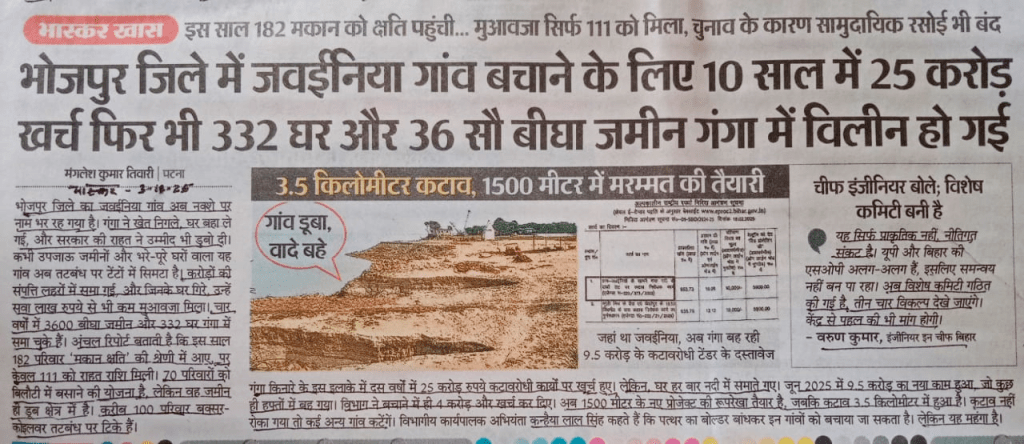
In Bihar a river runs where once a village was This July, the Ganga took everything that belonged to Jawaniya village in Bhojpur district of Bihar. Jawaniya is conjoined with another village, Chakki Naurangia, both on the Bihar-Uttar Pradesh border. Homes and lands in both villages have been lost forever.
Floods force closure of Bhavani Island Back-to-back floods at the Prakasam Barrage across the Krishna River have become a bane for the tourism department, which has once again been forced to close Bhavani Island and suspend boat operations, severely impacting tourism revenue. The department has already suffered a revenue loss of nearly Rs 1.8 crore, as boating services to Bhavani Island and room bookings at Berm Park were suspended for 60 consecutive days earlier this season. Now, the tourism department has once again been compelled to halt boating operations to Bhavani Island after the floodwater level at Prakasam Barrage exceeded the one lakh cusecs mark on Oct. 30.
HFL BREACH
India’s Rivers in Extreme Floods in Oct 2025 Interestingly, the Musi river at Anantharam site has breached the HFL 4 times in past 5 years while the Gundlakamma river at Marella site has crossed the HFL after 15 years. Of all HFL crossing events in Oct 2025, four happened in 1st week while two took place in the last week of Oct. 2025.
URBAN FLOODS
₹1632cr Master Plan for Jhelum flood mitigation Minister for Jal Shakti Department, Javed Ahmed Rana on Oct. 27 said that the government has Rs 1632 Crore Master Plan is in the pipeline for river Jhelum flood mitigation. He said that a comprehensive flood mitigation plan including deep de-silting and increasing carrying capacity of river Jhelum and its flood spilling channels is in the pipeline to enhance flood mitigation measures in the Valley.
The Minister said that nearly Rs 15 crores flood protection works have been undertaken in Srinagar to mitigate flood risk. He informed that as part of long-term and permanent flood protection measures, under PMDP Phase-II, various bank protection works have been undertaken at critical locations adjoining the above areas at a cost of Rs. 12.30 crores. Furthermore, to mitigate the risk of overflow, raising of embankments in vulnerable stretches has been carried out at a cost of Rs 2.49 crores, thereby enhancing the overall flood resilience of the area.
Mumbai: BMC to create 164 ‘Sponge Parks’ Under nature-based solutions to combat flooding, recharge groundwater, and enhance urban resilience, the BMC has decided to create sponge parks across Mumbai. The locations will include existing gardens and open plots.
The BMC proposal outlining some 26 measures to mitigate flooding in Mumbai costs around Rs 12,000 crore. Apart from Mumbai, the cities of Pune and Chennai are also working to create sponge parks to tackle urban flooding. Mukherjee said, “…Creation of each sponge parks costs around Rs 10 lakhs.” A senior officer from BMC Enviornment department said that a plot near Lallubhai Compound in Mankhurd is being developed into natural mechanism to prevent flooding and a smaller portion will include sponge park. “MMRDA has given its NOC to develop the ‘laal maidan’ (the plot) and a project management consultant is appointed.”
HIMALAYAN DISASTERS
Compensate Himalayan states to preserve ecology A group of retired civil servants and diplomats on Nov. 03 urged the 16th Finance Commission to compensate Himalayan states Himachal Pradesh, Jammu and Kashmir, Sikkim and Uttarakhand to preserve the ecology of the region. They urged the commission to follow up and amplify the 12th Finance Commission’s concept of a “Green Bonus” that allocated funds proportional to the steps taken by the states for ecology and sustainability. The commission, set up in December 2023, will recommend distribution of tax revenue between the Union government and the states for a five-year period between the financial years 2026-’27 and 2030-’31.
The former bureaucrats said that despite this, the states make a non-monetary, yet vital, contribution to the “country’s wellbeing, quality of life and in sectors like agriculture, climate control, hydel power, carbon capture and tourism”. The letter claimed that northern India and its Gangetic plain “would not survive” without the forests, the glaciers and rivers that originate from Himachal, Kashmir and Uttarakhand. “These rivers sustain a population of almost 400 million people and are a lifeline for many cities,” the group said.
Report warns of temperature rise, heavy rainfall in Himachal With climate change threatening to forestall Himachal’s development trajectory, the first UNDP Himachal Pradesh Human Development Report 2025 has cautioned against rise of temperature by up to three per cent till 2050 along with extremely heavy rainfall and accelerated glacial melting.
Signs of climate change in the report include 1.5 degree decrease in temperature since 1901, extremely heavy rainfall, cloudbursts, unpredictable monsoons, seasonal shifts and heat waves. The report becomes even more relevant in view of the fact that the state has suffered Rs 46,000 crore losses in the last five years due to extreme weather events. It points towards rise in number of fire alerts from 714 in 2022-23 summer to over 10,000 in 2023-24.
Uttarakhand: Villages devastated by rain and buried under rubble Three villages in Chamoli district were destroyed by heavy rains on the night of September 18-19, 2025. The floods and debris flows killed seven people, including twin infants, and wiped-out dozens of homes. Survivors, many displaced once before by the 1999 Chamoli earthquake, have again lost everything. Relief remains patchy — some families await compensation and official recognition of their land rights. Livelihoods, fields, and orchards have been buried under mud, leaving residents uncertain of where or how to rebuild.
POWER ALTERNATIVES
Demand for cancellation of Rs 20000 Cr Ladakh Solar Power Project The demand for the cancellation of the central govt’s Rs 20,000-crore mega solar power project in Himachal Pradesh is getting louder, with Kargil war hero and BJP leader Brigadier Khushal Thakur (retd) also joining the activists and environmentalists in raising the issue. According to Thakur, the project, under which 713-km high voltage direct current (HVDC) transmission lines will be set up from Pang in Ladakh to the national grid in Kaithal, Haryana, via Lahaul Spiti, Kullu, Mandi, and Bilaspur districts of Himachal Pradesh, is likely to aggravate the environmental destruction in the state and must be shelved.
The Centre in 2023 approved a 5 GW grid power line at a cost of Rs 20,773 crore to evacuate power from a 13 GW solar park, to be built over 20,000 acres of land in Pang in Ladakh. The project is likely to be completed by 2029-30.
India’s installed power generation capacity crosses 500 GW As of September 30, 2025, the country’s total installed electricity capacity has crossed 500 GW, reaching 500.89 GW, from 249 GW in 2014, the ministry said. Renewable generation has also exceeded 50 per cent of the demand. Power generation from non-fossil fuel sources — renewable energy, hydro, and nuclear — stand at 256.09 GW, over 51 per cent of the total. While fossil fuel-based sources were at 244.80 GW, about 49 per cent of the total.
New scheme for restructuring power distribution utilities The government is preparing a new plan to reform power distribution companies. This plan may involve selling a part of the stake to private partners and restructuring existing debt. States could receive financial support for capital projects. To qualify, states will need to allow private sector involvement in their distribution networks.
ENVIRONMENT GOVERNANCE
SC Pulls Up Uttarakhand HC The Supreme Court has strongly criticised the Uttarakhand High Court for entertaining a plea and staying a sanction order that was passed during the pendency of proceedings before the apex court concerning illegal constructions and felling of trees in the Corbett Tiger Reserve. The apex court, which has been monitoring the investigation by the Central Bureau of Investigation (CBI) into the alleged illegal constructions in Corbett, noted that it had earlier questioned the Uttarakhand Government for not granting sanction for prosecution. Following the Court’s oral observations on September 8, 2025, the State granted sanction for prosecution against one officer on September 16, 2025.
However, that officer, identified as Rahul, Chief Conservator of Forests, later filed a writ petition before the Uttarakhand High Court challenging the sanction order. The High Court, on October 14, 2025, admitted the matter and stayed the operation of the sanction order. Taking exception to this, the Supreme Court remarked that such a move “virtually amounts to interference” with its ongoing proceedings.
SOUTH ASIA
India comes out in support of Afganistan plan to dam Pakistan-bound river India backed Afghanistan’s announcement that it will build a dam on the Kunar river, saying it stands ready to support Afghanistan in sustainable water management, including on hydroelectric projects. Amidst Afghanistan-Pakistan tensions, the govt also reiterated its position that it is fully committed to the sovereignty and territorial integrity of Afghanistan.On the dam issue, ministry of external affairs spokesperson Randhir Jaiswal said there’s a history of cooperation between India and Afghanistan on such issues, including the Salma Dam in Herat province.
Pakistan: Dams & FloodsThe recent floods were followed by another round of uninformed debate on the need for new dams. Large dams have long been misconstrued as a solution to all Pakistan’s river water problems. Our development planners should shun concrete and steel based solutions and focus instead on nature-based flood management methods. The debate on flood management needs a fresh approach
REST OF THE WORLD
Celebration marks completion of tributary restoration at key Klamath River sites The end of construction activity on four priority tributaries to the Klamath River was marked with a “restoration celebration” hosted by Resource Environmental Solutions (RES) and attended last week by tribal leaders, contractors and others. As restoration contractor for the Klamath River Renewal project, RES led the effort to rehabilitate these key tributaries using a large playbook of stream restoration designs and practices. Collectively, these four tributaries historically had provided over 25 miles of high-quality habitat for salmon and steelhead. Each one was rendered inaccessible to these species by four dams constructed in the first half of the 1900s.
Salmon clear last Klamath dams For the first time in more than 100 years, Chinook salmon have been spotted at the confluence of the Sprague and Williamson rivers in Chiloquin, the government seat of the Klamath Tribes in Southern Oregon. It’s the latest milestone following the removal of four dams on the Klamath River last year, which was the largest river restoration project in U.S. history.
SANDRP

 SANDRP