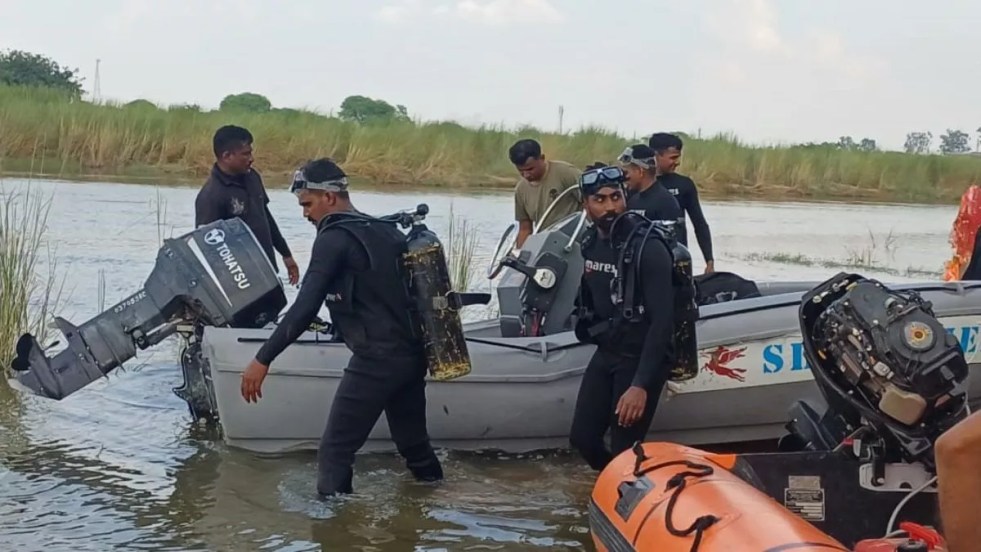
(Feature Image: Search operation going on in Utangan river Agra to recover the bodies of victims)
In the latest example of how illegal sand mine pits are proving to be a death trap across the country; 12 people have lost their lives after falling in deep sand mine pit in Utangan river in Agra district. The incident occurred when 13 young and adult villagers entered the river and suddenly fell into the cavity around 1 pm Oct 2 on Dussehra near Dungarwala village under Khairagarh tehsil.
About the Incident: All the deceased aged between 15 to 32 belonged to Kusiarpur village and had visited the river along with about 50 other villagers for immersion of Goddess Durga idol at the end of Navratri festival.
The villagers had started idol immersion practice only four years back. Many of the victims had not even informed their families about the ceremony. The Kusiarpur village is about 3km away from the Utangan river. The place is located about 45 km from Agra and just 500 meter away from Rajasthan border.
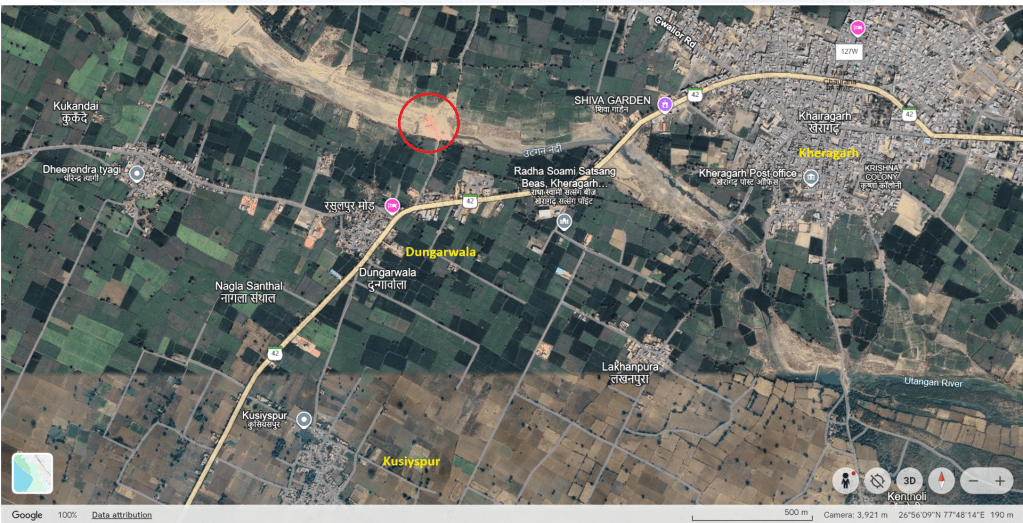
On the day of incident, finding shallow water level along the right bank, the villagers decided to immerse the 4 feet tall idol near middle section of the river. After which 13 people holding the idol formed a human chain and started moving towards deeper parts. At this point of time, one person suddenly slipped into a deep pit following which the others also lost balance and in sequence got drowned in the same area.
The villagers present at the site could rescue three persons. Two of them were later declared brought dead when sent to a hospital. Three dead bodies were recovered in next day while seven remained untraceable. Demanding timely action, the villagers blocked the NH 42, pelted stones at SDM vehicle and had heated altercation with local leaders and the MP.
Search Operation: A joint search mission by National Disaster Response Force (NDRF) Ghaziabad (20 persons), State Disaster Response Force (SDRF) Etawah (15 persons), PAC Flood Company (27 person) was started in early morning of Oct 3, which was eventually joined by the Army’s 50 Para Brigade and 411 Para Field Company (19 persons).
Later on, the Nagar Palika, Police, Metro Corporation, a private company and local villagers also assisted the search operation with men, labour and machineries including poclains, suction pumps, boring machines and compressor. The compressor machine got stuck in fields and could not reach the riverbank.
Three more bodies were found in the following days. The remaining four bodies were recovered after 130 hours long operation on sixth day on Oct. 07. This happened after the rescued person under treatment visited the accident spot and helped the search teams in figuring out the exact location of drowning.
The mud was removed with use of high compressor allowing bodies to float to the surface. All the 7 dead bodies were found from the same deep pit. The deceased were identified as, Sachin (14), Deepak (15), Manoj (15), Abhishek (16), Vinesh (19), Oke (19), Gajendra (20), Karan (21), Haresh (22), Bhagwati (23), Gagan (25), and Ompal (35).
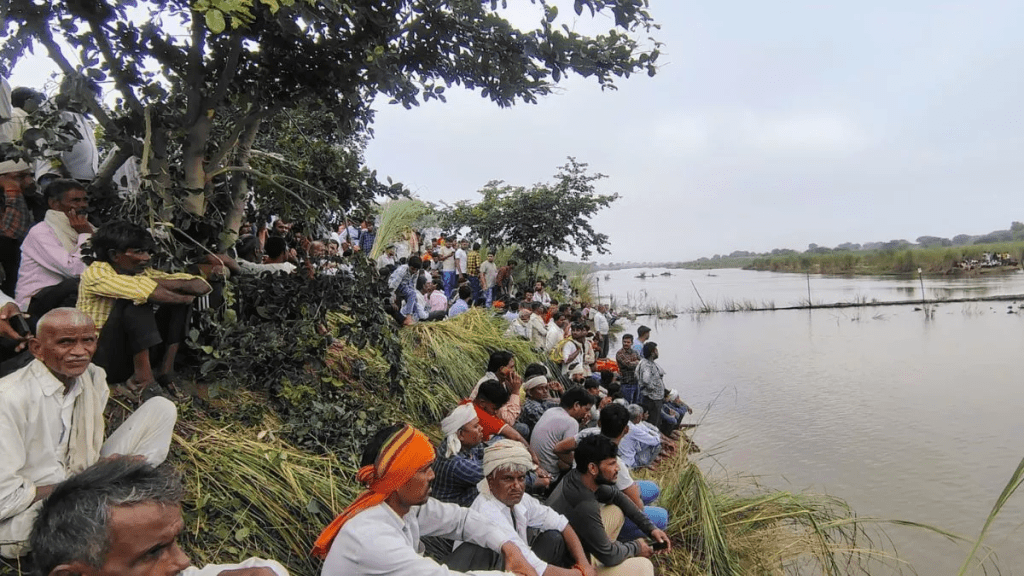
Delay by Dam Release: On the first day itself, the Agra DM had requested his counterparts in Karauli, Dholpur and Bharatpur against water releases from dams in Rajasthan till the search operation lasts. Despite this, the Parbati dam discharged about 2107 cusecs water which severely affected the work.
The releases increased the flood level and damaged a temporarily built mud bund and 200 meters long trench to divert and channelize the river flows away from the accident spot. Hereafter, the DM placed some SDMs and Patwaris at the sites of dams in Rajasthan to monitor the discharges. The exercise of bund and channelization was repeated again with the help of the villagers and machines. Then a storm and rain spell on Oct 5 delayed the rescue work. About 15 feet deep other cavities around the pit also made the rescue mission difficult.
Unclear Picture: Media reports have shared three different versions on the incident making it unclear whether it happened before, during or after the immersion ceremony. The location of the incident was about 1km upstream the place designated for idol immersion in Khairagarh. Some reports have raised questions about why Kusiarpur villagers went for immersion at the undesignated site.
However, other reports mentioned the villagers including kids and women on tractors had first visited the designated site but reportedly found it barricaded and was refused entry by the police. While returning, they planned to visit upstream location which was close to a crematorium site lacking safety arrangements and vigil.
Accountability Missing: The pit formed in the riverbed is reported to be 15-18 feet, 20-25 feet, 25-30 feet deep in different reports. The victims were first trapped at the muddy, sticky bottom and then their bodies got covered by thick soil layer from above. Many reports have mentioned the deep pit in the riverbed was created due to illegal sand mining. Even June 2022 Google Earth image clearly shows deep pit formation in riverbed which could be the possible location of this incident.
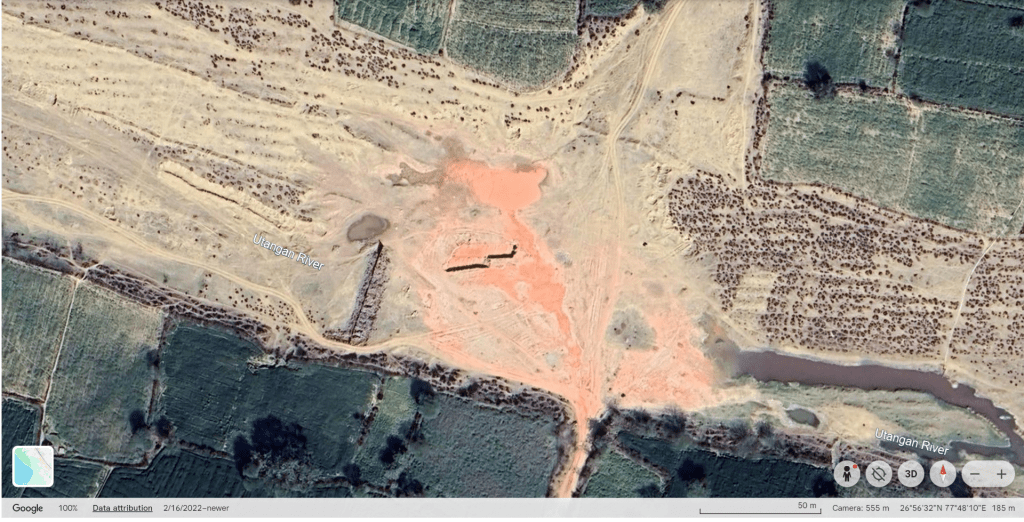
Ironically, the DM named it ‘Operation Utangan’ and strangely termed it a natural disaster. He said that the families of each deceased will be provided ₹4 lakh as compensation and the officials, govt staff and villagers involved in the rescue work will be rewarded on republic day on Jan. 26, 2026.
The DM has reportedly submitted full report about the incident, but it is not in public domain. The administration has planned to build a crematorium costing ₹24 lakh at the accident spot. It is also planning a strategy to deter such incidents in future.
Disappointingly, the illegal sand mine pits are increasingly resulting in avoidable deaths of scores innocent human beings across the country on annual basis. Like in other cases, this preventable accident is being labeled as an unfortunate incident caused by a natural disaster.
The most important questions to ask are how such a deep pit was formed in the riverbed? Why was it left in unrestored condition? Who is responsible for illegal sand mining?
Even more tragic is the prevailing official approach where the administration first squarely failed in checking the illegal mining in the river and then portraying the search operation as an achievement by recovering the mortals of innocent who died untimely due to its inaction and negligence. If this is the state of affairs, the lives of riverine people are on the mercy of such illegal sand mine pits in the country. (Report links 1, 2, 3, 4, 5, 6, 7, 8, 9, 10, 11, 12, 13)
Utangan River also known as Gambhir river originates from Aravali hills near Hindaun city in Kirauli district of Rajasthan. The river has a catchment area of 4316 sq km. It flows for 288 km before merging into Yamuna near Rihauli village under Bah tehsil of Agra. For a long distance the river forms boundary between Rajasthan and Uttar Pradesh.
Earlier the river was perennial but over the years it has become ephemeral largely due to water abstraction by dams and catchment degradation. Sesa, Kher and Parbati (different from tributary of Kali Sindh in Chambal basin) are the key tributaries of Utangan. Kakund another tributary of the river is also tapped in Baretha dam in Kiruali.
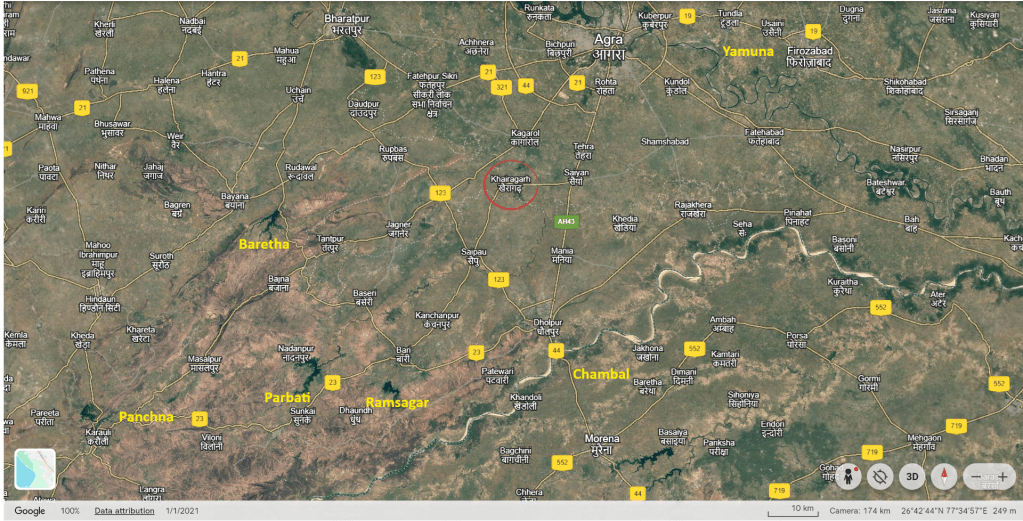
Panchna is the largest dam built on the river in Kirauli which is a confluence point of five rivers named Barkhera, Bhadrawati, Bhansawat, Attaki and Manchi. In recent years, there has been demand for building a dam on Utangan in Rehawali area under Fatehabad tehsil, Agra for potable water supply and flood control.
SANDRP

 SANDRP