Last October, we were about 15 kms from Chasoti in the Paddar valley of Jammu when we met Dular Singh jee, Priest of Machail Mata Temple, accompanied by other members of the Temple Management Board. They were on their way to Mindhal Mata Temple also on the banks of Chenab in the neighboring Pangi Valley. Theirs was a journey upstream and ours was downstream. We talked of Chenab, floods, Mindhal and Machail Mata Yatra (pilgrimage) and beautifully carved wooden temples of this region.
And today, Dular Singh jee, who is just 3kms from Chasoti, tells me in voice choked with emotion, “I have not seen such a catastrophic flashflood in my life.” The flood that started around 12 noon on Aug 14 2025, devastating Machail Mata yatra and pilgrims at Chasoti. “Mata Rani sabki raksha kare”. (May the deity protect all). He is also worried about villages like “Hangu, Hanoti, Hamori and Bhajanu Nalla”.
Pawan Kumar, a young contractor working on small projects from downstream Pandel tells me that flash floods and cloudbursts did occur in the past, but he has not even heard stories of devastation akin to what has now occurred in Chasoti.
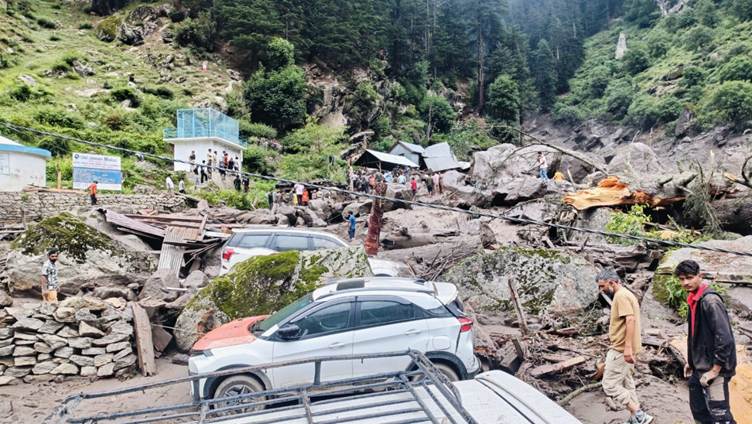
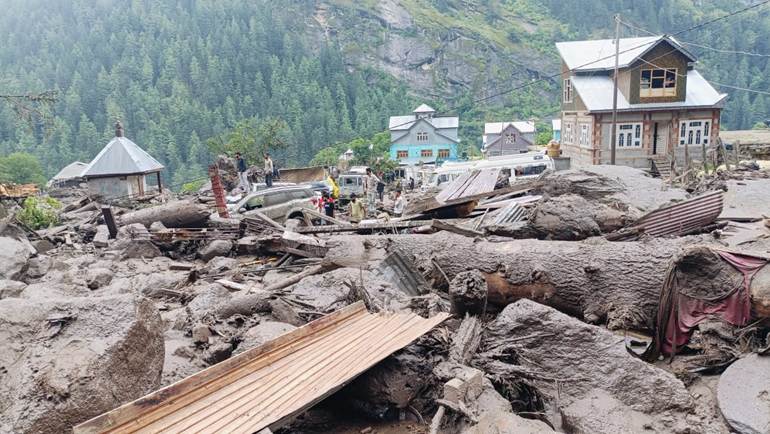

As I write, close to 56 bodies including of two CISF jawans and rest mostly pilgrims on Machail Mata Yatra have been recovered from the flashflood. More than 250 people are yet unaccounted for. There were 1000-1200 people at the site when the incident occurred. “I believe more than 500 people are still trapped under the debris in Kishtwar, and some officials are saying the number may exceed 1,000. It is a moment of deep sadness.” J&K Chief Minister Omar Abdullah said.
He said it needs to be ascertained if there was any lapse on the administration’s part, as “we already knew about the weather (forecast). Could we have taken more steps from the government and the administration to save these precious lives? We have to make ourselves accountable on this account.”
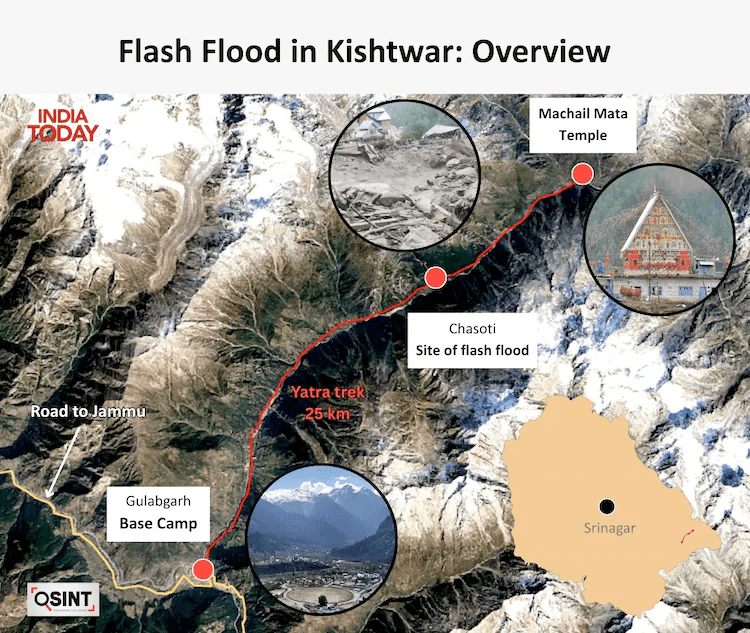
Chasoti village is a small settlement that serves as a base camp for Machail Mata yatra. For a remote region, this village in South Jammu is startlingly populated with homes and guest houses close to the Chasoti or Jasnai Nalla. Most of the makeshift shops, community kitchens, a security camp and parking areas have been washed away by the flood. The annual event reportedly attracts nearly 300,000 pilgrims. The Machail Mata Yatra, which began on July 25 and was scheduled to end Sept. 5, has been suspended. Officials have urged people to avoid the area until conditions improve.
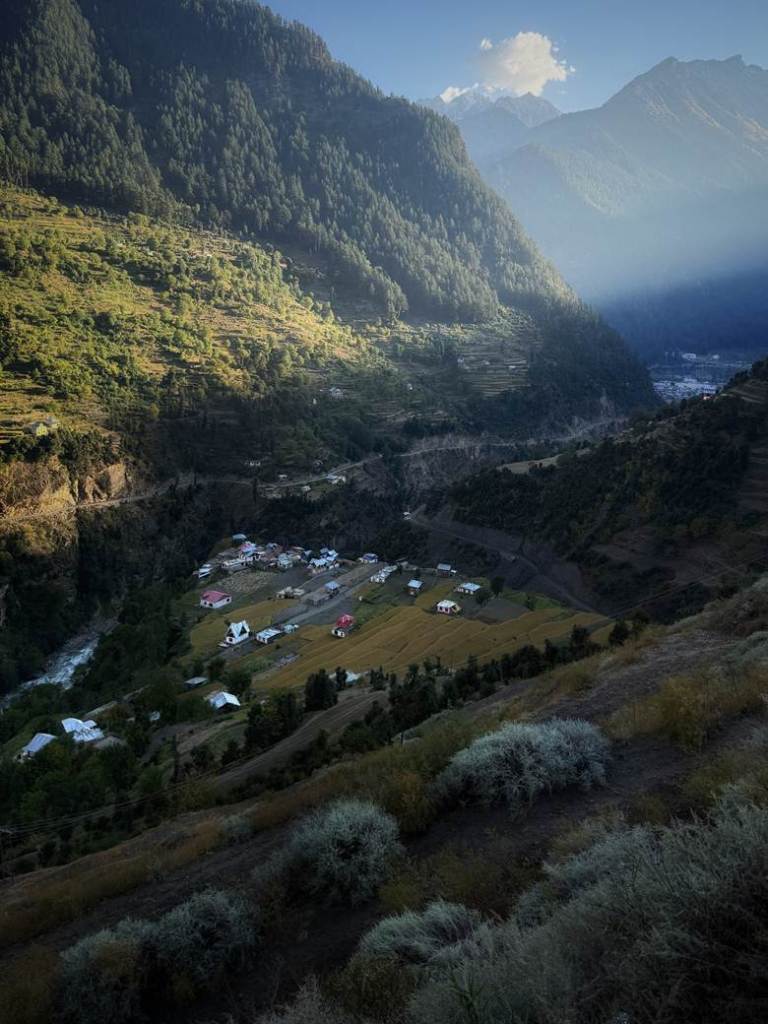
Recurrent flashfloods in Paddar Valley and Bhut Nalla
Paddar valley/ sub division of Kishtwar District on the banks of Chenab and on the boundary of Himachal Pradesh and Jammu, is no stranger to floods. Bhut Nallah, an important tributary of Chenab flowing through the heart of Paddar valley has been experiencing repeated flash floods and landslides during the past few years. In 2021, flash floods here caused 4 confirmed deaths while around 30 people were washed away. Flashfloods in 2023 also led to loss of life.
Chasoti was facing recurrent flood damage during the last few weeks. It was also reported in local news channels. A road had been washed away. Two to three weeks back, there was also a news that the Yatra will be suspended because of these damages. What happened to those decisions?
This is a video of Chasoti from 25th July 2025! Why was the pilgrimage not cancelled then?
For example, look at this news posted on July 29, 2025. It states: “Last Night due to heavy Rainfall road again washed away at Jasnai nallah near Chishoti Gulabgarh . Concerned agencies on job to repair the road. However yatra has been stopped till the road gets repaired.”
This is a video made around July 29 2025 https://www.facebook.com/watch/?v=1958891671591029. This too https://www.facebook.com/reel/1195287638930228
They should have given enough warning to suspend congregation of thousands of people in this region.
Reasons behind the catastrophic flooding
As of now, the reasons behind flooding at Chasoti-possibly the Jasnai Nalla, are unclear. It might be cloudburst, landslide, GLOF or a combination of causes. This nalla that flows through Chasoti is not an inconsequential stream. It arises close to the 21,000 feet elevation Brammah II Peak of Kishtwar Himalayas and flows down the extreme steep slopes to Chasoti to meet Bhut Nallah which in turn meets the Chenab/ Chandrabhaga in Gulabgarh. The region is famed for its rare Sapphire/ Neelam mines.
Bhut Nallah basin which is home to the Machail Mata Mandir at an elevation of 2800 mts, witnesses thousands of pilgrims every year, walking along steep slopes for about 30 kms from Gulab Garh to Machail in the month of August, when monsoon related mishaps are at their peak. Many of the pilgrims drive up till Chasoti and walk to Machail.
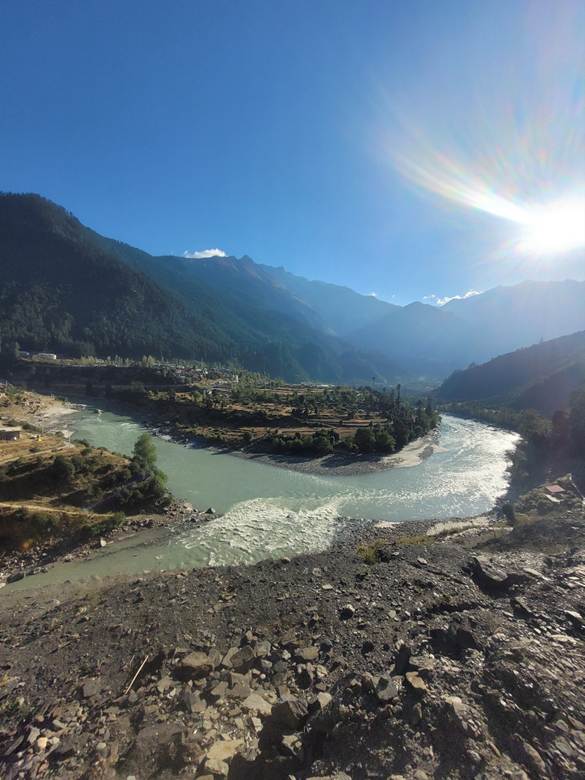
The region is extremely vulnerable to climate disasters as has been studied, forecasted and witnessed by communities. Paddar sub division is the remotest valley in Jammu, sharing borders with Zanskar in Ladakh in the North and with Pangi valley in Himachal Pradesh to the east. Kishtwar district, which has an unusually high density of hydropower projects is also the “most vulnerable” district in J & K for GLOF related events. A few months back in April 2025, Ramban region in Kishtwar faced flashfloods claiming 3 lives and displacing thousands.
Retreating Glaciers
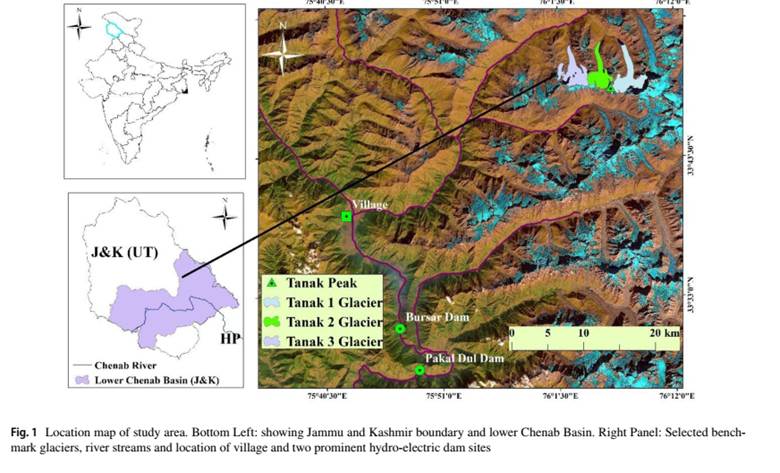
Bhut Nalla Basin where Machail and Chasoti lie, has an area of 390 sq kms and is home to 90 glaciers[i]. In 18 years between 1993-2021, glacial area of Bhut Nalla basin has decreased, number of glaciers have increased (indicating fragmentation of glaciers) with average glacial retreat of 11 meters/year. This is in keeping with rapid retreat of glaciers in Chenab Valley. (See Our report: https://storymaps.arcgis.com/stories/ba82aadda7114d5b862fc8c48c1ad56b)

10 kms from a Highly Hazardous Glacial Lake
Recent joint study by Central Jammu University, Geological Survey of India and University of Kashmir, highlighted 11 High Risk glacial lakes in Jammu and Kashmir. Out of these, three are further highlighted as “Highly Hazardous Glacial lakes” whose stability could be “severely compromised” by external factors such as cloudbursts. All of these three highly hazardous glacial lakes are in Kishtwar District. Of which, Hangu Lake is about 10 kms from Chasoti as the crow flies and Mudikasar Lake is about 50 kms away. This study was commissioned by Department of Disaster Management, Relief, Rehabilitation and Reconstruction (DDMRRR) of Jammu and Kashmir to formulate risk mitigation strategies for tackling GLOF events in the Union territory (UT).
Dr. Sunil Dhar from Central Jammu University and one of the authors of this report tells me that impact of this event on Hangu Lake should be monitored for safety.
Hydropower Projects in a volatile region
The entire Chenab basin from Lahaul, Miyar valley, Pangi valley, Paddar valley, Bhadrawah is under siege from large hydropower projects. While the dams in Himachal section of Chenab are yet to start construction as they face strong opposition from communities, a series of back to back projects have been commissioned or are under-construction in Jammu region. Scientists have repeatedly raised red flags about the impacts of GLOFs, flashfloods and landslides on these projects and also worsening due to these projects. Uttarakhand, Sikkim and Himachal Pradesh have witnessed how hydropower projects in hazard zones lead to compounded impacts on communities.
Dr. Sunil Dhar says that this region is a hotspot of climate and geological activity and hydropower projects need to respond to that. He wryly adds that borders of Kishtwar High Altitude National Park were changed to accommodate hydropower projects in this region, so a National Park was changed, but projects were not changed!
624 MW Kiru Hydropower project which is nearly complete is hardly 30 kms downstream Chasoti as the crow flies. Immediately after 624 MW Kiru is 540 MW Kwar Project.
In the upstream, proposed 500 MW Dugar Hydropower project is planned just 28 kms as the crow flies. About 50 kms upstream, near the proposed Purthi Hydropower Project is a glacial lake called Kadu Nalla which is expanding at an alarming rate and is under a shadow of a GLOF.
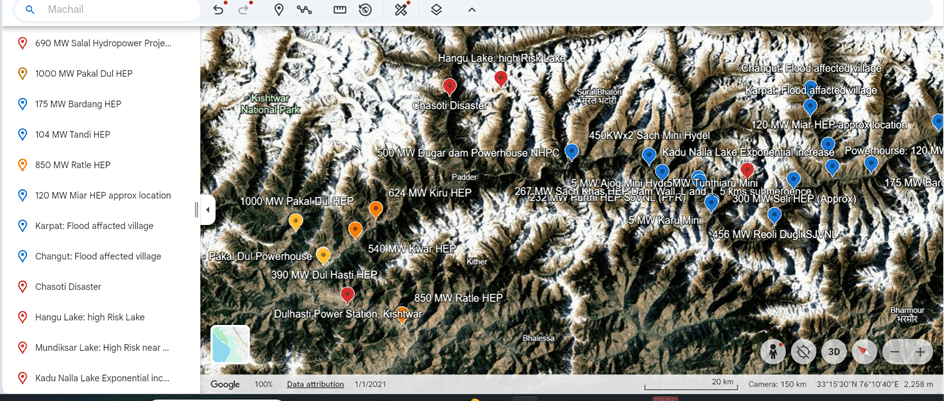
There is no comprehensive study of planned, under construction or commissioned projects in the Chenab Basin from a Climate Change or, more appropriately Climate Disaster perspective. Nor there is any credible cumulative impact assessment or carrying capacity study. This is highly problematic and such assessments should be undertaken asap whether or not individual projects have received clearances.
As I write this, several places along the Chenab Basin from Lindur and Miyar in Himachal to Bhut Nalla in Kishtwar are facing flashfloods and disasters.
Machail Mata Yatra
Although Machail Mata shrine is an ancient, beautiful shrine both in Gulabgarh and Machail, the Yatra has been a recent phenomenon. As told by priests and pilgrims, a yatra from Gulabgarh to the shrine in the month of August only started around 1980s initiated by retired Police Official Kuldeep Singh Jamwal. Before that, the shrine was locally worshipped and celebrated by officials like Colonel Hukam Singh Yadav and when they travelled to Zanskar from Machail.
Looking at the extremely fragile and vulnerable region, repeated flash floods, cloudbursts and disasters and a yatra in the riskiest months of August, it will be wise to maintain a modest pilgrimage with limited pilgrims and not push for an event where several thousand of people congregate in an extremely vulnerable, remote region.
We have travelled extensively through villages of Padar like Lingri, Pandel, Tunkhel, Palali, Gulab Garh etc. Many settlements of the region are so remote that they nearly function off grid. It is difficult for aid to reach these places in time. Dr. Dhar also seconds this saying the safest way to avoid human tragedies in these regions is to discourage large congregations,
It is imperative that in-depth studies of glacial lakes, nallas and glacial moraine are undertaken in the region in which local communities are resource persons and partners. Dr. Dhar tells us that important climate information can be obtained by pastoralists and shepherds of the region, if only we are ready to listen and understand.
Infrastructure activities like road cutting, hydropower projects with blasting, tunneling, muck dumping inside the river (as done blatantly by Ratle hydropower project), dense shops and guest houses close to fast flowing, hazardous nallahs is not advisable for this region.
Any such decisions need to be assessed credibly and their accountability fixed.
Parineeta Dandekar, SANDRP (parineeta.dandekar@gmail.com)
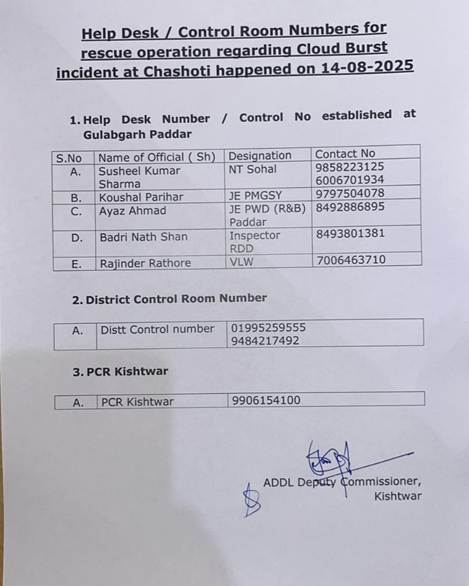
Helpline Numbers Chasoti/ GulabGarh/Kishtwar
[i] Garg et al, Evolving Glacier Patterns in the Chenab River Basin (1993-2021): Drivers and Environmental Implications, https://www.sciencedirect.com/science/article/abs/pii/S0048969725000646?via%3Dihub

 SANDRP