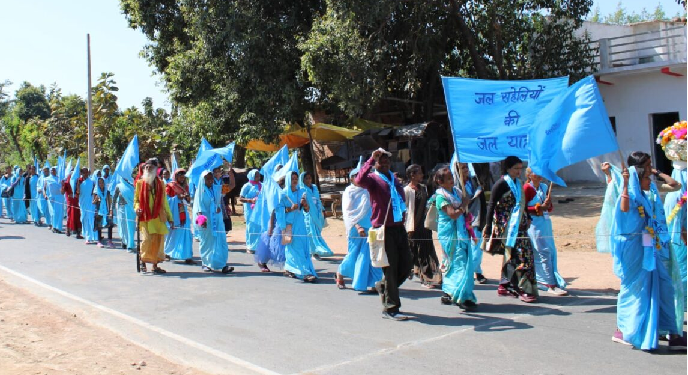
(Feature Image: The Jal Saheliyon ki Jal Yatra or the ‘Water walk of Women friends of Water,’ an over 300 km-long march for water conservation started in Feb 2025. Source: Global Bihari)
Marking World Water Day 2025, this compilation highlights top ten positive efforts made during last one year by village communities and women groups in India for restoration and protection of their water resources. The report also shares some important water conservation initiatives being taken by the various governments in India. The first part of the series has covered water efficient practices being adopted by the Indian farmers.
1. Madhya Pradesh ‘Jal Sahelis’ show the way On February 2, 2025, the Jal Sahelis (Women friends of water) of Bundelkhand embarked on what was perhaps a ‘never done before’ walk for water: The Jal Saheliyon ki Jal Yatra or the ‘Water walk of Women friends of Water,’ an over 300 kilo metre-long march for water conservation.
This incredible journey of 19 days was undertaken from start to finish by a whopping 368 Jal Sahelis who walked continuously for 19 days. Some 1,000 Jal Sahelis participated in the yatra and on the last day, the yatra was concluded in the presence of 2,500 plus persons and Former MP CM and current Union Agriculture and Rural Development Minister, Shivraj Chauhan. During this yatra the Jal Sahelis walked through five districts of Niwari, Jhansi, Lalitpur, Tikamgarh and Chhatarpur, carrying earthen pots filled with water from seven rivers of Bundelkhand. https://globalbihari.com/accelerated-action-jal-sahelis-show-the-way-before-international-womens-day/ (08 March. 2025)
2. Rajasthan ‘Jal Sahelis’ lead water conservation efforts “I am filling water in my pitcher. It is so heavy that I can’t lift it. This pond is like a sea. Who dug the pond? My father and my brother dug it.” The lyrics narrate the efforts of the men in digging the pond and the women who shoulder the responsibility of fetching water, painting a vivid picture of their collective struggle and resilience. These women are members of ‘Jal Sahelis’, or Friends of Water, who emerged as the unsung heroes of their community – a title they earned through their relentless efforts and unwavering determination. Led by forty-year-old Leela Khatun, the team’s mission was to restore a traditional pond, known locally as ‘nadi’ or ‘talaab’, that had once been the lifeblood of their village. https://www.unicef.org/india/stories/jal-sahelis-lead-water-conservation-efforts-rajasthan (05 June 2024)
3. Madhya Pradesh A dam the village built People of the Bilpura village in Panna district own roughly 80 acres of land that lies between the dam and their village. “Earlier there was a small naala [stream] and it was used in a few acres,” says Maharaj Singh. “Only after the dam came, have we all been able to plant in our fields.” Since the dam was rebuilt in 2016, he has not had to go – his earnings from farming are sustaining him and his family. Water from the dam now lasts through the year and it’s also used for cattle.
The move to rebuild the small dam was the outcome of public meetings held by the People’s Science Institute. The state had built a dam on a pond near a grove of kaitha (wood apple) trees. It was built not once, but three times over 10 years. The last time it caved during a monsoon, state officials decided enough was enough and reduced the size of the dam. The small dam did not suffice: “water barely reached the fields, and it dried out well before summer so was of no use for our irrigation needs,” says Maharaj. “Only about 15 acres could be cultivated & only one crop.”
In 2016, people from the village decided to take matters into their own hands and offered their labour as donation to rebuild it. “We carried mud, dug, broke stones and placed them, and in one month we had finished the dam. All the people were from our village, mostly Adivasi and some Other Backward Class,” says Maharaj who also took part. The new dam is bigger in size and has not one but two weirs to allow the water to flow out evenly and prevent another break. https://ruralindiaonline.org/en/articles/the-dam-the-village-built/ (13 Oct. 2024)
4. Tamil Nadu Soil conservation boosts water retention in 40 tribal villages Soil conservation and water retention measures were rolled out across 40 tribal villages in the Tirupattur Forest Division as part of a project aimed at reclaiming and improving tribal lands. The initiative, spearheaded by Tamil Nadu Biodiversity Conservation and Greening Project Climate Change Response (TBGPCCR), is expected to benefit these villages by reducing soil erosion and boosting groundwater levels. Project director I Anwardeen said eight methods were introduced to manage natural water resources more effectively. These methods include well recharge pits, water absorption trenches, trench-cum-bunds, stone bunds, loose rock check dams, recharge shafts, and percolation ponds. Each technique was tailored to address specific soil and water challenges in the region. https://timesofindia.indiatimes.com/city/chennai/innovative-soil-conservation-techniques-enhance-water-retention-in-40-tribal-villages/articleshow/114664127.cms (28 Oct. 2024)
5. Chhattisgarh Village fought water crisis with conservation efforts A few years ago, Parstara in Dhamtari district grappled with drought and a severe water shortage. The groundwater levels in the region had significantly declined and the crisis led to routine crop failures resulting in a significant drop in farmers’ incomes. To combat the existing challenge, the village chief Parmanand Adil and local community leaders initiated the ‘Jal Jagr’ campaign.
Efforts were made to conserve rainwater through the construction of soak pits and rainwater harvesting practices in every household. Water conservation measures were also introduced in public places and even in the schools. The farmers of the village also switched from water-intensive paddy crops to drought-resistant crops.
Now the local agrarian community cultivate pulses, oilseeds, chickpeas, mustard, moong and urad among others. “Instead of relying only on paddy, we now grow crops that require less water. This has helped in efforts aimed to conserve water and also boosted our income,” says Ramnarayan Sahu, a local farmer. Impressed with the achievement of the villagers, the state govt has decided to observe it as ‘Jal Jagr Mahotsav’ to be held in Dhamtari on Oct 5-6. https://www.newindianexpress.com/nation/2024/Sep/29/how-chhattisgarh-village-fought-water-crisis-with-conservation-efforts (29 Sept. 2024) The villagers also ensured that anyone caught cultivating paddy would be penalized with an amount of Rs 27,000 per ha. Additionally, the villagers prepared rainwater harvesting soak pits, and rooftop structures were built in the village. The village has 203 tube wells. Previously, the underground water level had reached about 200 feet, but now it is at about 70 feet. Due to these measures, the villagers of Parastarai did not face water scarcity this summer. The fertility of the land has increased due to crop rotation, benefitting the farmers. https://timesofindia.indiatimes.com/city/raipur/parastarai-villagers-combat-water-crisis-with-crop-shift/articleshow/110918581.cms (17 June 2024)
6. Haryana Water conservation by Meo communities This article explores the work of Tarun Bharat Sangh (TBS), an NGO that has rejuvenated over 16,000 traditional water bodies, including Johads and revived some dead rivers including Sairni, Tevar, Jahajwali, Tildeh, Ruparel, Agrani, Bhagani, Sarsa, Arvari, Maheshwra, Sahibi across Rajasthan, Haryana and Maharashtra. https://vikalpsangam.org/article/how-the-meo-community-fights-stereotypes-with-sustainable-water-management/ (29 Oct. 2024)
7. Jharkhand Giridih saves its village ponds Ponds of Giridih had remained stagnant until last year when a grant from NITI Aayog helped revive them. For the first time in about 25 years, the old pond of Govindatand was renovated. “Our committee ensured that the repair was successful. Water-holding capacity has increased following the removal of accumulated silt. However, the pond’s eastern end sees erosion. If a retaining wall is built around the pond, water loss and the resultant soil erosion can be stopped. The village has one more pond, so we are also seeking funds for renovating it,” says Govindatand pani panchayat samiti secretary Muralidhar Verma.
“NITI Aayog had sent a proposal to many districts, including ours, to do some unique work. We chose to work in the area of water conservation,” Aszadullah, project coordinator, District Mineral Foundation Trust, Giridih says. Similarly, Bokaro, Garhwa and Palamu districts chose to work on its water bodies.
“As per the NITI Aayog proposal, we had to implement 67 modules [a water conservation unit] on old ponds in the district to increase their holding capacity. With the implementation of one module, 10,000 cubic meters of water can be stored in ponds. In some cases, we implemented two modules in one pond and three modules in different blocks. In all, 57 ponds were renovated, of which 52 were in 2023 and five in 2024,” notes Aszadullah. After this work, the water bodies in the district could store 67 crore litres of rainwater, benefiting 1,17,625 people. https://101reporters.com/article/environment/Giridih_saves_its_village_ponds_with_NITI_Aayogs_help (7 Jan 2025)
8. Andhra Pradesh Vissakoderu village overcomes decade-old water problem The man behind the achievement is Srinivas, who gave priority to spend the 15th Finance Commission grant of Rs 10 lakh only on works related to supply of drinking water to villagers. He spent Rs 2.5 lakh on laying an extra pipeline and construction of new water purification unit, Rs 4.5 lakh for repairing two waterbeds and remaining amount on alum treatment unit, resulting in the supply of 2.5 lakh litres of water to 2,500 families daily.
“For the last two decades, Vissakoderu had been depending on water tankers and bottled treated water as the raw water from the GNV canal contains pollutants. Now, we are able to purify the water and supply potable drinking water to villagers through two overhead tanks. During the previous government, the Finance Commission grants were diverted, leaving us no scope to utilise them for our purpose. But this time, the State govt gave much needed autonomy on fund utilisation, which helped us bring the dysfunctional drinking water supply system back into operation,” Srinivas said. https://www.newindianexpress.com/states/andhra-pradesh/2025/Feb/10/vissakoderu-village-in-west-godavari-dist-overcomes-decade-old-water-problem (10 Feb. 2025)
9. Jharkhand Women of Jharia’s coalfields revived dugwell Neeche Mohalla’s dugwell now has water all through the year and has never gone dry since the women took charge of it in 2017 and desilted it with fawda [spade/shovel] and hathoda [hammer]. Neeche Mohalla’s dugwell is now an example of successful Shallow Aquifer Management, commonly known as SAM, under AMRUT 2.0 that targets to have access to clean water for all urban citizens, increase coverage of sewerage and septage. Simply put, a shallow aquifer is the first layer of groundwater which is tapped upon digging the ground. Dugwells tap this layer of water and have been a source of water for centuries. (Nidhi Jamwal) https://www.downtoearth.org.in/governance/jharkhand-once-reviled-and-ignored-these-women-of-jharias-coalfields-revived-dugwell-to-ensure-year-round-water-supply (12 Mar 2025)
10. Karnataka Bantwal: 6 women build over 200 RWH pits Six women from the Chiguru Sanjeevini Federation of Vitlamudnoor gram panchayat in the taluk have constructed more than 200 rainwater harvesting pits to increase groundwater levels by directing rainwater from the hills into these pits during the monsoon.
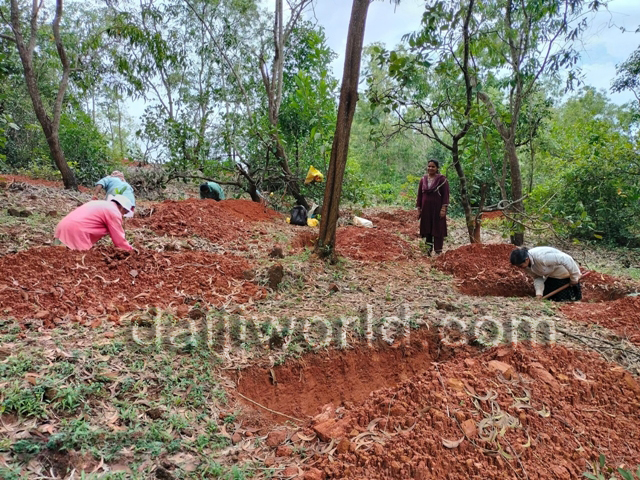
These pits, built at Kundadka Kushalanagara, are expected to provide significant benefits during the summer. The area consists of 1.8 acres of cemetery land, of which only 50 cents are used for cremation and burial, while the remaining area contains a cashew farm. The gram panchayat decided to construct the rainwater harvesting pits under the MNAREGA. Upon communication to the Sanjeevini Federation, with the aim of providing employment to the village women, six members of the federation dug pits 6 ft in length, 2 ft in width & 2 ft in depth. https://daijiworld.com/news/newsDisplay?newsID=1228120 (20 Sep 2024)
Some Relevant Reports
Centre “Watershed Yatra” Union Minister of Rural Development Shri Shivraj Singh Chouhan has on Feb 5 launched a national level mass outreach campaign “Watershed Yatra”, in Hybrid mode to generate people’s participation and create awareness about the Watershed Development activities carried out under Watershed Development Component of Pradhan Mantri Krishi Sinchayee Yojana (WDC-PMKSY 2.0) in project areas.
Under this, the works done in the project areas through government funding and public participation will be evaluated at the state level and the projects doing excellent and remarkable work will be given an additional reward of Rs. 20 lakh per project. A total provision of Rs 70.8 crore has been made for this, which will benefit 177 projects every year. The evaluation of projects for this year’s competition will be done in tApril.
The Watershed Yatra will consist of Van movement for around 60-90 days across 805 projects, which cover 6673 GPs (13587 villages) in 26 States and 2 UTs. Under the activity of Watershed ki Panchayat, talk by experts about sustainable soil and water management practices will be organized and around 8,000 individuals having contributed in implementation of WDC-PMKSY works in different Project Areas will be honoured, which will further motivate watershed communities. https://www.pib.gov.in/PressReleasePage.aspx (05 Feb. 2025)
Sustainable & safe use of treated mine water Coal India Limited (CIL), NLC India Limited (NLCIL), and Singareni Collieries Company Limited (SCCL), has been promoting the utilization of treated mine water for drinking, irrigation, and industrial purposes. The quality of treated mine water for gainful utilization is guided by the provisions of the Environmental Protection Act, 1986, the Water (Prevention and Control of Pollution) Act, 1974, and directives issued by the CPCB and respective SPCBs. Additionally, Coal/Lignite PSUs have formulated their own standard operating procedures to ensure the safe and effective utilization of treated mine water for various purposes.
In Jharkhand, MoU has been signed between the Govt of Jharkhand and CIL to facilitate the utilization of mine water within the command areas of Central Coalfields Limited (CCL), Bharat Coking Coal Limited (BCCL), and Eastern Coalfields Limited (ECL). https://pib.gov.in/PressReleasePage.aspx (10 Mar 2025)
Haryana State claims 85% water conservation goals Haryana claims to have achieved 85% of its target by saving 5.8 billion cubic meters (BCM) of water from March 2023 till Feb 2025, according to an estimate by the Haryana Water Resources Authority (HWRA). Officials said this was done by reusing treated wastewater, promoting efficient cultivation methods, encouraging crop diversification, adopting micro-irrigation techniques and enhancing groundwater recharge. The state aims to save 6.9 BCM by the end of March 2025.
Haryana recorded an 11% increase in groundwater recharge from 2023 to 2024, as reported by the Central Ground Water Board (CGWB). For 2025-26, the state has planned to dig up 244 water bodies over 1,185 acres, with storage capacity of 12,000 million litres. Haryana aims to reuse 50% of treated wastewater by March 2025 and take this up to 100% by Dec 2028. https://timesofindia.indiatimes.com/city/gurgaon/crop-diversification-to-reuse-haryana-meets-85-water-conservation-goals/articleshowprint/118846299.cms (10 Mar. 2025)
Maharashtra Mission creates more storage in water bodies The Jal Samruddhi Abhiyan was aimed at removing silt from Gangapur and other dams. The project was developed by the district administration with the help of private entities. From the excavation of silt to transportation, almost all the work was carried out by private firms. The farmers, however, also pay the transportation costs to some extent. “A total of 82,266 cubic metres of silt was removed from all 8 locations where the project was started. This removal helped us restore a water capacity of 8.22 crore litres,” a senior WRD official said. The officer further added that under this project, govt did not spend anything. Apart from the Gangapur dam, 1.29 crore litres of capacity were reclaimed in a minor irrigation tank at Vilholi. https://timesofindia.indiatimes.com/city/nashik/mission-creates-more-storage-in-water-bodies/articleshow/110647913.cms (03 June 2024)
Kerala Plans to revive Surangas in Kasaragod By incorporating Suranga restoration into the MGNREGS, the district administration seeks to promote water conservation, improve livelihoods, and foster women’s leadership in community development through the “Nari Shakthi Se Jal Shakthi” campaign.
A groundwater department officer said, “We will collect the number of surangas in Kasaragod with the help of Kudumbashree and renovate them through MGNREGS. We are planning to execute the project as part of JSA. In the initial phase, we plan to conduct a survey to determine the number of Surangas in the district. Kasaragod is divided into six blocks, of which Kasaragod block is considered a critical block as the majority of the recharged water is used and Manjeshwar block is considered a semi-critical block.” https://www.newindianexpress.com/states/kerala/2024/Oct/21/district-administration-plans-to-revive-surangas-to-tackle-water-scarcity-in-kasaragod (21 Oct. 2024)
Compiled by Bhim Singh Rawat (bhim.sandrp@gmail.com)

 SANDRP