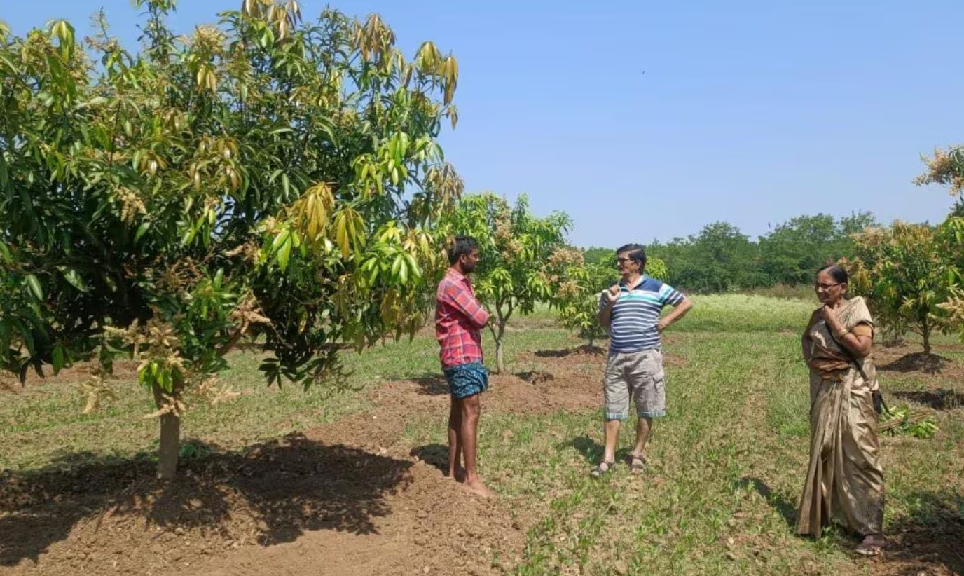
(Feature Image: Horticulture cultivation in Punjab records a 42% increase in area and four-fold increase in produce value in a decade. Source: Express File Photo)
Aiming to advocate sustainable management of freshwater resources, the day of March 22 is annually celebrated as World Water Day across the world since 1993. The theme for this year’s 33rd such event is Glacier Preservation. Since agriculture sector is biggest user of surface as well as groundwater, SANDRP marks the day by presenting top ten reports which highlight the water efficient practices being adopted by farmers and some of these also being supported by the governments in India during 2024.
1. Punjab Farmers diversifying agriculture through horticulture Punjab farmers backed by the state horticulture department are leading a “silent revolution” in agriculture diversification, recording a 42 per cent increase in the area under horticulture in a decade from 278,583 ha in 2011-12 to 482,000 ha in 2023-24, despite the dept operating with “just 25% of its total sanctioned staff strength”. Emerged as a vital transformation to further diversify the predominantly paddy-wheat cropping system, horticulture occupies only 6.16 % of Punjab’s gross cropped area of 7.826 million ha, yet its economic contribution is remarkable.
In 2023-24, the value of horticultural produce recorded a four-fold growth at Rs 26,580.38 crore from Rs 6,267.40 crore in 2011-12, accounting for 17.03 % of gross domestic product (GDP) in the agricultural sector, which stands at Rs 156,068.46 crore, from much less area under cultivation than other traditional crops, according to the horticulture dept. Notably, the total production of horticultural crops during this period nearly doubled — from 5.223 million tons (MT) in 2011-12 to 9.527 MT in 2023-24.
The area under fruits increased from 76,592 ha in 2013-14 to 103,287 ha in 2023-24 & the area under vegetables saw a rise from 203,734 to 356,476 ha in the same period. Additionally, around 20,000 ha in Punjab are now dedicated to other horticultural crops such as flowers, seeds, mushrooms, medicinal plants, oilseeds, celery & turmeric. https://indianexpress.com/article/cities/chandigarh/punjab-farmers-silent-revolution-diverse-agriculture-horticulture-9798396/ (25 Jan. 2025)
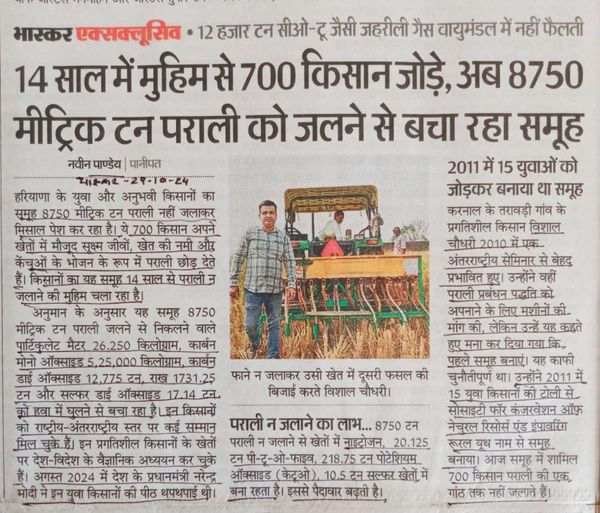
2. Haryana Interesting story of farmers of Tarawadi village in Karnal district who are not burning the crop residue. 700 farmers are mulching the 8750 tons of crop residue into the land since 2010-11, now for 14 years. The group led by Vishal Chaudhary is called Society for conservation of natural resources and empowering Rural Youth. (DRP NB 041124)
3. Maharashtra BBF a possible solution to farmers’ woes Introduced in 2020 in the Marathwada and Vidarbha, the broad bed and furrow (BBF) system was devised to help farmers in rain-fed areas tide over moisture stress during periods of a long break in rainfall. “The raised beds helped in conserving soil moisture better,” said Vijay Kolekar, agronomics and soil science specialist of the govt’s Project on Climate Resilient Agriculture (PoCRA). This was one of the many interventions adopted to help Maharashtra farmers tide over the vagaries of nature, he added.
For farmers in Vidarbha and Marathwada, it was excess rainfall, especially during the retreat of the monsoon, that was a major concern. Quality concerns would pull down the prices of crops if it rained during harvest. But farmers say BBF is allowing them to protect their harvest to a great extent. More and more farmers in the state are now adapting to this method of cultivation to help them tide over both floods and monsoon breaks. According to Kolekar, around 20 per cent of the 40 lakh hectares of soybean area of the state has now adopted this method. “We have ensured that BBF machines are available at every custom hiring centre of the state – this helps during the kharif sowing window,” he said. https://indianexpress.com/article/cities/pune/maharashtra-possible-solution-farmers-drought-flood-woes-9529298/ (23 Aug. 2024)
4. Odisha Climate-resilient agriculture through rice fallow initiative Rice fallow, or uncropped land left after rice harvest, is a major agricultural issue in eastern India. However, introducing technologies and crops with tailored agronomy based on landscape suitability helps turn it into an opportunity. It also helps farm income and ensure food and nutritional security. Odisha has a cultivable area of over 6.18 million ha and is endowed with 10 agro-climatic zones. The state predominantly relies on rice cultivation to meet the food demands of its 45 M population. The area under rice crops accounts for about 60 % the total sown area during the Kharif season.
The rice fallow management approach, the principal secretary said, “helps in enhancing crop coverage, reducing soil degradation, increasing soil nutrients through crop systems approach, improving nutrition security through the consumption of pulses and other crops and above all, making effective use of the natural resources of the region. The Govt of Odisha aims to further scale the rice fallow management initiative in coming years.” The state govt implemented the project on rice fallow management for the first time during 2022-23 Rabi, achieving 70,000 ha.
During 2023-24 Rabi, the programme has been scaled up to 382,000 ha. The scheme is being implemented in all 30 districts of the state. Key objectives of the scheme include optimal utilisation of residual soil moisture, increasing cropping intensity, upscaling production of pulses and oilseeds, restoration of soil health and fostering better market linkages for the produce. Eight crops, including green gram, black gram, field pea, Bengal gram, grass pea, lentil, mustard and sesamum have been targeted. Local varieties of green gram have shown great potential. https://www.downtoearth.org.in/blog/agriculture/how-odisha-is-promoting-climate-resilient-agriculture-through-rice-fallow-initiative-95363 (3 Apr 2024)
5. Andhra Pradesh-Telangana A unique movement in 73 villages on the AP-Telangana border where farmers with borewell share them with those who do not have and collectively regulate use of borewell. No new borewells agreement has been signed for ten years. The project started in 2007 under a World Bank funded program which got over long back. Farmers are taking it forward on their own. The groundwater levels have already seen improvement. https://www.facebook.com/share/p/1FYsnpm9gp/ (17 March 2025)
6. Andhra Pradesh Mission to save indigenous seeds Pachari Devullu, an expert in tribal agriculture and founder of the Sanjeevani Rural Development Society, has committed his life to preserving indigenous seed varieties that are at risk of disappearing. Operating from Killoguda village in Dumbriguda, Alluri Seetharama Raju district, Devullu’s mission extends across Visakhapatnam, Vizianagaram, Srikakulam & parts of E & W Godavari. These regions are home to tribal communities that have cultivated a rich diversity of crops for generations.
Devullu’s seed bank has over 300 varieties of desi seeds including an impressive array of millets such as ragi, guli ragi, foxtail, jowar, and pearl millets. Devullu actively engages with tribal farmers throughout Andhra. He organizes seed festivals and workshops to raise awareness about the importance of traditional seed varieties. His extensive travels through remote villages allow him to share his expertise and absorb invaluable local knowledge.
In 2011, the state govt honored him with a Biodiversity Award. The following year, the Union Govt’s Department of Agriculture recognized his outstanding contributions with the Plant Genome Saviour Community Award and a cash prize. Devullu’s work serves as a rallying cry for sustainable practices. Preserving native seed varieties is not only about protecting crops—it’s about nurturing a legacy that bridges the wisdom of our past with the promise of a sustainable future. https://www.thehansindia.com/andhra-pradesh/mission-to-save-indigenous-seeds-in-andhra-pradesh-942382 (05 Feb. 2025)
7. Tamil Nadu Delta farmers cultivating indigenous rice varieties Farmers in the ‘rice bowl’ of south India, the Cauvery delta, are reviving traditional ways of farming and shifting to more resilient traditional rice varieties, inspired by initiatives such as the ‘Save our Rice’ campaign. Of the 186,000 acres planted with traditional paddy varieties in Tamil Nadu, the Cauvery delta covers 42,000 acres. https://www.downtoearth.org.in/blog/agriculture/cauvery-delta-farmers-are-gaining-resilience-by-cultivating-indigenous-rice-varieties-96873 (26 Jun 2024)
8. Arunachal Pradesh How Ziro thrives with limited water resources The people of Ziro have found innovative ways to manage their farming and daily water needs. Siikhee Lake, an artificial lake, now plays a crucial role in the town’s water supply. Originally, the area where Siikhee Lake now exists was used as farmland by local villagers. Recognising the need for a sustainable water source, particularly for farming and drinking, the community decided to transform the farmland into a lake. This transformation was essential to ensure a steady water supply for the future. The project to create Siikhee Lake began around the year 2000 when the local community started digging a large pit in the middle of their fields to form a reservoir. The lake was finally completed and officially opened in 2019. Those who initially owned the farmland are now members of a society that manages the lake. This society, consisting of about 200 members, holds annual meetings to discuss the upkeep of the lake, fish harvesting schedules, and other essential matters. https://arunachaltimes.in/index.php/2024/08/13/how-ziro-thrives-with-limited-water-resources/ (13 Aug. 2024)
9. Manipur SRI introduced As an initiative measure, the Directorate of Environment, Govt of Manipur has introduced the SRI (System of Rice Intensification) technique to reduce GHGs emissions and improve agricultural productivity in Phayeng village in Manipur where a project to transform the village to a carbon positive eco model village is in progress. 21 farmers covering 12 ha land had been selected based on their interest on innovative ideas and field conditions for pilot study of SRI. https://ccmanipur.mn.gov.in/en/blog/16/55/
10. Report APCNF, Soil scientist win esteemed Gulbenkian Prize Two Indian entities have been awarded the prestigious 2024 Gulbenkian Prize for Humanity for their pioneering work in sustainable agriculture, the Calouste Gulbenkian Foundation announced on Jul 12. The Andhra Pradesh Community Managed Natural Farming (APCNF) programme and Dr. Rattan Lal, a renowned soil scientist of Indian origin, share the 1 million euro prize with an Egyptian organization, the Portuguese philanthropic institution said.
APCNF, implemented by Rythu Sadhikara Samstha (RySS), is recognized as the world’s largest agroecology programme, benefiting over a million smallholder farmers across 5,00,000 ha in Andhra Pradesh. Vijay Kumar Thallam, Executive Vice Chairman of RySS, said, “The APCNF programme empowers small farmers by enabling them to switch to natural farming methods. It has immense benefits to both farmers and the soil they rely on.” The programme supports farmers in transitioning from chemically intensive agriculture to ‘natural farming’ methods, including organic residue use and crop diversification.
Dr Rattan Lal, honoured for his soil-centric approach to agriculture, said, “Soil health and sustainable agriculture are crucial to resolve the challenges of food security and fight climate change across the world.” The jury, chaired by former Chancellor of Germany Angela Merkel, selected the winners from 181 nominations spanning 117 nationalities. https://indianexpress.com/article/india/andhra-natural-farming-gulbenkian-prize-9449138/ (12 July 2024) The APCNF initiative was launched in 2016 by the state govt to find a sustainable solution to farmers’ distress caused by economic crises in agriculture and climate change. Andhra Pradesh is also supporting 12 other States in the country and this year (2024-25) the State plans to send its farmers to five different countries to take this seeding of natural farming to farmers there. https://www.thehindu.com/news/national/andhra-pradesh/andhra-pradeshs-natural-farming-model-wins-gulbenkian-prize/article68395631.ece (12 July 2024) Professor Lal is the founder and director of the Carbon Management and Sequestration Centre at Ohio State University. His work focuses on soil carbon sequestration, climate change, soil health & global food security, soil degradation & restoration, soil quality & sustainable agriculture. https://timesofindia.indiatimes.com/city/ludhiana/pau-alumnus-wins-gulbenkian-prize-for-humanity-in-sustainable-agriculture/articleshow/111740156.cms (15 Jul 2024)
Some Relevant Reports
Punjab IAS farmer grows paddy using only 25% water IAS Kahan Singh Pannu-64, who retired in Sept 2020, now manages 17 acre of farmland in Jai Nagar village, Patiala. Initially, on one acre of land, he successfully grew paddy using the Seeding of Rice on Beds (SRB) technique, achieving a yield of 26.5 quintals per acre—equivalent to yields from larger fields where traditional flooding methods are used. He has even invented a machine to assist with this method and is encouraging other farmers to adopt it to help conserve ground water.
SRB requires only 25 % of the water needed for conventional puddling. He emphasized that SRB does not require standing water, thereby reducing methane emissions. The open soil structure enhances rainwater absorption and fosters beneficial soil microbes. This technique, which costs relatively little, is accessible for village cooperatives, agro-service centres, & large-scale rice cultivators. https://indianexpress.com/article/cities/chandigarh/punjab-ias-officer-turned-farmer-paddy-water-9650090/ (02 Nov. 2024)
Farmers cultivating a network for ZBNF A group of farmers led by 48-yr old Narinder Singh, from village Ajjowal of Hoshiarpur with an MSc in IT, had quietly defied conventional practices. Narinder, who owns 7 acres, and his group started practicing near-zero-budget natural farming in 2011, well before the govt’s policy shift. Rather than relying on costly inputs, they embraced natural and sustainable practices. Over the years, Narinder and his small group of about 15 like-minded farmers organised workshops and farm visits, sharing insights on how to make use of on-farm resources. Today, nearly 75 farmers are following similar practices on over a 100 acres. https://indianexpress.com/article/cities/chandigarh/seeds-of-change-how-punjab-farmers-are-cultivating-a-network-for-zero-budget-natural-farming-9650700/ (3 Nov 2024)
Maharashtra E- PAVAS: A digital app for equitable water distribution A customised digital application, E-PAVAS (ई- पावसं), was developed to assist WUAs. E-PAVAS stands for “Electronic Paani Vapar Sanstha,” and aims to improve transparency within WUAs and ensure integrated, equitable water distribution and sustainable water use. The app aids in monitoring water demand, grievance reporting and data visualisation. It consists of two main components that support the functions of the WUAs namely, the E-PAVAS mobile application and the E-PAVAS web portal. The mobile application is designed for WUA members (farmers). It supports individual WUA members in the submission of water demand forms and in reporting problems such as water shortages or system breakages.
It also assists WUA management through a Web interface that consolidates crop and seasonal water demand data, checks these against the WUA’s water quota, and helps prepare irrigation schedules. The app notifies members of their water allocation schedules and generates records required for compliance with the MMISF Act, thus aiding with member-specific water tariffs, whether area-based or volumetric. E-PAVAS also serves as a communication channel, allowing WUA management to update members directly. The app complies fully with India’s data protection laws. https://www.indiawaterportal.org/agriculture/irrigation/e-pavas-a-digital-app-that-helps-water-users-associations-ensure-equitable-water-distribution (15 Feb. 2025)
Innovation New tool to measure agricultural water insecurity The Agricultural Water Insecurity Experience (AgWISE) module is a questionnaire designed to assess the severity and impact of water-related problems on agricultural production. By asking a series of 13 questions, the module helps researchers gauge adequacy, reliability, accessibility, and safety of water related to agriculture. Respondents are asked to rate the frequency of water-related challenges they have faced over the past 12 months, such as worries about water availability, interruptions to water supply, forced changes in farming practices, difficult decisions related to water use, food shortages, and stress and anxiety.
By analysing these responses, researchers can gain valuable insights into the social, economic, and psychological impacts of water insecurity. The AgWISE module offers several benefits. It considers the interconnectedness of different aspects of water insecurity, including crop production, livestock, and household water use. It recognizes that water insecurity affects different groups of people in different ways, taking into account factors like gender, age, and socioeconomic status. It can be used by researchers, policymakers, and practitioners to inform evidence-based interventions and develop strategies to improve water management and agricultural resilience. https://www.cgiar.org/news-events/news/a-new-tool-to-measure-agricultural-water-insecurity/ (16 Nov. 2024)
Compiled by Bhim Singh Rawat (bhim.sandrp@gmail.com)

 SANDRP