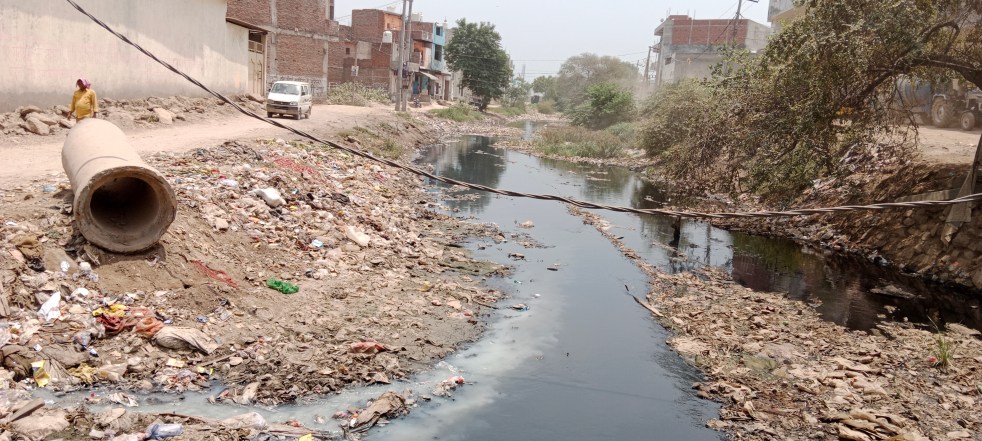
(Feature Image: Drain No 6 in Kundli, Sonipat filled with industrial effluents. BS Rawat/ SANDRP/ May 2023)
This annual overview compiles the top ten reports showing the rising contamination of groundwater resources in India during 2024. It includes some shocking facts from Punjab, Himachal Pradesh, Haryana, Gujarat, Telangana, Kerala, Ladakh, Assam, Chhattisgarh, Karnataka and W Bengal, in addition to reports from CGWB (Central Ground Water Board) a Parliamentary Committee. The contaminants reported in groundwater include nitrates, fluorides, arsenic, uranium, heavy metals (Chromium, cadmium, nickel, manganese, selenium, among others), Iron, salinity, among others. Since most people consume groundwater assuming it to be safe, what is reported here is only a tip of the proverbial toxic-berg. The easiest way forward, besides more regular monitoring and improved governance is rainwater harvesting on war footing. However, the government, busy pushing more big dams and interlinking projects, has little real priority for that.
1. CGWB’s Water Quality Report 2024 The Central Ground Water Board (CGWB) released an important report last week: Annual Ground Water Quality Report 2024. It reveals rise in nitrate, fluoride, arsenic and uranium contimination of groundwater in India. As per the report, the number of districts affected by high nitrate levels in groundwater has gone up to 440 (near 56% of all 779 districts in country) from 359 found in 2017 assessment which means in 7 years 81 more districts have been found having excessive nitrate levels in groundwater.
The concentration of fluoride levels has exceeded permissible levels in samples tested from Rajasthan, Haryana, Karnataka, Andhra Pradesh and Telangana. Even the monsoon effect has been found unhelpful in reducing fluoride concentration in Telangana. The arsenic contamination has increased in floodplains of the Ganga and Brahmaputra rivers. Similarly, 42% of samples have been found exceeding permissible limits for uranium contamination particularly in over-exploited, critical and semi-critical groundwater stress zones.
Broadly the report have raised concerns over rising contamination. Secondly, the report shows the failure of govt’s in arresting the deterioration. Once the quality deteriorates, it is very difficult, if not impossible to reverse it even in short and medium terms. It is particularly noteworthy that this news comes in the golden jubilee year of Water Pollution Act in India, showing how badly the Act and institutions set up in its aftermath have failed. https://sandrp.in/2025/01/06/drp-nb-060125-concerns-about-contradictions-in-cgwbs-reports/ (06 Jan. 2025)
Districts with excess nitrates in GW at 7-year high There are 440 districts with excessive nitrates in their groundwater as of 2023, an increase from 359 such districts in 2017, according to a report by the CGWB on Wednesday (Jan 1). The data suggests that about 56% of India’s districts have excessive nitrates — defined as more than 45 mg per litre — in their groundwater, largely due to the use of subsidised, nitrogenous, synthetic fertilizer, a key input for farming. https://www.thehindu.com/sci-tech/energy-and-environment/districts-with-excess-nitrates-in-groundwater-at-seven-year-high/article69050971.ece (01 Jan. 2025) High nitrate levels in GW threaten public health in 440 districts. https://www.telegraphindia.com/india/high-nitrate-levels-threaten-public-health-in-440-districts-reports-central-ground-water-board/cid/2074907 (02 Jan. 2025) There are two major concerns with excess nitrate content: first, methemoglobinemia, or a reduced ability of red blood cells to carry oxygen. This sometimes causes ‘Blue Baby Syndrome,’ in infants. The bigger problem is environmental: once nitrates in groundwater rise to the surface and become part of lakes and ponds, algal blooms throttle the health of aquatic ecosystems. https://www.thehindu.com/opinion/editorial/%E2%80%8Bwater-woes-on-the-state-of-indias-groundwater/article69058025.ece (04 Jan. 2025)
Fluoride contamination major cause of concern in 5 states According to the Annual Ground Water Quality Report — 2024, fluoride concentration exceeding the permissible limit in water is a major concern in five states, including Telangana. Although the monsoon season led to some improvement in these states, the overall contamination levels remain alarmingly high, it added. The upper limit of fluoride in drinking water is 1.5 mg/L. As per the report prepared by the CGWB, the number of samples analysed in Telangana is 1,150. Of these, fluoride in 171 samples exceeded the permissible limit, which is 14.87 per cent. In 28 out of 33 districts in the state, fluoride content in groundwater was detected at one or more location. The effect of monsoon recharge in reducing fluoride concentration was not much in Telangana. https://www.newindianexpress.com/states/telangana/2025/Jan/01/fluoride-contamination-alarmingly-high-in-telangana-jal-shakti-report (01 Jan. 2025)
2. Punjab Worst fear comes true: village runs out of groundwater For the residents of Patton village in Fatehgarh Sahib, the only pump set, installed by water supply and sanitation department, has stopped lifting water since August last year. The residents claim that the aquifers in the village have dried up completely and they are not getting any water for past several months. Upon visiting Patton on June 12, it is learnt that the groundwater had high concentration of fluoride — caused by indiscriminate extraction and excessive use of phosphatic fertilisers — making it unfit for consumption.
“Several villages in Fatehgarh Sahib are affected. As many as 69 villages in Khera block alone are drinking canal water. The underground water has a high fluoride content,” Sanjay Giri, Junior Engineer handling canal water supply in Khera block, said. “We cannot say there is no water. Water is there, but it is highly concentrated. Residents having submersible bored to 350 feet can extract water, but it is unfit for consumption,” he added. https://indianexpress.com/article/cities/chandigarh/pump-runs-dry-village-demands-new-borewell-pvt-firm-9389309/ (14 June 2024)
Abohar farmers worried as subsurface saline water level rises Around five villages in Abohar are dealing with subsurface waterlogging, also known as “sem” in the local language. After the monsoons, saline water has surfaced in some areas of these villages, and it is present at a depth of 2-4 feet in large patches where either kinnow or cotton has been cultivated. The issue is serious in Patti Billa, Dalmirkhera, Sappanwali, Giddranwali, and Daulatpura in Abohar villages. Each of these villages has agricultural land ranging from 2,000 to 2,500 acres, where farmers cultivate cotton and kinnow. This time, they have also attempted to grow paddy. Sappanwali village is a nursery for government-approved kinnow saplings, while Daulatpura has most of its area dedicated to paddy cultivation.
Farmers alleged that the increase in underground water levels in some areas is due to the lack of cleanliness in existing “sem nallahs”. They have also pointed out that this season, heavy rainfall in Abohar, an area near the border of Rajasthan, is a contributing factor that cannot be denied. The area under cotton in the Fazilka district has decreased to 50 per cent this year. Some villages have attempted to sow paddy for the first time in certain patches. It remains to be seen whether the paddy crop has also contributed to the rise in underground water level, as observed by the authorities. The problem exists in many Muktsar villages as well, but farmers are currently occupied with the paddy crop in the area and, therefore, are not raising the issue at the moment, said Jakhar. https://indianexpress.com/article/cities/chandigarh/farmers-in-punjabs-abohar-worried-as-subsurface-saline-water-level-rises-9572656/ (18 Sept. 2024)
Abohar farmers take up paddy after grim harvest Dependent on canal water owing to the high saline content in groundwater, the farmers in this area banked on kinnow orchards due to their ability to survive with less water compared to other water-guzzling crops. Cotton, too, was preferred due to the same reason. However, this season, a change has been observed in the kinnow belt of Punjab, with farmers sowing paddy, primarily basmati varieties, after uprooting their orchards.
Sources in the Agriculture Department said more than 1,000 acres of kinnow orchards have made way for paddy cultivation this year. In Fazilka, only 50,341 hectares were under cotton cultivation this year compared to 92,000 hectares last year. Sources said a few cotton farmers switched to paddy following pink bollworm and white fly attacks on crops. https://indianexpress.com/article/cities/chandigarh/abohar-punjab-mini-california-ditches-kinnow-orchards-paddy-grim-harvest-9491182/ (02 Aug. 2024)
Danger swells in wells High levels of arsenic, uranium, iron, and nitrate have contaminated groundwater in the Amritsar and Tarn Taran areas of Majha region. The joint research of Pondicherry University’s earth sciences department and Fatehgarh Sahib’s World University has revealed alarming indicators for public health.
These institutes had evaluated the levels and spatial distribution of potentially toxic elements (PTEs) — arsenic (As), iron (Fe), uranium (U), and nitrate (NO3-) — in 2,709 groundwater samples that the state’s water supply and sanitation department had drawn from Majha’s Tarn Taran, Amritsar, Gurdaspur, and Pathankot districts. The analysis of this data suggested that arsenic levels in 16% or 334 of the locations in the study zone had surpassed the safe limit of 0.05 parts per million (ppm). Amritsar was the worst case, followed by Gurdaspur and Tarn Taran. Pathankot was the only district within safe limits. https://timesofindia.indiatimes.com/city/chandigarh/high-levels-of-arsenic-uranium-iron-and-nitrate-contaminate-groundwater-in-amritsar-and-tarn-taran-punjab/articleshow/112960513.cms (01 Sept. 2024)
Dangerous amount of toxicity in groundwater Heavy metals and anthropogenic pollutants beyond the permissible limits for human consumption have been reported in isolated pockets in groundwater of Punjab. This was revealed in a report submitted by Minister of State for Jal Shakti Raj Bhushan Chaudhary in reply to a question by Congress MP Charanjit Singh Channi. According to the minister, groundwater samples showed dangerous concentrations of contaminants such as nitrate, iron, arsenic, selenium, chromium, manganese, nickel, cadmium, lead and uranium, all exceeding permissible limits set by the BIS. https://www.tribuneindia.com/news/punjab/dangerous-amount-of-toxicity-in-punjab-groundwater-report-643361 (26 July 2024)
3. Himachal Pradesh Carcinogenic content found in Baddi-Barotiwala groundwater In an alarming revelation, assessment of groundwater by the Indian Institute of Technology (IIT), Mandi, and IIT-Jammu in the state’s Baddi-Barotiwala industrial area has revealed high carcinogenic risks for adults, mainly from industrial nickel and chromium. Experts claim, “If left unattended, the lower Himalayan region is on a trajectory similar to south-western Punjab, which is considered the cancer belt of India.”
Dr Nitin Joshi, Assistant Professor, IIT-Jammu, while expressing concern, said, “The analysis revealed that, if left unattended, the lower Himalayan region is on a trajectory similar to south-western Punjab”. The belt houses more than 90 per cent of the state’s industry and non-functional effluent treatment plants where untreated effluents are conveniently let out through the drains. They find their way into the ground water much to the peril of the residents.
“Industrialisation has contaminated groundwater with toxic metals, exceeding permissible limits. The reliance on untreated groundwater has caused numerous health problems, including cancer and renal disease between 2013 and 2018,” indicates the study. The study once again corroborated the sorry state of affairs in this industrial belt while stressing the need for improved effluent treatment to reduce these risks. https://www.tribuneindia.com/news/himachal/carcinogenic-content-found-in-baddi-barotiwala-groundwater-630507 (14 June 2024)
4. Haryana Village struggling with polluted groundwater A 5-acre pond in Kharkhara village, Rewari district has become a receptacle for household sewage. The contamination in the pond is degrading the quality of the groundwater, causing hand pumps and borewells to produce foul-smelling water. Prakash Yadav, a village resident, filed a petition with NGT in June 2023, highlighting the issue and the tribunal constituted a committee to investigate the matter. Greywater generated from households ends up causing waterlogging in absence of proper drains in villages. The entire village has been affected, said Sushila, village Sarpanch. “We have faced this issue before, but it is more serious now because the village population has increased, leading to higher water consumption and thus more wastewater being released,” she said. https://www.downtoearth.org.in/water/greywater-issues-plague-this-haryana-village-struggling-with-polluted-groundwater-treatment-woes (28 May 2024)
Arsenic kills by stealth in villages Since 1983, when arsenic contamination of groundwater sources was officially confirmed in W Bengal, the situation has remained unaddressed, with reports suggesting that the problem may have actually worsened. This is a result of inadequate coordination between the central and state govts, which paid little attention to fix the crisis. Central govt information released in 2016 suggested that 9.6 million people in W Bengal, 1.6 m in Assam, 1.2 m in Bihar, 0.5 m in Uttar Pradesh, and 13,000 in Jharkhand – a massive swathe of territory in India’s Ganga Basin – were at “immediate risk”.
More recently, an extensive study found that groundwater in about 20% of India’s total land mass contains “toxic levels of arsenic,” exposing more than 250 m people to Arsenic. https://thediplomat.com/2024/10/arsenic-kills-by-stealth-in-indias-villages/ (10 Oct. 2024)
Toxic legacy of green revolution Jayati Ghosh. While the introduction of high-yielding seed varieties has saved hundreds of millions of people from hunger, it has diminished the nutritional quality and increased the toxicity of staple grains. To establish a sustainable and nutritiously rich food system, countries should adopt agroecological practices based on smallholder farming. https://www.project-syndicate.org/commentary/agribusiness-harms-nutrition-increases-disease-lessons-from-india-by-jayati-ghosh-2024-02 (12 Feb 2024) Detailed studies needed to understand nutrient exchange between groundwater and surface water for ensuring sustainability. https://www.downtoearth.org.in/water/detailed-studies-needed-as-phosphorus-contaminates-groundwater-threatens-aquatic-life-in-india (3 Sep 2024)
5. Gujarat 85% of state struggles with contaminated GW Recent findings shared in the Lok Sabha have revealed major groundwater quality concerns across Gujarat, with 28 out of 33 districts (85 per cent) impacted by salinity. According to data from the CGWB 2022-23 report, 30 districts (91 per cent) are grappling with high fluoride levels, while an alarming 32 districts (97 per cent) are experiencing significant nitrate contamination. Gujarat is among six Indian states where more than 75 per cent of the districts are affected by all three types of contamination. The data was presented by Raj Bhushan Choudhary, the Minister of State for Jal Shakti. https://www.vibesofindia.com/85-of-gujarat-struggles-with-contaminated-groundwater-says-official-data/? (09 Dec. 2024) Nitrate contamination, surpassing the safe limit of 45 mg/l, was found in 32 districts, and arsenic levels above 0.01 mg/l affected 12 districts. Additionally, 14 districts reported iron concentrations exceeding 1 mg/l. Fluoride levels exceeding 1.5 mg/L have been recorded in several districts. In a Reply by the Union Ministry of Jal Shakti in response to MP R Girirajan’s question in the Rajya Sabha, the government highlighted the grave health hazards posed by contaminated groundwater. https://www.newindianexpress.com/nation/2024/Dec/16/gujarat-groundwater-crisis-alarming-contamination-levels-across-districts-revealed (16 Dec. 2024)
6. Telangana Private RO units linked to resurgence of fluorosis in Nalgonda The resurgence of fluorosis in several villages in Nalgonda district has been linked to the flourishing business of private Reverse Osmosis (RO) units. These units, intended to provide clean drinking water, are reportedly supplying groundwater with high fluoride content, undermining the efforts of initiatives like Mission Bhagiratha, which aims to provide safe drinking water to rural households.
Private water units are largely free from any form of administrative supervision. Political patronage has insulated these units from official controls, as they deliberately discourage use of Mission Bhagiratha water by the people in the villages. These units draw groundwater at places from depths exceeding 1,000 feet. The problem is not limited to households but extends to welfare hostels and schools, including international and corporate schools.
Before the State’s bifurcation, there were nearly 12,500 private mineral water units (RO units) in the erstwhile Nalgonda district. Many of these units were established as commercial ventures with little social concern and no knowledge of proper water purification and de-fluoridation processes. The situation has not improved, and there is a risk of further proliferation of such units.
Superstition and misinformation are the twin contributing factors to the issue. Residents of Guvvalagutta Tanda in the Deverakonda area believe that the Krishna River water is contaminated with industrial pollutants from upstream towns and districts, making it unfit for consumption. This belief has persisted since the tragic helicopter crash that claimed the life of former Chief Minister YS Rajasekhara Reddy on September 2, 2009. The crash site, Pavurala Gutta in the Rudrakonda Hills of the Nallamala Range, is part of the Krishna River catchment area. Despite thousands of TMCs of water flowing down the river since then, the villagers’ impression of Krishna water remains unchanged. Consequently, they rely mainly on groundwater and are exposed to multiple health hazards. https://telanganatoday.com/private-ro-units-linked-to-resurgence-of-fluorosis-in-telanganas-nalgonda (28 Dec. 2024)
Nitrate-laced groundwater everywhere Groundwater in most part of Telangana may not be safe for drinking, unless purified before consumption, due to excessive concentration of nitrates because of unrestrained use of fertilisers for crop production in the rural areas, and, in urban areas, untreated water percolating into the ground. There is not a single district, out of the 33 in the state, which is not plagued by the problem of excessive nitrate concentrations, the levels being more than the permissible limits. According to the CGWB, Rangareddy district is at No. 3 among the top 15 districts in the country where groundwater has extensive nitrate levels. Adilabad is at No. 11 followed by Siddipet at No. 12 while Palnadu district in Andhra Pradesh is at No. 8.
In its annual groundwater survey report 2024 released in Dec last week, the CGWB said that nitrate contamination of ground water is “primarily linked to agricultural run-off and overuse of fertilisers.” Telangana has among the highest fertiliser use per ha with the National Academy of Agricultural Sciences-New Delhi’s State of India Agriculture report for 2024 pegging the average fertilizer consumption at 297.5 kg/ ha for 2021-22. As perthe Fertiliser Association of India’s 2022-23 annual review, fertiliser use in Telangana saw a 4.7 % growth from 2021-22 to 2022-23. https://www.deccanchronicle.com/southern-states/telangana/nitrate-laced-ground-water-everywhere-in-telangana-1853572 (11 Jan 2025)
7. Kerala Study points to groundwater nitrate threat A study jointly conducted by researchers from Kerala University of Fisheries and Ocean Studies (Kufos), Kerala University, and Centre for Water Resources Development and Management (CWRDM), has highlighted a noticeable rise in nitrate levels in the groundwater resources. Nitrate contamination in groundwater is a growing concern globally, with potential health implications, especially for vulnerable populations like women and children.
Using data from the CGWB, the researchers found that nitrate concentrations in several areas exceed the BIS limit of 45 mg/l. The affected regions include the northern parts of Thiruvananthapuram, the western coastal zones of Thrissur, Malappuram, and Kozhikode, and the eastern parts of the Idukki district.
The study, covering data from 2010 and 2018, identified consistent areas with high nitrate concentrations, despite the uneven spatial distribution. The researchers evaluated human health risks through oral ingestion and dermal contact pathways and stressed the need for proactive water quality management to protect public health. https://timesofindia.indiatimes.com/city/kochi/groundwater-nitrate-contamination-study-in-kerala-reveals-health-risks/articleshow/111046235.cms (17 June 2024)
Fluoride contamination detected in three districts Fluoride contamination has been mostly detected beyond permissible limits in a total of nine areas in Palakkad, Malappuram and Alappuzha districts in Kerala, according to the State Environment department. The places include Muthalamada, Pallassena, Agali, Sholayur, Koppannu and Vattalakki (Palakkad); Komalapuram-1, Pazhaveedu (Alappuzha); and Manjeri (Malappuram). https://www.thehindu.com/news/national/kerala/high-levels-of-fluoride-contamination-detected-in-three-districts-of-kerala/article67954492.ece (15 March 2024)
8. Assam Arsenic found in groundwater in 19 districts A study by the Columbia University states that long-term exposure to arsenic in water may increase the risk of cardiovascular diseases. The study, which pointed out heart disease risk even at exposure levels below the regulatory limit (10μg/L), assumes significance for Assam because as per CGWB data, 19 districts – Sivasagar, Jorhat, Golaghat, Sonitpur, Lakhimpur, Dhemaji, Hailakandi, Karimganj, Cachar, Barpeta, Bongaigaon, Goalpara, Dhubri, Nalbari, Nagaon, Morigaon, Kamrup, Darrang, and Baksa have arsenic above 10 μg/l. https://assamtribune.com/assam/arsenic-found-in-groundwater-in-19-districts-of-assam-central-govt-data-1556748 (02 Nov. 2024)
9. Chhattisgarh High levels of uranium in groundwater Dangerously high uranium levels – 3-4 times the WHO’s 15 μg/ litre limit and higher even than the govt’s limit of 30 μg/ litre – have been recorded in drinking water sources across at least six Chhattisgarh dists, significantly increasing the risk of cancers and pulmonary conditions, as well as skin and kidney diseases. https://www.ndtv.com/india-news/uranium-in-drinking-water-in-india-chhattisgarh-red-flag-as-uranium-in-drinking-water-is-3-4-times-above-limit-6845521 (22 Oct. 2024)
10. Ladakh Heavy metal contamination In Leh’s GW A groundbreaking study by the Birbal Sahni Institute of Palaeosciences (BSIP) in Lucknow has revealed alarming levels of heavy metal contamination in the groundwater of Leh district leading to sharp increase in cancer cases in the region over the past decade. The findings, published in Environmental Geochemistry and Health, suggest a strong correlation between contaminated water and increase in cancer cases.
Dr. Arif Ansari, the lead researcher, highlighted that cancer-related deaths in Ladakh have increased by 27% over the last ten years, rising from 135 in 2013 to 171 in 2022. The study attributes this trend to the presence of toxic heavy metals in groundwater, marking the first such comprehensive analysis in the high-altitude region. https://www.freepressjournal.in/india/heavy-metal-contamination-in-lehs-groundwater-linked-to-rising-cancer-cases-reveals-bsip-study (02 Dec. 2024)
Other reports:
Karnataka GW contaminated by excessive fluoride, nitrate in Chikkaballapur In another bleak pointer to groundwater contamination in Chikkaballapur Taluk, a new study has recorded excessive fluoride and nitrate in samples and marked children who consume the water at a higher health risk. https://www.deccanherald.com/india/karnataka/groundwater-contamination-leaveschildren-at-higher-riskfindschikkaballapurstudy-3189942 (13 Sep 2024)
Uttar Pradesh Baghpat becoming a cancer district In Gangnauli village of Baghpat people have been living under a web of diseases caused by the contaminated groundwater they consume daily. Whether a person is 10 years old or 50, illnesses like Stomach infections, Bone deformities and Cancer have affected every second person in this village. From requesting clean drinking water to fighting a court case for it…the villagers have tried it all. https://www.youtube.com/watch?v=xHuBLjb8fXE&t=242s (15 May 2024)
Water in Agra village making people sick In Patti Panchgai village, just 9 kms from Agra, drinking water is turning into a silent threat, leaving villagers disabled and putting their future at risk. High levels of fluoride and arsenic in the water have affected everyone—from children and youth to the elderly. Watch this report to uncover the alarming impact of this toxic water crisis on the lives of the villagers. https://www.youtube.com/watch?v=GMmS52coJYE (06 Nov. 2024)
Parliamentary Committee Water in 19K villages contaminated A parliamentary committee report shows that there are over 19,000 villages in the country that have undrinkable water and the government failed to provide them temporary facilities such as tankers water. These habitations are affected by arsenic, fluoride, iron, salinity, nitrate and other heavy metals. However, the government successfully provided temporary measures to fluoride and arsenic-affected villages while water contaminated with iron, salinity, nitrate and other metals is almost ignored.
Most habitations’ drinking water sources are contaminated with iron and salinity. Assam (6,749) is at the top of the list followed by Odisha (1,118) with a number of villages where drinking water sources are affected by iron. The other states affected by iron contamination are Tripura (326), Uttar Pradesh (209), Bihar (66) and Kerala (58). Rajasthan topped the list of the largest number of habitations affected by nitrate and salinity. There are 8,840 villages affected by salinity and 436 villages affected by nitrate contamination in the state. The report shows that the government has only provided around 5% villages with temporary measures like tankers or setting up community water purification plants. https://www.newindianexpress.com/nation/2024/Feb/08/water-in-19k-villages-contaminated-only-5-have-temporary-steps-in-place (08 Feb. 2024)
Compiled by Bhim Singh Rawat (bhim.sandrp@gmail.com)
Also see the first part of the overview covering reports on important studies done on groundwater issue in 2024.

 SANDRP
One thought on “Groundwater 2024: Increasing Contamination: Tip of a Toxic-berg?”