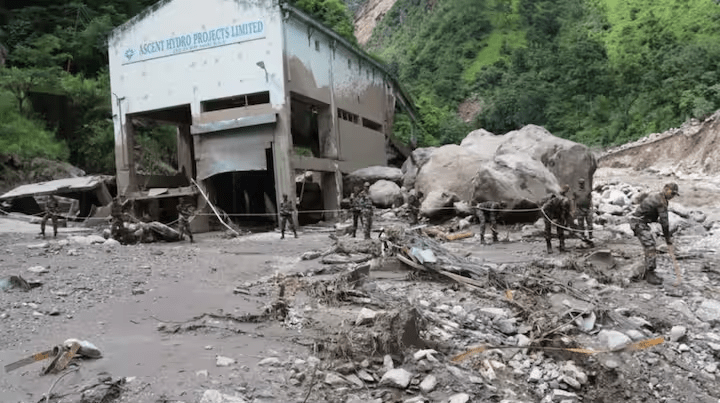
(Powerhouse of a hydro project ravaged by cloudburst induced flashflood in Sutlej basin Shimla, Himachal Pradesh in Aug 2024. Image Source: Social Media)
This 2024 annual overview focusses on important reports highlighting the safety and sustainability issues of the hydro and dam projects in India in 2024 in the context of Climate Change, including Glacier melt and GLOFs. The compilation shows that the climate change driven extreme weather events have become significant threat for the structural safety of these projects.
This is even more relevant in inherently vulnerable areas like the Himalayas and Western Ghats from the point of view of seismic activity, young erosion prone mountain, flash floods, avalanches and landslides. Here the impact of climate change effects like more intensified hydrological cycles, cloud bursts, reduction in snow fall, glacier melts and GLOF (Glacier Lake Outburst Flood) increase the vulnerability including landslide dams and avalanche dams.
On top of it we are adding the third layers of major infrastructure projects that involves deforestation, damming, tunnelling, blasting, muck generation and its indiscriminate dumping in rivers and drastic changes in river flows. As we see in reports here and elsewhere, the dams and hydro projects act as force multipliers at times of disaster.
The fourth layer is our poor disaster management. Each major intervention in such areas require disaster potential assessment and how that changes with the project. But we are not doing even honest environment or social impact assessments. Thus we are massively increasing the disaster potential in these areas without knowing or estimating such potential. The sufferers are the local communities, rivers and environment.
The part 1 of the 2024 yearend roundup related to Dams and Hydropower projects has documented the accidents and disasters related to dam and HEP projects in India in 2024. The part 2 focuses on community resistance against hydro projects in Himalayan states. The part 3 covers the struggle of dam projects affected people. The part 4 highlights growing concerns against pump storage projects. The part 5 underlines the hydro and dam projects facing corruption and scam charges in the country.
MoJS Himalayan river basins under climate change threat The Union Ministry of Jal Shakti has urged the need for climate mitigation to prevent a severe reduction in snow cover due to climate change. It also urged to save water resources in major river basins including the Ganges, Indus and Brahmaputra. The ministry filed an affidavit in response to the NGT notice. The NGT had previously issued a notice to the ministry regarding the accelerated melting of snow and glaciers that would impact different Himalayan River basins. https://www.newindianexpress.com/nation/2024/Nov/27/himalayan-river-basins-under-climate-change-threat-urgent-action-needed-jal-shakti-ministry (27 Nov. 2024)
SJVN Climate Change resulted in adverse hydrological conditions for HEPs: CMD Climate Change-induced erratic weather patterns resulted in adverse hydrological conditions for our flagship hydro projects, said SJVN Limited’s Chairman and Managing Director (CMD) Sushil Sharma. “2023-24 has been a challenging year for the company on the operational front. The impact of Climate Change is becoming visible in the form of erratic weather patterns across the globe,” said the SJVN CMD in the company’s annual report for 2023-24. “Heavy rains and flash floods during the peak generation period followed by sub-normal discharge during the remaining part of the year resulted in adverse hydrological conditions for our flagship hydro projects,” said Sharma. https://psuwatch.com/newsupdates/climate-change-resulted-in-adverse-hydrological-conditions-for-sjvn-hydro-projects-cmd (26 Aug. 2024)
Sikkim Submerged Teesta III dam was doomed from start A shoddy consortium, hefty debts and a design that proved to be catastrophic: over 36 years since the Teesta III dam was first proposed, it has come to only spell disaster for the state. https://www.eastmojo.com/sikkim/2024/01/20/eastmojo-investigation-submerged-sikkim-dam-was-doomed-from-start/ (20 Jan. 2024) This second part looks into how many other hydropower projects (besides Teesta III HEP that was subject of first part) were also plagued with similar problems. https://www.eastmojo.com/news/2024/01/26/eastmojo-investigation-how-a-hydropower-boom-turned-into-a-sikkims-bane/ (26 Jan. 2024)
Himalayan People left to suffer avoidable disaster The combined impact of industrialization and climate change is destabilizing the delicate balance of this Himalayan region. Yet, the responsible voices to safeguard Sikkim’s fragile ecosystem largely falls on deaf ears. Why aren’t more voices joining this vital cause? The flood in 2023 highlighted the dangers of such infrastructure in fragile regions. When dams collapsed under the weight of floodwaters, they exacerbated the destruction instead of alleviating it. https://www.eastmojo.com/news/aipp-eastmojo-fellowship-2024/2024/12/12/a-hard-choice-sikkimese-left-to-choose-between-climate-change-development/ (12 De. 2024)

Landslide a warning to upcoming HEPs Experts concur that the Centre needs to re-consider such hydro projects. “Are we ready for such a geological surprise?” asks Himanshu Thakkar of the SANDRP. Thakkar says Sikkim’s landslides were the result of ‘improper’ geological assessment before construction in 2008. “Such projects would repeatedly fail if complex geological settings of the region keep getting ignored,” Thakkar adds. https://www.newindianexpress.com/xplore/2024/Aug/31/sikkim-landslide-is-a-warning-to-upcoming-hydro-projects (31 Aug. 2024)
Hydel push can’t ignore Teesta III failures In part 2 of this series, M Rajshekhar explores how India is pushing for dams with a broken system, one that creates winners and losers as seen in the aftermath of Teesta III. Eighteen years after the country liberalised power generation, it’s useful to study what hydro-criminality has produced. Its primary output, as this report will argue, is a skewed distribution of risks and rewards. Teesta III illustrates that point to perfection. There are lessons to be learnt from its collapse. https://carboncopy.info/indias-new-hydel-push-cant-turn-blind-eye-to-teesta-iii-failures/ (1 Mar 2024)
SC issues notice over damages to Teesta dam The Supreme Court has issued a notice to the state govt in response to SLP (appeal) by the Sikkim Democratic Front for seeking an independent central agency investigation on complete destruction of the Teesta III Dam & insurmountable loss of lives and damage to properties. https://www.indiatodayne.in/sikkim/story/sc-issues-notice-to-sikkim-government-over-damages-to-teesta-dam-loss-of-lives-during-glacial-lake-outburst-797925-2024-01-31 (31 Jan 2024)
Arunachal Pradesh NHPC safety cliams unconvincing NHPC claims about safety of the Dams clearly are not convincing and are also not based on facts. By using terms like “most of” and “far off” they have tried to hide the real vulnerabilities. They should have also stated that Teesta V, under construction Teesta VI were also damaged and the Teesta Low Dam III even farther away, remained non operable for many months. They have not mentioned any of these. https://nenow.in/environment/nhpc-assures-safety-of-arunachal-hydropower-projects-following-teesta-river-flood.html (04 March 2024)
Jammu & Kashmir 11 ‘high-risk’ Alpine lakes can create catastrophic GLOFs The study has identified Kishtwar in Chenab valley of Jammu division as the “most vulnerable” district of the Union territory. The preliminary findings of these studies noted that there are three high-risk lakes – Mundikeswar, Hangu Lake and an unnamed lake in the Kishtwar dist of Jammu – that are ‘highly hazardous’, while the remaining eight such alpine lakes are located in the Kashmir valley. “These lakes exhibit characteristics such as unstable moraines, steep downstream gradients, and proximity to unstable glacier tongues, making them critical for targeted mitigation measures,” the study, which is being coordinated by Dr Binay Kumar, Associate Director at the Centre for Development of Advanced Computing Ahmedabad, noted.
According to a 2023 study by the ICIMOD, more than 70% of the 700 GLOFs in the world since 1833 have taken place in the past 50 years with the year 1980 witnessing the highest number (15) of GLOF events followed by 13 in 2015. An official spokesperson of DDMRRR said that the strategy, which has not yet been made public, would be implemented in two phases and a Glacial Lake Outburst Flood Early Warning System is also proposed to be established to “enhance preparedness”. https://thewire.in/environment/jammu-kashmir-glof-risk-lakes (29 Dec. 2024)
Land subsidence in Chenab valley Chenab valley in Kashmir sinking in three districts of Doda, Ramban and Kistwar. Besides large number of mega hydro projects, big highways and railways joining Jammu and Srinagar pass here with multiple tunnels. It is also a seismic zone. But these major interventions done without any disaster risk assessment. https://www.bhaskar.com/national/news/jammu-kashmir-land-sinking-situation-update-chenab-valley-ramban-132960435.html (02 May 2024) Many experts also point out that chaotic construction and large-scale development projects, such as the construction of tunnels, highways, and railways, have had an impact on the mountains surrounding the Ramban area, making them more susceptible to landslides and land subsidence. https://www.downtoearth.org.in/news/urbanisation/unplanned-constructions-wastewater-seepage-causing-land-subsidence-in-chenab-valley-95986 (06 May 2024) NDMA team is conducting a thorough examination of the reasons behind the land subsidence and the future threats in the area. Prof Kanungo said the committee would submit a comprehensive report to the ministry suggesting measures for the sustainable development of the area. https://www.tribuneindia.com/news/j-k/ndma-team-initiates-survey-of-land-subsidence-in-ramban-619684 (09 May 2024)
Branwar SHEP damaging ecology & economy “Na khuda hi mila, na visaal-e-sanam/ Na idhar ke rahe, na udhar ke rahe.” This couplet describes the fate of many communities and people living in remote areas of Jammu & Kashmir especially the forest dwellers whose resources (land, forest, water) were acquired for so-called developmental projects. These hydropower projects left communities with economic losses and ecological damage. Even small hydropower projects have been harming the biodiversity, ecology and economic conditions of people. When the 7.5 MW Branwar Hydropower project was being constructed around 15 years back in a forest village called Branwar in District Budgam, a lot of false promises were made to villagers by the local politicians. Dr Raja Muzaffar Bhat describes the information after firsthand visit. https://kashmirobserver.net/2024/07/30/havoc-on-ecology-and-economy-small-hydro-power-project-branwar-and-broken-vows/ (30 July 2024)
Himachal Pradesh Glacial lakes posing threat to lives & infra The number of glacial lakes in the Satluj river catchment area has almost doubled from 562 in 2019 to 1,048 in 2023, according to satellite data analysed in a recent study by the Centre on Climate Change of Himachal Pradesh Council for Science Technology-Environment (HIMCOSTE). The catchment area of the Satluj basin was studied from upstream of Jhakri to the Mansarover Lake in Tibet, in the Trans Himalayan Region from where the river originates.
Of the 1,048 lakes mapped in 2023, 900 are small, each spanning an area of less than five ha, while 89 lakes have an area 5-10 ha, and 59 lakes are bigger than 10 ha each. “Over the years, the number of glacial lakes has been gradually increasing. In fact, as the frequency of small lakes with an area of less than 5 ha has been rising, it indicates that the climate warming effects are more significant in the higher Himalayan region. The swift melting of glaciers and less snowfall during the winter could be reasons behind the rise in lakes,” said S.S. Randhawa, a co-author of the study, and the principal scientific officer at HIMCOSTE. https://www.thehindu.com/sci-tech/energy-and-environment/glacial-lakes-multiply-in-himachal-pradesh-and-tibet-posing-a-threat-to-lives-and-infrastructure-downstream/article68510232.ece (10 Aug. 2024)
Why finance environmentally damaging HEPs? The State Bank of India is the lead financier for stage one of the SJVN’s 210 Mw Luhri HEP in Kullu. The fact that the bank has not been visible in the discussions about the effects of the project highlights the unwillingness of Indian financial institutions to take responsibility for the human and ecological consequences of their investments. https://scroll.in/article/1065582/by-financing-environmentally-damaging-projects-can-indian-funders-be-held-liable (04 April 2024)
Year after flood; dams yet to install EWS Having taken few lessons from last year’s monsoon mayhem that killed at least 509 in Himachal Pradesh, the hydel power dams in HP are still reluctant to install an EWS. https://www.hindustantimes.com/cities/chandigarh-news/year-after-monsoon-mayhem-himachal-dams-yet-to-install-early-warning-system-101721238425189.html (18 July 2024)
Despite mishaps, No geological study for 500-Mw Dugar HEP The FAC advised NHPC Ltd to carry out a study through the Wadia Institute of Himalayan Geology, an autonomous govt-run institute based in Dehradun, to ascertain the geological fragility, if any, of the project site. But NHPC Ltd rejected the advice saying that it already has the consent of the Geological Survey of India. It also said that the project report has been vetted through agencies including the Central Electricity Authority (CEA), Central Water Commission (CWC) and the National Committee on Seismic Design Parameters. https://www.newsclick.in/despite-mishaps-himalayan-range-no-geological-study-500-mw-dugar-hep (30 Dec. 2023)
Cloudbursts happening around HEPs. Hydropower projects have been or are being built in four of the six locations where the cloudbursts took place during the last one-week, environmental activists said. Furthermore, most incidents of natural disasters that occurred during the last one year happened around some power or national highway project. The 2023 disasters in the Malana, Sainj, Parvati, Larji power projects, as well as the Bhakra and Pong dams, were major factors in the huge losses incurred. The disasters caused losses of Rs 12,000 crore and killed 441 people. https://www.downtoearth.org.in/climate-change/himachal-cloudbursts-are-hydropower-projects-to-blame (04 Aug. 2024)
Uttarakhand HEPs worth over ₹70Kcr at risk due to extreme weather Extreme weather events could potentially destroy or seriously delay hydroelectric power plants worth Rs 70,150 crore, suggests a report released on Nov 13 by the think tank Climate Risk Horizons. The report, “Assessing the Vulnerability of Hydroelectric Power Plants in Uttarakhand“, notes that the state is highly susceptible to extreme weather events including flash floods, landslides, glacial lake outbursts and drought.
There are 18 operational HEPs in the state with many more in development, the report added. Extreme weather events could damage infrastructure, leading to project delays and significant cost escalations. The report was based on a case study of the 2021 flash floods in Chamoli district, which destroyed the Tapovan-Vishnugad hydropower project. “The initial project cost of Rs 2,978 crore has more than doubled due to the flash floods,” the report observed. The authors identified eight major river basins and assigned them ratings from high to low risk based on the population density of nearby settlements, nearby glacial discharge patterns and damage assessment of past flash floods. The report suggests that the Joshimath-Srinagar basin is the most vulnerable to natural disasters, followed by the Tehri-Uttarkashi and Pithoragarh-Bageshwar basins. There are 15 hydropower projects currently in development across these three basins worth Rs 70,150 crore.

In an accompanying press release, the lead author of the report, Sagar Asapur, said that three steps were essential for all hydropower investments: avoiding high-risk zones, incorporating climate-proofing strategies and embracing innovative financial mechanisms. https://scroll.in/latest/1075600/hydropower-projects-worth-over-rs-70000-crore-at-risk-due-to-extreme-weather-in-uttarakhand- (13Nov. 2024) https://hindi.downtoearth.org.in/climate-change/15-hydropower-projects-in-uttarakhand-are-in-high-risk-areas (14 Nov. 2024)
Study needed to pin NTPC tunnel role in Joshimath sinking Residents and officials alike continue to believe that NTPC’s construction has created a heavy load on land in Joshimath. “To a certain degree, tunnelling by NTPC is also a contributing factor of land sinking here,” the official said. “But studies have to be completed to say it assertively.” https://scroll.in/article/1061812/why-joshimath-residents-have-moved-back-to-unsafe-houses (10 Jan. 2023)
Fast development destabilizes Himalaya region Fast development destabilizes India’s Himalaya region: As India boosts its infrastructure development in the Himalayan region, many ongoing construction projects are putting pressure on the fragile ecosystem. DW travelled to Uttarakhand, where communities are paying a high price. https://www.dw.com/en/fast-development-destabilizes-indias-himalaya-region/video-70840566 (21Nov 2024) Video report on hydropower & disaster risks in Himalayas. https://india.mongabay.com/2024/01/video-hydropower-in-the-himalayas-and-disaster-risks/ (12 Jan. 2024)
HEPs facing risks, opposition Himanshu Thakkar of SANDRP says, “The Chamoli disaster, the Himachal floods or the breaking of the glacial lake in Sikkim were natural, but the reason for them turning into a disaster was human. The breaking of the hydro power project in Chamoli caused such a large number of deaths. The floods in Himachal started due to rain, but due to the water released from the dams, this flood became many times bigger. In Sikkim too, the breaking of the dam caused more damage downstream”.
Thakkar says, “The process of working on hydro power or other development projects should be democratic. In this, it is important to give honest, full and correct information to the local people and involve them in the decision making. The cost benefit analysis should be done by combining the potential danger from big dams, the possibility of disaster, the impact on the environment and society. After this, such development plans should be made only if the people give their consent”. https://indiaspendhindi.com/cover-story/election-2024-increasing-risk-increasing-opposition-yet-dam-projects-are-expanding-rapidly-903274 (09 April 2024)
Dammed in Himalayas Huge dams in the quake-prone Himalayas risk catastrophe. Despite warnings, construction continues, gambling with lives and ecosystems. Delays, disasters, and devolvement are the norm rather than the exception in most such projects planned across India. Yet more are on the anvil as clearances get issued. Resentment against these projects has been brewing for a long time in Arunachal Pradesh, with human rights groups and organisations pleading to let affected people have a greater say in the decision-making process. Their objections have gone largely unheeded.
The big question then is, are projects of this magnitude worth it? The answer involves not just cost-benefit analyses and understanding of the recent dismal history of the hydropower sector but another essential element: risk. Hydropower projects in the Himalaya face two real, ever-present, risks: the possibility of a devastating earthquake and ruinous floods caused by glacial lake overflows. https://frontline.thehindu.com/environment/sikkim-glacial-lake-earthquake-mount-everest-himalayas-hydropower-dams/article68449344.ece (3 Aug 2024)
Local people, environment suffer from HEPs projects India’s policies on renewable energy, especially its push for large hydropower projects, have been criticised by experts on account of a lack of consideration for communities residing on these lands, as well as for financial and scientific reasons. Large hydropower projects often ignore the complexity and risk of construction on the local terrain, geology, hydrology and ecology. This negligence impacts local communities significantly during or after construction. “Far from being cost-effective, these have ended up causing distress to people, especially communities living around river basins,” said Shripad Dharmadhikary of Manthan Adhyayan Kendra, a Pune-based centre that monitors and analyses water and energy issues. “There is no cumulative impact assessment of these projects, though some of them are in very close proximity, becoming the reason for environmental disasters.” https://idronline.org/article/climate-emergency/whats-missing-from-indias-climate-action-plans/ (16 July 2024)
Compiled by Bhim Singh Rawat (bhim.sandrp@gmail.com)

 SANDRP