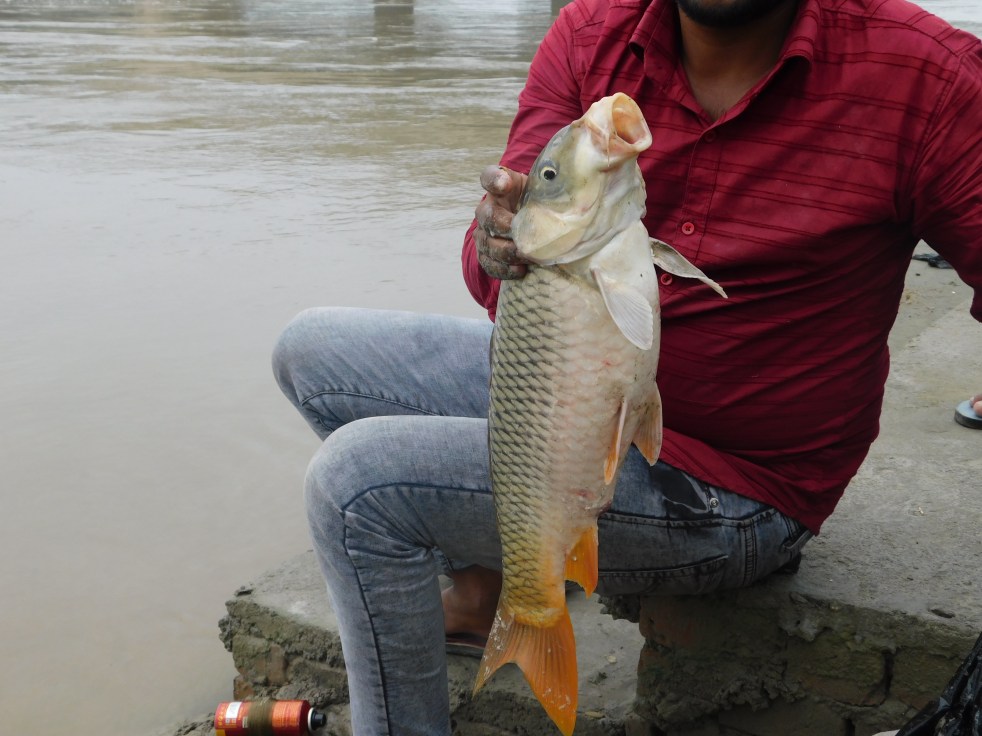
(Feature Image: Prized catch of a fishman at Yamuna bank in Kairana, UP in Sept 2024)
During past one year, there have been several new studies and reports published amplifying the adverse effects of developmental projects including dams, waterways, river interlinking, invasive fish species, degradation of rivers and climate change on river fish and fisherfolks in India. In the last part of the annul overview on the World Fisheries Day on Nov 21 2024, we focus on these important studies and reports highlighting the threats and challenges on freshwater fish and fisherfolks.
Also see the first part of the series covering top ten developments on fish, fisheries and fisherfolks, the second part outlining the suffering of fish and struggle of fisherfolks amid growing threats, the third part compiling mass fish death incidents in Indian waterbodies, rivers during past one year.
1 Dams, Hydro Power Projects
Hydropower Impacts on Biodiversity A new study of available scientific publications on impact of Hydropower projects on biodiversity provides a thorough review. The review does not directly give a call not to construct more such destructive projects. But it is useful for anyone concerned about the impact of dam projects on rivers.
The study discusses the impacts of hydropower projects on both aquatic and semi-aquatic species in riverine ecosystem and cumulative impacts spatially and temporally across river basins. Dams disrupt longitudinal connectivity and act as physical barriers in upstream-downstream movement of species. Upstream of dam, there is static water environment rather than flowing river environment. In the downstream, the hydropower projects adversely affect the water flow, sediment flow, thermal regimes, affecting water quality and environmental cues for the fish movement. All these also affect the floodplains both upstream and downstream.
If one goes through any of the Environment Impact Reports, Cumulative Impact Assessments or Carrying Capacity studies of any dam, hydropower projects or even river linking projects and river basins, we find none of these aspects in any credible way in India. And yet almost all the dams and hydropower projects in India get away with such shoddy, unscientific, dishonest reports and there are no consequences for the EIA/ CIA/ CCS consultants. https://sandrp.in/2024/10/28/drp-nb-28×24-hydropower-impacts-on-biodiversity/ (24 Oct. 2024) Moreover, retention effects of reservoirs and flow regulation alter river–floodplain exchanges of water, sediment and nutrients, modifying the habitats on which riverine species depend. Improvements to flow regulation, fishway design and sediment redistribution can mitigate some of these ecological impacts. Future research could support reforms to dam operations and design adaptations to balance renewable electricity development and biodiversity conservation through systematic basin-scale planning, long-term monitoring, adaptive management and involving multiple actors in decision-making. https://www.nature.com/articles/s43017-024-00596-0 (14 Oct. 2024)
Study GDW database info for large-scale applications Abstract: There are millions of river barriers worldwide, ranging from wooden locks to concrete dams, many of which form associated impoundments to store water in small ponds or large reservoirs. However, global datasets are often biased towards particular regions or specific applications, such as hydropower dams affecting fish migration, and are thus not globally consistent. This paper presents a new river barrier and reservoir database developed by the Global Dam Watch (GDW) consortium that integrates, harmonizes, and augments existing global datasets to support large-scale analyses. Data curation involved extensive quality control processes to create a single, globally consistent data repository of instream barriers and reservoirs that are co-registered to a digital river network. Version 1.0 of the GDW database contains 41,145 barrier locations and 35,295 associated reservoir polygons representing a cumulative storage capacity of 7,420 km3 and an artificial terrestrial surface water area of 304,600 km2. https://nature.com/articles/s41597-024-03752-9 (08 Oct. 2024)
Study River damming impacts fish habitat, associated conservation measures Abstract: Dams have extensively altered global river dynamics, including riverine connectivity, hydrological, thermal, sediment and solute regimes, and the channel morphology. These alterations have detrimental effects on the quality and quantity of fish habitat and associated impacts on aquatic life. Indeed, dams have been implicated in the decline of numerous fishes, emphasizing the need for effective conservation measures. This paper (River damming impacts on fish habitat and associated conservation measures. Reviews of Geophysics, 61, e2023RG000819) presents a global synthesis of critical issues concerning the impacts of river damming on physical fish habitats, with a particular focus on key fish species across continents. It also considers current fish conservation measures and their applicability in different contexts. Finally, it identifies future research needs. The information presented herein could help support dam operation under the constraints of future climate change and human needs. https://agupubs.onlinelibrary.wiley.com/doi/pdfdirect/10.1029/2023RG000819
IUCN Migratory freshwater fish populations ‘down by more than 80% since 1970’ “Migratory fish populations have crashed by more than 80% since 1970, new findings show… according to a new report by the Living Planet Index – a rate of wildlife loss six times that of animals that live on land or in the sea… Populations are declining in all regions of the world, but it is happening fastest in South America and the Caribbean, where abundance of these species has dropped by 91% over the past 50 years… This region has the world’s largest freshwater migrations, but dams, mining and humans diverting water are destroying river ecosystems. In Europe, populations of migratory freshwater fishes have fallen by 75%, according to the latest update to the Living Planet Index.” https://www.theguardian.com/environment/article/2024/may/21/living-planet-index-migratory-freshwater-fish-populations-decline-dams-weirs-mining-water-abstraction-pollution-threat-aoe, https://theconversation.com/the-surge-in-hydroelectric-dams-is-driving-massive-biodiversity-loss-230895 (24 May 2024)
Free-flowing rivers will protect key migratory fish species A report by the Convention on the Conservation of Migratory Species of Wild Animals makes for grim reading on migratory fishes (see go.nature.com/3v8pdv2). Among the 37 species with sufficient data, populations have declined by an average of 90% since 1970. Migratory fishes have key ecological roles, and their decline undermines Indigenous cultures, food security and biodiversity conservation. https://www.nature.com/articles/d41586-024-00825-y (19 March 2024)
Study Saving the Hilsa in Narmada by letting the flow! The paper titled ‘Assessment of optimal dam release for anadromous fish migration in estuary’ published in Ecological Indicators discusses the findings of a study that investigates the effects of Sardar Sarovar Dam (SSD) on downstream flow, and estimates the flow requirements necessary to support anadromous fish migration namely that of the hilsa fish in the Narmada River estuary. https://www.indiawaterportal.org/articles/saving-hilsa-letting-narmada-flow (20 April 2024)
Himachal Pradesh Fish production declines in Govind Sager There is decline in fish production in Gobind Sagar Lake of Bhakhra Dam from 328.26 T in 2018-19 to 182.84 T in 2022-23, majorly due to upstream dams like Kol Dam, Karcham Wangtoo, Nathpa Jhakri, Rampur HEPs as per a CIFRI study. https://www.tribuneindia.com/news/himachal/fish-production-declines-in-gobind-sagar-578727 (04 Jan. 2024)
Assam Mega-dam will change river, livelihood Expected to be fully operational in 2026, the Subansiri Lower HEP dam will change the natural flow of the river. For most of the day, the dam will hold back water, letting only a small amount through, roughly equivalent to the region’s dry season. But for about four hours each night, it will release water to generate power, sending a raging river downstream almost like during monsoon season. The dam will not only block the movement of fish, but also change the way people living downstream experience the river’s flows. https://theconversation.com/indias-new-mega-dam-will-roil-lives-downstream-with-wild-swings-in-water-flow-every-day-229085 (04 Sept. 2024)
2 Climate Change Impact
IUCN Freshwater fish highlight escalating climate impacts on species State of the world’s freshwater fish species: -Today’s update completes the first comprehensive assessment of the world’s freshwater fish species, revealing that 25% (3,086 out of 14,898 assessed species) are at risk of extinction. At least 17% of threatened freshwater fish species are affected by climate change, including decreasing water levels, rising sea levels causing seawater to move up rivers, and shifting seasons.
This compounds threats from pollution, which impacts 57% of freshwater fish species at risk of extinction, dams and water extraction, which affect 45%, overfishing, which threatens 25%, and invasive species and disease, which harm 33%. For example, the large-toothed Lake Turkana robber (Brycinus ferox) – an economically important species in Kenya – has moved from Least Concern to Vulnerable on the IUCN Red List, due to overfishing, climate-change driven habitat degradation and dams reducing freshwater entering the lake. https://www.iucn.org/press-release/202312/freshwater-fish-highlight-escalating-climate-impacts-species-iucn-red-list (11 Dec. 2023)
North East Scientists to study 3 fish species for climate vulnerability The move to conduct the study by the fisheries scientists from Assam, Manipur, Meghalaya and Nagaland came after the recently concluded 3-day GIZ, a German development agency sponsored workshop on ‘Climate Vulnerability Assessment of the Selected Fish Species in Northeast India’, at the Assam Don Bosco University campus in Sonapur on the outskirts of Guwahati.
The three fish species are – Snow trout (Schizothorax richardsonii), Tor mahseer (Tor tor) and Tire track eel (Mastacembelus armatus). The findings of the study will help in developing a protocol for climate vulnerability assessment particularly for northeast India.
The river systems in India’s northeast, including Brahmaputra, Barak-Surma-Meghna and Chindwin, which have a vast catchment area, are home to 435 fish species (as per IUCN 2010 reports), including 427 indigenous species. https://www.hindustantimes.com/cities/others/scientists-to-study-3-fish-species-for-climate-vulnerability-assessment-in-northeast-101709701504823.html (06 March 2024)
Assam Fishermen trapped by climate change The seppa, bair, darki, duyer, diyaar are just some of the indigenous bamboo fishing traps that Jalal Ali crafts for a living. But truant monsoons have shrunk Assam’s many waterbodies, and the demand for fishing traps has fallen sharply, and so has his income. https://ruralindiaonline.org/en/articles/trapped-by-climate-change-in-the-brahmaputra/- (17 Oct 2024)
Karnataka Drought shrinks inland fisheries output by over 30% The severe drought this year has hit inland fisheries hard across the State as tanks and lakes are drying up. Officials in the Directorate of Fisheries say both production and sowing of inland fish have reduced by around 30% this year. Across the districts, fish production target reached only 65% and fingerling sowing has not crossed 70% of the target. https://www.thehindu.com/news/national/karnataka/drought-shrinks-inland-fisheries-output-by-over-30/article67834775.ece (01 March 2024)
Fish shortage crisis impacts fisheries sector In Udupi, Dakshina Kannada, and Uttara Kannada districts, an unprecedented drought has hit this year, unlike anything seen in the past four years. Boats are not catching fish as anticipated, with many remaining anchored. Unplanned fishing holidays are being declared during the fishing season itself to mitigate the burden of potential losses. https://www.daijiworld.com/news/newsDisplay?newsID=1171789 (29 Feb. 2024)
Himachal Pradesh Drop in fish production due to floods The Economic Survey report for 2023-24 revealed that the total fish production in HP dropped substantially in 2023 for the first time in over a decade, mainly because of the unprecedented floods during 2023 monsoon. As per the report, the total fish production decreased from around 17,026 T in 2022 to 11,377 T in 2023, a drop of 33.4%. The total monetary value of the fish which stood at Rs 261.5 cr in 2022 also came down to Rs 179.49 cr in 2023, a drop of 50%. “The unprecedented floods last year washed away many fish farms and destroyed breeding & feeding grounds of the fish. The destruction was at a massive scale that caused losses to not only farm owners but also impacted the overall fish production,” said Bhupinder Kumar, deputy director, fisheries dept.
There are over 50 fish species that are produced and found in the waters of Himachal Pradesh, but the trout is the most popular. However, trout production has also been decreasing for the last many years due to a number of reasons, including massive construction activities near rivers, rapid urbanisation and illegal and destructive means of fishing. The trout production in the state has dropped gradually from the highest 19.18 T in 2012-13 to 7.72 T in 2023-24. Introduced by the British in the 1890s, two trout varieties are found in Himachal Pradesh — brown trout (Salmo Trutta Fario) & rainbow trout (Salmo Gairdneri). https://timesofindia.indiatimes.com/city/shimla/seo-impact-hp-records-drop-in-fish-production-due-to-floods/articleshow/108571318.cms (18 March 2024)
Maharashtra Ujani dam level dips to lowest in 40 years The dam is a source of income for fishermen in Indapur. The Bhigwan fish market has emerged as one of the ‘biggest river fish’ markets in the state on Pune-Solapur highway. The economy of local eateries is dependent on this market. People from different parts of the state visit this fish market regularly. “But less water in the dam has impacted the fishermen as they are not getting enough catch. This year, fishing has been dull,” said Pravin Kadekar, a fisherman from Bhigwan market. https://timesofindia.indiatimes.com/city/pune/ujani-dam-level-dips-to-lowest-in-40-years-indapur-villages-hit/articleshowprint/110546829.cms (30 May 2024)
Fisherwomen in deep water due to climate change Fishers in Konkan coast, especially the women dependent on fishing, face hardships as the fish catch declines due to rising sea levels and marine pollution. According to Swapnaja Mohite, the head of the Dept of Fisheries Science at the Govt Fisheries College in Ratnagiri, the alarming levels of carbon dioxide in the oceans due to accelerated global warming pose a major threat to marine species. “The increasing carbon dioxide levels lead to acidification of seawater, resulting in the formation of carbonic acid. This leads to a depletion of oxygen in certain regions, forming ‘dead zones’, where marine life either perishes or migrates elsewhere,” said Mohite. https://www.villagesquare.in/climate-change-threatens-fisherwomens-livelihoods-in-konkan/ (17 Jan. 2024)
3 Interlinking of Rivers, Inland Waterways
Report Interlinking of rivers could flood freshwater with invasive fish Max Martin: About a third of the total area in India provides suitable habitat for invasive alien fish, aiding their countrywide spread, including in biodiversity hotspots. Using species occurrence records with select environmental variables and species distribution models, a new study by ATREE reports that 12 species of invasive fish can become widespread. Scientists are urging for careful assessments and policy changes amidst global concern about invasive species and their effects on freshwater ecosystems and the livelihoods dependent on them.
The threatened environments listed by the new study published in The Environmental Monitoring and Assessment include the biodiversity hotspots of the Western Ghats, northeast India and the Sundarbans delta. “India’s proposed river linking projects … may cause homogenization that may threaten our native and endemic freshwater biota,” noted M. Nobinraja of S. M. Sehgal Foundation Centre for Biodiversity and Conservation, ATREE, Bangalore & colleagues, in their new study. https://india.mongabay.com/2023/12/interlinking-of-rivers-could-flood-indias-freshwater-with-invasive-fish/ (27 Dec. 2023)
Manthan Report on Amba waterway (NW-10) IWAI has anticipated a substantial increase in this traffic, rising from 28.54 MMT in 2022-23 to 116 MMT by 2052-53. From Rewas Port to Dharamtar Jetty, a 19.42 km operational stretch of the Amba River is a tidal estuary providing a rich breeding habitat for the diverse aquatic flora and fauna. The riverine waters also provide a livelihood for thousands of fisher people residing along the banks of the Amba River. Against this backdrop, this report attempts to understand the challenges and socio-ecological impacts of cargo operations on NW-10. https://www.manthan-india.org/ambamarch24/ (March 2024)
4 Migratory Fish Lack Protection
Study Fish moving between marine & freshwater ecosystems have no protection A new study has found that 62 per cent of Marine Protected Areas (MPAs) dedicated to protect rare migratory fish species fall outside their core habitats. The study, published in the British Ecological Society’s Journal of Applied Ecology, found that MPAs designated to protect diadromous fish species did not align with their core habitats.
Diadromous fish are those which migrate between saltwater and freshwater environments. Only 55 per cent of modelled core habitats identified for diadromous fish overlapped with the MPAs. Of these protected areas, only half had measures in place for the protection of the fish, according to the study. https://www.downtoearth.org.in/news/wildlife-biodiversity/fish-moving-between-marine-freshwater-ecosystems-have-designated-protected-areas-but-no-protection-in-them-study-96402 (29 May 2024)
UN Migratory species increasingly under threat More than a fifth of migratory species under international protection are threatened with extinction, including nearly all nomadic fish, according to the first UN expert assessment. The report comes as governments gather for a summit in Samarkand, Uzbekistan, to discuss how to better protect the world’s migratory species. The Convention covers Migratory Species (CMS) that require international coordination to protect their survival. The report authors identified 399 threatened migratory species that are not listed under the convention. https://www.theguardian.com/environment/2024/feb/12/from-turtles-to-fruit-bats-migratory-species-increasingly-under-threat-says-un (12 Feb. 2024) -The report provides a global overview of the conservation status and population trends of migratory animals, combined with the latest information on their main threats and successful actions to save them. The main focus of the report is the 1,189 animal species that have been recognised by CMS Parties as needing international protection and are listed under CMS, though it also features analysis linked to over 3,000 additional non-CMS migratory species. https://in.investing.com/news/landmark-un-report-reveals-shocking-state-of-wildlife-4015342 (12 Feb. 2024)
Report The fish that skips & crawls on land Due to their sensitivity to environmental changes, mudskippers serve as indicator species, reflecting the health of intertidal habitats. Monitoring mudskipper populations, therefore, can provide insights into the impacts of climate change on a landscape and habitat degradation. Understanding the nuances of mudskipper biology not only contributes to scientific knowledge but also emphasises the importance of preserving intertidal habitats for the diversity of life they support. https://india.mongabay.com/2024/03/the-fish-that-skips-and-crawls-on-land/ (12 March 2024)
5 Threat to Subterranean Fish
Report GW pumping threatens underground species Globally, we pump almost 1,000 cubic kilometres of this ancient water each year. We’re using it far faster than it can naturally replenish About a third of the world’s largest groundwater basins are in distress, meaning levels are continuously declining.
That’s bad news for the thousands of species living down there, including the cavefish, blind eels, blind beetles and translucent crustaceans that rely on groundwater. There’s little to no protection in place for these species globally. But groundwater ecosystems play a vital role in surface ecosystems. https://theconversation.com/we-rely-heavily-on-groundwater-but-pumping-too-much-threatens-thousands-of-underground-species-218919 (12 Dec. 2023)
Kerala 4 freshwater fish species face risk of extinction 4 freshwater fish from Kerala are among the 36 species from India that were included for the first time in IUCN’s Red List, updated on Dec 11. Inclusion in the list signals that these species are now endangered or face the risk of extinction unless measures are taken to prevent it.
“The four are subterranean fish species (found in water bodies under the surface). They are Kryptoglanis Shajii, Horaglanis Abdulkalami, Pangio Bhujia & Aenigmachanna Gollum. While the first three are categorised as endangered, Aenigmachanna Gollum (snakehead Gollum) is in the vulnerable category,” said Dr Rajeev Raghavan, assistant professor of Kerala University of Fisheries and Ocean Studies, Kochi. According to the fisheries scientist, this is particularly worrying given how there are only 13 subterranean fish species in Kerala. A quarter of them are already on the list!
“Interestingly, Gollum snakehead is 1 of the 2 freshwater fish species considered protected in India — since the amendment of the Indian Wildlife (Protection) Act last year. Sadly, not many people are aware of this. Even the forest dept, usually tasked with enforcing protection laws, is not clued in about this development,” Dr Rajeev said. It further compounds the situation that unlike river & marine fish, subterranean fish live in people-dominated areas. “Groundwater extraction poses a big threat to these fishes. They stand the risk of faster extermination than others,” he said. https://www.newindianexpress.com/states/kerala/2023/dec/13/scientists-worried-as-four-freshwater-fish-species-in-keralaface-risk-of-extinction-2640960.html (13 Dec 2023)
6 Invasive Fish Species
Commentary India needs to step up its fight against invasive fishes Projects like river linking and dams, ambitious in their aim to meet the country’s water needs, potentially pave the way for unwanted consequences. The connectivity among major rivers and reservoirs, while promising for water management, could end up in catastrophe by facilitating biological invasions. Similarly, the promotion of exotic fish species and restocking fish ponds with exotic fingerlings need reconsideration. Instead, a shift towards the promotion of native fish species could prove more beneficial. This not only enhances fish productivity but also contributes to conserving biodiversity and increasing nutritional diversity.
Addressing the complex challenge of aquatic invasion requires a combination of strategies. This includes the development of specialized tools, extensive research, investments in capacity building and grassroots training, as well as widespread awareness and education initiatives for the stakeholders and public. Achieving success in this attempt relies on collaborative efforts where harmonious and like-minded parties come together, pooling their resources and expertise. https://india.mongabay.com/2024/02/commentary-india-needs-to-step-up-its-fight-against-invasive-fishes/ (05 Feb. 2024)
Report Invasive Tilapia, found growing in marine waters The total tilapia production in 2022 was estimated to be about 70,000 T, with 30,000 from aquaculture alone, according to a joint study by WorldFish and the Confederation of Indian Industry. India has also set an ambitious goal to produce 0.766 MT tilapia by 2027. Unintended releases and escapes from aquaculture pens have resulted in their widespread presence across freshwater habitats in India, including streams, lakes, and backwaters. They dominate waterways like the Ganga and Yamuna rivers and can even be found in the biodiversity-rich Andaman Islands and Western Ghats. https://india.mongabay.com/2024/03/tilapia-a-highly-adaptable-and-invasive-fish-found-growing-in-marine-waters/ (19 March 2024)
This fish can stay alive in mud for months without water The suckermouth catfish, a dweller of tropical freshwater environments, is known for its resilience and adaptability, particularly its ability to survive in conditions that would be inhospitable to other fish. While the pleco’s capacity to live in a zombie-like state without water is certainly impressive, it also raises questions about the impact of such species on native ecosystems. As humans continue to influence natural habitats, the spread of resilient species like the pleco could have unforeseen consequences on biodiversity & ecological balance. https://timesofindia.indiatimes.com/etimes/trending/explained-how-this-fish-can-stay-alive-in-mud-for-months-without-water/articleshowprint/110877969.cms (10 June 2024)
Threats from Gambusia fish Several districts in India have released Gambusia fish into local water bodies to tackle the dengue outbreaks. These fish feed on mosquito larvae. However, the use of Gambusia affinis, commonly known as mosquitofish, is not without controversy. The IUCN lists Gambusia affinis among the 100 worst invasive alien species globally. Experts like Nobin Raja, who conducts research in genetics, evolutionary biology, and ecology at the ATREE, Bengaluru, raise significant concerns.
“Gambusia’s effectiveness is limited. While it might reduce mosquitoes in small ponds, it often prefers other prey and can cause ecological harm by displacing native species and preying on other fauna in freshwater ecosystems. This can lead to a decline in native biodiversity,” he says. Broad-spectrum insecticide sprays can have serious environmental consequences. These not only target mosquitoes but also harm beneficial insects such as bees and butterflies, as well as songbirds that rely on insects for food. Moreover, they are less effective in reducing mosquito populations since they mainly target adult mosquitoes. https://www.newindianexpress.com/magazine/2024/Aug/24/bitten-by-the-bug (24 Aug. 2024)
Uttar Pradesh Dominance of exotic fish species in Yamuna, NGT told The NGT has been informed that exotic fish species dominate the river Yamuna, while Indian fish species have declined. The green body was hearing the issue of the decreasing population of Indian fish species in the Yamuna. It had earlier sought a response from authorities, including the Central Inland Fisheries Research Institute (CIFRI) in Prayagraj.
It further said that the Tenualosa Ilisha(Hilsa/ Ilish) fishery had been totally wiped out from the riverine stretch in Prayagraj since 2010 due to the construction of the Farakka barrage. According to the report, the exotic fishery in the Yamuna was primarily represented by Common Carp (Cyprinus carpio), Nile tilapia (Oreochromis Niloticus), and Clarias Gariepinus. Other significant contributors included Clarias Gariepinus (Thai Mangur) at Delhi (Wazirabad). Referring to the studies about their composition, the report said, “These indicate an overall dominance of exotic fish species in the river Yamuna.” https://theprint.in/india/dominance-of-exotic-fish-species-in-yamuna-ngt-told/2351532/ (11 Nov. 2024)
Tamil Nadu Invasive fish species found in Thamirabarani The Manimuthar Agathiyamalai People’s Natural Resources Conservation Centre has found 13 native fish species in the Thamirabarani River. It was found that there is also a dangerous tank cleaner fish in it.
The fishermen said, “If they are trapped in the net, they bite and damage the net to escape. The inland fishermen catch 5-10 kg of farmed fish per day. Each fish weighs 0.5 to 1.5 kg. One of these fish may come from the dam. Or someone left them there.” The Tambaqui native to the Amazon is a fast-growing, all-eating and robust fish that tolerates poor water quality, especially low oxygen content. https://www.news18.com/india/in-tamil-nadu-fish-species-found-in-south-america-spotted-in-thamirabarani-river-8831092.html (28 Mar 2024)
Chennai Invasive fish species affecting natives in Korattur lake A survey of Korattur lake in Chennai undertaken by a group of native fish enthusiasts and inland fishermen on Aug 18 has found multiple invasive fish species in the waterbody, which they suspect are affecting the natives. Native fish enthusiast Beta Mahatvaraj said: “Invasive fish such as plecos destabilise the eco system in the waterbody. They are burrowers & can excavate the earth.” Due to their armoured plating on themselves and less meat, birds rarely feed on them & they continue to affect the native Indian fish species, he said. They caught plecos, tilapias, Midas cichlids, flowerhorns, Gambusia, others. https://www.thehindu.com/news/national/tamil-nadu/invasive-fish-species-affecting-natives-in-korattur-lake/article68539578.ece (19 Aug 2024)
Pune Invasive species of plants & organisms dominate rivers Experts have suggested that multiple invasive species of organisms including fish and invertebrates introduced through aquarium trade have now completely challenged the native pool of organisms in the Mula-Mutha, Indrayani and Pavana rivers of the city. According to biologists, many organisms have been introduced through aquarium trade where snails and exotic fishes end up being introduced into the river due to multiple reasons (e.g. a simple flush down the toilet). https://timesofindia.indiatimes.com/city/pune/invasive-species-of-plants-organisms-dominate-rivers/articleshow/107411429.cms (05 Feb. 2024)
Gurugram Sultanpur wetland is being deliberately dried up Drying up the water bodies, officials said, was essential. In Jan 2024, the wildlife dept shut off water supply from the Gurgaon canal to Sultanpur, a designated Ramsar site. It was because they had spotted catfish last year. Catfish is an invasive species that consumes smaller fish rapidly. https://timesofindia.indiatimes.com/city/gurgaon/ecosystem-under-siege-why-sultanpur-wetland-is-being-deliberately-dried-up/articleshow/109705614.cms (30 April 2024)
7 River Degradation & Riverbed Mining
UNEP Concerns about phosphorus environmental impact Globally, phosphorus losses from land to fresh waters have doubled in the last century and continue to increase. 80 % of the mineral is lost or wasted during use. Along with the environmental fallout, it costs farmers, factory owners and others about US$265 billion a year. Wastewater discharges some 3 millions tonnes of phosphorus into the environment every year globally. Proper treatment could reduce the concentration of phosphorus and nitrogen in wastewater by at least 80 %.
Excess phosphorus, like the other key nutrient, nitrogen, depletes soils of their richness. It also pollutes lakes, rivers and the ocean in a process known as eutrophication. This leads to algal blooms which contaminate supplies of drinking water and create oxygen-starved dead zones, which can kill fish and other aquatic species. Phosphorus pollution is a prime driver of biodiversity loss and contributes to the degradation of ecosystems on which humanity depends. Eutrophication is estimated to cost the US economy alone US$2.2 billion annually. https://www.unep.org/news-and-stories/story/what-phosphorus-and-why-are-concerns-mounting-about-its-environmental-impact (24 Jan. 2024)
Report Human actions changing rivers Agriculture and urbanisation are likely speeding up the process of breakdown of plant litter in rivers and streams globally, according to a new study. This could contribute to increased greenhouse gas emissions and disrupt the food chain, the study published in Science warned. Leaves that reach the rivers are decomposed by bacteria and fungi. They are, in turn, consumed by insects, which are then preyed upon by fish. Faster decomposition rates mean the carbon is released into the atmosphere even before the insects get a chance to absorb the carbon from the leaf.
“When human activities change the fundamental ways rivers work, it is concerning. Increases in decomposition rates may be problematic for the global carbon cycle and animals, like insects and fish, that live in streams,” Krista Capps, co-author of the study and associate professor atthe University of Georgia, said. https://www.downtoearth.org.in/news/climate-change/human-actions-are-changing-rivers-by-altering-decomposition-rates-increasing-greenhouse-gas-emissions-study-96445 (31 May 2024)
Study Ganga in Varanasi contaminated with heavy metals A team of Banaras Hindu University, CSIR-Indian Institute of Toxicology Research (CSIR-IITR), Lucknow & Academy of Scientific and Innovative Research (AcSIR), Ghaziabad, in a joint research, has found the presence of heavy metals in Ganga, putting human health and life in the city to risk. The risk to health is from metals contaminating water and aquatic life. The study, ‘Ecological & Health Risk Assessment of Heavy Metals Bioaccumulation in Ganga fish near Varanasi’ was published online in the Springer Nature on Dec 26.
According to Mishra, presence of heavy metals was observed in the river water, sediment, and edible fishes of the Ganga in Varanasi dist. According to the study, sediment was particularly polluted with cadmium, posing a potential threat to species dwelling at the bottom of the river. Although the levels of heavy metals in the fish muscles were below the hazard quotient, it is evident that prolonged consumption of such contaminated fish could lead to bioaccumulation in the food chain. This, in turn, may result in accumulation of heavy metals in human organs, surpassing the hazard index and causing various health risks to the local population. https://www.daijiworld.com/news/newsDisplay?newsID=1154063 (31 Dec. 2023)
Bihar Illegal mining threats Large-scale illegal sand mining is damaging riverbeds and its ecology. It is also changing the morphology and natural flow of rivers, as huge volumes of sand are being extracted through machines. The damage to river biodiversity is badly affecting the habitat and staple food (fish, mainly small fish) of Gangetic dolphins.
“Our livelihood is affected by illegal sand mining because it badly hits river fish. We are poor and falsely targeted for disturbing dolphins in rivers, but the sand mafia are powerful & operate in lucrative illegal sand mining, which is posing the real danger to dolphins”, Anil Shahni, a fisherman near Digha ghat in Patna, said. https://www.newsclick.in/bihar-rampant-illegal-sand-mining-threatens-gangetic-river-dolphins-ganga-tributaries (02 Sept. 2024)
W Bengal Decline in fish varieties in rivers The degraded state of Bengal’s rivers are posing a threat to more than 23 million people dependent on freshwater fish for their livelihoods. https://scroll.in/video/1064593/eco-india-what-is-causing-a-decline-in-fish-varieties-in-the-rivers-of-bengal (03 March 2023)
Assam Riverine livelihoods of the Kaibartas Fish is a prominent part of Assam’s culture. Many communities—the Kaibartas, for example—define their identity around fishing. The Kaibarta community in Assam resides in the riverine areas of the Brahmaputra. Their name loosely translates to ‘those who earn their livelihood from water’. Historically, they have lived in Assam, Bengal, Bihar, and Odisha in India, as well as in Nepal, Bangladesh, and Bhutan. The Kaibartas have traditionally worked as expert fishermen, boat rowers, and farmers. The community is also divided into subcastes on the basis of occupation: Jaliya Kaibarta (those engaged in fishing and boating) and Haliya Kaibarta (those engaged in agriculture). However, in the last few years, climate change has emerged as a threat to their resilience and poses severe challenges to their economic and cultural survival.
However, even as competition for fishing rises, the breeding rates of fish are declining. Dipen ascribes the lower breeding rates to not only climate change but also rapid urbanisation, such as the construction of new bridges between mainland Guwahati and New Guwahati. Studies conducted by scientists in various countries have found that bridge construction has a negative impact on aquatic life in the rivers and streams. https://idronline.org/article/livelihoods/photo-essay-the-riverine-livelihoods-of-the-kaibartas-in-assam/ (23 Aug. 2024)
Letter to SC flags rampant sand mining in Karbi Anglong area In a letter to CEC, environmentalist, Mukrang Engleng wrote on July 3: “The impact of sand mining through machinery in the Deithor and Rangsali rivers has led to habitat destruction, erosion of river banks, alteration of river flow patterns, and disruption of aquatic ecosystems. It has also resulted in loss of biodiversity, the fish populations have declined drastically, & degradation of water quality has also increased drastically posing health risk to both human and animal lives. Furthermore, sand mining has exacerbated flooding, as it alters the natural sediment balance of the river. Socially and economically, it has affected communities that rely on rivers for livelihoods, such as fishing and agriculture”. https://www.hindustantimes.com/india-news/letter-to-supreme-court-flags-rampant-sand-mining-in-karbi-anglong-area-101721244190590.html (18 July 2024)
J & K Illegal mining vandalising river’s biota In blatant violation of rules, heavy machinery is used to extract riverbed material at Sail, Doenkuel Bagh, Ohangam and its adjoining villages. Sukhnag is known for trout fish and haphazard excavation of riverbed material is causing extensive damage to aquatic life. Earlier this year, halting of water flow to a trout fish farm due to haphazard riverbed mining led to death of over 2000 trout. https://www.greaterkashmir.com/opinion/illegal-riverbed-mining-vandalising-rivers-flora-and-fauna/ (22 Oct. 2024)
8 Unsustainable Aquaculture, Fishing
DTE Poor regulation of aquaculture endangers human health In an order recently, the Madras HC recognised that illegal aquaculture farms were causing damage to agriculture & environment & ordered the closure of all illegal aquaculture farms in TN in six months.
While this decision is commendable, environmental damage is only one concern associated with under-regulated aquaculture. Risks to human health are another dimension. While the HC order is a step in the right direction, a lot more operational controls need to be mandated in aquaculture to minimise its hazardous health impacts. There is an imminent need for aquaculture laws and policies to recognise the interconnectedness between fish health & the health of fish consumers. https://www.downtoearth.org.in/blog/governance/poor-regulation-of-aquaculture-endangers-human-health-94787 (04 March 2024)
Report Aquaculture is now main global fish source For the 1st time, aquaculture production has exceeded the catch from traditional fisheries, the U.N. food and agriculture agency said, with just 10 countries – China, Indonesia, India, Vietnam, Bangladesh, the Philippines, South Korea, Norway, Egypt & Chile – accounting for 90% of all aquaculture production.
FAO said it is also important to develop the industry elsewhere, especially in Africa, which is currently a net importer of fish. Critics, however, say aquafarming can damage the environment and put disease and invasive species into the wild, but FAO says this can be avoided by having proper regulation & monitoring. https://www.hindustantimes.com/business/aquaculture-becomes-main-global-source-for-fish-india-among-top-producers-101717860172317.html (8 Jun 2024)
Catla (Labeo catla) was one of the top 10 species of aquatic animals harvested by humans in 2022, according to a new report released by the United Nations on June 7, 2024. With over 4 MT harvested in 2022, catla is eighth on the list of ‘Top ten species items’, The State of World Fisheries and Aquaculture 2024 noted. The species is “endemic to the riverine system in northern India, Indus plain and adjoining hills of Pakistan, Bangladesh, Nepal and Myanmar, and has been introduced later into almost all riverine systems, reservoirs and tanks all over India”, according to the FAO report. https://www.downtoearth.org.in/news/wildlife-biodiversity/catla-among-india-s-3-major-carps-among-top-10-species-of-aquatic-animals-harvested-in-2022-fao-96596 (08 June 2024)
West Bengal Chinese nets endangering wetlands’ aquatic eco-system A fishing net, prohibited in Bangladesh for at least 3 yrs, is now being employed extensively across Bengal, endangering not only fish but also endangered turtles and diverse array of wetland birds. Bangladesh prohibited the manufacture, storage and utilisation of China Duari nets through a draft notification in 2021 because of the menace they posed to wetland faunal communities.
According to members of HEAL, the nets were mainly being used in Nadia, Malda, Murshidabad, South 24 Parganas and Cooch Behar. “China Duari nets are placed in shallow water bodies where they entrap fish that ingress through the funnel-like inlets. The mesh size is so small that even fries are incapable of escaping. Once deployed, the nets remain in wetlands for days, ensnaring not only fish but also invertebrates, frogs, snakes and birds. The potential to entrap fries and young fingerlings can lead to a significant decline in fish population over time. In fact, China Duari poses a major threat to the entire wetland animal community. These nets are also being increasingly employed for turtle poaching in Murshidabad,” said HEAL’s Suvrajyoti Chatterjee. https://timesofindia.indiatimes.com/city/kolkata/chinese-nets-endangering-turtles-and-birds-in-bengal-wetlands/articleshow/112772002.cms (25 Aug 2024)
Compiled by Bhim Singh Rawat (bhim.sandrp@gmail.com)

 SANDRP