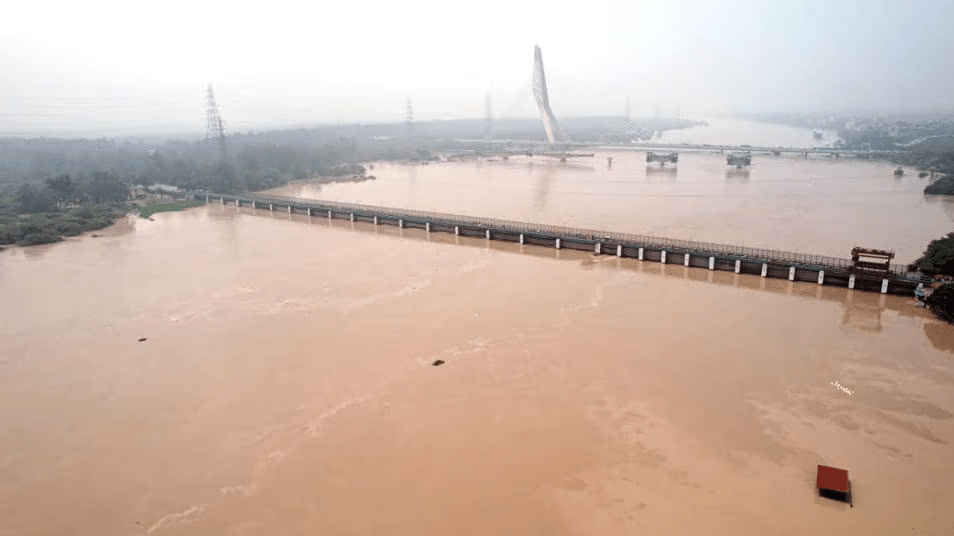
(Feature Image: A view of overflowing Yamuna river at Wazirabad in New Delhi on 13 July. Image Credit: HT PRINT/Live Mint)
It has been a year since Delhi witnessed one of the worst flood spells in Yamuna after four and half decade. The unusual deluge in river on July13, 2023 breached the highest flood level (HFL) 207.49 meter at Old Delhi Railway Station (DRS) attained on September 6,1978 by 1.17 m margin and set 208.66 m as new HFL.
Apart from severely impacting thousands of people in the city, the July 2023 Yamuna flood caught the concerned govt agencies responsible for flood mitigation by surprise and exposed the way city planners particularly DDA, NHAI have been dealing with river floodplains.
Firstly, even after one year, the CWC has not publicly explained reasons behind the unbelievable 1.17 m rise recorded in Yamuna flood level at DRS site while the discharges from Hathnikund Barrage (HKB) in Haryana were almost half (3.6 lakh cusecs) on Jul 11, 2023 in comparison with over 7 lakh cusecs registered on Sept 3, 1978.
As per the Feb 2024 Parliamentary Committee report, CWC has blamed Wazirabad Barrage for flooding Delhi by releasing 11,37,020 cusecs water for 2 hours on July 13, 2023 but the agency did not provide any credible analysis of rainfall figures and water discharges data to back its claim. It also questionably bailed out ITO barrage whose 5 gates were found closed in the peak of flood spell.
The three barrages at Wazirabad, ITO and Okhla within limited 22km stretch of Yamuna in Delhi are being managed by three different governments of Delhi, Haryana and Uttar Pradesh with no information on hourly water discharges in public domain. They also seem lacking coordination with each other and CWC as central agency has so far taken no step improve the situation.
Similarly, Delhi has already lost more than 2500 ha Yamuna floodplain to development & encroachment. Despite NGT orders DDA, NHAI continue to encroach more floodplain land. The casting yards at Usmanpur, soil dumping at Shashtri Park, construction four-lane service road between Maharani Bagh and Kalindi Kunj squeezing the floodplain are recent examples.
Despite multiple NGT orders, the DDA so far has neither mapped nor demarcated the Yamuna floodplain. Moreover, DDA has been proposing changes in the O Zone status to regularize unauthorized colonies in the floodplain.
Despite High Court order the DDA has not removed construction waste dotting riverscape in Delhi. Despite Parliamentary Committee recommendation, the DDA and concerned agencies have neither prepared guidelines and rules regarding dumping of construction and other waste in the Yamuna nor have they established common portal to furnish and update data on sand mining, floodplain/wetland encroachment and dumping of waste into the river.
Likewise, the government agencies have so far not assessed or addressed the issues of increasing siltation and too many bridges on the river impacting its flood carrying capacity.
The overall scenario indicates no change in the approach of govt agencies responsible for flood mitigation and floodplain management and the capital city is bound to face a repeat of July 2023 flood disaster following a few intense rainfall spells in upper catchment.
URBAN FLOODS
Delhi Making river monsoon ready Nearly a year after the historic floods, work to desilt the area around the ITO Barrage is on at a frenetic pace.
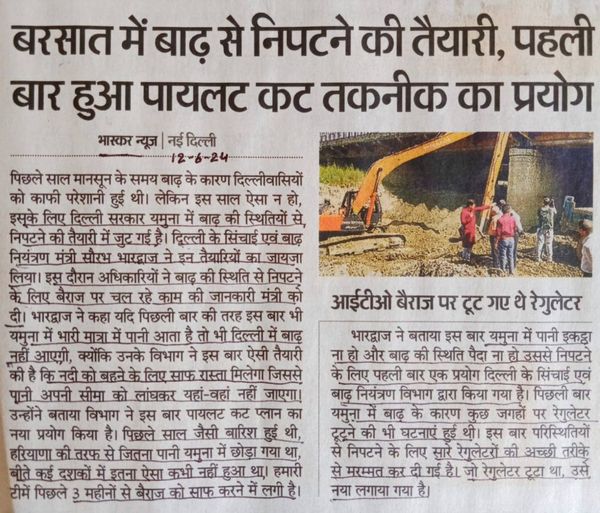
The Delhi government’s Irrigation and Flood Control Department started work in the area nearly two months ago to make sure there is no repeat of last year. Among other important measures taken is the construction of bunds along with raising the height of embankments.
In April, I&FC minister Saurabh Bharadwaj wrote to Haryana Chief Minister Nayab Singh Saini to direct Haryana Irrigation Department officers to open all ITO barrage gates. The barrage is under the ownership of the Haryana government.
The department has another worry on its hands — plateaus have formed on the riverbed because of the dumping of debris and discarded construction material. An official said agencies working on the Regional Rapid Transit System (between Sarai Kale Khan and Meerut) and Barapullah Flyover extension have left behind sheet piles, pile caps, and debris that can’t be eroded by water, which means the movement of water through the barrage slows down. https://indianexpress.com/article/cities/delhi/building-new-bunds-clearing-silt-and-debris-how-delhi-is-making-yamuna-banks-monsoon-ready-9378963/ (8 June 2024)
Minister claims about some pilot cut technique that will help deal with Yamuna floods this time. Not clear what he means by that. He also says the ITO barrage gates have been maintained/ repaired.
Urban expansion makes city susceptible to flooding The national capital is undergoing one of the world’s fastest urban expansions, with little regard for the land’s natural topography and drainage capacity. This has left Delhi vulnerable to flooding during spells of intense rainfall. “Topography determines drainage patterns,” Manu Bhatnagar, principal director, Natural Heritage Division, INTACH, told The Indian Express. “If one looks at Delhi’s historic cities — from Tughlakabad, Mehrauli, and Shahjahanabad to Civil Lines, New Delhi, and the Cantonment area — all were carefully selected, and built on higher ground. In Delhi’s villages too, the centre of the village would always be five to six metres higher than the village periphery,” he said.
This allowed rainwater to drain out. But as the city has expanded, not enough thought has gone behind building with regards to the land’s drainage capacities. Thus, with high-intensity rain there is significant run-off (unconfined flow of water, which occurs when there is more water on the land’s surface than it can absorb), and existing drainage systems have been inadequate, Bhatnagar explained. Construction in low-lying areas only makes things worse. For instance, many nallahs from across South Delhi, as far as Chanakyapuri and R K Puram, converge at Sarai Kale Khan, a low-lying area in South East Delhi, next to the Yamuna. This is why the bustling urban village sees intense flooding every year.
Water bodies which can help manage flooding have also been systematically destroyed. “According to official records, Delhi has some 1,000 water bodies. But on the ground there are not more than 400. These 600 ‘missing’ water bodies which could have managed flooding in the city have been filled up, and converted into valuable real estate,” Bhatnagar said.
Ravindran, who was Delhi Urban Arts Commission (DUAC) chairman from 2008-2011, said that urban planners need to come up with a “water masterplan”. “Today, land is seen as real estate. There has been a consistent neglect of water as a planning resource… In fact, water should be the primary driving factor behind any master planning,” he said. He added that no comprehensive planning taking into account the city’s clean and waste water flows has been carried out in the last 70 years. This is why, for example, the new Pragati Maidan Tunnel, inaugurated by the Prime Minister in 2022, has been flooded each monsoon.
Construction in Delhi’s flood plains began as early as the 1900s, when the British decided to build a railway line along the river bed. Much later, the Ring Road came up, again on the Yamuna flood plain. Ravindran said that over the years, the floodplain has been used for all sorts of reasons, from building bridges to buildings. Around 65 hectares of land on the flood plains near Kashmere Gate was reclaimed by the Delhi Metro for its maintenance shed. During the Commonwealth Games in 2010, a bus maintenance facility was built again on the floodplains. The ITO-Pragati Maidan area, which has been seeing flooding for years, was once a low-lying wetland. https://indianexpress.com/article/explained/how-urban-expansion-makes-delhi-susceptible-to-flooding-9427017/ (02 July 2024)
Interlinked drains to multiple agencies behind perennial waterlogging problem According to senior PWD officials and experts, key reasons are multiplicity of departments, lack of coordination, poor infrastructure, faulty design, and increasing population. Another major reason is the long-pending ‘Drainage Master Plan’, which is yet to be implemented owing to several problems such as the initial plan being rejected to poor response to tenders.
At least 11 different agencies look after roads and drains. “There is no coordination among departments… for instance, there was confusion over which department the Barapullah drain falls under… we manage main stormwater drains but… domestic sewer water is often released into it. Due to this, the drain overflows and water comes onto the road,” said a senior PWD official. The official added, “Some problem occurred at the Yamuna River gate… and Barapullah drain… which was the reason behind flooding in South and New Delhi.” https://indianexpress.com/article/cities/delhi/interlinked-drains-to-multiple-agencies-whats-behind-delhis-perennial-problem-9421802/ (29 June 2024)
From extreme heat to rivers on roads in just 24 hours Just weeks after enduring one of its hottest periods in history, the Indian capital experienced a deluge, receiving a staggering 228.1 mm of rainfall within a span of 24 hours. This amount surpasses Delhi’s average rainfall for the entire month of June, transforming relief from the heat into widespread disruption.
-As per the IMD the torrential downpour marked a 266 per cent departure from the norm for this time of year. Areas surrounding the Delhi airport alone received 148.5 mm of rain in just three hours on Friday (June 28), exceeding the total rainfall recorded in June of the previous year (101.7 mm). The Safdarjung Observatory, Delhi’s main weather station, registered 228.1 mm of rain in the 24 hours ending at 8:30 am on Friday (June 28). This amount is more than three times the average June rainfall of 74.1 mm and marks the highest June rainfall in at least 16 years. https://economictimes.indiatimes.com/news/india/how-indias-capital-went-from-extreme-heat-to-heavy-floods/articleshow/111336100.cms (28 June 2024)
Surgeries put off at AIIMS & LNJP At least 50% of the surgeries at AIIMS were cancelled due to waterlogging in the basements of the trauma centre and Cardiothoracic Neurosciences Centre (CNC), where electric panels are located. Many parking areas also got flooded. According to doctors, the water receded in two hours. https://timesofindia.indiatimes.com/city/delhi/rain-disrupts-medical-services-at-aiims-and-lnjp-due-to-heavy-rainfall/articleshow/111351481.cms (29 June 2024)
Tunnel vision: Pragati Maidan drainage overlooked A five-member PWD committee formed in March submitted a report in April about the area’s problems, but govt agencies didn’t take any steps to prevent or manage the waterlogging in and around the tunnel before the rainy season began. The expert report determined that one of the reasons for the waterlogging was the involvement of two different agencies working on different components of the Pragati Maidan complex redevelopment.
Among the suggestion made by the expert committee, dumping of water by civic authorities, mainly NDMC, around the tunnel was a major problem and should be stopped. An NDMC official countered, “This is just a blame game. It is PWD itself which resorts to dumping rainwater inside the tunnel.” The high-level report also highlighted the need for a new drain around the tunnel, in addition to the two existing drains. https://timesofindia.indiatimes.com/city/delhi/tunnel-vision-drainage-issues-at-pragati-maidan-transit-corridor/articleshow/111372058.cms (30 June 2024)
Pragati Maidan tunnel remained closed for three days due to water logging after June 28 rainfall spell. https://www.india.com/news/delhi/delhi-rains-pragati-maidan-tunnel-reopened-for-traffic-more-downpours-predicted-in-coming-days-7052086/ (01 July 2024)
No lessons learnt from ’23; ITO drain floods again The deluge in areas surrounding ITO, Connaught Place and Tilak Marg, on June 28 morning was a grim reminder of the historic July 2023 floods in the city displacing around 28,000 people.
Officials from the Public Works Department (PWD) said that most of the water from across parts of ITO goes into drain number 12, maintained by the Municipal Corporation of Delhi (MCD). “Our team visited the drain on June 27 and found that work seemed to have just started, and most of the desilting and cleaning was still not done. MCD had earlier claimed that desilting was complete. We have written to the MCD to get the work done at the earliest. Due to the silt deposited in the drain, there is a high probability of backflow of water into the PWD drain which may cause waterlogging in the Supreme Court campus and Mathura Road,” said a PWD official. https://www.hindustantimes.com/cities/delhi-news/no-lessons-learnt-from-23-ito-drain-floods-new-delhi-again-101719599029375.html (29 June 2024) https://indianexpress.com/article/cities/delhi/delhi-minister-atishi-inspects-flood-damaged-chandrawal-water-treatment-plant-9424376/ (30 June 2024)
Infamous flooded underpasses make a comeback Minto Bridge underpass, the Pragati Maidan and Mathura Road tunnels, Tilak Bridge railway underpass near ITO, Azad Market, Zakhira, Azadpur and Chatta Rail (behind Red Fort) underpasses in north Delhi, Mehram Nagar underpass leading to Terminal 3 of Delhi airport, and Ashok Nagar underpass in east Delhi were also inundated, with several vehicles being submerged in the flooded areas. https://www.hindustantimes.com/cities/delhi-news/infamous-flooded-underpasses-make-a-comeback-in-delhi-man-drowns-in-azadpur-101719598910444.html (29 June 2024)
City does not drain water efficiently The long-term data at high frequency – for an hour or three hours – is not publicly available. IMD’s intensity categories for 24-hour rainfall do not suggest an increase in the intensity of rain in Delhi. While total annual rain decreased by 25% in the 2011-2020 decade compared to LPA, rain of “rather heavy” or higher intensity (rain of 35.5mm or more in 24 hours) decreased by 64%. On the other hand, moderate rain (7.6-35.5mm in 24 hours) decreased by 7%. It is only rain of even lower intensity (all classified as different types of light rain) that increased by 6%. https://www.hindustantimes.com/cities/delhi-news/yamunas-water-level-suggests-delhi-does-not-drain-water-efficiently-101719598969953.html (29 June 2024)
Death toll rises to 11 https://www.newindianexpress.com/nation/2024/Jun/29/delhi-rains-death-toll-rises-to-11-bodies-of-4-kids-recovered-from-flooded-areas (30 June 2024)
Environment min blames plastic waste Union Environment Minister Bhupender Yadav attributed the waterlogging in Delhi following torrential rains on June 28 morning to drains being clogged with plastic waste. https://www.business-standard.com/politics/delhi-rain-chaos-environment-min-blames-plastic-waste-slams-state-govt-124062800474_1.html (28 June 2024) However, key question is, what has the Union MoEF done about restricting the production of such plastics or improving their management in the country.
Rains sink lawyer chambers in NCR After hours spent in draining the water out – which required both the assistance of MCD and of private pumps that were frantically purchased – they were shocked to walk into an entirely ruined office. All the furniture and reference books were floating across the lobby, bookshelves rain-sacked, computer screens and laptops broken, and files completely destroyed. https://www.barandbench.com/columns/delhi-rains-sink-lawyer-chambers-in-ncr (29 June 2024)
Waterlogging, traffic snarls add to chaos The heavy rainfall spell in Delhi on June 28 have again exposed the poor maintenance of existing drainage system which is further disrespected, even damaged by growing infrastructure projects. Unabated tree felling, absence of RWH facilities and concretization of surface area has only worsened the scenario. https://www.business-standard.com/india-news/heavy-rains-pound-delhi-5-dead-waterlogging-traffic-snarls-add-to-chaos-124062801357_1.html (29 June 2024)
Gurugram Rainwater floods homes, roads At least 20 spots across the city witnessed severe waterlogging, forcing residents to remain indoors during the first half of the day on June 28. According to the weather department, the city received 30mm of rainfall, while Sohna recorded 80mm, leading to waterlogging on several stretches of NH-48. https://www.hindustantimes.com/cities/gurugram-news/rainwater-floods-homes-roads-in-gurugram-101719600529996.html (28 June 2024)
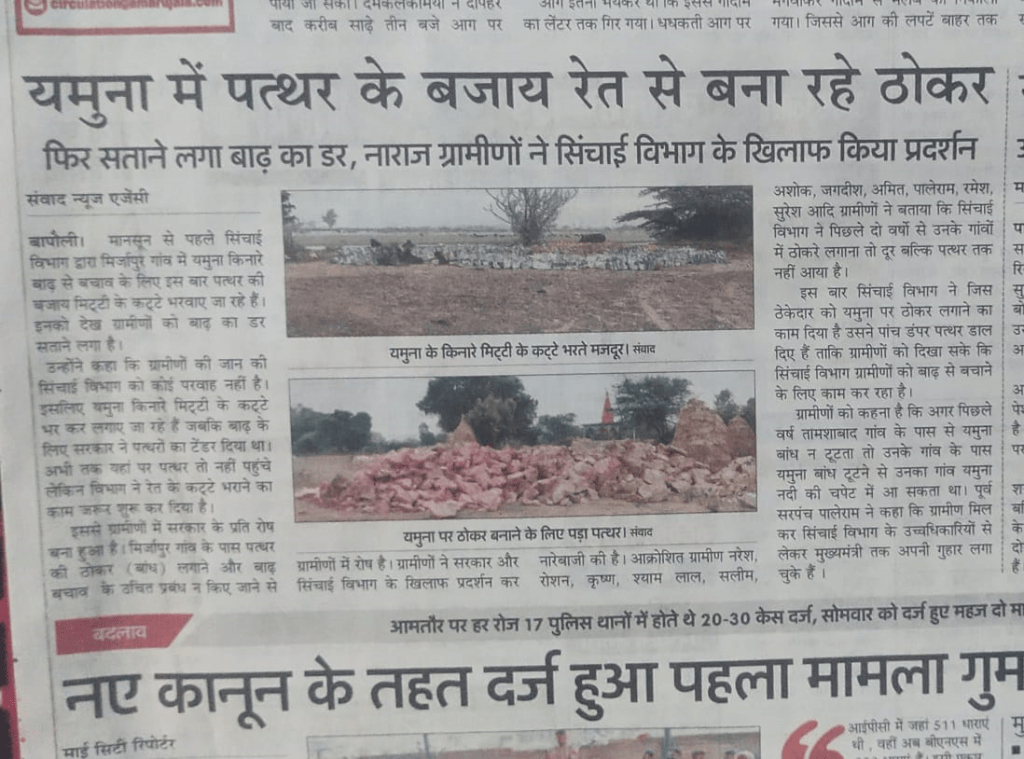
Haryana Farmers in Panipat fear flood threats alleging that irrigation department has been placing sand bags instead of stone boulders to tackle riverbank erosion and embankment breach incidents.
YAMUNA FLOODPLAIN
Delhi Focus on Hathnikund-Okhla Barrage stretch for floodplain demarcation Delhi Pollution Control Committee (DPCC) has presented its findings to NGT regarding the demarcation of floodplain in Delhi to prevent future flooding incidents. The report was submitted in response to an earlier NGT directive, which was based on a Times of India article titled, “Why Flooding Has Forced DDA’s Master Plan Rethink”, published in Aug 2023.
DPCC, in a report dated June 26, said “a meeting of the high-level committee (HLC) was held on 07.05.2024 under the chairmanship of chief secretary, govt of NCT of Delhi… executive director, NMCG, one of the members of HLC, informed the committee that ministry of jal shakti had constituted a committee for a joint flood management study of the river Yamuna for its reach between Hathnikund and Okhla Barrage in which principal secretary, irrigation & flood control department (I&FCD) is a member from GNCTD.” The report further stated regarding the SOP for demarcation of the floodplain that I&FCD had identified the flood of 2011 as 1 in 25 frequency event. https://timesofindia.indiatimes.com/city/delhi/focus-on-hathnikund-okhla-barrage-stretch-for-floodplain-demarcation/articleshow/111388763.cms (01 July 2024)
Excessive silt brings Palla floodplain project to halt According to this report, DJB plan of expanding the pilot from 26 acres to 1000 acres at Palla to hold excess Yamuna flood waters for subsequent use is facing hurdles in terms of silt accumulation. The issue will be taken to NGT. https://timesofindia.indiatimes.com/city/delhi/excessive-silt-brings-palla-floodplain-project-to-halt/articleshow/111297442.cms (27 June 2024)
SC upholds demolition of temple on floodplains The Supreme Court on June 14 upheld a Delhi HC order for the demolition of a Pracheen Shiv Mandir situated at Geeta Colony close to the Yamuna floodplains. A vacation bench of Justice Sanjay Kumar & Justice Augustine George Masih said, “Where is the proof of Pracheen Temple to begin with? Ancient temples were built with rocks and not with cement and painted”.
The HC had said the land in dispute is meant for larger public interest and the petitioner society cannot claim any vested rights to continue to occupy and use it. The court said the land falls under the Zonal Development Plan for Zone-‘O’ as approved by the Ministry of Urban Development. The High Court had said the petitioner society has miserably failed to show any documents with regard to its title, right or interest over the land and there is no proof of the temple having any historical significance. https://www.hindustantimes.com/india-news/sc-upholds-demolition-of-pracheen-shiv-mandir-on-yamuna-floodplains-in-delhi-101718362139711.html (14 June 2024)
YAMUNA FLOWS
MoJS Portal to ecologically monitor Ganga The Environmental flows (E-flows) Monitoring System has been developed by the NMCG and was launched in the presence of Jal Shakti Minister C.R. Patil on June 14. Along with real-time analysis of the water quality of the Ganga, Yamuna, and their tributaries, it also allows monitoring of the Namami Gange program. This includes monitoring the performance of STPs, and ensuring that they operate at their rated capacity. River water quality is also monitored at various locations.
Mr. Patil said that he would focus on completing the ongoing projects under the Namami Gange Mission, including those involving the Ganga & tributaries, within the stipulated time frame. https://www.thehindu.com/sci-tech/energy-and-environment/jal-shakti-ministry-launches-portal-to-ecologically-monitor-the-ganga/article68294107.ece (16 Jun 2024)
This portal encompasses online dashboards such as the Ganga Tarang Portal, Project Management Tool Dashboard and the Ganga Districts Performance Monitoring System. https://pib.gov.in/PressReleasePage.aspx?PRID=2025113 (13 June 2024)
The Yamuna has dried up along several stretches in Delhi, leaving bone-dry banks. https://news.abplive.com/news/india/heatwave-in-india-death-toll-yamuna-dry-north-india-monsoon-1696114 (17 June 2024)
DAMS & HYDRO POWER PROJECTS IN YAMUNA BASIN
Uttarakhand UP man drowns in Yamuna The site of incident is just downstream the power house of 120 Mw Vyasi HEP. In June the natural water level in the river is generally low. The incident could be a result of water releases from the power house. A man from Uttar Pradesh drowned on June 8 while bathing in the Yamuna river near the Osho Ashram. The police identified the victim as Mrinal (19), a resident of Indirapuram, Ghaziabad. Mrinal slipped and fell into the river while bathing and was swept away by its strong currents. https://www.theweek.in/wire-updates/national/2024/06/08/nrg8-ukd-drowning.html (8 Jun 2024)
Himachal Pradesh Renukaji dam work to begin after Feb. 2025 Among the reasons attributed for its delay are opposition from local residents as well as the environmentalists, red tape, besides a series of technical and feasibility reports which were submitted to the Central government for seeking various clearances.
The design of dam and diversion tunnels are nearing finalisation. According to the reply, “The Central Water Commission (CWC) has been appointed design consultant and a panel of geological experts is undertaking investigations for the design of the dam and diversion tunnels. The investigation in the main dam area have been completed while investigation in the spillway and downstream cofferdam area is underway.” Based on the results of these investigations, the CWC will proceed to design the dam and diversion tunnels. The commencement of construction for the diversion tunnels is expected in Aug 2024.
It envisages 148-m high rock-fill dam on the Giri river at Dadahu in Sirmaur district and a dam toe powerhouse. It has been declared a Project of National Importance. The cost shall be borne by the Central Govt and beneficiary states in the ratio of 90:10. Its estimated cost is Rs 6,946.99 crore. 947.4 ha out of 954.27 ha of private land has been acquired whereas 909 ha of forestland will be transferred after the Forest Clearance Stage-II. https://www.tribuneindia.com/news/himachal/envisaged-in-1976-work-on-renukaji-dam-to-begin-after-february-next-year-633233 (23 June 2024)
INTERLINKING OF YAMUNA RIVERS
PKC Linking MP & Rajasthan sign MoU Madhya Pradesh and Rajasthan govts on Sunday signed an agreement for the implementation of the Rs 72,000 crore Parbati-Kalisindh-Chambal river linking project. A Memorandum of Understanding (MoU) was signed in the presence of Rajasthan CM Bhajanlal Sharma & MP CM Mohan Yadav in Bhopal.
The project proposes to provide drinking and industrial water in 13 districts of eastern Rajasthan, Malwa and Chambal regions of Madhya Pradesh apart from providing irrigation in a minimum 2.8 lakh ha each in both the states including supplementation of route tanks in the states. The link project will help utilise the available water resources of the Chambal basin. “Following this agreement, facilities can be expanded in 13 districts of Madhya Pradesh including Morena, Gwalior, Sheopur, and Rajgarh,” Yadav said. https://timesofindia.indiatimes.com/city/bhopal/mp-and-rajasthan-sign-mou-for-joint-river-linking-project/articleshow/111389707.cms (01 July 2024)
YAMUNA WATER SHARING DISPUTES
Time to review UYRB There is need for urgent review of Upper Yamuna River Board agreement to facilitate scientific distribution of Yamuna waters. Otherwise, the objective of river revival and solution to Delhi water crisis cannot be achieved. https://sandrp.in/2024/06/05/yamuna-manthan-050624-time-to-review-uyrb-to-address-delhi-water-crisis-save-river/ (05 June 2024)
Himachal U-turn; says ‘No surplus water left’ Reacting to this abrupt U-turn by Himachal Pradesh, the Supreme Court bench couldn’t hide its irritation and called out the ‘casual’ manner of operating at inter-state governance. “You do not understand the repercussion of your statement to cover up the earlier statement…” a Vacation Bench of Justices Prashant Kumar Mishra and Prasanna B Varal was quoted by Live Law. It further warned the concerned attorney of contempt in case the hill state is being wrongly reported to not have surplus water.
“The officer who has supplied that chart is saying that we have excess water of 137 cusecs and the additional AG was not properly apprised of the situation. Now, you are issuing a letter that 137 cusecs is already in the pipeline…” the Bench added.
Realising the gravity of the situation, Himachal Pradesh’s Advocate General offered an apology. https://www.downtoearth.org.in/news/water/no-end-in-sight-for-delhi-s-water-shortage-as-himachal-does-u-turn-says-no-surplus-water-left–96683 (13 June 2024)
SC asks UYRB to decide Delhi govt’s plea for additional water. https://www.livelaw.in/top-stories/supreme-court-asks-yamuna-river-board-to-decide-delhi-govts-plea-for-additional-water-hp-govt-withdraws-statement-on-surplus-water-260416 (13 June 2024)
Doubts over how city will process HP water DJB achieved a significant milestone on June 7 by producing 1,002 million gallons per day (MGD) of water, exceeding the combined capacity of its nine water treatment plants by around 47 MGD. Following the Supreme Court’s directive on June 6, Himachal Pradesh is set to provide water to the capital. However, concerns have been expressed about DJB’s capacity to effectively use the additional raw water.
“Given that the existing water treatment plants are already operating at their maximum capacity, there is limited scope for accommodating and processing extra water,” said a DJB official. “We estimate that around 67 MGD of water will be available when Haryana releases water, but that will not reflect in the actual water production.” It is being estimated that only around 30 MGD will be available in the next few days, presenting a challenge to DJB. https://timesofindia.indiatimes.com/city/delhi/doubts-over-delhis-capacity-to-process-himachal-pradesh-water/articleshow/110807773.cms (08 June 2024)
SC tells Himachal to release surplus water “Since Himachal Pradesh… is ready, willing to release the surplus water available with it, we direct that Himachal Pradesh shall release 137 cusecs of surplus water available with it from the upstream, so that the water reaches Hathnikund and Delhi through Wazirabad,” a bench of Justices Prashant Kumar Mishra and K V Viswanathan said. The court then directed that a report on the matter be submitted before it on June 10.
Referring to the court’s June 3 direction for the Upper Yamuna River Board (UYRB) to discuss the issue, the bench noted: “In compliance with the order, UYRB convened its meeting on June 5 and discussed the water crisis faced by Delhi. Two pertinent issues discussed in the meeting were the matter related to actualisation of MoU between Delhi and Himachal Pradesh, and secondly, additional water required by Delhi and the way forward.”
During the hearing, Justice Mishra asked the Haryana counsel: “What is your objection if we direct release of excess water available with Himachal Pradesh for the benefit of Delhi?” The Haryana government counsel questioned: “Who will determine that it is excess water,” adding that there is no system in place to measure its excess water. https://indianexpress.com/article/cities/delhi/delhi-water-shortage-himachal-pradesh-haryana-supreme-court-9375374/ (07 June 2024)
Govt of India argues in SC that 52% of water meant for Delhi is pilfered by industries and tanker mafia. The question is what is the centre doing about it? https://timesofindia.indiatimes.com/city/delhi/tanker-mafia-industries-pilfer-52-of-water-meant-for-delhi-centre-claims-in-apex-court/articleshow/110683821.cms (04 June 2024)
YAMUNA RIVERS
SANDRP Blog Chasing Streams, Springs of Asan River in Dehradun Despite being an important tributary to the Yamuna River in Shivalik hills of Dehradun, the Asan appears among the least explored and documented rivers. While most of the people believe and even available online maps depict Chandrabani temple as origin place of the Asan, a field visit to track the river course reveals some interesting information.
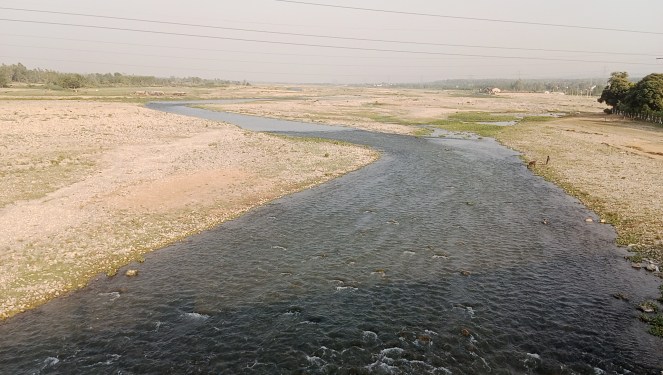
This part one of photo blog documents the river course in its founding catchment sharing pictures and our field observations about the river’s origin place, past history and present situation. https://sandrp.in/2024/06/11/photo-blog-chasing-streams-springs-of-asan-river-in-dehradun/ (11 June 2024)
Asan Rivers Struggling to Survive in Dehradun In recent years, the National Highway Authority of India (NHAI) has approved two highway projects which have potential to irreversibly damage the watersheds of Asan rivers. https://sandrp.in/2024/06/25/photo-blog-ii-asan-rivers-struggling-to-survive-in-dehradun/ (25 June 2024)
Report Plastic choak drains but bans are not enough Bhim Singh Rawat, associate coordinator, South Asia Network for Dams, Rivers and People (SANDRP), found that water bodies in and around Dehradun city were bunged up with solid waste, most of which was plastic. “There is not a single stream or river that has not turned into a dumping yard of municipal plastic waste here. Certain places of the Rispana, Bindal, Asan rivers have turned into plastic rivers,” he says. Clearly, the plastic ban lacks teeth, is poorly implemented.
It is at odds with industrial policies and projects that push for more plastic use without a foresight of its environmental, social and health consequences, says Rawat, “This shows the failure of governance and that remains our reality.” While one arm of the government pushes its use, another imposes a blanket ban; something is bound to slip in between. https://questionofcities.org/plastic-chokes-drains-but-bans-are-not-enough/ (28 Jun 2024)
Ghaziabad Hindon pollution: GMC hands list to NGT In Dec last year, the civic corporation submitted a 485-page report to the tribunal stating that 55 drains in seven districts flow into the river, carrying with them 944 MLD of sewage. Of this, 713 MLD were treated by 16 STPs but 231 MLD of untreated sewage still was discharged into the river.
The GMC’s 2023 report said there are 357 industries along the banks of the Hindon, of which 33 non-conforming and polluting units have been shut down. It said environmental compensation costs to the tune of Rs 76.78 crore had been imposed on 13 defaulting units across the seven districts, of which only Rs 96.74 lakh had been recovered. https://timesofindia.indiatimes.com/city/ghaziabad/gmc-hands-list-to-ngt-to-check-discharge-of-effluents-into-hindon/articleshow/110314280.cms (22 May 2024)
Noida Notices for construction on floodplains Among the 350 notices issued, 176 were issued to residents of Haibatpur village for illegal construction in the Hindon floodplains. The remaining notices were sent to residents of Sunpura village. Officials added that they had previously issued public notices cautioning people against purchasing plots or flats in these illegal buildings, as they lack the necessary approvals.
The notices were issued as per standard procedure under Section 10 of the UP Industrial Area Development Act by work circle 1 and 2 of the Authority’s project department. If the violators fail to remove the illegal constructions themselves, the Authority will take action to remove them & recover the associated costs from the violators. https://timesofindia.indiatimes.com/city/noida/350-served-notices-for-construction-on-govt-land-hindon-floodplains/articleshow/110314459.cms (22 May 2024)
YAMUNA POLLUTION
Delhi New STPs to use UV treatment Water will be subjected to ultraviolet treatment at some STP to control faecal coliform level and, thus, reduce pollution in the Yamuna. Though only the STP at Kapashera is equipped with UV technology, water is currently being treated for faecal coliform in 15 other STPs too. It was earlier reported that over 75% of the city’s STPs were failing to reduce faecal coliform level. This was because most of the STPs had no technology for bacterial disinfection through either chlorination, UV treatment or ozonation, despite an order to the effect by the NGT.
According to Delhi Jal Board officials, the goal is to upgrade 28 of the 39 STPs by Sep. These upgrades will bring the STPs in line with the standards accepted by NGT, including reducing faecal coliform level to below 230 units. Another official said that of 15 currently compliant STPs, the one at Kapashera was using UV treatment while the others employed chlorination and other processes. Nine others are undergoing augmentation and four are having trials. https://timesofindia.indiatimes.com/city/delhi/clean-yamuna-new-stps-to-use-uv-treatment/articleshow/111241907.cms (25 June 2024)
Survey to identify units discharging waste in river The DPCC is conducting a survey to identify grossly polluting units operational in 25 redevelopment areas. These ‘red’ category units, including dyeing, electroplating and phosphating, discharge untreated waste into the Yamuna through drains. Officials stated that after identifying such units, steps will be taken to either transition these units to cleaner operations in a time-bound manner or close them. It was reported last year that industries in 25 areas for redevelopment under Master Plan Delhi 2021 (MPD 2021) are not connected to common effluent treatment plants and such units are discharging untreated effluents into Yamuna through drains. https://timesofindia.indiatimes.com/city/delhi/survey-to-identify-units-discharging-waste-into-yamuna/articleshow/111442448.cms (3 July 2024)
NGT TO DPCC: Fine agency over sewage flow into stormwater drain The NGT has directed Delhi Pollution Control Committee to identify the agency which damaged the sewer line leading to discharge of sewage into a stormwater drain passing through Malviya Nagar and Greater Kailash, creating a health hazard for more than three years without any action by the authorities. It also ordered DPCC to impose an environmental compensation charge on the violator. Activist Sunil Kumar Aledia had sent a complaint to NGT last year. https://timesofindia.indiatimes.com/city/delhi/ngt-directs-dpcc-to-fine-agency-over-sewage-flow-into-stormwater-drain/articleshow/110020998.cms (11 May 2024)
Irrigation dept to manage all 22 major drains All major 22 drains in the city will be handed over to the Irrigation and Flood Control Department (I&FC) of Delhi govt by the end of May for better maintenance and operation, a Municipal Corporation of Delhi (MCD) official said. The move has come in the wake of Delhi High Court’s directions on April 8 to Delhi govt to assign the management of all open drains in the city to one agency to streamline drainage management & mitigate flooding. The court has directed completion of desilting of 21 drains by Dec 31, 2024, & Najafgarh drain by June 2025. https://timesofindia.indiatimes.com/city/delhi/irrigation-dept-to-manage-all-22-major-drains-in-city/articleshow/109866199.cms (6 May 2024)
Haryana 13 illegal denim dyeing units in Sonepat served notices The State Pollution Control Board has served show-cause notices to 13 illegal jeans dyeing units in the Ferozepur Bangar area of Kharkhoda in the district, reportedly for violating pollution norms and discharging effluents without treatment in the open. These units were running without the consent to operate and valid permission for the extraction of groundwater from the Haryana Water Resources Authority. According to the complainant, these units had no effluent treatment plant and were discharging effluents directly into drains, which was also a big reason for pollution in the Yamuna. Delhi-based environmentalist Varun Gulati had filed a complaint in the NGT alleging that over 500 dyeing units were operating in the residential and non-confirming areas — Dheeraj Nagar and Surya Vihar of Faridabad district; Friends Colony, Pyau Maniyari, Ferozpur Bangar of Sonepat district; Bajghera, Dhankot, Dhanwapur and Sector 37 of Gurugram and Badsa village of Jhajjar district and Nizampur in Bahadurgarh. https://www.tribuneindia.com/news/haryana/13-illegal-denim-dyeing-units-in-sonepat-served-notices-629065 (09 June 2024)
Himachal Pradesh Paonta Sahib seeks to turn kids into ‘Yamuna Warriors’ The Paonta Sahib forest division has launched an initiative “Yamuna Hamari Dharohar”. Aimed at spreading awareness about environmental conservation among schoolchildren, the program seeks to foster a sense of responsibility towards river and environmental conservation. In Oct 2022, Yamuna Van Vihar was established as a recreational hub for the town. This was followed by the inauguration of the Yamuna Riverfront Nature Park in Feb 2024. The initiative aims to inspire these youngsters to become ‘Yamuna Warriors’. https://www.tribuneindia.com/news/himachal/paonta-sahib-seeks-to-turn-kids-into-yamuna-warriors-622667 (19 May 2024)
IWP Sludge for food, food for thought A considerable quantity of sludge is generated from STPs across the country, but the data on the utilisation of this sludge is not available. At a few STPs, this sludge is being used for gardening inside the premises of the treatment plant. Some STPs claim to use the sludge for horticultural and forestry crops, but most STPs have no plans for utilisation, the sludge is disposed of in an unsafe manner. Safe treatment and use of sewage sludge will combat public health and environmental health risks and work as a substitute for chemical fertilisers, reducing greenhouse gas emissions.
Countries like Australia, South Africa, the United Kingdom (UK), and the US use sludge as fertiliser or soil conditioner. Some of the best management measures developed countries follow to ensure safety are stabilisation, dewatering, composting, pellet production, and heat drying of sludge for broader applications. The most commonly used stabilization methods are anaerobic digestion and lime stabilization. https://www.indiawaterportal.org/articles/sludge-food-food-thought (4 June 2024)
YAMUNA FISH, FISHERFOLKS
यमुना में ऑक्सीजन की कमी से लाखों मछलियों की मौत यमुना में ऑक्सीजन का स्तर घटने से बीते कुछ दिनों में लाखों की तादाद में मछलियां मर गई हैं। अन्य जलीय जीवों की जान भी खतरे में है। यमुना किनारे रहने वाले किसान और मछुआरे बताते हैं कि यमुना में केमिकल युक्त पानी छोड़े जाने से मछलियां मर रही हैं, जबकि जीव वैज्ञानिकों का मानना है कि गर्मी के दिनों में पानी में ऑक्सीजन का स्तर बेहद कम हो जाने के कारण अक्सर ऐसा होता है।
यमुना किनारे उतरा रहीं मरी मछलियों के कारण दुर्गंध से करीब एक किलोमीटर के दायरे में लोगों का सांस लेना मुश्किल हो गया है। वजीराबाद पुस्ते से बुराड़ी पल्ला नंबर-4 के जीरो पॉइंट तक तीन-चार दिन से लाखों मरी मछलियां उतरा रही हैं। स्थानीय किसानों और मछुआरों ने बताया कि यमुना नदी में सोनीपत नहर से आने वाला पानी जब से छोड़ा जाता है, तो इसी प्रकार से मछलियां मर जाती हैं। साल में एक-दो बार आठ नंबर नहर से इसी तरह से जहरीला पानी छोड़ा जाता है। ये इंडस्ट्रियल एरिया से निकला खतरनाक रसायन मिला पानी होता है, जिस कारण यमुना का पानी जहरीला हो गया है। https://www.amarujala.com/delhi-ncr/lakhs-of-fish-died-due-to-decreasing-oxygen-level-in-yamuna-2024-07-04 (04 July 2024)
MINING IN YAMUNA RIVERS
MoEF Relevant agenda of FAC meet to be held on July 4 2024:
Proposal FOR USE OF 6.2255 HA. OF FOREST LAND FOR EXTRACTION OF SAND, STONE AND BAJRI FROM YAMUNA RIVER, IN PAONTA SAHIB FOREST DIVISION, DIST SIRMOUR IN HIMACHAL PRADESH; more such proposals from Uttarakhand. https://forestsclearance.nic.in/AgendaDetail.aspx?id=303%21dis1 (Jun 2024)
Relevant Agenda of MoEF’s Expert Appraisal Committee meeting of River Valley Projects to be held on July 18-19 2024:
1. Cumulative Impact Assessment and Carrying Capacity Study of Yamuna River Basin in Uttarakhand by Indian Council of Forestry Research & Education, Dehradun: Additional TOR
2. Cumulative Impact Assessment and Carrying Capacity Study of Yamuna River Basin in Himachal Pradesh by Indian Council of Forestry Research and Education, Dehradun: TOR (https://parivesh.nic.in/utildoc/81028116_1720011738362.pdf)
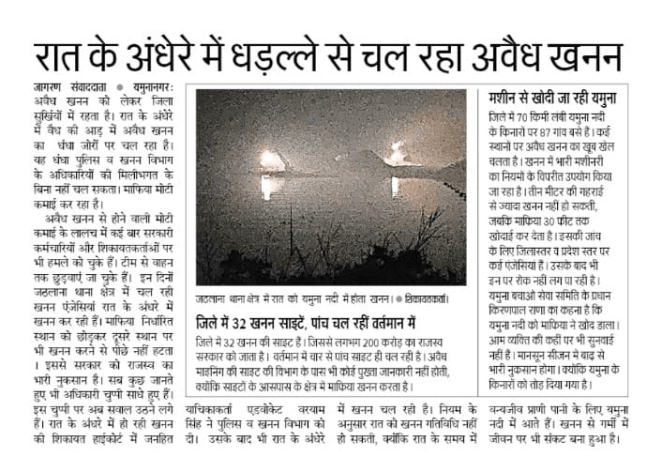
Haryana In violation of norms miners indulging in mechanized instream mining in Yamuna river at Jathlana, Yamuna Nagar in late night hours. (Dainik Jagran 19 June 2026)
Miners from Uttar Pradesh side carrying out illegal mechanized sand mining creating deep pits in farmlands belonging to Pabnera village of Sonipat Haryana along Yamuna floodplain. (Dainik Bhaskar 28 June 2024)

ED arrests mining baron The Enforcement Directorate (ED), Headquarters, Delhi, which arrested mining businessman from Hisar Vedpal Singh Tanwar on May 30 in connection with illegal mining in Dadam area in Bhiwani district, has taken him on remand for interrogation till June 6. The accused were associated with the firms Govardhan Mines Minerals (GMM), Karamjit Singh Co Limited (KJSL), Sunder Marketing Associates (SMA) and Baba Samaj which held the mining lease and had been associated with mining operations in Dadam from 2013. https://www.tribuneindia.com/news/haryana/enforcement-directorate-arrests-mining-baron-remanded-in-custody-till-june-6-627524 (04 June 2024)
Uttar Pradesh GB Nagar admin cracks down on illegal crushing work on floodplains A joint team of Gautam Budh Nagar administration, irrigation dept, UP Pollution Control Board, and district police launched inspections on June 24 and cracked whip on illegal stone crushing.
District magistrate (Gautam Budh Nagar) Manish Kumar Verma said, “Inspections were conducted and the mobile units setup in the floodplains of Yamuna, falling under Basantpur and Asgarpur areas were sealed. A major portion was occupied by the operators illegally who were indulging in activities of crushing of stones through machineries, boulders and C&D (construction and demolition) waste.” As per the information from the pollution control board officials, the exercise is prohibited and results in air pollution.
The sub-divisional magistrates have been directed to identify the violators and landowners who have given land on rent for such operations while ensuring the area remains sealed. Additionally, the ground water department has also been asked to carry out survey of illegal borewells in the area & penalize the violators. https://www.hindustantimes.com/cities/noida-news/gb-nagar-administration-cracks-down-on-illegal-crushing-work-on-yamuna-floodplains-101719255817443.html (25 June 2024)
YAMUNA WETLANDS, LAKES, WATER BODIES
Uttarakhand Aquatic insects choke as heavy metals poison Asan wetland This paper titled ‘The impact of heavy metal concentrations on aquatic insect populations in the Asan Wetland of Dehradun, Uttarakhand’ published in Nature Scientific Reports discusses the findings of a study that looked at the impact of heavy metal pollution on the distribution and biodiversity of aquatic insects in the Asan Wetland of Dehradun, Uttarakhand. The research used data collected from three sites within the Asan Wetland in Dehradun, Uttarakhand. https://www.indiawaterportal.org/articles/aquatic-insects-choke-heavy-metals-poison-asan-wetland (23 June 2024)
YAMUNA URBAN WATER
Delhi Network of hauz, baoli & nullah that once fed the capital The decline of Delhi’s hydraulic system (hauz, baoli and nullah) started during the British colonial period. The British, unfamiliar with the city’s ancient water management techniques, opted for a more modern approach to water supply. The colonisers replaced the network with a piped water system. They heavily relied on the Yamuna River as the primary source of water. But with time, the Yamuna turned foul.
The piped water system also led to the neglect of Delhi’s old hydraulic system. The nullahs, baolis, and bundhs, which had sustained the city for centuries, were gradually abandoned and left to decay. Sure, those old water structures could have supplemented the supply and helped recharge the groundwater. https://www.indiatoday.in/india/story/delhi-temparature-summer-alert-hauz-baoli-nullah-once-fed-hydraulic-structures-ancient-medieval-history-2555143-2024-06-19 (19 Jun 2024)
Lakes project is helping recharge GW https://timesofindia.indiatimes.com/city/delhi/delhi-govts-successful-lakes-project-helps-recharge-groundwater/articleshow/111298154.cms (27 Jun 2024)
The Delhi govt’s lake revival project, based on recycling treated wastewater, has been successful in southwest Delhi, where the groundwater table has increased by up to 6 m in the last three years. The study, which looked at successful lake rejuvenation models across the country, found the groundwater table had increased by around 6 m at Pappankalan, by around 4 m at Nilothi and by 3 m and at Najafgarh through the artificial lakes created there by the govt in 2021. https://www.hindustantimes.com/cities/delhi-news/groundwater-table-rose-by-3m-in-nilothi-najafgarh-report-on-delhi-lakes-101719424683662.html (27 June 2024)
The urban water crisis of Delhi and other global south cities, is a crisis of equitable and just distribution, of the political economy of water and waste water management in our cities. It is not about the absolute scarcity of water. There has been steep rise in population of Delhi in the last decade to nearly 30 million today. 45 litres per capita a day is all that a million plus residents of Sangam Vihar in Delhi are getting (and there are several other such settlements), while some of us are getting five to ten times this supply. This needs to be set right. https://www.downtoearth.org.in/blog/water/delhi-water-crisis-how-to-address-water-shortage-in-our-dense-unplanned-settlements-96785 (20 June 2024)
SC slams govt for not rectifying defects in water scarcity plea The judges on June 10 emphasized that court processes should not be taken lightly, warning that they might dismiss the plea if issues persist. “You straightaway hand over a series of documents in court and then you say you are suffering a deficit of water and pass an order today itself. You are raising all grounds of urgency and sitting leisurely,” the bench stated, adjourning the matter to Jun 12. https://timesofindia.indiatimes.com/city/delhi/dont-take-us-for-granted-sc-slams-delhi-govt-for-not-rectifying-defects-in-water-scarcity-plea/articleshow/110868037.cms (10 Jun 2024)
Why Delhi struggles with water shortage Many factors contribute, including the over-extraction of groundwater, pollution of water sources, growth of the migrant population, adverse impacts of climate change, inefficient water management, and inter-state water disputes. https://indianexpress.com/article/opinion/columns/delhi-water-shortage-problem-how-can-it-be-fixed-9369435/ (03 June 2024)
Tanker mafia profiting from govt borewells—pipes Flourshing illegal water tanker business in Sangam Vihar, Okhala and Dwarka in Delhi: Private tanker operators are seizing control of govt-authorised borewells, diverting water from pipes & illegally drilling. They are selling public water that would otherwise be freely available to residents, while GW levels are depleting.
“The tanker mafia business operates at multiple levels. They receive support from politicians, police, and lower-ranking officials in the Jal Board,” alleged Puneet Singhal, a social and environmental activist working with the people of Sangam Vihar. He added that in return, these influential people sponsor election campaigns and bribe officials to look the other way. https://theprint.in/ground-reports/delhi-water-tanker-mafia-jal-board-borewells-pipes-profits-politics/2149003/ (27 June 2024)
Residents battle scarcity amidst tanker mafia monopoly During peak demand, the tanker operators raised prices by 200 to 300 per cent. A 2,000-litre tanker that costs Rs 600-700 in February-March costs around Rs 1,800 to 2,000 this summer. https://www.downtoearth.org.in/news/water/tanker-economy-revealed-in-delhi-sangam-vihar-residents-battle-scarcity-amidst-tanker-mafia-monopoly-96870 (26 June 2024)
Water shortage affects surgeries at Safdarjung Hospital Five surgeries that were scheduled had to be postponed due to water shortage in the hospital due to a significantly reduced flow of fresh water from NDMC. To meet requirements, the authorities have been relying on hired tankers. https://timesofindia.indiatimes.com/city/delhi/delhi-water-crisis-shortage-affects-surgeries-at-safdarjung-hospital/articleshow/111126360.cms (20 Jun 2024)
According to a 2023 report by the Ministry of Jal Shakti, 73.5 per cent of surface water bodies in Delhi were not usable due to effluents, waste and drying up. https://www.hindustantimes.com/india-news/water-supply-crisis-deepens-nationwide-southern-states-still-fare-worse-101717753487244.html (07 June 2024)
According to the Economic Survey of Delhi 2023-24, 58% of the water produced by the Delhi Jal Board is “non-revenue”. It is either stolen or leaked. Across the globe, the average of non-revenue water is around 25% to 30%. In 2021, of the 925 MGD of water produced on an average from April to December, only around 419 MGD was delivered to consumers and billed. https://indianexpress.com/article/cities/delhi/from-treatment-plants-to-taps-why-over-half-of-citys-water-goes-missing-in-transit-9396564/ (17 June 2024) https://indianexpress.com/article/cities/delhi/water-delhi-shortfall-evaporation-losses-heat-haryana-9382050/ (10 June 2024)
Gurugram 200 societies suffer at the hands of tanker mafia Tanker mafia has allegedly damaged water pipeline of a residential society — Emaar Imperial Gardens, Sector 102, Gurugram — as its members failed to pay them “protection money”. The incident highlights the plight of residents amid the growing menace of tanker mafia in New Gurugram. It is learnt that people living in around 200 residential societies located along the Dwarka Expressway were being forced to pay “protection money” to the water mafia or buy tankers from them at exorbitant prices. Many residential societies in the city had been dependent on water tankers to meet their daily requirements for around a decade.
When Gurugram Metropolitan Development Authority (GMDA) expanded its water supply network, these tanker providers went out of business. So, they began asking residents for money to ensure the “safety of the pipelines in the area”. Residents of multiple societies said they had written to the GMDA to file a police complaint in this matter, but the GMDA has not filed any complaint, highlighting that the society’s pipeline was the responsibility of the developer and not the GMDA. https://www.tribuneindia.com/news/haryana/200-societies-along-dwarka-e-way-suffer-at-the-hands-of-tanker-mafia-634420 (27 June 2024)
Faridabad 75% of the limited number of existing Rain Water Harvesting systems are defunct. https://www.tribuneindia.com/news/haryana/majority-of-rainwater-harvesting-systems-defunct-in-faridabad-629993 (12 Jun 2024) https://www.tribuneindia.com/news/haryana/75-rainwater-harvesting-systems-in-faridabad-defunct-571708 (14 Dec. 2023)
123% of GW recharged last year, extracted This was the highest among 75 districts in UP, where the average was way below at 70.8%. Ghaziabad was followed by Noida and Firozabad, where the annual average extraction rate was 104.8% and 104.7%, respectively.
With a population of 48.6 lakh, Ghaziabad is home to more than 56,000 micro, small, medium and heavy industries. The city, the study showed, extracted 46,191 hectare-metre (HAM) — 1 HAM is equal to 100 lakh litres — of groundwater through last year. While 2,246.1 HAM was extracted for industrial use, a major chunk — 36,881.8 HAM — was used for irrigation. A total of 7,063.5 HAM was needed for household use. The district has 52,000 ha agricultural land.
In comparison, its water table was replenished by 41,675.3 HAM from various sources, including rainfall. But an average of 4,167.5 HAM of water was wasted, which means only 37,507.7 HAM was left for extraction. https://timesofindia.indiatimes.com/city/ghaziabad/ghaziabad-extracted-123-of-groundwater-recharged-last-year-highest-in-uttar-pradesh/articleshow/111044877.cms (17 June 2024)
Barkot Residents protest against water crisis Residents of Barkot in Uttarkashi, and members of various social organisations staged a protest march on Friday (June 21) against the water crisis. https://timesofindia.indiatimes.com/city/dehradun/residents-protest-against-water-crisis-in-barkot/articleshow/111179453.cms (22 June 2024)
MONSOON
Haryana Driest June in 5 years The state recorded 29.3mm of rainfall this June, a deficit of 46%. Its normal precipitation is 54.7mm for the month. On the other end of the scale was June 2023, which witnessed multiple spells of pre-monsoon showers, leaving the state with surplus rainfall of 80.7mm. The last time that the state recorded deficit rain in June was in 2022 (36mm). Precipitation in June 2020 and 2021 was nearly ‘normal’.
Rainfall patterns across districts varied. In Ambala, Chandigarh and Panchkula, showers in June this year were 90% below the normal. Only Nuh, Gurgaon, Faridabad and Panipat recorded excess rainfall, and that too, because of a sudden deluge of showers on June 28. https://timesofindia.indiatimes.com/city/gurgaon/haryana-records-driest-june-in-5-yrs/articleshow/111416187.cms (02 July 2024)
Delhi Highest rain for June since 1936 at one station Safdarjung station in Delhi recorded 228.1mm of rainfall in a 24-hour period between 8:30 am on June 27 and 28, stating 148.5mm out of this came in just a three-hours during 2:30-5:30am. This is likely to be the wettest single-day spell of rain for June in the capital since 1936, when Delhi recorded 235.5mm. https://www.hindustantimes.com/cities/delhi-news/delhi-receives-228-1mm-of-rainfall-in-24hrs-likely-to-be-highest-for-june-since-1936-101719556056994.html (28 June 2024)
Report Cities unprepared for extreme heat, rainfall “Looking at the current trajectory, we are destined to get worse floods before we make any improvements,” says Himanshu Thakkar, coordinator of SANDRP, “Even when pre-monsoon work is done, it’s clearly not enough. They do it at the last moment; I have seen it in our colony in Delhi.”
Cities are, ultimately, about imagination. “You can choose a manner of urbanisation, and still urbanise,” argues Himanshu Thakkar, “For example, a concrete footpath can be designed in such a way that it also has the capacity to percolate water. You can have rainwater harvesting even on roads. And most cities have huge open spaces such as parks – Delhi is one of them – which can be hugely used for rainwater harvesting.”
If the government, as the biggest landowner, were to ensure this, it would make a difference to the city, Thakkar adds. “Groundwater is our biggest storage capacity, it doesn’t involve costs, and it is decentralised… It may not be possible to flood-proof cities but it is possible to reduce floods. This will also improve water security in cities. We can also use treated sewage as a resource to rejuvenate wetlands, streams and local water bodies.” https://questionofcities.org/why-indias-cities-are-not-prepared-for-extreme-heat-and-high-rainfall/ (30 June 2024)
RELEVANT REPORTS
Study Record low snow risk to over 600 mn in Ganga basin “Snow melt contributes to 10.3% in the Ganga river basin, while glacier melt contributes 3.1%, so comparatively, the contribution from snow is quite significant,” said Sher Muhammad, lead author of HKH snow update 2024. “This lower snow this year may affect water availability if there is less rainfall in the early season, as the snowmelt contribution primarily contributes early in the summer.”
In the Gangetic basin, there has been significant fluctuations in snow persistence in the past 22 years. Prior to 2024, 2018 had the lowest snow persistence at 15.2% below normal, while the highest snow persistence of 25.6% above normal was recorded in 2015. 2024 has shown the lowest snow persistence, with a value of 17% below normal. The river basin is home to more than 600 million Indians. https://www.hindustantimes.com/india-news/lowest-snow-cover-year-for-ganga-basin-101718563716298.html (17 June 2024) The Indus river basin was down 23 % below normal levels, while the Brahmaputra river basin had snow persistence below normal at 15 %. https://phys.org/news/2024-06-himalayas-threatens.html (17 Jun 2024)
Compiled by Bhim Singh Rawat (bhim.sandrp@gmail.com)
Also see: Yamuna Manthan 05 June 2024; Yamuna Manthan 02 May 2024
Follow us on: www.facebook.com/sandrp.in; https://twitter.com/Indian_Rivers
Carrying forward the legacy of Yamuna conservation work done by Yamuna Jiye Abhiyan led by its convener Late Manoj Mishra, SANDRP is publishing a compilation of news reports and other relevant information on contemporary issues related to Yamuna River from Feb 2024. This is the sixth such monthly report and we will try to release such updates in the first week of every month. The main purpose of the exercise is to monitor, document and research the issues affecting the Yamuna rivers and riverine people so that all concerned may get updated information on ground realities of the river and its people. All of you are requested to read, share and give suggestions to improve it.

 SANDRP